Japan Suspension & Handling Parts Market Size & Growth Rate
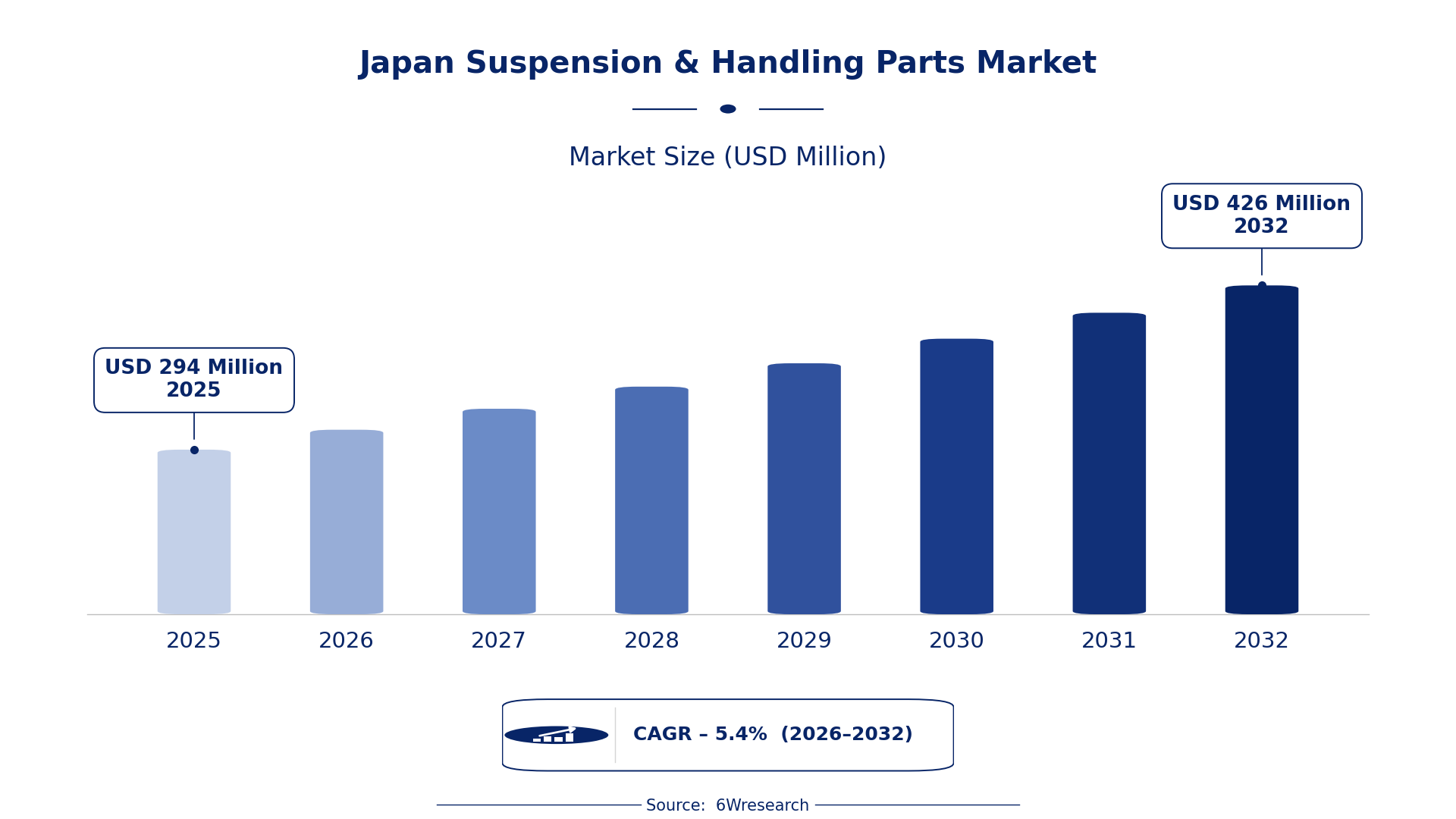
According to 6Wresearch internal database and industry insights, the Japan Suspension & Handling Parts Market was valued at USD 294 Million in 2025 and is projected to reach USD 426 Million by 2032, growing at a CAGR of approximately 5.4% during 2026–2032.
Japan Suspension & Handling Parts Market Highlights
| Report Metric | Details |
| Report Name | Japan Suspension & Handling Parts Market (2026-2032) |
| Market Size 2025 | USD 294 Million |
| Market Size 2032 | USD 426 Million |
| Absolute Growth 2025–2032 | USD 132 Million |
| CAGR 2026–2032 | 5.4% |
| Peak Annual Growth | 6.3% in 2028 |
| Forecast Period | 2026–2032 |
| Historical Data | 2022–2025 |
| Base Year | 2025 |
| Leading Part Type, 2025 | Shock Absorbers (36% share) |
| Leading Vehicle Segment, 2025 | Passenger/Commercial (53% share) |
| Leading Material Type, 2025 | Steel (37% share) |
| Leading End User, 2025 | OEMs (42% share) |
| Fastest-Growing Part Type | Control Arms (7.5% CAGR) |
| Fastest-Growing Vehicle Segment | Light/Heavy Vehicles (7.1% CAGR) |
| Fastest-Growing Material Type | Forged Aluminum (8.0% CAGR) |
| Fastest-Growing End User | Aftermarket Suppliers (6.8% CAGR) |
| Growing Sector | Aftermarket Suppliers |
| Key End Users | OEMs, Aftermarket Suppliers, Auto Service Providers, Vehicle Manufacturers |
Japan Suspension & Handling Parts Market Year-wise Growth Rate and Key Drivers (2022–2032)
This graph illustrates the annual growth rates of the market from 2022 to 2032, highlighting a steady upward trajectory and projected market expansion over the forecast period.
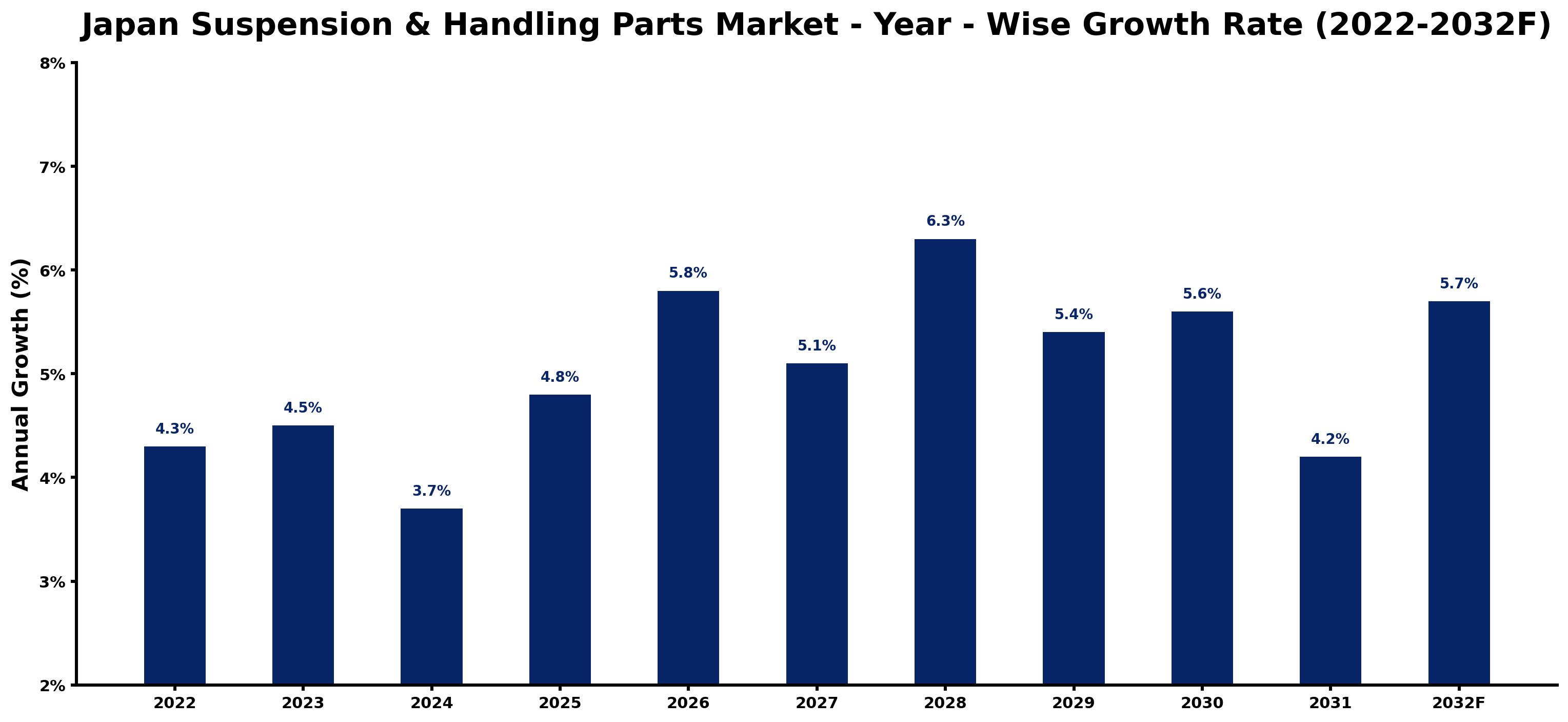
The following figures match every annual growth estimate with the main market development of that year, giving the reasoning behind each rise or slowdown.
| Year | Estimated Annual Growth (%) | Market Rationale |
| 2022 | 4.3 | The market experienced steady growth supported by strong vehicle production rates. |
| 2023 | 4.5 | Growth accelerated due to increased demand from the automotive sector. |
| 2024 | 3.7 | The growth rate slowed as manufacturers adjusted to market conditions. |
| 2025 | 4.8 | Demand surged with the introduction of new vehicle models and technologies. |
| 2026 | 5.8 | The market expanded further as electric vehicle adoption increased. |
| 2027 | 5.1 | Growth moderated as supply chain challenges began to surface. |
| 2028 | 6.3 | The peak growth year saw heightened demand for advanced suspension technologies. |
| 2029 | 5.4 | A slight slowdown occurred as the market stabilised after peak growth. |
| 2030 | 5.6 | Demand rebounded with new innovations in suspension systems. |
| 2031 | 4.2 | Growth decelerated as market conditions normalised post-peak. |
| 2032 | 5.7 | The market is projected to grow as electric vehicle production ramps up. |
Note: Market size estimations and growth projections presented in this report are based on 6Wresearch's proprietary forecasting methodology, utilizing the latest available industry data, government publications, and primary research inputs.
Japan Suspension & Handling Parts Market Synopsis
Suspension and handling parts are crucial components in vehicle suspension systems, improving ride quality and stability. Crafted from steel, aluminum, and rubber, these parts play a key role in the automotive industry, especially for manufacturers and auto service providers. The Japan Suspension & Handling Parts Market is expanding due to rising vehicle production, with over 8 million vehicles produced in 2022, and increasing demand for electric vehicle suspension parts as adoption grows. The Tokyo region remains a central hub for automotive manufacturing, further driving growth.
Market Dynamics Impact Analysis (2026–2032)
| Factor | Type | Impact | Primary Segment Affected |
| Rising vehicle production rates | Driver | High | Suspension Systems |
| Increased adoption of electric vehicles | Driver | High | Suspension Systems |
| Expansion of the automotive aftermarket | Opportunity | High | Aftermarket Suppliers |
| Growing demand for lightweight materials | Opportunity | Medium | Shock Absorbers |
| Supply chain disruptions affecting material availability | Restraint | High | Shock Absorbers |
| Increasing competition from foreign manufacturers | Restraint | Medium | Shock Absorbers |
| High costs associated with advanced suspension technologies | Challenge | High | Suspension Systems |
| Regulatory pressures on emissions and materials | Challenge | Medium | Shock Absorbers |
Evaluation of Drivers in Japan Suspension & Handling Parts Market (2026–2032)
Demand rests on the following drivers, each shown with the segment it touches most.
| Drivers | Primary Segment Affected | Why It Matters (Evidence) |
| Strong vehicle production | Suspension Systems | Japan's automotive sector produced over 8 million vehicles in 2022, increasing demand for suspension parts. |
| Rising electric vehicle adoption | Suspension Systems | The demand for electric vehicle suspension parts is increasing due to growing EV adoption. |
| Expansion of the automotive aftermarket | Aftermarket Suppliers | The automotive aftermarket in Japan is valued at approximately ¥1 trillion, driving demand for replacement parts. |
| Technological advancements in materials | Shock Absorbers | The use of aluminum in suspension parts is increasing for weight reduction, appealing to manufacturers. |
| Increased focus on vehicle safety | Suspension Systems | The average age of vehicles in Japan is around 13 years, necessitating upgrades and replacements. |
Behind the steady rise in orders sits strong vehicle production, with over 8 million vehicles manufactured in 2022, driving demand for suspension parts. The automotive aftermarket, valued at approximately ¥1 trillion, is expanding, prompting aftermarket suppliers to increase their offerings. The growing adoption of electric vehicles is also influencing demand for specialized suspension components. Furthermore, advancements in materials, such as the increasing use of aluminum, are appealing to manufacturers seeking to reduce weight. As vehicle safety becomes a priority, the average age of vehicles in Japan, around 13 years, necessitates upgrades to suspension systems.
Evaluation of Restraints in Japan Suspension & Handling Parts Market
The table below lists the restraints and the evidence behind each.
| Market Restraint | Primary Segment Affected | Why It Matters (Evidence) |
| Supply chain disruptions | Suspension Systems | Producers face delays in production schedules due to reliance on specific material imports, impacting delivery times. |
| Regulatory compliance costs | Shock Absorbers | Manufacturers must invest in quality assurance processes to meet JIS standards, extending time-to-market for new products. |
| Rising raw material costs | Control Arms | The costs of raw materials, particularly aluminum, have surged by 15% over the past year, impacting profitability. |
| Technological investment requirements | Bushings & Bearings | Technological advancements in suspension systems require substantial R&D investment, diverting funds from production capabilities. |
| Market competition | Stabilizer Bars | Increased competition in the automotive sector pressures manufacturers to lower prices, affecting margins. |
Japan Suspension & Handling Parts Market Challenges
Producers in Japan's automotive sector face supply chain disruptions due to reliance on specific material imports, resulting in production delays that impact vehicle manufacturers. Stringent JIS standards require extensive quality assurance, causing new product launches to be postponed by as much as six months for producers. Rapid technological advancements in suspension systems demand substantial R&D investments, diverting funds from production and inflating costs for manufacturers. The price of aluminium has increased by 15% in the past year, tightening profit margins for producers and ultimately raising costs for buyers.
Trends in the Japan Suspension & Handling Parts Market
The trends below show where the Japan Suspension & Handling Parts Market is heading.
- Shift Towards Lightweight Materials: The Tokyo region is increasingly adopting lightweight materials in suspension components, with aluminum usage projected to rise by 30% by 2032. This shift is driven by the need for improved vehicle efficiency and performance.
- Transition to Electric Vehicle Suspension Systems: Since 2022, the demand for electric vehicle suspension parts has surged, reflecting the growing EV market. By 2025, EV sales are expected to reach 1 million units, necessitating specialized components.
- Emergence of Advanced Suspension Technologies: The Tokyo Motor Show 2023 showcased advancements in suspension technology, highlighting innovations that improve vehicle handling and safety. This trend is likely to influence buyer preferences in the coming years.
- Focus on Sustainability in Automotive Parts: Japan's automotive industry is prioritising sustainability, with initiatives aimed at reducing carbon footprints. The Green Growth Strategy supports this shift, promoting eco-friendly materials in vehicle manufacturing.
Investment Opportunities in the Japan Suspension & Handling Parts Market
The following areas offer the clearest openings for investors and suppliers in the Japan Suspension & Handling Parts Market.
- Investment in Electric Vehicle Components: With electric vehicle sales projected to reach 1 million units by 2025, there is an opportunity to supply specialised suspension parts. Collaborating with auto manufacturers in the Tokyo region can facilitate market entry.
- Expansion of Aftermarket Offerings: The automotive aftermarket in Japan, valued at approximately ¥1 trillion, presents opportunities for suppliers to provide replacement parts. Partnering with auto service providers can enhance market penetration.
- Development of Lightweight Suspension Solutions: The increasing use of aluminum in suspension parts for weight reduction creates an opportunity for suppliers to develop innovative solutions. Engaging with manufacturers focused on efficiency can drive growth.
- Focus on Sustainable Materials: The shift towards sustainability in automotive parts presents opportunities for suppliers of eco-friendly materials. Collaborating with manufacturers committed to sustainability initiatives can open new markets.
Government Initiatives in the Japan Suspension & Handling Parts Market
The GX Promotion Act (2023) establishes a legal framework for promoting green technologies in the automotive sector, building on previous initiatives like the Green Growth Strategy. This act encourages manufacturers to invest in sustainable practices and technologies, enhancing their competitiveness in the market. The act aims to support the transition towards carbon neutrality by 2050, promoting innovation and investment in green technologies.
The Ministry of Economy, Trade and Industry supports innovation in the automotive sector through funding programmes, with approximately ¥10 billion allocated for research and development in green technologies. This funding aims to assist manufacturers in adopting advanced practices and improving production efficiency, ultimately benefiting the automotive supply chain.
Future Insight of the Japan Suspension & Handling Parts Market
Technological advancements will reshape the suspension parts market by 2032, with increased aluminium use expected to rise by 30%. The growing adoption of electric vehicles will drive demand for specialised suspension components, compelling suppliers to innovate. Government-backed innovation programmes will enhance production efficiency, benefiting producers and ensuring timely delivery. Events like the Tokyo Motor Show will showcase cutting-edge suspension technologies, influencing buyer preferences and shaping future market trends.
Market Segmentation Analysis
Japan Suspension & Handling Parts Market report covers a detailed analysis of the following market segments:
By Part Type – Shock Absorbers Lead, Control Arms Expected to Grow Fastest
According to Saurav Kr Singh, Senior Research Analyst at 6Wresearch, Shock Absorbers accounted for 36% of the market by part type in 2025. Shock absorbers are crucial for vehicle suspension performance, making them indispensable for both manufacturers and service providers. Their widespread use in Japan's automotive sector, especially in the Tokyo region, reinforces their dominant market position. Control Arms are set to record the highest CAGR in this split, 7.5% over 2026–2032. Control arms are witnessing rapid growth due to the increasing emphasis on vehicle stability and control, particularly following advancements showcased at the Tokyo Motor Show 2023. This trend suggests a promising future demand as manufacturers pursue further innovations in suspension technology. Suppliers must ensure the availability of control arms to meet the surging market demand.
By Vehicle Segment – Passenger/Commercial Leads, Light/Heavy Vehicles Expected to Grow Fastest
With 53% of vehicle segment revenue in 2025, Passenger/Commercial was the largest category. The passenger/commercial vehicle segment dominates the market as it encompasses a broad range of vehicles produced in Japan, including over 8 million vehicles in 2022. This extensive production base ensures a steady demand for suspension parts across various applications. Light/Heavy Vehicles are projected to grow fastest, at a CAGR of 7.1% during 2026–2032. Light/heavy vehicles are projected to grow rapidly, driven by the diverse needs of the automotive market to cater to varying vehicle weight categories. This growth is further supported by the increasing production of electric vehicles requiring specialised suspension components. Suppliers must adapt their offerings to cater to the evolving needs of light and heavy vehicle manufacturers.
By Material Type – Steel Leads, Forged Aluminum Expected to Grow Fastest
Steel took 37% of material type revenue in 2025, more than any other category. Steel remains the leading material in the suspension parts market due to its durability and strength, making it the preferred choice for manufacturers. Its established presence in the automotive sector ensures a consistent demand for steel components. Over 2026–2032, Forged Aluminum is expected to post the fastest growth, at a CAGR of 8.0%. Forged aluminum is gaining traction as a high-performance material, particularly in applications where weight reduction is critical. With the automotive industry increasingly focusing on efficiency, the shift towards forged aluminum is expected to accelerate. Manufacturers should invest in developing forged aluminum components to capitalise on the growing demand for lightweight solutions.
By End User – OEMs Lead, Aftermarket Suppliers Expected to Grow Fastest
In 2025, OEMs led the end user split with a 42% share. OEMs are the main customers for new suspension parts, holding a significant market share due to their integral role in vehicle production. Their established partnerships with component suppliers guarantee a steady demand for high-quality parts. The quickest growth will come from Aftermarket Suppliers, forecast to expand at a CAGR of 6.8% between 2026 and 2032. Aftermarket suppliers are experiencing swift growth as vehicle owners require replacement parts for maintenance, driven by the average vehicle age of around 13 years in Japan. This trend presents a considerable opportunity for suppliers targeting the aftermarket segment. Suppliers should refine their distribution strategies to effectively respond to the increasing demand from aftermarket suppliers.
Key Attractiveness of the Report
- 10 Years of Market Numbers
- Historical Data Starting from 2022 to 2025
- Base Year 2025
- Forecast Data until 2032
- Key Performance Indicators Impacting the Market
- Major Upcoming Developments and Projects
Key Highlights of the Report:
- Japan Suspension & Handling Parts Market Outlook
- Market Size of Japan Suspension & Handling Parts Market, 2025
- Forecast of Japan Suspension & Handling Parts Market, 2032
- Historical Data and Forecast of Japan Suspension & Handling Parts Revenues & Volume for the Period 2022-2032F
- Japan Suspension & Handling Parts Market Trend Evolution
- Japan Suspension & Handling Parts Market Drivers and Challenges
- Japan Suspension & Handling Parts Price Trends
- Japan Suspension & Handling Parts Porter's Five Forces
- Japan Suspension & Handling Parts Industry Life Cycle
- Historical Data and Forecast of Japan Suspension & Handling Parts Market Revenues & Volume By Part Type for the Period 2022-2032F
- Historical Data and Forecast of Japan Suspension & Handling Parts Market Revenues & Volume By Shock Absorbers for the Period 2022-2032F
- Historical Data and Forecast of Japan Suspension & Handling Parts Market Revenues & Volume By Control Arms for the Period 2022-2032F
- Historical Data and Forecast of Japan Suspension & Handling Parts Market Revenues & Volume By Bushings & Bearings for the Period 2022-2032F
- Historical Data and Forecast of Japan Suspension & Handling Parts Market Revenues & Volume By Stabilizer Bars for the Period 2022-2032F
- Historical Data and Forecast of Japan Suspension & Handling Parts Market Revenues & Volume By Vehicle Segment for the Period 2022-2032F
- Historical Data and Forecast of Japan Suspension & Handling Parts Market Revenues & Volume By Passenger/Commercial for the Period 2022-2032F
- Historical Data and Forecast of Japan Suspension & Handling Parts Market Revenues & Volume By Light/Heavy Vehicles for the Period 2022-2032F
- Historical Data and Forecast of Japan Suspension & Handling Parts Market Revenues & Volume By Suspension Systems for the Period 2022-2032F
- Historical Data and Forecast of Japan Suspension & Handling Parts Market Revenues & Volume By Steering Handling for the Period 2022-2032F
- Historical Data and Forecast of Japan Suspension & Handling Parts Market Revenues & Volume By Material Type for the Period 2022-2032F
- Historical Data and Forecast of Japan Suspension & Handling Parts Market Revenues & Volume By Steel for the Period 2022-2032F
- Historical Data and Forecast of Japan Suspension & Handling Parts Market Revenues & Volume By Forged Aluminum for the Period 2022-2032F
- Historical Data and Forecast of Japan Suspension & Handling Parts Market Revenues & Volume By Rubber/Metal for the Period 2022-2032F
- Historical Data and Forecast of Japan Suspension & Handling Parts Market Revenues & Volume By Steel Alloy for the Period 2022-2032F
- Historical Data and Forecast of Japan Suspension & Handling Parts Market Revenues & Volume By End User for the Period 2022-2032F
- Historical Data and Forecast of Japan Suspension & Handling Parts Market Revenues & Volume By OEMs for the Period 2022-2032F
- Historical Data and Forecast of Japan Suspension & Handling Parts Market Revenues & Volume By Aftermarket Suppliers for the Period 2022-2032F
- Historical Data and Forecast of Japan Suspension & Handling Parts Market Revenues & Volume By Auto Service Providers for the Period 2022-2032F
- Historical Data and Forecast of Japan Suspension & Handling Parts Market Revenues & Volume By Vehicle Manufacturers for the Period 2022-2032F
- Japan Suspension & Handling Parts Import Export Trade Statistics
- Market Opportunity Assessment By Part Type
- Market Opportunity Assessment By Vehicle Segment
- Market Opportunity Assessment By Material Type
- Market Opportunity Assessment By End User
- Japan Suspension & Handling Parts Top Companies Market Share
- Japan Suspension & Handling Parts Competitive Benchmarking By Technical and Operational Parameters
- Japan Suspension & Handling Parts Company Profiles
- Japan Suspension & Handling Parts Key Strategic Recommendations
Market Covered
This report examines the market across the segments below.
By Part Type
- Shock Absorbers
- Control Arms
- Bushings & Bearings
- Stabilizer Bars
By Vehicle Segment
- Passenger/Commercial
- Light/Heavy Vehicles
- Suspension Systems
- Steering Handling
By Material Type
- Steel
- Forged Aluminum
- Rubber/Metal
- Steel Alloy
By End User
- OEMs
- Aftermarket Suppliers
- Auto Service Providers
- Vehicle Manufacturers































