Japan Suspension Parts Market Size & Growth Rate
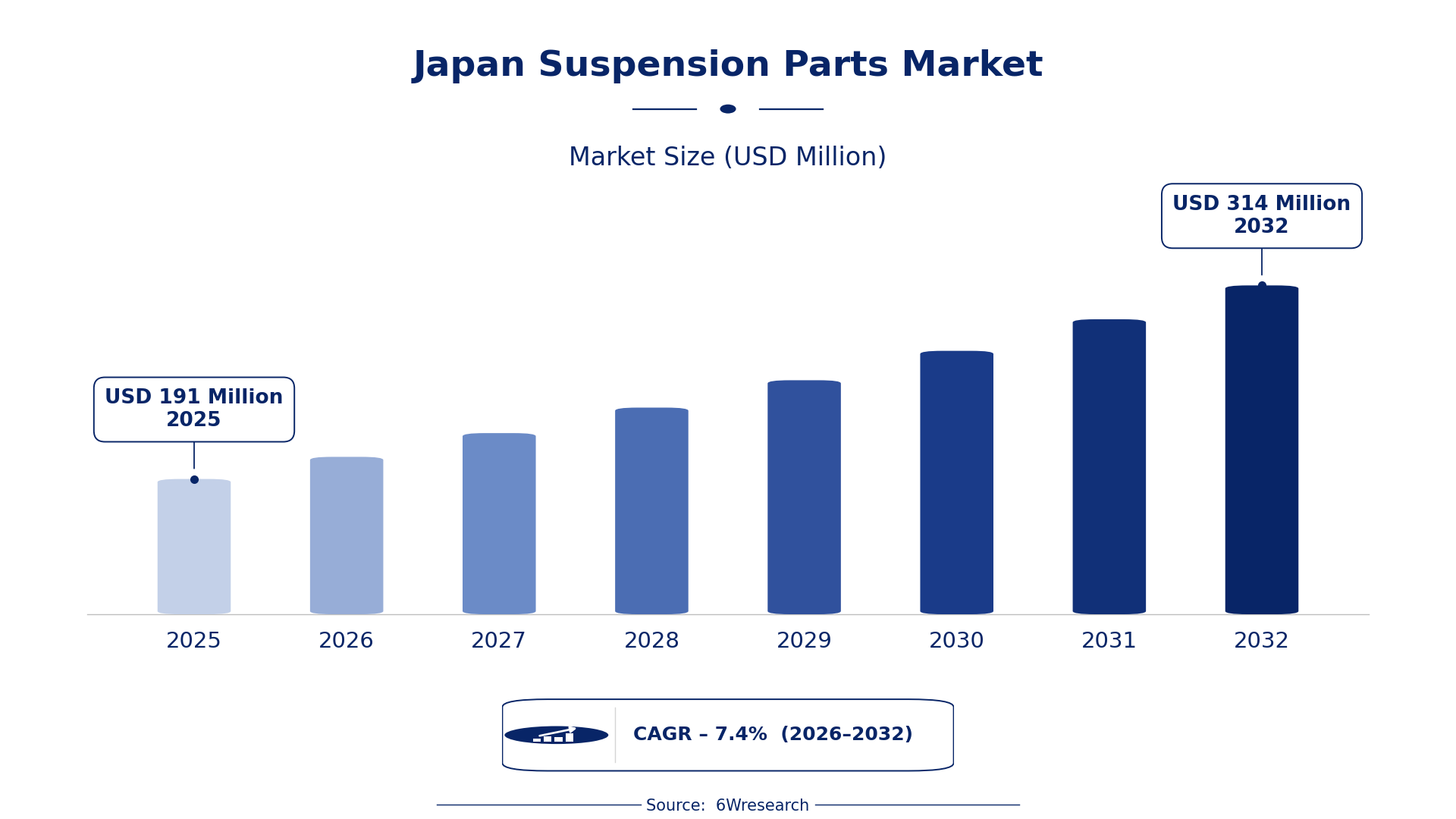
According to 6Wresearch internal database and industry insights, the Japan Suspension Parts Market was valued at USD 191 Million in 2025 and is projected to reach USD 314 Million by 2032, growing at a CAGR of approximately 7.4% during 2026–2032.
Japan Suspension Parts Market Highlights
| Report Metric | Details |
| Report Name | Japan Suspension Parts Market (2026-2032) |
| Market Size 2025 | USD 191 Million |
| Market Size 2032 | USD 314 Million |
| Absolute Growth 2025–2032 | USD 123 Million |
| CAGR 2026–2032 | 7.4% |
| Peak Annual Growth | 8.9% in 2027 |
| Forecast Period | 2026–2032 |
| Historical Data | 2022–2025 |
| Base Year | 2025 |
| Leading Part Category, 2025 | OEM Parts (50% share) |
| Leading Manufacturing Type, 2025 | Factory Installed (42% share) |
| Leading Distribution Channel, 2025 | Dealerships (47% share) |
| Leading End User, 2025 | Vehicle Manufacturers (40% share) |
| Fastest-Growing Part Category | Aftermarket Parts (9.3% CAGR) |
| Fastest-Growing Manufacturing Type | Replacement (10.0% CAGR) |
| Fastest-Growing Distribution Channel | Online Stores (9.7% CAGR) |
| Fastest-Growing End User | Garages & Mechanics (9.4% CAGR) |
| Growing Sector | Aftermarket Services |
| Key End Users | Vehicle Manufacturers, Garages & Mechanics, Performance Vehicle Owners |
Japan Suspension Parts Market Year-wise Growth Rate and Key Drivers (2022–2032)
This graph illustrates the annual growth rates of the market from 2022 to 2032, highlighting a steady upward trajectory and projected market expansion over the forecast period.
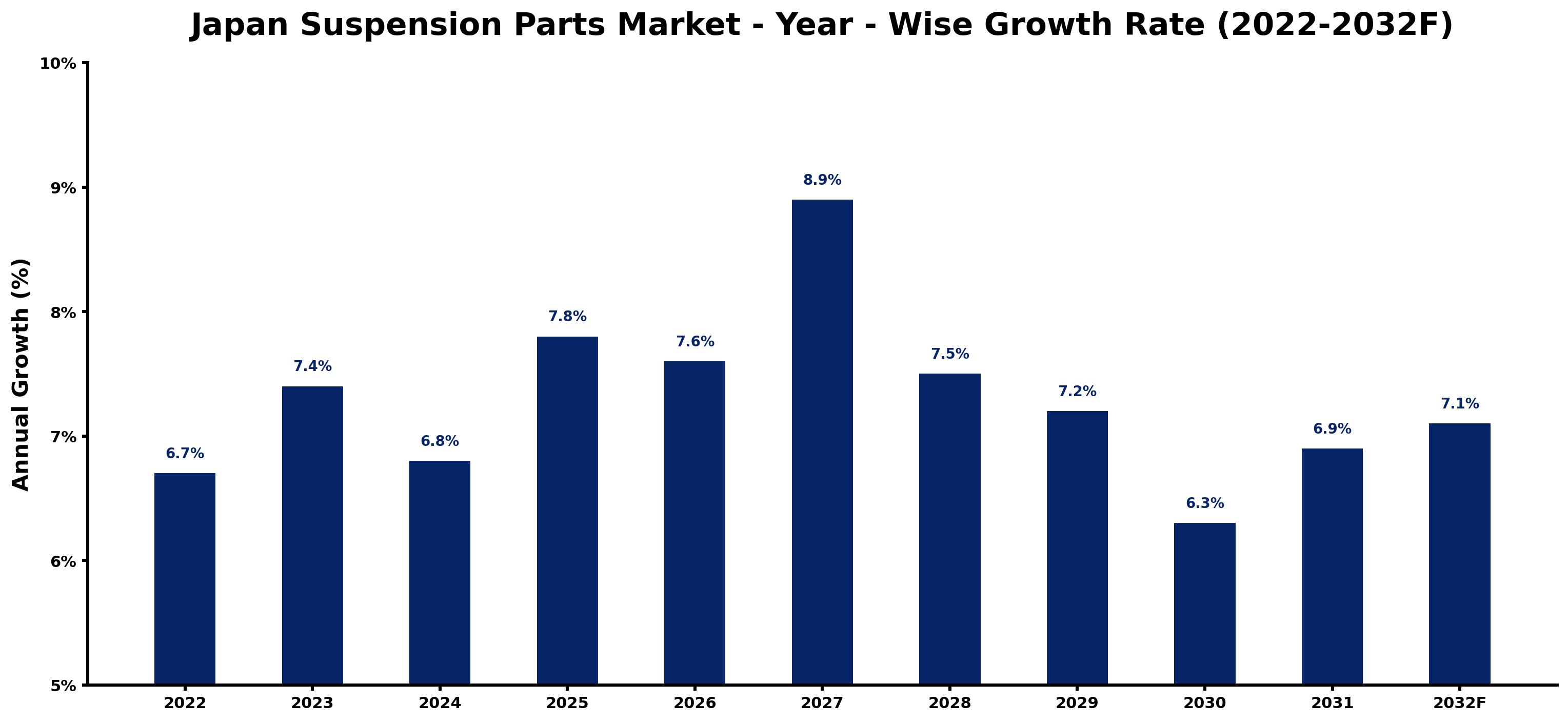
Each row of the following table gives one year's estimated growth and the event or demand shift that explains it.
| Year | Estimated Annual Growth (%) | Market Rationale |
| 2022 | 6.7 | The automotive industry produced over 8 million vehicles, driving demand for suspension parts. |
| 2023 | 7.4 | Growth accelerated due to increased vehicle production and a strong aftermarket segment. |
| 2024 | 6.8 | A slight slowdown occurred as production stabilised and demand normalised. |
| 2025 | 7.8 | The market saw a peak as vehicle manufacturers ramped up production ahead of new standards. |
| 2026 | 7.6 | Growth is expected to slow as the market adjusts to the previous year's peak activity. |
| 2027 | 8.9 | A surge in demand will be driven by the introduction of new vehicle models and technologies. |
| 2028 | 7.5 | The market is projected to experience a slowdown as the effects of previous growth begin to stabilise. |
| 2029 | 7.2 | Demand will continue to slow as manufacturers focus on efficiency and cost management. |
| 2030 | 6.3 | A further slowdown is anticipated as the market adjusts to changing consumer preferences. |
| 2031 | 6.9 | Growth is expected to pick up again as aftermarket services expand and vehicle age increases. |
| 2032 | 7.1 | The market is projected to grow as electric vehicle production gains momentum. |
Note: Market size estimations and growth projections presented in this report are based on 6Wresearch's proprietary forecasting methodology, utilizing the latest available industry data, government publications, and primary research inputs.
Japan Suspension Parts Market Synopsis
Suspension parts are essential components of a vehicle's suspension system, made from metals and polymers to support weight and absorb shocks. The Japan Suspension Parts Market is expanding due to the automotive industry producing over 8 million vehicles in 2022, alongside a thriving aftermarket valued at approximately 1 trillion yen annually. The increasing average age of vehicles on the road, now over 10 years, drives demand for replacement parts, while the rising interest in performance parts among car enthusiasts further stimulates market growth.
Market Dynamics Impact Analysis (2026–2032)
| Factor | Type | Impact | Primary Segment Affected |
| Strong demand from domestic vehicle manufacturers | Driver | High | OEM Parts |
| Growing aftermarket segment driven by vehicle age | Driver | High | Aftermarket Parts |
| Increasing interest in performance modifications | Opportunity | Medium | Performance Parts |
| Expansion of online sales channels for auto parts | Opportunity | Medium | Aftermarket Parts |
| Fluctuating raw material prices affecting production costs | Restraint | High | OEM Parts |
| Regulatory compliance costs for safety standards | Restraint | High | Replacement |
| High costs associated with advanced manufacturing technologies | Challenge | High | Factory Installed |
| Competition from international suppliers impacting pricing | Challenge | Medium | Economy Parts |
Evaluation of Drivers in Japan Suspension Parts Market (2026–2032)
Demand rests on the following drivers, each shown with the segment it touches most.
| Drivers | Primary Segment Affected | Why It Matters (Evidence) |
| Increased vehicle production | OEM Parts | Japan's automotive industry produced over 8 million vehicles in 2022, boosting demand for OEM suspension parts. |
| Rising vehicle age | Aftermarket Parts | The average age of vehicles on Japanese roads is over 10 years, increasing the need for replacement parts. |
| Growing interest in performance upgrades | Performance Parts | Performance parts are popular among car enthusiasts in urban areas, driving demand for modifications. |
| Expansion of online sales | Aftermarket Parts | Online sales of auto parts have increased by 15% in the last year, catering to tech-savvy consumers. |
| Investment in electric vehicle production | OEM Parts | In 2023, the government launched a program to support electric vehicle parts manufacturing, driving new demand. |
Behind the steady rise in orders sits the increasing production of vehicles, with over 8 million manufactured in 2022, leading to higher demand for OEM components. The average age of vehicles on Japanese roads exceeds 10 years, prompting more consumers to seek aftermarket replacement solutions. The popularity of performance modifications among car enthusiasts in urban areas is driving demand for specialised components. The rapid expansion of online sales channels has made it easier for consumers to access needed items, with a 15% increase in auto parts sales last year.
Evaluation of Restraints in Japan Suspension Parts Market
The table below lists the restraints and the evidence behind each.
| Market Restraint | Primary Segment Affected | Why It Matters (Evidence) |
| Fluctuating raw material prices | OEM Parts | Rising costs of metals and polymers affect production expenses, impacting pricing strategies for OEM parts. |
| Compliance with safety standards | Replacement | Meeting JIS standards increases operational costs for manufacturers, affecting the pricing of replacement parts. |
| High costs of advanced manufacturing technologies | Factory Installed | Investments in new technologies for manufacturing can be prohibitively expensive, limiting production scalability. |
| Competition from international suppliers | Economy Parts | Local manufacturers face pressure from cheaper imports, making it difficult to maintain market share. |
| Limited consumer awareness of performance options | Performance Parts | Many consumers are unaware of the benefits of performance parts, hindering market growth. |
Japan Suspension Parts Market Challenges
Quality issues with suspension parts create obstacles, as buyers often face inconsistent standards that jeopardise vehicle safety. This problem arises from the stringent JIS standards, which many manufacturers struggle to comply with, resulting in delays of up to three months for domestic vehicle producers. Supply chain disruptions occur due to reliance on specific materials, forcing suppliers to absorb increased costs, which can reach 20% for metals and polymers. Slow technology adoption leads to inefficiencies, preventing suppliers from innovating, which ultimately delays the introduction of advanced solutions for buyers. Competition from imported parts pressures local manufacturers to lower prices, risking quality and reliability.
Trends in the Japan Suspension Parts Market
Buyers and suppliers in the Japan Suspension Parts Market are adjusting to the following trends.
- Shift towards Online Sales Channels: The automotive parts market is increasingly shifting towards online sales, with a 15% rise in online auto parts sales last year. This trend is driven by tech-savvy consumers seeking convenience and competitive pricing.
- Rising Popularity of Performance Parts: Performance parts are gaining traction among car enthusiasts, particularly in urban areas. This trend reflects a growing interest in vehicle customisation, with the Tuning Association of Japan promoting modifications.
- Growth in Electric Vehicle Component Manufacturing: The government launched a program in 2023 to support electric vehicle parts manufacturing, targeting a shift towards sustainable automotive solutions. This initiative is set to reshape the market significantly.
- Increasing Average Vehicle Age: The average age of vehicles on Japanese roads has surpassed 10 years, creating a sustained demand for replacement parts. This trend highlights the importance of aftermarket services in maintaining vehicle safety.
Investment Opportunities in the Japan Suspension Parts Market
The openings below show where demand in the Japan Suspension Parts Market is visible and how suppliers can enter.
- Supply of Replacement Parts: With over 30 million registered vehicles in Japan, there is a significant opportunity to supply replacement parts. The aftermarket segment is valued at approximately 1 trillion yen annually, indicating strong demand.
- Expansion of Online Retail Platforms: The online auto parts market is growing rapidly, with a 15% increase in sales last year. Investing in e-commerce platforms can tap into this expanding consumer base effectively.
- Manufacturing of Electric Vehicle Parts: The government's 2023 program to support electric vehicle parts manufacturing presents a timely opportunity. Suppliers can engage with local vehicle manufacturers to meet the rising demand for EV components.
- Custom-Built Parts for Enthusiasts: The niche market for custom-built parts is growing, driven by performance vehicle owners. Engaging with tuning shops can facilitate entry into this specialized segment.
Government Initiatives in the Japan Suspension Parts Market
The Building Energy Efficiency Act, amended in 2022, mandates that all new buildings meet energy standards, indirectly impacting the automotive sector by promoting energy-efficient vehicles. Compliance with these standards influences manufacturers to adopt advanced technologies in their production processes, supporting the automotive industry.
In 2023, funding was allocated to support electric vehicle parts manufacturing, overseen by the Ministry of Land, Infrastructure, Transport and Tourism. This initiative aims to strengthen the domestic supply chain for EV components, benefiting local manufacturers.
Future Insight of the Japan Suspension Parts Market
The advancement of electric vehicle technology will reshape the demand for suspension parts by 2032, as government initiatives support the production of related components. The integration of smart manufacturing technologies will improve production efficiency, enabling suppliers to meet market needs more effectively. Urban car enthusiasts will increasingly pursue performance modifications, compelling suppliers to adapt their offerings. With over 30 million registered vehicles, the persistent demand for replacement components will ensure a thriving market for both buyers and suppliers.
Market Segmentation Analysis
Japan Suspension Parts Market report covers a detailed analysis of the following market segments:
By Part Category – OEM Parts Lead, Aftermarket Parts Expected to Grow Fastest
According to Saurav Kr Singh, Senior Research Analyst at 6Wresearch, OEM Parts took 50% of part category revenue in 2025, more than any other category. OEM parts are essential for new vehicle production, reflecting Japan's strong automotive sector with over 8 million vehicles manufactured in 2022. The segment benefits from a stable supply chain and compliance with JIS standards, ensuring high quality for vehicle manufacturers. Aftermarket Parts are projected to grow fastest, at a CAGR of 9.3% during 2026–2032. The aftermarket parts segment is experiencing rapid growth due to the increasing average age of vehicles on the road, which exceeds 10 years. As older vehicles necessitate more frequent maintenance and replacement, this segment is poised for continued expansion. Suppliers should focus on enhancing their aftermarket offerings to address the growing demand for replacement components.
By Manufacturing Type – Factory Installed Leads, Replacement Expected to Grow Fastest
In 2025, Factory Installed led the manufacturing type split with a 42% share. Factory installed parts dominate the market as they are standard in new vehicles, ensuring compliance with safety regulations overseen by the Ministry of Land, Infrastructure, Transport and Tourism. This segment benefits from stable demand linked to the production of over 8 million vehicles annually. Over 2026–2032, Replacement is expected to post the fastest growth, at a CAGR of 10.0%. Replacement parts are experiencing the highest growth as they are essential for maintaining the ageing fleet of over 30 million registered vehicles in Japan. This trend highlights the increasing need for reliable and efficient replacement solutions. Manufacturers should focus on developing high-quality replacement parts to address the maintenance needs of older vehicles.
By Distribution Channel – Dealerships Lead, Online Stores Expected to Grow Fastest
Dealerships accounted for 47% of the market by distribution channel in 2025. Dealerships are the primary sales channel for OEM parts, providing direct access to vehicle manufacturers and ensuring adherence to quality standards. Their established presence in the automotive market supports consistent sales and fosters customer loyalty. The quickest growth will come from Online Stores, forecast to expand at a CAGR of 9.7% between 2026 and 2032. Online stores are quickly becoming a vital distribution channel for aftermarket parts, evidenced by a 15% rise in online sales in the past year. This trend highlights a shift in consumer behaviour towards the convenience of purchasing auto parts online. Suppliers need to bolster their online strategies to capitalise on the increasing trend of e-commerce in the automotive parts sector.
By End User – Vehicle Manufacturers Lead, Garages & Mechanics Expected to Grow Fastest
The largest end user category in 2025 was Vehicle Manufacturers, at 40% of revenue. Vehicle manufacturers are the leading end users of OEM parts, as they require these components for new vehicle assembly and compliance with safety standards. Their substantial production volumes create a steady demand for high-quality parts. Garages & Mechanics are set to record the highest CAGR in this split, 9.4% over 2026–2032. Garages and mechanics are experiencing the fastest growth as they increasingly rely on various parts to service the ageing vehicle population. The demand for maintenance and repair services is driving this segment's expansion. Suppliers should strengthen relationships with garages and mechanics to ensure a steady supply of parts for maintenance and repair services.
Key Attractiveness of the Report
- 10 Years of Market Numbers
- Historical Data Starting from 2022 to 2025
- Base Year 2025
- Forecast Data until 2032
- Key Performance Indicators Impacting the Market
- Major Upcoming Developments and Projects
Key Highlights of the Report:
- Japan Suspension Parts Market Outlook
- Market Size of Japan Suspension Parts Market, 2025
- Forecast of Japan Suspension Parts Market, 2032
- Historical Data and Forecast of Japan Suspension Parts Revenues & Volume for the Period 2022-2032F
- Japan Suspension Parts Market Trend Evolution
- Japan Suspension Parts Market Drivers and Challenges
- Japan Suspension Parts Price Trends
- Japan Suspension Parts Porter's Five Forces
- Japan Suspension Parts Industry Life Cycle
- Historical Data and Forecast of Japan Suspension Parts Market Revenues & Volume By Part Category for the Period 2022-2032F
- Historical Data and Forecast of Japan Suspension Parts Market Revenues & Volume By OEM Parts for the Period 2022-2032F
- Historical Data and Forecast of Japan Suspension Parts Market Revenues & Volume By Aftermarket Parts for the Period 2022-2032F
- Historical Data and Forecast of Japan Suspension Parts Market Revenues & Volume By Performance Parts for the Period 2022-2032F
- Historical Data and Forecast of Japan Suspension Parts Market Revenues & Volume By Economy Parts for the Period 2022-2032F
- Historical Data and Forecast of Japan Suspension Parts Market Revenues & Volume By Manufacturing Type for the Period 2022-2032F
- Historical Data and Forecast of Japan Suspension Parts Market Revenues & Volume By Factory Installed for the Period 2022-2032F
- Historical Data and Forecast of Japan Suspension Parts Market Revenues & Volume By Replacement for the Period 2022-2032F
- Historical Data and Forecast of Japan Suspension Parts Market Revenues & Volume By Custom-Built for the Period 2022-2032F
- Historical Data and Forecast of Japan Suspension Parts Market Revenues & Volume By Mass-Produced for the Period 2022-2032F
- Historical Data and Forecast of Japan Suspension Parts Market Revenues & Volume By Distribution Channel for the Period 2022-2032F
- Historical Data and Forecast of Japan Suspension Parts Market Revenues & Volume By Dealerships for the Period 2022-2032F
- Historical Data and Forecast of Japan Suspension Parts Market Revenues & Volume By Online Stores for the Period 2022-2032F
- Historical Data and Forecast of Japan Suspension Parts Market Revenues & Volume By Tuning Shops for the Period 2022-2032F
- Historical Data and Forecast of Japan Suspension Parts Market Revenues & Volume By Auto Part Retailers for the Period 2022-2032F
- Historical Data and Forecast of Japan Suspension Parts Market Revenues & Volume By End User for the Period 2022-2032F
- Historical Data and Forecast of Japan Suspension Parts Market Revenues & Volume By Vehicle Manufacturers for the Period 2022-2032F
- Historical Data and Forecast of Japan Suspension Parts Market Revenues & Volume By Garages & Mechanics for the Period 2022-2032F
- Historical Data and Forecast of Japan Suspension Parts Market Revenues & Volume By Performance Vehicle Owners for the Period 2022-2032F
- Historical Data and Forecast of Japan Suspension Parts Market Revenues & Volume By Cost-Conscious Customers for the Period 2022-2032F
- Japan Suspension Parts Import Export Trade Statistics
- Market Opportunity Assessment By Part Category
- Market Opportunity Assessment By Manufacturing Type
- Market Opportunity Assessment By Distribution Channel
- Market Opportunity Assessment By End User
- Japan Suspension Parts Top Companies Market Share
- Japan Suspension Parts Competitive Benchmarking By Technical and Operational Parameters
- Japan Suspension Parts Company Profiles
- Japan Suspension Parts Key Strategic Recommendations
Market Covered
Coverage by segment is as follows.
By Part Category
- OEM Parts
- Aftermarket Parts
- Performance Parts
- Economy Parts
By Manufacturing Type
- Factory Installed
- Replacement
- Custom-Built
- Mass-Produced
By Distribution Channel
- Dealerships
- Online Stores
- Tuning Shops
- Auto Part Retailers
By End User
- Vehicle Manufacturers
- Garages & Mechanics
- Performance Vehicle Owners
- Cost-Conscious Customers































