Japan Suspension Position Sensor Market Size & Growth Rate
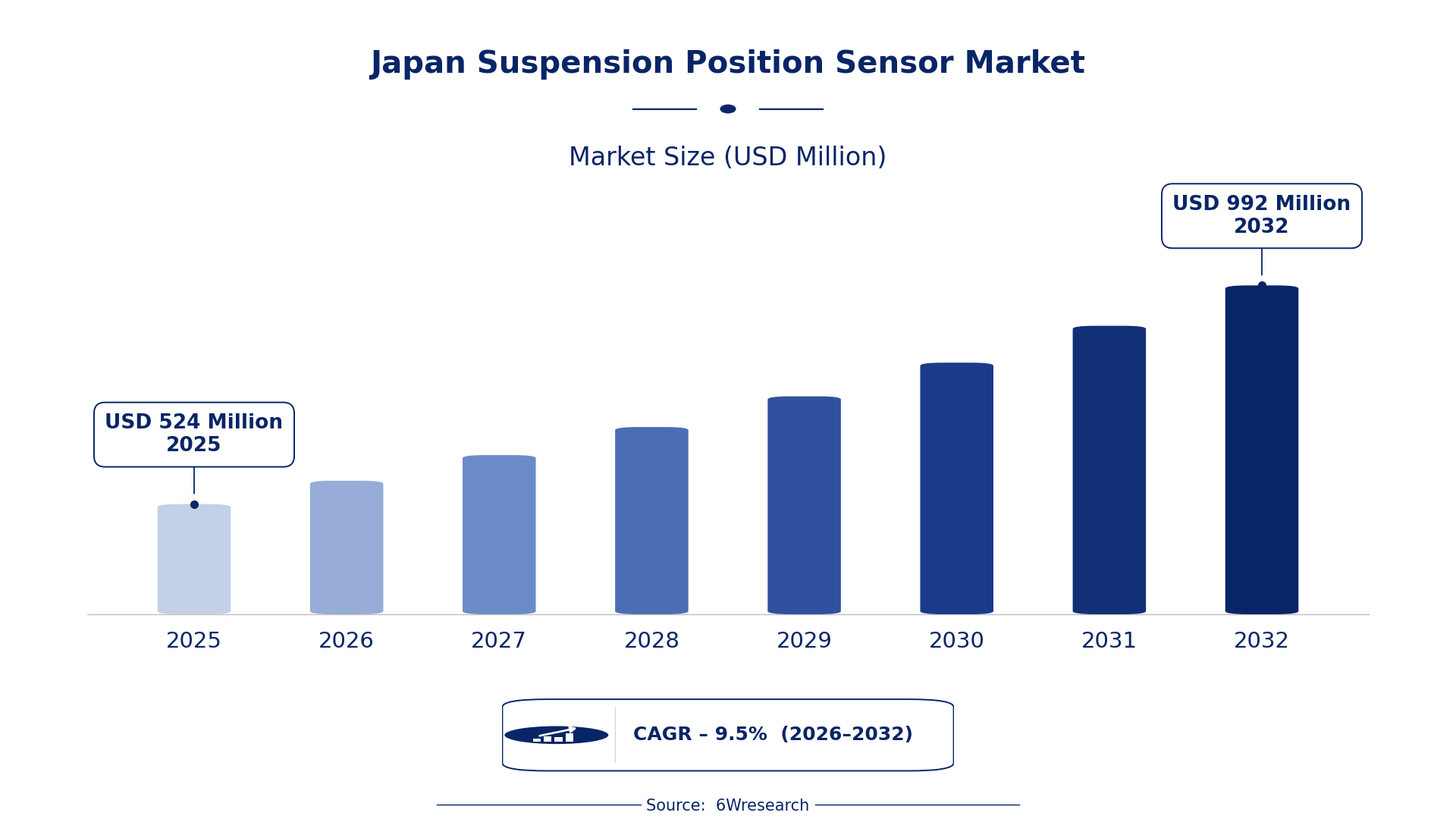
According to 6Wresearch internal database and industry insights, the Japan Suspension Position Sensor Market was valued at USD 524 Million in 2025 and is projected to reach USD 992 Million by 2032, growing at a CAGR of approximately 9.5% during 2026–2032.
Japan Suspension Position Sensor Market Highlights
| Report Metric | Details |
| Report Name | Japan Suspension Position Sensor Market (2026-2032) |
| Market Size 2025 | USD 524 Million |
| Market Size 2032 | USD 992 Million |
| Absolute Growth 2025–2032 | USD 468 Million |
| CAGR 2026–2032 | 9.5% |
| Peak Annual Growth | 10.3% in 2030 |
| Forecast Period | 2026–2032 |
| Historical Data | 2022–2025 |
| Base Year | 2025 |
| Leading Sensor Type, 2025 | Linear Potentiometers (54% share) |
| Leading Measurement Mechanism, 2025 | Resistive (41% share) |
| Leading Vehicle Segment, 2025 | Passenger Cars (41% share) |
| Leading End User, 2025 | OEMs (42% share) |
| Fastest-Growing Sensor Type | Hall Effect Sensors (13.9% CAGR) |
| Fastest-Growing Measurement Mechanism | Magnetic Field (12.3% CAGR) |
| Fastest-Growing Vehicle Segment | Sports Cars (13.2% CAGR) |
| Fastest-Growing End User | Advanced Electronics Firms (12.7% CAGR) |
| Growing Sector | automotive |
| Key End Users | OEMs, automotive tier suppliers, sensor manufacturers, advanced electronics firms |
Japan Suspension Position Sensor Market Year-wise Growth Rate and Key Drivers (2022–2032)
This graph illustrates the annual growth rates of the market from 2022 to 2032, highlighting a steady upward trajectory and projected market expansion over the forecast period.
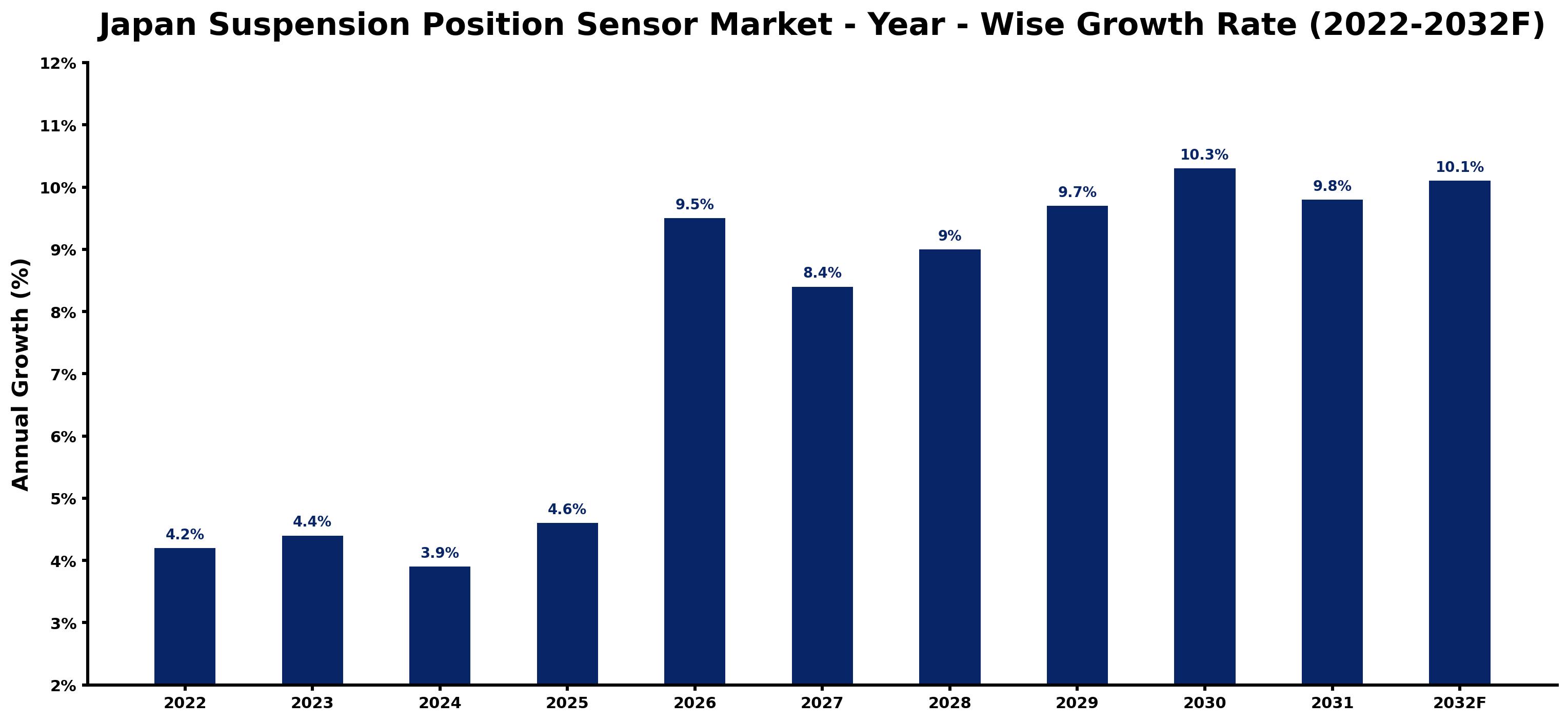
The following figures match every annual growth estimate with the main market development of that year, giving the reasoning behind each rise or slowdown.
| Year | Estimated Annual Growth (%) | Market Rationale |
| 2022 | 4.2 | The market experienced steady growth as automotive production remained strong. |
| 2023 | 4.4 | Demand increased due to rising vehicle registrations and production levels. |
| 2024 | 3.9 | Growth slowed slightly as manufacturers adjusted to market conditions. |
| 2025 | 4.6 | The market saw faster growth driven by the introduction of new vehicle models. |
| 2026 | 9.5 | Demand surged as electric vehicle registrations reached new highs. |
| 2027 | 8.4 | Growth slowed as manufacturers faced supply chain challenges. |
| 2028 | 9.0 | The market rebounded with increased investment in advanced technologies. |
| 2029 | 9.7 | Demand rose as more manufacturers adopted advanced driver-assistance systems. |
| 2030 | 10.3 | The peak growth year was driven by advancements in sensor technology. |
| 2031 | 9.8 | Growth slowed slightly as the market stabilised after rapid expansion. |
| 2032 | 10.1 | Demand continues to rise with ongoing investments in EV technology. |
Note: Market size estimations and growth projections presented in this report are based on 6Wresearch's proprietary forecasting methodology, utilizing the latest available industry data, government publications, and primary research inputs.
Japan Suspension Position Sensor Market Synopsis
Suspension Position Sensors measure the position of a vehicle's suspension system, ensuring stability and ride comfort. The Japan Suspension Position Sensor Market is growing due to the thriving automotive industry, which produces over 4 million vehicles annually. The rise in production of passenger cars and electric vehicles, along with initiatives from the Ministry of Economy, Trade and Industry to promote EV technology, fuels this expansion. This environment encourages investments in advanced sensor technologies, further increasing market demand and innovation.
Market Dynamics Impact Analysis (2026–2032)
| Factor | Type | Impact | Primary Segment Affected |
| Rising production of electric vehicles | Driver | High | Passenger Cars |
| Increased adoption of advanced driver-assistance systems | Driver | High | OEMs |
| Growing demand for high-performance vehicles | Opportunity | High | Sports Cars |
| Investment in automotive technology innovation | Opportunity | Medium | Advanced Electronics Firms |
| Supply chain disruptions affecting sensor availability | Restraint | High | Sensor Manufacturers |
| Fluctuating raw material costs impacting production | Restraint | Medium | Automotive Tier Suppliers |
| High costs of advanced sensor technologies | Challenge | High | OEMs |
| Competition from alternative sensor technologies | Challenge | Medium | Sensor Manufacturers |
Evaluation of Drivers in Japan Suspension Position Sensor Market (2026–2032)
The main growth drivers and the segments they affect most are set out below.
| Drivers | Primary Segment Affected | Why It Matters (Evidence) |
| Increased electric vehicle production | Passenger Cars | In 2022, approximately 1.5 million electric vehicles were registered, driving sensor demand for improved performance. |
| Adoption of advanced driver-assistance systems | OEMs | The rise in these systems increases the need for reliable suspension position sensors, enhancing vehicle safety and functionality. |
| Growing consumer preference for high-performance vehicles | Sports Cars | Sports Cars require precise suspension tuning, leading to higher sensor purchases for performance optimisation. |
| Investment in automotive technology innovation | Advanced Electronics Firms | Increased funding for R&D boosts demand for advanced sensors, enhancing vehicle capabilities. |
| Expansion of automotive manufacturing in the Tokyo region | Sensor Manufacturers | The Tokyo region hosts numerous OEMs and suppliers, driving local sensor production. |
Buyers are adding capacity as the automotive sector in Japan continues to thrive, producing over 4 million vehicles annually. In 2022, approximately 1.5 million electric vehicles were registered, increasing demand for advanced suspension position sensors. The adoption of advanced driver-assistance systems is rising, prompting manufacturers to invest more in reliable sensor technologies. Growing consumer preference for high-performance vehicles drives demand for precise suspension tuning. Investment in automotive technology innovation is also increasing, with funding for R&D improving sensor capabilities.
Evaluation of Restraints in Japan Suspension Position Sensor Market
The main factors holding the market back are set out below.
| Market Restraint | Primary Segment Affected | Why It Matters (Evidence) |
| Supply chain disruptions impacting sensor availability | Sensor Manufacturers | Manufacturers faced delays in component delivery, affecting production schedules and sensor availability. |
| Fluctuating raw material costs impacting production | Automotive Tier Suppliers | Rising costs of raw materials have led to increased production expenses, affecting pricing strategies. |
| High costs of advanced sensor technologies | OEMs | The investment required for advanced sensor integration can limit adoption among smaller manufacturers. |
| Competition from alternative sensor technologies | Sensor Manufacturers | Emerging technologies may divert investment away from traditional suspension position sensors. |
| Regulatory compliance costs for new technologies | OEMs | Meeting standards like ISO 26262 incurs additional costs for manufacturers. |
Japan Suspension Position Sensor Market Challenges
Producers face challenges with outdated sensing technologies, which delays sensor availability and increases production time for new vehicle models by 20%. This issue arises from insufficient investment in modern manufacturing processes, impacting competitiveness among local manufacturers. Intense competition among automotive manufacturers drives down prices, compelling producers to compromise on quality, resulting in higher warranty claims that cost buyers significantly. Regulatory standards such as JIS B 1501 and ISO 26262 impose strict compliance requirements, which can delay product launches by up to six months, hindering market entry for new technologies.
Trends in the Japan Suspension Position Sensor Market
Four trends stand out in the Japan Suspension Position Sensor Market.
- Shift from Traditional to Advanced Sensor Technologies: Japan's automotive industry is increasingly adopting advanced sensor technologies, such as Hall Effect Sensors, to improve vehicle performance. This shift reflects the automotive sector's aim for enhanced vehicle capabilities.
- Transition from Conventional to Electric Vehicles: The Tokyo region is experiencing a significant transition towards electric vehicles, with a target of 1 million EVs on the road by 2030. This shift drives demand for advanced suspension position sensors in the automotive sector.
- Passenger Cars Prioritised over Commercial Vehicles: OEMs are focusing on passenger cars, which held a 41% market share in 2025. This trend mirrors a growing consumer preference for personal vehicles, increasing the demand for related sensor technologies.
- Emergence of Sports Cars as a Key Segment: Sports Cars are becoming increasingly important in Japan's automotive market, with a projected CAGR of 13.2% from 2026 to 2032. This growth is driven by consumer demand for high-performance vehicles requiring advanced suspension systems.
Investment Opportunities in the Japan Suspension Position Sensor Market
The following opportunities in the Japan Suspension Position Sensor Market pair current demand with a clear way in.
- OEMs seeking advanced suspension solutions: OEMs are currently focusing on integrating advanced suspension position sensors into new models, driven by the demand for improved vehicle performance. The projected growth of 10.3% in 2030 indicates a strong market opportunity.
- Investment in electric vehicle technology: With the government's target of 1 million EVs by 2030, suppliers can invest in advanced sensor technologies. Collaborating with local manufacturers in the Tokyo region can facilitate market entry.
- Growing demand from sports car manufacturers: Sports car manufacturers are increasingly seeking precise suspension tuning solutions. The projected growth for this segment presents a significant opportunity for suppliers.
- Expansion of automotive R&D facilities: The establishment of new R&D facilities in Japan is creating opportunities for sensor manufacturers to develop innovative products. Investing in partnerships with advanced electronics firms can enhance market presence.
Government Initiatives in the Japan Suspension Position Sensor Market
The Semiconductor and Digital Industry Strategy, launched by METI in June 2021, aims to secure domestic semiconductor manufacturing. This strategy impacts suspension position sensor producers by ensuring a stable supply of critical components necessary for sensor production. The Economic Security Promotion Act of 2022 supports supply-chain resilience for critical products, enhancing the reliability of sensor technology in the automotive sector.
The Economic Security Promotion Act promotes the stability of supply chains for critical materials, enabling OEMs to secure the necessary components for advanced suspension position sensors, ensuring timely production and delivery. Additionally, the GX Basic Policy, adopted in 2023, aims for about JPY 150 trillion in public-private decarbonisation investment over 10 years, further supporting the transition to electric vehicles and the associated sensor technologies.
Future Insight of the Japan Suspension Position Sensor Market
Investment in EV technology will stimulate demand for advanced components as the government aims for 1 million EVs on the road by 2030. The Tokyo region will likely experience a rise in automotive manufacturing facilities, enhancing local production capabilities. Advanced driver-assistance systems will necessitate more sophisticated designs, encouraging suppliers to innovate. Support from the Japan Automobile Manufacturers Association will promote collaboration between manufacturers and technology developers, driving advancements in component capabilities.
Market Segmentation Analysis
Japan Suspension Position Sensor Market report covers a detailed analysis of the following market segments:
By Sensor Type – Linear Potentiometers Lead, Hall Effect Sensors Expected to Grow Fastest
According to Saurav Kr Singh, Senior Research Analyst at 6Wresearch, Linear Potentiometers took 54% of sensor type revenue in 2025, more than any other category. Linear Potentiometers command the largest share as they are widely utilised in suspension systems for accurate position measurement, essential for maintaining vehicle stability. Their prevalence in Japan's automotive sector, which produces over 4 million vehicles annually, underscores their importance. Over 2026–2032, Hall Effect Sensors are expected to post the fastest growth, at a CAGR of 13.9%. Hall Effect Sensors are rapidly gaining traction due to their reliability and accuracy, particularly in advanced driver-assistance systems. The anticipated increase in the adoption of these systems will further fuel the demand for Hall Effect technology. Suppliers must focus on developing Hall Effect Sensors to meet the rising demand for advanced automotive applications.
By Measurement Mechanism – Resistive Leads, Magnetic Field Expected to Grow Fastest
Resistive held 41% of the Japan Suspension Position Sensor Market by measurement mechanism in 2025. Resistive mechanisms lead the market as they are commonly employed in traditional suspension systems, providing reliable position feedback. Their established presence in the automotive industry, particularly among original equipment manufacturers, solidifies their dominant position. Magnetic Field is set to record the highest CAGR in this split, 12.3% over 2026–2032. Magnetic Field mechanisms are witnessing quick growth due to their implementation in modern suspension systems that require precise position tracking. The growing complexity of vehicle dynamics drives the need for these advanced measurement technologies. Buyers should evaluate the transition to Magnetic Field technologies to improve the performance and reliability of their suspension systems.
By Vehicle Segment – Passenger Cars Lead, Sports Cars Expected to Grow Fastest
The largest vehicle segment category in 2025 was Passenger Cars, at 41% of revenue. Passenger Cars represent the largest segment for suspension position sensors, as they are the primary vehicles produced in Japan. With over 4 million vehicles manufactured annually, this segment drives substantial demand for these sensors. The quickest growth will come from Sports Cars, forecast to expand at a CAGR of 13.2% between 2026 and 2032. Sports Cars are seeing the fastest growth as they require precise suspension tuning for optimal performance. The increasing popularity of high-performance vehicles in the market is contributing to this surge in demand. Suppliers should tailor their products to meet the specific needs of the Sports Car segment to capitalise on this growth opportunity.
By End User – OEMs Lead, Advanced Electronics Firms Expected to Grow Fastest
With 42% of end user revenue in 2025, OEMs was the largest category. OEMs are the primary end users of suspension position sensors, integrating these components directly into vehicle manufacturing processes. Their critical role in the automotive supply chain ensures a consistent demand for reliable sensor technologies. Advanced Electronics Firms are projected to grow fastest, at a CAGR of 12.7% during 2026–2032. Advanced Electronics Firms are rapidly increasing their presence in the automotive sector, driven by the demand for sophisticated technology in vehicles. Their emphasis on developing advanced solutions is accelerating growth in this segment. Suppliers should engage with Advanced Electronics Firms to explore collaborative opportunities in the development of next-generation automotive technologies.
Key Attractiveness of the Report
- 10 Years of Market Numbers
- Historical Data Starting from 2022 to 2025
- Base Year 2025
- Forecast Data until 2032
- Key Performance Indicators Impacting the Market
- Major Upcoming Developments and Projects
Key Highlights of the Report:
- Japan Suspension Position Sensor Market Outlook
- Market Size of Japan Suspension Position Sensor Market, 2025
- Forecast of Japan Suspension Position Sensor Market, 2032
- Historical Data and Forecast of Japan Suspension Position Sensor Revenues & Volume for the Period 2022-2032F
- Japan Suspension Position Sensor Market Trend Evolution
- Japan Suspension Position Sensor Market Drivers and Challenges
- Japan Suspension Position Sensor Price Trends
- Japan Suspension Position Sensor Porter's Five Forces
- Japan Suspension Position Sensor Industry Life Cycle
- Historical Data and Forecast of Japan Suspension Position Sensor Market Revenues & Volume By Sensor Type for the Period 2022-2032F
- Historical Data and Forecast of Japan Suspension Position Sensor Market Revenues & Volume By Linear Potentiometers for the Period 2022-2032F
- Historical Data and Forecast of Japan Suspension Position Sensor Market Revenues & Volume By Hall Effect Sensors for the Period 2022-2032F
- Historical Data and Forecast of Japan Suspension Position Sensor Market Revenues & Volume By Optical Sensors for the Period 2022-2032F
- Historical Data and Forecast of Japan Suspension Position Sensor Market Revenues & Volume By Inductive Sensors for the Period 2022-2032F
- Historical Data and Forecast of Japan Suspension Position Sensor Market Revenues & Volume By Measurement Mechanism for the Period 2022-2032F
- Historical Data and Forecast of Japan Suspension Position Sensor Market Revenues & Volume By Resistive for the Period 2022-2032F
- Historical Data and Forecast of Japan Suspension Position Sensor Market Revenues & Volume By Magnetic Field for the Period 2022-2032F
- Historical Data and Forecast of Japan Suspension Position Sensor Market Revenues & Volume By Light-Based for the Period 2022-2032F
- Historical Data and Forecast of Japan Suspension Position Sensor Market Revenues & Volume By Electromagnetic for the Period 2022-2032F
- Historical Data and Forecast of Japan Suspension Position Sensor Market Revenues & Volume By Vehicle Segment for the Period 2022-2032F
- Historical Data and Forecast of Japan Suspension Position Sensor Market Revenues & Volume By Passenger Cars for the Period 2022-2032F
- Historical Data and Forecast of Japan Suspension Position Sensor Market Revenues & Volume By Sports Cars for the Period 2022-2032F
- Historical Data and Forecast of Japan Suspension Position Sensor Market Revenues & Volume By Commercial Vehicles for the Period 2022-2032F
- Historical Data and Forecast of Japan Suspension Position Sensor Market Revenues & Volume By EVs & Hybrids for the Period 2022-2032F
- Historical Data and Forecast of Japan Suspension Position Sensor Market Revenues & Volume By End User for the Period 2022-2032F
- Historical Data and Forecast of Japan Suspension Position Sensor Market Revenues & Volume By OEMs for the Period 2022-2032F
- Historical Data and Forecast of Japan Suspension Position Sensor Market Revenues & Volume By Advanced Electronics Firms for the Period 2022-2032F
- Historical Data and Forecast of Japan Suspension Position Sensor Market Revenues & Volume By Sensor Manufacturers for the Period 2022-2032F
- Historical Data and Forecast of Japan Suspension Position Sensor Market Revenues & Volume By Automotive Tier Suppliers for the Period 2022-2032F
- Japan Suspension Position Sensor Import Export Trade Statistics
- Market Opportunity Assessment By Sensor Type
- Market Opportunity Assessment By Measurement Mechanism
- Market Opportunity Assessment By Vehicle Segment
- Market Opportunity Assessment By End User
- Japan Suspension Position Sensor Top Companies Market Share
- Japan Suspension Position Sensor Competitive Benchmarking By Technical and Operational Parameters
- Japan Suspension Position Sensor Company Profiles
- Japan Suspension Position Sensor Key Strategic Recommendations
Market Covered
The following segment groups are covered in the report.
By Sensor Type
- Linear Potentiometers
- Hall Effect Sensors
- Optical Sensors
- Inductive Sensors
By Measurement Mechanism
- Resistive
- Magnetic Field
- Light-Based
- Electromagnetic
By Vehicle Segment
- Passenger Cars
- Sports Cars
- Commercial Vehicles
- EVs & Hybrids
By End User
- OEMs
- Advanced Electronics Firms
- Sensor Manufacturers
- Automotive Tier Suppliers































