Japan Suspension System Market Size & Growth Rate
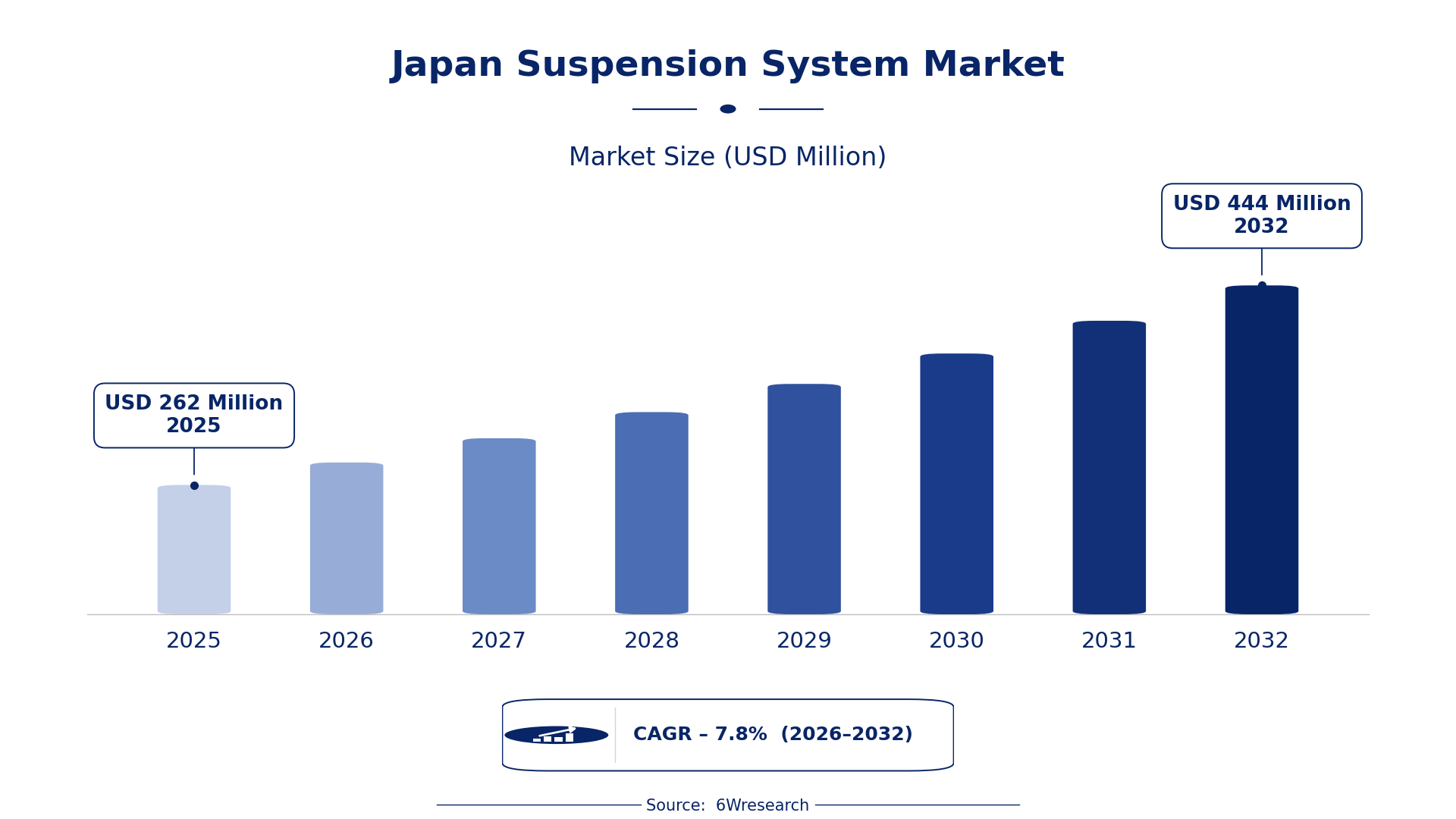
According to 6Wresearch internal database and industry insights, the Japan Suspension System Market was valued at USD 262 Million in 2025 and is projected to reach USD 444 Million by 2032, growing at a CAGR of approximately 7.8% during 2026–2032.
Japan Suspension System Market Highlights
| Report Metric | Details |
| Report Name | Japan Suspension System Market (2026-2032) |
| Market Size 2025 | USD 262 Million |
| Market Size 2032 | USD 444 Million |
| Absolute Growth 2025–2032 | USD 182 Million |
| CAGR 2026–2032 | 7.8% |
| Peak Annual Growth | 8.4% in 2032 |
| Forecast Period | 2026–2032 |
| Historical Data | 2022–2025 |
| Base Year | 2025 |
| Leading System Type, 2025 | Passive Suspension (43% share) |
| Leading Technology Used, 2025 | Conventional Shock Absorbers (44% share) |
| Leading Vehicle Segment, 2025 | Compact & Sedan Cars (41% share) |
| Leading End User, 2025 | OEMs (42% share) |
| Fastest-Growing System Type | Active Suspension (10.8% CAGR) |
| Fastest-Growing Technology Used | Adaptive Control (11.3% CAGR) |
| Fastest-Growing Vehicle Segment | Luxury & Premium Vehicles (11.0% CAGR) |
| Fastest-Growing End User | Suspension Tech Providers (10.4% CAGR) |
| Growing Sector | automotive aftermarket |
| Key End Users | OEMs, suspension tech providers, fleet manufacturers, automotive aftermarket suppliers |
Japan Suspension System Market Year-wise Growth Rate and Key Drivers (2022–2032)
This graph illustrates the annual growth rates of the market from 2022 to 2032, highlighting a steady upward trajectory and projected market expansion over the forecast period.
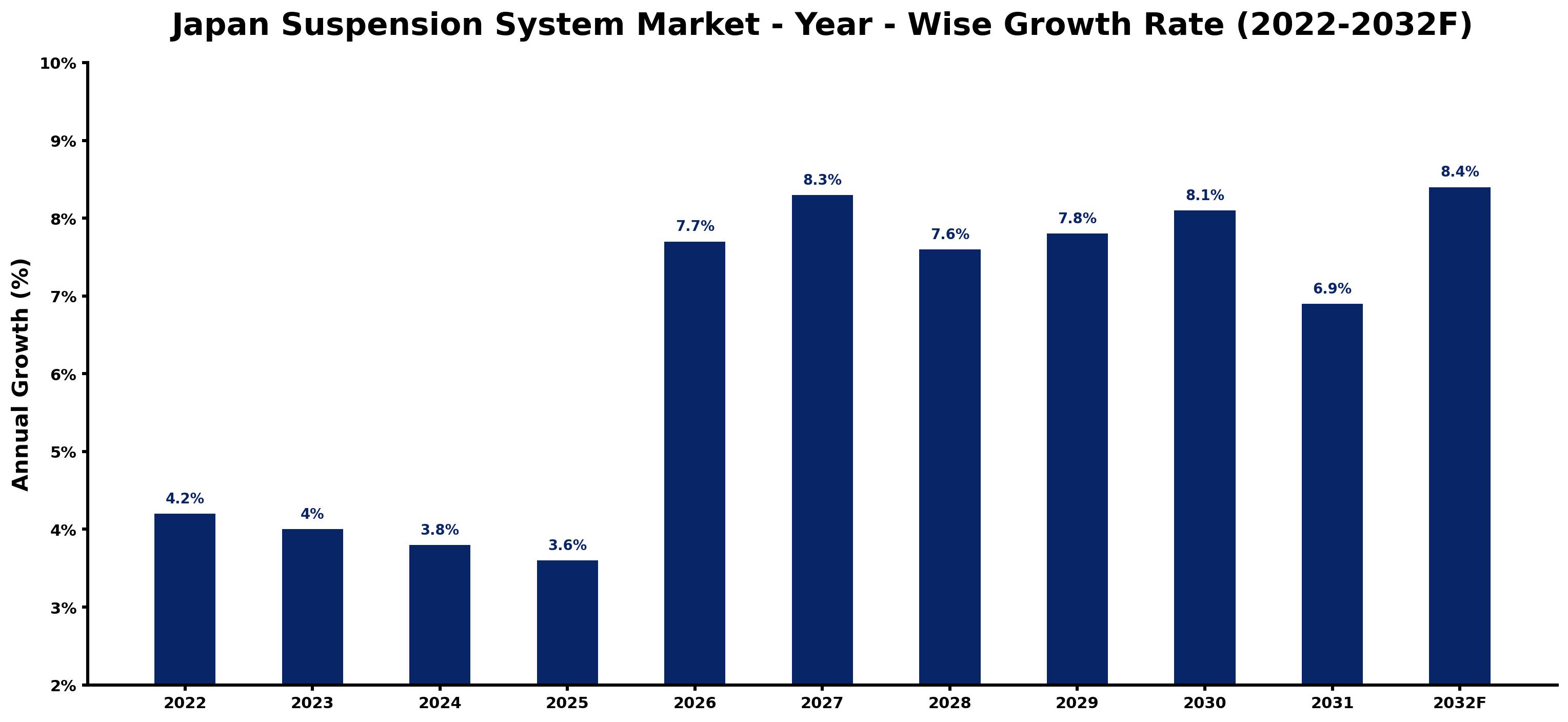
For each year, the table pairs the estimated growth rate with the leading influence on demand, showing how the drivers changed across the period.
| Year | Estimated Annual Growth (%) | Market Rationale |
| 2022 | 4.2 | The market exhibited steady growth due to consistent automotive production levels. |
| 2023 | 4.0 | Growth slowed slightly as the market adjusted to previous peaks in production. |
| 2024 | 3.8 | The market continued to experience a slowdown as demand stabilised. |
| 2025 | 3.6 | The growth rate decreased further as the market matured and competition intensified. |
| 2026 | 7.7 | Growth is expected to accelerate as investments in advanced suspension technologies increase. |
| 2027 | 8.3 | Demand is projected to rise due to higher production rates in luxury vehicles. |
| 2028 | 7.6 | Growth is anticipated to slow again as the market faces saturation in certain segments. |
| 2029 | 7.8 | A renewed interest in performance vehicles will boost market growth. |
| 2030 | 8.1 | The market is expected to expand as electronic suspension systems gain wider adoption. |
| 2031 | 6.9 | Growth is projected to slow as market conditions stabilise after rapid advancements. |
| 2032 | 8.4 | Demand is expected to surge due to a rise in luxury and electric vehicle production. |
Note: Market size estimations and growth projections presented in this report are based on 6Wresearch's proprietary forecasting methodology, utilizing the latest available industry data, government publications, and primary research inputs.
Japan Suspension System Market Synopsis
Suspension systems are critical technologies that support vehicle weight, absorb shocks, and maintain tire contact with the road. The Japan Suspension System Market is driven by domestic users and exports, particularly in the luxury and electric vehicle segments. The market is growing due to increased production levels, advancements in suspension technology, and an automotive aftermarket valued at ¥4 trillion, highlighting the importance of suspension parts in vehicle maintenance and upgrades.
Market Dynamics Impact Analysis (2026–2032)
| Factor | Type | Impact | Primary Segment Affected |
| Increased production of luxury vehicles drives demand for advanced suspension systems. | Driver | High | Active Suspension |
| The growing popularity of electric vehicles creates opportunities for innovative suspension solutions. | Opportunity | High | EVs & Hybrids |
| The need for reliable suspension in heavy commercial vehicles constrains market growth. | Restraint | Medium | Heavy Commercial Vehicles |
| Rising competition among suspension technology providers poses challenges for market players. | Challenge | Medium | Suspension Tech Providers |
| The demand for suspension replacements rises due to the aging vehicle fleet. | Driver | High | Conventional Shock Absorbers |
| The Tokyo Motor Show showcases advancements in suspension technology, promoting growth. | Opportunity | Medium | Luxury & Premium Vehicles |
| Stringent safety regulations may increase compliance costs for manufacturers. | Restraint | High | OEMs |
| Technological advancements require continuous investment, straining smaller firms. | Challenge | Medium | Suspension Tech Providers |
Evaluation of Drivers in Japan Suspension System Market (2026–2032)
The factors lifting demand, and the evidence behind each, are summarised below.
| Drivers | Primary Segment Affected | Why It Matters (Evidence) |
| Increased luxury vehicle production supports demand for advanced suspension systems. | Active Suspension | Active suspension systems are used in over 20% of new luxury vehicles in Japan, improving performance. |
| The aging vehicle fleet necessitates suspension replacements, boosting aftermarket sales. | Conventional Shock Absorbers | The average age of vehicles in Japan is 13.5 years, increasing demand for suspension replacements. |
| The rise in electric vehicle production drives demand for innovative suspension technologies. | EVs & Hybrids | The adoption rate of electronic suspension systems is expected to reach 35% by 2025, improving performance. |
| Heavy commercial vehicles require reliable suspension for load handling and stability. | Heavy Commercial Vehicles | Heavy commercial vehicles represent 25% of suspension system sales in Japan, indicating strong demand. |
| The Tokyo metropolitan area accounts for a significant portion of automotive demand. | Luxury & Premium Vehicles | The Tokyo metropolitan area accounts for 30% of Japan's automotive demand, driving suspension system sales. |
Volumes grow on the back of increased production levels in the luxury vehicle segment, where over 20% of new vehicles feature active suspension systems. The average age of vehicles in Japan is 13.5 years, leading to heightened demand for suspension replacements. The adoption of electronic suspension systems is projected to reach 35% by 2025, reflecting the shift towards advanced technologies. Heavy commercial vehicles, which account for 25% of suspension system sales, also contribute to rising volumes. The Tokyo metropolitan area, representing 30% of automotive demand, further fuels growth in this sector.
Evaluation of Restraints in Japan Suspension System Market
The following restraints limit how fast demand can grow.
| Market Restraint | Primary Segment Affected | Why It Matters (Evidence) |
| Stringent safety regulations increase compliance costs for manufacturers. | OEMs | The Ministry of Land, Infrastructure, Transport and Tourism oversees vehicle safety standards, impacting production costs by up to ¥200 million annually. |
| Rising competition among suspension technology providers pressures profit margins. | Suspension Tech Providers | Increased innovation and investment are necessary to remain competitive in Japan's automotive sector, leading to higher operational costs. |
| The aging vehicle fleet may lead to increased maintenance costs for users. | Heavy Commercial Vehicles | As vehicles age, the need for suspension replacements rises, impacting overall vehicle operating costs significantly. |
| Market saturation in certain segments limits growth potential. | Luxury & Premium Vehicles | High demand for luxury vehicles has led to increased competition, constraining profit margins for manufacturers. |
| Economic fluctuations can affect consumer spending on vehicle upgrades. | Conventional Shock Absorbers | Economic downturns may lead consumers to delay suspension replacements, impacting sales and aftermarket growth. |
Japan Suspension System Market Challenges
Buyers encounter rising costs from stringent vehicle safety regulations enforced by the Ministry of Land, Infrastructure, Transport and Tourism, which can increase compliance expenses by up to ¥200 million annually. Producers face higher production costs due to fluctuating raw material prices, leading to a 15% increase in component costs that squeeze profit margins. Importers deal with intense competition for advanced technologies, as over 20% of new luxury vehicles incorporate active systems, driving up prices for high-quality components. Supply chain disruptions, often triggered by natural disasters, can delay shipments and result in a 10% increase in lead times for essential parts, affecting vehicle availability for producers.
Trends in the Japan Suspension System Market
Several trends are reshaping the Japan Suspension System Market; the most important are set out below.
- Shift towards Active and Electronic Suspension Systems: The Tokyo Motor Show highlights advancements in suspension technology, showcasing active and electronic systems. With over 20% of new luxury vehicles featuring active suspension, this trend reflects the industry's focus on performance and comfort.
- Increase in Electronic Suspension System Adoption: Japan is experiencing a rise in the adoption of electronic suspension systems, expected to reach 35% by 2025. This shift is driven by the growing demand for improved vehicle performance, particularly in electric vehicles.
- Importance of Aftermarket Suspension Parts: The automotive aftermarket in Japan is valued at ¥4 trillion, with suspension parts being a key segment. This growth indicates increasing consumer investment in vehicle maintenance and upgrades.
- Expansion of Luxury Vehicle Segment: The luxury vehicle segment is rapidly expanding, projected to grow at a CAGR of 11.0% from 2026 to 2032. This growth is driven by rising disposable incomes and consumer preferences for advanced features.
Investment Opportunities in the Japan Suspension System Market
Investors looking at the Japan Suspension System Market should consider the following areas.
- Tokyo Motor Show as a Platform for Innovation: The Tokyo Motor Show presents opportunities for suppliers to showcase advanced suspension technologies, with the potential to reach a large audience in the automotive sector.
- Investment in Electric Vehicle Suspension Solutions: With the adoption of electronic suspension systems expected to reach 35% by 2025, there is a growing opportunity for suppliers to invest in solutions for electric vehicles.
- Demand for Suspension Replacements: The aging vehicle fleet presents an opportunity for aftermarket suppliers to meet the increasing demand for suspension replacements, particularly in urban areas.
- Collaboration with OEMs for Advanced Technologies: Collaborating with OEMs to develop advanced suspension systems can open new markets, especially in the luxury vehicle segment.
Government Initiatives in the Japan Suspension System Market
The Electrical Appliance and Material Safety Act regulates the safety of electrical components in suspension systems, ensuring compliance for manufacturers. This law mandates rigorous testing and certification processes, impacting production timelines and costs for suspension system producers in Japan. Compliance with JIS D 5201, a standard for shock absorbers, is also essential for maintaining safety and performance standards in the automotive sector.
In 2023, the government allocated ¥500 million for automotive innovation programs, administered by the Ministry of Economy, Trade and Industry. These funds support research and development in advanced suspension technologies, promoting growth in the sector and ensuring that manufacturers can meet evolving safety and performance standards.
Future Insight of the Japan Suspension System Market
The Tokyo Motor Show will feature cutting-edge automotive technologies, paving the way for improved suspension systems. By 2032, the adoption of electronic suspension systems is projected to reach 35%, significantly enhancing vehicle handling and comfort for buyers. Government initiatives will support research and development in automotive technologies, encouraging innovation among suppliers. As the average vehicle age rises to 13.5 years, demand for suspension replacements will surge, benefiting the aftermarket valued at ¥4 trillion.
Market Segmentation Analysis
Japan Suspension System Market report covers a detailed analysis of the following market segments:
By System Type – Passive Suspension Leads, Active Suspension Expected to Grow Fastest
According to Saurav Kr Singh, Senior Research Analyst at 6Wresearch, with 43% of system type revenue in 2025, Passive Suspension was the largest category. Passive suspension systems hold the largest share as they are standard in most vehicles, providing essential shock absorption for everyday driving. Their prevalence is evident in Japan's automotive production, where a significant number of vehicles are compact and sedan cars. Active Suspension is projected to grow fastest, at a CAGR of 10.8% during 2026–2032. Active suspension systems are rapidly gaining traction, particularly in luxury vehicles, where over 20% of new models incorporate this technology. The growing consumer preference for enhanced handling and comfort is expected to further accelerate this segment's growth. Suppliers should focus on developing active suspension technologies to meet the rising demand in the luxury vehicle market.
By Technology Used – Conventional Shock Absorbers Lead, Adaptive Control Expected to Grow Fastest
Conventional Shock Absorbers held 44% of the Japan Suspension System Market by technology used in 2025. Conventional shock absorbers dominate the market due to their extensive application across various vehicle types, making them a fundamental component in the automotive industry. Their reliability and cost-effectiveness contribute to their widespread adoption among manufacturers. Over 2026–2032, Adaptive Control is expected to post the fastest growth, at a CAGR of 11.3%. Adaptive control technology is experiencing rapid growth as manufacturers seek to implement advanced systems in high-end vehicles. The increasing consumer demand for superior ride quality is driving the expansion of this segment. Manufacturers must invest in adaptive technologies to remain competitive in the evolving market.
By Vehicle Segment – Compact & Sedan Cars Lead, Luxury & Premium Vehicles Expected to Grow Fastest
The largest vehicle segment category in 2025 was Compact & Sedan Cars, at 41% of revenue. Compact and sedan cars represent the majority of vehicles in Japan, leading to a high demand for suspension systems tailored for these models. This segment's dominance is highlighted by the country's substantial automotive production figures. The quickest growth will come from Luxury & Premium Vehicles, forecast to expand at a CAGR of 11.0% between 2026 and 2032. Luxury and premium vehicles are witnessing the fastest growth due to rising consumer interest in advanced suspension technologies that enhance performance and comfort. This trend indicates a shift in buyer preferences within the automotive sector. Suppliers should target luxury vehicle manufacturers to capitalise on this expanding market segment.
By End User – OEMs Lead, Suspension Tech Providers Expected to Grow Fastest
OEMs accounted for 42% of the market by end user in 2025. OEMs are the primary users of suspension systems, integrating these components into their vehicle production processes. Their essential role in the automotive supply chain ensures a steady demand for suspension technologies. Suspension Tech Providers are set to record the highest CAGR in this split, 10.4% over 2026–2032. Suspension tech providers are rapidly increasing their market share as they supply advanced components to OEMs, addressing the complexities of modern vehicles. This trend highlights the necessity for collaboration between manufacturers and technology providers. Establishing strategic partnerships with suspension tech providers will be crucial for OEMs to access cutting-edge solutions.
Key Attractiveness of the Report
- 10 Years of Market Numbers
- Historical Data Starting from 2022 to 2025
- Base Year 2025
- Forecast Data until 2032
- Key Performance Indicators Impacting the Market
- Major Upcoming Developments and Projects
Key Highlights of the Report:
- Japan Suspension System Market Outlook
- Market Size of Japan Suspension System Market, 2025
- Forecast of Japan Suspension System Market, 2032
- Historical Data and Forecast of Japan Suspension System Revenues & Volume for the Period 2022-2032F
- Japan Suspension System Market Trend Evolution
- Japan Suspension System Market Drivers and Challenges
- Japan Suspension System Price Trends
- Japan Suspension System Porter's Five Forces
- Japan Suspension System Industry Life Cycle
- Historical Data and Forecast of Japan Suspension System Market Revenues & Volume By System Type for the Period 2022-2032F
- Historical Data and Forecast of Japan Suspension System Market Revenues & Volume By Passive Suspension for the Period 2022-2032F
- Historical Data and Forecast of Japan Suspension System Market Revenues & Volume By Active Suspension for the Period 2022-2032F
- Historical Data and Forecast of Japan Suspension System Market Revenues & Volume By Semi-Active Suspension for the Period 2022-2032F
- Historical Data and Forecast of Japan Suspension System Market Revenues & Volume By Air Suspension for the Period 2022-2032F
- Historical Data and Forecast of Japan Suspension System Market Revenues & Volume By Technology Used for the Period 2022-2032F
- Historical Data and Forecast of Japan Suspension System Market Revenues & Volume By Conventional Shock Absorbers for the Period 2022-2032F
- Historical Data and Forecast of Japan Suspension System Market Revenues & Volume By Adaptive Control for the Period 2022-2032F
- Historical Data and Forecast of Japan Suspension System Market Revenues & Volume By Electronically Controlled for the Period 2022-2032F
- Historical Data and Forecast of Japan Suspension System Market Revenues & Volume By Pneumatic Systems for the Period 2022-2032F
- Historical Data and Forecast of Japan Suspension System Market Revenues & Volume By Vehicle Segment for the Period 2022-2032F
- Historical Data and Forecast of Japan Suspension System Market Revenues & Volume By Compact & Sedan Cars for the Period 2022-2032F
- Historical Data and Forecast of Japan Suspension System Market Revenues & Volume By Luxury & Premium Vehicles for the Period 2022-2032F
- Historical Data and Forecast of Japan Suspension System Market Revenues & Volume By EVs & Hybrids for the Period 2022-2032F
- Historical Data and Forecast of Japan Suspension System Market Revenues & Volume By Heavy Commercial Vehicles for the Period 2022-2032F
- Historical Data and Forecast of Japan Suspension System Market Revenues & Volume By End User for the Period 2022-2032F
- Historical Data and Forecast of Japan Suspension System Market Revenues & Volume By OEMs for the Period 2022-2032F
- Historical Data and Forecast of Japan Suspension System Market Revenues & Volume By Suspension Tech Providers for the Period 2022-2032F
- Historical Data and Forecast of Japan Suspension System Market Revenues & Volume By Smart Vehicle Platforms for the Period 2022-2032F
- Historical Data and Forecast of Japan Suspension System Market Revenues & Volume By Fleet Manufacturers for the Period 2022-2032F
- Japan Suspension System Import Export Trade Statistics
- Market Opportunity Assessment By System Type
- Market Opportunity Assessment By Technology Used
- Market Opportunity Assessment By Vehicle Segment
- Market Opportunity Assessment By End User
- Japan Suspension System Top Companies Market Share
- Japan Suspension System Competitive Benchmarking By Technical and Operational Parameters
- Japan Suspension System Company Profiles
- Japan Suspension System Key Strategic Recommendations
Market Covered
The following segment groups are covered in the report.
By System Type
- Passive Suspension
- Active Suspension
- Semi-Active Suspension
- Air Suspension
By Technology Used
- Conventional Shock Absorbers
- Adaptive Control
- Electronically Controlled
- Pneumatic Systems
By Vehicle Segment
- Compact & Sedan Cars
- Luxury & Premium Vehicles
- EVs & Hybrids
- Heavy Commercial Vehicles
By End User
- OEMs
- Suspension Tech Providers
- Smart Vehicle Platforms
- Fleet Manufacturers































