Japan Suspension System Parts Market Size & Growth Rate
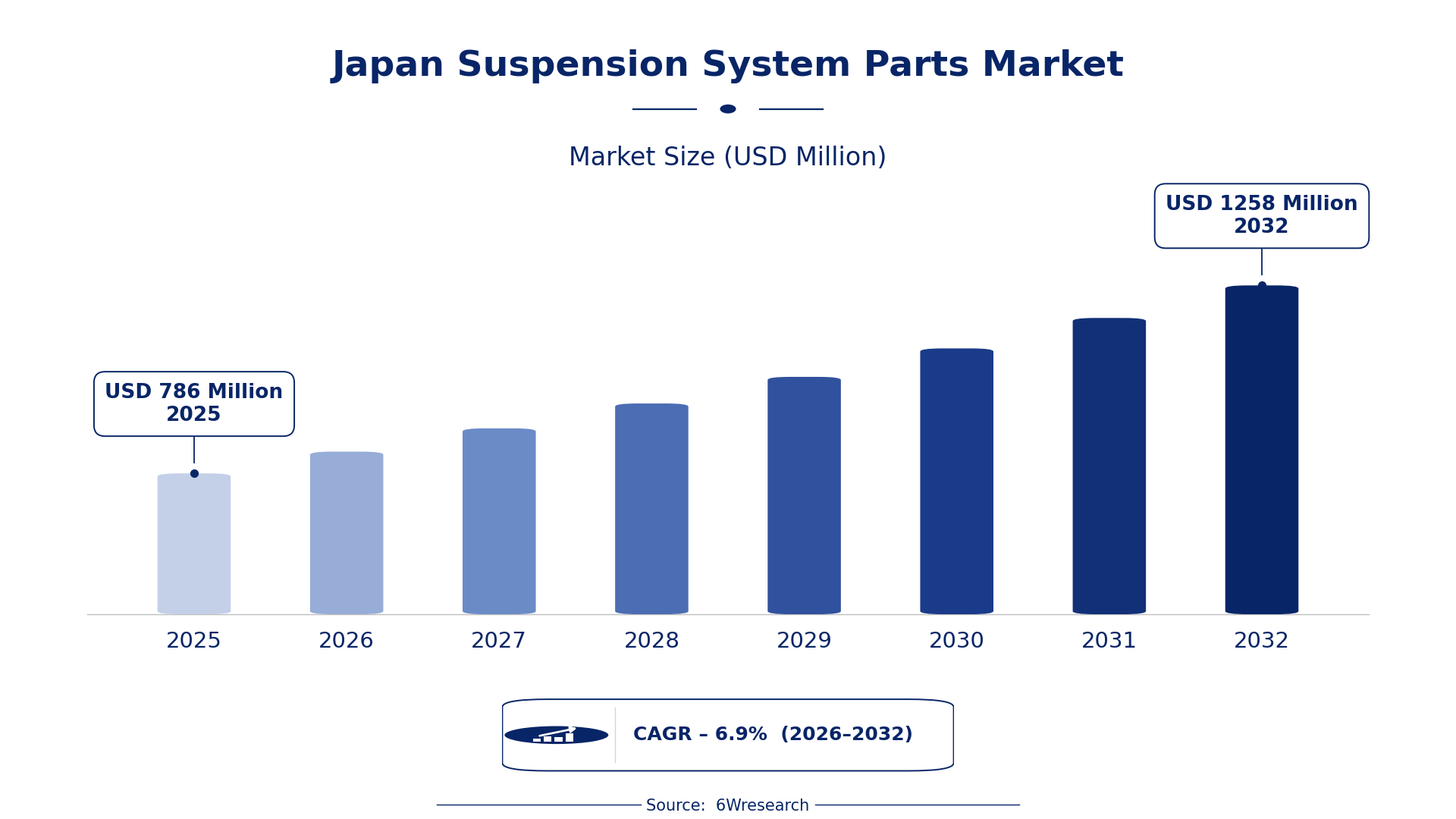
According to 6Wresearch internal database and industry insights, the Japan Suspension System Parts Market was valued at USD 786 Million in 2025 and is projected to reach USD 1,258 Million by 2032, growing at a CAGR of approximately 6.9% during 2026–2032.
Japan Suspension System Parts Market Highlights
| Report Metric | Details |
| Report Name | Japan Suspension System Parts Market (2026-2032) |
| Market Size 2025 | USD 786 Million |
| Market Size 2032 | USD 1,258 Million |
| Absolute Growth 2025–2032 | USD 472 Million |
| CAGR 2026–2032 | 6.9% |
| Peak Annual Growth | 8.0% in 2032 |
| Forecast Period | 2026–2032 |
| Historical Data | 2022–2025 |
| Base Year | 2025 |
| Leading Part Type, 2025 | Springs (40% share) |
| Leading Material Type, 2025 | High-Carbon Steel (42% share) |
| Leading Service Type, 2025 | Replacement (44% share) |
| Leading End User, 2025 | Auto Repair Workshops (49% share) |
| Fastest-Growing Part Type | Shock Absorbers (9.9% CAGR) |
| Fastest-Growing Material Type | Twin Tube/Mono Tube (10.1% CAGR) |
| Fastest-Growing Service Type | OEM or Aftermarket (9.3% CAGR) |
| Fastest-Growing End User | Spare Part Distributors (9.0% CAGR) |
| Growing Sector | automotive aftermarket |
| Key End Users | auto repair workshops, spare part distributors, component assemblers |
Japan Suspension System Parts Market Year-wise Growth Rate and Key Drivers (2022–2032)
This graph illustrates the annual growth rates of the market from 2022 to 2032, highlighting a steady upward trajectory and projected market expansion over the forecast period.
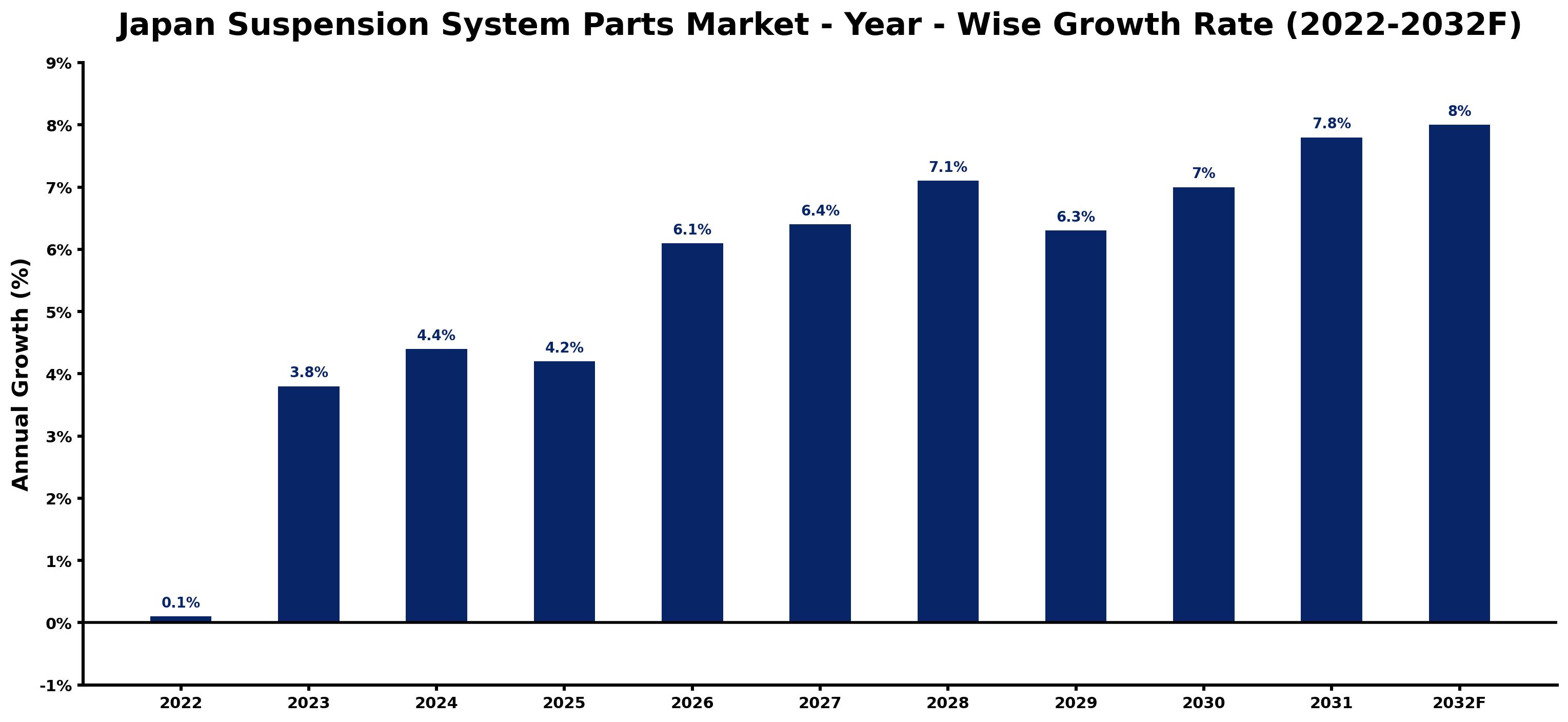
The table below sets out the estimated growth rate for each year and the main factor behind it.
| Year | Estimated Annual Growth (%) | Market Rationale |
| 2022 | 0.1 | The market experienced minimal growth due to a stable automotive sector and limited demand for new parts. |
| 2023 | 3.8 | Growth accelerated as vehicle production increased, reflecting a recovery in consumer spending on automotive parts. |
| 2024 | 4.4 | The market continued to expand, driven by rising vehicle production and a growing focus on aftermarket parts. |
| 2025 | 4.2 | Growth slowed slightly as the market stabilised after previous peaks in production and demand. |
| 2026 | 6.1 | Demand is expected to rise significantly, supported by increased investments in vehicle manufacturing and technology. |
| 2027 | 6.4 | Growth is projected to continue as the automotive sector embraces innovation and improved supply chains. |
| 2028 | 7.1 | The market is anticipated to grow further, driven by advancements in suspension technologies and increased vehicle sales. |
| 2029 | 6.3 | Growth is expected to slow as the market matures, but demand for replacement parts remains strong. |
| 2030 | 7.0 | Demand is projected to rise again, influenced by a shift towards electric vehicles and their specific suspension needs. |
| 2031 | 7.8 | The market is expected to grow as manufacturers adapt to new technologies and consumer preferences. |
| 2032 | 8.0 | The peak growth year will be driven by robust demand for advanced suspension components in electric vehicles. |
Note: Market size estimations and growth projections presented in this report are based on 6Wresearch's proprietary forecasting methodology, utilizing the latest available industry data, government publications, and primary research inputs.
Japan Suspension System Parts Market Synopsis
Suspension system parts play a vital role in vehicle performance, supporting weight, absorbing shocks, and enhancing stability. These components, made from materials like steel and rubber, are essential for improving vehicle handling and safety. The Japan Suspension System Parts Market is growing due to increasing vehicle production, with the automotive aftermarket projected to reach 3 trillion yen by 2025. Additionally, the average vehicle age exceeds 13 years, driving demand for replacement parts and upgrades, particularly in urban areas where performance enhancements are popular.
Market Dynamics Impact Analysis (2026–2032)
| Factor | Type | Impact | Primary Segment Affected |
| Rising vehicle production and sales | Driver | High | Springs |
| The aging vehicle fleet increases replacement part demand | Driver | High | Shock Absorbers |
| Growing interest in performance upgrades among enthusiasts | Opportunity | Medium | Performance Upgrade |
| Expansion of automotive manufacturing in the Tokyo region | Opportunity | Medium | Sway Bars |
| Supply chain disruptions affecting material availability | Restraint | High | High-Carbon Steel |
| High competition among suppliers leading to price pressures | Restraint | Medium | OEM or Aftermarket |
| Limited capacity for rapid scaling of production | Challenge | High | Replacement |
| Technological advancements requiring significant investment | Challenge | Medium | Twin Tube/Mono Tube |
Evaluation of Drivers in Japan Suspension System Parts Market (2026–2032)
Key forces behind demand, with the segment each one moves most, are listed below.
| Drivers | Primary Segment Affected | Why It Matters (Evidence) |
| Increased vehicle production | Springs | Japan's automotive sector produced 8.3 million vehicles in 2022, driving demand for springs. |
| High average vehicle age | Shock Absorbers | With an average vehicle age over 13 years, demand for shock absorber replacements is rising. |
| Popularity of aftermarket upgrades | Performance Upgrade | Performance upgrades are increasingly popular among car enthusiasts in urban areas. |
| Focus on quality aftermarket parts | OEM or Aftermarket | The automotive aftermarket is projected to reach 3 trillion yen by 2025, indicating strong demand. |
| Technological advancements in suspension design | Twin Tube/Mono Tube | New designs are improving vehicle performance, increasing demand for modern suspension components. |
What keeps demand rising is the production of vehicles, with Japan manufacturing 8.3 million units in 2022. The average vehicle age exceeds 13 years, leading to heightened demand for replacement parts. Popularity for aftermarket upgrades is growing, particularly among urban car enthusiasts. The automotive aftermarket is expected to reach 3 trillion yen by 2025, reflecting strong consumer spending on quality parts. Technological advancements in suspension design are driving demand, as manufacturers seek to improve vehicle performance and safety.
Evaluation of Restraints in Japan Suspension System Parts Market
Several factors work against faster growth; the main ones are summarised below.
| Market Restraint | Primary Segment Affected | Why It Matters (Evidence) |
| Supply chain disruptions | High-Carbon Steel | Material shortages have led to delays in production and increased costs for manufacturers. |
| Intense competition among suppliers | OEM or Aftermarket | High competition results in price pressures, affecting profit margins for suppliers. |
| Limited production capacity for rapid scaling | Replacement | Manufacturers face challenges in quickly scaling production to meet rising demand. |
| Technological investment requirements | Twin Tube/Mono Tube | Advancements in suspension technology require significant investments that can limit smaller players. |
| Regulatory compliance costs | Sway Bars | Compliance with standards like JIS B 2705 increases operational costs for manufacturers. |
Japan Suspension System Parts Market Challenges
In 2022, Japan's automotive sector produced 8.3 million vehicles, intensifying competition among suspension system parts suppliers and pushing prices down for producers. Rapid technology shifts require costly upgrades in manufacturing processes, which many smaller suppliers struggle to afford, limiting their market presence. A shortage of skilled workers in the automotive industry affects production efficiency, causing delays in parts availability for over 5,000 auto repair workshops. Dependence on high-carbon steel exposes manufacturers to supply chain disruptions, resulting in longer lead times and increased costs for producers.
Trends in the Japan Suspension System Parts Market
These developments are changing demand patterns in the Japan Suspension System Parts Market.
- Shift towards Electric Vehicle Parts: The automotive sector is increasingly focusing on electric vehicle parts, driven by the government's 2023 program promoting EV manufacturing. This shift is expected to create new opportunities for suppliers, with the market for electric vehicle parts projected to grow.
- Transition from Traditional to High-Performance Suspension Systems: Since 2023, there has been a notable shift towards high-performance suspension systems, particularly in urban areas. The demand for enhanced vehicle stability and handling is driving this trend, with a growing number of aftermarket products available.
- Emergence of Advanced Materials in Suspension Parts: The use of advanced materials like high-carbon steel is becoming more prevalent in suspension parts manufacturing. This change began in 2022, with manufacturers adopting these materials for their strength and durability, enhancing overall vehicle performance.
- Prioritisation of Quality in Aftermarket Parts: The focus on quality in aftermarket parts has intensified since 2022, as consumers demand higher standards. The Japan Automobile Manufacturers Association's efforts to enforce quality standards have led to increased consumer trust and spending.
Investment Opportunities in the Japan Suspension System Parts Market
The openings below show where demand in the Japan Suspension System Parts Market is visible and how suppliers can enter.
- Local Partnerships for EV Parts Manufacturing: Investing in partnerships with local manufacturers to produce electric vehicle parts is timely, as the market is expected to grow. Collaborating with auto repair workshops can facilitate entry into this expanding sector.
- Expansion into Urban Performance Upgrades: With a growing interest in performance upgrades among urban car enthusiasts, there is a clear opportunity to supply high-performance suspension parts. Targeting auto tuning centers can help capture this market segment.
- Investment in High-Quality Aftermarket Components: The automotive aftermarket is projected to reach 3 trillion yen by 2025, indicating a strong demand for quality parts. Suppliers should focus on high-quality components to effectively meet this demand.
- Certification for Compliance with JIS Standards: Investing in certification for compliance with JIS B 2705 standards can enhance market credibility. This is particularly important for manufacturers aiming to supply to the automotive sector.
Government Initiatives in the Japan Suspension System Parts Market
The Economic Security Promotion Act of 2022 impacts buyers of suspension system parts by supporting supply-chain resilience for critical materials. This measure ensures that manufacturers can maintain consistent production levels and meet quality standards, benefiting consumers through improved availability of parts.
In 2023, the Japanese government launched a program to promote electric vehicle parts manufacturing, with the Ministry of Land, Infrastructure, Transport and Tourism overseeing its implementation. This initiative aims to fund projects that enhance the production capabilities of automotive suppliers, ensuring they can meet the growing demand for EV components.
Future Insight of the Japan Suspension System Parts Market
Investment in electric vehicle parts manufacturing will reshape the market by 2032, generating demand for advanced suspension components. The automotive aftermarket in Japan is projected to reach 3 trillion yen by 2025, indicating robust opportunities for suppliers. The JIS B 2705 standard will enhance quality assurance, benefiting buyers seeking reliable components. Collaborative efforts between manufacturers and regulatory bodies will drive innovations in suspension technologies, ensuring that both buyers and suppliers can meet evolving market needs.
Market Segmentation Analysis
Japan Suspension System Parts Market report covers a detailed analysis of the following market segments:
By Part Type – Springs Lead, Shock Absorbers Expected to Grow Fastest
According to Saurav Kr Singh, Senior Research Analyst at 6Wresearch, in 2025, Springs led the part type split with a 40% share. Springs hold the largest market share due to their critical role in load support and ride quality, essential for vehicle performance. Their extensive use in Japan's automotive sector, which produced 8.3 million vehicles in 2022, underscores their importance. The quickest growth will come from Shock Absorbers, forecast to expand at a CAGR of 9.9% between 2026 and 2032. Shock absorbers are experiencing rapid growth as they are vital for controlling vehicle motion, increasingly sought after by consumers. The trend of performance upgrades among car enthusiasts in urban areas is a significant factor propelling this segment's expansion. Suppliers should focus on improving shock absorber quality and availability to meet rising consumer expectations.
By Material Type – High-Carbon Steel Leads, Twin Tube/Mono Tube Expected to Grow Fastest
High-Carbon Steel held 42% of the Japan Suspension System Parts Market by material type in 2025. High-carbon steel dominates the market due to its strength and versatility in manufacturing various suspension parts. This material's widespread use aligns with Japan's automotive industry standards, ensuring reliability and safety in vehicle components. Twin Tube/Mono Tube is projected to grow fastest, at a CAGR of 10.1% during 2026–2032. The twin tube/mono tube design is gaining traction as it is key for shock absorber design, offering improved performance and comfort. The push towards high-quality aftermarket parts is accelerating the demand for these advanced designs. Manufacturers must invest in the development of twin tube/mono tube designs to capture the growing market segment.
By Service Type – Replacement Leads, OEM or Aftermarket Expected to Grow Fastest
With 44% of service type revenue in 2025, Replacement was the largest category. Replacement services dominate the market as they are commonly required for worn-out parts, reflecting the ageing vehicle population in Japan. With the average vehicle age exceeding 13 years, the demand for replacement parts remains robust. Over 2026–2032, OEM or Aftermarket is expected to post the fastest growth, at a CAGR of 9.3%. OEM or aftermarket services are growing quickly as both options are important for market expansion, driven by the increasing number of auto repair workshops. The automotive aftermarket is projected to reach 3 trillion yen by 2025, highlighting substantial growth potential. Suppliers should ensure a steady supply of both OEM and aftermarket parts to cater to diverse consumer preferences.
By End User – Auto Repair Workshops Lead, Spare Part Distributors Expected to Grow Fastest
The largest end user category in 2025 was Auto Repair Workshops, at 49% of revenue. Auto repair workshops are the largest end user segment for suspension system parts, serving as primary service providers. With over 5,000 workshops across Japan, they play a crucial role in maintaining vehicle performance and safety. Spare Part Distributors are set to record the highest CAGR in this split, 9.0% over 2026–2032. Spare part distributors are witnessing the fastest growth as they are essential for supplying parts to repair workshops and consumers. The rising demand for replacement parts is driving this segment's rapid advancement. Distributors should strengthen their networks to guarantee timely delivery and availability of parts to satisfy market demands.
Key Attractiveness of the Report
- 10 Years of Market Numbers
- Historical Data Starting from 2022 to 2025
- Base Year 2025
- Forecast Data until 2032
- Key Performance Indicators Impacting the Market
- Major Upcoming Developments and Projects
Key Highlights of the Report:
- Japan Suspension System Parts Market Outlook
- Market Size of Japan Suspension System Parts Market, 2025
- Forecast of Japan Suspension System Parts Market, 2032
- Historical Data and Forecast of Japan Suspension System Parts Revenues & Volume for the Period 2022-2032F
- Japan Suspension System Parts Market Trend Evolution
- Japan Suspension System Parts Market Drivers and Challenges
- Japan Suspension System Parts Price Trends
- Japan Suspension System Parts Porter's Five Forces
- Japan Suspension System Parts Industry Life Cycle
- Historical Data and Forecast of Japan Suspension System Parts Market Revenues & Volume By Part Type for the Period 2022-2032F
- Historical Data and Forecast of Japan Suspension System Parts Market Revenues & Volume By Springs for the Period 2022-2032F
- Historical Data and Forecast of Japan Suspension System Parts Market Revenues & Volume By Shock Absorbers for the Period 2022-2032F
- Historical Data and Forecast of Japan Suspension System Parts Market Revenues & Volume By Mounts & Bearings for the Period 2022-2032F
- Historical Data and Forecast of Japan Suspension System Parts Market Revenues & Volume By Sway Bars for the Period 2022-2032F
- Historical Data and Forecast of Japan Suspension System Parts Market Revenues & Volume By Material Type for the Period 2022-2032F
- Historical Data and Forecast of Japan Suspension System Parts Market Revenues & Volume By High-Carbon Steel for the Period 2022-2032F
- Historical Data and Forecast of Japan Suspension System Parts Market Revenues & Volume By Twin Tube/Mono Tube for the Period 2022-2032F
- Historical Data and Forecast of Japan Suspension System Parts Market Revenues & Volume By Rubber/Metal for the Period 2022-2032F
- Historical Data and Forecast of Japan Suspension System Parts Market Revenues & Volume By Alloy Steel for the Period 2022-2032F
- Historical Data and Forecast of Japan Suspension System Parts Market Revenues & Volume By Service Type for the Period 2022-2032F
- Historical Data and Forecast of Japan Suspension System Parts Market Revenues & Volume By Replacement for the Period 2022-2032F
- Historical Data and Forecast of Japan Suspension System Parts Market Revenues & Volume By OEM or Aftermarket for the Period 2022-2032F
- Historical Data and Forecast of Japan Suspension System Parts Market Revenues & Volume By Maintenance for the Period 2022-2032F
- Historical Data and Forecast of Japan Suspension System Parts Market Revenues & Volume By Performance Upgrade for the Period 2022-2032F
- Historical Data and Forecast of Japan Suspension System Parts Market Revenues & Volume By End User for the Period 2022-2032F
- Historical Data and Forecast of Japan Suspension System Parts Market Revenues & Volume By Auto Repair Workshops for the Period 2022-2032F
- Historical Data and Forecast of Japan Suspension System Parts Market Revenues & Volume By Spare Part Distributors for the Period 2022-2032F
- Historical Data and Forecast of Japan Suspension System Parts Market Revenues & Volume By Component Assemblers for the Period 2022-2032F
- Historical Data and Forecast of Japan Suspension System Parts Market Revenues & Volume By Auto Tuning Centers for the Period 2022-2032F
- Japan Suspension System Parts Import Export Trade Statistics
- Market Opportunity Assessment By Part Type
- Market Opportunity Assessment By Material Type
- Market Opportunity Assessment By Service Type
- Market Opportunity Assessment By End User
- Japan Suspension System Parts Top Companies Market Share
- Japan Suspension System Parts Competitive Benchmarking By Technical and Operational Parameters
- Japan Suspension System Parts Company Profiles
- Japan Suspension System Parts Key Strategic Recommendations
Market Covered
Coverage by segment is as follows.
By Part Type
- Springs
- Shock Absorbers
- Mounts & Bearings
- Sway Bars
By Material Type
- High-Carbon Steel
- Twin Tube/Mono Tube
- Rubber/Metal
- Alloy Steel
By Service Type
- Replacement
- OEM or Aftermarket
- Maintenance
- Performance Upgrade
By End User
- Auto Repair Workshops
- Spare Part Distributors
- Component Assemblers
- Auto Tuning Centers































