Japan Sustainability in Packaging Market Size & Growth Rate
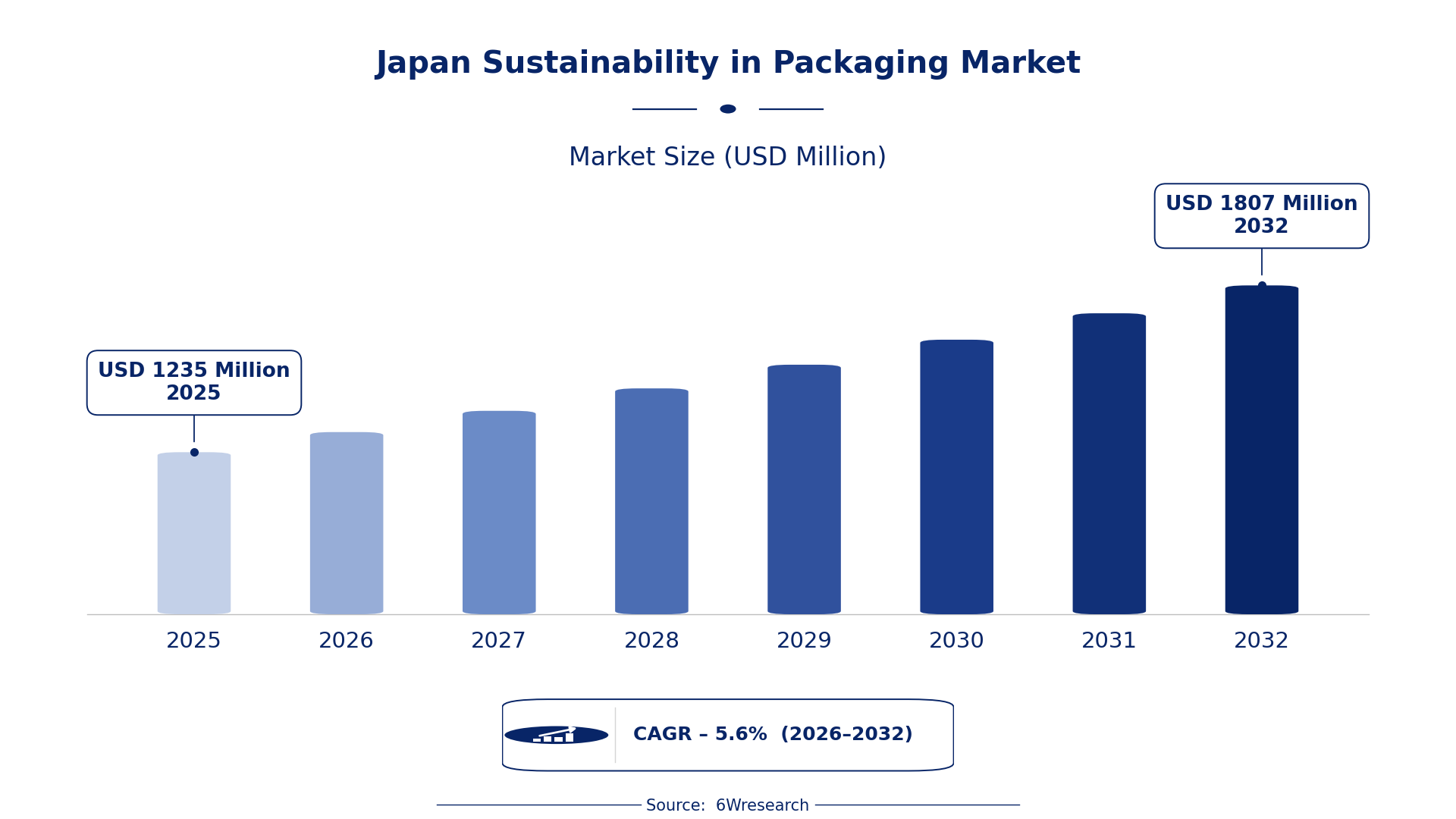
According to 6Wresearch internal database and industry insights, the Japan Sustainability in Packaging Market was valued at USD 1,235 Million in 2025 and is projected to reach USD 1,807 Million by 2032, growing at a CAGR of approximately 5.6% during 2026–2032.
Japan Sustainability in Packaging Market Highlights
| Report Metric | Details |
| Report Name | Japan Sustainability in Packaging Market (2026-2032) |
| Market Size 2025 | USD 1,235 Million |
| Market Size 2032 | USD 1,807 Million |
| Absolute Growth 2025–2032 | USD 572 Million |
| CAGR 2026–2032 | 5.6% |
| Peak Annual Growth | 6.5% in 2028 |
| Forecast Period | 2026–2032 |
| Historical Data | 2022–2025 |
| Base Year | 2025 |
| Leading Packaging Type, 2025 | Recyclable Packaging (42% share) |
| Leading Material Source, 2025 | Paper/Cardboard (46% share) |
| Leading Application Sector, 2025 | Food & Beverage (53% share) |
| Leading End User, 2025 | FMCG Companies (47% share) |
| Fastest-Growing Packaging Type | Biodegradable Packaging (7.8% CAGR) |
| Fastest-Growing Material Source | Plant-Based Films (8.0% CAGR) |
| Fastest-Growing Application Sector | Personal Care (7.5% CAGR) |
| Fastest-Growing End User | Cosmetics Brands (7.4% CAGR) |
| Growing Sector | Personal Care |
| Key End Users | Food & Beverage, Personal Care, E-commerce/Logistics, Fresh Produce |
Japan Sustainability in Packaging Market Year-wise Growth Rate and Key Drivers (2022–2032)
This graph illustrates the annual growth rates of the market from 2022 to 2032, highlighting a steady upward trajectory and projected market expansion over the forecast period.
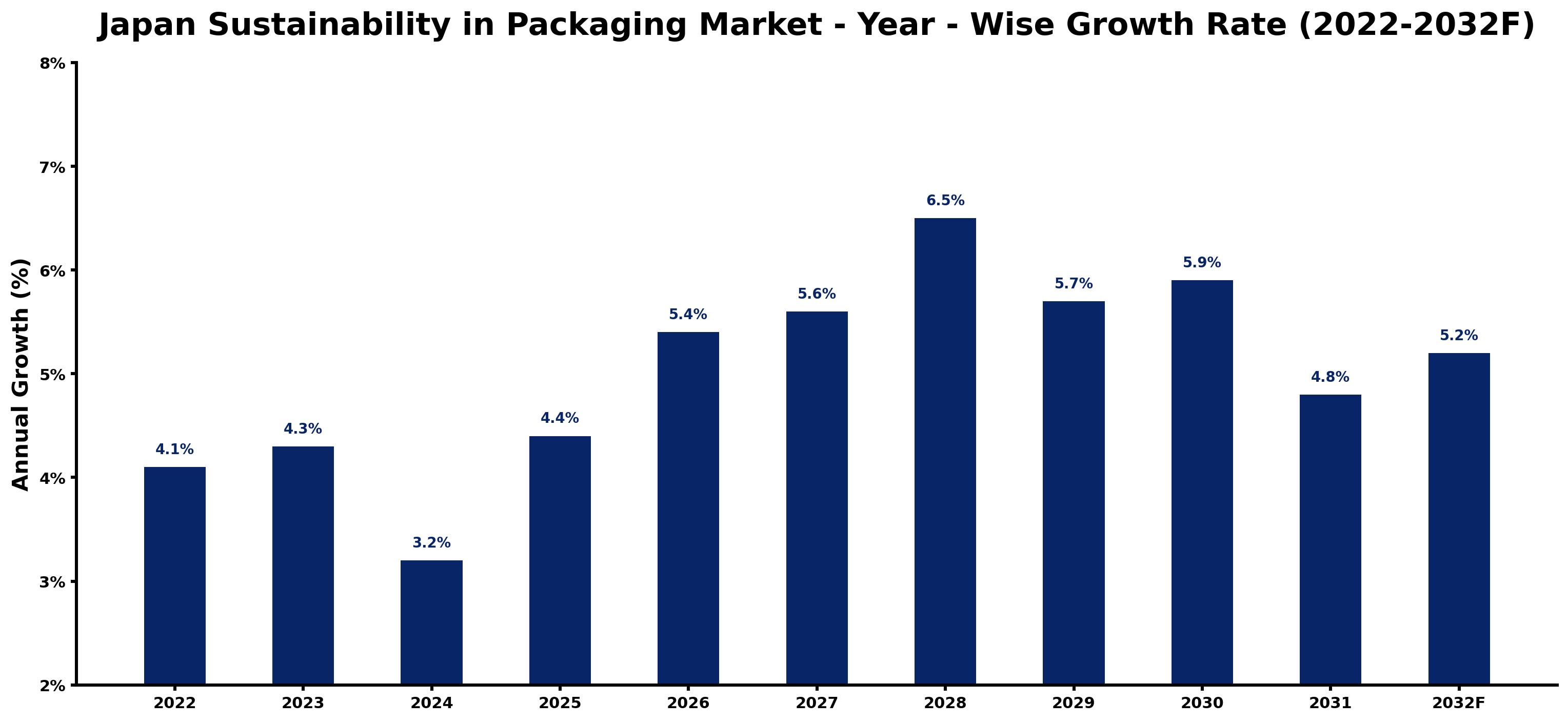
Year by year, the estimates below pair each growth rate with the development that shaped it.
| Year | Estimated Annual Growth (%) | Market Rationale |
| 2022 | 4.1 | The market showed steady growth, reflecting increased awareness of sustainability. |
| 2023 | 4.3 | Demand rose as consumers supported eco-friendly initiatives and practices. |
| 2024 | 3.2 | Growth slowed due to market adjustments and evolving consumer preferences. |
| 2025 | 4.4 | The market experienced a resurgence as businesses adopted sustainable packaging solutions. |
| 2026 | 5.4 | Demand accelerated as more companies committed to eco-friendly practices. |
| 2027 | 5.6 | Growth continued as consumer awareness of sustainability remained high. |
| 2028 | 6.5 | The peak growth rate was achieved, driven by innovations in packaging materials. |
| 2029 | 5.7 | Growth slowed slightly as the market began to stabilise after rapid expansion. |
| 2030 | 5.9 | Demand increased again as new sustainable packaging technologies emerged. |
| 2031 | 4.8 | Growth moderated as the market matured and competition intensified. |
| 2032 | 5.2 | The market is expected to grow steadily as sustainability remains a priority. |
Note: Market size estimations and growth projections presented in this report are based on 6Wresearch's proprietary forecasting methodology, utilizing the latest available industry data, government publications, and primary research inputs.
Japan Sustainability in Packaging Market Synopsis
Sustainability in Packaging focuses on developing materials that reduce environmental impact, utilising eco-friendly options like recycled paper and biodegradable plastics. In Japan, the market is driven by strong demand from the Food & Beverage sector, which accounts for 40% of sustainable packaging needs. The government's Circular Economy policy aims for 100% recyclable packaging by 2025, while consumer awareness has surged, with 70% supporting eco-friendly initiatives, creating a fertile ground for investment and innovation.
Market Dynamics Impact Analysis (2026–2032)
| Factor | Type | Impact | Primary Segment Affected |
| Growing consumer awareness of sustainability | Driver | High | Biodegradable Packaging |
| Government initiatives promoting recycling and eco-friendly materials | Driver | High | Recyclable Packaging |
| Increasing demand for sustainable packaging in food services | Opportunity | High | Food & Beverage |
| Rising interest in plant-based packaging materials | Opportunity | Medium | Plant-Based Films |
| Limited availability of sustainable raw materials | Restraint | High | Recyclable Packaging |
| Higher production costs for biodegradable materials | Restraint | Medium | Biodegradable Packaging |
| Competition from traditional packaging materials | Challenge | High | Reusable Packaging |
| Slow adoption of sustainable practices among smaller companies | Challenge | Medium | FMCG Companies |
Evaluation of Drivers in Japan Sustainability in Packaging Market (2026–2032)
The following drivers explain most of the expected growth.
| Drivers | Primary Segment Affected | Why It Matters (Evidence) |
| Increased consumer demand for eco-friendly products | Biodegradable Packaging | Biodegradable packaging usage in food services has increased by 25% since 2020, leading to more purchases by restaurants. |
| Government support for recycling initiatives | Recyclable Packaging | Japan's recycling rate for paper packaging is approximately 80%, encouraging businesses to adopt recyclable materials. |
| Growth in the Food & Beverage sector | Food & Beverage | The sector accounts for 40% of sustainable packaging demand, prompting suppliers to enhance their offerings. |
| Rising awareness of environmental issues | Plant-Based Films | With 70% of the population supporting eco-friendly initiatives, demand for plant-based materials is increasing. |
| Development of sustainability certification programs | Compostable Packaging | The Japan Packaging Institute launched a sustainability certification program in 2023, boosting consumer confidence. |
Orders keep climbing as consumer awareness of sustainability has surged, with 70% supporting eco-friendly practices. The Food & Beverage sector, accounting for 40% of sustainable packaging demand, is driving purchases of biodegradable materials, which have seen a 25% increase in usage since 2020. Japan's recycling rate for paper packaging is approximately 80%, prompting businesses to adopt recyclable solutions. As a result, demand for plant-based materials is expected to grow by 15% annually through 2025, reflecting changing consumer preferences.
Evaluation of Restraints in Japan Sustainability in Packaging Market
Below are the constraints most often cited by buyers and suppliers, with the segment each affects.
| Market Restraint | Primary Segment Affected | Why It Matters (Evidence) |
| Limited availability of sustainable raw materials | Recyclable Packaging | The supply of eco-friendly materials is limited, making it challenging for producers to meet demand. |
| Higher production costs for biodegradable materials | Biodegradable Packaging | The cost of sourcing biodegradable materials can deter companies from switching from traditional options. |
| Competition from traditional packaging materials | Reusable Packaging | Reusable packaging faces competition from cheaper, conventional materials that dominate the market. |
| Slow adoption of sustainable practices among smaller companies | FMCG Companies | Many smaller FMCG companies lack the resources to invest in sustainable packaging solutions. |
| Consumer price sensitivity towards eco-friendly products | Compostable Packaging | Higher prices for compostable packaging can limit adoption among price-sensitive consumers. |
Japan Sustainability in Packaging Market Challenges
High demand for skilled workers in sustainable packaging leads to project delays for producers. This shortage exists due to insufficient training programs in Japan, costing companies time and potential revenue losses. Complex regulations on packaging materials create compliance challenges for suppliers, resulting in increased operational costs that can reach 20%. Supply chain issues arise from dependence on specific eco-friendly materials, causing delays in product availability for buyers. Rapid technological changes require ongoing investment, which can strain budgets for smaller producers, limiting their ability to compete effectively in the market.
Trends in the Japan Sustainability in Packaging Market
Buyers and suppliers in the Japan Sustainability in Packaging Market are adjusting to the following trends.
- Tokyo as a Hub for Sustainable Packaging Innovation: Tokyo is becoming a centre for sustainable packaging innovation, with numerous initiatives supporting eco-friendly practices. The city has seen a 25% increase in biodegradable packaging usage since 2020, indicating a shift towards greener solutions.
- FMCG Companies Focusing on Eco-Friendly Practices: FMCG Companies are increasingly adopting sustainable packaging solutions, influenced by consumer demand for eco-friendly products. This shift is reflected in the 40% share of the Food & Beverage sector in sustainable packaging demand.
- Growing Interest in Plant-Based Packaging Materials: The trend towards plant-based packaging materials is gaining momentum, with an expected growth rate of 15% annually through 2025. This shift is largely influenced by consumer preferences for eco-friendly options.
- Emergence of Sustainability Certification Programs: The introduction of sustainability certification programs in 2023 is reshaping the packaging industry. These programs are expected to build consumer trust, resulting in increased demand for certified sustainable products.
Investment Opportunities in the Japan Sustainability in Packaging Market
Several openings in the Japan Sustainability in Packaging Market merit attention from investors.
- Gap in Sustainable Packaging Solutions: With Japan's recycling rate for paper packaging at approximately 80%, there is a significant opportunity to supply innovative sustainable packaging solutions. Targeting FMCG Companies can facilitate market entry through partnerships.
- Investment in Biodegradable Materials: The rising demand for biodegradable packaging, which has increased by 25% since 2020, presents an opportunity to invest in production facilities for these materials. Collaborating with food service providers can enhance market reach.
- Plant-Based Packaging Expansion: The anticipated growth of plant-based materials by 15% annually through 2025 indicates a need for suppliers to develop these products. Establishing joint ventures with local manufacturers can streamline entry.
- Sustainability Certification Program Participation: The sustainability certification program launched in 2023 offers a pathway for companies to enhance credibility. Engaging with the Japan Packaging Institute can facilitate compliance and market acceptance.
Government Initiatives in the Japan Sustainability in Packaging Market
The Food Sanitation Act amendment (2018) introduced a positive list system for synthetic resins used in food utensils, containers and packaging, effective from June 2020. This regulation ensures that only approved materials are used, enhancing safety and sustainability in packaging.
The Plastic Resource Circulation Act (2021) promotes the reduction, reuse and recycling of plastics, supporting alternatives such as biomass and biodegradable plastics. This act encourages producers to adopt eco-friendly practices, aligning with consumer demand for sustainable options.
Future Insight of the Japan Sustainability in Packaging Market
The rollout of new recycling facilities by 2025 will streamline waste processing and support the government's Circular Economy policy. As the government aims for 100% recyclable packaging, buyers will benefit from a wider range of compliant options. The sustainability certification program from the Japan Packaging Institute will improve transparency, allowing buyers to make better-informed choices. Increased use of plant-based materials will spur innovation, with a projected growth rate of 15% annually through 2025.
Market Segmentation Analysis
Japan Sustainability in Packaging Market report covers a detailed analysis of the following market segments:
By Packaging Type – Recyclable Packaging Leads, Biodegradable Packaging Expected to Grow Fastest
According to Saurav Kr Singh, Senior Research Analyst at 6Wresearch, Recyclable Packaging took 42% of packaging type revenue in 2025, more than any other category. Recyclable packaging holds the largest share as it is extensively used to reduce landfill waste, especially in urban areas like Tokyo. The support from the Ministry of the Environment's '3R' initiative further solidifies its position among consumers and businesses. Biodegradable Packaging is set to record the highest CAGR in this split, 7.8% over 2026–2032. Biodegradable packaging is experiencing rapid growth, with a 25% increase in usage within food services since 2020. This surge is propelled by rising consumer demand for eco-friendly options, which is expected to continue as awareness increases. Suppliers should focus on enhancing their recyclable and biodegradable offerings to meet the growing expectations of environmentally conscious consumers.
By Material Source – Paper/Cardboard Leads, Plant-Based Films Expected to Grow Fastest
Paper/Cardboard held 46% of the Japan Sustainability in Packaging Market by material source in 2025. Paper and cardboard are the leading materials in sustainable packaging, largely due to their traditional acceptance and effectiveness in reducing environmental impact. Their established infrastructure and recycling systems in Japan contribute to their dominant market share. Plant-Based Films are projected to grow fastest, at a CAGR of 8.0% during 2026–2032. Plant-based films are rapidly gaining traction, with an anticipated growth rate of 15% annually through 2025. This increase is driven by a shift in consumer preferences towards eco-friendly materials, making them an attractive option for manufacturers. Buyers should consider integrating plant-based materials into their packaging strategies to align with consumer preferences for sustainability.
By Application Sector – Food & Beverage Leads, Personal Care Expected to Grow Fastest
Food & Beverage accounted for 53% of the market by application sector in 2025. The food and beverage sector accounts for 40% of sustainable packaging demand, driven by its focus on reducing waste and improving recycling practices. This significant volume of packaging consumption establishes its leading role in the market. The quickest growth will come from Personal Care, forecast to expand at a CAGR of 7.5% between 2026 and 2032. The personal care sector is rapidly expanding as brands adopt sustainable practices to appeal to eco-conscious consumers. This trend indicates a broader shift towards sustainability across various industries, suggesting continued growth opportunities. Suppliers targeting the personal care sector should develop sustainable packaging solutions to capitalise on this upward trend.
By End User – FMCG Companies Lead, Cosmetics Brands Expected to Grow Fastest
The largest end user category in 2025 was FMCG Companies, at 47% of revenue. FMCG companies are the largest users of sustainable packaging solutions, driven by their need to meet consumer expectations for environmentally responsible products. Their extensive distribution networks and high volume of packaging usage contribute to their leading position in the market. Over 2026–2032, Cosmetics Brands are expected to post the fastest growth, at a CAGR of 7.4%. Cosmetics brands are increasingly adopting eco-friendly packaging, reflecting a growing trend towards sustainability in the beauty industry. As consumer awareness rises, this segment is expected to expand rapidly, further increasing its market share. Suppliers should prioritise developing sustainable packaging options tailored for cosmetics brands to capture this emerging market.
Key Attractiveness of the Report
- 10 Years of Market Numbers
- Historical Data Starting from 2022 to 2025
- Base Year 2025
- Forecast Data until 2032
- Key Performance Indicators Impacting the Market
- Major Upcoming Developments and Projects
Key Highlights of the Report:
- Japan Sustainability in Packaging Market Outlook
- Market Size of Japan Sustainability in Packaging Market, 2025
- Forecast of Japan Sustainability in Packaging Market, 2032
- Historical Data and Forecast of Japan Sustainability in Packaging Revenues & Volume for the Period 2022-2032F
- Japan Sustainability in Packaging Market Trend Evolution
- Japan Sustainability in Packaging Market Drivers and Challenges
- Japan Sustainability in Packaging Price Trends
- Japan Sustainability in Packaging Porter's Five Forces
- Japan Sustainability in Packaging Industry Life Cycle
- Historical Data and Forecast of Japan Sustainability in Packaging Market Revenues & Volume By Packaging Type for the Period 2022-2032F
- Historical Data and Forecast of Japan Sustainability in Packaging Market Revenues & Volume By Recyclable Packaging for the Period 2022-2032F
- Historical Data and Forecast of Japan Sustainability in Packaging Market Revenues & Volume By Biodegradable Packaging for the Period 2022-2032F
- Historical Data and Forecast of Japan Sustainability in Packaging Market Revenues & Volume By Reusable Packaging for the Period 2022-2032F
- Historical Data and Forecast of Japan Sustainability in Packaging Market Revenues & Volume By Compostable Packaging for the Period 2022-2032F
- Historical Data and Forecast of Japan Sustainability in Packaging Market Revenues & Volume By Material Source for the Period 2022-2032F
- Historical Data and Forecast of Japan Sustainability in Packaging Market Revenues & Volume By Paper/Cardboard for the Period 2022-2032F
- Historical Data and Forecast of Japan Sustainability in Packaging Market Revenues & Volume By Plant-Based Films for the Period 2022-2032F
- Historical Data and Forecast of Japan Sustainability in Packaging Market Revenues & Volume By Rigid Containers for the Period 2022-2032F
- Historical Data and Forecast of Japan Sustainability in Packaging Market Revenues & Volume By PLA/Bagasse for the Period 2022-2032F
- Historical Data and Forecast of Japan Sustainability in Packaging Market Revenues & Volume By Application Sector for the Period 2022-2032F
- Historical Data and Forecast of Japan Sustainability in Packaging Market Revenues & Volume By Food & Beverage for the Period 2022-2032F
- Historical Data and Forecast of Japan Sustainability in Packaging Market Revenues & Volume By Personal Care for the Period 2022-2032F
- Historical Data and Forecast of Japan Sustainability in Packaging Market Revenues & Volume By E-commerce/Logistics for the Period 2022-2032F
- Historical Data and Forecast of Japan Sustainability in Packaging Market Revenues & Volume By Fresh Produce for the Period 2022-2032F
- Historical Data and Forecast of Japan Sustainability in Packaging Market Revenues & Volume By End User for the Period 2022-2032F
- Historical Data and Forecast of Japan Sustainability in Packaging Market Revenues & Volume By FMCG Companies for the Period 2022-2032F
- Historical Data and Forecast of Japan Sustainability in Packaging Market Revenues & Volume By Cosmetics Brands for the Period 2022-2032F
- Historical Data and Forecast of Japan Sustainability in Packaging Market Revenues & Volume By Retail Distributors for the Period 2022-2032F
- Historical Data and Forecast of Japan Sustainability in Packaging Market Revenues & Volume By Organic Food Producers for the Period 2022-2032F
- Japan Sustainability in Packaging Import Export Trade Statistics
- Market Opportunity Assessment By Packaging Type
- Market Opportunity Assessment By Material Source
- Market Opportunity Assessment By Application Sector
- Market Opportunity Assessment By End User
- Japan Sustainability in Packaging Top Companies Market Share
- Japan Sustainability in Packaging Competitive Benchmarking By Technical and Operational Parameters
- Japan Sustainability in Packaging Company Profiles
- Japan Sustainability in Packaging Key Strategic Recommendations
Market Covered
This report examines the market across the segments below.
By Packaging Type
- Recyclable Packaging
- Biodegradable Packaging
- Reusable Packaging
- Compostable Packaging
By Material Source
- Paper/Cardboard
- Plant-Based Films
- Rigid Containers
- PLA/Bagasse
By Application Sector
- Food & Beverage
- Personal Care
- E-commerce/Logistics
- Fresh Produce
By End User
- FMCG Companies
- Cosmetics Brands
- Retail Distributors
- Organic Food Producers































