Japan Sustainable Agriculture Input Market Size & Growth Rate
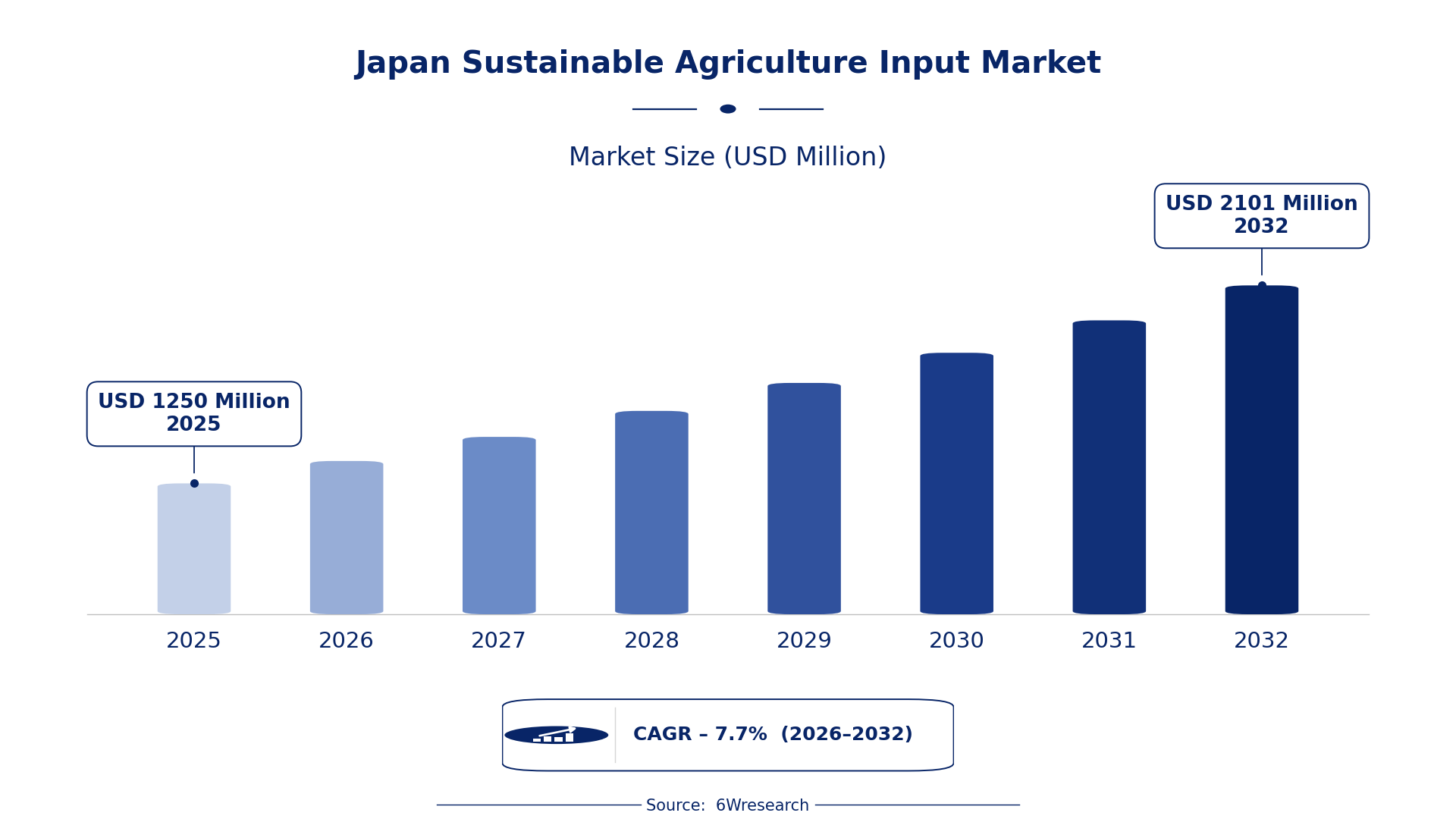
According to 6Wresearch internal database and industry insights, the Japan Sustainable Agriculture Input Market was valued at USD 1,250 Million in 2025 and is projected to reach USD 2,101 Million by 2032, growing at a CAGR of approximately 7.7% during 2026–2032.
Japan Sustainable Agriculture Input Market Highlights
| Report Metric | Details |
| Report Name | Japan Sustainable Agriculture Input Market (2026-2032) |
| Market Size 2025 | USD 1,250 Million |
| Market Size 2032 | USD 2,101 Million |
| Absolute Growth 2025–2032 | USD 851 Million |
| CAGR 2026–2032 | 7.7% |
| Peak Annual Growth | 8.7% in 2028 |
| Forecast Period | 2026–2032 |
| Historical Data | 2022–2025 |
| Base Year | 2025 |
| Leading Input Type, 2025 | Organic Fertilizers (40% share) |
| Leading Use Category, 2025 | Nutrient Management (36% share) |
| Leading Application Crop, 2025 | Fruits & Vegetables (42% share) |
| Leading End User, 2025 | Regenerative Farmers (44% share) |
| Fastest-Growing Input Type | Biostimulants (11.2% CAGR) |
| Fastest-Growing Use Category | Growth Enhancement (10.1% CAGR) |
| Fastest-Growing End User | Agri Cooperatives (10.0% CAGR) |
| Growing Sector | Organic Agriculture |
| Key End Users | Regenerative Farmers, Agricultural Cooperatives, Crop Input Retailers |
Japan Sustainable Agriculture Input Market Year-wise Growth Rate and Key Drivers (2022–2032)
This graph illustrates the annual growth rates of the market from 2022 to 2032, highlighting a steady upward trajectory and projected market expansion over the forecast period.
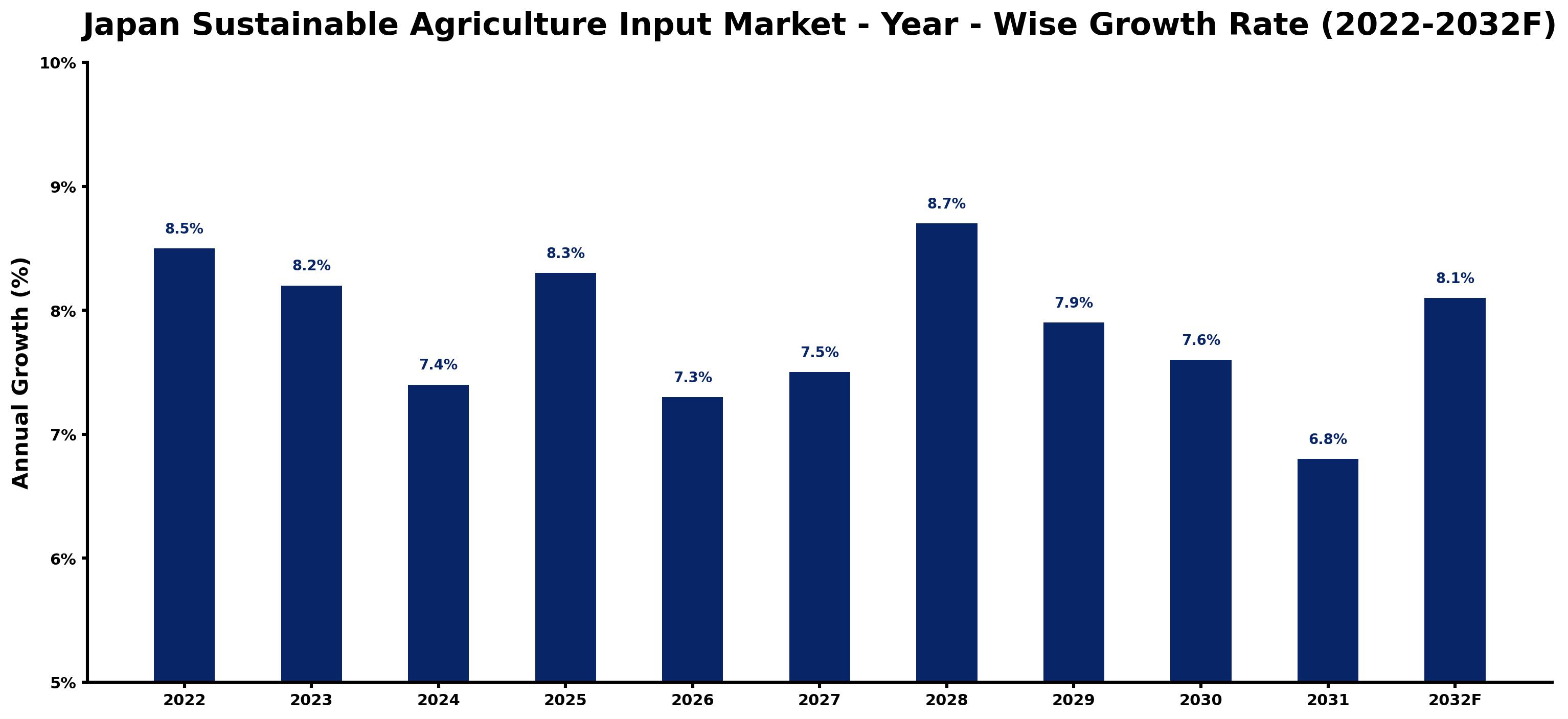
The yearly estimates that follow link every growth rate to its principal driver, so readers can see why the pace changed in each period.
| Year | Estimated Annual Growth (%) | Market Rationale |
| 2022 | 8.5 | The market experienced strong demand from environmentally conscious farmers and cooperatives. |
| 2023 | 8.2 | Demand growth slowed slightly due to increased competition and market saturation in certain areas. |
| 2024 | 7.4 | A further slowdown occurred as farmers adjusted to new sustainable practices and inputs. |
| 2025 | 8.3 | Demand accelerated as more farmers adopted organic practices, driven by consumer preferences for sustainability. |
| 2026 | 7.3 | Growth is expected to slow again as the market stabilises after rapid expansions in previous years. |
| 2027 | 7.5 | A slight uptick in growth is projected as new biostimulants gain traction among farmers. |
| 2028 | 8.7 | The market is expected to peak with investments in sustainable technologies and practices. |
| 2029 | 7.9 | Growth is projected to slow as the market begins to normalise after the peak in 2028. |
| 2030 | 7.6 | A continued slowdown is anticipated as the market adjusts to new regulations and standards. |
| 2031 | 6.8 | The market will maintain growth, albeit at a slower rate, as organic farming practices mature. |
| 2032 | 8.1 | A resurgence in demand is expected as the government pushes for increased organic farmland. |
Note: Market size estimations and growth projections presented in this report are based on 6Wresearch's proprietary forecasting methodology, utilizing the latest available industry data, government publications, and primary research inputs.
Japan Sustainable Agriculture Input Market Synopsis
Sustainable agriculture inputs encompass organic fertilizers, biostimulants, eco-friendly herbicides, and biocontrol agents derived from natural materials to improve soil fertility and enhance crop resilience. The Japan Sustainable Agriculture Input Market is growing due to increasing consumer demand for organic produce, with government plans to raise organic farmland to 3% by 2030. Agricultural cooperatives and regenerative farmers are primary buyers, driving the need for these inputs as they implement sustainable practices and strive for better crop yields through efficient resource management. In 2022, the organic fertilizer market was valued at approximately 150 billion JPY, indicating strong growth potential.
Market Dynamics Impact Analysis (2026–2032)
| Factor | Type | Impact | Primary Segment Affected |
| Growing consumer preference for organic produce | Driver | High | Organic Fertilizers |
| Government initiatives promoting sustainable practices | Driver | High | Biostimulants |
| Increasing urban agriculture initiatives | Opportunity | Medium | Eco-Friendly Herbicides |
| Rising demand for organic inputs in horticulture | Opportunity | Medium | Biocontrol Agents |
| Regulatory challenges for chemical inputs | Restraint | High | Eco-Friendly Herbicides |
| Limited awareness among traditional farmers | Restraint | Medium | Organic Fertilizers |
| Supply chain disruptions affecting input availability | Challenge | High | Biostimulants |
| High initial costs for sustainable inputs | Challenge | Medium | Organic Fertilizers |
Evaluation of Drivers in Japan Sustainable Agriculture Input Market (2026–2032)
Key forces behind demand, with the segment each one moves most, are listed below.
| Drivers | Primary Segment Affected | Why It Matters (Evidence) |
| Increasing consumer demand for organic produce | Organic Fertilizers | This demand drives farmers to invest in organic fertilizers, leading to a market valued at approximately 150 billion JPY. |
| Support for biostimulants in rice cultivation | Biostimulants | This support improves crop resilience and yield, encouraging farmers to adopt these inputs for better productivity. |
| Rising number of registered organic farms | Eco-Friendly Herbicides | The increase in organic farms boosts the demand for eco-friendly herbicides, aligning with sustainable agricultural practices. |
| Interest in regenerative farming practices | Biocontrol Agents | This interest leads to increased adoption of biocontrol agents for sustainable pest management, enhancing crop health. |
| Growth in urban agriculture initiatives | Nutrient Management | Urban agriculture projects in regions like Tokyo stimulate the need for effective nutrient management solutions. |
Behind the steady rise in orders sits the increasing consumer demand for organic fruits and vegetables, prompting farmers to invest in organic fertilizers, with the market valued at approximately 150 billion JPY. Support for biostimulants in rice cultivation promotes their use, improving crop resilience and yield. Interest in regenerative farming practices leads to increased use of biocontrol agents for sustainable pest management, while the rising number of registered organic farms boosts demand for organic fertilizers, positively impacting market dynamics.
Evaluation of Restraints in Japan Sustainable Agriculture Input Market
The following restraints limit how fast demand can grow.
| Market Restraint | Primary Segment Affected | Why It Matters (Evidence) |
| Regulatory challenges for chemical inputs | Eco-Friendly Herbicides | Stricter regulations limit the availability of certain chemical inputs, hindering market growth for eco-friendly herbicides. |
| Limited awareness among traditional farmers | Organic Fertilizers | Many traditional farmers remain unaware of the benefits of organic fertilizers, slowing adoption rates. |
| Supply chain disruptions affecting input availability | Biostimulants | Recent supply chain issues have led to delays in the availability of biostimulants, impacting farmers' purchasing decisions. |
| High initial costs for sustainable inputs | Organic Fertilizers | The high costs associated with sustainable inputs deter some farmers from making the switch. |
| Market saturation in certain regions | Eco-Friendly Herbicides | In some areas, the market for eco-friendly herbicides has become saturated, limiting growth potential. |
Japan Sustainable Agriculture Input Market Challenges
High production costs for sustainable agriculture inputs place a burden on buyers, as the dependence on natural materials can raise prices by 20% for farmers. Limited access to skilled labour in sustainable farming practices hampers suppliers' ability to meet market demands, delaying crop yields for over 1,000 registered organic farms. Regulatory challenges complicate the certification process under Japanese Agricultural Standards, extending timeframes for market entry and affecting the availability of inputs for local farmers. Slow technology adoption among producers restricts productivity improvements, leading to inefficiencies that impact overall competitiveness in the sector.
Trends in the Japan Sustainable Agriculture Input Market
Four trends stand out in the Japan Sustainable Agriculture Input Market.
- Shift from Conventional to Organic Practices: Since 2023, regenerative farmers have increasingly adopted organic practices, with over 1,000 registered organic farms now in Japan. This shift reflects a growing commitment to sustainability and environmental health.
- Urban Agriculture Initiatives Gaining Momentum: In 2023, urban agriculture initiatives in the Tokyo region have surged, promoting sustainable practices among city dwellers. This trend supports local food production and reduces transportation emissions.
- Rising Demand for Biostimulants in Rice Cultivation: The use of biostimulants in rice cultivation has increased, driven by the need for improved crop resilience. This trend aligns with Japan's focus on sustainable agriculture and food security.
- Increased Focus on Pest Management Solutions: As of 2023, there is a heightened focus on biocontrol agents for pest management, reducing reliance on chemical pesticides. This trend is important for maintaining ecological balance in agriculture.
Investment Opportunities in the Japan Sustainable Agriculture Input Market
Several openings in the Japan Sustainable Agriculture Input Market merit attention from investors.
- Gap in Organic Fertilizer Supply: With the organic fertilizer market valued at approximately 150 billion JPY, a supply gap exists. Regenerative farmers are seeking dependable sources, creating an opportunity for suppliers to enter the market through partnerships.
- Growing Need for Biostimulants: The rising adoption of biostimulants, particularly in rice cultivation, underscores a demand for these products. Suppliers can target regenerative farmers aiming to improve crop resilience and yield.
- Urban Agriculture Expansion: Urban agriculture initiatives in the Tokyo region are expanding, generating demand for eco-friendly herbicides. Suppliers can tap into this market by collaborating with local agricultural cooperatives.
- Rising Interest in Biocontrol Agents: As farmers pursue sustainable pest management solutions, opportunities arise for biocontrol agents. Suppliers can connect with regenerative farmers to address this demand.
Government Initiatives in the Japan Sustainable Agriculture Input Market
The GX Promotion Act, enacted in 2023, strengthens the legal framework for sustainable agriculture, building on previous laws such as the Chemical Substances Control Law. This act encourages producers to adopt environmentally friendly practices and report on chemical usage, improving transparency in the market and supporting sustainable agriculture inputs.
The Ministry of Agriculture, Forestry and Fisheries oversees the implementation of sustainable agriculture initiatives, approving funding for projects that promote organic farming practices. This includes support for educational programs aimed at increasing awareness among farmers about sustainable practices.
Future Insight of the Japan Sustainable Agriculture Input Market
Data analytics will transform demand for sustainable inputs by 2032, enabling farmers to optimise their practices. The Japanese government aims to increase organic farmland to 3% by 2030, broadening the market for sustainable agriculture inputs. Urban agriculture initiatives in the Tokyo region will further stimulate interest in eco-friendly herbicides. As consumer demand for organic fruits and vegetables grows, educational support from associations will improve sustainable farming practices nationwide.
Market Segmentation Analysis
Japan Sustainable Agriculture Input Market report covers a detailed analysis of the following market segments:
By Input Type – Organic Fertilizers Lead, Biostimulants Expected to Grow Fastest
According to Saurav Kr Singh, Senior Research Analyst at 6Wresearch, Organic Fertilizers accounted for 40% of the market by input type in 2025. Organic fertilizers dominate this market segment because they are crucial for enhancing soil fertility and crop yield, which are key for sustainable agriculture. Their widespread adoption is supported by initiatives from the Ministry of Agriculture, Forestry and Fisheries, particularly through the Green Food System Strategy. Biostimulants are set to record the highest CAGR in this split, 11.2% over 2026–2032. Biostimulants are experiencing rapid growth due to their increasing application in rice cultivation, a staple crop in Japan. This growth is driven by the demand for improved crop resilience and sustainable farming practices among local producers. Suppliers should focus on organic fertilizers to meet the rising demand from environmentally conscious farmers.
By Use Category – Nutrient Management Leads, Growth Enhancement Expected to Grow Fastest
The largest use category category in 2025 was Nutrient Management, at 36% of revenue. Nutrient management is the leading category as it is essential for optimising crop nutrition, which directly impacts yield and quality. The growth of organic farms in Japan highlights the critical need for effective nutrient management strategies among growers. Growth Enhancement is projected to grow fastest, at a CAGR of 10.1% during 2026–2032. Growth enhancement is the fastest growing category, reflecting the urgent need for improved plant health among farmers. This trend aligns with the increasing consumer demand for organic fruits and vegetables, which drives agricultural productivity. Buyers should prioritise nutrient management solutions to boost crop productivity and meet market expectations.
By Application Crop – Fruits & Vegetables Lead and Record the Fastest Growth
Fruits & Vegetables held 42% of the Japan Sustainable Agriculture Input Market by application crop in 2025. Fruits and vegetables lead the application crop segment due to the high demand for organic inputs in this area, driven by consumer preferences for organic produce. The Tokyo region's urban agriculture initiatives further amplify this demand, showcasing the importance of sustainable practices. The same category are also set to grow fastest, at a CAGR of 10.7% during 2026–2032. Fruits and vegetables are also the fastest growing application crop, indicating a sustained interest in organic cultivation. The overlap with the leading segment suggests that suppliers can benefit from focusing on this high-demand area. Suppliers should align their strategies with the growing focus on organic fruits and vegetables to capture market opportunities.
By End User – Regenerative Farmers Lead, Agri Cooperatives Expected to Grow Fastest
In 2025, Regenerative Farmers led the end user split with a 44% share. Regenerative farmers are the largest user group of sustainable agriculture inputs, as they are committed to practices that enhance environmental health and soil fertility. Their growing numbers indicate a significant shift towards sustainable farming practices in Japan. Over 2026–2032, Agri Cooperatives are expected to post the fastest growth, at a CAGR of 10.0%. Agri cooperatives are the fastest growing end user segment, playing a vital role in helping farmers adopt sustainable practices. Their expansion correlates with the increasing demand for organic produce and the need for collaborative resource sharing among farmers. Suppliers should collaborate with agri cooperatives to effectively engage with and support regenerative farmers in their sustainable agriculture efforts.
Key Attractiveness of the Report
- 10 Years of Market Numbers
- Historical Data Starting from 2022 to 2025
- Base Year 2025
- Forecast Data until 2032
- Key Performance Indicators Impacting the Market
- Major Upcoming Developments and Projects
Key Highlights of the Report:
- Japan Sustainable Agriculture Input Market Outlook
- Market Size of Japan Sustainable Agriculture Input Market, 2025
- Forecast of Japan Sustainable Agriculture Input Market, 2032
- Historical Data and Forecast of Japan Sustainable Agriculture Input Revenues & Volume for the Period 2022-2032F
- Japan Sustainable Agriculture Input Market Trend Evolution
- Japan Sustainable Agriculture Input Market Drivers and Challenges
- Japan Sustainable Agriculture Input Price Trends
- Japan Sustainable Agriculture Input Porter's Five Forces
- Japan Sustainable Agriculture Input Industry Life Cycle
- Historical Data and Forecast of Japan Sustainable Agriculture Input Market Revenues & Volume By Input Type for the Period 2022-2032F
- Historical Data and Forecast of Japan Sustainable Agriculture Input Market Revenues & Volume By Organic Fertilizers for the Period 2022-2032F
- Historical Data and Forecast of Japan Sustainable Agriculture Input Market Revenues & Volume By Biostimulants for the Period 2022-2032F
- Historical Data and Forecast of Japan Sustainable Agriculture Input Market Revenues & Volume By Eco-Friendly Herbicides for the Period 2022-2032F
- Historical Data and Forecast of Japan Sustainable Agriculture Input Market Revenues & Volume By Biocontrol Agents for the Period 2022-2032F
- Historical Data and Forecast of Japan Sustainable Agriculture Input Market Revenues & Volume By Use Category for the Period 2022-2032F
- Historical Data and Forecast of Japan Sustainable Agriculture Input Market Revenues & Volume By Nutrient Management for the Period 2022-2032F
- Historical Data and Forecast of Japan Sustainable Agriculture Input Market Revenues & Volume By Growth Enhancement for the Period 2022-2032F
- Historical Data and Forecast of Japan Sustainable Agriculture Input Market Revenues & Volume By Weed Control for the Period 2022-2032F
- Historical Data and Forecast of Japan Sustainable Agriculture Input Market Revenues & Volume By Pest & Disease Resistance for the Period 2022-2032F
- Historical Data and Forecast of Japan Sustainable Agriculture Input Market Revenues & Volume By Application Crop for the Period 2022-2032F
- Historical Data and Forecast of Japan Sustainable Agriculture Input Market Revenues & Volume By Pulses & Legumes for the Period 2022-2032F
- Historical Data and Forecast of Japan Sustainable Agriculture Input Market Revenues & Volume By Cereals & Oilseeds for the Period 2022-2032F
- Historical Data and Forecast of Japan Sustainable Agriculture Input Market Revenues & Volume By Fruits & Vegetables for the Period 2022-2032F
- Historical Data and Forecast of Japan Sustainable Agriculture Input Market Revenues & Volume By Horticulture Crops for the Period 2022-2032F
- Historical Data and Forecast of Japan Sustainable Agriculture Input Market Revenues & Volume By End User for the Period 2022-2032F
- Historical Data and Forecast of Japan Sustainable Agriculture Input Market Revenues & Volume By Regenerative Farmers for the Period 2022-2032F
- Historical Data and Forecast of Japan Sustainable Agriculture Input Market Revenues & Volume By Crop Input Retailers for the Period 2022-2032F
- Historical Data and Forecast of Japan Sustainable Agriculture Input Market Revenues & Volume By Agrochemical Distributors for the Period 2022-2032F
- Historical Data and Forecast of Japan Sustainable Agriculture Input Market Revenues & Volume By Agri Cooperatives for the Period 2022-2032F
- Japan Sustainable Agriculture Input Import Export Trade Statistics
- Market Opportunity Assessment By Input Type
- Market Opportunity Assessment By Use Category
- Market Opportunity Assessment By Application Crop
- Market Opportunity Assessment By End User
- Japan Sustainable Agriculture Input Top Companies Market Share
- Japan Sustainable Agriculture Input Competitive Benchmarking By Technical and Operational Parameters
- Japan Sustainable Agriculture Input Company Profiles
- Japan Sustainable Agriculture Input Key Strategic Recommendations
Market Covered
This report examines the market across the segments below.
By Input Type
- Organic Fertilizers
- Biostimulants
- Eco-Friendly Herbicides
- Biocontrol Agents
By Use Category
- Nutrient Management
- Growth Enhancement
- Weed Control
- Pest & Disease Resistance
By Application Crop
- Pulses & Legumes
- Cereals & Oilseeds
- Fruits & Vegetables
- Horticulture Crops
By End User
- Regenerative Farmers
- Crop Input Retailers
- Agrochemical Distributors
- Agri Cooperatives































