Japan Sustainable Agriculture Market Size & Growth Rate
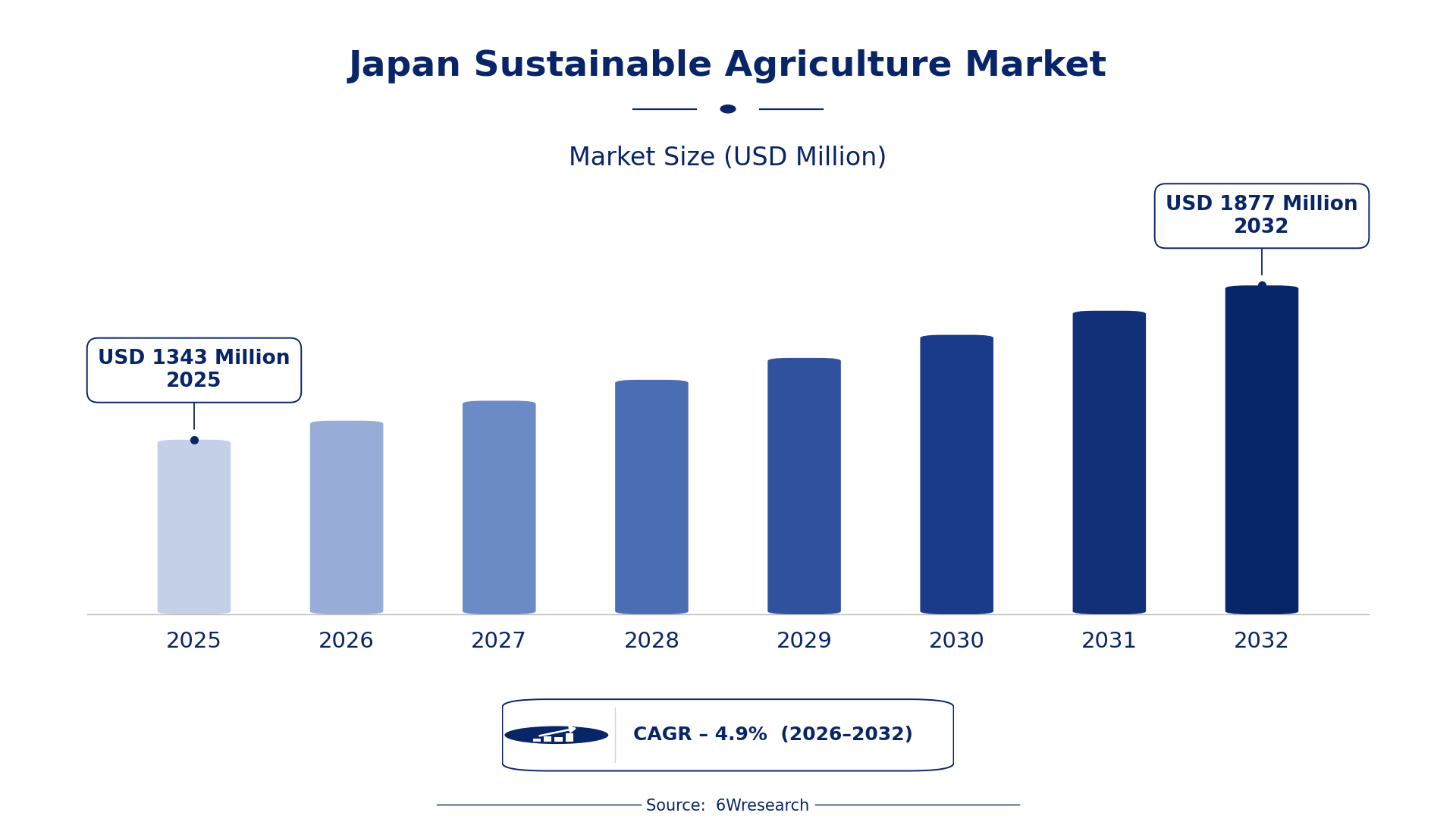
According to 6Wresearch internal database and industry insights, the Japan Sustainable Agriculture Market was valued at USD 1,343 Million in 2025 and is projected to reach USD 1,877 Million by 2032, growing at a CAGR of approximately 4.9% during 2026–2032.
Japan Sustainable Agriculture Market Highlights
| Report Metric | Details |
| Report Name | Japan Sustainable Agriculture Market (2026-2032) |
| Market Size 2025 | USD 1,343 Million |
| Market Size 2032 | USD 1,877 Million |
| Absolute Growth 2025–2032 | USD 534 Million |
| CAGR 2026–2032 | 4.9% |
| Peak Annual Growth | 5.7% in 2032 |
| Forecast Period | 2026–2032 |
| Historical Data | 2022–2025 |
| Base Year | 2025 |
| Leading Product / Service, 2025 | Organic Fertilizers (47% share) |
| Leading Functionality, 2025 | Soil Nutrient Supply (40% share) |
| Leading Application Area, 2025 | Crop Cultivation (42% share) |
| Leading Distribution Channel, 2025 | Retail & Wholesale (41% share) |
| Leading End User, 2025 | Farmers (47% share) |
| Fastest-Growing Product / Service | Smart Irrigation Systems (6.8% CAGR) |
| Fastest-Growing Functionality | Water Efficiency (6.4% CAGR) |
| Fastest-Growing Application Area | Horticulture (5.9% CAGR) |
| Fastest-Growing Distribution Channel | Online Platforms (6.6% CAGR) |
| Fastest-Growing End User | Farms & Cooperatives (6.5% CAGR) |
| Growing Sector | Sustainable Agriculture |
| Key End Users | Farmers, Agricultural Firms, Farms & Cooperatives |
Japan Sustainable Agriculture Market Year-wise Growth Rate and Key Drivers (2022–2032)
This graph illustrates the annual growth rates of the market from 2022 to 2032, highlighting a steady upward trajectory and projected market expansion over the forecast period.
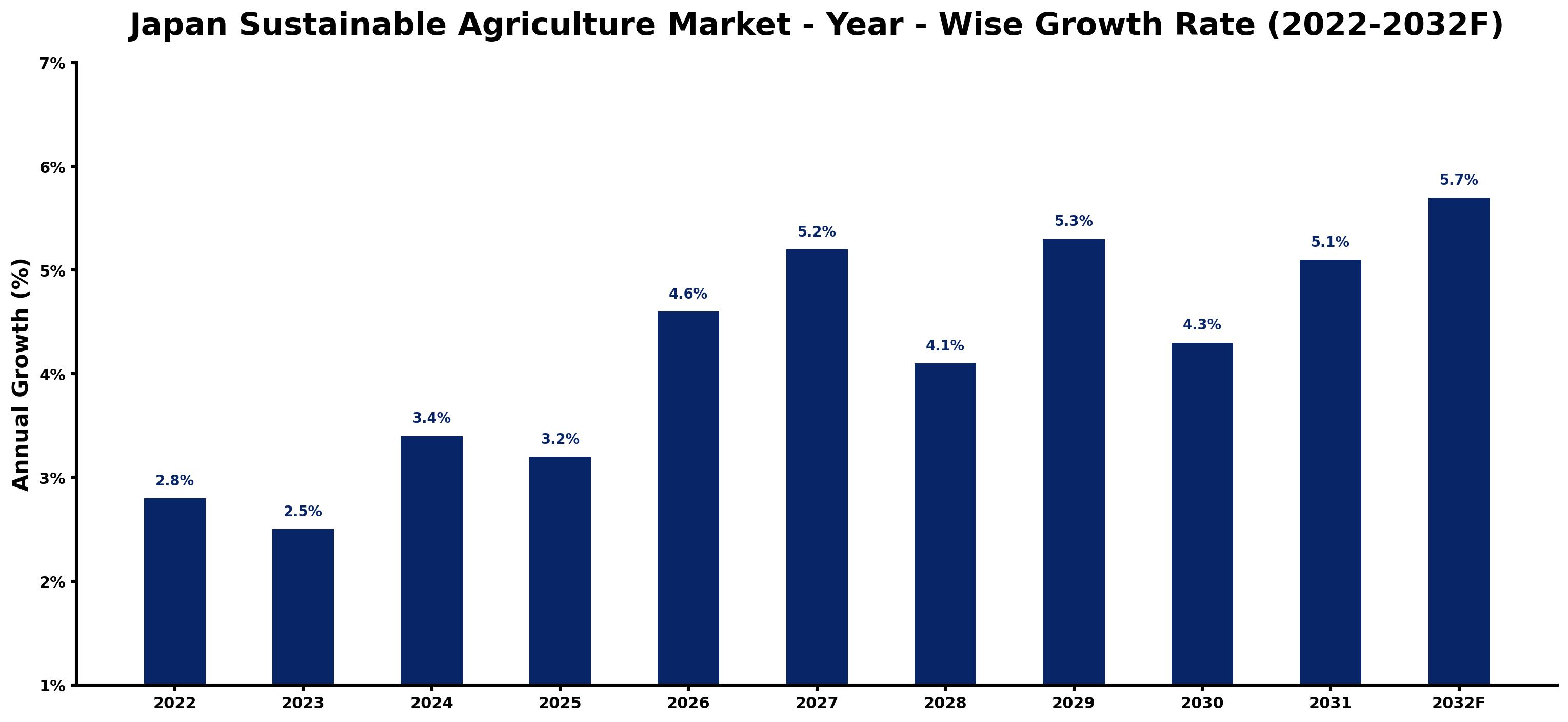
For each year, the table pairs the estimated growth rate with the leading influence on demand, showing how the drivers changed across the period.
| Year | Estimated Annual Growth (%) | Market Rationale |
| 2022 | 2.8 | The market experienced steady growth as consumer interest in sustainable practices remained strong. |
| 2023 | 2.5 | Growth slowed slightly as farmers adjusted to new organic standards and practices introduced the previous year. |
| 2024 | 3.4 | Increased adoption of organic farming techniques contributed to a faster growth rate in sustainable agriculture. |
| 2025 | 3.2 | The market continued to grow as more farmers embraced sustainable agriculture methods and technologies. |
| 2026 | 4.6 | Demand is expected to surge with the introduction of advanced smart irrigation systems across various farms. |
| 2027 | 5.2 | The expansion of sustainable practices will lead to a rise in market activity and investment opportunities. |
| 2028 | 4.1 | Growth is projected to slow as the market stabilises after rapid advancements in sustainable technology. |
| 2029 | 5.3 | Increased investment in sustainable agriculture initiatives will drive demand higher and support local farmers. |
| 2030 | 4.3 | The market is expected to see a slight slowdown as farmers adapt to evolving consumer preferences and practices. |
| 2031 | 5.1 | Demand will accelerate again as new technologies improve farming efficiency and sustainability. |
| 2032 | 5.7 | The market is projected to peak as sustainability becomes a core focus for agricultural practices in Japan. |
Note: Market size estimations and growth projections presented in this report are based on 6Wresearch's proprietary forecasting methodology, utilizing the latest available industry data, government publications, and primary research inputs.
Japan Sustainable Agriculture Market Synopsis
Sustainable agriculture prioritises environmental health, economic profitability, and social equity through practices such as organic farming and integrated pest management. The Japan Sustainable Agriculture Market is growing due to rising consumer demand for organic produce and government initiatives promoting sustainability. The Ministry of Agriculture, Forestry and Fisheries allocated ¥10 billion for sustainable agriculture initiatives, while the adoption of smart irrigation systems is increasing, significantly improving water efficiency and crop yields across the country.
Market Dynamics Impact Analysis (2026–2032)
| Factor | Type | Impact | Primary Segment Affected |
| Increased consumer demand for organic produce | Driver | High | Organic Fertilizers |
| Government support for sustainable practices | Driver | High | Smart Irrigation Systems |
| Growing interest in eco-friendly farming methods | Opportunity | High | Bio-Pesticides |
| Rising investment in sustainable agriculture technologies | Opportunity | High | Seed Varieties |
| Challenges in transitioning to organic farming | Restraint | Medium | Crop Cultivation |
| Limited access to advanced agricultural technologies | Restraint | Medium | Soil Nutrient Supply |
| High initial costs for sustainable farming methods | Challenge | High | Farmers |
| Slow adoption rates of new technologies | Challenge | Medium | Agricultural Firms |
Evaluation of Drivers in Japan Sustainable Agriculture Market (2026–2032)
The following drivers explain most of the expected growth.
| Drivers | Primary Segment Affected | Why It Matters (Evidence) |
| High consumer interest in organic products | Organic Fertilizers | This interest drives farmers to invest in organic fertilizers to meet market demand, with over 1.5 million organic farms in Japan responding to this trend. |
| Government funding for sustainable agriculture | Smart Irrigation Systems | The ¥10 billion allocated for sustainable initiatives encourages farmers to adopt smart irrigation systems, improving water efficiency and crop yields. |
| Growing awareness of environmental issues | Bio-Pesticides | As awareness increases, more farmers are using bio-pesticides, which are now applied in over 30% of organic farms in Japan. |
| Technological advancements in agriculture | Seed Varieties | Innovations in seed varieties improve crop yield, attracting investment from agricultural firms focused on sustainability. |
| Support from agricultural associations | Crop Cultivation | The Japan Organic Agriculture Association promotes organic standards, encouraging farmers to adopt sustainable practices. |
The strongest pull on demand comes from the increasing consumer interest in organic products, with over 1.5 million organic farms in Japan responding to this trend. Growing awareness of environmental issues has led to bio-pesticides being used in over 30% of organic farms. Technological advancements in seed varieties are boosting crop yields, while support from agricultural associations promotes organic standards, driving further adoption of sustainable practices among farmers in regions like Hokkaido.
Evaluation of Restraints in Japan Sustainable Agriculture Market
The main factors holding the market back are set out below.
| Market Restraint | Primary Segment Affected | Why It Matters (Evidence) |
| High initial costs for organic farming transition | Crop Cultivation | Farmers face substantial upfront investments to switch to organic practices, which can deter adoption significantly. |
| Limited access to advanced agricultural technologies | Soil Nutrient Supply | Many farmers lack the resources to implement the latest technologies, hindering growth and efficiency. |
| Slow adoption of sustainable practices | Bio-Pesticides | Some farmers are hesitant to transition due to unfamiliarity with bio-pesticides, impacting their usage rates. |
| Regulatory hurdles for organic certification | Organic Fertilizers | Navigating the certification process can be complex and time-consuming for farmers, delaying market entry. |
| Market competition from conventional products | Smart Irrigation Systems | Conventional farming methods often have lower costs, making it challenging for sustainable alternatives to compete effectively. |
Japan Sustainable Agriculture Market Challenges
Supply chain disruptions hinder producers' access to essential resources, causing delays that can extend harvest times for farmers by up to three months. Many producers lack access to training on sustainable techniques, resulting in inefficiencies that can reduce crop yields by 15%. Increased competition from imported products forces local producers to lower their prices, impacting profit margins by around 10%. Buyers face rising costs due to limited availability of certified organic products, which can elevate prices by 10% compared to conventional options.
Trends in the Japan Sustainable Agriculture Market
Several trends are reshaping the Japan Sustainable Agriculture Market; the most important are set out below.
- Shift towards Organic Farming Practices: The Ministry of Agriculture, Forestry and Fisheries promotes organic farming through the Organic JAS certification, leading to over 1.5 million organic farms in Japan as of 2023.
- Rise of Smart Irrigation Systems: Since 2023, the adoption rate of smart irrigation systems has reached around 25%, improving water efficiency for farmers across regions like Tokyo and Hokkaido.
- Increased Use of Bio-Pesticides: Bio-pesticides are now used in over 30% of organic farms, reflecting a growing trend towards reducing chemical pesticide use in agriculture.
- Expansion of Sustainable Agriculture Initiatives: The Sustainable Agricultural Development Program aims to increase organic farming by 50% by 2030, indicating a strong commitment to sustainable practices.
Investment Opportunities in the Japan Sustainable Agriculture Market
The opportunities below stand out in the Japan Sustainable Agriculture Market for new entrants and existing suppliers.
- Partner with Local Farmers: With over 1.5 million organic farms, there is an opportunity to supply organic fertilizers, especially in regions like Hokkaido, where demand is high for sustainable inputs.
- Invest in Smart Irrigation Technologies: The adoption rate of smart irrigation systems is around 25%, presenting an opportunity for suppliers to enter the market by partnering with agricultural firms and cooperatives.
- Develop Bio-Pesticide Solutions: As bio-pesticides are used in over 30% of organic farms, there is a growing need for suppliers to develop products that meet organic standards and improve crop health.
- Support Seed Variety Innovations: Investment in diverse seed varieties is crucial, especially in Hokkaido, where unique conditions allow for enhanced crop yields and resilience.
Government Initiatives in the Japan Sustainable Agriculture Market
The Economic Security Promotion Act of 2022 supports supply-chain resilience for critical agricultural products, ensuring that producers can access necessary materials for sustainable practices. This act encourages investment in technologies that improve agricultural productivity and sustainability, with a funding allocation of ¥10 billion for related initiatives.
The Digital Agency, established in September 2021, leads government digital transformation efforts, approving funding for projects that aim to modernise agricultural practices. This includes initiatives that improve data management and technology adoption among farmers, enhancing their ability to implement sustainable agriculture methods.
Future Insight of the Japan Sustainable Agriculture Market
The Sustainable Agricultural Development Program will introduce advanced irrigation facilities, improving water management for producers by 2032. Government investments will increase the number of organic farms by 50%, enhancing supply for buyers. Adoption of innovative farming techniques will improve productivity and sustainability, benefiting both suppliers and buyers. Enhanced focus on diverse seed varieties will promote biodiversity, ensuring a more resilient agricultural sector.
Market Segmentation Analysis
Japan Sustainable Agriculture Market report covers a detailed analysis of the following market segments:
By Product / Service – Organic Fertilizers Lead, Smart Irrigation Systems Expected to Grow Fastest
According to Prakhar Dixit, Senior Research Analyst at 6Wresearch, Organic Fertilizers took 47% of product / service revenue in 2025, more than any other category. Organic fertilizers hold the largest share as they are essential for maintaining soil health, which is critical for sustainable practices. For instance, over 1.5 million organic farms in Japan rely on these fertilizers to support productivity and environmental goals. Smart Irrigation Systems are set to record the highest CAGR in this split, 6.8% over 2026–2032. Smart irrigation systems are experiencing rapid growth due to their capacity to improve water efficiency, a key factor in sustainable agriculture. With an adoption rate of around 25%, this segment is poised for continued expansion as resource management gains importance. Suppliers should focus on developing products that enhance soil health and water efficiency to meet market needs.
By Functionality – Soil Nutrient Supply Leads, Water Efficiency Expected to Grow Fastest
Soil Nutrient Supply held 40% of the Japan Sustainable Agriculture Market by functionality in 2025. Soil nutrient supply is the leading functionality as it is critical for plant growth and overall agricultural productivity. This importance is underscored by the high number of organic farms that prioritise nutrient-rich soil for sustainable practices. Water Efficiency is projected to grow fastest, at a CAGR of 6.4% during 2026–2032. Water efficiency is the fastest-growing functionality, driven by the need for better resource management in agriculture. As water scarcity becomes a pressing issue, the emphasis on efficient irrigation methods will continue to rise. Buyers will increasingly seek solutions that optimise soil nutrients and water use to ensure sustainable farming practices.
By Application Area – Crop Cultivation Leads, Horticulture Expected to Grow Fastest
The largest application area category in 2025 was Crop Cultivation, at 42% of revenue. Crop cultivation is the leading application area as it represents the core of agricultural practices in Japan, aligning with the nation's commitment to food security. This segment is vital for integrating sustainable methods into essential production processes. Over 2026–2032, Horticulture is expected to post the fastest growth, at a CAGR of 5.9%. Horticulture is the fastest-growing application area, fuelled by increasing interest in urban agriculture and local food movements. This trend supports efforts to enhance food security in urban settings, underscoring the significance of this segment. Suppliers should concentrate on horticultural solutions to capitalise on the growing urban agriculture trend.
By Distribution Channel – Retail & Wholesale Leads, Online Platforms Expected to Grow Fastest
With 41% of distribution channel revenue in 2025, Retail & Wholesale was the largest category. Retail and wholesale channels dominate distribution, effectively linking suppliers with a wide array of end users. This method is crucial for reaching farmers and agricultural stakeholders throughout Japan. The quickest growth will come from Online Platforms, forecast to expand at a CAGR of 6.6% between 2026 and 2032. Online platforms are rapidly becoming the fastest-growing distribution channel, driven by their convenience and accessibility for buyers. This shift reflects a notable change in purchasing habits within the agricultural sector. Suppliers must enhance their online strategies to engage a broader audience and adapt to changing consumer preferences.
By End User – Farmers Lead, Farms & Cooperatives Expected to Grow Fastest
In 2025, Farmers led the end user split with a 47% share. Farmers constitute the largest end user group, as they are the main consumers of sustainable agriculture products. With approximately 1.4 million individuals involved in farming, their preferences heavily influence market trends. Farms & Cooperatives are set to record the highest CAGR in this split, 6.5% over 2026–2032. Farms and cooperatives are the fastest-growing segment among end users, as collaborative farming practices become more popular. This growth is supported by initiatives that encourage collective efforts in sustainable agriculture. Suppliers should tailor their offerings to address the distinct needs of both individual farmers and cooperative groups to maximise market penetration.
Key Attractiveness of the Report
- 10 Years of Market Numbers
- Historical Data Starting from 2022 to 2025
- Base Year 2025
- Forecast Data until 2032
- Key Performance Indicators Impacting the Market
- Major Upcoming Developments and Projects
Key Highlights of the Report:
- Japan Sustainable Agriculture Market Outlook
- Market Size of Japan Sustainable Agriculture Market, 2025
- Forecast of Japan Sustainable Agriculture Market, 2032
- Historical Data and Forecast of Japan Sustainable Agriculture Market Revenues & Volume for the Period 2022-2032F
- Japan Sustainable Agriculture Market Trend Evolution
- Japan Sustainable Agriculture Market Drivers and Challenges
- Japan Sustainable Agriculture Market Price Trends
- Japan Sustainable Agriculture Market Porter's Five Forces
- Japan Sustainable Agriculture Market Industry Life Cycle
- Historical Data and Forecast of Japan Sustainable Agriculture Market Revenues & Volume By Product / Service for the Period 2022-2032F
- Historical Data and Forecast of Japan Sustainable Agriculture Market Revenues & Volume By Organic Fertilizers for the Period 2022-2032F
- Historical Data and Forecast of Japan Sustainable Agriculture Market Revenues & Volume By Bio-Pesticides for the Period 2022-2032F
- Historical Data and Forecast of Japan Sustainable Agriculture Market Revenues & Volume By Smart Irrigation Systems for the Period 2022-2032F
- Historical Data and Forecast of Japan Sustainable Agriculture Market Revenues & Volume By Seed Varieties for the Period 2022-2032F
- Historical Data and Forecast of Japan Sustainable Agriculture Market Revenues & Volume By Functionality for the Period 2022-2032F
- Historical Data and Forecast of Japan Sustainable Agriculture Market Revenues & Volume By Soil Nutrient Supply for the Period 2022-2032F
- Historical Data and Forecast of Japan Sustainable Agriculture Market Revenues & Volume By Pest Control for the Period 2022-2032F
- Historical Data and Forecast of Japan Sustainable Agriculture Market Revenues & Volume By Water Efficiency for the Period 2022-2032F
- Historical Data and Forecast of Japan Sustainable Agriculture Market Revenues & Volume By Drought Resistance for the Period 2022-2032F
- Historical Data and Forecast of Japan Sustainable Agriculture Market Revenues & Volume By Application Area for the Period 2022-2032F
- Historical Data and Forecast of Japan Sustainable Agriculture Market Revenues & Volume By Crop Cultivation for the Period 2022-2032F
- Historical Data and Forecast of Japan Sustainable Agriculture Market Revenues & Volume By Horticulture for the Period 2022-2032F
- Historical Data and Forecast of Japan Sustainable Agriculture Market Revenues & Volume By Crop Fields for the Period 2022-2032F
- Historical Data and Forecast of Japan Sustainable Agriculture Market Revenues & Volume By Agriculture for the Period 2022-2032F
- Historical Data and Forecast of Japan Sustainable Agriculture Market Revenues & Volume By Distribution Channel for the Period 2022-2032F
- Historical Data and Forecast of Japan Sustainable Agriculture Market Revenues & Volume By Retail & Wholesale for the Period 2022-2032F
- Historical Data and Forecast of Japan Sustainable Agriculture Market Revenues & Volume By Distributors for the Period 2022-2032F
- Historical Data and Forecast of Japan Sustainable Agriculture Market Revenues & Volume By Online Platforms for the Period 2022-2032F
- Historical Data and Forecast of Japan Sustainable Agriculture Market Revenues & Volume By Direct Supply for the Period 2022-2032F
- Historical Data and Forecast of Japan Sustainable Agriculture Market Revenues & Volume By End User for the Period 2022-2032F
- Historical Data and Forecast of Japan Sustainable Agriculture Market Revenues & Volume By Farmers for the Period 2022-2032F
- Historical Data and Forecast of Japan Sustainable Agriculture Market Revenues & Volume By Agricultural Firms for the Period 2022-2032F
- Historical Data and Forecast of Japan Sustainable Agriculture Market Revenues & Volume By Farms & Cooperatives for the Period 2022-2032F
- Historical Data and Forecast of Japan Sustainable Agriculture Market Revenues & Volume By Farmers for the Period 2022-2032F
- Japan Sustainable Agriculture Market Import Export Trade Statistics
- Market Opportunity Assessment By Product / Service
- Market Opportunity Assessment By Functionality
- Market Opportunity Assessment By Application Area
- Market Opportunity Assessment By Distribution Channel
- Market Opportunity Assessment By End User
- Japan Sustainable Agriculture Market Top Companies Market Share
- Japan Sustainable Agriculture Market Competitive Benchmarking By Technical and Operational Parameters
- Japan Sustainable Agriculture Market Company Profiles
- Japan Sustainable Agriculture Market Key Strategic Recommendations
Market Covered
The report covers the following segments.
By Product / Service
- Organic Fertilizers
- Bio-Pesticides
- Smart Irrigation Systems
- Seed Varieties
By Functionality
- Soil Nutrient Supply
- Pest Control
- Water Efficiency
- Drought Resistance
By Application Area
- Crop Cultivation
- Horticulture
- Crop Fields
- Agriculture
By Distribution Channel
- Retail & Wholesale
- Distributors
- Online Platforms
- Direct Supply
By End User
- Farmers
- Agricultural Firms
- Farms & Cooperatives































