Japan Sustainable Aquaculture Market Size & Growth Rate
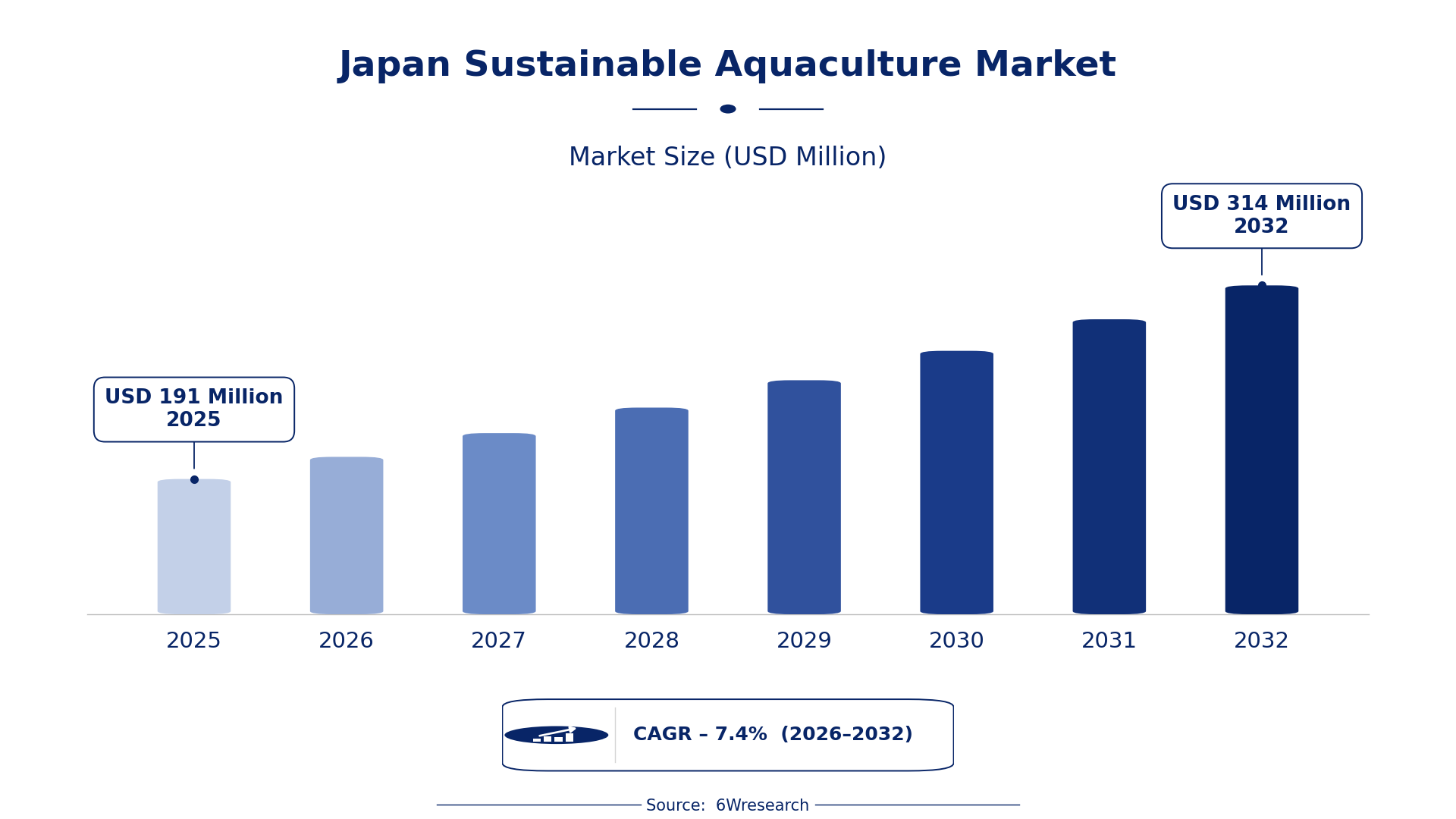
According to 6Wresearch internal database and industry insights, the Japan Sustainable Aquaculture Market was valued at USD 191 Million in 2025 and is projected to reach USD 314 Million by 2032, growing at a CAGR of approximately 7.4% during 2026–2032.
Japan Sustainable Aquaculture Market Highlights
| Report Metric | Details |
| Report Name | Japan Sustainable Aquaculture Market (2026-2032) |
| Market Size 2025 | USD 191 Million |
| Market Size 2032 | USD 314 Million |
| Absolute Growth 2025–2032 | USD 123 Million |
| CAGR 2026–2032 | 7.4% |
| Peak Annual Growth | 8.0% in 2032 |
| Forecast Period | 2026–2032 |
| Historical Data | 2022–2025 |
| Base Year | 2025 |
| Leading Aquaculture Type, 2025 | Recirculating Aquaculture (33% share) |
| Leading Feed Type, 2025 | Organic Feed (34% share) |
| Leading Environment Focus, 2025 | Water Recycling (38% share) |
| Leading End User, 2025 | Fish Exporters (45% share) |
| Fastest-Growing Aquaculture Type | Biofloc Technology (10.7% CAGR) |
| Fastest-Growing Environment Focus | Nutrient Reuse (9.8% CAGR) |
| Fastest-Growing End User | Urban Fish Farms (9.7% CAGR) |
| Growing Sector | Sustainable seafood production |
| Key End Users | Fish exporters, coastal aquaculture farms, urban fish farms, green label seafood brands |
Japan Sustainable Aquaculture Market Year-wise Growth Rate and Key Drivers (2022–2032)
This graph illustrates the annual growth rates of the market from 2022 to 2032, highlighting a steady upward trajectory and projected market expansion over the forecast period.

Each row of the following table gives one year's estimated growth and the event or demand shift that explains it.
| Year | Estimated Annual Growth (%) | Market Rationale |
| 2022 | 7.0 | The market experienced steady growth due to rising seafood consumption. |
| 2023 | 7.2 | Demand increased as consumers sought more sustainable seafood options. |
| 2024 | 6.3 | Growth slowed as market adjustments occurred to meet new standards. |
| 2025 | 7.4 | Investment in aquaculture innovation spurred higher growth rates. |
| 2026 | 7.7 | New technologies are expected to drive demand for efficient aquaculture practices. |
| 2027 | 8.0 | The market peaked as sustainability became a priority for consumers. |
| 2028 | 6.6 | Growth is projected to slow as the market stabilises after rapid expansion. |
| 2029 | 7.5 | Demand is expected to rise again with increased exports to international markets. |
| 2030 | 6.9 | The market will face a slowdown as competition intensifies among producers. |
| 2031 | 6.8 | Growth is projected to continue but at a reduced rate due to market saturation. |
| 2032 | 8.0 | The market is expected to peak again as new facilities come online. |
Note: Market size estimations and growth projections presented in this report are based on 6Wresearch's proprietary forecasting methodology, utilizing the latest available industry data, government publications, and primary research inputs.
Japan Sustainable Aquaculture Market Synopsis
Sustainable aquaculture in Japan refers to environmentally responsible fish farming practices that minimise ecological impact. The Japan Sustainable Aquaculture Market is thriving, driven by domestic consumer demand for high-quality seafood and export opportunities. The Fisheries Agency promotes sustainable practices, while systems like recirculating aquaculture improve efficiency. With aquaculture production reaching 1.2 million tons in 2022, the market is set to grow as investments in technology and infrastructure increase, aiming for a 30% contribution to fish supply by 2030.
Market Dynamics Impact Analysis (2026–2032)
| Factor | Type | Impact | Primary Segment Affected |
| Growing consumer preference for sustainable seafood | Driver | High | Organic Feed |
| Increased investment in aquaculture technology | Driver | High | Recirculating Aquaculture |
| Emerging urban fish farms in metropolitan areas | Opportunity | Medium | Urban Fish Farms |
| Rising demand for organic feed among health-conscious consumers | Opportunity | High | Organic Feed |
| Regulatory compliance costs for aquaculture producers | Restraint | High | Integrated Multi-Trophic |
| Limited availability of sustainable feed sources | Restraint | Medium | Biofloc Technology |
| Competition from imported seafood products | Challenge | High | Fish Exporters |
| Technological barriers for small-scale producers | Challenge | Medium | Coastal Aquaculture Farms |
Evaluation of Drivers in Japan Sustainable Aquaculture Market (2026–2032)
These are the developments adding the most demand over the forecast period.
| Drivers | Primary Segment Affected | Why It Matters (Evidence) |
| Rising seafood consumption per capita | Fish Exporters | Annual seafood consumption in Japan is approximately 25 kg, driving demand for aquaculture products. |
| Increased focus on sustainability | Organic Feed | Organic feed usage in aquaculture has risen by 15% since 2020, reflecting consumer preferences. |
| Technological advancements in aquaculture | Recirculating Aquaculture | Systems are being adopted in over 30 coastal farms, improving efficiency and sustainability. |
| Government support for aquaculture innovation | Biofloc Technology | A ¥2 billion subsidy program from the Ministry of Agriculture, Forestry and Fisheries promotes technological upgrades. |
| Expansion of urban aquaculture initiatives | Urban Fish Farms | New installations in Tokyo are meeting local demand for fresh seafood, enhancing supply chains. |
Most of the extra volume comes from the rising seafood consumption per capita, which is approximately 25 kg annually. This increase drives demand for aquaculture products, particularly among fish exporters who seek to meet consumer preferences. The use of organic feed has also risen by 15% since 2020, reflecting a shift towards health-conscious choices. Urban fish farms are gaining traction, with several new installations in 2023, further boosting local seafood supply.
Evaluation of Restraints in Japan Sustainable Aquaculture Market
Below are the constraints most often cited by buyers and suppliers, with the segment each affects.
| Market Restraint | Primary Segment Affected | Why It Matters (Evidence) |
| Regulatory compliance costs for producers | Integrated Multi-Trophic | Producers face high costs to meet the Food Sanitation Act's HACCP-based hygiene management requirements. |
| Limited availability of sustainable feed sources | Biofloc Technology | The reliance on specific feed types restricts production capabilities and increases operational costs. |
| Market saturation in certain regions | Fish Exporters | Increased competition from imports puts pressure on local producers to maintain pricing. |
| Technological barriers for small-scale producers | Coastal Aquaculture Farms | Small farms struggle to adopt advanced technologies, limiting their competitiveness in the market. |
| Environmental regulations impacting operations | Water Recycling | Compliance with biodiversity protection measures increases operational complexity. |
Japan Sustainable Aquaculture Market Challenges
Producers face rising costs due to a shortage of skilled workers, which limits the adoption of advanced aquaculture techniques. This issue arises from an ageing population in rural areas, causing delays in production for those dependent on local expertise. Buyers encounter increased expenses as organic feed prices have surged by 15% since 2020, which squeezes their profit margins. Supply chain disruptions stem from biodiversity protection mandates enforced by the Fisheries Agency, complicating input sourcing and causing delays in seafood availability. Competition intensifies as urban fish farms in Tokyo expand, forcing traditional producers to innovate or risk losing market share.
Trends in the Japan Sustainable Aquaculture Market
Several trends are reshaping the Japan Sustainable Aquaculture Market; the most important are set out below.
- Shift towards Urban Aquaculture: In 2023, urban fish farms gained traction in Tokyo, with several new installations meeting local seafood demand. This trend reflects a growing preference for fresh, locally sourced products, with urban farms expected to play a significant role in future production.
- Transition to Organic Feed: The demand for organic feed has surged, with usage increasing by 15% since 2020. This shift is driven by health-conscious consumers seeking sustainable seafood options, prompting producers to adapt their practices accordingly.
- Emergence of Integrated Multi-Trophic Systems: Integrated Multi-Trophic Aquaculture is being practiced in over 30 coastal farms, improving ecosystem balance and productivity. This method is gaining recognition for its sustainability benefits, attracting interest from environmentally focused buyers.
- Focus on Biodiversity Protection: Biodiversity protection measures mandated under the Fisheries Act are reshaping aquaculture practices. Producers are increasingly adopting these measures to ensure compliance and appeal to environmentally conscious consumers.
Investment Opportunities in the Japan Sustainable Aquaculture Market
The following opportunities in the Japan Sustainable Aquaculture Market pair current demand with a clear way in.
- Investment in Urban Fish Farms: Tokyo's urban fish farms are gaining popularity, with several new installations in 2023. This presents an opportunity for investment in local seafood production, catering to health-conscious consumers seeking fresh products.
- Expansion of Organic Feed Production: With organic feed usage rising by 15% since 2020, there is a gap in supply. Investing in organic feed production can cater to the growing demand from health-focused aquaculture operations.
- Development of Biofloc Technology: The use of biofloc technology is expanding, with over 100 farms adopting it since 2021. This presents an opportunity for suppliers to provide solutions that improve sustainability in aquaculture.
- Partnerships for Nutrient Reuse Practices: Nutrient reuse practices are being adopted in 40% of aquaculture farms. Collaborating with local producers can facilitate the development of sustainable practices that meet regulatory standards.
Government Initiatives in the Japan Sustainable Aquaculture Market
The Food Sanitation Act amendment, fully applied in June 2021, mandates HACCP-based hygiene management for food businesses. This regulation affects aquaculture producers, requiring them to implement strict hygiene protocols to ensure seafood safety and quality. Compliance with these standards is essential for maintaining market access and consumer trust.
The Ministry of Agriculture, Forestry and Fisheries supports aquaculture innovation through a ¥2 billion subsidy program. This funding aims to promote technological advancements in the sector, improving overall production efficiency and encouraging sustainable practices.
Future Insight of the Japan Sustainable Aquaculture Market
Urban fish farms are set to expand significantly by 2032, introducing innovative practices that improve resource efficiency. The government’s ¥2 billion subsidy program will drive aquaculture innovation, enhancing production capabilities across the sector. New sustainable seafood labeling standards will enable buyers to make informed choices, boosting consumer confidence in quality products. By 2030, aquaculture's contribution to total fish supply is projected to reach 30%, providing suppliers with opportunities to adopt sustainable practices and cater to evolving consumer preferences.
Market Segmentation Analysis
Japan Sustainable Aquaculture Market report covers a detailed analysis of the following market segments:
By Aquaculture Type – Recirculating Aquaculture Leads, Biofloc Technology Expected to Grow Fastest
According to Saurav Kr Singh, Senior Research Analyst at 6Wresearch, Recirculating Aquaculture took 33% of aquaculture type revenue in 2025, more than any other category. Recirculating aquaculture holds the largest share as it promotes efficient water use and waste management, making it a top choice for fish farmers. This method is especially prevalent in Kumamoto, a key coastal region contributing significantly to seafood supply. Biofloc Technology is projected to grow fastest, at a CAGR of 10.7% during 2026–2032. Biofloc technology is experiencing rapid growth because it improves feed conversion rates and sustainability, appealing to aquaculture operators looking for effective solutions. The integration of this method in over 100 farms since 2021 illustrates a shift towards more sustainable practices. Suppliers should focus on advancing technologies that enhance recirculating systems to meet rising demand.
By Feed Type – Organic Feed Leads and Records the Fastest Growth
The largest feed type category in 2025 was Organic Feed, at 34% of revenue. Organic feed dominates the market as it aligns with health-conscious consumer demand, ensuring that aquaculture products meet quality expectations. The increasing usage of organic feed, which has risen by 15% since 2020, reflects this trend. Organic Feed is also forecast to expand faster than any other category, at a CAGR of 10.4% over 2026–2032. The organic feed segment is also the fastest-growing, driven by rising consumer awareness regarding sustainable food sources. This dual role strengthens its market position, allowing suppliers to capitalise on both current demand and future growth. Buyers will increasingly seek organic feed options, prompting suppliers to expand their offerings in this category.
By Environment Focus – Water Recycling Leads, Nutrient Reuse Expected to Grow Fastest
Water Recycling held 38% of the Japan Sustainable Aquaculture Market by environment focus in 2025. Water recycling leads the market as it is vital for conserving resources, making it a core practice among aquaculture facilities. This focus is evident in government initiatives that encourage sustainable aquaculture under the Green Growth Strategy. Over 2026–2032, Nutrient Reuse is expected to post the fastest growth, at a CAGR of 9.8%. Nutrient reuse is the fastest-growing segment, as it promotes practices that reduce waste and improve efficiency in aquaculture operations. With 40% of farms adopting these methods, there is a clear movement towards more responsible farming techniques. Suppliers must create solutions that facilitate nutrient reuse to align with sustainability goals.
By End User – Fish Exporters Lead, Urban Fish Farms Expected to Grow Fastest
Fish Exporters accounted for 45% of the market by end user in 2025. Fish exporters represent the largest share as they are the primary market for aquaculture products, driving demand for high-quality seafood. The established export channels ensure a steady flow of products from aquaculture farms to international markets. The quickest growth will come from Urban Fish Farms, forecast to expand at a CAGR of 9.7% between 2026 and 2032. Urban fish farms are the fastest-growing segment, reflecting an emerging trend in urban areas where space is limited but demand for local seafood is high. The recent installations in Tokyo highlight this shift towards urban aquaculture solutions. Suppliers should explore partnerships with urban fish farms to tap into this growing market.
Key Attractiveness of the Report
- 10 Years of Market Numbers
- Historical Data Starting from 2022 to 2025
- Base Year 2025
- Forecast Data until 2032
- Key Performance Indicators Impacting the Market
- Major Upcoming Developments and Projects
Key Highlights of the Report:
- Japan Sustainable Aquaculture Market Outlook
- Market Size of Japan Sustainable Aquaculture Market, 2025
- Forecast of Japan Sustainable Aquaculture Market, 2032
- Historical Data and Forecast of Japan Sustainable Aquaculture Revenues & Volume for the Period 2022-2032F
- Japan Sustainable Aquaculture Market Trend Evolution
- Japan Sustainable Aquaculture Market Drivers and Challenges
- Japan Sustainable Aquaculture Price Trends
- Japan Sustainable Aquaculture Porter's Five Forces
- Japan Sustainable Aquaculture Industry Life Cycle
- Historical Data and Forecast of Japan Sustainable Aquaculture Market Revenues & Volume By Aquaculture Type for the Period 2022-2032F
- Historical Data and Forecast of Japan Sustainable Aquaculture Market Revenues & Volume By Recirculating Aquaculture for the Period 2022-2032F
- Historical Data and Forecast of Japan Sustainable Aquaculture Market Revenues & Volume By Integrated Multi-Trophic for the Period 2022-2032F
- Historical Data and Forecast of Japan Sustainable Aquaculture Market Revenues & Volume By Cage-Free Systems for the Period 2022-2032F
- Historical Data and Forecast of Japan Sustainable Aquaculture Market Revenues & Volume By Biofloc Technology for the Period 2022-2032F
- Historical Data and Forecast of Japan Sustainable Aquaculture Market Revenues & Volume By Feed Type for the Period 2022-2032F
- Historical Data and Forecast of Japan Sustainable Aquaculture Market Revenues & Volume By Organic Feed for the Period 2022-2032F
- Historical Data and Forecast of Japan Sustainable Aquaculture Market Revenues & Volume By Algae, Shellfish Systems for the Period 2022-2032F
- Historical Data and Forecast of Japan Sustainable Aquaculture Market Revenues & Volume By Natural Conditions for the Period 2022-2032F
- Historical Data and Forecast of Japan Sustainable Aquaculture Market Revenues & Volume By Minimal Waste for the Period 2022-2032F
- Historical Data and Forecast of Japan Sustainable Aquaculture Market Revenues & Volume By Environment Focus for the Period 2022-2032F
- Historical Data and Forecast of Japan Sustainable Aquaculture Market Revenues & Volume By Water Recycling for the Period 2022-2032F
- Historical Data and Forecast of Japan Sustainable Aquaculture Market Revenues & Volume By Nutrient Reuse for the Period 2022-2032F
- Historical Data and Forecast of Japan Sustainable Aquaculture Market Revenues & Volume By Biodiversity Protection for the Period 2022-2032F
- Historical Data and Forecast of Japan Sustainable Aquaculture Market Revenues & Volume By Disease Control for the Period 2022-2032F
- Historical Data and Forecast of Japan Sustainable Aquaculture Market Revenues & Volume By End User for the Period 2022-2032F
- Historical Data and Forecast of Japan Sustainable Aquaculture Market Revenues & Volume By Fish Exporters for the Period 2022-2032F
- Historical Data and Forecast of Japan Sustainable Aquaculture Market Revenues & Volume By Coastal Aquaculture Farms for the Period 2022-2032F
- Historical Data and Forecast of Japan Sustainable Aquaculture Market Revenues & Volume By Green Label Seafood Brands for the Period 2022-2032F
- Historical Data and Forecast of Japan Sustainable Aquaculture Market Revenues & Volume By Urban Fish Farms for the Period 2022-2032F
- Japan Sustainable Aquaculture Import Export Trade Statistics
- Market Opportunity Assessment By Aquaculture Type
- Market Opportunity Assessment By Feed Type
- Market Opportunity Assessment By Environment Focus
- Market Opportunity Assessment By End User
- Japan Sustainable Aquaculture Top Companies Market Share
- Japan Sustainable Aquaculture Competitive Benchmarking By Technical and Operational Parameters
- Japan Sustainable Aquaculture Company Profiles
- Japan Sustainable Aquaculture Key Strategic Recommendations
Market Covered
The study includes the following segmentation.
By Aquaculture Type
- Recirculating Aquaculture
- Integrated Multi-Trophic
- Cage-Free Systems
- Biofloc Technology
By Feed Type
- Organic Feed
- Algae
- Shellfish Systems
- Natural Conditions
- Minimal Waste
By Environment Focus
- Water Recycling
- Nutrient Reuse
- Biodiversity Protection
- Disease Control
By End User
- Fish Exporters
- Coastal Aquaculture Farms
- Green Label Seafood Brands
- Urban Fish Farms































