Japan Sustainable Automotive Fluids Market Size & Growth Rate
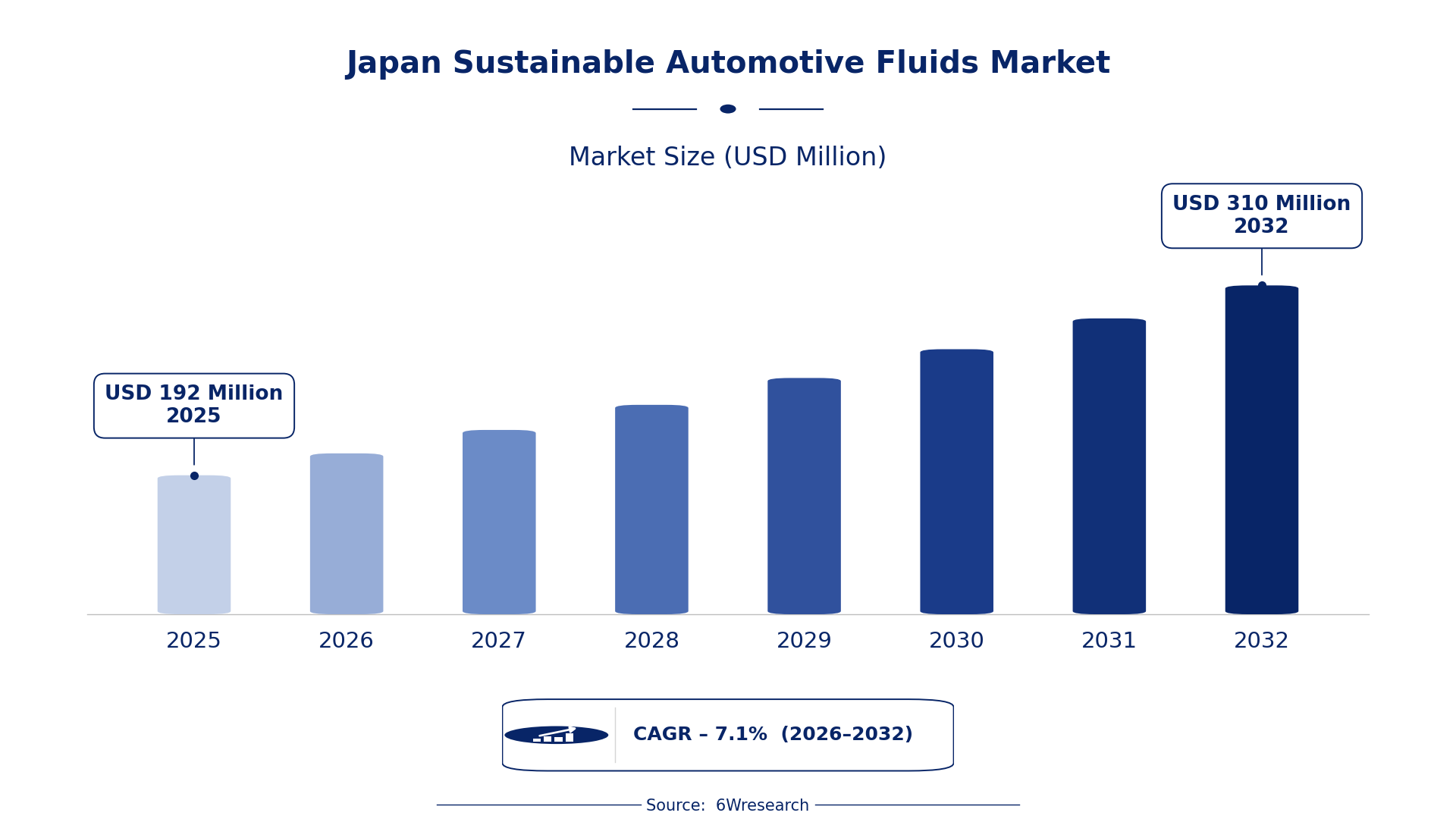
According to 6Wresearch internal database and industry insights, the Japan Sustainable Automotive Fluids Market was valued at USD 192 Million in 2025 and is projected to reach USD 310 Million by 2032, growing at a CAGR of approximately 7.1% during 2026–2032.
Japan Sustainable Automotive Fluids Market Highlights
| Report Metric | Details |
| Report Name | Japan Sustainable Automotive Fluids Market (2026-2032) |
| Market Size 2025 | USD 192 Million |
| Market Size 2032 | USD 310 Million |
| Absolute Growth 2025–2032 | USD 118 Million |
| CAGR 2026–2032 | 7.1% |
| Peak Annual Growth | 7.4% in 2029 |
| Forecast Period | 2026–2032 |
| Historical Data | 2022–2025 |
| Base Year | 2025 |
| Leading Fluid Type, 2025 | Bio-Based Engine Oil (42% share) |
| Leading Base Material, 2025 | Plant-Based Esters (39% share) |
| Leading Application Area, 2025 | Engine Lubrication (45% share) |
| Leading End User, 2025 | EV Manufacturers (40% share) |
| Fastest-Growing Fluid Type | Eco Coolants (10.2% CAGR) |
| Fastest-Growing Base Material | Glycol Alternatives (10.1% CAGR) |
| Fastest-Growing Application Area | Radiator Systems (8.2% CAGR) |
| Fastest-Growing End User | Vehicle OEMs (9.3% CAGR) |
| Growing Sector | Radiator Systems |
| Key End Users | Engine Lubrication, Radiator Systems, Gear Lubrication, Brake Hydraulics |
Japan Sustainable Automotive Fluids Market Year-wise Growth Rate and Key Drivers (2022–2032)
This graph illustrates the annual growth rates of the market from 2022 to 2032, highlighting a steady upward trajectory and projected market expansion over the forecast period.
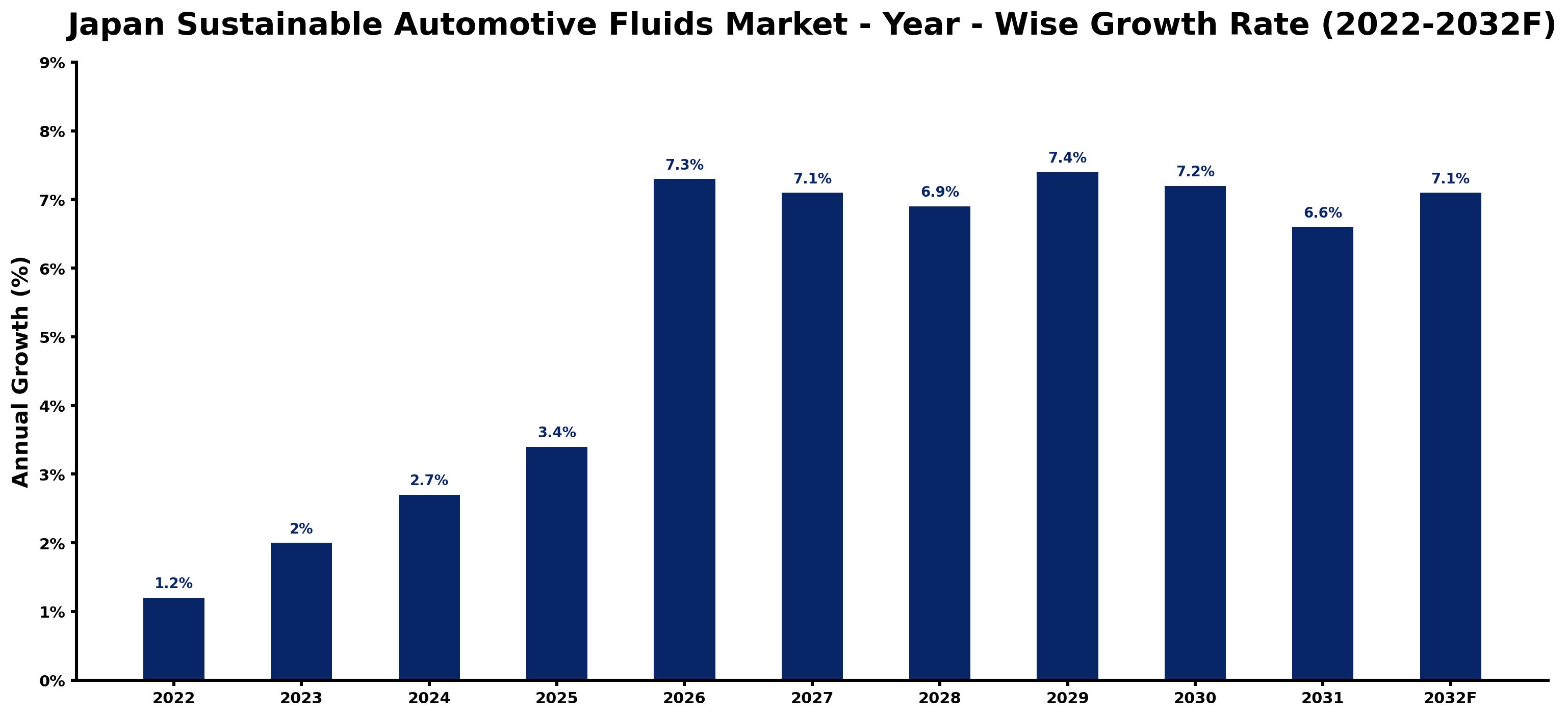
Year by year, the estimates below pair each growth rate with the development that shaped it.
| Year | Estimated Annual Growth (%) | Market Rationale |
| 2022 | 1.2 | The market experienced initial growth as demand for sustainable products increased. |
| 2023 | 2.0 | Growth accelerated due to heightened awareness of environmental issues among consumers. |
| 2024 | 2.7 | Demand rose further as more manufacturers adopted eco-friendly practices. |
| 2025 | 3.4 | The market peaked historically as electric vehicle production surged in Japan. |
| 2026 | 7.3 | Growth is projected to remain strong as decarbonisation efforts gain traction. |
| 2027 | 7.1 | The market continues to grow, but at a slower rate as it stabilises. |
| 2028 | 6.9 | Growth slows slightly as the market adjusts to new consumer preferences. |
| 2029 | 7.4 | A peak in growth is anticipated as investments in sustainable technologies increase. |
| 2030 | 7.2 | Growth is expected to slow as the market matures and competition intensifies. |
| 2031 | 6.6 | The market is projected to grow at a slower rate, reflecting market saturation. |
| 2032 | 7.1 | Growth is anticipated to rise again as new sustainable products are introduced. |
Note: Market size estimations and growth projections presented in this report are based on 6Wresearch's proprietary forecasting methodology, utilizing the latest available industry data, government publications, and primary research inputs.
Japan Sustainable Automotive Fluids Market Synopsis
Sustainable automotive fluids are eco-friendly lubricants and coolants derived from renewable resources, such as plant oils and esters. These fluids reduce friction and improve performance in vehicles. The Japan Sustainable Automotive Fluids Market is expanding due to rising demand from electric vehicle manufacturers and aftermarket service shops. With Japan targeting a 46% reduction in greenhouse gas emissions by 2030, investments in sustainable technologies are driving growth, particularly in urban areas where eco-friendly solutions are increasingly adopted.
Market Dynamics Impact Analysis (2026–2032)
| Factor | Type | Impact | Primary Segment Affected |
| Rising electric vehicle production drives demand for eco-friendly fluids. | Driver | High | Bio-Based Engine Oil |
| Increased environmental regulations push manufacturers to adopt sustainable solutions. | Driver | High | Eco Coolants |
| The shift towards greener automotive technologies creates new market opportunities. | Opportunity | High | Green Transmission Fluids |
| Growing consumer preference for sustainable products opens new avenues for suppliers. | Opportunity | Medium | Biodegradable Brake Fluids |
| High production costs limit the affordability of sustainable fluids for consumers. | Restraint | High | Plant-Based Esters |
| Limited awareness of sustainable options among traditional vehicle owners hampers growth. | Restraint | Medium | Glycol Alternatives |
| Supply chain disruptions can delay the availability of sustainable fluids. | Challenge | High | Synthetic/Low-toxicity |
| Competition from conventional automotive fluids affects market penetration. | Challenge | Medium | Vegetable Oil Derived |
Evaluation of Drivers in Japan Sustainable Automotive Fluids Market (2026–2032)
The following drivers explain most of the expected growth.
| Drivers | Primary Segment Affected | Why It Matters (Evidence) |
| Increased electric vehicle adoption drives demand for bio-based engine oils. | Bio-Based Engine Oil | The number of electric vehicles in Japan is expected to exceed 1 million by 2025, prompting manufacturers to seek sustainable options. |
| Environmental regulations require the use of eco-friendly coolants in vehicles. | Eco Coolants | Japan aims to reduce CO2 emissions from vehicles by 30% by 2030, increasing the need for compliant products. |
| The automotive aftermarket is shifting towards sustainable maintenance solutions. | Biodegradable Brake Fluids | The aftermarket service sector in Japan is valued at approximately 10 billion USD, with rising interest in eco-friendly options. |
| Growing awareness of sustainability among consumers boosts demand for green transmission fluids. | Green Transmission Fluids | Sustainable auto brands are gaining market share, focusing on eco-friendly technologies. |
| Investment in decarbonisation initiatives supports the growth of sustainable automotive fluids. | Plant-Based Esters | Japan's GX Basic Policy targets about JPY 150 trillion of public and private decarbonisation investment over 10 years. |
Several shifts outside the market lift sales. The number of electric vehicles in Japan is projected to exceed 1 million by 2025, which drives demand for bio-based engine oils. The automotive aftermarket, valued at approximately 10 billion USD, is increasingly adopting biodegradable brake fluids. Consumer interest in sustainability is pushing vehicle OEMs to integrate green transmission fluids into their products, aligning with national decarbonisation investments over the next decade.
Evaluation of Restraints in Japan Sustainable Automotive Fluids Market
These are the pressures that could keep growth below its potential.
| Market Restraint | Primary Segment Affected | Why It Matters (Evidence) |
| High production costs limit the affordability of sustainable fluids for consumers. | Plant-Based Esters | The average vehicle ownership in Japan is around 0.6 vehicles per person, impacting consumer spending on premium fluids. |
| Limited awareness of sustainable options among traditional vehicle owners hampers growth. | Glycol Alternatives | Many consumers remain unaware of the benefits of eco-friendly products, slowing market penetration. |
| Supply chain disruptions can delay the availability of sustainable fluids. | Synthetic/Low-toxicity | Global supply chain issues have affected the timely delivery of raw materials for sustainable fluid production. |
| Competition from conventional automotive fluids affects market penetration. | Vegetable Oil Derived | Traditional fluids are often cheaper and more readily available, making it difficult for sustainable options to compete. |
| Regulatory compliance costs can deter new entrants into the market. | Eco Coolants | Manufacturers must invest in testing and certification to meet JIS K 2241 standards, raising barriers to entry. |
Japan Sustainable Automotive Fluids Market Challenges
Regulatory hurdles create delays for producers, often extending product launches by six months. Buyers face rising costs as eco-friendly options remain limited, leading to price increases of 15% compared to traditional fluids. Technology adoption lags, with only 20% of manufacturers investing in sustainable solutions, which stifles innovation and efficiency. Competition intensifies as traditional fluid suppliers struggle to adapt, risking a 20% market share loss to emerging eco-friendly brands, ultimately squeezing margins for non-compliant producers.
Trends in the Japan Sustainable Automotive Fluids Market
The shifts below are changing how Japan Sustainable Automotive Fluids Market products are bought and supplied.
- Shift towards Eco-Friendly Fluids: In 2023, the Ministry of the Environment launched a green vehicle promotion program, which will likely increase adoption of sustainable automotive fluids. This initiative will boost market growth as more manufacturers align with eco-friendly standards.
- Transition from Conventional to Sustainable Products: The number of electric vehicles in Japan is projected to exceed 1 million by 2025, prompting a shift towards sustainable automotive fluids. This trend is reshaping product offerings in the automotive sector.
- Emergence of Biodegradable Brake Fluids: Biodegradable brake fluids are increasingly used in urban areas to reduce pollution. This shift is supported by growing consumer demand for environmentally friendly products, creating new market opportunities.
- Growing Investment in Decarbonisation: Japan's GX Basic Policy aims for about JPY 150 trillion of public and private decarbonisation investment over 10 years. This funding is expected to drive innovation and adoption of sustainable automotive fluids.
Investment Opportunities in the Japan Sustainable Automotive Fluids Market
Investors looking at the Japan Sustainable Automotive Fluids Market should consider the following areas.
- Rising Demand for Eco-Friendly Products: With Japan targeting a 46% cut in greenhouse gas emissions by 2030, there is a strong opportunity for suppliers of sustainable automotive fluids to meet this demand. EV manufacturers are particularly keen on integrating these fluids.
- Expansion in the Automotive Aftermarket: The automotive aftermarket in Japan is valued at approximately 10 billion USD, presenting a strong opportunity for suppliers of biodegradable brake fluids and eco coolants. Partnering with aftermarket service shops can facilitate market entry.
- Investment in Sustainable Technologies: Japan's GX Basic Policy indicates a growing investment in sustainable technologies, creating opportunities for suppliers of plant-based esters. Collaborating with vehicle OEMs can enhance market reach.
- Focus on Urban Areas for Eco-Friendly Solutions: Urban areas are increasingly adopting biodegradable brake fluids to reduce pollution, creating a demand gap. Suppliers can target these regions for growth by establishing local partnerships.
Government Initiatives in the Japan Sustainable Automotive Fluids Market
The regulatory framework for sustainable automotive fluids is shaped by several key laws. The GX Promotion Act of 2023 establishes a legal basis for promoting green technologies, while the Green Growth Strategy, updated in 2021, identifies growth sectors for decarbonisation. These measures encourage manufacturers to invest in sustainable solutions, aligning with Japan's target for net zero emissions by 2050.
The Ministry of the Environment plays a key role in approving and funding initiatives related to sustainable automotive fluids. The green vehicle promotion program launched in 2023 aims to support the adoption of eco-friendly products, while funding for research and development in sustainable technologies is facilitated through various government schemes. These efforts are designed to strengthen the market for sustainable automotive fluids in Japan.
Future Insight of the Japan Sustainable Automotive Fluids Market
The green vehicle promotion program will stimulate the production of sustainable automotive fluids, with output projected to reach 1.5 million tons by 2025. By 2032, advancements in bio-based technologies will improve product performance, benefiting both buyers and suppliers. The increasing number of electric vehicles will drive demand for eco-friendly lubricants, as manufacturers strive to meet stringent emissions targets. Decarbonisation investments will provide suppliers with opportunities to innovate and diversify their product offerings.
Market Segmentation Analysis
Japan Sustainable Automotive Fluids Market report covers a detailed analysis of the following market segments:
By Fluid Type – Bio-Based Engine Oil Leads, Eco Coolants Expected to Grow Fastest
According to Saurav Kr Singh, Senior Research Analyst at 6Wresearch, Bio-Based Engine Oil took 42% of fluid type revenue in 2025, more than any other category. Bio-Based Engine Oil holds a substantial share due to its critical role in engine lubrication, which is vital for reducing environmental impact. The extensive use of this fluid in the Tokyo region, a key automotive manufacturing hub, underlines its importance. Eco Coolants are set to record the highest CAGR in this split, 10.2% over 2026–2032. Eco Coolants are rapidly gaining traction as they are increasingly utilised in radiator systems for efficient cooling, particularly with the anticipated rise in electric vehicles exceeding 1 million by 2025. This trend indicates a growing preference for sustainable solutions in the automotive sector. Suppliers should prioritise the development of eco-friendly coolants to align with the rising demand from manufacturers.
By Base Material – Plant-Based Esters Lead, Glycol Alternatives Expected to Grow Fastest
In 2025, Plant-Based Esters led the base material split with a 39% share. Plant-Based Esters lead the market as they provide a versatile base for various sustainable automotive fluids, aligning with Japan's environmental initiatives. Their endorsement under standards like JIS K 2241 further solidifies their widespread acceptance and use. Glycol Alternatives are projected to grow fastest, at a CAGR of 10.1% during 2026–2032. Glycol Alternatives are experiencing rapid growth due to their effectiveness as eco-friendly coolant solutions, appealing to manufacturers focused on sustainability. The automotive industry's shift towards greener technologies ensures this segment's continued expansion. Buyers can expect a broader range of eco-friendly materials as suppliers respond to sustainability demands.
By Application Area – Engine Lubrication Leads, Radiator Systems Expected to Grow Fastest
Engine Lubrication held 45% of the Japan Sustainable Automotive Fluids Market by application area in 2025. Engine Lubrication holds the largest share due to its critical role in vehicle performance and longevity, with domestic manufacturers prioritising this application. The Japanese automotive industry’s focus on reducing emissions further solidifies its importance in the market. The quickest growth will come from Radiator Systems, forecast to expand at a CAGR of 8.2% between 2026 and 2032. Radiator Systems are experiencing rapid growth as they are vital for maintaining optimal engine temperature, particularly with the anticipated rise in electric vehicle production. This growth will likely continue as manufacturers increasingly prioritise efficiency in their designs. Suppliers should focus on developing advanced solutions for radiator systems to capitalise on this expanding market segment.
By End User – EV Manufacturers Lead, Vehicle OEMs Expected to Grow Fastest
EV Manufacturers accounted for 40% of the market by end user in 2025. EV Manufacturers are the largest end user group, increasingly adopting sustainable fluids in their production processes to align with environmental regulations. This shift is supported by government initiatives aimed at reducing CO2 emissions from vehicles. Over 2026–2032, Vehicle OEMs are expected to post the fastest growth, at a CAGR of 9.3%. Vehicle OEMs are experiencing the fastest growth as they integrate sustainable fluids into new models to meet consumer demand for eco-friendly options. This trend will likely continue as the market for sustainable vehicles expands. Suppliers should strengthen partnerships with vehicle OEMs to secure a foothold in the evolving market.
Key Attractiveness of the Report
- 10 Years of Market Numbers
- Historical Data Starting from 2022 to 2025
- Base Year 2025
- Forecast Data until 2032
- Key Performance Indicators Impacting the Market
- Major Upcoming Developments and Projects
Key Highlights of the Report:
- Japan Sustainable Automotive Fluids Market Outlook
- Market Size of Japan Sustainable Automotive Fluids Market, 2025
- Forecast of Japan Sustainable Automotive Fluids Market, 2032
- Historical Data and Forecast of Japan Sustainable Automotive Fluids Revenues & Volume for the Period 2022-2032F
- Japan Sustainable Automotive Fluids Market Trend Evolution
- Japan Sustainable Automotive Fluids Market Drivers and Challenges
- Japan Sustainable Automotive Fluids Price Trends
- Japan Sustainable Automotive Fluids Porter's Five Forces
- Japan Sustainable Automotive Fluids Industry Life Cycle
- Historical Data and Forecast of Japan Sustainable Automotive Fluids Market Revenues & Volume By Fluid Type for the Period 2022-2032F
- Historical Data and Forecast of Japan Sustainable Automotive Fluids Market Revenues & Volume By Bio-Based Engine Oil for the Period 2022-2032F
- Historical Data and Forecast of Japan Sustainable Automotive Fluids Market Revenues & Volume By Eco Coolants for the Period 2022-2032F
- Historical Data and Forecast of Japan Sustainable Automotive Fluids Market Revenues & Volume By Green Transmission Fluids for the Period 2022-2032F
- Historical Data and Forecast of Japan Sustainable Automotive Fluids Market Revenues & Volume By Biodegradable Brake Fluids for the Period 2022-2032F
- Historical Data and Forecast of Japan Sustainable Automotive Fluids Market Revenues & Volume By Base Material for the Period 2022-2032F
- Historical Data and Forecast of Japan Sustainable Automotive Fluids Market Revenues & Volume By Plant-Based Esters for the Period 2022-2032F
- Historical Data and Forecast of Japan Sustainable Automotive Fluids Market Revenues & Volume By Glycol Alternatives for the Period 2022-2032F
- Historical Data and Forecast of Japan Sustainable Automotive Fluids Market Revenues & Volume By Synthetic/Low-toxicity for the Period 2022-2032F
- Historical Data and Forecast of Japan Sustainable Automotive Fluids Market Revenues & Volume By Vegetable Oil Derived for the Period 2022-2032F
- Historical Data and Forecast of Japan Sustainable Automotive Fluids Market Revenues & Volume By Application Area for the Period 2022-2032F
- Historical Data and Forecast of Japan Sustainable Automotive Fluids Market Revenues & Volume By Engine Lubrication for the Period 2022-2032F
- Historical Data and Forecast of Japan Sustainable Automotive Fluids Market Revenues & Volume By Radiator Systems for the Period 2022-2032F
- Historical Data and Forecast of Japan Sustainable Automotive Fluids Market Revenues & Volume By Gear Lubrication for the Period 2022-2032F
- Historical Data and Forecast of Japan Sustainable Automotive Fluids Market Revenues & Volume By Brake Hydraulics for the Period 2022-2032F
- Historical Data and Forecast of Japan Sustainable Automotive Fluids Market Revenues & Volume By End User for the Period 2022-2032F
- Historical Data and Forecast of Japan Sustainable Automotive Fluids Market Revenues & Volume By EV Manufacturers for the Period 2022-2032F
- Historical Data and Forecast of Japan Sustainable Automotive Fluids Market Revenues & Volume By Vehicle OEMs for the Period 2022-2032F
- Historical Data and Forecast of Japan Sustainable Automotive Fluids Market Revenues & Volume By Sustainable Auto Brands for the Period 2022-2032F
- Historical Data and Forecast of Japan Sustainable Automotive Fluids Market Revenues & Volume By Aftermarket Service Shops for the Period 2022-2032F
- Japan Sustainable Automotive Fluids Import Export Trade Statistics
- Market Opportunity Assessment By Fluid Type
- Market Opportunity Assessment By Base Material
- Market Opportunity Assessment By Application Area
- Market Opportunity Assessment By End User
- Japan Sustainable Automotive Fluids Top Companies Market Share
- Japan Sustainable Automotive Fluids Competitive Benchmarking By Technical and Operational Parameters
- Japan Sustainable Automotive Fluids Company Profiles
- Japan Sustainable Automotive Fluids Key Strategic Recommendations
Market Covered
Coverage by segment is as follows.
By Fluid Type
- Bio-Based Engine Oil
- Eco Coolants
- Green Transmission Fluids
- Biodegradable Brake Fluids
By Base Material
- Plant-Based Esters
- Glycol Alternatives
- Synthetic/Low-toxicity
- Vegetable Oil Derived
By Application Area
- Engine Lubrication
- Radiator Systems
- Gear Lubrication
- Brake Hydraulics
By End User
- EV Manufacturers
- Vehicle OEMs
- Sustainable Auto Brands
- Aftermarket Service Shops































