Japan Sustainable Baby Packaging Market Size & Growth Rate
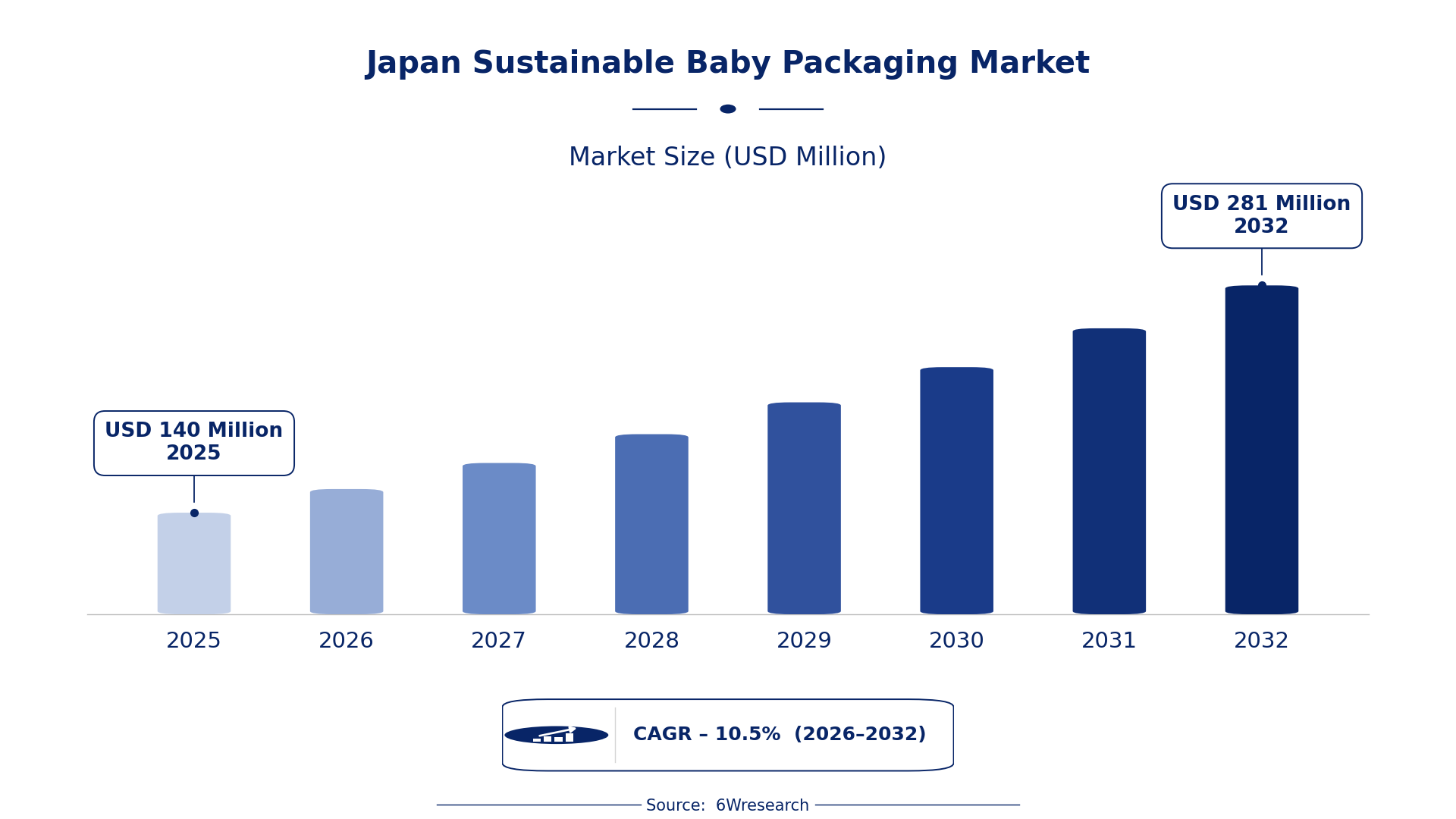
According to 6Wresearch internal database and industry insights, the Japan Sustainable Baby Packaging Market was valued at USD 140 Million in 2025 and is projected to reach USD 281 Million by 2032, growing at a CAGR of approximately 10.5% during 2026–2032.
Japan Sustainable Baby Packaging Market Highlights
| Report Metric | Details |
| Report Name | Japan Sustainable Baby Packaging Market (2026-2032) |
| Market Size 2025 | USD 140 Million |
| Market Size 2032 | USD 281 Million |
| Absolute Growth 2025–2032 | USD 141 Million |
| CAGR 2026–2032 | 10.5% |
| Peak Annual Growth | 11.6% in 2029 |
| Forecast Period | 2026–2032 |
| Historical Data | 2022–2025 |
| Base Year | 2025 |
| Leading Packaging Type, 2025 | Bottles (47% share) |
| Leading Material Used, 2025 | Bioplastic (PLA) (45% share) |
| Leading Product Category, 2025 | Baby Food (38% share) |
| Leading End User, 2025 | Baby Food Brands (37% share) |
| Fastest-Growing Packaging Type | Tubes (14.7% CAGR) |
| Fastest-Growing Material Used | Recyclable PE/PP (15.2% CAGR) |
| Fastest-Growing Product Category | Skincare Products (15.7% CAGR) |
| Fastest-Growing End User | Natural Baby Brands (14.3% CAGR) |
| Growing Sector | organic baby food |
| Key End Users | baby food brands, natural baby brands, diaper manufacturers, sustainable retailers |
Japan Sustainable Baby Packaging Market Year-wise Growth Rate and Key Drivers (2022–2032)
This graph illustrates the annual growth rates of the market from 2022 to 2032, highlighting a steady upward trajectory and projected market expansion over the forecast period.
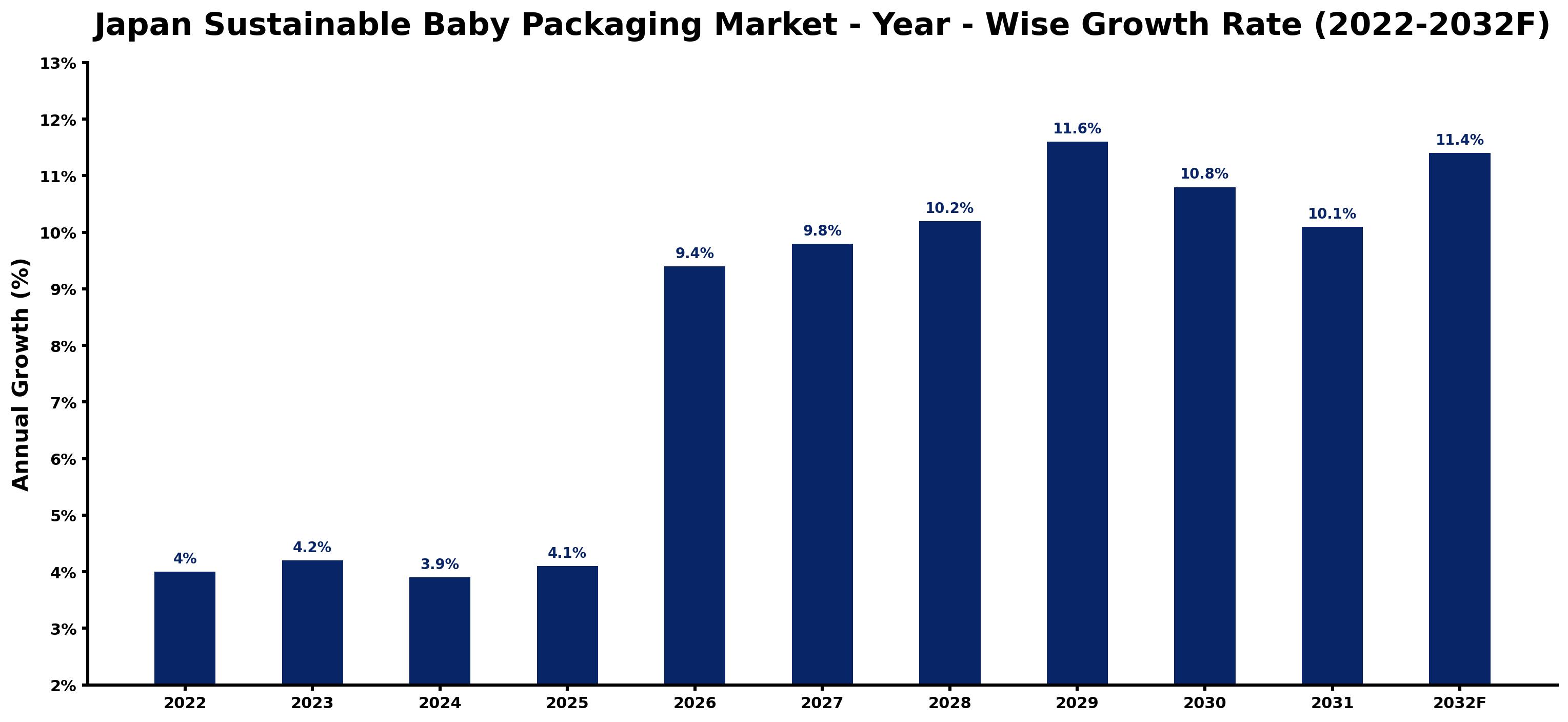
For each year, the table pairs the estimated growth rate with the leading influence on demand, showing how the drivers changed across the period.
| Year | Estimated Annual Growth (%) | Market Rationale |
| 2022 | 4.0 | The market experienced steady growth due to rising environmental awareness among consumers. |
| 2023 | 4.2 | Growth accelerated as more baby food brands adopted sustainable packaging solutions. |
| 2024 | 3.9 | The market slowed slightly as competition intensified among packaging providers. |
| 2025 | 4.1 | Demand increased again as consumers showed preference for eco-friendly products. |
| 2026 | 9.4 | The market is expected to grow as investment in sustainable materials rises. |
| 2027 | 9.8 | Demand is expected to continue climbing with the expansion of natural baby brands in Japan. |
| 2028 | 10.2 | Growth is projected to remain strong as consumer awareness of sustainable packaging reaches new heights. |
| 2029 | 11.6 | The market is expected to peak as packaging solutions gain widespread acceptance. |
| 2030 | 10.8 | Growth is projected to slow slightly as the market matures and competition stabilises. |
| 2031 | 10.1 | Demand is expected to continue rising, supported by ongoing consumer interest in sustainability. |
| 2032 | 11.4 | The market is projected to grow faster as regulatory support for eco-friendly practices strengthens. |
Note: Market size estimations and growth projections presented in this report are based on 6Wresearch's proprietary forecasting methodology, utilizing the latest available industry data, government publications, and primary research inputs.
Japan Sustainable Baby Packaging Market Synopsis
Sustainable baby packaging includes eco-friendly solutions crafted from biodegradable or recyclable materials, primarily intended for baby food, skincare products, and diapers. The Japan Sustainable Baby Packaging Market is growing as consumer awareness of environmental issues rises alongside government initiatives that promote sustainable practices. In 2023, 70% of baby food brands reported using sustainable packaging, indicating a shift in buyer preferences. The organic baby food market, valued at over 300 billion yen annually, further propels this demand, creating opportunities for sustainable packaging solutions.
Market Dynamics Impact Analysis (2026–2032)
| Factor | Type | Impact | Primary Segment Affected |
| Growing consumer preference for eco-friendly products | Driver | High | Baby Food |
| Increased regulatory support for sustainable packaging | Driver | High | Diapers/Wipes |
| Rising number of natural baby brands | Opportunity | High | Natural Baby Brands |
| Expansion of the organic baby food market | Opportunity | Medium | Organic Purees |
| High competition among packaging providers | Restraint | Medium | Pouches |
| Limited consumer awareness in some segments | Restraint | High | Skincare Products |
| High costs associated with sustainable materials | Challenge | High | Bottles |
| Challenges in recycling infrastructure | Challenge | Medium | Compostable Films |
Evaluation of Drivers in Japan Sustainable Baby Packaging Market (2026–2032)
Below are the drivers that matter most for revenue growth, with supporting evidence.
| Drivers | Primary Segment Affected | Why It Matters (Evidence) |
| Investment in renewable resources for packaging | Bioplastic (PLA) | This investment supports the adoption of bioplastics, with 45% market share in 2025, driven by eco-conscious baby food brands. |
| Increased consumer demand for sustainable products | Recyclable PE/PP | With a CAGR of 15.2%, recyclable materials are becoming a standard in baby product packaging, appealing to sustainability-focused retailers. |
| Government initiatives promoting eco-friendly practices | FSC-certified Paper | The 2020 Plastic Resource Circulation Strategy encourages the use of sustainable materials, leading to a 20% increase in FSC-certified paper usage. |
| Growth in the organic baby food sector | Organic Purees | The organic baby food market, valued at over 300 billion yen, drives demand for sustainable packaging solutions. |
| Rising awareness of environmental issues among consumers | Natural Baby Brands | With 65% consumer awareness, brands are increasingly adopting sustainable packaging to meet buyer expectations. |
Orders keep climbing as investment in renewable resources for packaging rises, supporting the adoption of bioplastics, which accounted for 45% of the market in 2025. Increased consumer demand for sustainable products drives the adoption of recyclable materials, projected to grow at 15.2%. The booming organic baby food sector, valued at over 300 billion yen, fuels demand for sustainable packaging solutions, while rising awareness of environmental issues among consumers encourages brands to adopt eco-friendly practices. The use of compostable films is also gaining traction as consumers seek more environmentally friendly options.
Evaluation of Restraints in Japan Sustainable Baby Packaging Market
The main factors holding the market back are set out below.
| Market Restraint | Primary Segment Affected | Why It Matters (Evidence) |
| High costs associated with sustainable materials | Bottles | The cost of bioplastics can be higher, impacting profit margins for producers, with prices rising by 10% since 2020. |
| Limited consumer awareness in some segments | Skincare Products | Despite growing interest, awareness of sustainable packaging remains low among consumers of skincare products, limiting market growth, with only 40% awareness reported. |
| High competition among packaging providers | Pouches | Intense competition can lead to price wars, impacting profitability for manufacturers in the sustainable packaging sector, with price reductions reaching 15%. |
| Challenges in recycling infrastructure | Compostable Films | Inadequate recycling facilities hinder the effective disposal of compostable films, affecting their market adoption, with only 25% of facilities equipped for compostables. |
| Regulatory complexities in packaging standards | Diapers/Wipes | Navigating the various regulations can complicate the development and approval of new sustainable packaging solutions, with over 30 different standards to consider. |
Japan Sustainable Baby Packaging Market Challenges
In 2023, 70% of baby food brands reported using sustainable packaging solutions, yet supply chain disruptions often hinder access to eco-friendly materials, causing delays in product launches for manufacturers. Many suppliers struggle with outdated machinery, which extends production times and limits options for buyers seeking diverse packaging solutions. Traditional packaging remains dominant in the market, leading brands to hesitate in adopting sustainable alternatives, which restricts growth opportunities for eco-friendly products. Rising costs of biodegradable materials may increase prices for consumers, potentially lowering demand for sustainable packaging solutions.
Trends in the Japan Sustainable Baby Packaging Market
Below are the shifts with the largest effect on the Japan Sustainable Baby Packaging Market.
- Launch of the Eco Mark Program: The Eco Mark program certifies environmentally friendly products, including baby packaging, promoting sustainability in the industry. In 2023, 70% of baby food brands reported using certified packaging solutions.
- Shift towards Bioplastics in Packaging: The Tokyo metropolitan area is experiencing a shift towards bioplastics for baby packaging. The use of bioplastics is projected to reach 45% market share by 2025, driven by consumer demand for sustainable options.
- Increasing Adoption of FSC-certified Paper: The use of FSC-certified paper for baby packaging is gaining momentum, with a 20% increase since 2020. This trend is fuelled by the growing environmental consciousness among consumers and brands.
- Natural Baby Brands Prioritising Sustainability: Natural baby brands are increasingly prioritising sustainable packaging solutions. With a 15% growth in the number of such brands over the last three years, this shift is reshaping packaging practices.
Investment Opportunities in the Japan Sustainable Baby Packaging Market
Below are the investment opportunities with the strongest case in the Japan Sustainable Baby Packaging Market.
- Rising Demand for Eco-friendly Packaging Solutions: With 70% of baby food brands adopting sustainable packaging, there is an opportunity for suppliers of bioplastics and recyclable materials. Collaborating with baby food brands can strengthen market presence.
- Expansion of the Organic Baby Food Market: The organic baby food market, valued at over 300 billion yen, presents an opportunity for packaging providers to develop sustainable solutions. Targeting organic brands can lead to fruitful partnerships.
- Growth of Natural Baby Brands: The increase in natural baby brands, growing by 15% in three years, creates demand for sustainable packaging. Suppliers can enter this market by partnering with these brands.
- Government Support for Sustainable Initiatives: Government subsidies for sustainable packaging initiatives reached 5 billion yen in 2023, creating opportunities for businesses to invest in eco-friendly solutions. Engaging with government programs can facilitate market entry.
Government Initiatives in the Japan Sustainable Baby Packaging Market
The Food Sanitation Act amendment (2018) established a positive list system for synthetic resins used in food packaging, ensuring safety and compliance. This measure, effective since June 2020, requires producers to adhere to strict standards, promoting the use of sustainable materials in baby packaging.
In 2023, the Ministry of the Environment allocated 5 billion yen for sustainable packaging initiatives, supporting projects that promote eco-friendly practices. The Ministry of Health, Labour and Welfare encourages sustainable practices in baby product manufacturing, further supporting compliance and safety.
Future Insight of the Japan Sustainable Baby Packaging Market
By 2032, buyers in the organic baby food sector will likely see a complete transition to sustainable packaging driven by increased consumer awareness and supportive regulations. The Tokyo metropolitan area will lead in adopting advanced recycling technologies, enhancing material availability for suppliers. Government subsidies will further stimulate developments in eco-friendly materials, encouraging suppliers to innovate in production processes. The Eco Mark program is expected to expand, simplifying the identification of genuinely sustainable packaging options for consumers.
Market Segmentation Analysis
Japan Sustainable Baby Packaging Market report covers a detailed analysis of the following market segments:
By Packaging Type – Bottles Lead, Tubes Expected to Grow Fastest
According to Saurav Kr Singh, Senior Research Analyst at 6Wresearch, in 2025, Bottles led the packaging type split with a 47% share. Bottles are essential for packaging baby food and beverages, making them a vital choice for parents. Their widespread use in urban centres like Tokyo reflects the strong demand for this packaging type in the market. Tubes are projected to grow fastest, at a CAGR of 14.7% during 2026–2032. Tubes are rapidly gaining traction due to their convenience and growing use for baby skincare products. The increase in natural baby brands by 15% over the last three years highlights the shift towards tube packaging. Suppliers should consider expanding their offerings to include tube packaging to meet the rising demand in this segment.
By Material Used – Bioplastic (PLA) Leads, Recyclable PE/PP Expected to Grow Fastest
Bioplastic (PLA) took 45% of material used revenue in 2025, more than any other category. Bioplastic (PLA) leads the market as it is increasingly preferred for sustainable packaging due to its eco-friendly properties. The growing awareness among consumers in Japan about sustainable materials has driven the adoption of bioplastics in various packaging applications. The quickest growth will come from Recyclable PE/PP, forecast to expand at a CAGR of 15.2% between 2026 and 2032. Recyclable PE/PP materials are rapidly gaining traction as they are becoming standard in many packaging types, reflecting a shift towards sustainability. The 2023 campaign by the Ministry of the Environment to reduce plastic waste further supports this trend. For suppliers, focusing on recyclable materials will be essential to align with market demands and regulatory expectations.
By Product Category – Baby Food Leads, Skincare Products Expected to Grow Fastest
With 38% of product category revenue in 2025, Baby Food was the largest category. Baby food packaging commands the largest share as it serves as a primary application area for sustainable solutions. The organic baby food market's annual valuation of over 300 billion yen illustrates the significance of this product category. Over 2026–2032, Skincare Products are expected to post the fastest growth, at a CAGR of 15.7%. Skincare products are witnessing the fastest growth as they increasingly adopt sustainable packaging, driven by consumer preferences for environmentally friendly options. The trend is evident as more brands incorporate sustainable practices into their offerings. Suppliers should target the skincare segment to capitalise on the increasing demand for sustainable packaging solutions.
By End User – Baby Food Brands Lead, Natural Baby Brands Expected to Grow Fastest
The largest end user category in 2025 was Baby Food Brands, at 37% of revenue. Baby food brands are the largest users of sustainable packaging due to their focus on eco-friendly practices in product offerings. This trend is supported by the high percentage of baby food brands reporting the use of sustainable packaging solutions. Natural Baby Brands are set to record the highest CAGR in this split, 14.3% over 2026–2032. Natural baby brands are rapidly adopting sustainable packaging as they prioritise eco-friendly practices, reflecting changing consumer preferences. The growth of these brands indicates a shift towards more sustainable options in the market. Suppliers should target natural baby brands to meet the rising demand for sustainable packaging in this segment.
Key Attractiveness of the Report
- 10 Years of Market Numbers
- Historical Data Starting from 2022 to 2025
- Base Year 2025
- Forecast Data until 2032
- Key Performance Indicators Impacting the Market
- Major Upcoming Developments and Projects
Key Highlights of the Report:
- Japan Sustainable Baby Packaging Market Outlook
- Market Size of Japan Sustainable Baby Packaging Market, 2025
- Forecast of Japan Sustainable Baby Packaging Market, 2032
- Historical Data and Forecast of Japan Sustainable Baby Packaging Revenues & Volume for the Period 2022-2032F
- Japan Sustainable Baby Packaging Market Trend Evolution
- Japan Sustainable Baby Packaging Market Drivers and Challenges
- Japan Sustainable Baby Packaging Price Trends
- Japan Sustainable Baby Packaging Porter's Five Forces
- Japan Sustainable Baby Packaging Industry Life Cycle
- Historical Data and Forecast of Japan Sustainable Baby Packaging Market Revenues & Volume By Packaging Type for the Period 2022-2032F
- Historical Data and Forecast of Japan Sustainable Baby Packaging Market Revenues & Volume By Bottles for the Period 2022-2032F
- Historical Data and Forecast of Japan Sustainable Baby Packaging Market Revenues & Volume By Tubes for the Period 2022-2032F
- Historical Data and Forecast of Japan Sustainable Baby Packaging Market Revenues & Volume By Wrappers for the Period 2022-2032F
- Historical Data and Forecast of Japan Sustainable Baby Packaging Market Revenues & Volume By Pouches for the Period 2022-2032F
- Historical Data and Forecast of Japan Sustainable Baby Packaging Market Revenues & Volume By Material Used for the Period 2022-2032F
- Historical Data and Forecast of Japan Sustainable Baby Packaging Market Revenues & Volume By Bioplastic (PLA) for the Period 2022-2032F
- Historical Data and Forecast of Japan Sustainable Baby Packaging Market Revenues & Volume By Recyclable PE/PP for the Period 2022-2032F
- Historical Data and Forecast of Japan Sustainable Baby Packaging Market Revenues & Volume By Compostable Films for the Period 2022-2032F
- Historical Data and Forecast of Japan Sustainable Baby Packaging Market Revenues & Volume By FSC-certified Paper for the Period 2022-2032F
- Historical Data and Forecast of Japan Sustainable Baby Packaging Market Revenues & Volume By Product Category for the Period 2022-2032F
- Historical Data and Forecast of Japan Sustainable Baby Packaging Market Revenues & Volume By Baby Food for the Period 2022-2032F
- Historical Data and Forecast of Japan Sustainable Baby Packaging Market Revenues & Volume By Skincare Products for the Period 2022-2032F
- Historical Data and Forecast of Japan Sustainable Baby Packaging Market Revenues & Volume By Diapers/Wipes for the Period 2022-2032F
- Historical Data and Forecast of Japan Sustainable Baby Packaging Market Revenues & Volume By Organic Purees for the Period 2022-2032F
- Historical Data and Forecast of Japan Sustainable Baby Packaging Market Revenues & Volume By End User for the Period 2022-2032F
- Historical Data and Forecast of Japan Sustainable Baby Packaging Market Revenues & Volume By Baby Food Brands for the Period 2022-2032F
- Historical Data and Forecast of Japan Sustainable Baby Packaging Market Revenues & Volume By Natural Baby Brands for the Period 2022-2032F
- Historical Data and Forecast of Japan Sustainable Baby Packaging Market Revenues & Volume By Diaper Manufacturers for the Period 2022-2032F
- Historical Data and Forecast of Japan Sustainable Baby Packaging Market Revenues & Volume By Sustainable Retailers for the Period 2022-2032F
- Japan Sustainable Baby Packaging Import Export Trade Statistics
- Market Opportunity Assessment By Packaging Type
- Market Opportunity Assessment By Material Used
- Market Opportunity Assessment By Product Category
- Market Opportunity Assessment By End User
- Japan Sustainable Baby Packaging Top Companies Market Share
- Japan Sustainable Baby Packaging Competitive Benchmarking By Technical and Operational Parameters
- Japan Sustainable Baby Packaging Company Profiles
- Japan Sustainable Baby Packaging Key Strategic Recommendations
Market Covered
The following segment groups are covered in the report.
By Packaging Type
- Bottles
- Tubes
- Wrappers
- Pouches
By Material Used
- Bioplastic (PLA)
- Recyclable PE/PP
- Compostable Films
- FSC-certified Paper
By Product Category
- Baby Food
- Skincare Products
- Diapers/Wipes
- Organic Purees
By End User
- Baby Food Brands
- Natural Baby Brands
- Diaper Manufacturers
- Sustainable Retailers































