Japan Sustainable Battery Market Size & Growth Rate
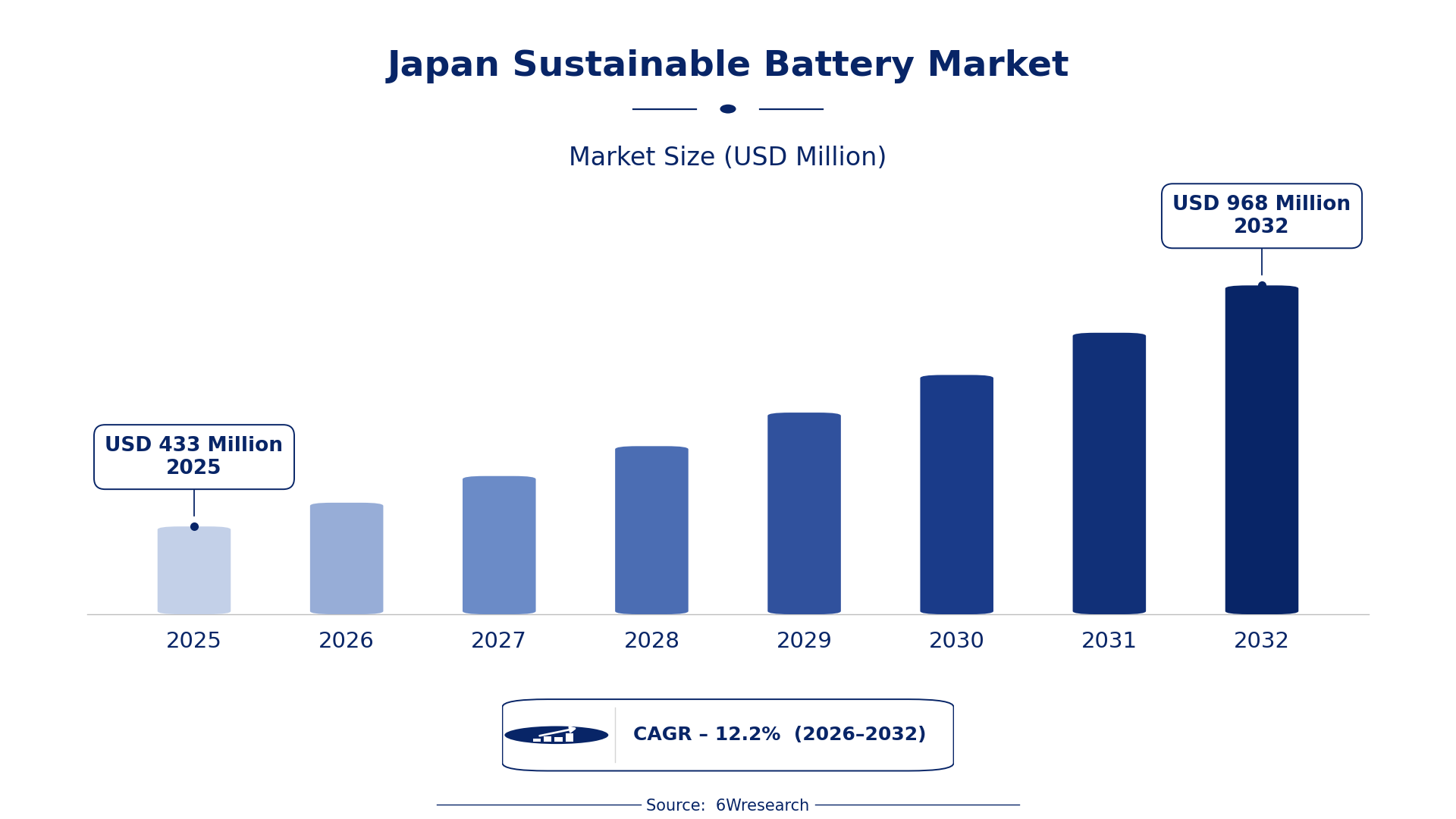
According to 6Wresearch internal database and industry insights, the Japan Sustainable Battery Market was valued at USD 433 Million in 2025 and is projected to reach USD 968 Million by 2032, growing at a CAGR of approximately 12.2% during 2026–2032.
Japan Sustainable Battery Market Highlights
| Report Metric | Details |
| Report Name | Japan Sustainable Battery Market (2026-2032) |
| Market Size 2025 | USD 433 Million |
| Market Size 2032 | USD 968 Million |
| Absolute Growth 2025–2032 | USD 535 Million |
| CAGR 2026–2032 | 12.2% |
| Peak Annual Growth | 13.1% in 2029 |
| Forecast Period | 2026–2032 |
| Historical Data | 2022–2025 |
| Base Year | 2025 |
| Leading Battery Type, 2025 | Solid-State Batteries (51% share) |
| Leading Chemistry Used, 2025 | Lithium Metal (52% share) |
| Leading Application Sector, 2025 | Electric Vehicles (39% share) |
| Leading End User, 2025 | EV Manufacturers (44% share) |
| Fastest-Growing Battery Type | Redox Flow Batteries (17.4% CAGR) |
| Fastest-Growing Chemistry Used | Water-Based Electrolyte (15.6% CAGR) |
| Fastest-Growing Application Sector | Grid Storage (15.7% CAGR) |
| Fastest-Growing End User | Renewable Energy Firms (15.8% CAGR) |
| Growing Sector | Electric Vehicles |
| Key End Users | EV Manufacturers, Renewable Energy Firms, Consumer Electronics Producers |
Japan Sustainable Battery Market Year-wise Growth Rate and Key Drivers (2022–2032)
This graph illustrates the annual growth rates of the market from 2022 to 2032, highlighting a steady upward trajectory and projected market expansion over the forecast period.
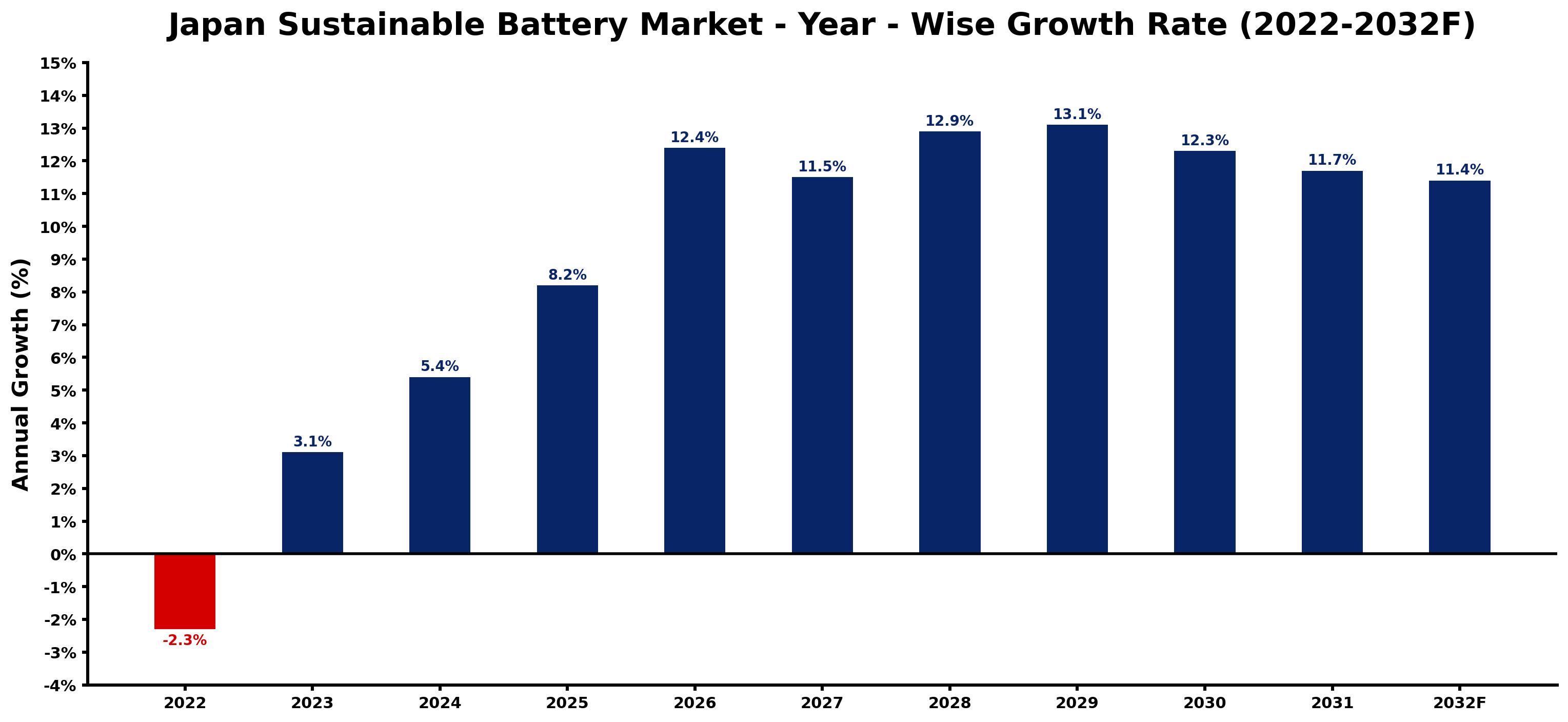
Annual growth estimates for each year appear below with the principal reason behind them, explaining the shifts that set the pace of the market.
| Year | Estimated Annual Growth (%) | Market Rationale |
| 2022 | -2.3 | The market faced initial challenges due to supply chain disruptions. |
| 2023 | 3.1 | Demand began to recover as electric vehicle sales increased. |
| 2024 | 5.4 | Growth continued as consumer awareness of sustainable options rose. |
| 2025 | 8.2 | Strong demand from the electric vehicle sector drove growth. |
| 2026 | 12.4 | Investment in green technology and infrastructure is expected to accelerate market expansion. |
| 2027 | 11.5 | Growth is projected to slow slightly as supply chain issues persist. |
| 2028 | 12.9 | Renewable energy projects will boost demand for sustainable batteries. |
| 2029 | 13.1 | The market is expected to peak as advancements in battery technology emerge. |
| 2030 | 12.3 | Growth will moderate due to market saturation in some segments. |
| 2031 | 11.7 | Demand will remain strong, but growth rates will begin to stabilise. |
| 2032 | 11.4 | The market is projected to continue growing steadily as new technologies emerge. |
Note: Market size estimations and growth projections presented in this report are based on 6Wresearch's proprietary forecasting methodology, utilizing the latest available industry data, government publications, and primary research inputs.
Japan Sustainable Battery Market Synopsis
Sustainable batteries are advanced energy storage solutions designed to minimise environmental impact through eco-friendly materials and innovative technologies like solid-state and sodium-ion chemistries. Their primary applications include powering electric vehicles, storing renewable energy, and supplying energy to consumer electronics. The Japan Sustainable Battery Market is growing due to rising domestic demand from the electric vehicle sector and substantial investments in green technology, with the government targeting ¥150 trillion in decarbonisation investments over the next decade.
Market Dynamics Impact Analysis (2026–2032)
| Factor | Type | Impact | Primary Segment Affected |
| Increasing demand for electric vehicles drives battery production. | Driver | High | Electric Vehicles |
| Rising investments in renewable energy projects create storage needs. | Driver | High | Grid Storage |
| Growing consumer electronics market presents new opportunities for battery use. | Opportunity | High | Consumer Electronics |
| Development of sodium-ion batteries offers cost-effective alternatives. | Opportunity | Medium | Sodium-Ion Batteries |
| Supply chain disruptions impact battery availability. | Restraint | High | Solid-State Batteries |
| High production costs hinder market growth for new technologies. | Restraint | Medium | Solid-State Batteries |
| Limited recycling infrastructure affects sustainable practices. | Challenge | High | Recyclable Li-ion |
| Competition from established battery technologies poses risks. | Challenge | Medium | Solid-State Batteries |
Evaluation of Drivers in Japan Sustainable Battery Market (2026–2032)
Key forces behind demand, with the segment each one moves most, are listed below.
| Drivers | Primary Segment Affected | Why It Matters (Evidence) |
| Surge in electric vehicle sales increases battery demand. | Electric Vehicles | In 2025, electric vehicles accounted for 39% of battery applications, driving manufacturers to increase production. |
| Investment in renewable energy projects boosts storage needs. | Grid Storage | The total installed capacity for grid storage batteries in Japan is 1.5 GW, highlighting the growing market. |
| Government initiatives promote sustainable battery development. | Solid-State Batteries | The GX Promotion Act aims for net-zero emissions by 2050, encouraging battery innovation. |
| Technological advancements improve battery performance and safety. | Solid-State Batteries | Solid-state technology increases energy density and safety, attracting investment. |
| Consumer electronics demand drives battery innovation. | Consumer Electronics | Consumer electronics account for 30% of battery demand, pushing for more efficient solutions. |
Orders keep climbing as electric vehicle sales continue to rise, driven by strong demand from manufacturers aiming to meet consumer expectations. Investment in renewable energy projects fuels the need for efficient storage solutions, with the total installed capacity for grid storage batteries in Japan reaching 1.5 GW. Technological advancements in solid-state batteries improve performance, attracting funding from various sectors. The consumer electronics market, which accounts for a substantial portion of battery demand, pushes for energy solutions that enhance user experience.
Evaluation of Restraints in Japan Sustainable Battery Market
The following restraints limit how fast demand can grow.
| Market Restraint | Primary Segment Affected | Why It Matters (Evidence) |
| Supply chain disruptions limit battery availability. | Solid-State Batteries | The Economic Security Promotion Act highlights the need for resilience in critical product supply chains. |
| High production costs hinder adoption of new technologies. | Solid-State Batteries | The Battery Industry Strategy aims to boost domestic manufacturing capacity, but costs remain a barrier. |
| Limited recycling infrastructure affects sustainable practices. | Recyclable Li-ion | Government subsidies for battery recycling initiatives are still developing. |
| Competition from established battery technologies poses risks. | Solid-State Batteries | Traditional lithium-ion batteries dominate the market, making it hard for new entrants. |
| Regulatory hurdles slow down innovation in battery production. | Sodium-Ion Batteries | Compliance with ISO 14001 standards adds complexity to new product launches. |
Japan Sustainable Battery Market Challenges
Producers face high costs due to reliance on eco-friendly materials, raising prices by up to 20% and limiting competitiveness. Buyers encounter delays in accessing advanced battery technologies, which can prolong project timelines by several months. Technology gaps exist as many producers lack access to vital research, slowing innovation and impacting market growth. Supply chain disruptions arise from dependency on specific materials, leading to potential shortages that can delay projects for buyers by several months.
Trends in the Japan Sustainable Battery Market
Buyers and suppliers in the Japan Sustainable Battery Market are adjusting to the following trends.
- Shift from Lithium-Ion to Sodium-Ion Batteries: Sodium-ion batteries are emerging as a cost-effective alternative to lithium-ion technology, with several universities in Japan developing prototypes. This shift is expected to reduce production costs significantly.
- Transition to Solid-State Batteries: Solid-state batteries are gaining traction due to their high energy density and safety features. The Japanese government is investing ¥2 trillion in green technology by 2025, supporting this transition.
- Increasing Focus on Battery Recycling: The government supports recycling initiatives through subsidies, aiming to enhance sustainability in the industry. This approach aligns with Japan's broader goals of reducing greenhouse gas emissions and fostering environmentally friendly technologies.
- Emergence of Grid Storage Solutions: Grid storage is becoming a critical component of renewable energy management. The total installed capacity for grid storage batteries in Japan is 1.5 GW, indicating strong market potential.
Investment Opportunities in the Japan Sustainable Battery Market
Where to invest in the Japan Sustainable Battery Market: the main openings are set out below.
- Supply of Sodium-Ion Batteries: With a growing interest in cost-effective alternatives, sodium-ion batteries present a strong opportunity for investment. Renewable energy firms are looking for reliable storage solutions, creating demand.
- Partnerships for Battery Recycling: Investing in battery recycling infrastructure is essential as the market grows. Collaborating with local recycling firms can facilitate entry into this emerging sector.
- Development of Solid-State Battery Technology: The shift towards solid-state batteries is creating demand for new production facilities. Tokyo, as a hub for battery research, is ideal for establishing partnerships.
- Expansion in Consumer Electronics: The consumer electronics market, accounting for 30% of battery demand, is expanding rapidly. Suppliers should focus on innovative battery solutions to meet this growing need.
Government Initiatives in the Japan Sustainable Battery Market
The Economic Security Promotion Act, enacted in 2022, supports supply-chain resilience for critical products, including batteries. This law encourages producers to improve their supply chain management and invest in local manufacturing capabilities. Additionally, the Battery Industry Strategy aims to bolster domestic manufacturing capacity by 2030, strengthening Japan's position in the global battery market.
The Ministry of the Environment plays a vital role in implementing battery recycling initiatives through funding and subsidies. The agency supports projects that promote circular economy practices, ensuring that sustainable batteries are produced and disposed of responsibly. This approach aligns with Japan's broader goals of reducing greenhouse gas emissions and fostering environmentally friendly technologies.
Future Insight of the Japan Sustainable Battery Market
Technological advancements in battery production will reshape demand patterns by 2032, offering new alternatives to traditional solutions. The government's ¥2 trillion investment in green technology will stimulate innovation and improve production capabilities, benefiting both buyers and suppliers. New recycling initiatives supported by subsidies will promote sustainable sourcing of materials, reducing waste and improving supply chains. The target of 100% electrification of new vehicles by 2035 will further drive the adoption of sustainable batteries, creating opportunities for growth in the market.
Market Segmentation Analysis
Japan Sustainable Battery Market report covers a detailed analysis of the following market segments:
By Battery Type – Solid-State Batteries Lead, Redox Flow Batteries Expected to Grow Fastest
According to Saurav Kr Singh, Senior Research Analyst at 6Wresearch, the largest battery type category in 2025 was Solid-State Batteries, at 51% of revenue. Solid-State Batteries dominate the market because they offer high energy density and enhanced safety, making them ideal for electric vehicles. Their advanced technology is particularly sought after by manufacturers in urban centres like Tokyo, where reliable energy storage is essential. The quickest growth will come from Redox Flow Batteries, forecast to expand at a CAGR of 17.4% between 2026 and 2032. Redox Flow Batteries are experiencing rapid growth due to their suitability for large-scale energy storage applications. This growth is supported by Japan's substantial investments in renewable energy infrastructure, which necessitate effective energy management systems. Suppliers need to focus on developing advanced technologies to meet the increasing demand for efficient energy storage solutions.
By Chemistry Used – Lithium Metal Leads, Water-Based Electrolyte Expected to Grow Fastest
In 2025, Lithium Metal led the chemistry used split with a 52% share. Lithium Metal leads this segment as it is favoured for its efficiency in niche applications, particularly in high-performance batteries. Its established use in electric vehicles and specialised devices ensures a steady demand from manufacturers. Over 2026–2032, Water-Based Electrolyte is expected to post the fastest growth, at a CAGR of 15.6%. Water-Based Electrolyte is gaining traction due to its environmental benefits and safety, appealing particularly to manufacturers looking to comply with stricter regulations. The increasing focus on sustainability in battery production further fuels its growth. Buyers may benefit from exploring diverse chemistry options to align with sustainability goals.
By Application Sector – Electric Vehicles Lead, Grid Storage Expected to Grow Fastest
Electric Vehicles held 39% of the Japan Sustainable Battery Market by application sector in 2025. Electric Vehicles dominate the application sector for sustainable batteries, driven by Japan's goal for 100% electrification of new vehicles by 2035. This sector benefits from substantial investments in electric vehicle technology and infrastructure development. Grid Storage is set to record the highest CAGR in this split, 15.7% over 2026–2032. Grid Storage is the fastest-growing application sector as it is essential for energy management, particularly with the increasing adoption of renewable energy sources. The urgency for effective energy solutions is underscored by Japan's total installed capacity for grid storage batteries. Suppliers should focus on innovations that address the energy management requirements of the grid storage sector.
By End User – EV Manufacturers Lead, Renewable Energy Firms Expected to Grow Fastest
EV Manufacturers took 44% of end user revenue in 2025, more than any other category. EV Manufacturers represent the largest end user segment for sustainable batteries, as they require effective energy storage for electric vehicles. The expansion of this sector is bolstered by government initiatives that encourage electric vehicle adoption and infrastructure development. Renewable Energy Firms are projected to grow fastest, at a CAGR of 15.8% during 2026–2032. Renewable Energy Firms are quickly increasing their use of sustainable batteries for energy storage, driven by the need for efficient energy management solutions. Government investments in green technology further propel this trend. Suppliers should seek partnerships with renewable energy firms to capitalise on opportunities in energy storage solutions.
Key Attractiveness of the Report
- 10 Years of Market Numbers
- Historical Data Starting from 2022 to 2025
- Base Year 2025
- Forecast Data until 2032
- Key Performance Indicators Impacting the Market
- Major Upcoming Developments and Projects
Key Highlights of the Report:
- Japan Sustainable Battery Market Outlook
- Market Size of Japan Sustainable Battery Market, 2025
- Forecast of Japan Sustainable Battery Market, 2032
- Historical Data and Forecast of Japan Sustainable Battery Revenues & Volume for the Period 2022-2032F
- Japan Sustainable Battery Market Trend Evolution
- Japan Sustainable Battery Market Drivers and Challenges
- Japan Sustainable Battery Price Trends
- Japan Sustainable Battery Porter's Five Forces
- Japan Sustainable Battery Industry Life Cycle
- Historical Data and Forecast of Japan Sustainable Battery Market Revenues & Volume By Battery Type for the Period 2022-2032F
- Historical Data and Forecast of Japan Sustainable Battery Market Revenues & Volume By Solid-State Batteries for the Period 2022-2032F
- Historical Data and Forecast of Japan Sustainable Battery Market Revenues & Volume By Redox Flow Batteries for the Period 2022-2032F
- Historical Data and Forecast of Japan Sustainable Battery Market Revenues & Volume By Sodium-Ion Batteries for the Period 2022-2032F
- Historical Data and Forecast of Japan Sustainable Battery Market Revenues & Volume By Recyclable Li-ion for the Period 2022-2032F
- Historical Data and Forecast of Japan Sustainable Battery Market Revenues & Volume By Chemistry Used for the Period 2022-2032F
- Historical Data and Forecast of Japan Sustainable Battery Market Revenues & Volume By Lithium Metal for the Period 2022-2032F
- Historical Data and Forecast of Japan Sustainable Battery Market Revenues & Volume By Water-Based Electrolyte for the Period 2022-2032F
- Historical Data and Forecast of Japan Sustainable Battery Market Revenues & Volume By Abundant Minerals for the Period 2022-2032F
- Historical Data and Forecast of Japan Sustainable Battery Market Revenues & Volume By Circular Supply Chain for the Period 2022-2032F
- Historical Data and Forecast of Japan Sustainable Battery Market Revenues & Volume By Application Sector for the Period 2022-2032F
- Historical Data and Forecast of Japan Sustainable Battery Market Revenues & Volume By Electric Vehicles for the Period 2022-2032F
- Historical Data and Forecast of Japan Sustainable Battery Market Revenues & Volume By Grid Storage for the Period 2022-2032F
- Historical Data and Forecast of Japan Sustainable Battery Market Revenues & Volume By Consumer Electronics for the Period 2022-2032F
- Historical Data and Forecast of Japan Sustainable Battery Market Revenues & Volume By Mobility & Tools for the Period 2022-2032F
- Historical Data and Forecast of Japan Sustainable Battery Market Revenues & Volume By End User for the Period 2022-2032F
- Historical Data and Forecast of Japan Sustainable Battery Market Revenues & Volume By EV Manufacturers for the Period 2022-2032F
- Historical Data and Forecast of Japan Sustainable Battery Market Revenues & Volume By Renewable Energy Firms for the Period 2022-2032F
- Historical Data and Forecast of Japan Sustainable Battery Market Revenues & Volume By Device OEMs for the Period 2022-2032F
- Historical Data and Forecast of Japan Sustainable Battery Market Revenues & Volume By Battery OEMs for the Period 2022-2032F
- Japan Sustainable Battery Import Export Trade Statistics
- Market Opportunity Assessment By Battery Type
- Market Opportunity Assessment By Chemistry Used
- Market Opportunity Assessment By Application Sector
- Market Opportunity Assessment By End User
- Japan Sustainable Battery Top Companies Market Share
- Japan Sustainable Battery Competitive Benchmarking By Technical and Operational Parameters
- Japan Sustainable Battery Company Profiles
- Japan Sustainable Battery Key Strategic Recommendations
Market Covered
The report covers the following segments.
By Battery Type
- Solid-State Batteries
- Redox Flow Batteries
- Sodium-Ion Batteries
- Recyclable Li-ion
By Chemistry Used
- Lithium Metal
- Water-Based Electrolyte
- Abundant Minerals
- Circular Supply Chain
By Application Sector
- Electric Vehicles
- Grid Storage
- Consumer Electronics
- Mobility & Tools
By End User
- EV Manufacturers
- Renewable Energy Firms
- Device OEMs
- Battery OEMs































