Japan Sustainable Beauty Market Size & Growth Rate
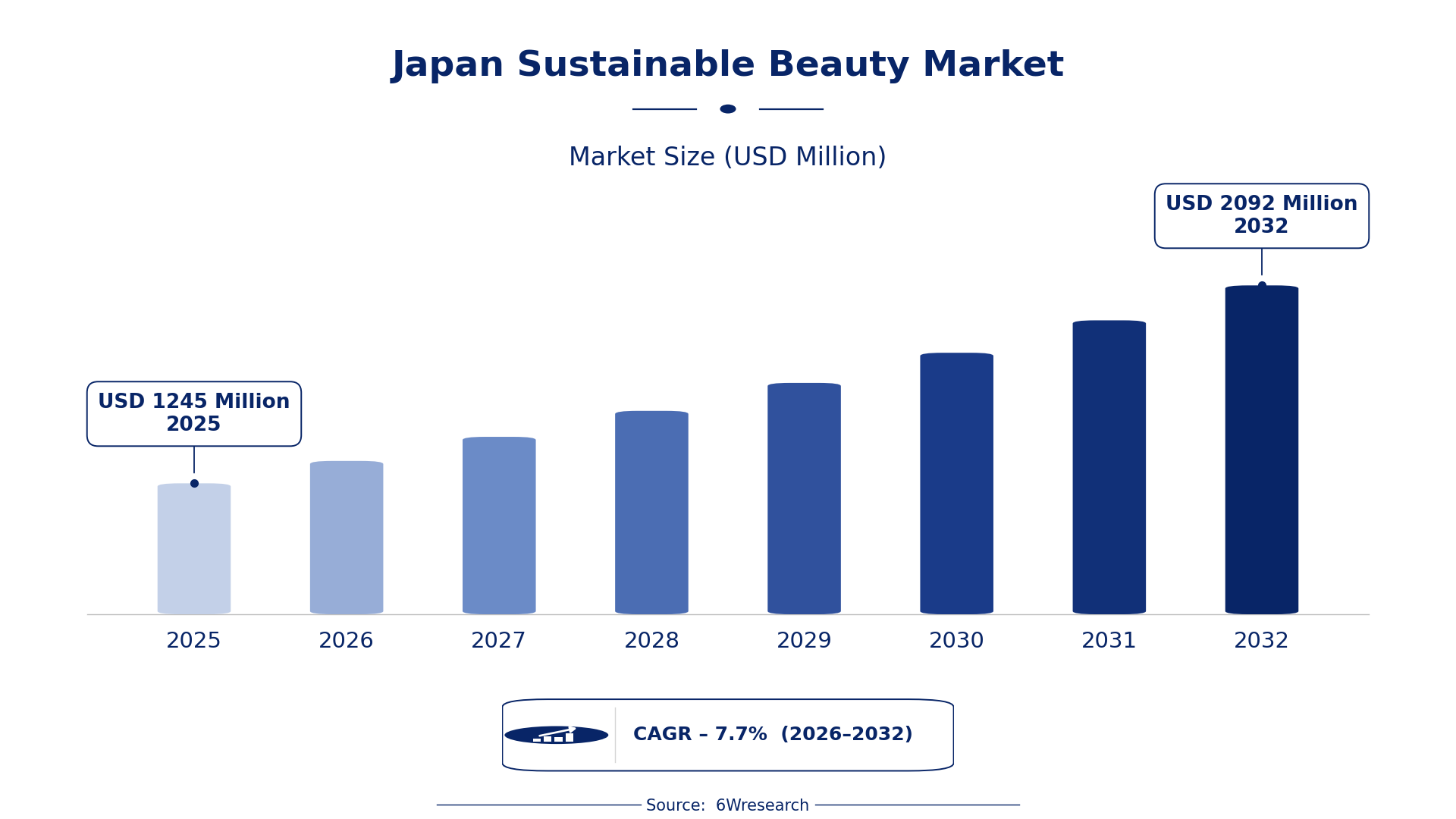
According to 6Wresearch internal database and industry insights, the Japan Sustainable Beauty Market was valued at USD 1,245 Million in 2025 and is projected to reach USD 2,092 Million by 2032, growing at a CAGR of approximately 7.7% during 2026–2032.
Japan Sustainable Beauty Market Highlights
| Report Metric | Details |
| Report Name | Japan Sustainable Beauty Market (2026-2032) |
| Market Size 2025 | USD 1,245 Million |
| Market Size 2032 | USD 2,092 Million |
| Absolute Growth 2025–2032 | USD 847 Million |
| CAGR 2026–2032 | 7.7% |
| Peak Annual Growth | 8.6% in 2027 |
| Forecast Period | 2026–2032 |
| Historical Data | 2022–2025 |
| Base Year | 2025 |
| Leading Product Type, 2025 | Organic Skincare (42% share) |
| Leading Ingredient Source, 2025 | Botanical/Essential Oils (35% share) |
| Leading Packaging Type, 2025 | Refillable Glass Jars (37% share) |
| Leading Distribution Channel, 2025 | Online Beauty Stores (42% share) |
| Fastest-Growing Product Type | Eco-Friendly Makeup (10.8% CAGR) |
| Fastest-Growing Ingredient Source | Vegan/Cruelty-Free (11.0% CAGR) |
| Fastest-Growing Packaging Type | Recyclable Compacts (11.2% CAGR) |
| Fastest-Growing Distribution Channel | Green Retail Chains (9.8% CAGR) |
| Growing Sector | Organic Skincare |
| Key End Users | eco-conscious consumers, beauty retailers, online beauty platforms, sustainable product manufacturers |
Japan Sustainable Beauty Market Year-wise Growth Rate and Key Drivers (2022–2032)
This graph illustrates the annual growth rates of the market from 2022 to 2032, highlighting a steady upward trajectory and projected market expansion over the forecast period.
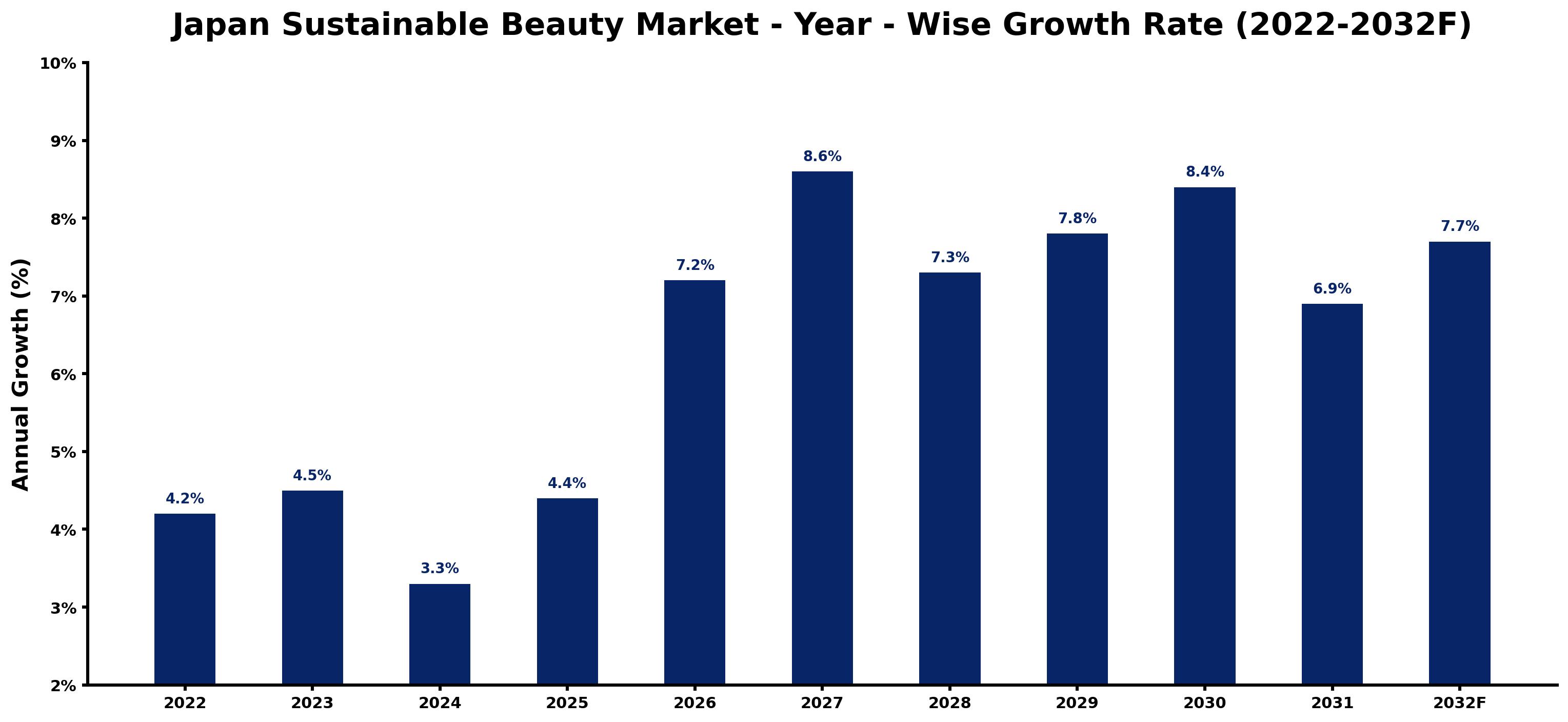
The table below sets out the estimated growth rate for each year and the main factor behind it.
| Year | Estimated Annual Growth (%) | Market Rationale |
| 2022 | 4.2 | The market experienced steady growth, reflecting increasing consumer interest in sustainability. |
| 2023 | 4.5 | Growth accelerated as more consumers sought eco-friendly beauty options. |
| 2024 | 3.3 | A slowdown occurred as consumers became more discerning about product claims. |
| 2025 | 4.4 | The market rebounded with renewed interest in organic skincare products. |
| 2026 | 7.2 | Growth is expected to surge as new eco-friendly brands enter the market. |
| 2027 | 8.6 | The peak growth year will see heightened demand for sustainable beauty products. |
| 2028 | 7.3 | A slight slowdown is projected as market saturation begins to set in. |
| 2029 | 7.8 | Demand is expected to pick up again, driven by innovative eco-friendly packaging solutions. |
| 2030 | 8.4 | Growth will remain strong as consumers increasingly prefer cruelty-free options. |
| 2031 | 6.9 | A slowdown is anticipated as competition intensifies among brands. |
| 2032 | 7.7 | Growth is expected to stabilise as the market matures. |
Note: Market size estimations and growth projections presented in this report are based on 6Wresearch's proprietary forecasting methodology, utilizing the latest available industry data, government publications, and primary research inputs.
Japan Sustainable Beauty Market Synopsis
Sustainable beauty products are formulated with eco-friendly ingredients and practices, focusing on minimal environmental impact. The Japan Sustainable Beauty Market is expanding, driven by rising consumer demand for organic skincare and eco-friendly makeup. With a population of approximately 125 million, many consumers prioritise sustainability, supported by initiatives from the Eco-Beauty Association and the Ministry of the Environment's eco-friendly packaging campaign, which aims to reduce waste in the beauty industry.
Market Dynamics Impact Analysis (2026–2032)
| Factor | Type | Impact | Primary Segment Affected |
| Growing consumer preference for eco-friendly products | Driver | High | Organic Skincare |
| Increase in certified organic beauty brands | Driver | High | Eco-Friendly Makeup |
| Rising demand for chemical-free haircare products | Opportunity | High | Natural Haircare |
| Expansion of online beauty retail channels | Opportunity | High | Online Beauty Stores |
| Limited awareness of sustainable practices among consumers | Restraint | Medium | Clean Fragrance |
| Challenges in sourcing sustainable ingredients | Restraint | Medium | Vegan/Cruelty-Free |
| High production costs for sustainable packaging | Challenge | High | Refillable Glass Jars |
| Intense competition among emerging brands | Challenge | Medium | Recyclable Compacts |
Evaluation of Drivers in Japan Sustainable Beauty Market (2026–2032)
The main growth drivers and the segments they affect most are set out below.
| Drivers | Primary Segment Affected | Why It Matters (Evidence) |
| Consumer demand for organic ingredients | Organic Skincare | Approximately 100 certified organic beauty brands are driving purchases among eco-conscious consumers. |
| Popularity of cruelty-free products | Eco-Friendly Makeup | The increasing interest in cruelty-free options is leading to higher sales among ethical consumers. |
| Growth of online shopping | Natural Haircare | Online Beauty Stores captured a 42% market share in 2025, boosting demand for chemical-free products. |
| Focus on recyclable packaging | Clean Fragrance | 75% of new beauty products prioritise recyclable packaging, appealing to environmentally aware buyers. |
| Rising interest in non-toxic fragrances | Vegan/Cruelty-Free | The demand for non-toxic fragrances is increasing, particularly among younger consumers. |
Volumes grow on the back of a shift towards organic ingredients, with over 100 certified organic beauty brands building consumer trust. In 2023, the online beauty retail segment accounted for 42% of sales, driven by convenience and accessibility. The popularity of cruelty-free products is rising, supported by advocacy from various organisations. In addition, 75% of new beauty products now feature recyclable packaging, reflecting consumer demand for sustainability. Non-toxic fragrances are particularly appealing to millennials, who increasingly seek chemical-free options in urban settings.
Evaluation of Restraints in Japan Sustainable Beauty Market
The table below lists the restraints and the evidence behind each.
| Market Restraint | Primary Segment Affected | Why It Matters (Evidence) |
| Limited consumer awareness of sustainable practices | Clean Fragrance | Many consumers remain unaware of the benefits of eco-friendly products, limiting market growth opportunities and affecting sales. |
| Challenges in sourcing sustainable ingredients | Vegan/Cruelty-Free | Sourcing eco-friendly materials can be difficult, impacting production timelines and increasing costs for manufacturers. |
| High production costs for sustainable packaging | Refillable Glass Jars | The costs associated with sustainable packaging solutions can deter some manufacturers from entering the market. |
| Intense competition among emerging brands | Recyclable Compacts | The influx of new brands creates a crowded market, making differentiation challenging for established players. |
| Consumer scepticism about product claims | Organic Skincare | Skepticism regarding the authenticity of sustainability claims can hinder purchasing decisions and affect sales. |
Japan Sustainable Beauty Market Challenges
In 2023, buyers face increased prices for sustainable beauty products due to a shortage of eco-friendly ingredients, which can inflate costs by 20% and limit purchasing options for retailers. Competition intensifies as numerous new brands enter the market, triggering price reductions that squeeze profit margins for established producers. Many suppliers struggle with outdated technology; only 30% have adopted advanced eco-packaging, causing delays in product launches and restricting market access. A lack of skilled formulators hampers producers, resulting in extended development times and potential revenue losses for brands unable to satisfy the rising consumer demand for sustainable options.
Trends in the Japan Sustainable Beauty Market
These developments are changing demand patterns in the Japan Sustainable Beauty Market.
- Shift towards Eco-Friendly Packaging in Tokyo: Tokyo is experiencing a notable shift towards eco-friendly packaging, with 75% of new beauty products prioritising recyclability. This trend aligns with consumer demand for sustainable options, prompting brands to innovate in their packaging solutions.
- Emergence of Vegan Beauty Products: Since 2022, the vegan beauty segment has gained traction, with a CAGR of 11.0%. This growth reflects a broader consumer preference for cruelty-free options, supported by advocacy from various organisations.
- Rise of Online Beauty Retailing: The online beauty retail sector has expanded significantly, capturing 42% of market share in 2025. This growth is driven by consumer preference for convenience and access to a wide range of sustainable products.
- Increased Demand for Organic Skincare: The organic skincare segment is projected to grow significantly by 2025, driven by consumer interest in natural ingredients and eco-friendly formulations. This trend is reshaping product offerings across the market.
Investment Opportunities in the Japan Sustainable Beauty Market
Several openings in the Japan Sustainable Beauty Market merit attention from investors.
- Partner with Local Eco-Friendly Brands: Now is an excellent time to invest in partnerships with local eco-friendly brands, as Japan has over 100 certified organic beauty brands. Collaborating with these brands can improve market presence and credibility.
- Invest in Recyclable Packaging Solutions: With 75% of new beauty products focusing on recyclable packaging, suppliers should invest in sustainable packaging technologies to meet growing consumer expectations. This is particularly relevant for brands targeting urban millennials.
- Focus on Vegan and Cruelty-Free Products: The increasing demand for vegan beauty products presents a strong opportunity for suppliers. Engaging with advocacy groups can facilitate market entry and brand recognition.
- Expand Online Distribution Channels: The rise of online beauty stores offers a significant opportunity for growth. Establishing a strong online presence can attract eco-conscious consumers seeking sustainable beauty options.
Government Initiatives in the Japan Sustainable Beauty Market
The Standards for Cosmetics, established in 2000, require all cosmetics sold in Japan to adhere to strict ingredient regulations. This measure ensures that producers meet safety and sustainability standards, thereby building consumer trust in sustainable beauty products. Furthermore, over 100 certified organic beauty brands are now operating under these regulations, enhancing the market's credibility.
In 2023, a campaign promoting eco-friendly packaging was launched, aiming to reduce waste in the beauty industry. This initiative is backed by the Eco-Beauty Association, which encourages sustainable practices among beauty brands, thereby supporting the growth of the sustainable beauty market.
Future Insight of the Japan Sustainable Beauty Market
By 2032, Japan's sustainable beauty market will transform as government-led initiatives encourage eco-friendly practices, prompting suppliers to innovate product offerings. Stricter sustainability standards will compel brands to enhance transparency in sourcing, fostering consumer trust. The push for cruelty-free products will expand, appealing to a wider audience and driving brand loyalty. With the Ministry of the Environment's campaign, 50% of new beauty products will incorporate recyclable packaging, aligning with consumer expectations for sustainability and responsible consumption.
Market Segmentation Analysis
Japan Sustainable Beauty Market report covers a detailed analysis of the following market segments:
By Product Type – Organic Skincare Leads, Eco-Friendly Makeup Expected to Grow Fastest
According to Prakhar Dixit, Senior Research Analyst at 6Wresearch, Organic Skincare accounted for 42% of the market by product type in 2025. Organic Skincare commands the largest share due to its widespread use in daily skincare routines, appealing to consumers who value sustainability. Urban centres like Tokyo showcase strong demand for these eco-friendly products, reflecting a robust installed base among environmentally conscious buyers. Eco-Friendly Makeup is set to record the highest CAGR in this split, 10.8% over 2026–2032. Eco-Friendly Makeup is experiencing rapid growth as it resonates with younger consumers increasingly aware of environmental impacts. This segment's expansion is supported by a rising number of brands introducing sustainable makeup options tailored to these preferences. Suppliers need to focus on eco-friendly makeup development to meet the increasing consumer demand in this segment.
By Ingredient Source – Botanical/Essential Oils Lead, Vegan/Cruelty-Free Expected to Grow Fastest
The largest ingredient source category in 2025 was Botanical/Essential Oils, at 35% of revenue. Botanical/Essential Oils lead the market as they are essential ingredients in many sustainable beauty products, appealing to environmentally conscious consumers. The increasing number of certified organic beauty brands in Japan further supports their popularity among buyers. Vegan/Cruelty-Free is projected to grow fastest, at a CAGR of 11.0% during 2026–2032. Vegan/Cruelty-Free ingredients are becoming increasingly important as consumers focus on ethical choices, particularly in urban areas where awareness of animal welfare is prominent. This trend will likely persist as more brands adopt cruelty-free practices to satisfy consumer expectations. Buyers are expected to prefer products that emphasise vegan and cruelty-free ingredients, influencing suppliers to adapt their offerings.
By Packaging Type – Refillable Glass Jars Lead, Recyclable Compacts Expected to Grow Fastest
Refillable Glass Jars held 37% of the Japan Sustainable Beauty Market by packaging type in 2025. Refillable Glass Jars are preferred by consumers aiming to reduce waste, making them a popular choice among sustainable beauty products. This trend is particularly strong in urban areas where eco-consciousness is prevalent. Over 2026–2032, Recyclable Compacts are expected to post the fastest growth, at a CAGR of 11.2%. Recyclable Compacts are rapidly gaining popularity as consumers seek convenient and sustainable packaging solutions that align with their values. The focus on recyclable materials is expected to grow as more brands respond to consumer demand for eco-friendly options. Suppliers should prioritise the development of recyclable packaging to meet the increasing consumer preference for sustainability.
By Distribution Channel – Online Beauty Stores Lead, Green Retail Chains Expected to Grow Fastest
Online Beauty Stores took 42% of distribution channel revenue in 2025, more than any other category. Online Beauty Stores are the primary distribution channel for sustainable beauty products, offering consumers easy access to a diverse range of eco-friendly options. This channel's popularity is particularly strong among younger consumers who favour the convenience of online shopping. The quickest growth will come from Green Retail Chains, forecast to expand at a CAGR of 9.8% between 2026 and 2032. Green Retail Chains are emerging as a rapidly growing channel, specifically catering to consumers looking for eco-friendly products in physical stores. The rise of these specialised retailers indicates a broader shift towards sustainability in the shopping experience. Suppliers should explore partnerships with green retail chains to expand their market presence and attract eco-conscious consumers.
Key Attractiveness of the Report
- 10 Years of Market Numbers
- Historical Data Starting from 2022 to 2025
- Base Year 2025
- Forecast Data until 2032
- Key Performance Indicators Impacting the Market
- Major Upcoming Developments and Projects
Key Highlights of the Report:
- Japan Sustainable Beauty Market Outlook
- Market Size of Japan Sustainable Beauty Market, 2025
- Forecast of Japan Sustainable Beauty Market, 2032
- Historical Data and Forecast of Japan Sustainable Beauty Revenues & Volume for the Period 2022-2032F
- Japan Sustainable Beauty Market Trend Evolution
- Japan Sustainable Beauty Market Drivers and Challenges
- Japan Sustainable Beauty Price Trends
- Japan Sustainable Beauty Porter's Five Forces
- Japan Sustainable Beauty Industry Life Cycle
- Historical Data and Forecast of Japan Sustainable Beauty Market Revenues & Volume By Product Type for the Period 2022-2032F
- Historical Data and Forecast of Japan Sustainable Beauty Market Revenues & Volume By Organic Skincare for the Period 2022-2032F
- Historical Data and Forecast of Japan Sustainable Beauty Market Revenues & Volume By Eco-Friendly Makeup for the Period 2022-2032F
- Historical Data and Forecast of Japan Sustainable Beauty Market Revenues & Volume By Natural Haircare for the Period 2022-2032F
- Historical Data and Forecast of Japan Sustainable Beauty Market Revenues & Volume By Clean Fragrance for the Period 2022-2032F
- Historical Data and Forecast of Japan Sustainable Beauty Market Revenues & Volume By Ingredient Source for the Period 2022-2032F
- Historical Data and Forecast of Japan Sustainable Beauty Market Revenues & Volume By Botanical/Essential Oils for the Period 2022-2032F
- Historical Data and Forecast of Japan Sustainable Beauty Market Revenues & Volume By Vegan/Cruelty-Free for the Period 2022-2032F
- Historical Data and Forecast of Japan Sustainable Beauty Market Revenues & Volume By Paraben-Free for the Period 2022-2032F
- Historical Data and Forecast of Japan Sustainable Beauty Market Revenues & Volume By Plant-Derived Scents for the Period 2022-2032F
- Historical Data and Forecast of Japan Sustainable Beauty Market Revenues & Volume By Packaging Type for the Period 2022-2032F
- Historical Data and Forecast of Japan Sustainable Beauty Market Revenues & Volume By Refillable Glass Jars for the Period 2022-2032F
- Historical Data and Forecast of Japan Sustainable Beauty Market Revenues & Volume By Recyclable Compacts for the Period 2022-2032F
- Historical Data and Forecast of Japan Sustainable Beauty Market Revenues & Volume By Recycled Plastic Bottles for the Period 2022-2032F
- Historical Data and Forecast of Japan Sustainable Beauty Market Revenues & Volume By Biodegradable Tubes for the Period 2022-2032F
- Historical Data and Forecast of Japan Sustainable Beauty Market Revenues & Volume By Distribution Channel for the Period 2022-2032F
- Historical Data and Forecast of Japan Sustainable Beauty Market Revenues & Volume By Online Beauty Stores for the Period 2022-2032F
- Historical Data and Forecast of Japan Sustainable Beauty Market Revenues & Volume By Green Retail Chains for the Period 2022-2032F
- Historical Data and Forecast of Japan Sustainable Beauty Market Revenues & Volume By Supermarkets for the Period 2022-2032F
- Historical Data and Forecast of Japan Sustainable Beauty Market Revenues & Volume By Boutique Stores for the Period 2022-2032F
- Japan Sustainable Beauty Import Export Trade Statistics
- Market Opportunity Assessment By Product Type
- Market Opportunity Assessment By Ingredient Source
- Market Opportunity Assessment By Packaging Type
- Market Opportunity Assessment By Distribution Channel
- Japan Sustainable Beauty Top Companies Market Share
- Japan Sustainable Beauty Competitive Benchmarking By Technical and Operational Parameters
- Japan Sustainable Beauty Company Profiles
- Japan Sustainable Beauty Key Strategic Recommendations
Market Covered
The study includes the following segmentation.
By Product Type
- Organic Skincare
- Eco-Friendly Makeup
- Natural Haircare
- Clean Fragrance
By Ingredient Source
- Botanical/Essential Oils
- Vegan/Cruelty-Free
- Paraben-Free
- Plant-Derived Scents
By Packaging Type
- Refillable Glass Jars
- Recyclable Compacts
- Recycled Plastic Bottles
- Biodegradable Tubes
By Distribution Channel
- Online Beauty Stores
- Green Retail Chains
- Supermarkets
- Boutique Stores































