Japan Sustainable Beverage Packaging Market Size & Growth Rate
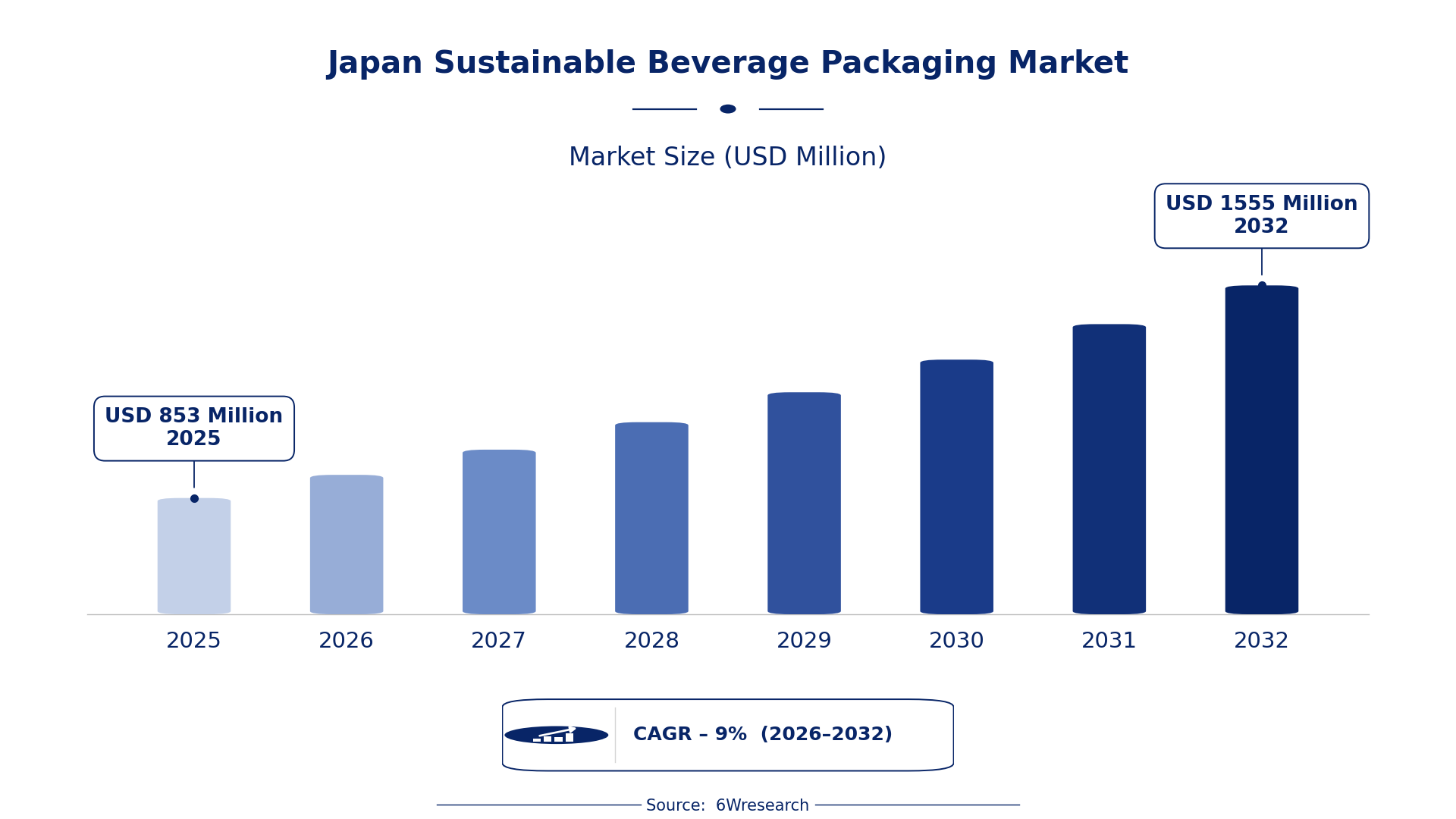
According to 6Wresearch internal database and industry insights, the Japan Sustainable Beverage Packaging Market was valued at USD 853 Million in 2025 and is projected to reach USD 1,555 Million by 2032, growing at a CAGR of approximately 9% during 2026–2032.
Japan Sustainable Beverage Packaging Market Highlights
| Report Metric | Details |
| Report Name | Japan Sustainable Beverage Packaging Market (2026-2032) |
| Market Size 2025 | USD 853 Million |
| Market Size 2032 | USD 1,555 Million |
| Absolute Growth 2025–2032 | USD 702 Million |
| CAGR 2026–2032 | 9% |
| Peak Annual Growth | 10.9% in 2026 |
| Forecast Period | 2026–2032 |
| Historical Data | 2022–2025 |
| Base Year | 2025 |
| Leading Packaging Type, 2025 | Aluminum Cans (36% share) |
| Leading Material Type, 2025 | PLA/Bio-PET (45% share) |
| Leading Beverage Type, 2025 | Carbonated Drinks (39% share) |
| Leading End User, 2025 | Beverage Manufacturers (45% share) |
| Fastest-Growing Packaging Type | Compostable Bottles (12.4% CAGR) |
| Fastest-Growing Beverage Type | Dairy/Plant-Based Drinks (12.9% CAGR) |
| Fastest-Growing End User | Dairy Producers (11.3% CAGR) |
| Growing Sector | beverage packaging |
| Key End Users | beverage manufacturers, dairy producers, soft drink brands, breweries/wineries |
Japan Sustainable Beverage Packaging Market Year-wise Growth Rate and Key Drivers (2022–2032)
This graph illustrates the annual growth rates of the market from 2022 to 2032, highlighting a steady upward trajectory and projected market expansion over the forecast period.

The yearly estimates that follow link every growth rate to its principal driver, so readers can see why the pace changed in each period.
| Year | Estimated Annual Growth (%) | Market Rationale |
| 2022 | 4.5 | The market showed solid growth, reflecting the rising consumer preference for sustainable solutions. |
| 2023 | 4.8 | Demand increased as consumers became more aware of environmental issues and their impact. |
| 2024 | 3.7 | Growth slowed as manufacturers adjusted to evolving sustainability standards and practices. |
| 2025 | 4.9 | The market rebounded with stronger adoption of eco-friendly packaging by beverage producers. |
| 2026 | 10.9 | Demand is expected to surge as investments in sustainable technologies reach new heights. |
| 2027 | 9.4 | Growth is projected to slow slightly as market saturation begins to set in. |
| 2028 | 9.2 | The market will continue to grow, driven by ongoing consumer demand for sustainable options. |
| 2029 | 8.9 | Growth is expected to slow further as competition intensifies among packaging solutions. |
| 2030 | 8.6 | The market will maintain a steady pace as companies focus on innovation in sustainable materials. |
| 2031 | 7.4 | Growth is projected to slow as the market approaches maturity, with established players dominating. |
| 2032 | 8.3 | Demand is expected to rise again as new technologies emerge in sustainable packaging. |
Note: Market size estimations and growth projections presented in this report are based on 6Wresearch's proprietary forecasting methodology, utilizing the latest available industry data, government publications, and primary research inputs.
Japan Sustainable Beverage Packaging Market Synopsis
Sustainable beverage packaging includes eco-friendly solutions made from renewable or recycled materials, designed to minimise environmental impact. The Japan Sustainable Beverage Packaging Market is valued at approximately 1 trillion JPY, driven by a growing emphasis on sustainability among consumers and manufacturers. Initiatives such as the Plastic Resource Circulation Strategy launched in 2023 fuel demand for sustainable packaging solutions across various beverage types, including juices, dairy drinks, and alcoholic beverages.
Market Dynamics Impact Analysis (2026–2032)
| Factor | Type | Impact | Primary Segment Affected |
| Growing consumer demand for eco-friendly products | Driver | High | Compostable Bottles |
| Increased investment in sustainable packaging technologies | Driver | High | PLA/Bio-PET |
| Expansion of recycling infrastructure and initiatives | Opportunity | High | Recyclable Cartons |
| Rising regulations promoting sustainable practices | Opportunity | Medium | Aluminum Cans |
| Challenges in sourcing sustainable materials | Restraint | High | Glass Bottles |
| Cost implications of transitioning to sustainable packaging | Restraint | Medium | High-Recycled Content |
| Limited consumer awareness about sustainable options | Challenge | High | Compostable Bottles |
| Competition from traditional packaging materials | Challenge | Medium | Recyclable Cartons |
Evaluation of Drivers in Japan Sustainable Beverage Packaging Market (2026–2032)
The main growth drivers and the segments they affect most are set out below.
| Drivers | Primary Segment Affected | Why It Matters (Evidence) |
| Increased consumer awareness of environmental issues | Compostable Bottles | This awareness drives beverage manufacturers to adopt eco-friendly packaging solutions, with compostable bottles projected to capture 20% of the market by 2025. |
| Investments in sustainable technologies by manufacturers | PLA/Bio-PET | These investments enable the production of high-quality sustainable materials, leading to a projected market share of 45% by 2025. |
| Government initiatives promoting recycling and sustainability | Recyclable Cartons | These initiatives support the growth of recyclable cartons, which currently account for 30% of the beverage packaging market. |
| Consumer preference for lightweight and sustainable packaging | Lightweight Glass | This preference is driving demand for lightweight glass, which is increasingly adopted in premium beverage segments. |
| Rising regulations on plastic waste reduction | Aluminum Cans | These regulations encourage the use of aluminum cans, which are popular for carbonated drinks and align with sustainability goals. |
What keeps demand rising is the increasing consumer awareness of environmental issues, prompting beverage manufacturers to adopt eco-friendly packaging solutions. In 2023, the market for sustainable packaging reached approximately 1 trillion JPY, fuelled by investments in sustainable technologies. The adoption of PLA/Bio-PET is projected to capture 45% of the market by 2025, as manufacturers focus on high-quality materials. The shift towards lightweight glass is also notable, as premium beverage segments increasingly adopt this sustainable option.
Evaluation of Restraints in Japan Sustainable Beverage Packaging Market
The key brakes on demand, and where they bite hardest, are shown below.
| Market Restraint | Primary Segment Affected | Why It Matters (Evidence) |
| Challenges in sourcing sustainable materials | Compostable Bottles | Limited availability of high-quality sustainable materials can hinder production, impacting manufacturers' ability to meet demand. |
| Cost implications of transitioning to sustainable packaging | High-Recycled Content | The initial investment for sustainable packaging can be high, affecting the financial viability for smaller producers. |
| Limited consumer awareness about sustainable options | Recyclable Cartons | Many consumers remain unaware of the benefits of sustainable packaging, limiting market growth potential. |
| Competition from traditional packaging materials | Glass Bottles | Traditional materials often have lower costs, making it challenging for sustainable alternatives to compete effectively. |
| Regulatory compliance costs | Aluminum Cans | Manufacturers face costs associated with meeting new sustainability regulations, impacting overall profitability. |
Japan Sustainable Beverage Packaging Market Challenges
Access to renewable packaging materials is a critical issue, as local producers struggle to secure sufficient supplies. This challenge arises from Japan's declining population, which has reduced the availability of raw materials and delayed production timelines for beverage manufacturers. A shortage of skilled workers in environmental management further complicates the situation, costing producers approximately 10% of potential revenue due to inefficiencies. Compliance with regulations like the 'Green Purchasing Law' incurs additional costs for manufacturers, limiting their ability to invest in innovative packaging solutions.
Trends in the Japan Sustainable Beverage Packaging Market
The following changes are redrawing the Japan Sustainable Beverage Packaging Market.
- Shift towards Lightweight Glass Packaging: Urban areas like Tokyo are experiencing a shift towards lightweight glass packaging, driven by consumer demand for premium beverages. In 2023, the government introduced incentives for companies using this type of packaging, aiming to reduce overall plastic waste.
- Increase in Compostable Bottle Usage: Compostable bottles are gaining traction in Japan, with projections indicating they will reach 20% of the beverage packaging market by 2025. This shift reflects a broader trend towards eco-friendly solutions in the beverage industry.
- Growing Adoption of PLA/Bio-PET: The use of PLA/Bio-PET is increasing, with manufacturers focusing on sustainable materials that meet consumer demands. By 2025, this material is expected to hold a 45% market share in beverage packaging.
- Expansion of Recycling Initiatives: Japan is enhancing its recycling initiatives, particularly in urban areas like Tokyo, where beverage manufacturers are encouraged to adopt recyclable cartons. Currently, recyclable cartons account for 30% of the beverage packaging market.
Investment Opportunities in the Japan Sustainable Beverage Packaging Market
The following opportunities in the Japan Sustainable Beverage Packaging Market pair current demand with a clear way in.
- Supply of Compostable Bottles: With the projected growth of compostable bottles to 20% of the market by 2025, suppliers can focus on producing these eco-friendly options. Beverage manufacturers are increasingly seeking sustainable packaging solutions.
- Investment in Recycling Infrastructure: There is a growing need for improved recycling infrastructure in urban areas, particularly in Tokyo. Investing in this infrastructure can help meet the rising demand for recyclable packaging solutions.
- Partnerships for Sustainable Packaging Solutions: Forming partnerships with local beverage manufacturers can facilitate entry into the sustainable packaging market. With the market valued at approximately 1 trillion JPY, opportunities abound for collaboration.
- Development of High-Recycled Content Materials: The demand for high-recycled content materials is increasing as consumers seek eco-conscious products. The Japan Paper Association supports initiatives to promote these materials, creating investment opportunities.
Government Initiatives in the Japan Sustainable Beverage Packaging Market
The Plastic Resource Circulation Act (2021) promotes the reduction, reuse, and recycling of plastics, encouraging producers to adopt sustainable practices. This act supports the transition to alternatives like biodegradable plastics, ensuring that manufacturers comply with environmental standards while meeting consumer demands. The act has led to increased investments in sustainable packaging, with the government allocating 500 million JPY in 2023 for related initiatives.
In 2023, beverage manufacturers are utilising the funding from the Ministry of the Environment to enhance their sustainable packaging practices. This support is aimed at reducing plastic waste and improving recycling efforts, benefiting companies that adopt eco-friendly materials and methods.
Future Insight of the Japan Sustainable Beverage Packaging Market
Advancements in recycling technology will reshape demand for sustainable packaging by 2032, enabling better material recovery and utilisation. The market for compostable bottles is projected to reach 20% by 2025, reflecting a shift towards eco-friendly alternatives. Government funding of 500 million JPY for sustainable initiatives will encourage suppliers to innovate and adopt greener practices. As Japan aims for a 25% reduction in plastic waste by 2030, buyers will increasingly seek packaging that aligns with these sustainability goals.
Market Segmentation Analysis
Japan Sustainable Beverage Packaging Market report covers a detailed analysis of the following market segments:
By Packaging Type – Aluminum Cans Lead, Compostable Bottles Expected to Grow Fastest
According to Saurav Kr Singh, Senior Research Analyst at 6Wresearch, Aluminum Cans took 36% of packaging type revenue in 2025, more than any other category. Aluminum cans hold the largest share in Japan's sustainable beverage packaging market due to their extensive use for carbonated drinks, which are highly favoured by consumers. The concentration of beverage manufacturers in the Tokyo region further amplifies the demand for this packaging type. Compostable Bottles are projected to grow fastest, at a CAGR of 12.4% during 2026–2032. The rapid growth of compostable bottles is driven by the rising consumer preference for eco-friendly packaging solutions, with projections indicating they will capture 20% of the market by 2025. As sustainability becomes increasingly important, aluminum cans will continue to solidify their leading position. Suppliers should prioritise their offerings in aluminum cans while also developing compostable bottle solutions to align with consumer expectations.
By Material Type – PLA/Bio-PET Leads and Records the Fastest Growth
PLA/Bio-PET held 45% of the Japan Sustainable Beverage Packaging Market by material type in 2025. PLA/Bio-PET leads the market as it is widely adopted for sustainable packaging, aligning with the increasing emphasis on environmental management standards like ISO 14001. This material's compatibility with various beverage types further solidifies its dominant position. The same category is also set to grow fastest, at a CAGR of 10.7% during 2026–2032. The rapid growth of PLA/Bio-PET is driven by its versatility and alignment with sustainability goals, making it a preferred choice among manufacturers. Its established market presence will likely expand as more companies adopt sustainable practices. Buyers are encouraged to prioritise suppliers who offer PLA/Bio-PET solutions to align with sustainability initiatives and regulatory requirements.
By Beverage Type – Carbonated Drinks Lead, Dairy/Plant-Based Drinks Expected to Grow Fastest
With 39% of beverage type revenue in 2025, Carbonated Drinks was the largest category. Carbonated drinks hold the largest share of the beverage packaging segment, largely due to their extensive consumption across various social occasions in Japan. This consistent demand drives manufacturers to prioritise sustainable packaging solutions for these products. The quickest growth will come from Dairy/Plant-Based Drinks, forecast to expand at a CAGR of 12.9% between 2026 and 2032. Dairy and plant-based drinks are experiencing notable growth, propelled by a rising consumer preference for healthier and environmentally friendly options. This trend indicates that the market for sustainable packaging will expand rapidly as these beverages gain popularity. Suppliers must adapt their offerings to meet the increasing demand for sustainable packaging in the dairy and plant-based beverage sector.
By End User – Beverage Manufacturers Lead, Dairy Producers Expected to Grow Fastest
The largest end user category in 2025 was Beverage Manufacturers, at 45% of revenue. Beverage manufacturers are the main consumers of sustainable packaging, driven by the need to comply with environmental regulations and cater to consumer preferences for eco-friendly products. Their substantial investments in sustainable practices propel the market forward. Over 2026–2032, Dairy Producers are expected to post the fastest growth, at a CAGR of 11.3%. Dairy producers are increasingly adopting sustainable practices in response to the rising consumer demand for environmentally friendly packaging solutions. This trend is expected to accelerate as sustainability becomes integral to the dairy sector. Suppliers must collaborate with dairy producers to provide customised sustainable packaging solutions that align with their operational goals.
Key Attractiveness of the Report
- 10 Years of Market Numbers
- Historical Data Starting from 2022 to 2025
- Base Year 2025
- Forecast Data until 2032
- Key Performance Indicators Impacting the Market
- Major Upcoming Developments and Projects
Key Highlights of the Report:
- Japan Sustainable Beverage Packaging Market Outlook
- Market Size of Japan Sustainable Beverage Packaging Market, 2025
- Forecast of Japan Sustainable Beverage Packaging Market, 2032
- Historical Data and Forecast of Japan Sustainable Beverage Packaging Revenues & Volume for the Period 2022-2032F
- Japan Sustainable Beverage Packaging Market Trend Evolution
- Japan Sustainable Beverage Packaging Market Drivers and Challenges
- Japan Sustainable Beverage Packaging Price Trends
- Japan Sustainable Beverage Packaging Porter's Five Forces
- Japan Sustainable Beverage Packaging Industry Life Cycle
- Historical Data and Forecast of Japan Sustainable Beverage Packaging Market Revenues & Volume By Packaging Type for the Period 2022-2032F
- Historical Data and Forecast of Japan Sustainable Beverage Packaging Market Revenues & Volume By Compostable Bottles for the Period 2022-2032F
- Historical Data and Forecast of Japan Sustainable Beverage Packaging Market Revenues & Volume By Recyclable Cartons for the Period 2022-2032F
- Historical Data and Forecast of Japan Sustainable Beverage Packaging Market Revenues & Volume By Aluminum Cans for the Period 2022-2032F
- Historical Data and Forecast of Japan Sustainable Beverage Packaging Market Revenues & Volume By Glass Bottles for the Period 2022-2032F
- Historical Data and Forecast of Japan Sustainable Beverage Packaging Market Revenues & Volume By Material Type for the Period 2022-2032F
- Historical Data and Forecast of Japan Sustainable Beverage Packaging Market Revenues & Volume By PLA/Bio-PET for the Period 2022-2032F
- Historical Data and Forecast of Japan Sustainable Beverage Packaging Market Revenues & Volume By Paperboard for the Period 2022-2032F
- Historical Data and Forecast of Japan Sustainable Beverage Packaging Market Revenues & Volume By High-Recycled Content for the Period 2022-2032F
- Historical Data and Forecast of Japan Sustainable Beverage Packaging Market Revenues & Volume By Lightweight Glass for the Period 2022-2032F
- Historical Data and Forecast of Japan Sustainable Beverage Packaging Market Revenues & Volume By Beverage Type for the Period 2022-2032F
- Historical Data and Forecast of Japan Sustainable Beverage Packaging Market Revenues & Volume By Juices & Teas for the Period 2022-2032F
- Historical Data and Forecast of Japan Sustainable Beverage Packaging Market Revenues & Volume By Dairy/Plant-Based Drinks for the Period 2022-2032F
- Historical Data and Forecast of Japan Sustainable Beverage Packaging Market Revenues & Volume By Carbonated Drinks for the Period 2022-2032F
- Historical Data and Forecast of Japan Sustainable Beverage Packaging Market Revenues & Volume By Alcoholic Beverages for the Period 2022-2032F
- Historical Data and Forecast of Japan Sustainable Beverage Packaging Market Revenues & Volume By End User for the Period 2022-2032F
- Historical Data and Forecast of Japan Sustainable Beverage Packaging Market Revenues & Volume By Beverage Manufacturers for the Period 2022-2032F
- Historical Data and Forecast of Japan Sustainable Beverage Packaging Market Revenues & Volume By Dairy Producers for the Period 2022-2032F
- Historical Data and Forecast of Japan Sustainable Beverage Packaging Market Revenues & Volume By Soft Drink Brands for the Period 2022-2032F
- Historical Data and Forecast of Japan Sustainable Beverage Packaging Market Revenues & Volume By Breweries/Wineries for the Period 2022-2032F
- Japan Sustainable Beverage Packaging Import Export Trade Statistics
- Market Opportunity Assessment By Packaging Type
- Market Opportunity Assessment By Material Type
- Market Opportunity Assessment By Beverage Type
- Market Opportunity Assessment By End User
- Japan Sustainable Beverage Packaging Top Companies Market Share
- Japan Sustainable Beverage Packaging Competitive Benchmarking By Technical and Operational Parameters
- Japan Sustainable Beverage Packaging Company Profiles
- Japan Sustainable Beverage Packaging Key Strategic Recommendations
Market Covered
Segments analysed in this report are listed below.
By Packaging Type
- Compostable Bottles
- Recyclable Cartons
- Aluminum Cans
- Glass Bottles
By Material Type
- PLA/Bio-PET
- Paperboard
- High-Recycled Content
- Lightweight Glass
By Beverage Type
- Juices & Teas
- Dairy/Plant-Based Drinks
- Carbonated Drinks
- Alcoholic Beverages
By End User
- Beverage Manufacturers
- Dairy Producers
- Soft Drink Brands
- Breweries/Wineries































