Japan Sustainable Coatings Market Size & Growth Rate
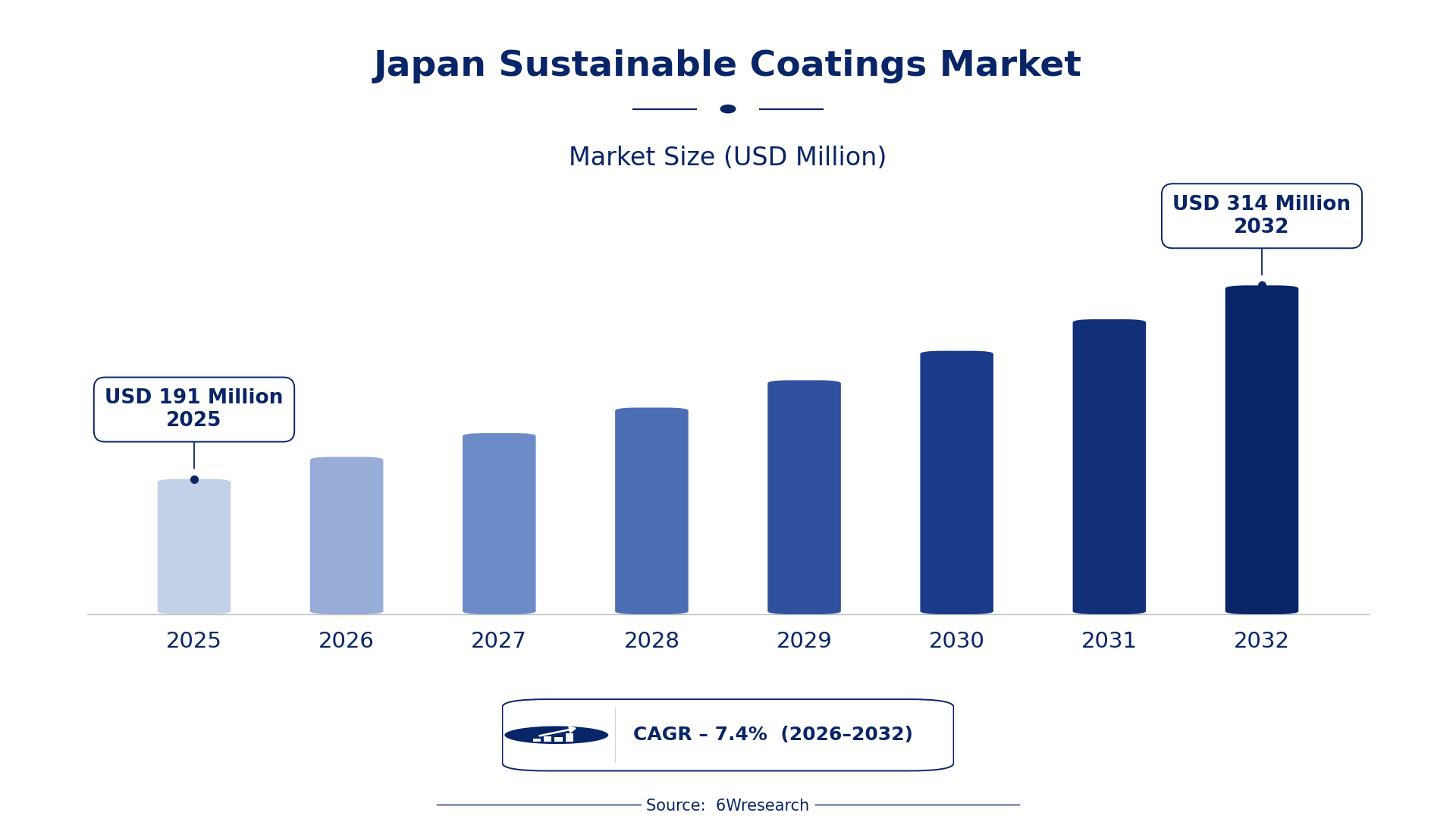
According to 6Wresearch internal database and industry insights, the Japan Sustainable Coatings Market was valued at USD 191 Million in 2025 and is projected to reach USD 314 Million by 2032, growing at a CAGR of approximately 7.4% during 2026–2032.
Japan Sustainable Coatings Market Highlights
| Report Metric | Details |
| Report Name | Japan Sustainable Coatings Market (2026-2032) |
| Market Size 2025 | USD 191 Million |
| Market Size 2032 | USD 314 Million |
| Absolute Growth 2025–2032 | USD 123 Million |
| CAGR 2026–2032 | 7.4% |
| Peak Annual Growth | 8.2% in 2027 |
| Forecast Period | 2026–2032 |
| Historical Data | 2022–2025 |
| Base Year | 2025 |
| Leading Coating Type, 2025 | Water-Based Coatings (41% share) |
| Leading Base Material, 2025 | Low-VOC Formulations (52% share) |
| Leading Application Segment, 2025 | Architecture & Construction (41% share) |
| Leading End User, 2025 | Paint Manufacturers (42% share) |
| Fastest-Growing Coating Type | Bio-Based Coatings (10.4% CAGR) |
| Fastest-Growing Base Material | Plant Oils & Resins (10.5% CAGR) |
| Fastest-Growing Application Segment | Wood & Furniture (9.9% CAGR) |
| Fastest-Growing End User | Industrial Coaters (9.2% CAGR) |
| Growing Sector | Construction |
| Key End Users | Paint Manufacturers, Automotive Manufacturers, Furniture Producers, Industrial Coaters |
Japan Sustainable Coatings Market Year-wise Growth Rate and Key Drivers (2022–2032)
This graph illustrates the annual growth rates of the market from 2022 to 2032, highlighting a steady upward trajectory and projected market expansion over the forecast period.
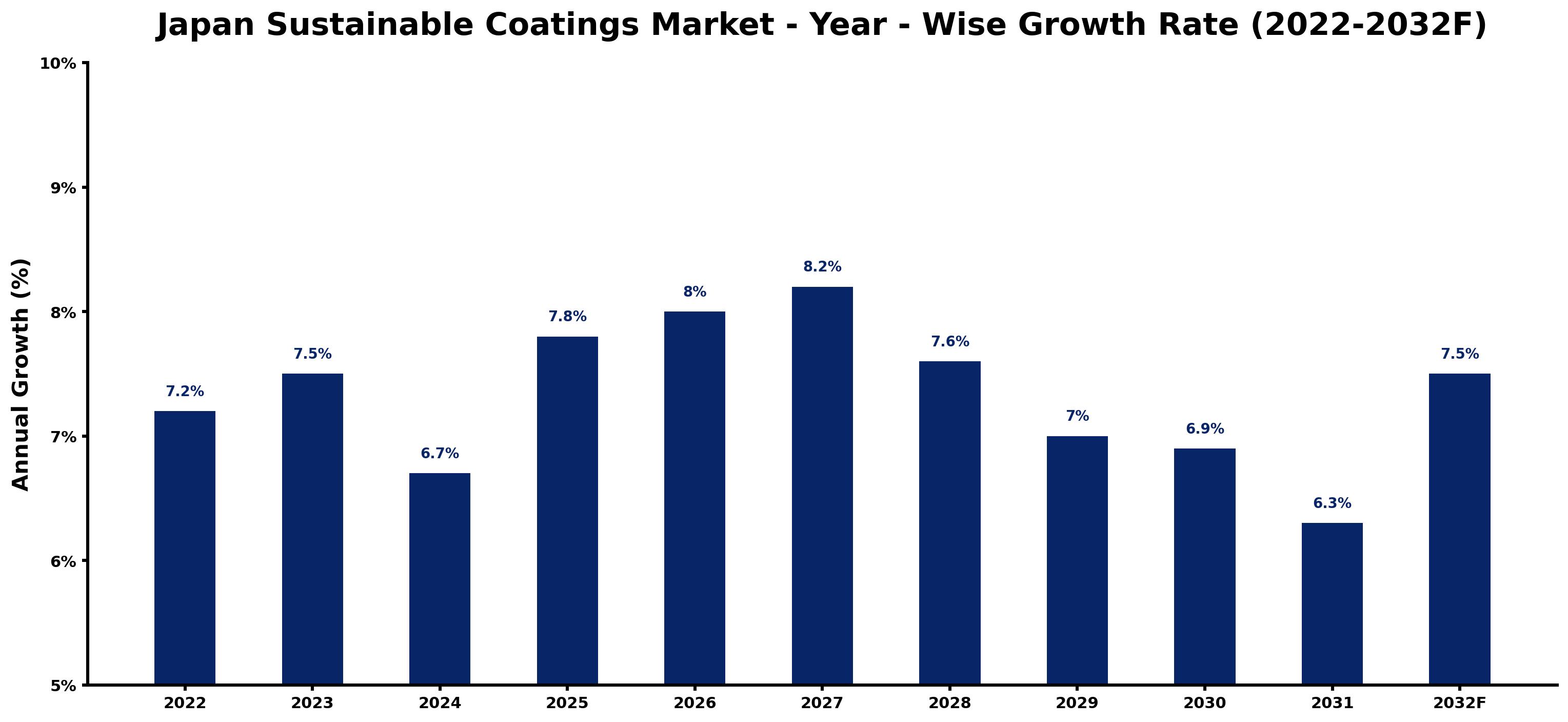
Year by year, the estimates below pair each growth rate with the development that shaped it.
| Year | Estimated Annual Growth (%) | Market Rationale |
| 2022 | 7.2 | The market showed strong growth due to rising eco-consciousness among consumers. |
| 2023 | 7.5 | Demand increased as construction projects expanded and automotive production rose. |
| 2024 | 6.7 | Growth slowed as market adjustments occurred following previous rapid expansion. |
| 2025 | 7.8 | The market rebounded with increased adoption of sustainable practices in various sectors. |
| 2026 | 8.0 | A surge in automotive manufacturing will drive higher demand for sustainable coatings. |
| 2027 | 8.2 | Eco-friendly initiatives will boost growth to its peak year. |
| 2028 | 7.6 | A slight slowdown will occur as market saturation begins in some segments. |
| 2029 | 7.0 | Growth will continue to decelerate as competition intensifies among suppliers. |
| 2030 | 6.9 | The market will maintain growth, albeit at a slower pace due to market maturity. |
| 2031 | 6.3 | A further slowdown will be observed as buyers become more selective in purchases. |
| 2032 | 7.5 | Demand is expected to rise again as new eco-friendly regulations are introduced. |
Note: Market size estimations and growth projections presented in this report are based on 6Wresearch's proprietary forecasting methodology, utilizing the latest available industry data, government publications, and primary research inputs.
Japan Sustainable Coatings Market Synopsis
Sustainable coatings are environmentally friendly products made from renewable resources or with low environmental impact, produced using advanced technologies that reduce volatile organic compounds. In Japan, the market is valued at approximately 200 million USD in 2023, driven by strong demand from the construction and automotive sectors. Government initiatives, such as the Chemical Substances Control Law, alongside the growing interest in eco-friendly products, stimulate investments in this sector, leading to increased adoption across various applications.
Market Dynamics Impact Analysis (2026–2032)
| Factor | Type | Impact | Primary Segment Affected |
| Rising construction activities in urban areas | Driver | High | Architecture & Construction |
| Increasing automotive production focusing on sustainability | Driver | High | Automotive Finishing |
| Growing demand for eco-friendly products among consumers | Opportunity | High | Wood & Furniture |
| Emerging regulations promoting low-VOC coatings | Opportunity | High | Water-Based Coatings |
| High production costs for sustainable materials | Restraint | Medium | Bio-Based Coatings |
| Limited awareness of sustainable options among consumers | Restraint | Medium | Powder Coatings |
| Compliance with stringent environmental regulations | Challenge | High | Low-VOC Formulations |
| Capacity constraints in production facilities | Challenge | Medium | UV-Curable Coatings |
Evaluation of Drivers in Japan Sustainable Coatings Market (2026–2032)
The table below links each growth driver to the segment it affects and the evidence for it.
| Drivers | Primary Segment Affected | Why It Matters (Evidence) |
| Urbanisation leading to increased construction | Architecture & Construction | The construction industry is projected to grow by 3% annually, increasing demand for sustainable coatings in building projects. |
| Automotive manufacturers shifting towards eco-friendly practices | Automotive Finishing | The automotive sector produced over 9 million vehicles in 2022, driving demand for sustainable coatings. |
| Consumer preference for eco-friendly products | Wood & Furniture | The growing interest in sustainable finishes is reflected among eco-conscious consumers in Japan, who represent 25% of the market. |
| Government initiatives promoting low-VOC coatings | Water-Based Coatings | The Chemical Substances Control Law encourages the use of low-VOC coatings in various applications, impacting 30% of the market. |
| Technological advancements in coating production | Powder Coatings | Innovations in production techniques are improving the durability and performance of powder coatings, increasing their market share. |
Several shifts outside the market lift sales. The construction industry is projected to grow by 3% annually, increasing the need for sustainable coatings in building projects. The automotive sector produced over 9 million vehicles in 2022, driving a surge in demand for these coatings. Consumer interest in eco-friendly products is clear, further boosting market growth. Innovations in production techniques are improving efficiency and product quality, allowing suppliers to meet rising demand effectively.
Evaluation of Restraints in Japan Sustainable Coatings Market
The table below lists the restraints and the evidence behind each.
| Market Restraint | Primary Segment Affected | Why It Matters (Evidence) |
| High production costs for sustainable materials | Bio-Based Coatings | The cost of sourcing renewable materials can limit production capabilities and increase prices. |
| Limited awareness of sustainable options among consumers | Powder Coatings | Many consumers lack knowledge about the benefits of sustainable coatings, hindering market growth. |
| Compliance with stringent environmental regulations | Low-VOC Formulations | Manufacturers face challenges in meeting evolving environmental standards, impacting production timelines. |
| Supply chain disruptions affecting material availability | UV-Curable Coatings | Global supply chain issues can delay sourcing of essential materials for production. |
| Market saturation in certain coating segments | Water-Based Coatings | As the market matures, competition increases, making it harder for new entrants to gain traction. |
Japan Sustainable Coatings Market Challenges
Increased competition from imported sustainable coatings raises costs for local producers, which can inflate prices for buyers in the automotive sector. Buyers in construction experience project delays due to limited local production capacity, potentially extending timelines by up to three weeks. A lack of skilled workers in advanced coating technologies hampers suppliers' ability to meet growing demand, resulting in lost market opportunities. Slow technology adoption affects many manufacturers' compliance with ISO 14001, causing operational inefficiencies that can increase expenses by 15% for producers.
Trends in the Japan Sustainable Coatings Market
Buyers and suppliers in the Japan Sustainable Coatings Market are adjusting to the following trends.
- Shift towards Low-VOC Products: The trend towards low-VOC products began in 2021 as consumers demanded more eco-friendly options. The Chemical Substances Control Law has encouraged manufacturers to adopt low-VOC formulations, representing approximately 30% of the market.
- Increased Adoption of Bio-Based Coatings: Since 2022, bio-based coatings have gained traction in Japan's furniture industry, particularly among eco-conscious consumers. This segment is expected to grow at a CAGR of 10.4%, reflecting rising environmental awareness.
- Growing Use of UV-Curable Coatings: The demand for UV-curable coatings has risen due to their efficiency in industrial applications. This trend is driven by the need for quick curing processes, enhancing productivity for manufacturers.
- Expansion of Sustainable Practices in Construction: The Tokyo Metropolitan Government initiated a program in 2022 to promote green building materials. This initiative has led to increased use of sustainable coatings in public infrastructure projects.
Investment Opportunities in the Japan Sustainable Coatings Market
Investors looking at the Japan Sustainable Coatings Market should consider the following areas.
- Supply of Low-VOC Coatings: The demand for low-VOC coatings is increasing as regulations tighten. Manufacturers can supply these products to the construction sector, which is projected to grow significantly in urban areas.
- Investment in Bio-Based Coatings: Bio-based coatings present a lucrative opportunity as demand rises. Suppliers can partner with furniture manufacturers focusing on eco-friendly products to enter this growing market.
- Development of UV-Curable Coatings: The rise in demand for UV-curable coatings offers a chance for innovation. Companies can invest in research and development to create efficient curing solutions for industrial applications.
- Expansion into Automotive Finishing: As automotive manufacturers shift towards sustainability, there is a need for eco-friendly coatings. Suppliers can enter this market by collaborating with car OEMs to provide sustainable solutions.
Government Initiatives in the Japan Sustainable Coatings Market
The Chemical Substances Control Law requires evaluation and control of new chemical substances, impacting producers of sustainable coatings. Compliance with this law ensures that manufacturers adhere to safety standards, promoting environmentally friendly practices in production. This law affects over 50% of the coatings market, ensuring a safer environment.
The Ministry of the Environment supports initiatives for eco-friendly coatings, providing funding for projects that promote sustainable practices. This support helps manufacturers invest in greener technologies and comply with regulations, with an annual budget of 10 million USD allocated for such initiatives.
Future Insight of the Japan Sustainable Coatings Market
The automotive sector will increasingly demand sustainable coatings as manufacturers shift towards greener practices, influencing suppliers to adapt their offerings. By 2032, local production of water-based coatings is expected to rise significantly, catering to the construction industry's evolving needs. Government initiatives will drive the adoption of updated JIS standards, ensuring higher quality and compliance across the market. As eco-conscious consumer behaviour grows, the furniture industry will likely see a substantial increase in the use of bio-based coatings, reflecting changing buyer preferences.
Market Segmentation Analysis
Japan Sustainable Coatings Market report covers a detailed analysis of the following market segments:
By Coating Type – Water-Based Coatings Lead, Bio-Based Coatings Expected to Grow Fastest
According to Saurav Kr Singh, Senior Research Analyst at 6Wresearch, Water-Based Coatings took 41% of coating type revenue in 2025, more than any other category. Water-based coatings dominate the market as they are extensively utilised in construction and furniture applications, largely due to their low VOC emissions. Their widespread adoption aligns with the government's push for environmentally friendly solutions in various sectors. Over 2026–2032, Bio-Based Coatings are expected to post the fastest growth, at a CAGR of 10.4%. Bio-based coatings are rapidly gaining traction, driven by a surge in consumer demand for eco-friendly products, particularly in niche markets. This segment is expected to expand as more consumers seek sustainable options for specialty applications. Suppliers should prioritise the development of eco-friendly coatings to align with growing consumer preferences.
By Base Material – Low-VOC Formulations Lead, Plant Oils & Resins Expected to Grow Fastest
Low-VOC Formulations accounted for 52% of the market by base material in 2025. Low-VOC formulations dominate the market as they are essential for compliance with stringent environmental regulations in Japan. This has resulted in a strong demand from manufacturers aiming to align with government initiatives promoting sustainable practices. Plant Oils & Resins are projected to grow fastest, at a CAGR of 10.5% during 2026–2032. Plant oils and resins are gaining traction as they are increasingly used in specific eco-friendly products, reflecting a shift towards renewable resources. This trend is likely to accelerate as more consumers seek sustainable alternatives in their purchases. Buyers will benefit from a broader range of sustainable options as manufacturers respond to environmental concerns.
By Application Segment – Architecture & Construction Leads, Wood & Furniture Expected to Grow Fastest
With 41% of application segment revenue in 2025, Architecture & Construction was the largest category. The architecture and construction sector leads the application segment for sustainable coatings, driven by a robust demand for eco-friendly building materials and practices. Government initiatives, such as the promotion of green building materials, further support this sector's prominence in the market. The quickest growth will come from Wood & Furniture, forecast to expand at a CAGR of 9.9% between 2026 and 2032. Wood and furniture applications are experiencing the fastest growth, fueled by a rising consumer preference for eco-friendly finishes. This segment is expanding as manufacturers adapt to the increasing demand for sustainable furniture solutions, particularly among environmentally conscious buyers. Suppliers should prioritise eco-friendly finishes to align with the growing demand from the furniture market.
By End User – Paint Manufacturers Lead, Industrial Coaters Expected to Grow Fastest
In 2025, Paint Manufacturers led the end user split with a 42% share. Paint manufacturers dominate the end user segment for sustainable coatings, as they are essential producers catering to diverse market needs. Their focus on sustainable practices is crucial for the overall advancement of the coatings market in Japan. Industrial Coaters are set to record the highest CAGR in this split, 9.2% over 2026–2032. Industrial coaters are witnessing the fastest growth due to their increasing adoption of sustainable coatings for various industrial applications. This trend indicates a significant shift towards sustainability within the industrial sector, enhancing their operational efficiency. Manufacturers should engage with industrial coaters to develop customised solutions that meet their sustainability goals.
Key Attractiveness of the Report
- 10 Years of Market Numbers
- Historical Data Starting from 2022 to 2025
- Base Year 2025
- Forecast Data until 2032
- Key Performance Indicators Impacting the Market
- Major Upcoming Developments and Projects
Key Highlights of the Report:
- Japan Sustainable Coatings Market Outlook
- Market Size of Japan Sustainable Coatings Market, 2025
- Forecast of Japan Sustainable Coatings Market, 2032
- Historical Data and Forecast of Japan Sustainable Coatings Revenues & Volume for the Period 2022-2032F
- Japan Sustainable Coatings Market Trend Evolution
- Japan Sustainable Coatings Market Drivers and Challenges
- Japan Sustainable Coatings Price Trends
- Japan Sustainable Coatings Porter's Five Forces
- Japan Sustainable Coatings Industry Life Cycle
- Historical Data and Forecast of Japan Sustainable Coatings Market Revenues & Volume By Coating Type for the Period 2022-2032F
- Historical Data and Forecast of Japan Sustainable Coatings Market Revenues & Volume By Water-Based Coatings for the Period 2022-2032F
- Historical Data and Forecast of Japan Sustainable Coatings Market Revenues & Volume By Powder Coatings for the Period 2022-2032F
- Historical Data and Forecast of Japan Sustainable Coatings Market Revenues & Volume By Bio-Based Coatings for the Period 2022-2032F
- Historical Data and Forecast of Japan Sustainable Coatings Market Revenues & Volume By UV-Curable Coatings for the Period 2022-2032F
- Historical Data and Forecast of Japan Sustainable Coatings Market Revenues & Volume By Base Material for the Period 2022-2032F
- Historical Data and Forecast of Japan Sustainable Coatings Market Revenues & Volume By Low-VOC Formulations for the Period 2022-2032F
- Historical Data and Forecast of Japan Sustainable Coatings Market Revenues & Volume By Polyester/Epoxy Blend for the Period 2022-2032F
- Historical Data and Forecast of Japan Sustainable Coatings Market Revenues & Volume By Plant Oils & Resins for the Period 2022-2032F
- Historical Data and Forecast of Japan Sustainable Coatings Market Revenues & Volume By Solvent-Free Resins for the Period 2022-2032F
- Historical Data and Forecast of Japan Sustainable Coatings Market Revenues & Volume By Application Segment for the Period 2022-2032F
- Historical Data and Forecast of Japan Sustainable Coatings Market Revenues & Volume By Architecture & Construction for the Period 2022-2032F
- Historical Data and Forecast of Japan Sustainable Coatings Market Revenues & Volume By Appliances for the Period 2022-2032F
- Historical Data and Forecast of Japan Sustainable Coatings Market Revenues & Volume By Automotive Finishing for the Period 2022-2032F
- Historical Data and Forecast of Japan Sustainable Coatings Market Revenues & Volume By Wood & Furniture for the Period 2022-2032F
- Historical Data and Forecast of Japan Sustainable Coatings Market Revenues & Volume By End User for the Period 2022-2032F
- Historical Data and Forecast of Japan Sustainable Coatings Market Revenues & Volume By Paint Manufacturers for the Period 2022-2032F
- Historical Data and Forecast of Japan Sustainable Coatings Market Revenues & Volume By White Goods OEMs for the Period 2022-2032F
- Historical Data and Forecast of Japan Sustainable Coatings Market Revenues & Volume By Car OEMs for the Period 2022-2032F
- Historical Data and Forecast of Japan Sustainable Coatings Market Revenues & Volume By Industrial Coaters for the Period 2022-2032F
- Japan Sustainable Coatings Import Export Trade Statistics
- Market Opportunity Assessment By Coating Type
- Market Opportunity Assessment By Base Material
- Market Opportunity Assessment By Application Segment
- Market Opportunity Assessment By End User
- Japan Sustainable Coatings Top Companies Market Share
- Japan Sustainable Coatings Competitive Benchmarking By Technical and Operational Parameters
- Japan Sustainable Coatings Company Profiles
- Japan Sustainable Coatings Key Strategic Recommendations
Market Covered
Segments analysed in this report are listed below.
By Coating Type
- Water-Based Coatings
- Powder Coatings
- Bio-Based Coatings
- UV-Curable Coatings
By Base Material
- Low-VOC Formulations
- Polyester/Epoxy Blend
- Plant Oils & Resins
- Solvent-Free Resins
By Application Segment
- Architecture & Construction
- Appliances
- Automotive Finishing
- Wood & Furniture
By End User
- Paint Manufacturers
- White Goods OEMs
- Car OEMs
- Industrial Coaters































