Japan Sustainable Crop Inputs Market Size & Growth Rate
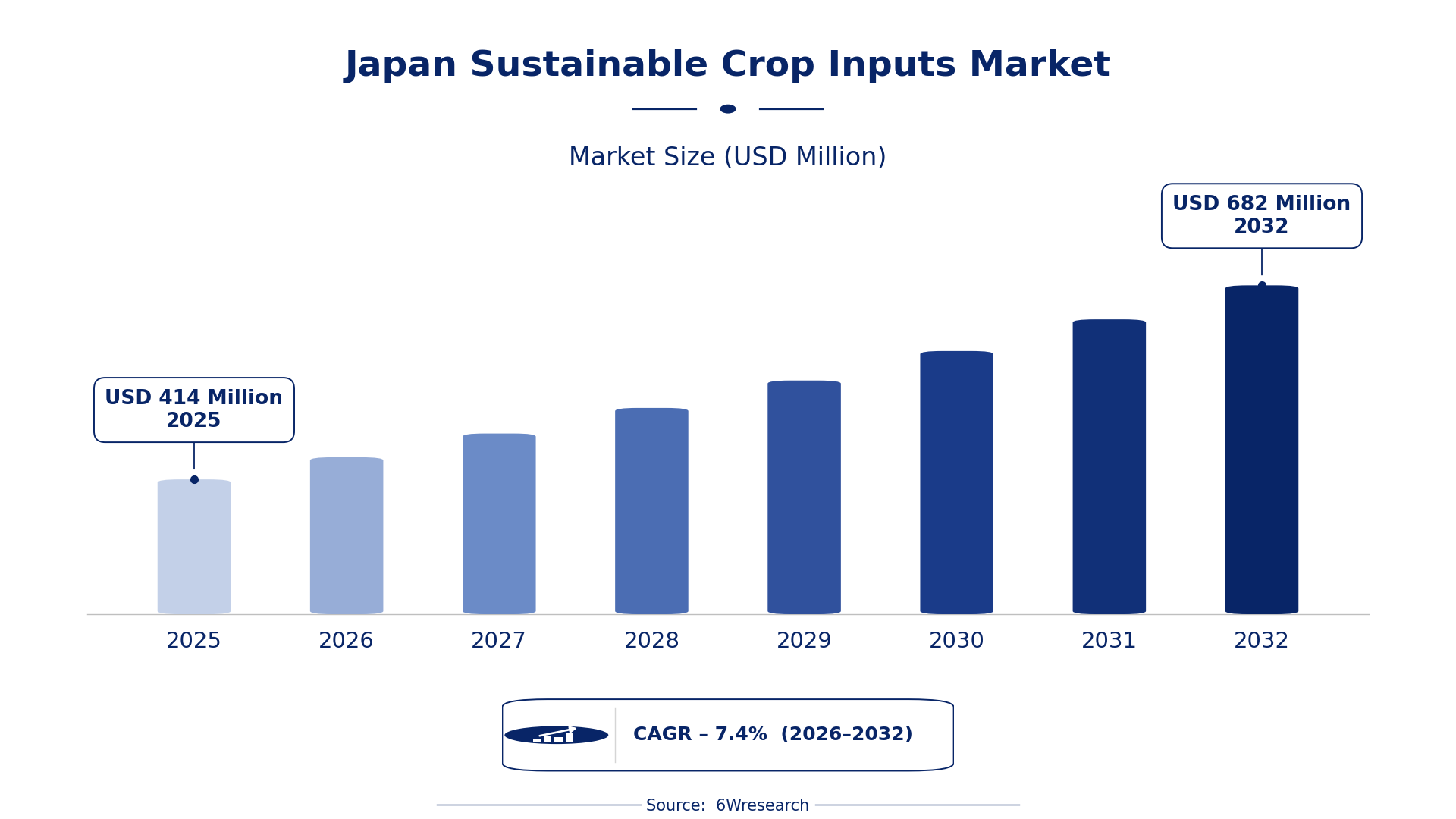
According to 6Wresearch internal database and industry insights, the Japan Sustainable Crop Inputs Market was valued at USD 414 Million in 2025 and is projected to reach USD 682 Million by 2032, growing at a CAGR of approximately 7.4% during 2026–2032.
Japan Sustainable Crop Inputs Market Highlights
| Report Metric | Details |
| Report Name | Japan Sustainable Crop Inputs Market (2026-2032) |
| Market Size 2025 | USD 414 Million |
| Market Size 2032 | USD 682 Million |
| Absolute Growth 2025–2032 | USD 268 Million |
| CAGR 2026–2032 | 7.4% |
| Peak Annual Growth | 8.5% in 2029 |
| Forecast Period | 2026–2032 |
| Historical Data | 2022–2025 |
| Base Year | 2025 |
| Leading Input Category, 2025 | Biostimulants (46% share) |
| Leading Source Material, 2025 | Seaweed/Proteins (50% share) |
| Leading Function, 2025 | Growth Enhancement (41% share) |
| Leading End User, 2025 | Agri Coops (37% share) |
| Fastest-Growing Input Category | Organic Fertilizers (9.8% CAGR) |
| Fastest-Growing Source Material | Compost/Manure (11.2% CAGR) |
| Fastest-Growing Function | Nutrient Supply (9.5% CAGR) |
| Fastest-Growing End User | Organic Farms (9.9% CAGR) |
| Growing Sector | Organic Farming |
| Key End Users | Agri Coops, Organic Farms, Regenerative Farmers, Agri Retailers |
Japan Sustainable Crop Inputs Market Year-wise Growth Rate and Key Drivers (2022–2032)
This graph illustrates the annual growth rates of the market from 2022 to 2032, highlighting a steady upward trajectory and projected market expansion over the forecast period.
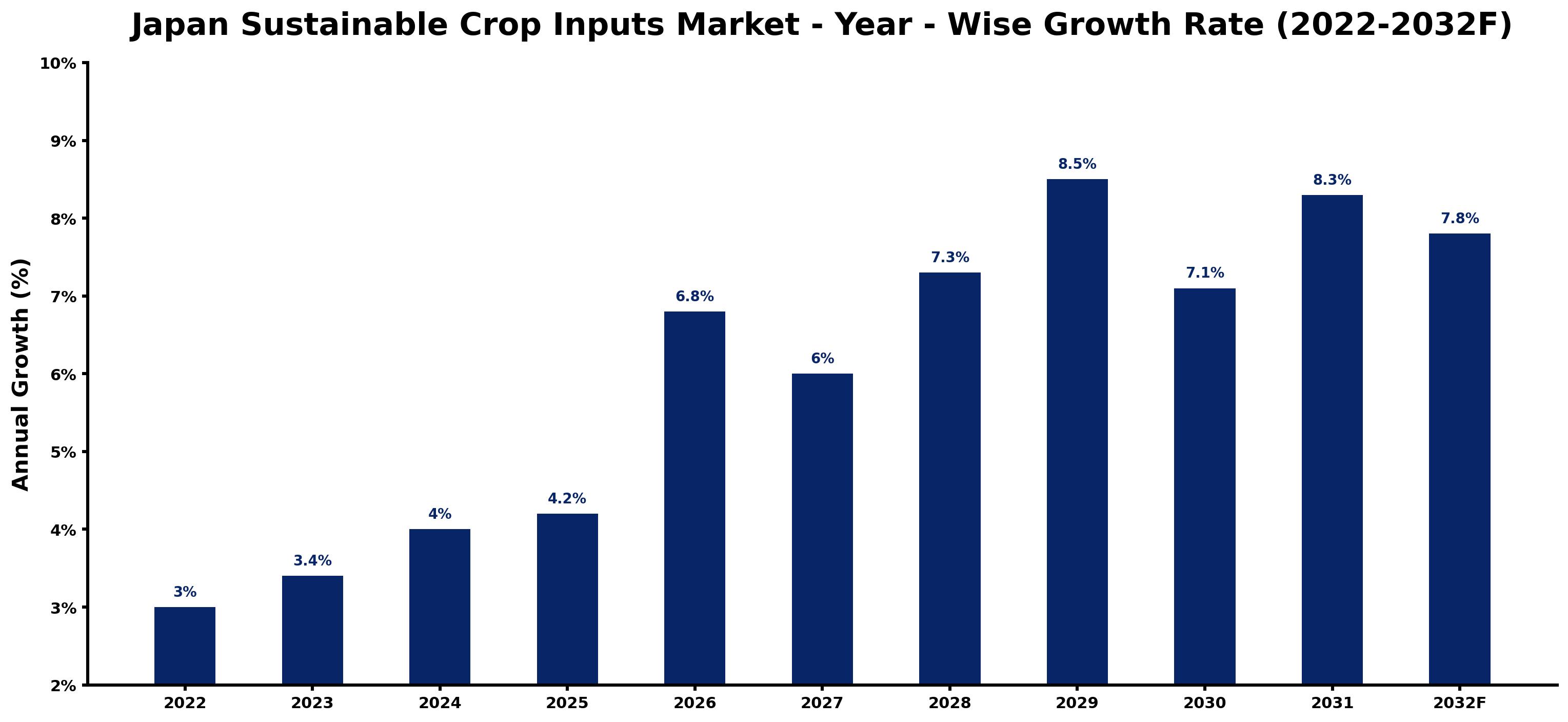
For each year, the table pairs the estimated growth rate with the leading influence on demand, showing how the drivers changed across the period.
| Year | Estimated Annual Growth (%) | Market Rationale |
| 2022 | 3.0 | The market showed steady growth as organic farming gained traction among farmers. |
| 2023 | 3.4 | Increased awareness of sustainable practices led to higher adoption rates of crop inputs. |
| 2024 | 4.0 | The introduction of new biostimulant products spurred further interest in sustainable farming. |
| 2025 | 4.2 | Organic farming initiatives expanded, driving demand for sustainable crop inputs. |
| 2026 | 6.8 | Growth is expected to rise as more farmers embrace environmentally friendly practices. |
| 2027 | 6.0 | The market is projected to grow at a slower pace as supply levels increase. |
| 2028 | 7.3 | Rising consumer demand for organic products will renew interest in sustainable inputs. |
| 2029 | 8.5 | The peak growth year will see significant investments in biostimulants for rice cultivation. |
| 2030 | 7.1 | A slight slowdown is anticipated as the market stabilises after rapid expansion. |
| 2031 | 8.3 | Demand will surge again as farmers seek to enhance soil health and crop yield. |
| 2032 | 7.8 | The market is projected to continue growing with ongoing support for organic farming initiatives. |
Note: Market size estimations and growth projections presented in this report are based on 6Wresearch's proprietary forecasting methodology, utilizing the latest available industry data, government publications, and primary research inputs.
Japan Sustainable Crop Inputs Market Synopsis
Sustainable crop inputs are environmentally friendly agricultural products made from natural materials like plant extracts and compost. The Japan Sustainable Crop Inputs Market is growing as organic farming practices gain traction, with around 30% of farmers projected to use these inputs by 2025. Key drivers of this expansion include government backing for organic initiatives and a rising consumer preference for eco-friendly products, particularly in urban centres like Tokyo, known for its organic farming initiatives.
Market Dynamics Impact Analysis (2026–2032)
| Factor | Type | Impact | Primary Segment Affected |
| Government initiatives promoting organic farming practices | Driver | High | Organic Fertilizers |
| Growing consumer demand for organic produce | Driver | High | Biostimulants |
| Rising interest in regenerative agriculture practices | Opportunity | High | Microbial Inoculants |
| Expansion of organic farming areas | Opportunity | High | Soil Amendments |
| Regulatory challenges in product certification | Restraint | Medium | Organic Fertilizers |
| Limited awareness among farmers about sustainable inputs | Restraint | Medium | Biostimulants |
| High initial investment costs for sustainable practices | Challenge | High | Microbial Inoculants |
| Competition from conventional fertilizers | Challenge | High | Organic Fertilizers |
Evaluation of Drivers in Japan Sustainable Crop Inputs Market (2026–2032)
The main growth drivers and the segments they affect most are set out below.
| Drivers | Primary Segment Affected | Why It Matters (Evidence) |
| Increased organic farming area | Organic Fertilizers | Japan's organic farming area reached 0.5 million hectares in 2022, driving demand for organic fertilizers among farmers. |
| Consumer preference for organic products | Biostimulants | Rising consumer demand for organic produce encourages farmers to adopt biostimulants to improve crop quality. |
| Government support for sustainable agriculture | Microbial Inoculants | Research funding allocated in 2023 promotes microbial inoculants, increasing their adoption in vegetable production. |
| Regenerative agriculture practices | Soil Amendments | With 15% of farmers adopting regenerative practices by 2025, soil amendments are increasingly sought for improving soil health. |
| Research funding for biostimulants | Biostimulants | In 2023, funds were allocated to support research on biostimulants, boosting their market presence. |
Several shifts outside the market lift sales. The organic farming area in Japan reached 0.5 million hectares in 2022, prompting farmers to seek organic fertilizers to improve crop yield. Rising consumer demand for organic products encourages farmers to adopt biostimulants to enhance crop quality. Increased interest in regenerative practices is driving the demand for soil amendments to restore soil health. Research funding for biostimulants, allocated in 2023, further boosts their market presence and encourages investment in sustainable practices.
Evaluation of Restraints in Japan Sustainable Crop Inputs Market
The following restraints limit how fast demand can grow.
| Market Restraint | Primary Segment Affected | Why It Matters (Evidence) |
| Regulatory challenges in product certification | Organic Fertilizers | Strict regulations complicate certification, limiting market access for new products. |
| Limited awareness among farmers about sustainable inputs | Biostimulants | Many farmers remain unaware of the benefits of biostimulants, hindering their adoption in agricultural practices. |
| High initial investment costs for sustainable practices | Microbial Inoculants | The initial costs associated with implementing microbial inoculants can deter farmers from transitioning to sustainable methods. |
| Competition from conventional fertilizers | Organic Fertilizers | Conventional fertilizers are often cheaper and more familiar to farmers, making it hard for organic options to compete. |
| Market fragmentation among suppliers | Soil Amendments | Numerous small suppliers lead to market fragmentation, complicating distribution and brand recognition for soil amendments. |
Japan Sustainable Crop Inputs Market Challenges
Outdated technology limits the effectiveness of crop inputs in Japan. Many producers continue to rely on conventional farming methods, which delays the adoption of biostimulants that could improve crop yield. A skills gap exists, with only 30% of farmers currently employing sustainable practices, hindering the government's target for organic farmland expansion. Regulatory complexities, such as recent updates to the JIS for organic fertilizers, create confusion and prolong the certification process for new products, ultimately slowing market growth. High production costs for organic fertilizers deter many farmers, forcing them to depend on conventional inputs that undermine sustainability efforts.
Trends in the Japan Sustainable Crop Inputs Market
Four trends stand out in the Japan Sustainable Crop Inputs Market.
- Shift towards Organic Farming: The trend towards organic farming has accelerated since 2022, with the government promoting organic practices through various initiatives. Approximately 30% of Japanese farmers are expected to adopt sustainable crop inputs by 2025, reflecting a notable shift in agricultural practices.
- Increased Use of Biostimulants: In 2023, Japan launched a program to increase biostimulant use in rice cultivation, aiming to improve crop resilience. This initiative is projected to boost the market for biostimulants, with an anticipated rise in adoption among rice farmers.
- Growing Interest in Regenerative Agriculture: Regenerative agriculture practices are gaining traction, with 15% of farmers adopting these methods by 2025. Local government programs encouraging sustainable practices are driving increased demand for soil amendments and microbial inoculants.
- Expansion of Organic Fertilizer Production: Japan exported 50,000 tons of organic fertilizers in 2022, highlighting the growing international demand for sustainable inputs. This trend is likely to continue as more countries seek eco-friendly agricultural solutions.
Investment Opportunities in the Japan Sustainable Crop Inputs Market
Investors looking at the Japan Sustainable Crop Inputs Market should consider the following areas.
- Local Partnerships for Sustainable Inputs: Local partnerships are essential for entering the sustainable crop inputs market, especially in regions like Tokyo. With 30% of farmers adopting these inputs by 2025, there is a clear opportunity for collaboration with agricultural cooperatives.
- Investment in Research for Biostimulants: The Japanese government allocated funds in 2023 for research on biostimulants, indicating a gap in product development. Suppliers can invest in creating new biostimulants to meet the growing demand from farmers.
- Expansion of Organic Farming Areas: With a target to increase organic farmland to 1 million hectares by 2030, there is a clear opportunity for suppliers of organic fertilizers. Collaborating with organic farms can facilitate market entry and growth.
- Focus on Soil Health Improvements: Soil amendments are important for enhancing soil health, with increasing adoption among regenerative farmers. Suppliers can target this segment, particularly in regions with high agricultural activity.
Government Initiatives in the Japan Sustainable Crop Inputs Market
The Economic Security Promotion Act, enacted in 2022, supports supply-chain resilience for critical agricultural products, including sustainable crop inputs. This law complements existing regulations by ensuring that producers meet safety and quality standards while promoting the use of organic fertilizers. The government aims to increase organic farmland to 1 million hectares by 2030, which will further support the growth of sustainable crop inputs.
The Japan Agricultural Standards (JAS) certifies organic products and inputs, ensuring compliance with quality standards. This agency plays a significant role in supporting sustainable agriculture, with allocated funds aimed at increasing the adoption of biostimulants and improving soil health.
Future Insight of the Japan Sustainable Crop Inputs Market
Japan's agricultural policy will shift towards organic farming, aiming to double organic farmland by 2030. This change will drive suppliers to develop new crop inputs that align with environmental goals. Increased focus on biostimulants in rice cultivation will improve productivity and encourage broader adoption of sustainable practices. Research funding will support advancements in technologies that promote soil health and crop resilience. As a result, more farmers are expected to adopt sustainable practices, fostering a greener agricultural sector.
Market Segmentation Analysis
Japan Sustainable Crop Inputs Market report covers a detailed analysis of the following market segments:
By Input Category – Biostimulants Lead, Organic Fertilizers Expected to Grow Fastest
According to Saurav Kr Singh, Senior Research Analyst at 6Wresearch, Biostimulants took 46% of input category revenue in 2025, more than any other category. Biostimulants dominate the market as they are widely used to enhance plant growth and resilience, particularly in rice cultivation. The recent government programme promoting biostimulant use highlights their critical role in sustainable agriculture. Organic Fertilizers are projected to grow fastest, at a CAGR of 9.8% during 2026–2032. Organic Fertilizers are witnessing rapid growth as farmers increasingly transition to organic practices, with an estimated 30% of Japanese farmers adopting sustainable crop inputs by 2025. The updated JIS standards for organic fertilizers are significantly influencing this shift. Suppliers should prioritise the development of organic fertilizers to align with the rising demand from the agricultural sector.
By Source Material – Seaweed/Proteins Lead, Compost/Manure Expected to Grow Fastest
With 50% of source material revenue in 2025, Seaweed/Proteins was the largest category. Seaweed/Proteins hold the largest share due to their recognition as natural growth enhancers and essential nutrients, vital for sustainable farming. The emphasis on organic farming initiatives in the Tokyo region supports this segment's leading position. Over 2026–2032, Compost/Manure is expected to post the fastest growth, at a CAGR of 11.2%. Compost/Manure is growing quickly as farmers focus on improving soil fertility and structure, in line with the government's target to increase organic farmland to 1 million hectares by 2030. Local government programmes promoting compost use are reinforcing this trend. Buyers will gain from sourcing compost and manure to improve soil quality and support organic farming practices.
By Function – Growth Enhancement Leads, Nutrient Supply Expected to Grow Fastest
The largest function category in 2025 was Growth Enhancement, at 41% of revenue. Growth Enhancement leads the market as it directly correlates with increased crop productivity and resilience, which are essential for Japan's agricultural demands. The heightened focus on sustainable practices among farmers underscores the importance of this function. Nutrient Supply is set to record the highest CAGR in this split, 9.5% over 2026–2032. Nutrient Supply is experiencing the fastest growth as farmers increasingly require essential nutrients for plant growth, especially in organic farming. The shift towards organic practices is significantly driving this demand. Suppliers must focus on nutrient supply solutions to meet the changing needs of organic farmers.
By End User – Agri Coops Lead, Organic Farms Expected to Grow Fastest
Agri Coops accounted for 37% of the market by end user in 2025. Agri Coops are the leading end user as they provide essential inputs to member farmers, facilitating the adoption of sustainable practices across the agricultural community. Their central role in supporting farmers enhances their market share. The quickest growth will come from Organic Farms, forecast to expand at a CAGR of 9.9% between 2026 and 2032. Organic Farms are rapidly increasing their use of sustainable inputs, reflecting the rising consumer demand for organic produce. With 15% of farmers expected to adopt regenerative practices by 2025, this segment's growth is set to accelerate. Suppliers should target organic farms to capitalise on the expanding market for sustainable crop inputs.
Key Attractiveness of the Report
- 10 Years of Market Numbers
- Historical Data Starting from 2022 to 2025
- Base Year 2025
- Forecast Data until 2032
- Key Performance Indicators Impacting the Market
- Major Upcoming Developments and Projects
Key Highlights of the Report:
- Japan Sustainable Crop Inputs Market Outlook
- Market Size of Japan Sustainable Crop Inputs Market, 2025
- Forecast of Japan Sustainable Crop Inputs Market, 2032
- Historical Data and Forecast of Japan Sustainable Crop Inputs Revenues & Volume for the Period 2022-2032F
- Japan Sustainable Crop Inputs Market Trend Evolution
- Japan Sustainable Crop Inputs Market Drivers and Challenges
- Japan Sustainable Crop Inputs Price Trends
- Japan Sustainable Crop Inputs Porter's Five Forces
- Japan Sustainable Crop Inputs Industry Life Cycle
- Historical Data and Forecast of Japan Sustainable Crop Inputs Market Revenues & Volume By Input Category for the Period 2022-2032F
- Historical Data and Forecast of Japan Sustainable Crop Inputs Market Revenues & Volume By Biostimulants for the Period 2022-2032F
- Historical Data and Forecast of Japan Sustainable Crop Inputs Market Revenues & Volume By Organic Fertilizers for the Period 2022-2032F
- Historical Data and Forecast of Japan Sustainable Crop Inputs Market Revenues & Volume By Soil Amendments for the Period 2022-2032F
- Historical Data and Forecast of Japan Sustainable Crop Inputs Market Revenues & Volume By Microbial Inoculants for the Period 2022-2032F
- Historical Data and Forecast of Japan Sustainable Crop Inputs Market Revenues & Volume By Source Material for the Period 2022-2032F
- Historical Data and Forecast of Japan Sustainable Crop Inputs Market Revenues & Volume By Seaweed/Proteins for the Period 2022-2032F
- Historical Data and Forecast of Japan Sustainable Crop Inputs Market Revenues & Volume By Compost/Manure for the Period 2022-2032F
- Historical Data and Forecast of Japan Sustainable Crop Inputs Market Revenues & Volume By Humic Acid/Biochar for the Period 2022-2032F
- Historical Data and Forecast of Japan Sustainable Crop Inputs Market Revenues & Volume By Nitrogen-Fixing Bacteria for the Period 2022-2032F
- Historical Data and Forecast of Japan Sustainable Crop Inputs Market Revenues & Volume By Function for the Period 2022-2032F
- Historical Data and Forecast of Japan Sustainable Crop Inputs Market Revenues & Volume By Growth Enhancement for the Period 2022-2032F
- Historical Data and Forecast of Japan Sustainable Crop Inputs Market Revenues & Volume By Nutrient Supply for the Period 2022-2032F
- Historical Data and Forecast of Japan Sustainable Crop Inputs Market Revenues & Volume By Soil Health for the Period 2022-2032F
- Historical Data and Forecast of Japan Sustainable Crop Inputs Market Revenues & Volume By Root Zone Support for the Period 2022-2032F
- Historical Data and Forecast of Japan Sustainable Crop Inputs Market Revenues & Volume By End User for the Period 2022-2032F
- Historical Data and Forecast of Japan Sustainable Crop Inputs Market Revenues & Volume By Agri Coops for the Period 2022-2032F
- Historical Data and Forecast of Japan Sustainable Crop Inputs Market Revenues & Volume By Organic Farms for the Period 2022-2032F
- Historical Data and Forecast of Japan Sustainable Crop Inputs Market Revenues & Volume By Regenerative Farmers for the Period 2022-2032F
- Historical Data and Forecast of Japan Sustainable Crop Inputs Market Revenues & Volume By Agri Retailers for the Period 2022-2032F
- Japan Sustainable Crop Inputs Import Export Trade Statistics
- Market Opportunity Assessment By Input Category
- Market Opportunity Assessment By Source Material
- Market Opportunity Assessment By Function
- Market Opportunity Assessment By End User
- Japan Sustainable Crop Inputs Top Companies Market Share
- Japan Sustainable Crop Inputs Competitive Benchmarking By Technical and Operational Parameters
- Japan Sustainable Crop Inputs Company Profiles
- Japan Sustainable Crop Inputs Key Strategic Recommendations
Market Covered
Segments analysed in this report are listed below.
By Input Category
- Biostimulants
- Organic Fertilizers
- Soil Amendments
- Microbial Inoculants
By Source Material
- Seaweed/Proteins
- Compost/Manure
- Humic Acid/Biochar
- Nitrogen-Fixing Bacteria
By Function
- Growth Enhancement
- Nutrient Supply
- Soil Health
- Root Zone Support
By End User
- Agri Coops
- Organic Farms
- Regenerative Farmers
- Agri Retailers































