Japan Sustainable Crop Protection Market Size & Growth Rate
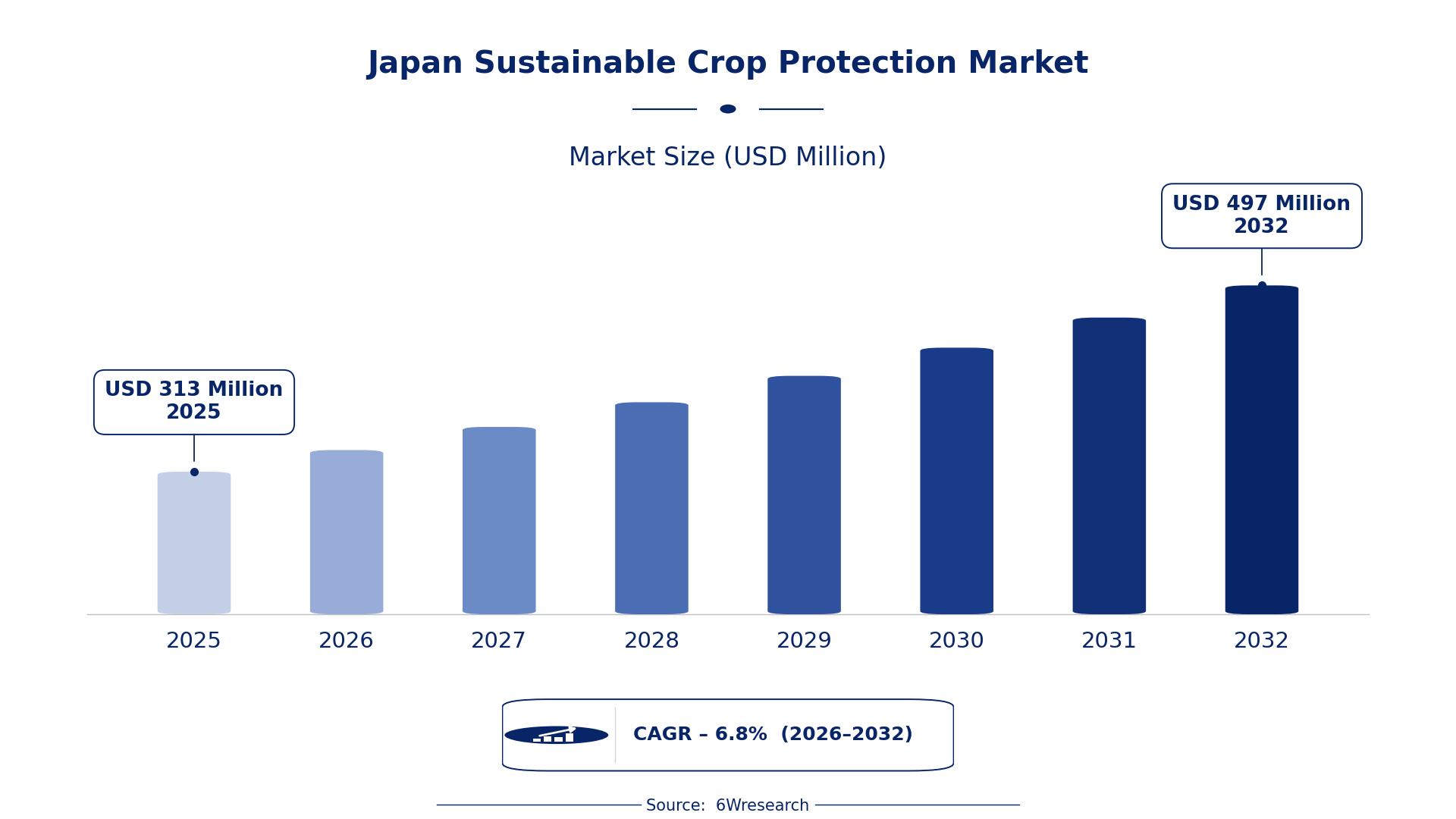
According to 6Wresearch internal database and industry insights, the Japan Sustainable Crop Protection Market was valued at USD 313 Million in 2025 and is projected to reach USD 497 Million by 2032, growing at a CAGR of approximately 6.8% during 2026–2032.
Japan Sustainable Crop Protection Market Highlights
| Report Metric | Details |
| Report Name | Japan Sustainable Crop Protection Market (2026-2032) |
| Market Size 2025 | USD 313 Million |
| Market Size 2032 | USD 497 Million |
| Absolute Growth 2025–2032 | USD 184 Million |
| CAGR 2026–2032 | 6.8% |
| Peak Annual Growth | 8.8% in 2027 |
| Forecast Period | 2026–2032 |
| Historical Data | 2022–2025 |
| Base Year | 2025 |
| Leading Protection Type, 2025 | Biopesticides (43% share) |
| Leading Source Type, 2025 | Botanical/Insect-Derived (44% share) |
| Leading Application Mode, 2025 | Sprays or Dusts (41% share) |
| Leading End User, 2025 | Organic Growers (40% share) |
| Fastest-Growing Protection Type | Biofungicides (9.6% CAGR) |
| Fastest-Growing Source Type | Fungi/Bacteria-Based (10.1% CAGR) |
| Fastest-Growing Application Mode | Soil Drench or Foliar (8.9% CAGR) |
| Fastest-Growing End User | Horticulture Farms (8.7% CAGR) |
| Growing Sector | Organic Farming |
| Key End Users | Organic Growers, Horticulture Farms, Smallholders |
Japan Sustainable Crop Protection Market Year-wise Growth Rate and Key Drivers (2022–2032)
This graph illustrates the annual growth rates of the market from 2022 to 2032, highlighting a steady upward trajectory and projected market expansion over the forecast period.
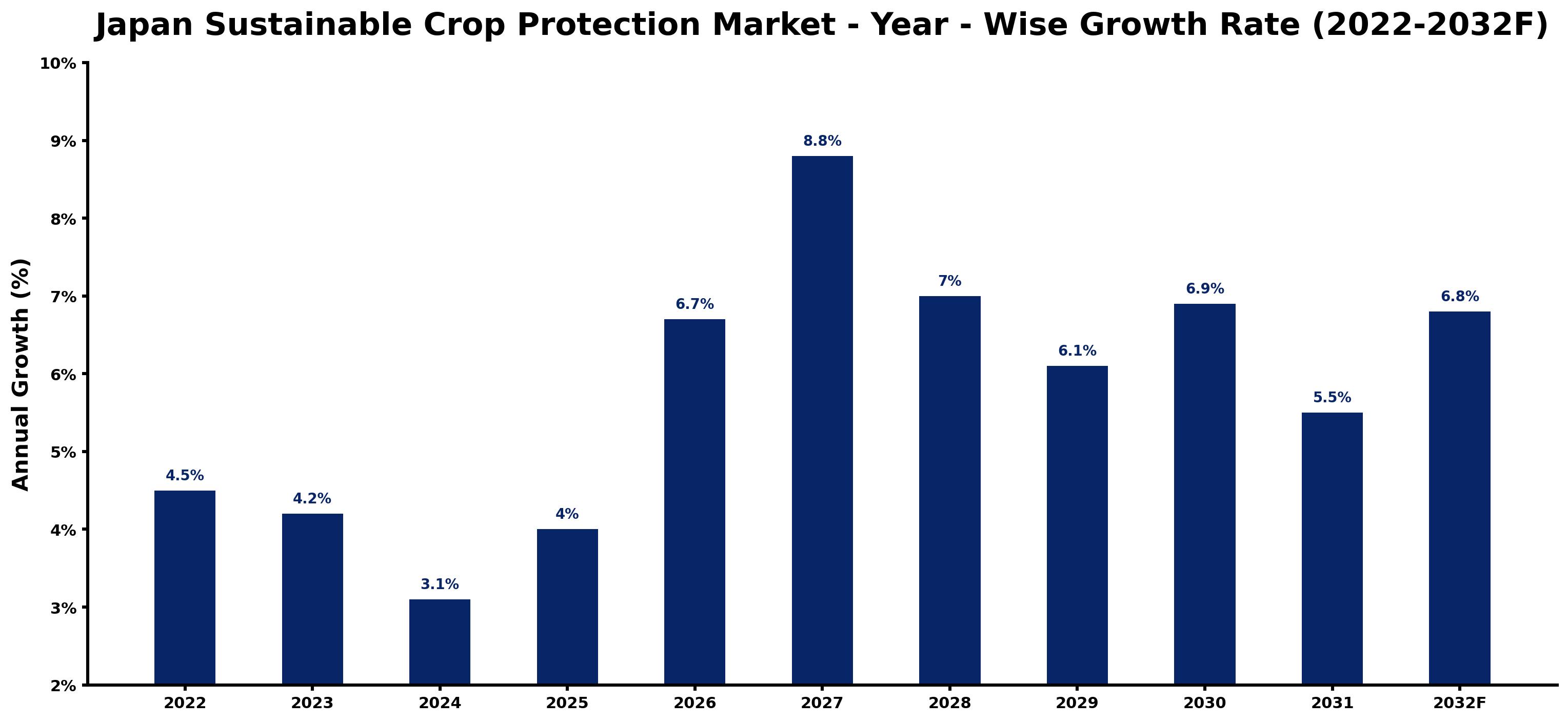
The following figures match every annual growth estimate with the main market development of that year, giving the reasoning behind each rise or slowdown.
| Year | Estimated Annual Growth (%) | Market Rationale |
| 2022 | 4.5 | The market saw steady growth due to increasing awareness of sustainable practices among farmers. |
| 2023 | 4.2 | Growth slowed as the market adjusted to changing consumer preferences and supply chain issues. |
| 2024 | 3.1 | Demand continued to rise but at a slower pace as growers explored alternative pest management strategies. |
| 2025 | 4.0 | A resurgence in growth occurred as organic farming practices gained traction among producers. |
| 2026 | 6.7 | A notable uptick is expected as investments in biopesticides increase. |
| 2027 | 8.8 | Peak growth will be driven by heightened consumer demand for eco-friendly agricultural products. |
| 2028 | 7.0 | Growth is projected to slow as market saturation begins to affect new product introductions. |
| 2029 | 6.1 | Demand is expected to continue decelerating as buyers become more selective in their purchases. |
| 2030 | 6.9 | A renewed interest in fermentation products will spur growth once again. |
| 2031 | 5.5 | Growth is projected to slow as the market stabilises amidst increasing competition. |
| 2032 | 6.8 | A resurgence in organic growers will boost demand for sustainable crop protection products. |
Note: Market size estimations and growth projections presented in this report are based on 6Wresearch's proprietary forecasting methodology, utilizing the latest available industry data, government publications, and primary research inputs.
Japan Sustainable Crop Protection Market Synopsis
Sustainable crop protection involves environmentally friendly pest control methods, including biopesticides and natural repellents derived from plants and microorganisms. The Japan Sustainable Crop Protection Market is expanding due to the growing organic farming sector, which reached 400,000 hectares in 2022, alongside increasing consumer demand for eco-friendly produce. Government initiatives, including a ¥2 billion allocation for sustainable agriculture in 2023, support this growth and drive purchases from organic growers and horticulture farms.
Market Dynamics Impact Analysis (2026–2032)
| Factor | Type | Impact | Primary Segment Affected |
| Growing organic farming area | Driver | High | Biopesticides |
| Increased consumer demand for eco-friendly produce | Driver | High | Biofungicides |
| Investment in sustainable agriculture initiatives | Opportunity | High | Natural Repellents |
| Rising awareness of biodiversity benefits | Opportunity | Medium | Fermentation Products |
| Regulatory constraints on chemical pesticides | Restraint | High | Biopesticides |
| Limited awareness among smallholder farmers | Restraint | Medium | Biofungicides |
| Competition from synthetic pesticide alternatives | Challenge | High | Natural Repellents |
| Technological barriers in product development | Challenge | Medium | Fermentation Products |
Evaluation of Drivers in Japan Sustainable Crop Protection Market (2026–2032)
The following drivers explain most of the expected growth.
| Drivers | Primary Segment Affected | Why It Matters (Evidence) |
| Increase in organic farming area | Biopesticides | Japan's organic farming area reached 400,000 hectares in 2022, driving demand for biopesticides among organic growers. |
| Consumer preference for eco-friendly products | Biofungicides | The growing consumer demand for organic produce encourages farmers to adopt biofungicides for pest management, as they align with organic standards. |
| Government funding for sustainable practices | Natural Repellents | In 2023, the government allocated ¥2 billion for sustainable agriculture, promoting the use of natural repellents among farmers. |
| Focus on biodiversity in agriculture | Fermentation Products | The promotion of biodiversity increases interest in fermentation products for pest control, as farmers seek environmentally friendly solutions. |
| Support from agricultural associations | Microbial | The Japan Plant Protection Association advocates for microbial pesticides, increasing their adoption among farmers. |
Behind the steady rise in orders sits the expansion of Japan's organic farming area, which reached 400,000 hectares in 2022, prompting more growers to seek biopesticides for pest control. The growing consumer demand for organic produce is driving farmers to adopt biofungicides, as they align with organic standards. Increased interest in fermentation products is apparent as farmers focus on biodiversity in agriculture. Advocacy from agricultural associations is further promoting the adoption of microbial pesticides among growers.
Evaluation of Restraints in Japan Sustainable Crop Protection Market
These restraints slow adoption and weigh on supplier margins.
| Market Restraint | Primary Segment Affected | Why It Matters (Evidence) |
| Regulatory constraints on chemical pesticides | Biopesticides | Regulatory constraints limit the options available to farmers, affecting the adoption of biopesticides. |
| Limited awareness among smallholder farmers | Biofungicides | Many smallholder farmers lack knowledge about biofungicides, hindering their adoption in pest management. |
| Competition from synthetic pesticide alternatives | Natural Repellents | Synthetic pesticides often offer immediate results, making it challenging for natural repellents to gain traction. |
| Technological barriers in product development | Fermentation Products | The complexity of developing fermentation products can delay their availability in the market. |
| Market saturation affecting new product introductions | Microbial | As the market matures, introducing new microbial products becomes increasingly difficult. |
Japan Sustainable Crop Protection Market Challenges
High costs of sustainable crop protection products deter buyers, with biopesticides accounting for only 10% of the pesticide market in 2022. A lack of skilled workers in sustainable agriculture hampers suppliers' ability to meet growing demand, resulting in production delays for horticulture farms. Limited technological advancements in fermentation and extraction processes restrict suppliers' capacity to innovate, which challenges producers in maintaining competitiveness. Intense competition from conventional pesticides pressures suppliers to lower prices, negatively impacting the profitability of sustainable options for buyers.
Trends in the Japan Sustainable Crop Protection Market
These developments are changing demand patterns in the Japan Sustainable Crop Protection Market.
- Shift from Chemical to Biopesticides: Since 2022, there has been a notable shift towards biopesticides in Japan's agricultural practices. The Tokyo region, responsible for 30% of organic vegetable production, reflects this trend as farmers increasingly adopt biopesticides to meet consumer demand.
- Emergence of Fermentation Products: In 2023, fermentation products gained popularity among organic growers as eco-friendly alternatives. This shift aligns with the government's push for sustainable agriculture, leading to increased adoption rates among farmers.
- Increased Use of Natural Repellents in Urban Gardening: Natural repellents have seen rising adoption in urban gardening practices, reflecting a broader trend towards sustainability. This change is supported by the growing interest in eco-friendly gardening solutions among city dwellers.
- Growth in Organic Vegetable Production: The production of organic vegetables in Japan has surged, with horticulture farms producing over 1 million tons annually. This growth highlights the increasing consumer preference for organic produce and sustainable farming methods.
Investment Opportunities in the Japan Sustainable Crop Protection Market
Below are the investment opportunities with the strongest case in the Japan Sustainable Crop Protection Market.
- Partner with Local Organic Growers: Now is the time to collaborate with local organic growers in regions like Tokyo, which leads in organic vegetable production. By supplying biopesticides, companies can tap into the growing market, projected to benefit from ¥2 billion in government funding.
- Invest in Fermentation Technology: Investing in fermentation technology is essential as the demand for eco-friendly pest control rises. With the government aiming for a 25% increase in organic farming by 2025, suppliers can benefit from this trend.
- Supply Microbial Solutions to Horticulture Farms: The timing is ideal to provide microbial solutions to horticulture farms, which are increasingly adopting sustainable practices. This sector is expected to grow as awareness of eco-friendly products rises.
- Expand Offerings in Urban Gardening: Expanding product offerings in urban gardening can capture the growing market of city dwellers seeking sustainable solutions. With increasing adoption of natural repellents, suppliers can effectively meet this demand.
Government Initiatives in the Japan Sustainable Crop Protection Market
The Waste Management and Public Cleansing Act regulates waste treatment and disposal, complementing the Food Recycling Law. This legislation mandates food businesses to reduce waste and recycle it into feed, fertiliser, and energy, promoting sustainable agricultural practices that benefit sustainable crop protection buyers. The government allocated ¥2 billion in 2023 to support these initiatives, enhancing compliance and encouraging sustainable practices among farmers.
The Ministry of Agriculture, Forestry and Fisheries oversees the implementation of these laws, ensuring compliance among food businesses. They provide funding for projects that align with sustainable agriculture, supporting initiatives that promote the use of biopesticides and natural repellents, benefiting organic growers and horticulture farms.
Future Insight of the Japan Sustainable Crop Protection Market
Advancements in extraction technology will transform demand for eco-friendly products by 2032, as producers adopt more efficient methods. The government's allocation of ¥2 billion for sustainable agriculture initiatives will support the development of new biopesticides and natural repellents. A projected 15% increase in organic growers by 2026 will create a thriving market for sustainable options. Enhanced food safety standards will ensure quality and safety in organic farming, benefiting both buyers and suppliers in the eco-friendly sector.
Market Segmentation Analysis
Japan Sustainable Crop Protection Market report covers a detailed analysis of the following market segments:
By Protection Type – Biopesticides Lead, Biofungicides Expected to Grow Fastest
According to Saurav Kr Singh, Senior Research Analyst at 6Wresearch, Biopesticides took 43% of protection type revenue in 2025, more than any other category. Biopesticides hold the largest share due to their critical role in organic farming, which is expanding in Japan. These products accounted for 10% of the pesticide market in 2022, highlighting their importance for organic growers. The quickest growth will come from Biofungicides, forecast to expand at a CAGR of 9.6% between 2026 and 2032. Biofungicides are experiencing rapid growth as they effectively address the rising concerns of fungal diseases affecting crops. The increasing prevalence of these diseases is driving demand for biofungicides, ensuring their market expansion. Suppliers must focus on biofungicides to meet the growing demand in the market.
By Source Type – Botanical/Insect-Derived Leads, Fungi/Bacteria-Based Expected to Grow Fastest
Botanical/Insect-Derived held 44% of the Japan Sustainable Crop Protection Market by source type in 2025. Botanical/Insect-Derived products dominate the market as they are derived from natural sources, appealing to organic growers prioritising eco-friendliness. Their established use in sustainable practices aligns with Japan's agricultural regulations and consumer preferences. Fungi/Bacteria-Based is projected to grow fastest, at a CAGR of 10.1% during 2026–2032. Fungi/Bacteria-Based solutions are gaining traction due to their effective natural pest control properties, which are increasingly recognised by growers. This shift is driven by the need for sustainable alternatives that do not harm beneficial organisms. Buyers may benefit from exploring fungi/bacteria-based options to diversify their pest management strategies.
By Application Mode – Sprays or Dusts Lead, Soil Drench or Foliar Expected to Grow Fastest
In 2025, Sprays or Dusts led the application mode split with a 41% share. Sprays or Dusts are the preferred application modes for pest control, offering convenience and effectiveness for various growers. Their widespread use across different farming practices in Japan underscores their importance in the market. Soil Drench or Foliar is set to record the highest CAGR in this split, 8.9% over 2026–2032. Soil Drench or Foliar applications are experiencing swift growth as they provide targeted pest management directly to the affected areas. This method is particularly beneficial in horticulture, where precision is vital for maintaining crop health. Suppliers should focus on developing products that support the rising preference for soil drench or foliar application methods.
By End User – Organic Growers Lead, Horticulture Farms Expected to Grow Fastest
Organic Growers accounted for 40% of the market by end user in 2025. Organic Growers represent the largest segment as they are the primary users of sustainable crop protection products, driven by the growth of organic farming areas in Japan. Their commitment to eco-friendly practices ensures a steady demand for these products. Over 2026–2032, Horticulture Farms are expected to post the fastest growth, at a CAGR of 8.7%. Horticulture Farms are growing quickly as they implement sustainable practices to meet the rising consumer demand for organic produce. Their contribution of over 1 million tons of vegetables annually underscores their importance in the market. Suppliers should concentrate on horticulture farms to capitalise on the increasing trend towards sustainable agriculture.
Key Attractiveness of the Report
- 10 Years of Market Numbers
- Historical Data Starting from 2022 to 2025
- Base Year 2025
- Forecast Data until 2032
- Key Performance Indicators Impacting the Market
- Major Upcoming Developments and Projects
Key Highlights of the Report:
- Japan Sustainable Crop Protection Market Outlook
- Market Size of Japan Sustainable Crop Protection Market, 2025
- Forecast of Japan Sustainable Crop Protection Market, 2032
- Historical Data and Forecast of Japan Sustainable Crop Protection Revenues & Volume for the Period 2022-2032F
- Japan Sustainable Crop Protection Market Trend Evolution
- Japan Sustainable Crop Protection Market Drivers and Challenges
- Japan Sustainable Crop Protection Price Trends
- Japan Sustainable Crop Protection Porter's Five Forces
- Japan Sustainable Crop Protection Industry Life Cycle
- Historical Data and Forecast of Japan Sustainable Crop Protection Market Revenues & Volume By Protection Type for the Period 2022-2032F
- Historical Data and Forecast of Japan Sustainable Crop Protection Market Revenues & Volume By Biopesticides for the Period 2022-2032F
- Historical Data and Forecast of Japan Sustainable Crop Protection Market Revenues & Volume By Biofungicides for the Period 2022-2032F
- Historical Data and Forecast of Japan Sustainable Crop Protection Market Revenues & Volume By Natural Repellents for the Period 2022-2032F
- Historical Data and Forecast of Japan Sustainable Crop Protection Market Revenues & Volume By Fermentation Products for the Period 2022-2032F
- Historical Data and Forecast of Japan Sustainable Crop Protection Market Revenues & Volume By Source Type for the Period 2022-2032F
- Historical Data and Forecast of Japan Sustainable Crop Protection Market Revenues & Volume By Botanical/Insect-Derived for the Period 2022-2032F
- Historical Data and Forecast of Japan Sustainable Crop Protection Market Revenues & Volume By Fungi/Bacteria-Based for the Period 2022-2032F
- Historical Data and Forecast of Japan Sustainable Crop Protection Market Revenues & Volume By Plant Extracts for the Period 2022-2032F
- Historical Data and Forecast of Japan Sustainable Crop Protection Market Revenues & Volume By Microbial for the Period 2022-2032F
- Historical Data and Forecast of Japan Sustainable Crop Protection Market Revenues & Volume By Application Mode for the Period 2022-2032F
- Historical Data and Forecast of Japan Sustainable Crop Protection Market Revenues & Volume By Sprays or Dusts for the Period 2022-2032F
- Historical Data and Forecast of Japan Sustainable Crop Protection Market Revenues & Volume By Soil Drench or Foliar for the Period 2022-2032F
- Historical Data and Forecast of Japan Sustainable Crop Protection Market Revenues & Volume By Foggers for the Period 2022-2032F
- Historical Data and Forecast of Japan Sustainable Crop Protection Market Revenues & Volume By Field Use for the Period 2022-2032F
- Historical Data and Forecast of Japan Sustainable Crop Protection Market Revenues & Volume By End User for the Period 2022-2032F
- Historical Data and Forecast of Japan Sustainable Crop Protection Market Revenues & Volume By Organic Growers for the Period 2022-2032F
- Historical Data and Forecast of Japan Sustainable Crop Protection Market Revenues & Volume By Horticulture Farms for the Period 2022-2032F
- Historical Data and Forecast of Japan Sustainable Crop Protection Market Revenues & Volume By Smallholders for the Period 2022-2032F
- Historical Data and Forecast of Japan Sustainable Crop Protection Market Revenues & Volume By Input Suppliers for the Period 2022-2032F
- Japan Sustainable Crop Protection Import Export Trade Statistics
- Market Opportunity Assessment By Protection Type
- Market Opportunity Assessment By Source Type
- Market Opportunity Assessment By Application Mode
- Market Opportunity Assessment By End User
- Japan Sustainable Crop Protection Top Companies Market Share
- Japan Sustainable Crop Protection Competitive Benchmarking By Technical and Operational Parameters
- Japan Sustainable Crop Protection Company Profiles
- Japan Sustainable Crop Protection Key Strategic Recommendations
Market Covered
The following segment groups are covered in the report.
By Protection Type
- Biopesticides
- Biofungicides
- Natural Repellents
- Fermentation Products
By Source Type
- Botanical/Insect-Derived
- Fungi/Bacteria-Based
- Plant Extracts
- Microbial
By Application Mode
- Sprays or Dusts
- Soil Drench or Foliar
- Foggers
- Field Use
By End User
- Organic Growers
- Horticulture Farms
- Smallholders
- Input Suppliers































