Japan Sustainable Energy Market Size & Growth Rate
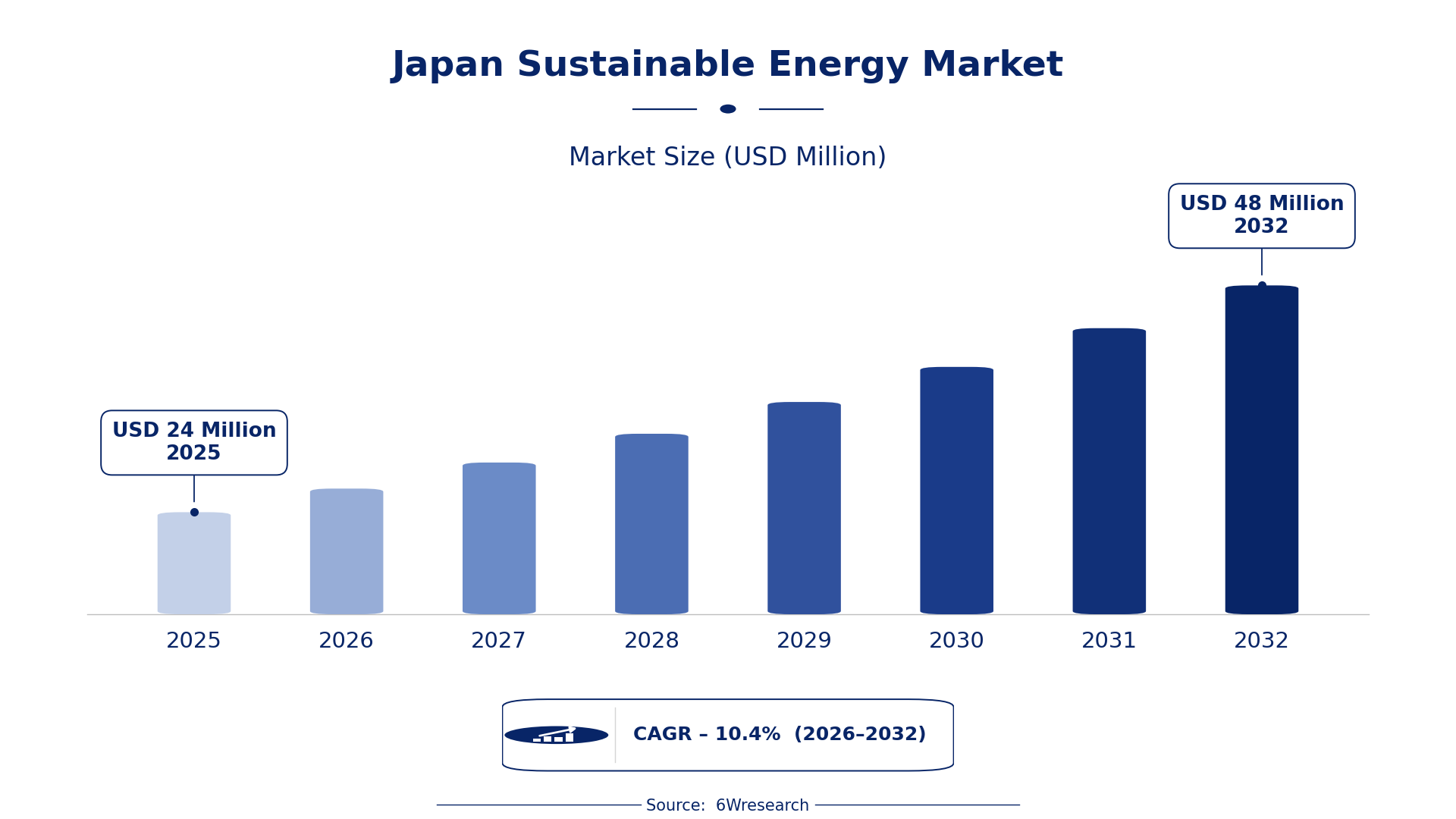
According to 6Wresearch internal database and industry insights, the Japan Sustainable Energy Market was valued at USD 24 Million in 2025 and is projected to reach USD 48 Million by 2032, growing at a CAGR of approximately 10.4% during 2026–2032.
Japan Sustainable Energy Market Highlights
| Report Metric | Details |
| Report Name | Japan Sustainable Energy Market (2026-2032) |
| Market Size 2025 | USD 24 Million |
| Market Size 2032 | USD 48 Million |
| Absolute Growth 2025–2032 | USD 24 Million |
| CAGR 2026–2032 | 10.4% |
| Peak Annual Growth | 12.7% in 2032 |
| Forecast Period | 2026–2032 |
| Historical Data | 2022–2025 |
| Base Year | 2025 |
| Leading Energy Source, 2025 | Solar Power (42% share) |
| Leading Generation Technology, 2025 | PV/Concentrated Solar (47% share) |
| Leading End Use Segment, 2025 | Grid Supply (41% share) |
| Leading End User, 2025 | Utility Companies (37% share) |
| Fastest-Growing Energy Source | Wind Energy (15.3% CAGR) |
| Fastest-Growing Generation Technology | Micro/Mini Hydro (15.4% CAGR) |
| Fastest-Growing End Use Segment | Rural Electrification (14.0% CAGR) |
| Fastest-Growing End User | IPPs (13.6% CAGR) |
| Growing Sector | Grid Supply |
| Key End Users | Utility Companies, IPPs, Government Bodies |
Japan Sustainable Energy Market Year-wise Growth Rate and Key Drivers (2022–2032)
This graph illustrates the annual growth rates of the market from 2022 to 2032, highlighting a steady upward trajectory and projected market expansion over the forecast period.
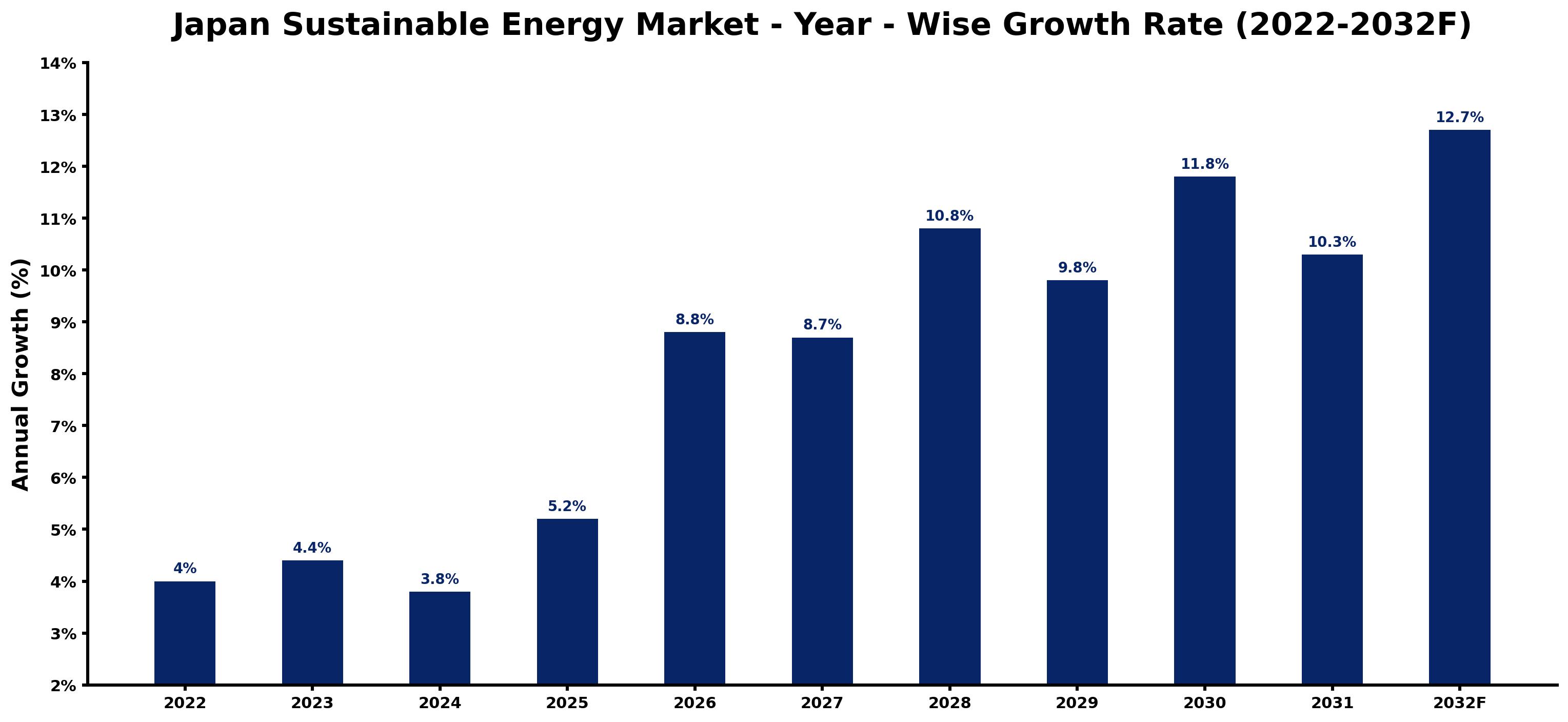
Annual growth estimates for each year appear below with the principal reason behind them, explaining the shifts that set the pace of the market.
| Year | Estimated Annual Growth (%) | Market Rationale |
| 2022 | 4.0 | The market experienced steady growth due to increasing energy needs. |
| 2023 | 4.4 | Growth accelerated as more renewable energy projects were initiated. |
| 2024 | 3.8 | Growth slowed as some projects faced delays in implementation. |
| 2025 | 5.2 | The market rebounded with investments in renewable technologies. |
| 2026 | 8.8 | Demand surged as public and private investments in decarbonisation increased. |
| 2027 | 8.7 | Growth slowed slightly as the market began to stabilise. |
| 2028 | 10.8 | Demand rose sharply due to advancements in energy technologies. |
| 2029 | 9.8 | Growth decelerated as market saturation began to set in. |
| 2030 | 11.8 | A surge in renewable energy adoption was driven by policy support. |
| 2031 | 10.3 | The market continued to grow, albeit at a slower pace than before. |
| 2032 | 12.7 | Demand peaked as the country approached its ambitious renewable targets. |
Note: Market size estimations and growth projections presented in this report are based on 6Wresearch's proprietary forecasting methodology, utilizing the latest available industry data, government publications, and primary research inputs.
Japan Sustainable Energy Market Synopsis
Sustainable energy in Japan encompasses renewable sources such as solar, wind, biomass, and hydro, harnessed through technologies like photovoltaic systems. The primary applications include electricity generation for residential, commercial, and industrial uses. The Japan Sustainable Energy Market is expanding, driven by government initiatives targeting 36-38% of energy from renewables by 2030 and investments projected at JPY 150 trillion over the next decade to support decarbonisation efforts nationwide.
Market Dynamics Impact Analysis (2026–2032)
| Factor | Type | Impact | Primary Segment Affected |
| Government initiatives promoting renewable energy adoption | Driver | High | Solar Power |
| Rising consumer demand for sustainable energy solutions | Driver | High | Wind Energy |
| Growing investment opportunities in renewable technologies | Opportunity | High | Biomass Energy |
| Increased demand for residential solar systems | Opportunity | High | Hydro Energy |
| High initial investment costs for renewable energy projects | Restraint | High | Solar Power |
| Regulatory complexities affecting project approvals | Restraint | Medium | Wind Energy |
| Competition from traditional energy sources | Challenge | High | Biomass Energy |
| Technological barriers in energy storage solutions | Challenge | Medium | Hydro Energy |
Evaluation of Drivers in Japan Sustainable Energy Market (2026–2032)
These are the developments adding the most demand over the forecast period.
| Drivers | Primary Segment Affected | Why It Matters (Evidence) |
| Government support through the Feed-in Tariff program | Solar Power | This initiative has led to over 2 million solar installations as of 2023. |
| Investments in offshore wind projects | Wind Energy | The Japan Wind Power Association supports these initiatives, boosting capacity with significant funding. |
| Public awareness of climate change | Biomass Energy | The Ministry of the Environment promotes biomass utilization, increasing demand for this energy source. |
| Rising electricity prices pushing consumers towards renewables | Hydro Energy | Hydroelectric power plants in the Tohoku region provide cost-effective energy solutions. |
| Government targets for renewable energy adoption | Grid Supply | The aim for 36-38% of energy from renewables by 2030 drives substantial investments. |
Spending rises as Japan's renewable energy capacity reached 100 GW in 2022, prompting utility companies to invest in sustainable solutions. The Feed-in Tariff program has supported solar energy adoption since 2012, resulting in over 2 million installations. Public awareness of climate change has increased demand for biomass energy, with the Ministry of the Environment promoting its utilisation. Rising electricity prices are pushing consumers toward hydro energy, particularly in the Tohoku region, where hydroelectric power plants are established and provide affordable energy. Government targets for renewable energy adoption are driving investments, aiming for a substantial share of energy from renewables by 2030.
Evaluation of Restraints in Japan Sustainable Energy Market
The following restraints limit how fast demand can grow.
| Market Restraint | Primary Segment Affected | Why It Matters (Evidence) |
| High initial costs of renewable energy technologies | Solar Power | Solar installations require substantial upfront investments, deterring some buyers. |
| Regulatory hurdles in project approvals | Wind Energy | Complex regulations can delay project timelines and increase costs. |
| Limited infrastructure for biomass energy utilization | Biomass Energy | Insufficient facilities for processing biomass restrict its widespread adoption. |
| Competition from cheaper fossil fuels | Hydro Energy | Lower prices for traditional energy sources can hinder renewable investments. |
| Technological limitations in energy storage systems | Grid Supply | Inefficient storage solutions affect the reliability of renewable supply. |
Japan Sustainable Energy Market Challenges
Producers face intense competition as Japan's renewable energy capacity reached 100 GW in 2022, yet demand continues to outpace supply, driving up operational costs. Distributors struggle with skills shortages, as the transition to advanced technologies requires a workforce trained in modern energy systems, delaying project timelines and increasing expenses. Buyers encounter regulatory hurdles, as evolving standards from the Ministry of Economy, Trade and Industry complicate compliance, risking fines and project cancellations. Technology adoption is hindered by high initial investments, limiting access to efficient systems and delaying the transition to sustainable solutions for residential and commercial users.
Trends in the Japan Sustainable Energy Market
The trends below show where the Japan Sustainable Energy Market is heading.
- Shift from Fossil Fuels to Renewable Sources: Since 2020, Japan has increasingly shifted its energy focus from fossil fuels to renewables, guided by the Green Growth Strategy. This transition aims for a substantial share of energy from renewables by 2030, encouraging utility companies to invest in sustainable technologies.
- Transition to Decentralised Energy Systems: Decentralised energy systems are gaining traction, particularly in rural areas. The government’s Rural Electrification initiative supports local energy generation, enhancing energy access for remote communities, with a target of 1 million electric vehicles by 2030.
- Emergence of Offshore Wind Energy: The Japan Wind Power Association has been instrumental in promoting offshore wind projects since 2021. This initiative is expected to increase renewable capacity, with substantial investments planned for the coming years.
- Prioritisation of Energy Storage Solutions: In 2022, Japan launched the Battery Industry Strategy to boost domestic battery manufacturing capacity. This strategy targets 150 GWh by 2030, addressing the need for efficient energy storage in renewable energy systems.
Investment Opportunities in the Japan Sustainable Energy Market
Several openings in the Japan Sustainable Energy Market merit attention from investors.
- Utility Companies seeking renewable energy solutions: With Japan's population of 125 million driving energy demand, utility companies are increasingly investing in renewable projects. The market gap for sustainable energy solutions is estimated at JPY 150 trillion over the next decade.
- Tohoku region's hydroelectric potential: The Tohoku region has ample hydroelectric power plants, presenting opportunities for investment in renewable energy projects. Collaborating with local authorities can facilitate entry into this market.
- Partnerships for residential solar systems: The recent subsidy program for residential solar systems creates a gap for suppliers. Forming joint ventures with local installers can help capture this growing market segment.
- Investment in biomass energy facilities: The Ministry of the Environment promotes biomass energy utilisation, indicating a need for processing facilities. Investing in these facilities can meet the demand from agro-industries and other sectors.
Government Initiatives in the Japan Sustainable Energy Market
The Hydrogen Society Promotion Act, enacted in 2024, supports the development of low-carbon hydrogen and ammonia supply chains, providing price-gap support to incentivise producers. This law is part of Japan's broader strategy to achieve net-zero emissions by 2050, aligning with the GX Promotion Act of 2023, which lays the groundwork for the country's decarbonisation efforts. These measures are crucial for producers and buyers involved in sustainable energy, as they create a supportive framework for investment and development.
The Ministry of Economy, Trade and Industry (METI) oversees the implementation of various energy policies, including the Battery Industry Strategy, which funds domestic battery manufacturing projects. This agency also approves initiatives under the Green Growth Strategy, which identifies sectors for investment and growth, ensuring that sustainable energy projects receive the necessary support and funding to thrive.
Future Insight of the Japan Sustainable Energy Market
By 2032, buyers will benefit from greater affordability in solar installations due to the new subsidy program, which aims to increase adoption rates. Renewable energy capacity could exceed 120 GW, driven by JPY 150 trillion in public and private decarbonisation investments over the next decade. The push for one million electric vehicles will require expanded charging infrastructure, influencing energy consumption patterns. Improved biomass practices will allow suppliers to diversify energy offerings, meeting sustainability goals and adapting to changing market demands.
Market Segmentation Analysis
Japan Sustainable Energy Market report covers a detailed analysis of the following market segments:
By Energy Source – Solar Power Leads, Wind Energy Expected to Grow Fastest
According to Saurav Kr Singh, Senior Research Analyst at 6Wresearch, Solar Power held 42% of the Japan Sustainable Energy Market by energy source in 2025. Solar power dominates the market due to its extensive use in residential and commercial sectors, with over 2 million installations reported in 2023. The Feed-in Tariff programme has been instrumental in promoting solar energy adoption since its inception in 2012, solidifying its leading position. Over 2026–2032, Wind Energy is expected to post the fastest growth, at a CAGR of 15.3%. Wind energy is rapidly expanding as government initiatives back offshore projects, which are essential for achieving ambitious renewable energy targets. The Japan Wind Power Association's active support for capacity growth is likely to further boost wind energy's market presence. Suppliers must focus on wind energy solutions to meet the rising demand and leverage growth opportunities.
By Generation Technology – PV/Concentrated Solar Leads, Micro/Mini Hydro Expected to Grow Fastest
PV/Concentrated Solar took 47% of generation technology revenue in 2025, more than any other category. PV/Concentrated solar technology is the leading method for solar energy generation, vital for fulfilling Japan's renewable energy goals. Its established application in residential and commercial energy generation reinforces its strong foothold in the market. The quickest growth will come from Micro/Mini Hydro, forecast to expand at a CAGR of 15.4% between 2026 and 2032. Micro/Mini hydro technology is growing swiftly due to its capacity to provide energy solutions in rural electrification. Government support for expanding renewable energy access is anticipated to accelerate the uptake of this technology. Buyers in rural areas may find new energy solutions through the implementation of micro/mini hydro systems.
By End Use Segment – Grid Supply Leads, Rural Electrification Expected to Grow Fastest
In 2025, Grid Supply led the end use segment split with a 41% share. Grid supply is the leading end use segment, essential for meeting national energy demands and ensuring the stability of the energy market. The government's commitment to increasing renewable energy sources further underscores the significance of grid supply. Rural Electrification is projected to grow fastest, at a CAGR of 14.0% during 2026–2032. Rural electrification is the fastest-growing segment, propelled by initiatives focused on providing energy access to remote communities. This emphasis on inclusive energy access is anticipated to drive substantial growth in this area. Suppliers should explore tailored solutions for rural electrification to address emerging market needs.
By End User – Utility Companies Lead, IPPs Expected to Grow Fastest
Utility Companies accounted for 37% of the market by end user in 2025. Utility companies are the primary consumers of renewable energy, tasked with distributing generated power to end users. Their established infrastructure and significant market presence confirm their leading role in the renewable energy sector. IPPs are set to record the highest CAGR in this split, 13.6% over 2026–2032. Independent power producers (IPPs) are quickly increasing their market share, playing a crucial role in energy supply and diversifying the market. Their growing involvement is expected to stimulate competition and innovation within the sector. Suppliers should consider collaborating with IPPs to explore new partnerships and broaden their market reach.
Key Attractiveness of the Report
- 10 Years of Market Numbers
- Historical Data Starting from 2022 to 2025
- Base Year 2025
- Forecast Data until 2032
- Key Performance Indicators Impacting the Market
- Major Upcoming Developments and Projects
Key Highlights of the Report:
- Japan Sustainable Energy Market Outlook
- Market Size of Japan Sustainable Energy Market, 2025
- Forecast of Japan Sustainable Energy Market, 2032
- Historical Data and Forecast of Japan Sustainable Energy Revenues & Volume for the Period 2022-2032F
- Japan Sustainable Energy Market Trend Evolution
- Japan Sustainable Energy Market Drivers and Challenges
- Japan Sustainable Energy Price Trends
- Japan Sustainable Energy Porter's Five Forces
- Japan Sustainable Energy Industry Life Cycle
- Historical Data and Forecast of Japan Sustainable Energy Market Revenues & Volume By Energy Source for the Period 2022-2032F
- Historical Data and Forecast of Japan Sustainable Energy Market Revenues & Volume By Solar Power for the Period 2022-2032F
- Historical Data and Forecast of Japan Sustainable Energy Market Revenues & Volume By Wind Energy for the Period 2022-2032F
- Historical Data and Forecast of Japan Sustainable Energy Market Revenues & Volume By Biomass Energy for the Period 2022-2032F
- Historical Data and Forecast of Japan Sustainable Energy Market Revenues & Volume By Hydro Energy for the Period 2022-2032F
- Historical Data and Forecast of Japan Sustainable Energy Market Revenues & Volume By Generation Technology for the Period 2022-2032F
- Historical Data and Forecast of Japan Sustainable Energy Market Revenues & Volume By PV/Concentrated Solar for the Period 2022-2032F
- Historical Data and Forecast of Japan Sustainable Energy Market Revenues & Volume By Onshore/Offshore for the Period 2022-2032F
- Historical Data and Forecast of Japan Sustainable Energy Market Revenues & Volume By Anaerobic Digesters for the Period 2022-2032F
- Historical Data and Forecast of Japan Sustainable Energy Market Revenues & Volume By Micro/Mini Hydro for the Period 2022-2032F
- Historical Data and Forecast of Japan Sustainable Energy Market Revenues & Volume By End Use Segment for the Period 2022-2032F
- Historical Data and Forecast of Japan Sustainable Energy Market Revenues & Volume By Residential/Commercial for the Period 2022-2032F
- Historical Data and Forecast of Japan Sustainable Energy Market Revenues & Volume By Grid Supply for the Period 2022-2032F
- Historical Data and Forecast of Japan Sustainable Energy Market Revenues & Volume By Industrial Heat & Power for the Period 2022-2032F
- Historical Data and Forecast of Japan Sustainable Energy Market Revenues & Volume By Rural Electrification for the Period 2022-2032F
- Historical Data and Forecast of Japan Sustainable Energy Market Revenues & Volume By End User for the Period 2022-2032F
- Historical Data and Forecast of Japan Sustainable Energy Market Revenues & Volume By Utility Companies for the Period 2022-2032F
- Historical Data and Forecast of Japan Sustainable Energy Market Revenues & Volume By IPPs for the Period 2022-2032F
- Historical Data and Forecast of Japan Sustainable Energy Market Revenues & Volume By Agro-Industries for the Period 2022-2032F
- Historical Data and Forecast of Japan Sustainable Energy Market Revenues & Volume By Government Bodies for the Period 2022-2032F
- Japan Sustainable Energy Import Export Trade Statistics
- Market Opportunity Assessment By Energy Source
- Market Opportunity Assessment By Generation Technology
- Market Opportunity Assessment By End Use Segment
- Market Opportunity Assessment By End User
- Japan Sustainable Energy Top Companies Market Share
- Japan Sustainable Energy Competitive Benchmarking By Technical and Operational Parameters
- Japan Sustainable Energy Company Profiles
- Japan Sustainable Energy Key Strategic Recommendations
Market Covered
The study includes the following segmentation.
By Energy Source
- Solar Power
- Wind Energy
- Biomass Energy
- Hydro Energy
By Generation Technology
- PV/Concentrated Solar
- Onshore/Offshore
- Anaerobic Digesters
- Micro/Mini Hydro
By End Use Segment
- Residential/Commercial
- Grid Supply
- Industrial Heat & Power
- Rural Electrification
By End User
- Utility Companies
- IPPs
- Agro-Industries
- Government Bodies































