Japan Sustainable Energy Systems Market Size & Growth Rate
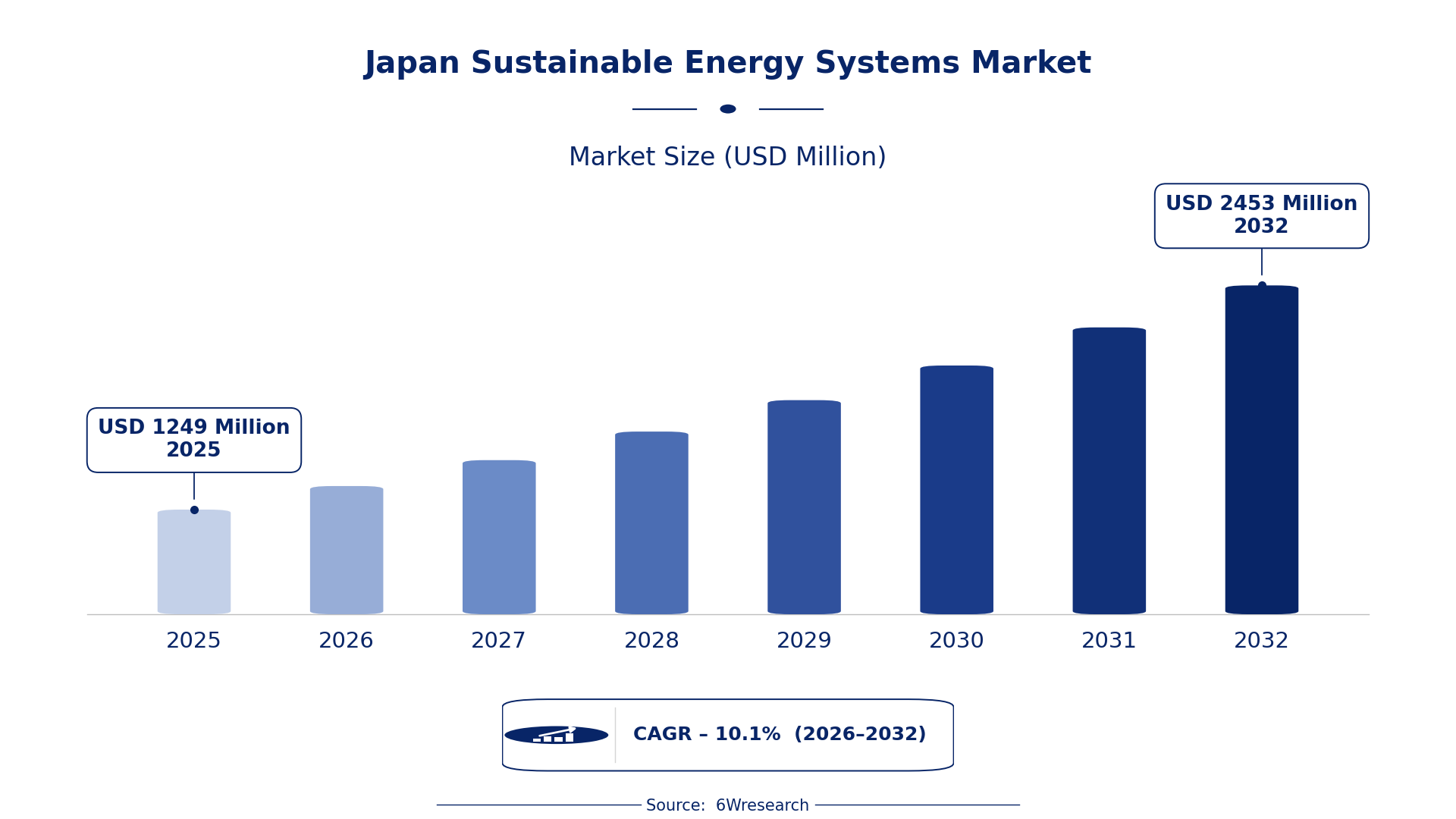
According to 6Wresearch internal database and industry insights, the Japan Sustainable Energy Systems Market was valued at USD 1,249 Million in 2025 and is projected to reach USD 2,453 Million by 2032, growing at a CAGR of approximately 10.1% during 2026–2032.
Japan Sustainable Energy Systems Market Highlights
| Report Metric | Details |
| Report Name | Japan Sustainable Energy Systems Market (2026-2032) |
| Market Size 2025 | USD 1,249 Million |
| Market Size 2032 | USD 2,453 Million |
| Absolute Growth 2025–2032 | USD 1,204 Million |
| CAGR 2026–2032 | 10.1% |
| Peak Annual Growth | 11.6% in 2026 |
| Forecast Period | 2026–2032 |
| Historical Data | 2022–2025 |
| Base Year | 2025 |
| Leading System Type, 2025 | Off-Grid Solar Systems (52% share) |
| Leading Integration Feature, 2025 | Battery Storage (39% share) |
| Leading Application Segment, 2025 | Utility Sector (50% share) |
| Leading End User, 2025 | Power Distributors (40% share) |
| Fastest-Growing System Type | Hybrid Energy Systems (14.2% CAGR) |
| Fastest-Growing Application Segment | Rural Areas (13.1% CAGR) |
| Fastest-Growing End User | Energy Service Firms (12.5% CAGR) |
| Growing Sector | Renewable Energy |
| Key End Users | Power Distributors, Energy Service Firms, Industrial Facilities |
Japan Sustainable Energy Systems Market Year-wise Growth Rate and Key Drivers (2022–2032)
This graph illustrates the annual growth rates of the market from 2022 to 2032, highlighting a steady upward trajectory and projected market expansion over the forecast period.
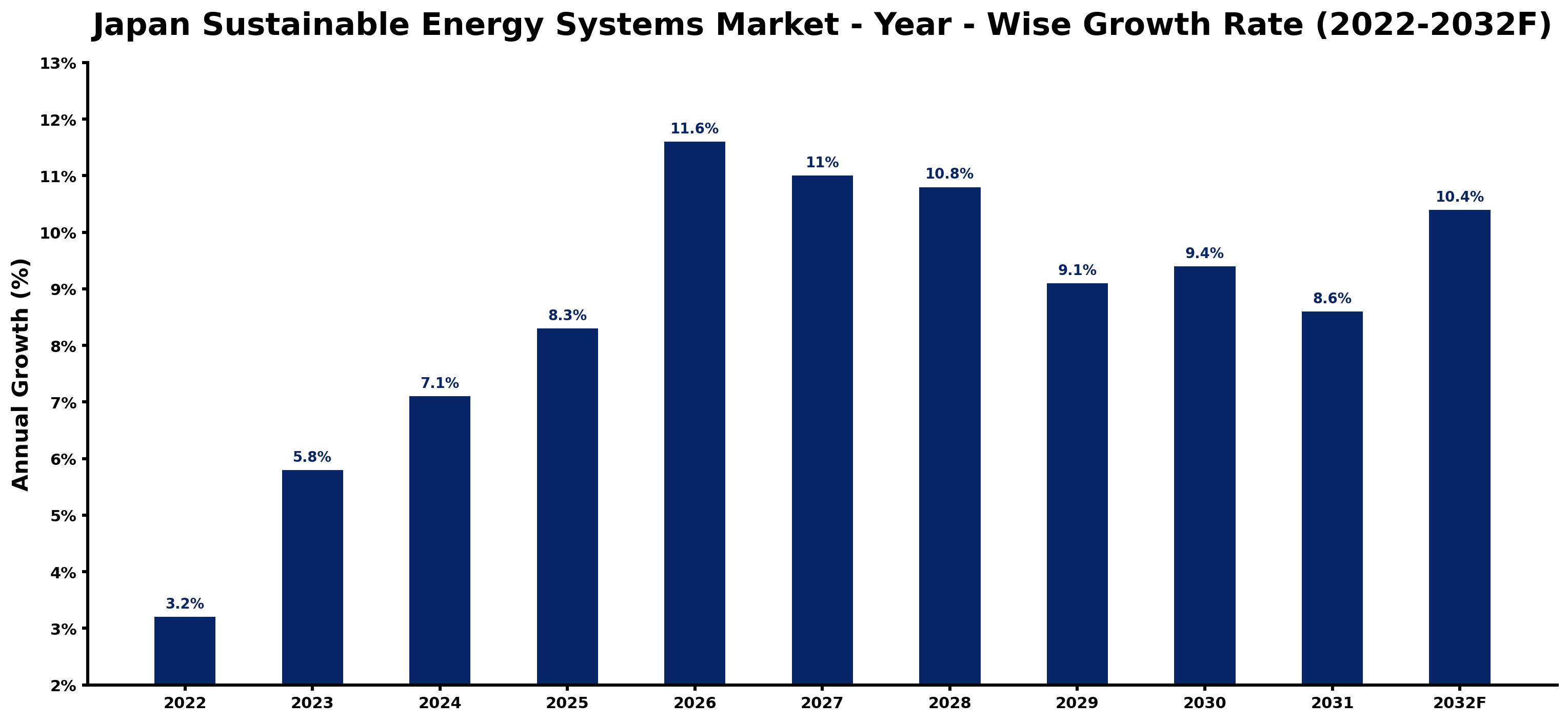
Year by year, the estimates below pair each growth rate with the development that shaped it.
| Year | Estimated Annual Growth (%) | Market Rationale |
| 2022 | 3.2 | Demand for sustainable energy systems increased as awareness of climate change grew. |
| 2023 | 5.8 | Adoption of renewable technologies accelerated due to rising energy costs and environmental concerns. |
| 2024 | 7.1 | Investment in green technologies surged, driven by government initiatives and private sector interest. |
| 2025 | 8.3 | The market expanded as more residential and commercial users sought energy efficiency solutions. |
| 2026 | 11.6 | Strong public and private investments in decarbonisation are expected to fuel market growth. |
| 2027 | 11.0 | Growth is projected to slow slightly as the market begins to stabilise after rapid expansion. |
| 2028 | 10.8 | Demand will continue to rise, supported by ongoing investments in renewable energy infrastructure. |
| 2029 | 9.1 | Market growth is expected to decelerate as competition intensifies among energy service firms. |
| 2030 | 9.4 | Renewable energy targets will prompt further investments in sustainable systems across sectors. |
| 2031 | 8.6 | Growth is projected to moderate as the market matures, with established players solidifying their positions. |
| 2032 | 10.4 | Demand is expected to rise again as new technologies and systems gain traction. |
Note: Market size estimations and growth projections presented in this report are based on 6Wresearch's proprietary forecasting methodology, utilizing the latest available industry data, government publications, and primary research inputs.
Japan Sustainable Energy Systems Market Synopsis
Sustainable energy systems utilise renewable sources like solar and wind, integrating them with storage and management technologies to provide reliable solutions. The Japan Sustainable Energy Systems Market is growing rapidly, driven by a target of achieving 36-38% of energy from renewables by 2030 and a JPY 150 trillion investment in decarbonisation over the next decade. Key drivers include urbanisation, rising energy costs, and government measures promoting sustainability and efficiency.
Market Dynamics Impact Analysis (2026–2032)
| Factor | Type | Impact | Primary Segment Affected |
| Government investment in decarbonisation initiatives | Driver | High | Battery Storage |
| Growing demand for energy efficiency in residential and commercial sectors | Driver | High | Hybrid Energy Systems |
| Rural areas seeking off-grid energy solutions | Opportunity | High | Off-Grid Solar Systems |
| Increasing adoption of smart grid technologies in urban areas | Opportunity | Medium | Smart Grids |
| High initial costs of sustainable energy systems | Restraint | High | Energy-as-a-Service |
| Limited awareness of sustainable energy options in rural communities | Restraint | Medium | Rural Areas |
| Regulatory compliance challenges for new technologies | Challenge | High | Utility Sector |
| Capacity constraints in domestic battery manufacturing | Challenge | Medium | Battery Storage |
Evaluation of Drivers in Japan Sustainable Energy Systems Market (2026–2032)
The table below links each growth driver to the segment it affects and the evidence for it.
| Drivers | Primary Segment Affected | Why It Matters (Evidence) |
| Government funding for renewable energy projects | Battery Storage | Japan's government allocated ¥10 billion for renewable energy R&D, boosting storage capacity and reliability. |
| Investment in energy efficiency technologies | Hybrid Energy Systems | With a target of 46% emissions reduction by 2030, businesses are investing in hybrid systems to meet regulations. |
| Rising energy costs prompting adoption of renewables | Off-Grid Solar Systems | As energy prices rise, rural areas increasingly adopt off-grid solar solutions for reliable power. |
| Integration of smart grid technologies | Smart Grids | Tokyo's implementation of smart grids improves energy distribution, driving demand for advanced energy management systems. |
| Growing interest in sustainable energy solutions | Energy-as-a-Service | The Green Growth Strategy encourages businesses to adopt energy-as-a-service models, reducing upfront costs. |
Rising energy costs have prompted rural areas to adopt off-grid solar systems, increasing their reliability. The integration of smart grid technologies optimises energy distribution, driving demand for advanced management systems. Interest in sustainable energy solutions is encouraging businesses to adopt energy-as-a-service models, which reduces upfront costs and improves efficiency.
Evaluation of Restraints in Japan Sustainable Energy Systems Market
Below are the constraints most often cited by buyers and suppliers, with the segment each affects.
| Market Restraint | Primary Segment Affected | Why It Matters (Evidence) |
| High initial costs of sustainable energy systems | Energy-as-a-Service | The upfront investment required for sustainable energy systems deters many potential users, limiting market growth. |
| Limited awareness of sustainable energy options | Rural Areas | Many rural communities lack knowledge about available sustainable energy solutions, hindering adoption rates. |
| Regulatory compliance challenges for new technologies | Utility Sector | Utilities face difficulties in meeting evolving regulations for integrating renewable sources, delaying project timelines. |
| Capacity constraints in domestic battery manufacturing | Battery Storage | Limited manufacturing capacity affects the availability of battery systems, impacting overall market growth. |
| Market competition leading to price wars | Hybrid Energy Systems | Intense competition among providers can lead to reduced profit margins, affecting investment in new technologies. |
Japan Sustainable Energy Systems Market Challenges
High installation costs for sustainable energy systems deter buyers, limiting their ability to invest in renewable technologies. Regulatory complexities from the Renewable Energy Law and Energy Conservation Law create delays in project approvals, frustrating developers and extending timelines by an average of six months. Increasing raw material costs, particularly for solar panels, can inflate project budgets by up to 20%, straining financial resources for investors. Technological integration issues, especially with smart grid systems, disrupt functionality, complicating energy management for users and leading to inefficiencies that can reduce overall energy savings.
Trends in the Japan Sustainable Energy Systems Market
The shifts below are changing how Japan Sustainable Energy Systems Market products are bought and supplied.
- Shift from Traditional to Smart Energy Management: Since 2023, urban areas have increasingly adopted smart grid technologies to optimise energy distribution. For example, Tokyo's smart grid implementation has improved energy efficiency, with a projected 20% reduction in energy waste.
- Transition from Centralised to Decentralised Energy Systems: Rural areas are moving towards off-grid solar systems, improving energy access. In 2023, over 3 million solar installations were reported, significantly increasing energy independence.
- Emergence of Energy-as-a-Service Models: The adoption of energy-as-a-service models is growing, allowing users to access sustainable energy solutions without upfront costs. This trend is supported by the Green Growth Strategy, which aims to lower barriers to entry.
- Prioritisation of Battery Storage Solutions: Battery storage systems are becoming essential for improving reliability in renewable energy. The total installed capacity reached 1.2 GW in 2023, reflecting a growing focus on storage.
Investment Opportunities in the Japan Sustainable Energy Systems Market
Below are the investment opportunities with the strongest case in the Japan Sustainable Energy Systems Market.
- Partnerships with Energy Service Firms: Now is an ideal time to collaborate with energy service firms to provide battery storage solutions, as demand is rising. The Green Innovation Fund supports startups in this sector.
- Investment in Rural Energy Solutions: With a target of 36-38% renewable energy by 2030, there is an opportunity to invest in off-grid solar systems for rural areas. Collaborating with local governments can facilitate market entry.
- Development of Smart Grid Technologies: The ongoing Smart City Initiative aims to integrate smart grids by 2025, presenting opportunities for technology providers to supply advanced solutions. Engaging with urban planners can open new avenues.
- Expansion of Hybrid Energy Systems: As hybrid energy systems grow, there is an opportunity to supply integrated solutions that combine multiple energy sources. The Chubu region is a hub for such projects, making it a strategic location.
Government Initiatives in the Japan Sustainable Energy Systems Market
The Hydrogen Society Promotion Act, enacted in 2024, supports the development of low-carbon hydrogen supply chains, providing price-gap support for producers. This measure encourages investment in hydrogen technologies, which are essential for sustainable energy systems.
The Agency for Natural Resources and Energy oversees the implementation of the Green Growth Strategy, which allocates funding for renewable energy projects. In 2023, the government allocated ¥10 billion to support clean energy technologies, benefiting various stakeholders.
Future Insight of the Japan Sustainable Energy Systems Market
Technological advancements in renewable energy systems will reshape demand by 2032, particularly in urban areas. Japan's commitment to achieving 36-38% of its energy from renewables by 2030 will drive suppliers to develop efficient solutions. The Green Innovation Fund will support the growth of clean energy technologies, enabling new market entrants to thrive. By 2030, the total capacity of wind energy is projected to reach 10 GW, presenting substantial opportunities for producers to expand their offerings.
Market Segmentation Analysis
Japan Sustainable Energy Systems Market report covers a detailed analysis of the following market segments:
By System Type – Off-Grid Solar Systems Lead, Hybrid Energy Systems Expected to Grow Fastest
According to Saurav Kr Singh, Senior Research Analyst at 6Wresearch, Off-Grid Solar Systems accounted for 52% of the market by system type in 2025. Off-Grid Solar Systems hold the largest share as they provide essential energy access to remote areas without grid connections. These systems are particularly vital in rural communities where traditional energy infrastructure is often lacking. Hybrid Energy Systems are set to record the highest CAGR in this split, 14.2% over 2026–2032. Hybrid Energy Systems are experiencing rapid growth because they effectively combine multiple energy sources, enhancing both reliability and efficiency. This trend is especially notable in regions like Chubu, which is known for its focus on renewable energy projects. Suppliers should focus on developing solutions that cater to the specific energy needs of both off-grid and hybrid systems.
By Integration Feature – Battery Storage Leads and Records the Fastest Growth
Battery Storage took 39% of integration feature revenue in 2025, more than any other category. Battery Storage leads the market as it is crucial for storing renewable energy for later use, thus improving overall system reliability. The total installed capacity of battery storage systems in Japan reached 1.2 GW in 2023, showcasing its widespread adoption across various applications. Battery Storage is also forecast to expand faster than any other category, at a CAGR of 13.4% over 2026–2032. Battery Storage is also the fastest-growing segment due to increasing investments in renewable energy technologies and the need for effective energy management. The government's allocation of ¥10 billion for renewable energy research and development further accelerates this growth. Buyers will benefit from improved energy reliability and efficiency as advancements in battery storage technologies progress.
By Application Segment – Utility Sector Leads, Rural Areas Expected to Grow Fastest
The largest application segment category in 2025 was Utility Sector, at 50% of revenue. The Utility Sector dominates the market as utilities are increasingly integrating renewable energy systems to adhere to regulatory requirements and address rising energy demands. This integration is essential for meeting Japan's goal of achieving 36-38% energy from renewable sources by 2030. Rural Areas are projected to grow fastest, at a CAGR of 13.1% during 2026–2032. Rural Areas represent the fastest-growing segment, driven by substantial demand for sustainable energy solutions in off-grid locations. The growing population in these areas intensifies the need for dependable energy access. Suppliers should customise their products to cater to the specific energy requirements of rural communities.
By End User – Power Distributors Lead, Energy Service Firms Expected to Grow Fastest
Power Distributors held 40% of the Japan Sustainable Energy Systems Market by end user in 2025. Power Distributors dominate the market due to their essential role in distributing energy generated from sustainable sources, ensuring that renewable energy reaches consumers. Their function is critical in supporting Japan's transition towards a more sustainable energy framework. The quickest growth will come from Energy Service Firms, forecast to expand at a CAGR of 12.5% between 2026 and 2032. Energy Service Firms are the fastest-growing segment as they provide customised sustainable energy solutions across various sectors. This growth is driven by an increasing focus on energy efficiency and management within the industry. Suppliers must collaborate with energy service firms to expand their market reach and enhance service offerings.
Key Attractiveness of the Report
- 10 Years of Market Numbers
- Historical Data Starting from 2022 to 2025
- Base Year 2025
- Forecast Data until 2032
- Key Performance Indicators Impacting the Market
- Major Upcoming Developments and Projects
Key Highlights of the Report:
- Japan Sustainable Energy Systems Market Outlook
- Market Size of Japan Sustainable Energy Systems Market, 2025
- Forecast of Japan Sustainable Energy Systems Market, 2032
- Historical Data and Forecast of Japan Sustainable Energy Systems Revenues & Volume for the Period 2022-2032F
- Japan Sustainable Energy Systems Market Trend Evolution
- Japan Sustainable Energy Systems Market Drivers and Challenges
- Japan Sustainable Energy Systems Price Trends
- Japan Sustainable Energy Systems Porter's Five Forces
- Japan Sustainable Energy Systems Industry Life Cycle
- Historical Data and Forecast of Japan Sustainable Energy Systems Market Revenues & Volume By System Type for the Period 2022-2032F
- Historical Data and Forecast of Japan Sustainable Energy Systems Market Revenues & Volume By Off-Grid Solar Systems for the Period 2022-2032F
- Historical Data and Forecast of Japan Sustainable Energy Systems Market Revenues & Volume By Hybrid Energy Systems for the Period 2022-2032F
- Historical Data and Forecast of Japan Sustainable Energy Systems Market Revenues & Volume By Smart Grids for the Period 2022-2032F
- Historical Data and Forecast of Japan Sustainable Energy Systems Market Revenues & Volume By Energy-as-a-Service for the Period 2022-2032F
- Historical Data and Forecast of Japan Sustainable Energy Systems Market Revenues & Volume By Integration Feature for the Period 2022-2032F
- Historical Data and Forecast of Japan Sustainable Energy Systems Market Revenues & Volume By Battery Storage for the Period 2022-2032F
- Historical Data and Forecast of Japan Sustainable Energy Systems Market Revenues & Volume By Solar + Wind for the Period 2022-2032F
- Historical Data and Forecast of Japan Sustainable Energy Systems Market Revenues & Volume By AI-Enabled Monitoring for the Period 2022-2032F
- Historical Data and Forecast of Japan Sustainable Energy Systems Market Revenues & Volume By Subscription Model for the Period 2022-2032F
- Historical Data and Forecast of Japan Sustainable Energy Systems Market Revenues & Volume By Application Segment for the Period 2022-2032F
- Historical Data and Forecast of Japan Sustainable Energy Systems Market Revenues & Volume By Rural Areas for the Period 2022-2032F
- Historical Data and Forecast of Japan Sustainable Energy Systems Market Revenues & Volume By Industrial Facilities for the Period 2022-2032F
- Historical Data and Forecast of Japan Sustainable Energy Systems Market Revenues & Volume By Utility Sector for the Period 2022-2032F
- Historical Data and Forecast of Japan Sustainable Energy Systems Market Revenues & Volume By Commercial Buildings for the Period 2022-2032F
- Historical Data and Forecast of Japan Sustainable Energy Systems Market Revenues & Volume By End User for the Period 2022-2032F
- Historical Data and Forecast of Japan Sustainable Energy Systems Market Revenues & Volume By Microgrid Operators for the Period 2022-2032F
- Historical Data and Forecast of Japan Sustainable Energy Systems Market Revenues & Volume By Energy Service Firms for the Period 2022-2032F
- Historical Data and Forecast of Japan Sustainable Energy Systems Market Revenues & Volume By Power Distributors for the Period 2022-2032F
- Historical Data and Forecast of Japan Sustainable Energy Systems Market Revenues & Volume By Energy Startups for the Period 2022-2032F
- Japan Sustainable Energy Systems Import Export Trade Statistics
- Market Opportunity Assessment By System Type
- Market Opportunity Assessment By Integration Feature
- Market Opportunity Assessment By Application Segment
- Market Opportunity Assessment By End User
- Japan Sustainable Energy Systems Top Companies Market Share
- Japan Sustainable Energy Systems Competitive Benchmarking By Technical and Operational Parameters
- Japan Sustainable Energy Systems Company Profiles
- Japan Sustainable Energy Systems Key Strategic Recommendations
Market Covered
The report covers the following segments.
By System Type
- Off-Grid Solar Systems
- Hybrid Energy Systems
- Smart Grids
- Energy-as-a-Service
By Integration Feature
- Battery Storage
- Solar + Wind
- AI-Enabled Monitoring
- Subscription Model
By Application Segment
- Rural Areas
- Industrial Facilities
- Utility Sector
- Commercial Buildings
By End User
- Microgrid Operators
- Energy Service Firms
- Power Distributors
- Energy Startups































