Japan Sustainable Farm Equipment Market Size & Growth Rate
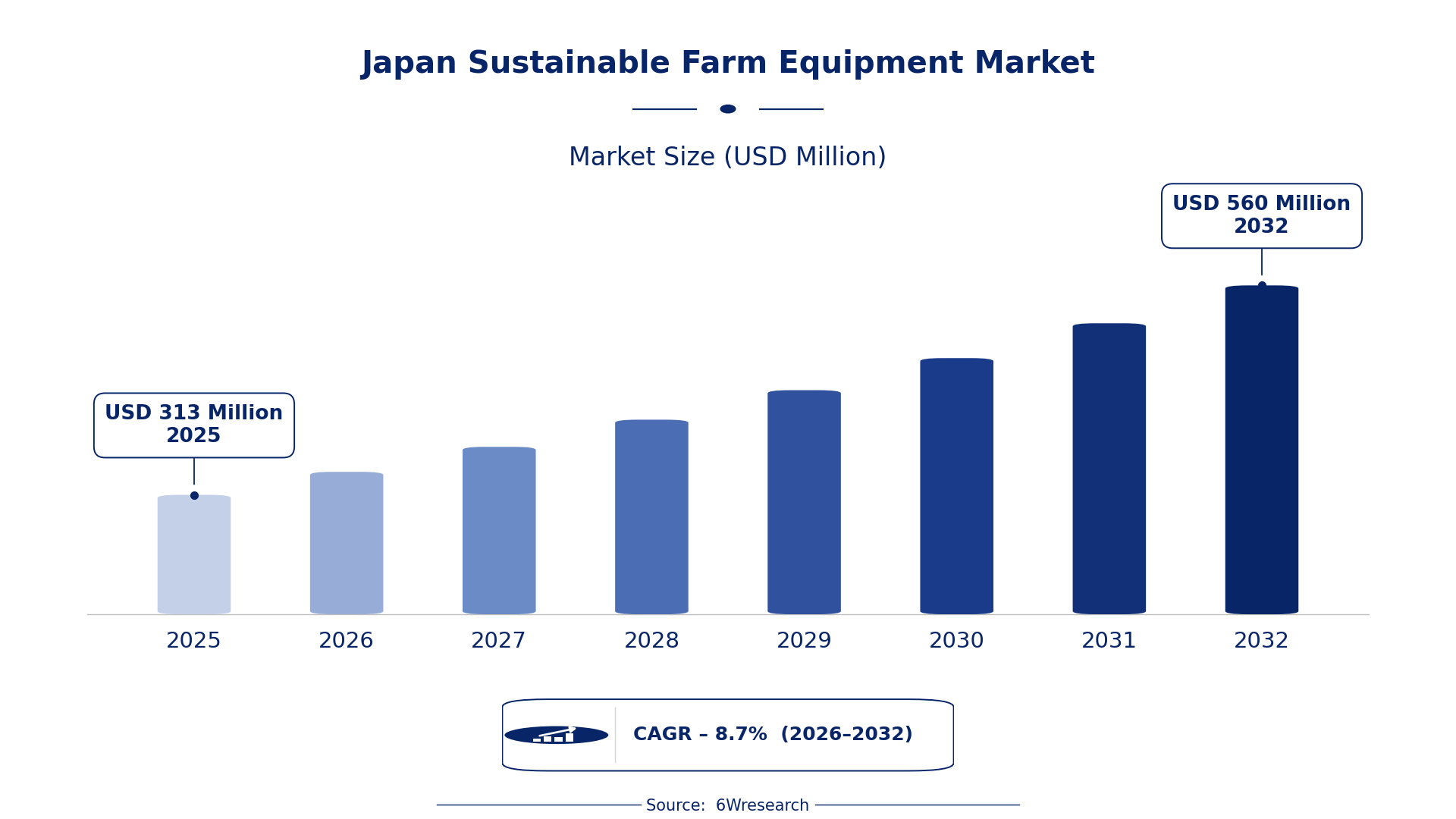
According to 6Wresearch internal database and industry insights, the Japan Sustainable Farm Equipment Market was valued at USD 313 Million in 2025 and is projected to reach USD 560 Million by 2032, growing at a CAGR of approximately 8.7% during 2026–2032.
Japan Sustainable Farm Equipment Market Highlights
| Report Metric | Details |
| Report Name | Japan Sustainable Farm Equipment Market (2026-2032) |
| Market Size 2025 | USD 313 Million |
| Market Size 2032 | USD 560 Million |
| Absolute Growth 2025–2032 | USD 247 Million |
| CAGR 2026–2032 | 8.7% |
| Peak Annual Growth | 9.4% in 2032 |
| Forecast Period | 2026–2032 |
| Historical Data | 2022–2025 |
| Base Year | 2025 |
| Leading Equipment Type, 2025 | Electric Tractors (41% share) |
| Leading Energy Type, 2025 | Battery/Electric (47% share) |
| Leading Crop Type, 2025 | Row Crops (49% share) |
| Leading End User, 2025 | Large Farms (51% share) |
| Fastest-Growing Equipment Type | Solar-Powered Irrigators (12.8% CAGR) |
| Fastest-Growing Crop Type | Organic Fields (13.0% CAGR) |
| Fastest-Growing End User | Water-Conscious Farms (11.9% CAGR) |
| Growing Sector | organic farming |
| Key End Users | large farms, water-conscious farms, smart ag companies |
Japan Sustainable Farm Equipment Market Year-wise Growth Rate and Key Drivers (2022–2032)
This graph illustrates the annual growth rates of the market from 2022 to 2032, highlighting a steady upward trajectory and projected market expansion over the forecast period.
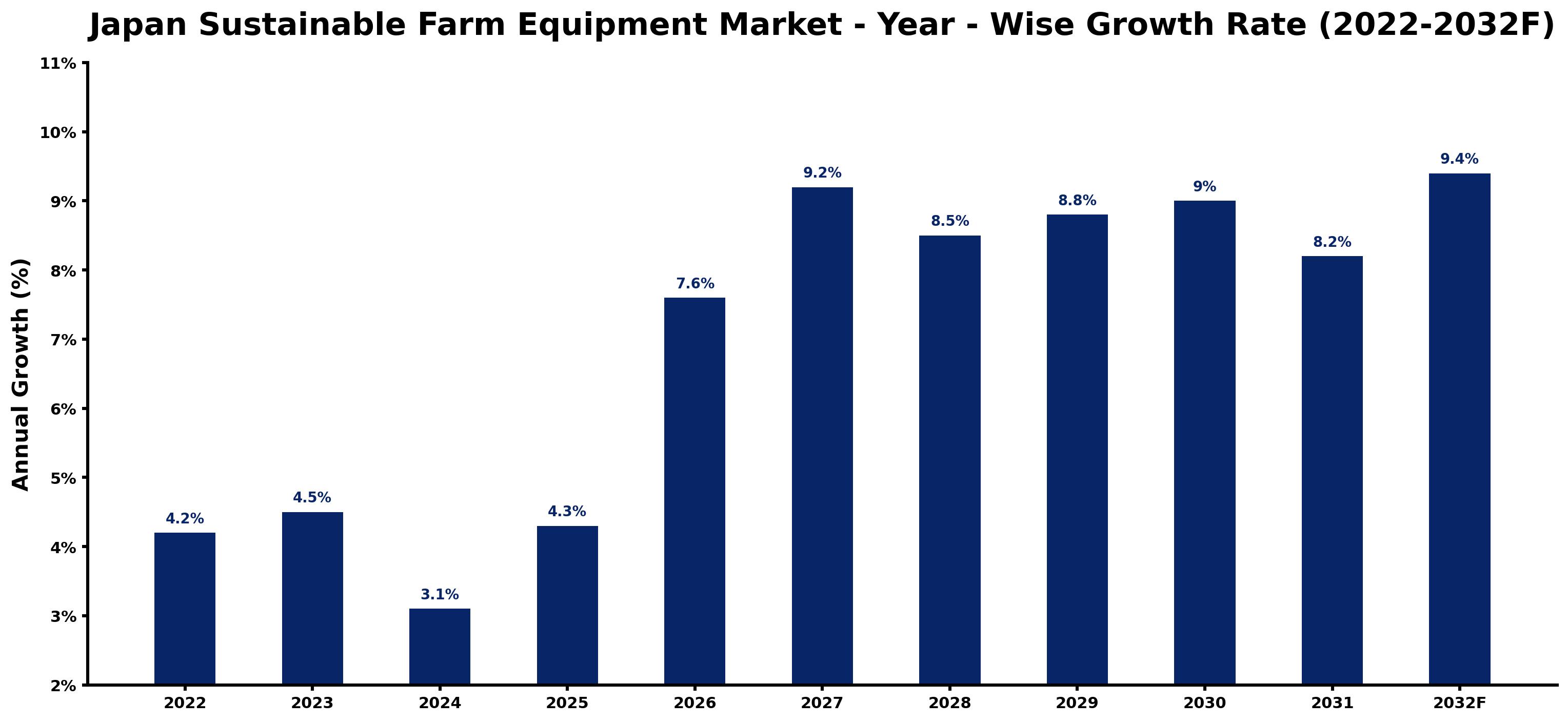
Each row of the following table gives one year's estimated growth and the event or demand shift that explains it.
| Year | Estimated Annual Growth (%) | Market Rationale |
| 2022 | 4.2 | The market showed steady growth due to increasing awareness of sustainable practices among farmers. |
| 2023 | 4.5 | Growth was driven by the government's initiatives promoting sustainable farming technologies. |
| 2024 | 3.1 | A slowdown occurred as farmers adjusted to new equipment and practices introduced the previous year. |
| 2025 | 4.3 | Demand increased again as more farmers adopted electric tractors in various prefectures. |
| 2026 | 7.6 | Growth is expected to accelerate as the adoption of solar-powered irrigators rises among water-conscious farms. |
| 2027 | 9.2 | The market will continue to expand with rising interest in autonomous tillers enhancing operational efficiency. |
| 2028 | 8.5 | A slight slowdown is projected as the market stabilises after rapid growth in previous years. |
| 2029 | 8.8 | Demand is expected to pick up again as organic farming gains popularity, driving equipment purchases. |
| 2030 | 9.0 | Growth will remain strong as farmers prepare to meet the 2030 organic farming target. |
| 2031 | 8.2 | The market is projected to experience a slowdown as the focus shifts towards integrating AI technology in farming. |
| 2032 | 9.4 | Demand is expected to peak as sustainable practices become mainstream, supported by government incentives. |
Note: Market size estimations and growth projections presented in this report are based on 6Wresearch's proprietary forecasting methodology, utilizing the latest available industry data, government publications, and primary research inputs.
Japan Sustainable Farm Equipment Market Synopsis
Sustainable farm equipment refers to agricultural machinery designed to minimise environmental impact while improving productivity. This equipment utilises advanced technologies such as electric motors and solar panels, enabling efficient farming practices. The Japan Sustainable Farm Equipment Market is expanding as environmentally conscious farmers seek solutions, supported by government measures like the Industrial Safety and Health Act, which aims to reduce greenhouse gas emissions by 26% by 2030.
Market Dynamics Impact Analysis (2026–2032)
| Factor | Type | Impact | Primary Segment Affected |
| Government incentives for sustainable practices | Driver | High | Electric Tractors |
| Rising consumer demand for organic produce | Driver | High | Organic Fields |
| Growing investment in renewable energy solutions | Opportunity | High | Solar-Powered Irrigators |
| Expansion of large farms adopting advanced technologies | Opportunity | Medium | Large Farms |
| High initial costs of sustainable equipment | Restraint | High | Biofuel Combines |
| Limited awareness among smaller farmers about available technologies | Restraint | Medium | Autonomous Tillers |
| Aging farmer population leading to labour shortages | Challenge | High | Water-Conscious Farms |
| Dependence on government subsidies for equipment purchases | Challenge | Medium | Battery/Electric |
Evaluation of Drivers in Japan Sustainable Farm Equipment Market (2026–2032)
The main growth drivers and the segments they affect most are set out below.
| Drivers | Primary Segment Affected | Why It Matters (Evidence) |
| Government support for electric tractors | Electric Tractors | The Ministry of Agriculture promotes electric tractors in 10 prefectures, increasing adoption rates among farmers. |
| Rising demand for organic produce | Organic Fields | Japan's organic farming market is valued at approximately 100 billion yen, driving equipment purchases for organic cultivation. |
| Increased adoption of solar-powered irrigation systems | Solar-Powered Irrigators | The Tokyo region reported over 200 installations in 2023, enhancing water efficiency for farmers. |
| Technological advancements in autonomous farming equipment | Autonomous Tillers | The adoption rate of autonomous tillers is estimated at 15% among large farms, improving operational efficiency. |
| Growing focus on reducing greenhouse gas emissions | Biofuel Combines | Japan aims to reduce emissions by 26% by 2030, boosting demand for biofuel-powered harvesting equipment. |
The organic farming market, valued at approximately 100 billion yen, drives demand for equipment tailored for organic cultivation. Solar-powered irrigation systems are gaining traction, with over 200 installations reported in the Tokyo region, improving water efficiency. Technological advancements in autonomous tillers have resulted in an estimated 15% adoption rate among large farms, boosting productivity. Japan's commitment to reducing greenhouse gas emissions by 26% by 2030 is stimulating demand for biofuel-powered harvesting equipment.
Evaluation of Restraints in Japan Sustainable Farm Equipment Market
The table below lists the restraints and the evidence behind each.
| Market Restraint | Primary Segment Affected | Why It Matters (Evidence) |
| High initial costs of sustainable equipment | Biofuel Combines | The average price of biofuel combines can deter smaller farms from investing in such technology. |
| Limited awareness among smaller farmers about available technologies | Autonomous Tillers | Many smaller farmers lack knowledge about the benefits of autonomous tillers, hindering adoption. |
| Dependence on government subsidies for equipment purchases | Battery/Electric | Farmers often rely on subsidies, making them hesitant to invest without financial support. |
| Aging farmer population leading to labour shortages | Water-Conscious Farms | The average age of farmers in Japan is 67, creating challenges in workforce availability. |
| Regulatory compliance costs for sustainable practices | Solar-Powered Irrigators | Farmers face additional costs to meet regulations, which impacts their willingness to invest. |
Japan Sustainable Farm Equipment Market Challenges
The limited adoption of electric tractors affects productivity, with only 1,200 large farms using this technology, which restricts efficiency gains for producers. Price competition among suppliers of sustainable farm equipment leads to lower profit margins, forcing some to delay investments in new technologies. Regulatory compliance from the Ministry of Agriculture, Forestry and Fisheries incurs additional costs for producers, which can delay equipment upgrades and inflate operational expenses. Rising minimum wage levels, currently at JPY 1,055 per hour, create financial challenges for buyers, particularly small-scale farmers who struggle to afford sustainable machinery.
Trends in the Japan Sustainable Farm Equipment Market
These developments are changing demand patterns in the Japan Sustainable Farm Equipment Market.
- Shift towards Electric Tractors: Large farms are increasingly adopting electric tractors, with a reported 41% market share in 2025. This shift reflects a growing commitment to sustainability and reducing emissions in farming operations.
- Integration of AI in Farming: The Smart Agriculture Strategy aims to integrate AI technology by 2025, improving operational efficiency. This initiative is expected to drive demand for advanced sustainable equipment among tech-savvy farmers.
- Increase in Solar-Powered Irrigation Systems: The adoption of solar-powered irrigation systems has increased by 25% in the last year, particularly among water-conscious farms. This trend highlights a growing focus on sustainable water management in agriculture.
- Rise of Organic Farming: Japan's goal of achieving 30% organic farming by 2030 is influencing equipment demand. The organic farming market, valued at approximately 100 billion yen, is driving investments in sustainable farm equipment.
Investment Opportunities in the Japan Sustainable Farm Equipment Market
The following opportunities in the Japan Sustainable Farm Equipment Market pair current demand with a clear way in.
- Expansion of Solar-Powered Irrigation: The Tokyo region is seeing a surge in solar-powered irrigation systems, with over 200 installations reported in 2023. Suppliers can invest in this growing market by partnering with local farmers.
- Investment in Electric Tractors: Now is the time to invest in electric tractors, supported by 5 billion yen in government subsidies. Large farms are key buyers, and local partnerships can facilitate market entry.
- Growth in Organic Farming Equipment: With Japan targeting 30% organic farming by 2030, there is an opportunity for suppliers of organic farming equipment. Engaging with agricultural cooperatives can provide access to this market.
- Development of Autonomous Farming Solutions: The rising adoption of autonomous tillers presents an opportunity for technology providers. Collaborating with agricultural technology firms can enhance market presence.
Government Initiatives in the Japan Sustainable Farm Equipment Market
Producers of sustainable farm equipment must comply with the Industrial Safety and Health Act, which mandates safety standards for machinery and hazardous substances. Compliance with this law is essential for manufacturers to avoid penalties and maintain market access. Additionally, the Act on the Rational Use of Energy requires large energy users, including agricultural machinery producers, to improve energy efficiency, directly impacting the design and functionality of sustainable equipment.
In 2023, the government allocated 5 billion yen for subsidies to promote electric tractors among farmers, administered by the Ministry of Agriculture, Forestry and Fisheries (MAFF). This funding supports farmers in transitioning to more sustainable practices, improving productivity while reducing environmental impact.
Future Insight of the Japan Sustainable Farm Equipment Market
By 2032, the integration of AI technology in farming will transform demand for sustainable farm equipment, enhancing operational efficiency. The 'Smart Agriculture Strategy' will drive innovation, encouraging suppliers to create advanced machinery tailored to eco-friendly practices. As Japan targets 30% organic farming by 2030, the need for sustainable solutions will escalate. The adoption of solar-powered irrigation systems will rise, particularly in regions like Tokyo, where over 200 installations have been reported, signalling a shift towards greener agricultural methods.
Market Segmentation Analysis
Japan Sustainable Farm Equipment Market report covers a detailed analysis of the following market segments:
By Equipment Type – Electric Tractors Lead, Solar-Powered Irrigators Expected to Grow Fastest
According to Saurav Kr Singh, Senior Research Analyst at 6Wresearch, Electric Tractors accounted for 41% of the market by equipment type in 2025. Electric tractors hold the largest share as they are essential for reducing emissions in farming operations, with approximately 1,200 large farms actively using them in Japan. The Japanese government's initiatives, such as the 'Green Agriculture Promotion Program', further support their widespread adoption. Over 2026–2032, Solar-Powered Irrigators are expected to post the fastest growth, at a CAGR of 12.8%. Solar-powered irrigators are experiencing rapid growth due to a 25% increase in adoption among water-conscious farms in the last year. This trend reflects the heightened focus on sustainable irrigation solutions amid growing environmental concerns. Suppliers should prioritise the development of solar-powered irrigation systems to meet the rising demand from environmentally conscious farmers.
By Energy Type – Battery/Electric Leads and Records the Fastest Growth
The largest energy type category in 2025 was Battery/Electric, at 47% of revenue. Battery/electric systems dominate the market as they power various sustainable farming equipment, aligning with the agricultural sector's shift towards eco-friendly practices. The government's support for electric tractors has further solidified this segment's leading position. Battery/Electric is also forecast to expand faster than any other category, at a CAGR of 10.4% over 2026–2032. Battery/electric systems are also the fastest-growing segment, driven by increasing investments in sustainable technologies and government initiatives. As the leader, this segment's growth will likely continue to accelerate as more farmers seek efficient energy solutions. Buyers will benefit from a broader range of battery/electric options as suppliers expand their offerings in response to market demand.
By Crop Type – Row Crops Lead, Organic Fields Expected to Grow Fastest
With 49% of crop type revenue in 2025, Row Crops was the largest category. Row crops represent the largest share as they are the primary crops cultivated using sustainable methods, supported by the extensive arable land dedicated to sustainable farming practices in Japan. This segment's prominence is further reinforced by government policies promoting sustainable agriculture. The quickest growth will come from Organic Fields, forecast to expand at a CAGR of 13.0% between 2026 and 2032. Organic fields are the fastest-growing segment, driven by Japan's target of achieving 30% organic farming by 2030. This growth reflects the increasing consumer demand for organic produce and the corresponding need for sustainable farming equipment. Suppliers should focus on developing equipment tailored for organic farming to capitalise on the growing market opportunities.
By End User – Large Farms Lead, Water-Conscious Farms Expected to Grow Fastest
Large Farms held 51% of the Japan Sustainable Farm Equipment Market by end user in 2025. Large farms hold the largest share as they are the primary users of advanced sustainable equipment, benefiting from economies of scale and substantial investments in technology. The government's support for sustainable practices among these large operations further solidifies their dominant position in the market. Water-Conscious Farms are projected to grow fastest, at a CAGR of 11.9% during 2026–2032. Water-conscious farms are experiencing the fastest growth due to the urgent need for efficient water management, particularly in areas with limited water resources. This trend reflects a broader shift towards sustainable farming practices, which will likely continue to gain momentum. Suppliers must focus on developing solutions tailored to the needs of water-conscious farms to capitalise on this growing market segment.
Key Attractiveness of the Report
- 10 Years of Market Numbers
- Historical Data Starting from 2022 to 2025
- Base Year 2025
- Forecast Data until 2032
- Key Performance Indicators Impacting the Market
- Major Upcoming Developments and Projects
Key Highlights of the Report:
- Japan Sustainable Farm Equipment Market Outlook
- Market Size of Japan Sustainable Farm Equipment Market, 2025
- Forecast of Japan Sustainable Farm Equipment Market, 2032
- Historical Data and Forecast of Japan Sustainable Farm Equipment Revenues & Volume for the Period 2022-2032F
- Japan Sustainable Farm Equipment Market Trend Evolution
- Japan Sustainable Farm Equipment Market Drivers and Challenges
- Japan Sustainable Farm Equipment Price Trends
- Japan Sustainable Farm Equipment Porter's Five Forces
- Japan Sustainable Farm Equipment Industry Life Cycle
- Historical Data and Forecast of Japan Sustainable Farm Equipment Market Revenues & Volume By Equipment Type for the Period 2022-2032F
- Historical Data and Forecast of Japan Sustainable Farm Equipment Market Revenues & Volume By Electric Tractors for the Period 2022-2032F
- Historical Data and Forecast of Japan Sustainable Farm Equipment Market Revenues & Volume By Solar-Powered Irrigators for the Period 2022-2032F
- Historical Data and Forecast of Japan Sustainable Farm Equipment Market Revenues & Volume By Biofuel Combines for the Period 2022-2032F
- Historical Data and Forecast of Japan Sustainable Farm Equipment Market Revenues & Volume By Autonomous Tillers for the Period 2022-2032F
- Historical Data and Forecast of Japan Sustainable Farm Equipment Market Revenues & Volume By Energy Type for the Period 2022-2032F
- Historical Data and Forecast of Japan Sustainable Farm Equipment Market Revenues & Volume By Battery/Electric for the Period 2022-2032F
- Historical Data and Forecast of Japan Sustainable Farm Equipment Market Revenues & Volume By PV Panels for the Period 2022-2032F
- Historical Data and Forecast of Japan Sustainable Farm Equipment Market Revenues & Volume By Ethanol/Diesel Blend for the Period 2022-2032F
- Historical Data and Forecast of Japan Sustainable Farm Equipment Market Revenues & Volume By AI & Electric for the Period 2022-2032F
- Historical Data and Forecast of Japan Sustainable Farm Equipment Market Revenues & Volume By Crop Type for the Period 2022-2032F
- Historical Data and Forecast of Japan Sustainable Farm Equipment Market Revenues & Volume By Row Crops for the Period 2022-2032F
- Historical Data and Forecast of Japan Sustainable Farm Equipment Market Revenues & Volume By Fruits & Vegetables for the Period 2022-2032F
- Historical Data and Forecast of Japan Sustainable Farm Equipment Market Revenues & Volume By Grains for the Period 2022-2032F
- Historical Data and Forecast of Japan Sustainable Farm Equipment Market Revenues & Volume By Organic Fields for the Period 2022-2032F
- Historical Data and Forecast of Japan Sustainable Farm Equipment Market Revenues & Volume By End User for the Period 2022-2032F
- Historical Data and Forecast of Japan Sustainable Farm Equipment Market Revenues & Volume By Large Farms for the Period 2022-2032F
- Historical Data and Forecast of Japan Sustainable Farm Equipment Market Revenues & Volume By Water-Conscious Farms for the Period 2022-2032F
- Historical Data and Forecast of Japan Sustainable Farm Equipment Market Revenues & Volume By Ag Equipment Lessors for the Period 2022-2032F
- Historical Data and Forecast of Japan Sustainable Farm Equipment Market Revenues & Volume By Smart Ag Companies for the Period 2022-2032F
- Japan Sustainable Farm Equipment Import Export Trade Statistics
- Market Opportunity Assessment By Equipment Type
- Market Opportunity Assessment By Energy Type
- Market Opportunity Assessment By Crop Type
- Market Opportunity Assessment By End User
- Japan Sustainable Farm Equipment Top Companies Market Share
- Japan Sustainable Farm Equipment Competitive Benchmarking By Technical and Operational Parameters
- Japan Sustainable Farm Equipment Company Profiles
- Japan Sustainable Farm Equipment Key Strategic Recommendations
Market Covered
Segments analysed in this report are listed below.
By Equipment Type
- Electric Tractors
- Solar-Powered Irrigators
- Biofuel Combines
- Autonomous Tillers
By Energy Type
- Battery/Electric
- PV Panels
- Ethanol/Diesel Blend
- AI & Electric
By Crop Type
- Row Crops
- Fruits & Vegetables
- Grains
- Organic Fields
By End User
- Large Farms
- Water-Conscious Farms
- Ag Equipment Lessors
- Smart Ag Companies































