Japan Sustainable Farming Inputs Market Size & Growth Rate
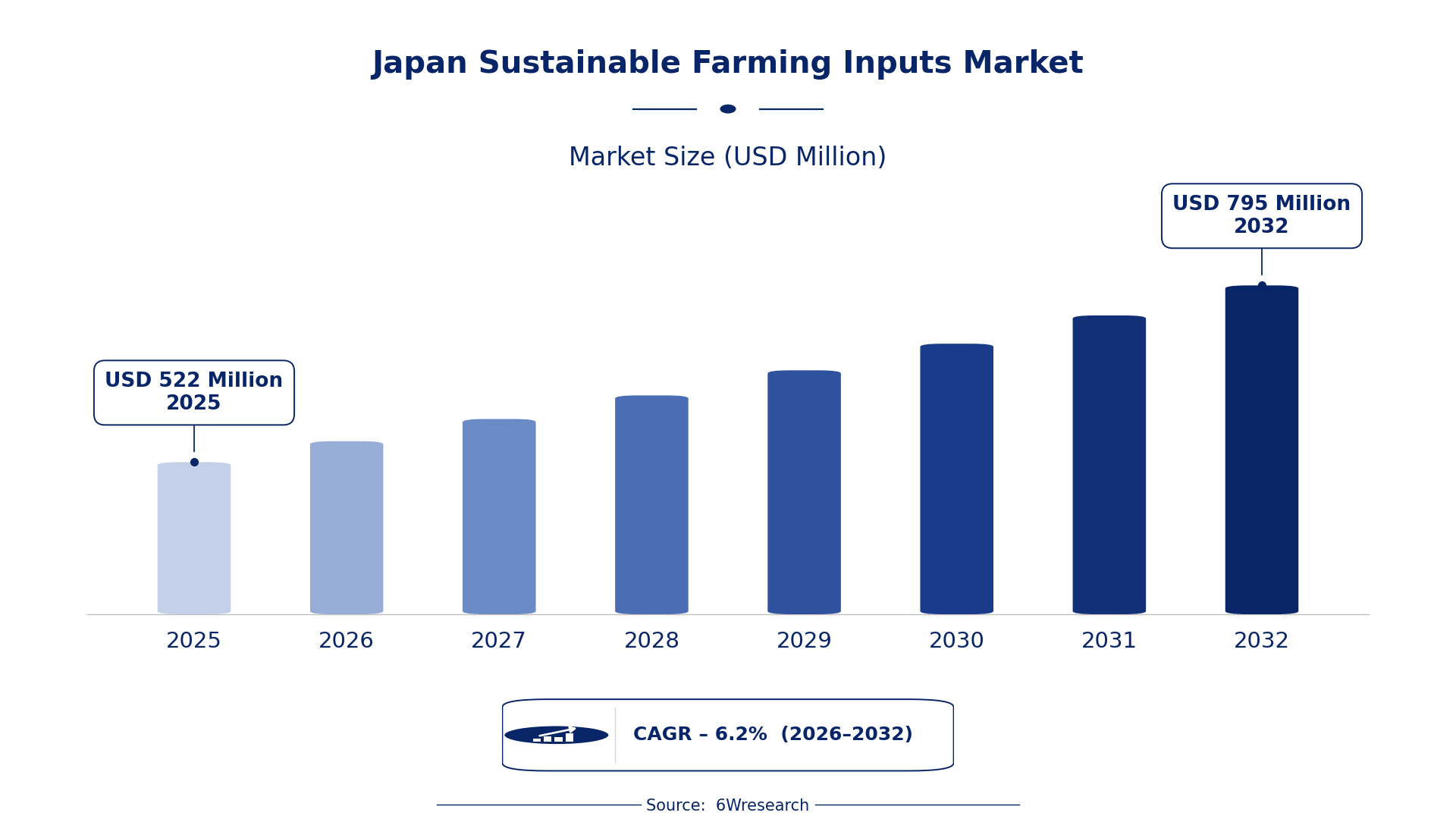
According to 6Wresearch internal database and industry insights, the Japan Sustainable Farming Inputs Market was valued at USD 522 Million in 2025 and is projected to reach USD 795 Million by 2032, growing at a CAGR of approximately 6.2% during 2026–2032.
Japan Sustainable Farming Inputs Market Highlights
| Report Metric | Details |
| Report Name | Japan Sustainable Farming Inputs Market (2026-2032) |
| Market Size 2025 | USD 522 Million |
| Market Size 2032 | USD 795 Million |
| Absolute Growth 2025–2032 | USD 273 Million |
| CAGR 2026–2032 | 6.2% |
| Peak Annual Growth | 7.0% in 2031 |
| Forecast Period | 2026–2032 |
| Historical Data | 2022–2025 |
| Base Year | 2025 |
| Leading Input Type, 2025 | Cover Crop Seeds (40% share) |
| Leading Application Method, 2025 | Direct Sowing (42% share) |
| Leading Eco Benefit, 2025 | Soil Enrichment (42% share) |
| Leading End User, 2025 | Small Scale Farms (34% share) |
| Fastest-Growing Input Type | Organic Soil Boosters (9.0% CAGR) |
| Fastest-Growing Application Method | Fertigation (8.3% CAGR) |
| Fastest-Growing Eco Benefit | Microbiome Recovery (8.4% CAGR) |
| Fastest-Growing End User | Organic Input Retailers (8.5% CAGR) |
| Growing Sector | Organic Farming |
| Key End Users | Small Scale Farms, Organic Input Retailers, Agro-Educational Programs |
Japan Sustainable Farming Inputs Market Year-wise Growth Rate and Key Drivers (2022–2032)
This graph illustrates the annual growth rates of the market from 2022 to 2032, highlighting a steady upward trajectory and projected market expansion over the forecast period.
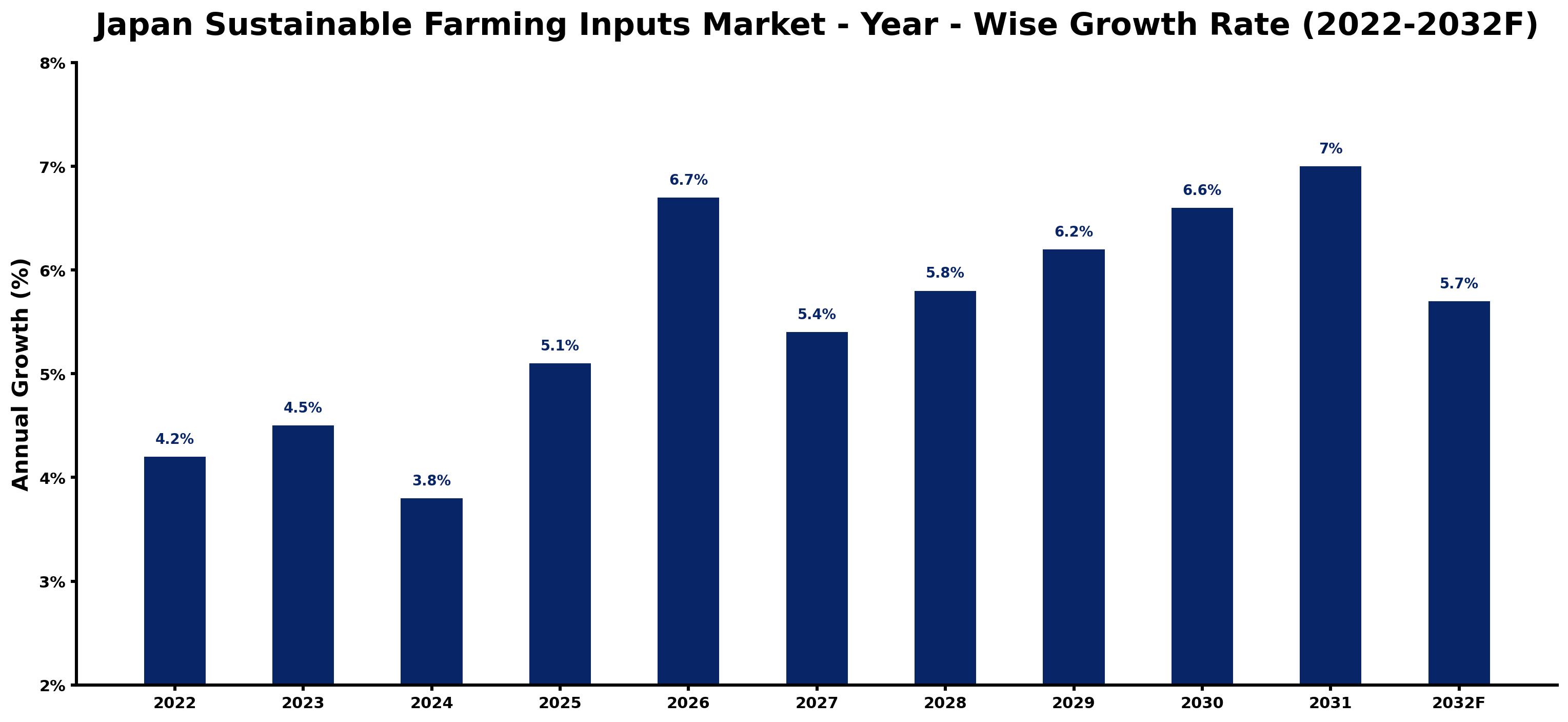
Below, each year's estimated growth is shown next to the factor that most influenced it.
| Year | Estimated Annual Growth (%) | Market Rationale |
| 2022 | 4.2 | The market showed steady growth due to increased awareness of sustainable practices. |
| 2023 | 4.5 | Growth was driven by rising consumer demand for organic products and practices. |
| 2024 | 3.8 | A slowdown occurred as market saturation began to affect growth rates. |
| 2025 | 5.1 | The market experienced a surge due to government support for organic farming initiatives. |
| 2026 | 6.7 | Growth is anticipated to rise as investment in sustainable practices increases across regions. |
| 2027 | 5.4 | The market is expected to see a slowdown as competition intensifies among product suppliers. |
| 2028 | 5.8 | Demand is projected to rise again with urban agriculture initiatives gaining traction in cities. |
| 2029 | 6.2 | Growth will continue as more farmers adopt sustainable inputs for crop production. |
| 2030 | 6.6 | The market is likely to maintain momentum with ongoing government initiatives promoting organic farming. |
| 2031 | 7.0 | A peak in growth is expected due to heightened consumer interest in sustainability. |
| 2032 | 5.7 | The market growth is anticipated to slow as it stabilises, reflecting a mature phase of adoption. |
Note: Market size estimations and growth projections presented in this report are based on 6Wresearch's proprietary forecasting methodology, utilizing the latest available industry data, government publications, and primary research inputs.
Japan Sustainable Farming Inputs Market Synopsis
Sustainable farming inputs encompass eco-friendly materials and practices that boost agricultural productivity while reducing environmental impact. These inputs, sourced from organic origins, include cover crop seeds and organic soil boosters, primarily aimed at enhancing soil health and crop yields. The Japan Sustainable Farming Inputs Market is growing due to rising consumer demand for organic products, government initiatives that support sustainable agriculture, and the increasing prevalence of urban farming practices. In 2023, the government allocated ¥10 billion for sustainable agriculture initiatives, further driving market expansion.
Market Dynamics Impact Analysis (2026–2032)
| Factor | Type | Impact | Primary Segment Affected |
| Growing consumer demand for organic produce is driving the adoption of sustainable farming inputs. | Driver | High | Organic Soil Boosters |
| Urban agriculture initiatives are creating new opportunities for sustainable farming inputs. | Opportunity | High | Cover Crop Seeds |
| Limited awareness of sustainable practices may hinder market penetration in rural areas. | Restraint | Medium | Fish Emulsions |
| The complexity of certification processes can slow down the adoption of organic inputs. | Challenge | High | Organic Soil Boosters |
| Government support for organic farming is fostering growth in sustainable inputs. | Driver | High | Botanical Sprays |
| The increasing number of certified organic farms is expanding the market for sustainable inputs. | Opportunity | Medium | Soil Enrichment |
| High initial costs of sustainable inputs can deter small farmers from adoption. | Restraint | High | Direct Sowing |
| Competition among suppliers can lead to price wars, affecting profitability. | Challenge | Medium | Fertigation |
Evaluation of Drivers in Japan Sustainable Farming Inputs Market (2026–2032)
Below are the drivers that matter most for revenue growth, with supporting evidence.
| Drivers | Primary Segment Affected | Why It Matters (Evidence) |
| Increased consumer interest in organic products drives demand for organic soil boosters. | Organic Soil Boosters | The number of certified organic farms in Japan reached 29,000 in 2023, resulting in higher purchases. |
| Government funding for sustainable agriculture initiatives boosts market growth. | Cover Crop Seeds | In 2023, the government allocated ¥10 billion for sustainable agriculture initiatives, encouraging farmers to invest. |
| Urban agriculture initiatives are expanding the market for sustainable inputs. | Fish Emulsions | Organic soil boosters are increasingly used in urban agriculture initiatives, resulting in more purchases. |
| The rising number of certified organic farms increases demand for botanical sprays. | Botanical Sprays | Regions like Tokyo and Hokkaido are leading in organic farming, driving higher sales of these inputs. |
| Growing awareness of soil health benefits drives the adoption of soil enrichment practices. | Soil Enrichment | Soil enrichment practices are part of the national agricultural sustainability strategy, promoting greater use. |
Buyers are adding capacity as consumer interest in organic products has surged, leading to a rise in certified organic farms, which reached 29,000 in 2023. Urban agriculture is gaining traction, resulting in increased use of organic soil boosters. The demand for botanical sprays is rising as organic farming becomes more prevalent in various regions. The national agricultural sustainability strategy promotes soil enrichment practices, driving further adoption among farmers.
Evaluation of Restraints in Japan Sustainable Farming Inputs Market
Several factors work against faster growth; the main ones are summarised below.
| Market Restraint | Primary Segment Affected | Why It Matters (Evidence) |
| Limited awareness of sustainable practices hinders market penetration in rural areas. | Fish Emulsions | Many rural farmers lack knowledge of sustainable inputs, reducing their adoption rates. |
| High initial costs of sustainable inputs deter small farmers from adoption. | Direct Sowing | Small-scale farmers often struggle with the upfront investment required for sustainable inputs. |
| Complex certification processes slow down the adoption of organic inputs. | Organic Soil Boosters | Navigating certification requirements can delay purchases for farmers. |
| Limited distribution channels restrict access to sustainable farming inputs. | Botanical Sprays | Many rural areas lack sufficient retailers for organic products, limiting availability. |
| Inconsistent quality of products can affect farmer trust in sustainable inputs. | Soil Enrichment | Concerns over product reliability and effectiveness can make farmers hesitant to invest. |
Japan Sustainable Farming Inputs Market Challenges
Japan's organic farmland covers over 1.5 million hectares, creating a supply challenge as local production cannot meet the rising demand for sustainable materials. Delays in sourcing eco-friendly inputs can cause farmers to miss critical planting windows, jeopardising crop yields. The costs of these materials have surged by up to 20%, making them less accessible for buyers, particularly smaller farms. A shortage of skilled labour in sustainable practices limits producers' ability to implement effective farming techniques, which can lead to reduced biodiversity and lower profitability for those reliant on these methods.
Trends in the Japan Sustainable Farming Inputs Market
The following changes are redrawing the Japan Sustainable Farming Inputs Market.
- Shift towards Urban Organic Farming Practices: The Tokyo Metropolitan Government launched a program in 2023 to support urban organic farming, leading to a 15% increase in urban farms. This trend indicates a growing market for sustainable farming inputs in urban areas.
- Emergence of Microbiome Recovery Practices: Microbiome recovery practices are gaining popularity among farmers, with an 8.4% growth rate projected. This shift reflects an increasing focus on soil health and biodiversity in agricultural practices.
- Transition from Traditional to Direct Sowing Methods: Farmers are increasingly adopting direct sowing methods, with a 42% market share in 2025. This change is driven by the need for efficient planting techniques that reduce soil disturbance.
- Rise of Pollinator-Friendly Practices: Pollinator-friendly practices are being promoted under Japan's Biodiversity Strategy, resulting in a 20% increase in such initiatives. This trend supports biodiversity and improves crop yields.
Investment Opportunities in the Japan Sustainable Farming Inputs Market
The following areas offer the clearest openings for investors and suppliers in the Japan Sustainable Farming Inputs Market.
- Growing interest in urban agriculture creates demand for sustainable inputs now: With urban farms increasing by 15% in 2023, there is an opportunity to supply organic soil boosters. Collaborating with local governments can facilitate market entry.
- Subsidies for sustainable inputs present a timely investment opportunity: The Japanese government introduced subsidies for farmers adopting sustainable inputs, with funding of ¥10 billion in 2023, making it an ideal time for investment in this sector.
- Increasing organic farmland opens new avenues for suppliers: The government's target to increase organic farmland to 3% by 2030 presents a chance for suppliers to engage with small-scale farms in regions like Hokkaido.
- Rising demand for organic fertilizers highlights market gaps: With the number of certified organic farms reaching 29,000, there is a clear gap in supply for fish emulsions. Partnering with local distributors can improve market presence.
Government Initiatives in the Japan Sustainable Farming Inputs Market
The Waste Management and Public Cleansing Act (1970) regulates waste treatment and disposal, ensuring that producers of sustainable farming inputs comply with environmental standards. This law has shaped the practices of organic farmers, promoting responsible waste management. In 2023, the Japanese government allocated ¥10 billion for sustainable agriculture initiatives, administered by the Ministry of Agriculture, Forestry and Fisheries. This funding supports farmers adopting sustainable practices and encourages the growth of the sustainable farming inputs market.
The Organic Agriculture Promotion Act (2023) aims to improve organic farming practices and increase organic farmland. The Ministry of Agriculture, Forestry and Fisheries oversees this initiative, promoting the adoption of eco-friendly inputs among farmers. This act is crucial for achieving the government's target of increasing organic farmland to 3% of total agricultural land by 2030.
Future Insight of the Japan Sustainable Farming Inputs Market
By 2032, buyers in urban areas will increasingly adopt eco-friendly practices, driven by government initiatives like the Tokyo support programme. The goal to expand organic farmland to 3% by 2030 will stimulate demand for sustainable inputs. Subsidies for these materials will encourage farmers to transition, resulting in improved productivity across the sector. Research by agricultural societies will advance eco-friendly techniques, ensuring that suppliers can meet the evolving needs of the market.
Market Segmentation Analysis
Japan Sustainable Farming Inputs Market report covers a detailed analysis of the following market segments:
By Input Type – Cover Crop Seeds Lead, Organic Soil Boosters Expected to Grow Fastest
According to Saurav Kr Singh, Senior Research Analyst at 6Wresearch, Cover Crop Seeds took 40% of input type revenue in 2025, more than any other category. Cover crop seeds hold the largest share due to their critical function in enhancing soil health and preventing erosion. With over 1.5 million hectares of organic farmland in Japan, these seeds are integral to sustainable agricultural practices. The quickest growth will come from Organic Soil Boosters, forecast to expand at a CAGR of 9.0% between 2026 and 2032. The rapid adoption of organic soil boosters is propelled by their direct advantages in improving soil structure and fertility. Urban agriculture initiatives increasingly prioritise these products, indicating a shift towards more sustainable farming methods. Suppliers should focus on developing and marketing organic soil boosters to meet the rising demands of urban agriculture.
By Application Method – Direct Sowing Leads, Fertigation Expected to Grow Fastest
The largest application method category in 2025 was Direct Sowing, at 42% of revenue. Direct sowing is the leading method as it is extensively used for planting cover crops directly into the soil, ensuring effective establishment. This method is prevalent among the over 29,000 certified organic farms in Japan, highlighting its importance in sustainable practices. Fertigation is set to record the highest CAGR in this split, 8.3% over 2026–2032. Fertigation is experiencing the fastest growth due to its efficient nutrient delivery through irrigation systems, which are increasingly adopted in greenhouse agriculture. This method aligns with government initiatives to promote sustainable farming practices across the country. Suppliers should explore opportunities to provide fertigation systems and related products to capitalise on this growing trend in agricultural methods.
By Eco Benefit – Soil Enrichment Leads, Microbiome Recovery Expected to Grow Fastest
In 2025, Soil Enrichment led the eco benefit split with a 42% share. Soil enrichment leads this segment as it significantly enhances soil quality and fertility over time, which is essential for sustainable farming. This benefit is crucial for maintaining the productivity of Japan's organic farmland and supporting long-term agricultural goals. Microbiome Recovery is projected to grow fastest, at a CAGR of 8.4% during 2026–2032. Microbiome recovery is swiftly gaining traction as it supports soil health by nurturing beneficial microorganisms, which are vital for sustainable agricultural practices. This trend aligns with national strategies aimed at improving soil health across diverse farming systems. This highlights the necessity for suppliers to develop products that promote microbiome recovery to satisfy the increasing demands of sustainable agriculture.
By End User – Small Scale Farms Lead, Organic Input Retailers Expected to Grow Fastest
Small Scale Farms held 34% of the Japan Sustainable Farming Inputs Market by end user in 2025. Small scale farms dominate the market as they are major users of sustainable inputs for local food production, reflecting a strong commitment to organic practices. Their reliance on these inputs is evident in the growing number of certified organic farms, which reached 29,000 in 2023. Over 2026–2032, Organic Input Retailers are expected to post the fastest growth, at a CAGR of 8.5%. Organic input retailers represent the fastest growing segment, fuelled by the increasing demand for specialised sustainable farming products. This growth signifies an expanding market for eco-friendly agricultural solutions, indicating a shift in consumer preferences towards sustainability. This trend presents an opportunity for suppliers to collaborate with organic input retailers to enhance distribution and reach a broader base of sustainable farming customers.
Key Attractiveness of the Report
- 10 Years of Market Numbers
- Historical Data Starting from 2022 to 2025
- Base Year 2025
- Forecast Data until 2032
- Key Performance Indicators Impacting the Market
- Major Upcoming Developments and Projects
Key Highlights of the Report:
- Japan Sustainable Farming Inputs Market Outlook
- Market Size of Japan Sustainable Farming Inputs Market, 2025
- Forecast of Japan Sustainable Farming Inputs Market, 2032
- Historical Data and Forecast of Japan Sustainable Farming Inputs Revenues & Volume for the Period 2022-2032F
- Japan Sustainable Farming Inputs Market Trend Evolution
- Japan Sustainable Farming Inputs Market Drivers and Challenges
- Japan Sustainable Farming Inputs Price Trends
- Japan Sustainable Farming Inputs Porter's Five Forces
- Japan Sustainable Farming Inputs Industry Life Cycle
- Historical Data and Forecast of Japan Sustainable Farming Inputs Market Revenues & Volume By Input Type for the Period 2022-2032F
- Historical Data and Forecast of Japan Sustainable Farming Inputs Market Revenues & Volume By Cover Crop Seeds for the Period 2022-2032F
- Historical Data and Forecast of Japan Sustainable Farming Inputs Market Revenues & Volume By Fish Emulsions for the Period 2022-2032F
- Historical Data and Forecast of Japan Sustainable Farming Inputs Market Revenues & Volume By Organic Soil Boosters for the Period 2022-2032F
- Historical Data and Forecast of Japan Sustainable Farming Inputs Market Revenues & Volume By Botanical Sprays for the Period 2022-2032F
- Historical Data and Forecast of Japan Sustainable Farming Inputs Market Revenues & Volume By Application Method for the Period 2022-2032F
- Historical Data and Forecast of Japan Sustainable Farming Inputs Market Revenues & Volume By Direct Sowing for the Period 2022-2032F
- Historical Data and Forecast of Japan Sustainable Farming Inputs Market Revenues & Volume By Fertigation for the Period 2022-2032F
- Historical Data and Forecast of Japan Sustainable Farming Inputs Market Revenues & Volume By Broadcast Application for the Period 2022-2032F
- Historical Data and Forecast of Japan Sustainable Farming Inputs Market Revenues & Volume By Foliar Use for the Period 2022-2032F
- Historical Data and Forecast of Japan Sustainable Farming Inputs Market Revenues & Volume By Eco Benefit for the Period 2022-2032F
- Historical Data and Forecast of Japan Sustainable Farming Inputs Market Revenues & Volume By Soil Enrichment for the Period 2022-2032F
- Historical Data and Forecast of Japan Sustainable Farming Inputs Market Revenues & Volume By Natural Fertilization for the Period 2022-2032F
- Historical Data and Forecast of Japan Sustainable Farming Inputs Market Revenues & Volume By Microbiome Recovery for the Period 2022-2032F
- Historical Data and Forecast of Japan Sustainable Farming Inputs Market Revenues & Volume By Pollinator-Friendly for the Period 2022-2032F
- Historical Data and Forecast of Japan Sustainable Farming Inputs Market Revenues & Volume By End User for the Period 2022-2032F
- Historical Data and Forecast of Japan Sustainable Farming Inputs Market Revenues & Volume By Agro-Educational Programs for the Period 2022-2032F
- Historical Data and Forecast of Japan Sustainable Farming Inputs Market Revenues & Volume By Small Scale Farms for the Period 2022-2032F
- Historical Data and Forecast of Japan Sustainable Farming Inputs Market Revenues & Volume By Ag Retail Chains for the Period 2022-2032F
- Historical Data and Forecast of Japan Sustainable Farming Inputs Market Revenues & Volume By Organic Input Retailers for the Period 2022-2032F
- Japan Sustainable Farming Inputs Import Export Trade Statistics
- Market Opportunity Assessment By Input Type
- Market Opportunity Assessment By Application Method
- Market Opportunity Assessment By Eco Benefit
- Market Opportunity Assessment By End User
- Japan Sustainable Farming Inputs Top Companies Market Share
- Japan Sustainable Farming Inputs Competitive Benchmarking By Technical and Operational Parameters
- Japan Sustainable Farming Inputs Company Profiles
- Japan Sustainable Farming Inputs Key Strategic Recommendations
Market Covered
The study includes the following segmentation.
By Input Type
- Cover Crop Seeds
- Fish Emulsions
- Organic Soil Boosters
- Botanical Sprays
By Application Method
- Direct Sowing
- Fertigation
- Broadcast Application
- Foliar Use
By Eco Benefit
- Soil Enrichment
- Natural Fertilization
- Microbiome Recovery
- Pollinator-Friendly
By End User
- Agro-Educational Programs
- Small Scale Farms
- Ag Retail Chains
- Organic Input Retailers































