Japan Sustainable Feed Market Size & Growth Rate
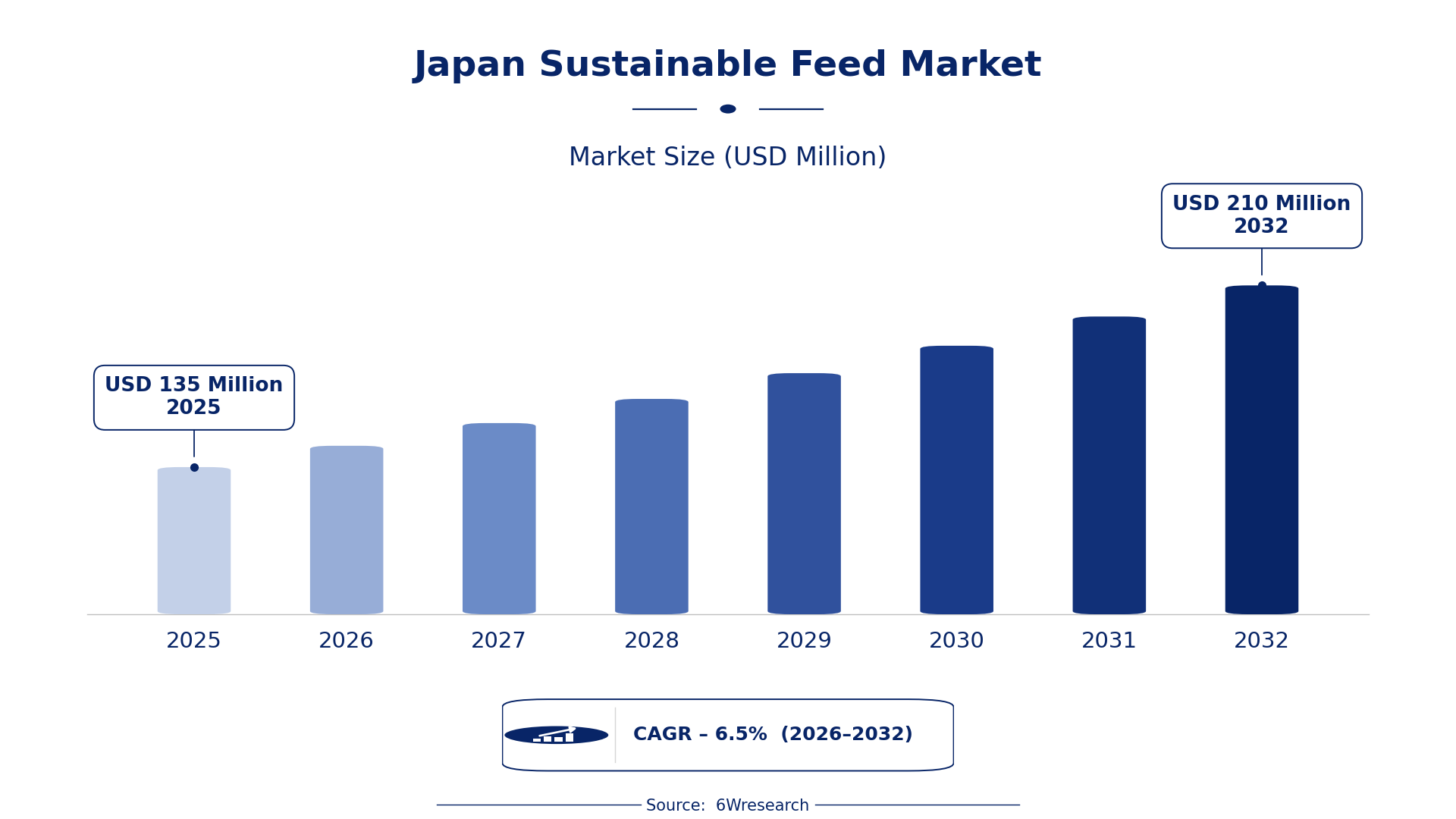
According to 6Wresearch internal database and industry insights, the Japan Sustainable Feed Market was valued at USD 135 Million in 2025 and is projected to reach USD 210 Million by 2032, growing at a CAGR of approximately 6.5% during 2026–2032.
Japan Sustainable Feed Market Highlights
| Report Metric | Details |
| Report Name | Japan Sustainable Feed Market (2026-2032) |
| Market Size 2025 | USD 135 Million |
| Market Size 2032 | USD 210 Million |
| Absolute Growth 2025–2032 | USD 75 Million |
| CAGR 2026–2032 | 6.5% |
| Peak Annual Growth | 7.8% in 2032 |
| Forecast Period | 2026–2032 |
| Historical Data | 2022–2025 |
| Base Year | 2025 |
| Leading Feed Type, 2025 | Insect-Based Feed (34% share) |
| Leading Source Material, 2025 | Black Soldier Fly (46% share) |
| Leading Livestock Category, 2025 | Poultry (41% share) |
| Leading End User, 2025 | Poultry Farmers (44% share) |
| Fastest-Growing Feed Type | Seaweed-Enriched Feed (9.2% CAGR) |
| Fastest-Growing Livestock Category | Swine (8.7% CAGR) |
| Fastest-Growing End User | Dairy Cooperatives (8.5% CAGR) |
| Growing Sector | Poultry |
| Key End Users | Poultry Farmers, Dairy Cooperatives, Pig Farms |
Japan Sustainable Feed Market Year-wise Growth Rate and Key Drivers (2022–2032)
This graph illustrates the annual growth rates of the market from 2022 to 2032, highlighting a steady upward trajectory and projected market expansion over the forecast period.
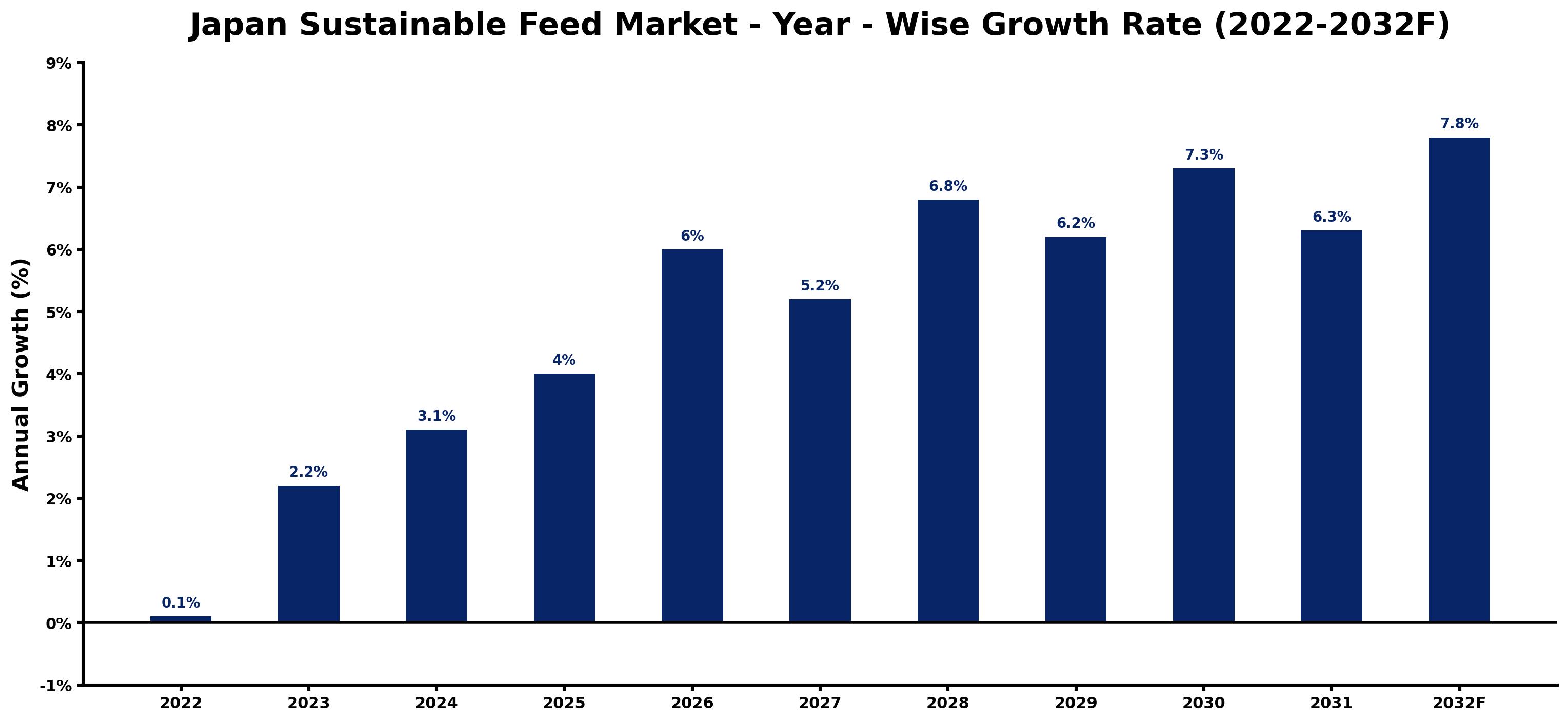
Year by year, the estimates below pair each growth rate with the development that shaped it.
| Year | Estimated Annual Growth (%) | Market Rationale |
| 2022 | 0.1 | Sustainable feed adoption was low, with limited awareness among livestock farmers. |
| 2023 | 2.2 | Adoption increased as environmental concerns became more prominent among poultry farmers. |
| 2024 | 3.1 | Growing interest in sustainable practices led to higher usage of insect-based feed. |
| 2025 | 4.0 | The poultry population reached approximately 150 million, driving demand for sustainable feed. |
| 2026 | 6.0 | Insect-based feed usage is expected to rise, reflecting a shift towards sustainable agriculture. |
| 2027 | 5.2 | Growth is projected to slow as some farmers face challenges in sourcing sustainable materials. |
| 2028 | 6.8 | Increased production of seaweed-enriched feed will contribute to rising adoption rates. |
| 2029 | 6.2 | A slight slowdown in growth is expected as market saturation approaches in certain segments. |
| 2030 | 7.3 | Demand for fermented feed is projected to surge, particularly among pig farms focusing on gut health. |
| 2031 | 6.3 | Growth is expected to slow again as competition intensifies among feed producers. |
| 2032 | 7.8 | The market is projected to peak with innovations in feed production enhancing sustainability. |
Note: Market size estimations and growth projections presented in this report are based on 6Wresearch's proprietary forecasting methodology, utilizing the latest available industry data, government publications, and primary research inputs.
Japan Sustainable Feed Market Synopsis
Sustainable feed in Japan primarily consists of alternative protein sources such as insects and seaweed, produced through fermentation and agricultural by-products. In 2023, the Ministry of Agriculture reported a 15% increase in insect-based feed usage, reflecting a shift towards sustainability in agriculture. The Japan Sustainable Feed Market is expanding due to rising environmental concerns among livestock farmers, particularly poultry farmers, and government initiatives promoting sustainable practices. With a total livestock population of around 8 million cattle, the demand for sustainable feed is expected to increase as farmers adopt more environmentally friendly practices.
Market Dynamics Impact Analysis (2026–2032)
| Factor | Type | Impact | Primary Segment Affected |
| Environmental concerns drive demand for sustainable feed alternatives. | Driver | High | Insect-Based Feed |
| Government initiatives promote sustainable agriculture practices among farmers. | Driver | High | Seaweed-Enriched Feed |
| Growing interest in sustainable livestock practices creates investment opportunities. | Opportunity | High | Fermented Feed |
| Rising demand for high-quality protein sources presents market entry points. | Opportunity | Medium | Spent Grain Feed |
| Limited access to sustainable feed options constrains market growth. | Restraint | High | Agricultural Residue |
| Competition among feed producers may lead to price pressures. | Restraint | Medium | Brewery Waste |
| High costs of sustainable feed production limit adoption rates. | Challenge | High | Black Soldier Fly |
| Regulatory compliance can delay product launches in the market. | Challenge | Medium | Kelp/Red Algae |
Evaluation of Drivers in Japan Sustainable Feed Market (2026–2032)
The following drivers explain most of the expected growth.
| Drivers | Primary Segment Affected | Why It Matters (Evidence) |
| Rising poultry population increases demand for sustainable feed. | Insect-Based Feed | In 2022, Japan's poultry population was approximately 150 million, driving higher feed consumption. |
| Government support for sustainable agriculture boosts market growth. | Seaweed-Enriched Feed | The Green Food System Strategy promotes sustainable practices among farmers, leading to increased adoption. |
| Increased awareness of environmental impact drives feed innovation. | Fermented Feed | In 2023, the Ministry of Agriculture reported a 15% increase in insect-based feed usage. |
| Growing dairy cooperative interest in sustainable feed enhances market. | Spent Grain Feed | Dairy cooperatives are exploring sustainable options to improve milk production efficiency. |
| Health benefits of sustainable feed attract livestock farmers. | Black Soldier Fly | Insect-based feeds improve gut health and nutrient absorption for livestock. |
Volumes grow on the back of rising poultry populations and increasing awareness of sustainability. The total livestock population in Japan, which includes around 8 million cattle, is driving demand for sustainable feed options. Dairy cooperatives are exploring sustainable feed to improve milk production efficiency, while the health benefits of insect-based feeds attract livestock farmers seeking better nutrition for their animals. Fermented feed is gaining traction among pig farms due to its positive impact on gut health, further supporting the market's growth.
Evaluation of Restraints in Japan Sustainable Feed Market
The main factors holding the market back are set out below.
| Market Restraint | Primary Segment Affected | Why It Matters (Evidence) |
| Limited access to sustainable feed options restricts farmer adoption. | Agricultural Residue | Many farmers lack the resources to source sustainable feed alternatives, impacting overall usage. |
| Competition among producers can lead to price pressures. | Brewery Waste | As more producers enter the market, pricing strategies may become aggressive, affecting margins. |
| High production costs hinder sustainable feed adoption rates. | Black Soldier Fly | Producers face costs in sourcing and processing insect-based feeds that limit market entry. |
| Regulatory compliance delays product launches in the market. | Kelp/Red Algae | Producers must navigate complex regulations, which can slow down market entry. |
| Limited consumer awareness of sustainable feed benefits constrains demand. | Spent Grain Feed | Farmers may not fully understand the advantages of using sustainable feed options. |
Japan Sustainable Feed Market Challenges
Producers face rising costs when transitioning to sustainable feed, with expenses increasing by 20% during this shift. Livestock farmers must comply with the JIS Z 2101 standard, introducing new regulations that can delay feed availability for suppliers. A shortage of skilled workers in sustainable feed production hampers innovation, limiting the competitiveness of local producers. Disruptions in sourcing essential ingredients like kelp and algae lead to inconsistent supply, negatively impacting livestock farmers' operations and profitability.
Trends in the Japan Sustainable Feed Market
Below are the shifts with the largest effect on the Japan Sustainable Feed Market.
- Poultry Farmers Increasingly Adopt Sustainable Feed: Poultry farmers are shifting towards sustainable feed options, with a notable rise in insect-based feed usage. In 2023, the Ministry of Agriculture reported a 15% increase in this segment, reflecting growing environmental awareness.
- Shift Towards Fermented Feed for Gut Health: Fermented feed is gaining popularity among pig farms, particularly for its benefits in improving gut health. This trend is evidenced by a growing number of studies highlighting its advantages for livestock nutrition.
- Kelp and Red Algae Gaining Traction: Kelp and red algae are becoming more prevalent in sustainable feed production, particularly in Hokkaido and Tohoku regions. Their nutritional benefits are driving increased adoption among livestock farmers, with production levels rising significantly.
- Dairy Cooperatives Exploring Sustainable Feed Options: Dairy cooperatives are increasingly looking into sustainable feed to improve production efficiency. This shift aligns with government initiatives promoting sustainable agriculture, as seen in recent funding efforts aimed at enhancing feed practices.
Investment Opportunities in the Japan Sustainable Feed Market
The following opportunities in the Japan Sustainable Feed Market pair current demand with a clear way in.
- Investment in Insect-Based Feed Production Facilities: With a 15% increase in insect-based feed usage reported in 2023, there is an opportunity for investment in production facilities. Poultry farmers are the primary buyers, and partnerships with local producers can facilitate entry.
- Expansion of Seaweed-Enriched Feed Production: The rising interest in seaweed-enriched feed presents an opportunity, with production concentrated in Hokkaido. Investing in processing facilities can meet the growing demand from livestock farmers.
- Investment in Fermented Feed Innovations: The increasing popularity of fermented feed among pig farms indicates a gap in the market. Suppliers can enter by collaborating with research institutions to develop new formulations.
- Utilising Brewery Waste for Sustainable Feed: As competition grows, the use of brewery waste as feed offers a unique opportunity. Establishing partnerships with breweries in the Kanto region can enhance supply chains.
Government Initiatives in the Japan Sustainable Feed Market
The Food Sanitation Act amendment, fully applied in June 2021, mandates HACCP-based hygiene management for food businesses, impacting sustainable feed producers by requiring stringent safety protocols. Compliance with these regulations ensures that feed products meet safety standards, which is crucial for maintaining consumer trust and market access. Additionally, the Waste Management and Public Cleansing Act regulates the treatment of waste, compelling producers to adopt environmentally friendly practices in their operations, thus supporting sustainable feed initiatives.
In 2023, the Japanese government allocated ¥1 billion to support sustainable feed innovation projects, administered by the Ministry of Agriculture, Forestry and Fisheries. This funding aims to enhance research and development in sustainable feed technologies, encouraging producers to invest in alternative protein sources. The Japan Feed Association also plays a role in promoting sustainable practices among its members, facilitating the adoption of innovative feed solutions across the industry.
Future Insight of the Japan Sustainable Feed Market
New sustainable feed facilities will emerge by 2032, driven by government funding for innovation projects. Insect-based feed usage will rise, reflecting growing acceptance among livestock farmers. Advances in fermentation technology will improve feed efficiency, benefiting producers and livestock. The focus on sustainable practices will encourage collaboration among agricultural stakeholders, fostering a more resilient supply chain.
Market Segmentation Analysis
Japan Sustainable Feed Market report covers a detailed analysis of the following market segments:
By Feed Type – Insect-Based Feed Leads, Seaweed-Enriched Feed Expected to Grow Fastest
According to Saurav Kr Singh, Senior Research Analyst at 6Wresearch, Insect-Based Feed held 34% of the Japan Sustainable Feed Market by feed type in 2025. Insect-based feed holds the largest share as it serves as a vital protein source for livestock, especially poultry. The substantial poultry population of around 150 million in Japan highlights the reliance on this feed type for sustainable practices. The quickest growth will come from Seaweed-Enriched Feed, forecast to expand at a CAGR of 9.2% between 2026 and 2032. Seaweed-enriched feed is experiencing rapid growth due to its role in improving the nutritional value of animal diets, essential for maintaining livestock health. The government's promotion of sustainable agriculture initiatives further drives the adoption of this feed type. Suppliers should focus on developing seaweed-enriched feed to align with the increasing demand from livestock farmers.
By Source Material – Black Soldier Fly Leads and Records the Fastest Growth
Black Soldier Fly accounted for 46% of the market by source material in 2025. Black soldier fly is the leading source material for sustainable feed due to its ability to convert organic waste into high-quality protein, appealing to environmentally conscious producers. Its widespread adoption aligns with the government's push for sustainable practices in agriculture. Black Soldier Fly is also forecast to expand faster than any other category, at a CAGR of 9.3% over 2026–2032. The black soldier fly segment is also the fastest-growing, as its production methods are becoming more efficient and cost-effective, increasing its appeal to feed manufacturers. This dual role as leader and fastest will likely strengthen its market position further. Buyers should consider sourcing black soldier fly products to ensure they are aligned with sustainability goals and market trends.
By Livestock Category – Poultry Leads, Swine Expected to Grow Fastest
Poultry took 41% of livestock category revenue in 2025, more than any other category. Poultry is the dominant livestock category for sustainable feed usage, driven by a large population and the industry's focus on reducing environmental impact. The increasing adoption of sustainable practices among poultry farmers supports this segment's leading position. Swine is projected to grow fastest, at a CAGR of 8.7% during 2026–2032. Swine is the fastest-growing category for sustainable feed adoption, as farmers recognise the benefits of improved gut health from fermented feed. This trend indicates a shift towards more sustainable practices in pig farming, complementing the established poultry segment. Suppliers should tailor their offerings to meet the specific needs of swine farmers to capture this emerging market opportunity.
By End User – Poultry Farmers Lead, Dairy Cooperatives Expected to Grow Fastest
The largest end user category in 2025 was Poultry Farmers, at 44% of revenue. Poultry farmers constitute the largest segment of sustainable feed users, motivated by the high demand for poultry products and a focus on environmentally responsible practices. Their significant market presence reinforces their leading role in the adoption of sustainable feed. Dairy Cooperatives are set to record the highest CAGR in this split, 8.5% over 2026–2032. Dairy cooperatives are progressively adopting sustainable feed solutions to improve milk production efficiency and cater to consumer preferences for sustainable practices. This trend indicates a shift among dairy producers towards more sustainable feeding methods. Suppliers should aim to provide dairy cooperatives with customised sustainable feed solutions to enhance their operational efficiency and sustainability goals.
Key Attractiveness of the Report
- 10 Years of Market Numbers
- Historical Data Starting from 2022 to 2025
- Base Year 2025
- Forecast Data until 2032
- Key Performance Indicators Impacting the Market
- Major Upcoming Developments and Projects
Key Highlights of the Report:
- Japan Sustainable Feed Market Outlook
- Market Size of Japan Sustainable Feed Market, 2025
- Forecast of Japan Sustainable Feed Market, 2032
- Historical Data and Forecast of Japan Sustainable Feed Revenues & Volume for the Period 2022-2032F
- Japan Sustainable Feed Market Trend Evolution
- Japan Sustainable Feed Market Drivers and Challenges
- Japan Sustainable Feed Price Trends
- Japan Sustainable Feed Porter's Five Forces
- Japan Sustainable Feed Industry Life Cycle
- Historical Data and Forecast of Japan Sustainable Feed Market Revenues & Volume By Feed Type for the Period 2022-2032F
- Historical Data and Forecast of Japan Sustainable Feed Market Revenues & Volume By Insect-Based Feed for the Period 2022-2032F
- Historical Data and Forecast of Japan Sustainable Feed Market Revenues & Volume By Seaweed-Enriched Feed for the Period 2022-2032F
- Historical Data and Forecast of Japan Sustainable Feed Market Revenues & Volume By Fermented Feed for the Period 2022-2032F
- Historical Data and Forecast of Japan Sustainable Feed Market Revenues & Volume By Spent Grain Feed for the Period 2022-2032F
- Historical Data and Forecast of Japan Sustainable Feed Market Revenues & Volume By Source Material for the Period 2022-2032F
- Historical Data and Forecast of Japan Sustainable Feed Market Revenues & Volume By Black Soldier Fly for the Period 2022-2032F
- Historical Data and Forecast of Japan Sustainable Feed Market Revenues & Volume By Kelp/Red Algae for the Period 2022-2032F
- Historical Data and Forecast of Japan Sustainable Feed Market Revenues & Volume By Agricultural Residue for the Period 2022-2032F
- Historical Data and Forecast of Japan Sustainable Feed Market Revenues & Volume By Brewery Waste for the Period 2022-2032F
- Historical Data and Forecast of Japan Sustainable Feed Market Revenues & Volume By Livestock Category for the Period 2022-2032F
- Historical Data and Forecast of Japan Sustainable Feed Market Revenues & Volume By Poultry for the Period 2022-2032F
- Historical Data and Forecast of Japan Sustainable Feed Market Revenues & Volume By Cattle for the Period 2022-2032F
- Historical Data and Forecast of Japan Sustainable Feed Market Revenues & Volume By Swine for the Period 2022-2032F
- Historical Data and Forecast of Japan Sustainable Feed Market Revenues & Volume By Sheep & Goats for the Period 2022-2032F
- Historical Data and Forecast of Japan Sustainable Feed Market Revenues & Volume By End User for the Period 2022-2032F
- Historical Data and Forecast of Japan Sustainable Feed Market Revenues & Volume By Poultry Farmers for the Period 2022-2032F
- Historical Data and Forecast of Japan Sustainable Feed Market Revenues & Volume By Dairy Cooperatives for the Period 2022-2032F
- Historical Data and Forecast of Japan Sustainable Feed Market Revenues & Volume By Pig Farms for the Period 2022-2032F
- Historical Data and Forecast of Japan Sustainable Feed Market Revenues & Volume By Smallholder Farms for the Period 2022-2032F
- Japan Sustainable Feed Import Export Trade Statistics
- Market Opportunity Assessment By Feed Type
- Market Opportunity Assessment By Source Material
- Market Opportunity Assessment By Livestock Category
- Market Opportunity Assessment By End User
- Japan Sustainable Feed Top Companies Market Share
- Japan Sustainable Feed Competitive Benchmarking By Technical and Operational Parameters
- Japan Sustainable Feed Company Profiles
- Japan Sustainable Feed Key Strategic Recommendations
Market Covered
Segments analysed in this report are listed below.
By Feed Type
- Insect-Based Feed
- Seaweed-Enriched Feed
- Fermented Feed
- Spent Grain Feed
By Source Material
- Black Soldier Fly
- Kelp/Red Algae
- Agricultural Residue
- Brewery Waste
By Livestock Category
- Poultry
- Cattle
- Swine
- Sheep & Goats
By End User
- Poultry Farmers
- Dairy Cooperatives
- Pig Farms
- Smallholder Farms































