Japan Sustainable Films Market Size & Growth Rate
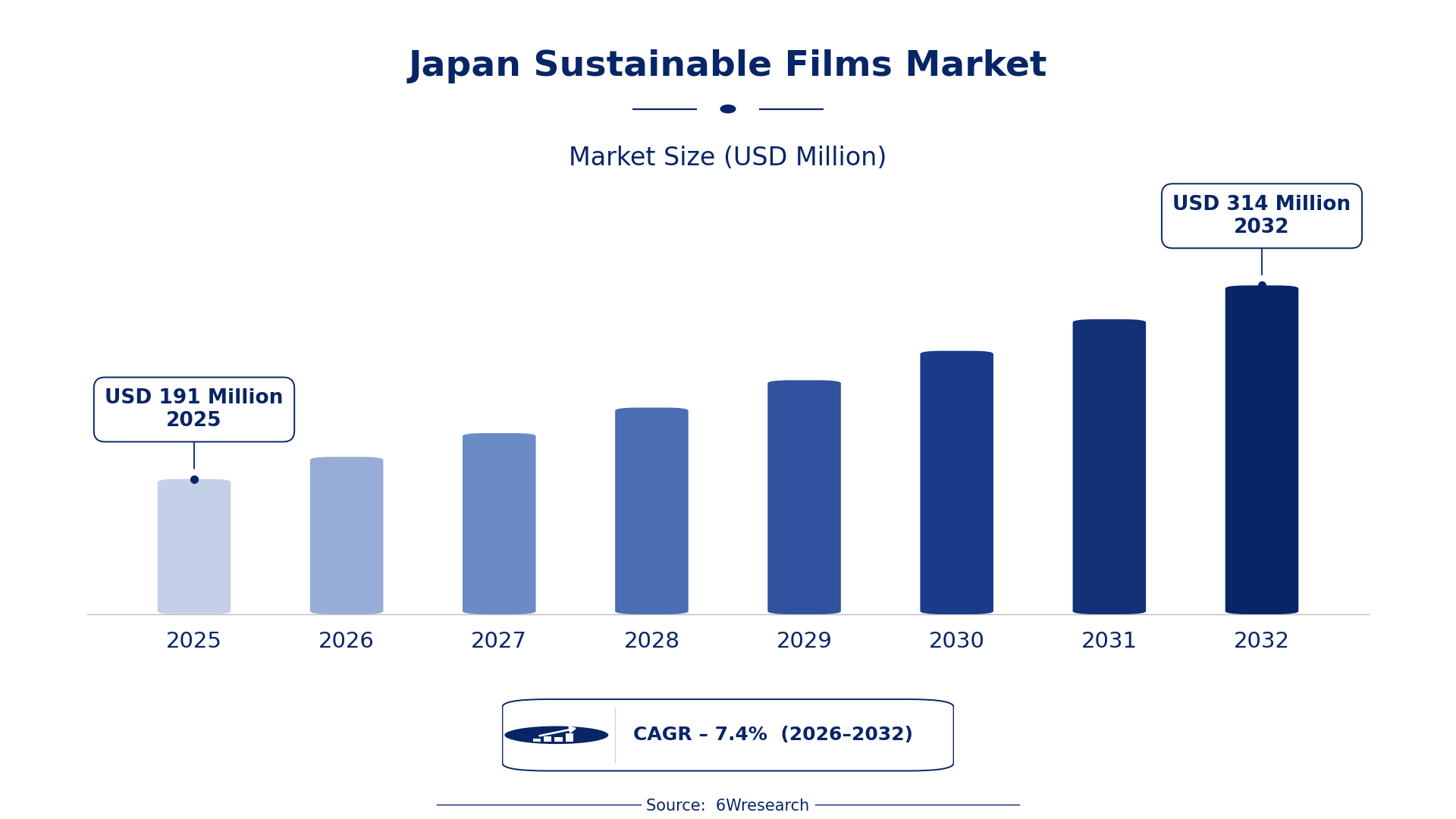
According to 6Wresearch internal database and industry insights, the Japan Sustainable Films Market was valued at USD 191 Million in 2025 and is projected to reach USD 314 Million by 2032, growing at a CAGR of approximately 7.4% during 2026–2032.
Japan Sustainable Films Market Highlights
| Report Metric | Details |
| Report Name | Japan Sustainable Films Market (2026-2032) |
| Market Size 2025 | USD 191 Million |
| Market Size 2032 | USD 314 Million |
| Absolute Growth 2025–2032 | USD 123 Million |
| CAGR 2026–2032 | 7.4% |
| Peak Annual Growth | 8.0% in 2032 |
| Forecast Period | 2026–2032 |
| Historical Data | 2022–2025 |
| Base Year | 2025 |
| Leading Sustainable Films, 2025 | Biodegradable Films (38% share) |
| Leading Product Type, 2025 | PLA Films (40% share) |
| Leading Material Type, 2025 | Polylactic Acid (49% share) |
| Leading Distribution Channel, 2025 | Direct Sales (39% share) |
| Leading End User Industry, 2025 | Food Packaging (36% share) |
| Fastest-Growing Sustainable Films | Compostable Films (9.9% CAGR) |
| Fastest-Growing Product Type | Starch-Based Films (10.2% CAGR) |
| Fastest-Growing Material Type | Corn Starch (10.6% CAGR) |
| Fastest-Growing Distribution Channel | Online Platforms (9.7% CAGR) |
| Fastest-Growing End User Industry | Retail & E-Commerce (10.3% CAGR) |
| Growing Sector | Food Packaging |
| Key End Users | Food manufacturers, agricultural producers, retail sector, e-commerce platforms |
Japan Sustainable Films Market Year-wise Growth Rate and Key Drivers (2022–2032)
This graph illustrates the annual growth rates of the market from 2022 to 2032, highlighting a steady upward trajectory and projected market expansion over the forecast period.
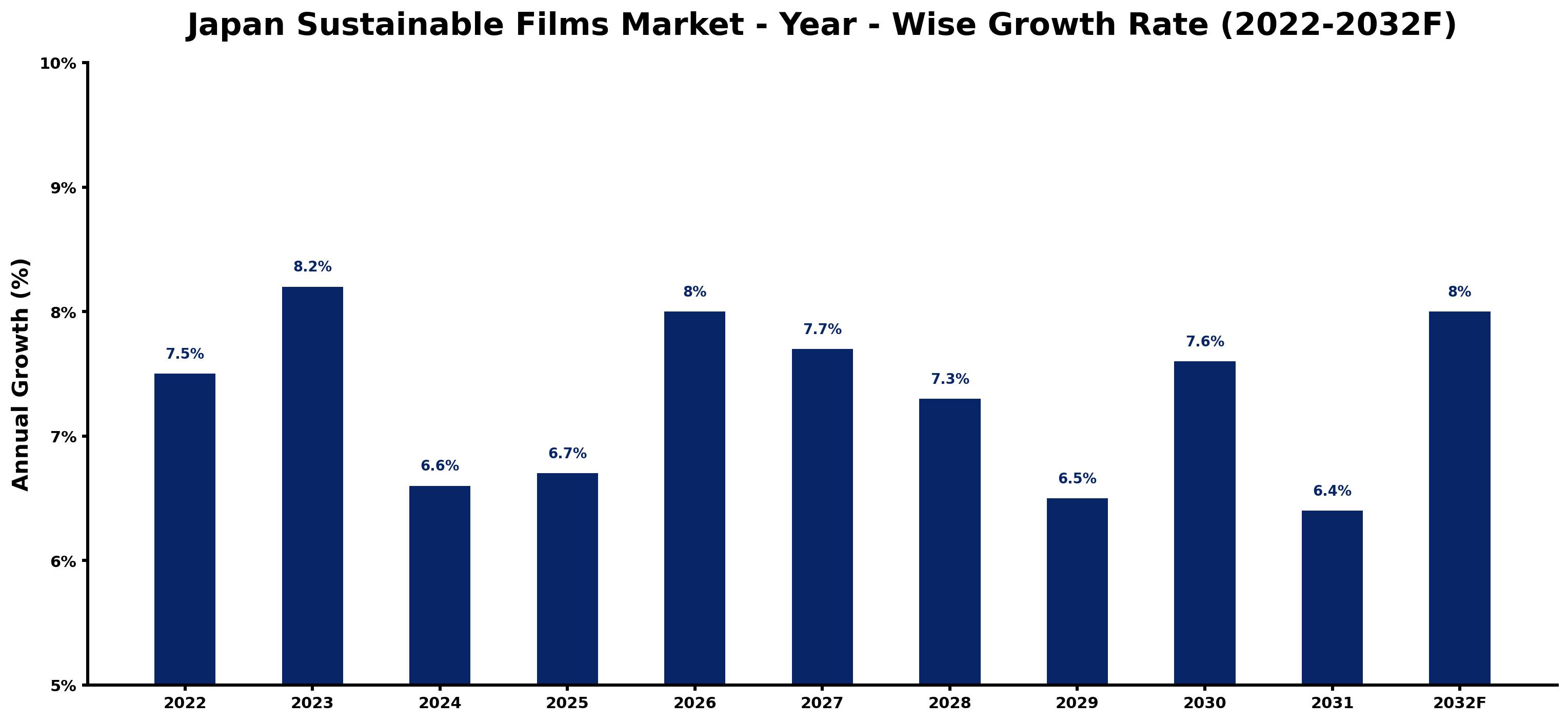
Annual growth estimates for each year appear below with the principal reason behind them, explaining the shifts that set the pace of the market.
| Year | Estimated Annual Growth (%) | Market Rationale |
| 2022 | 7.5 | Demand for sustainable films was strong, reflecting growing environmental awareness among consumers. |
| 2023 | 8.2 | The market experienced heightened interest in eco-friendly packaging solutions, boosting growth rates. |
| 2024 | 6.6 | Growth slowed slightly as competition increased and market saturation began to set in. |
| 2025 | 6.7 | Demand rebounded with renewed focus on sustainability in food packaging and retail sectors. |
| 2026 | 8.0 | An uptick in biodegradable material adoption is expected to drive faster growth in the market. |
| 2027 | 7.7 | Growth will slow again as manufacturers face challenges in scaling production capacity. |
| 2028 | 7.3 | Market growth is projected to continue decelerating due to increased supply chain pressures. |
| 2029 | 6.5 | A further slowdown is anticipated as consumer preferences begin to stabilise. |
| 2030 | 7.6 | Growth is expected to accelerate again as technological advancements in sustainable materials emerge. |
| 2031 | 6.4 | The market will see a slowdown as economic conditions begin to impact consumer spending. |
| 2032 | 8.0 | Renewed interest in sustainable practices is projected to lead to a resurgence in growth rates. |
Note: Market size estimations and growth projections presented in this report are based on 6Wresearch's proprietary forecasting methodology, utilizing the latest available industry data, government publications, and primary research inputs.
Japan Sustainable Films Market Synopsis
Sustainable films are eco-friendly packaging materials derived from renewable resources, including cornstarch and polylactic acid (PLA). They are primarily used in food packaging, agricultural applications, and retail packaging. The Japan Sustainable Films Market is projected to grow due to increasing environmental awareness, with over 100 million consumers showing interest in eco-friendly products. Government measures promote biodegradable materials, while Tokyo serves as a hub for sustainable packaging innovations, driving demand in various sectors.
Market Dynamics Impact Analysis (2026–2032)
| Factor | Type | Impact | Primary Segment Affected |
| Increasing environmental awareness among consumers | Driver | High | Biodegradable Films |
| Government initiatives promoting sustainable materials | Driver | High | Compostable Films |
| Growing demand for eco-friendly packaging solutions | Opportunity | High | Food Packaging |
| Expansion of retail and e-commerce sectors | Opportunity | Medium | Retail & E-Commerce |
| Challenges in scaling production capacity | Restraint | High | PLA Films |
| Competition from traditional packaging materials | Restraint | Medium | Polyethylene Films |
| Supply chain disruptions affecting material availability | Challenge | High | Biodegradable Films |
| Technological barriers in production processes | Challenge | Medium | Water-Soluble Films |
Evaluation of Drivers in Japan Sustainable Films Market (2026–2032)
Demand rests on the following drivers, each shown with the segment it touches most.
| Drivers | Primary Segment Affected | Why It Matters (Evidence) |
| Rising consumer demand for eco-friendly packaging | Biodegradable Films | Approximately 30% of food packaging is shifting towards sustainable options, increasing purchases from food manufacturers. |
| Government support for biodegradable materials | Compostable Films | The Plastic Resource Circulation Act encourages businesses to adopt sustainable practices, driving demand from various sectors. |
| Technological advancements in sustainable materials | PLA Films | Innovations in production processes improve the quality and availability of PLA films, attracting more buyers. |
| Growth in the agricultural sector | Starch-Based Films | In 2022, 20% of crop production adopted biodegradable films, leading to increased purchases from farmers. |
| Expansion of online retail channels | Online Platforms | The rise in e-commerce is driving demand for sustainable packaging solutions among online retailers. |
A wider customer base explains much of the growth, as increasing environmental awareness drives demand for sustainable films. The food packaging sector is shifting towards eco-friendly options, prompting food manufacturers to seek biodegradable materials. In 2022, the agricultural sector adopted biodegradable films for 20% of crop production, further boosting purchases. Technological advancements are improving the quality of PLA films, attracting more buyers across various industries. The rise in e-commerce is also driving demand for sustainable packaging solutions among online retailers, leading to increased purchases.
Evaluation of Restraints in Japan Sustainable Films Market
Below are the constraints most often cited by buyers and suppliers, with the segment each affects.
| Market Restraint | Primary Segment Affected | Why It Matters (Evidence) |
| Challenges in scaling production capacity | PLA Films | Manufacturers struggle to meet rising demand, resulting in delays in supply and increased costs for buyers. |
| Competition from traditional packaging materials | Polyethylene Films | Established materials continue to dominate the market, making it difficult for sustainable films to gain traction. |
| Supply chain disruptions affecting material availability | Biodegradable Films | Logistical issues have caused shortages, impacting production timelines and buyer confidence. |
| Technological barriers in production processes | Water-Soluble Films | Limited technology restricts the ability to produce high-quality water-soluble films, hindering market growth. |
| Higher initial costs compared to conventional materials | Compostable Films | The price difference deters some buyers from switching to sustainable options, slowing market adoption. |
Japan Sustainable Films Market Challenges
High production costs hinder the availability of sustainable films, as raw materials like cornstarch are more expensive than traditional plastics, squeezing producers' profit margins. Buyers in the food packaging sector face sourcing delays, with lead times extending by up to 30%, complicating their ability to fulfil consumer demand. Limited technical skills among workers restrict the adoption of advanced production techniques, resulting in inefficiencies that can increase operational costs for producers by around 15%. Supply chain disruptions, often triggered by natural disasters, can cause shortages, forcing hospitals to rely on less sustainable alternatives, jeopardising their environmental commitments.
Trends in the Japan Sustainable Films Market
The trends below show where the Japan Sustainable Films Market is heading.
- Shift towards Biodegradable Packaging: In Japan, approximately 30% of food packaging is transitioning to biodegradable materials, reflecting a growing consumer preference for eco-friendly options. This trend is expected to increase as awareness rises.
- Emergence of Online Sales Channels: The rise of e-commerce has led to a growing demand for sustainable packaging solutions, with online platforms gaining traction. This shift is evidenced by a projected growth rate of 9.7% for online sales in the sustainable films market.
- Focus on Compostable Standards: The introduction of the JIS K 14900 standard in 2023 has marked a key step towards ensuring the quality of compostable materials. This standard will likely build consumer trust and drive market growth.
- Expansion of Agricultural Applications: The agricultural sector in Japan is increasingly adopting biodegradable films, with 20% of crop production using these materials in 2022. This trend supports sustainability in farming practices.
Investment Opportunities in the Japan Sustainable Films Market
The following areas offer the clearest openings for investors and suppliers in the Japan Sustainable Films Market.
- Supply of Biodegradable Films: With 20% of crop production adopting biodegradable films, there is a clear opportunity for suppliers to meet this demand. Collaborating with agricultural cooperatives can facilitate market entry.
- Demand from Food Packaging Sector: The food packaging industry is increasingly seeking sustainable options, presenting a strong opportunity for manufacturers. Engaging with food producers can strengthen market presence.
- Investment in Compostable Materials: The introduction of the JIS K 14900 standard creates a demand for compliant materials, offering a chance for suppliers to invest in certified compostable films. Partnering with certification bodies can streamline entry.
- Expansion into Online Retail Channels: With online platforms projected to grow at a rate of 9.7%, there is a significant opportunity for suppliers to focus on e-commerce. Collaborating with logistics firms can improve distribution capabilities.
Government Initiatives in the Japan Sustainable Films Market
The Plastic Resource Circulation Act, enacted in 2021, mandates the reduction, reuse, and recycling of plastics, impacting producers of sustainable films. This law encourages manufacturers to innovate and improve their processes to comply with environmental standards, promoting a shift towards eco-friendly materials. The PRTR Law requires businesses to report their handling of designated chemical substances, ensuring accountability in production practices.
The Ministry of the Environment supports initiatives for reducing plastic waste through funding and approvals for projects that promote sustainable practices. For instance, the new subsidy program launched in 2023 aims to assist companies transitioning to sustainable materials, improving their market competitiveness.
Future Insight of the Japan Sustainable Films Market
Technological advancements in bioplastics will reshape demand for sustainable films by 2032, particularly as new production methods like extrusion and casting become more prevalent. The 2023 standard for compostable materials will drive compliance among suppliers, enhancing product offerings. With over 100 million consumers prioritising eco-friendly products, retailers will increasingly adopt sustainable packaging solutions. Government subsidies introduced in 2023 will support companies transitioning to sustainable materials, paving the way for broader market acceptance.
Market Segmentation Analysis
Japan Sustainable Films Market report covers a detailed analysis of the following market segments:
By Sustainable Films – Biodegradable Films Lead, Compostable Films Expected to Grow Fastest
According to Saurav Kr Singh, Senior Research Analyst at 6Wresearch, Biodegradable Films accounted for 38% of the market by sustainable films in 2025. Biodegradable films hold the largest share due to their extensive use in food packaging and agricultural applications, appealing to environmentally conscious consumers. For instance, approximately 30% of food packaging in Japan is shifting towards these sustainable options, reflecting a strong demand. Compostable Films are set to record the highest CAGR in this split, 9.9% over 2026–2032. Compostable films are experiencing rapid growth as they are specifically designed for waste reduction and composting, aligning with Japan's environmental initiatives. The introduction of the new standard for compostable materials in 2023 further supports this segment's expansion. Suppliers should focus on developing biodegradable and compostable solutions to meet the increasing demand from various sectors.
By Product Type – PLA Films Lead, Starch-Based Films Expected to Grow Fastest
With 40% of product type revenue in 2025, PLA Films was the largest category. PLA films dominate Japan's sustainable films market due to their prevalent application in food packaging, which is essential for meeting consumer demand for eco-friendly solutions. Their widespread use is evidenced by the substantial volume of food packaging that incorporates these materials. Starch-Based Films are projected to grow fastest, at a CAGR of 10.2% during 2026–2032. Starch-based films are witnessing rapid growth, primarily because they are increasingly adopted in agricultural films, reflecting the sector's shift towards biodegradable options. This trend is highlighted by the fact that 20% of crop production in 2022 utilised these films. Suppliers should focus on enhancing their offerings of starch-based films to leverage the growing agricultural sector's demand.
By Material Type – Polylactic Acid Leads, Corn Starch Expected to Grow Fastest
Polylactic Acid took 49% of material type revenue in 2025, more than any other category. Polylactic acid is the primary material for sustainable films, widely recognised for its eco-friendly properties and versatility in various applications. Its prominence is reflected in the substantial market share it holds within the sustainable films sector. The quickest growth will come from Corn Starch, forecast to expand at a CAGR of 10.6% between 2026 and 2032. Corn starch is rapidly gaining traction as a base material in films, particularly in agricultural applications where sustainability is becoming a priority. This growth is supported by the increasing adoption of biodegradable solutions in farming practices. Material suppliers should prioritise the development of corn starch-based products to capitalise on the growing demand.
By Distribution Channel – Direct Sales Leads, Online Platforms Expected to Grow Fastest
In 2025, Direct Sales led the distribution channel split with a 39% share. Direct sales are the leading distribution method, allowing manufacturers to maintain close relationships with customers and ensure optimal product availability. This approach is particularly beneficial in the sustainable films sector, where consumer education on product advantages is vital. Over 2026–2032, Online Platforms are expected to post the fastest growth, at a CAGR of 9.7%. Online platforms are emerging as the fastest-growing sales channel, driven by the increasing consumer preference for convenient and accessible purchasing methods. This shift aligns with the broader trend of digitalisation in retail and the growth of e-commerce. Suppliers need to strengthen their online presence to effectively cater to the rising number of consumers choosing digital purchasing options.
By End User Industry – Food Packaging Leads, Retail & E-Commerce Expected to Grow Fastest
The largest end user industry category in 2025 was Food Packaging, at 36% of revenue. Food packaging is the largest end-user sector for sustainable films, propelled by the growing consumer demand for environmentally responsible packaging solutions. The significant market size is illustrated by the ongoing transition towards sustainable materials within this industry. Retail & E-Commerce is set to record the highest CAGR in this split, 10.3% over 2026–2032. Retail and e-commerce are experiencing the fastest growth, as companies increasingly seek sustainable packaging to align with consumer preferences. This trend is particularly notable as more retailers incorporate sustainability into their business models. Focusing on the retail and e-commerce sectors could provide suppliers with valuable growth opportunities.
Key Attractiveness of the Report
- 10 Years of Market Numbers
- Historical Data Starting from 2022 to 2025
- Base Year 2025
- Forecast Data until 2032
- Key Performance Indicators Impacting the Market
- Major Upcoming Developments and Projects
Key Highlights of the Report:
- Japan Sustainable Films Market Outlook
- Market Size of Japan Sustainable Films Market, 2025
- Forecast of Japan Sustainable Films Market, 2032
- Historical Data and Forecast of Japan Sustainable Films Revenues & Volume for the Period 2022-2032F
- Japan Sustainable Films Market Trend Evolution
- Japan Sustainable Films Market Drivers and Challenges
- Japan Sustainable Films Price Trends
- Japan Sustainable Films Porter's Five Forces
- Japan Sustainable Films Industry Life Cycle
- Historical Data and Forecast of Japan Sustainable Films Market Revenues & Volume By Sustainable Films for the Period 2022-2032F
- Historical Data and Forecast of Japan Sustainable Films Market Revenues & Volume By Biodegradable Films for the Period 2022-2032F
- Historical Data and Forecast of Japan Sustainable Films Market Revenues & Volume By Compostable Films for the Period 2022-2032F
- Historical Data and Forecast of Japan Sustainable Films Market Revenues & Volume By Recyclable Films for the Period 2022-2032F
- Historical Data and Forecast of Japan Sustainable Films Market Revenues & Volume By Water-Soluble Films for the Period 2022-2032F
- Historical Data and Forecast of Japan Sustainable Films Market Revenues & Volume By Product Type for the Period 2022-2032F
- Historical Data and Forecast of Japan Sustainable Films Market Revenues & Volume By PLA Films for the Period 2022-2032F
- Historical Data and Forecast of Japan Sustainable Films Market Revenues & Volume By Starch-Based Films for the Period 2022-2032F
- Historical Data and Forecast of Japan Sustainable Films Market Revenues & Volume By Polyethylene Films for the Period 2022-2032F
- Historical Data and Forecast of Japan Sustainable Films Market Revenues & Volume By PVOH Films for the Period 2022-2032F
- Historical Data and Forecast of Japan Sustainable Films Market Revenues & Volume By Material Type for the Period 2022-2032F
- Historical Data and Forecast of Japan Sustainable Films Market Revenues & Volume By Polylactic Acid for the Period 2022-2032F
- Historical Data and Forecast of Japan Sustainable Films Market Revenues & Volume By Corn Starch for the Period 2022-2032F
- Historical Data and Forecast of Japan Sustainable Films Market Revenues & Volume By Recyclable PE for the Period 2022-2032F
- Historical Data and Forecast of Japan Sustainable Films Market Revenues & Volume By Polyvinyl Alcohol for the Period 2022-2032F
- Historical Data and Forecast of Japan Sustainable Films Market Revenues & Volume By Distribution Channel for the Period 2022-2032F
- Historical Data and Forecast of Japan Sustainable Films Market Revenues & Volume By Direct Sales for the Period 2022-2032F
- Historical Data and Forecast of Japan Sustainable Films Market Revenues & Volume By Online Platforms for the Period 2022-2032F
- Historical Data and Forecast of Japan Sustainable Films Market Revenues & Volume By Industrial Distributors for the Period 2022-2032F
- Historical Data and Forecast of Japan Sustainable Films Market Revenues & Volume By Specialty Stores for the Period 2022-2032F
- Historical Data and Forecast of Japan Sustainable Films Market Revenues & Volume By End User Industry for the Period 2022-2032F
- Historical Data and Forecast of Japan Sustainable Films Market Revenues & Volume By Food Packaging for the Period 2022-2032F
- Historical Data and Forecast of Japan Sustainable Films Market Revenues & Volume By Retail & E-Commerce for the Period 2022-2032F
- Historical Data and Forecast of Japan Sustainable Films Market Revenues & Volume By Agricultural Sector for the Period 2022-2032F
- Historical Data and Forecast of Japan Sustainable Films Market Revenues & Volume By Detergent Industry for the Period 2022-2032F
- Japan Sustainable Films Import Export Trade Statistics
- Market Opportunity Assessment By Sustainable Films
- Market Opportunity Assessment By Product Type
- Market Opportunity Assessment By Material Type
- Market Opportunity Assessment By Distribution Channel
- Market Opportunity Assessment By End User Industry
- Japan Sustainable Films Top Companies Market Share
- Japan Sustainable Films Competitive Benchmarking By Technical and Operational Parameters
- Japan Sustainable Films Company Profiles
- Japan Sustainable Films Key Strategic Recommendations
Market Covered
The report covers the following segments.
By Sustainable Films
- Biodegradable Films
- Compostable Films
- Recyclable Films
- Water-Soluble Films
By Product Type
- PLA Films
- Starch-Based Films
- Polyethylene Films
- PVOH Films
By Material Type
- Polylactic Acid
- Corn Starch
- Recyclable PE
- Polyvinyl Alcohol
By Distribution Channel
- Direct Sales
- Online Platforms
- Industrial Distributors
- Specialty Stores
By End User Industry
- Food Packaging
- Retail & E-Commerce
- Agricultural Sector
- Detergent Industry































