Japan Sustainable Fishing Market Size & Growth Rate
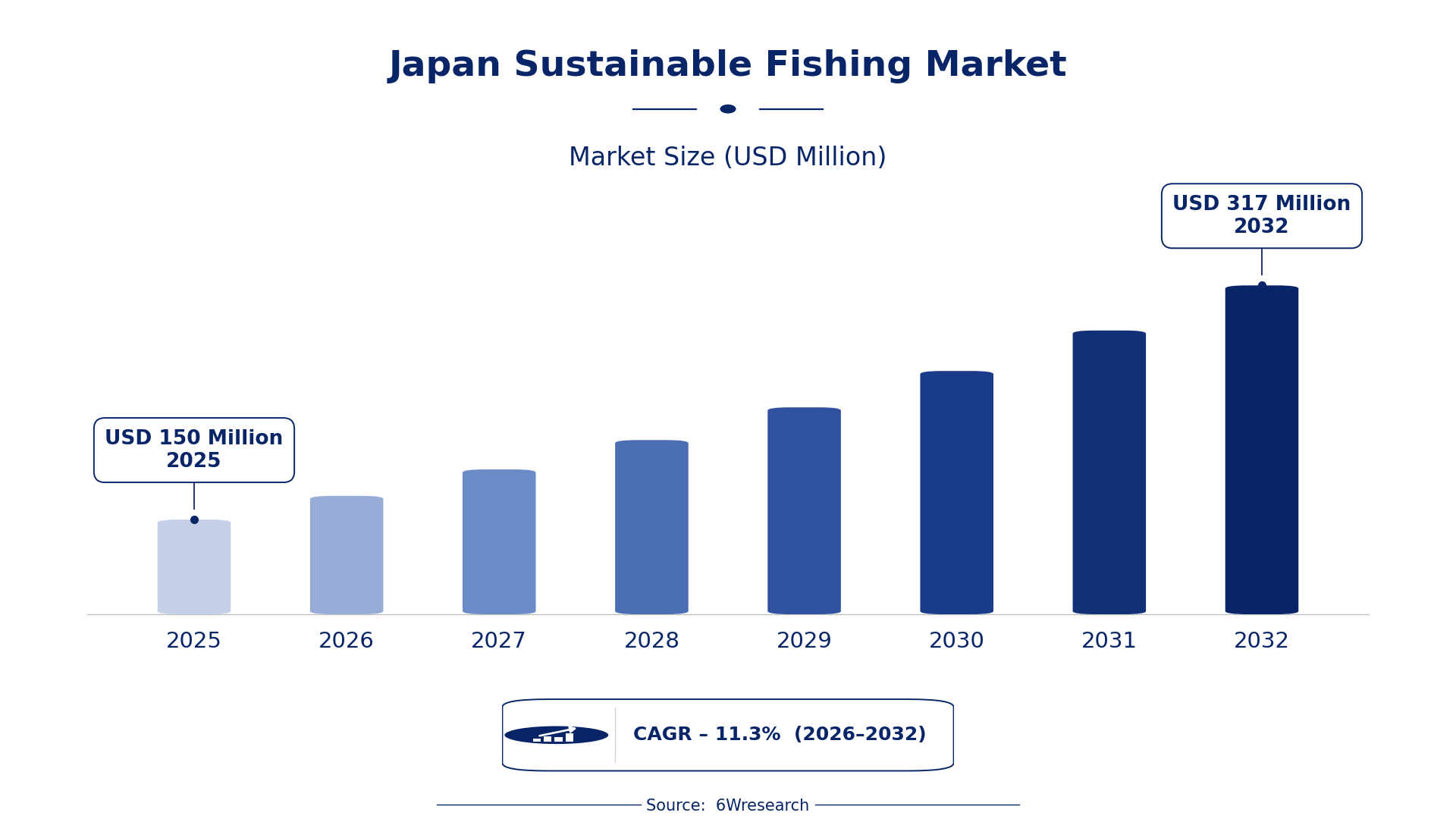
According to 6Wresearch internal database and industry insights, the Japan Sustainable Fishing Market was valued at USD 150 Million in 2025 and is projected to reach USD 317 Million by 2032, growing at a CAGR of approximately 11.3% during 2026–2032.
Japan Sustainable Fishing Market Highlights
| Report Metric | Details |
| Report Name | Japan Sustainable Fishing Market (2026-2032) |
| Market Size 2025 | USD 150 Million |
| Market Size 2032 | USD 317 Million |
| Absolute Growth 2025–2032 | USD 167 Million |
| CAGR 2026–2032 | 11.3% |
| Peak Annual Growth | 12.1% in 2026 |
| Forecast Period | 2026–2032 |
| Historical Data | 2022–2025 |
| Base Year | 2025 |
| Leading Sustainable Fishing, 2025 | Aquaculture Fish (42% share) |
| Leading Product Type, 2025 | Tuna (45% share) |
| Leading Fishing Method, 2025 | Pole and Line (33% share) |
| Leading Distribution Channel, 2025 | Direct Sales (44% share) |
| Leading End User Industry, 2025 | Food & Beverage Sector (37% share) |
| Fastest-Growing Product Type | Salmon (15.6% CAGR) |
| Fastest-Growing Fishing Method | Sustainable Farming (16.4% CAGR) |
| Fastest-Growing Distribution Channel | Online Platforms (14.8% CAGR) |
| Fastest-Growing End User Industry | Restaurants & Hotels (15.2% CAGR) |
| Growing Sector | Food & Beverage Sector |
| Key End Users | Restaurants & Hotels, Food & Beverage Sector, Household Consumption |
Japan Sustainable Fishing Market Year-wise Growth Rate and Key Drivers (2022–2032)
This graph illustrates the annual growth rates of the market from 2022 to 2032, highlighting a steady upward trajectory and projected market expansion over the forecast period.
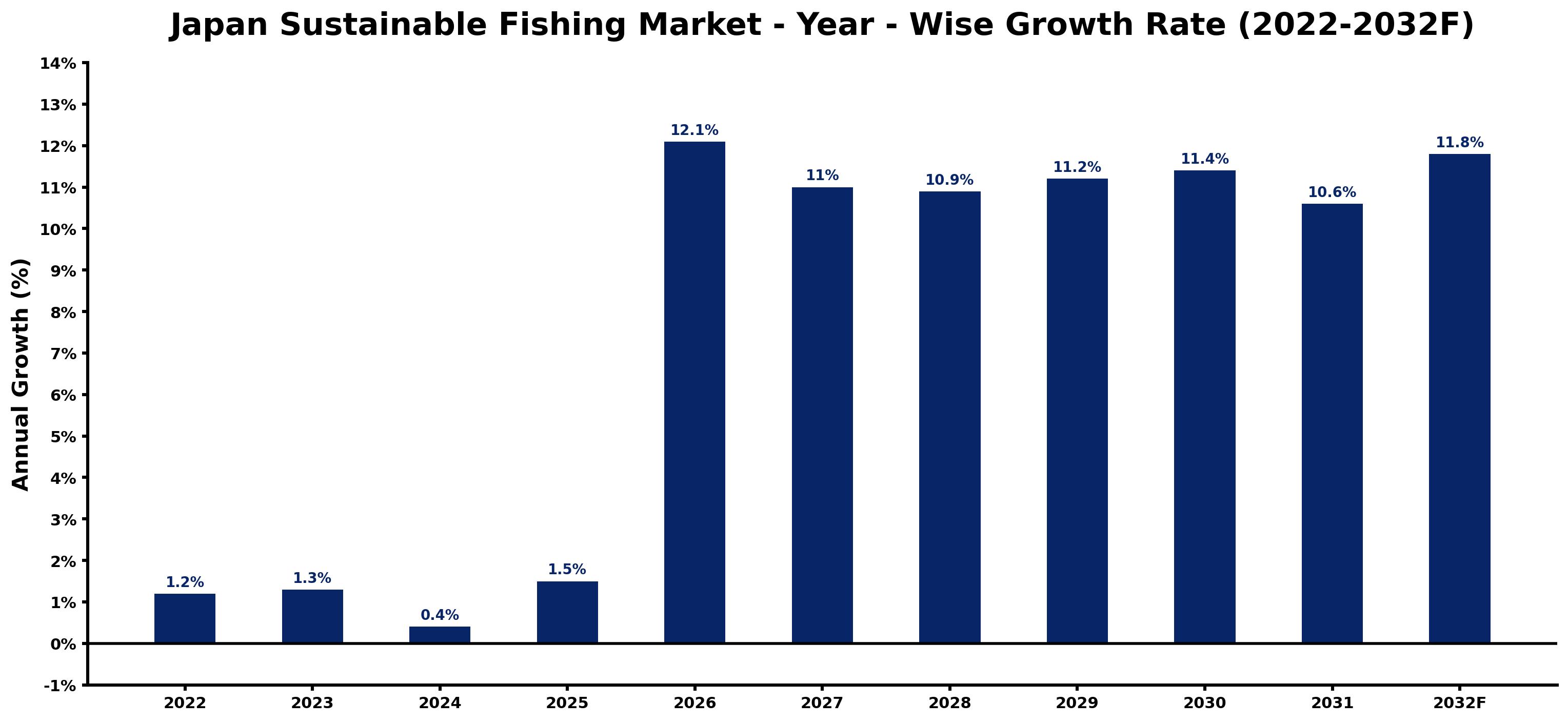
Each row of the following table gives one year's estimated growth and the event or demand shift that explains it.
| Year | Estimated Annual Growth (%) | Market Rationale |
| 2022 | 1.2 | The market showed steady growth with increased awareness of sustainable practices. |
| 2023 | 1.3 | Growth accelerated as consumer preferences shifted towards sustainable seafood options. |
| 2024 | 0.4 | Growth slowed due to market saturation and increased competition among suppliers. |
| 2025 | 1.5 | The market experienced a surge as sustainable fishing practices gained wider acceptance. |
| 2026 | 12.1 | Demand is expected to skyrocket with the introduction of new aquaculture initiatives and technologies. |
| 2027 | 11.0 | Growth is projected to moderate as the market adjusts to the rapid expansion of aquaculture. |
| 2028 | 10.9 | Continued investment in sustainable practices will lead to stable growth in seafood consumption. |
| 2029 | 11.2 | The market is expected to rebound as exports of sustainable seafood increase significantly. |
| 2030 | 11.4 | Growth is projected to remain strong, driven by rising consumer demand for quality seafood. |
| 2031 | 10.6 | The market will experience a slight slowdown as competition intensifies among producers. |
| 2032 | 11.8 | Demand is projected to rise further as sustainability becomes a key purchasing factor. |
Note: Market size estimations and growth projections presented in this report are based on 6Wresearch's proprietary forecasting methodology, utilizing the latest available industry data, government publications, and primary research inputs.
Japan Sustainable Fishing Market Synopsis
Sustainable Fishing practices in Japan ensure the health of fish populations and ecosystem preservation, employing methods such as aquaculture and line-caught fishing. The Japan Sustainable Fishing Market is growing due to rising domestic consumption and export opportunities, driven by a strong tradition of seafood consumption and increased awareness of environmental issues. In 2022, aquaculture production reached approximately 1 million tons, underscoring the shift towards sustainability. The Tokyo metropolitan area serves as a significant hub for seafood consumption, reflecting the increasing importance of sustainable practices in the industry.
Market Dynamics Impact Analysis (2026–2032)
| Factor | Type | Impact | Primary Segment Affected |
| Growing consumer preference for sustainable seafood | Driver | High | Aquaculture Fish |
| Increased aquaculture production capacity | Driver | High | Aquaculture Fish |
| Expansion of online seafood sales channels | Opportunity | High | Online Platforms |
| Investment in sustainable fishing technologies | Opportunity | High | Sustainable Farming |
| Higher retail prices for sustainable seafood | Restraint | Medium | Tuna |
| Limited awareness of sustainable practices among consumers | Restraint | Medium | Line-Caught Fish |
| High costs associated with certification and compliance | Challenge | High | Aquaculture Fish |
| Competition from conventional seafood suppliers | Challenge | Medium | Aquaculture Fish |
Evaluation of Drivers in Japan Sustainable Fishing Market (2026–2032)
Key forces behind demand, with the segment each one moves most, are listed below.
| Drivers | Primary Segment Affected | Why It Matters (Evidence) |
| Increased seafood consumption per capita | Aquaculture Fish | Japan's seafood consumption per capita is approximately 27 kg annually, prompting higher demand for aquaculture products. |
| Government support for sustainable aquaculture | Aquaculture Fish | In 2023, the government launched a program with a budget of 500 million yen to promote sustainable aquaculture. |
| Rising demand from the food and beverage sector | Tuna | The Food & Beverage Sector accounted for 37% of sustainable seafood consumption, driving demand for high-quality tuna. |
| Growing popularity of online seafood sales | Online Platforms | In 2022, online seafood sales accounted for a growing share of the market as consumers increasingly purchase seafood through digital channels. |
| Adoption of sustainable fishing standards | Sustainable Farming | The JIS for seafood quality ensures safety and promotes sustainable practices among producers. |
Orders keep climbing as Japan's seafood consumption per capita reaches approximately 27 kg annually, leading to increased demand for aquaculture products. The market is responding to changing consumer preferences, with online sales channels growing rapidly, indicating a shift in purchasing habits. The enforcement of the JIS for seafood quality promotes safety and sustainability, further boosting demand for certified products. These factors are driving an increase in sustainable seafood consumption across the country.
Evaluation of Restraints in Japan Sustainable Fishing Market
These are the pressures that could keep growth below its potential.
| Market Restraint | Primary Segment Affected | Why It Matters (Evidence) |
| Higher retail prices for sustainable seafood | Tuna | The average price of sustainable seafood in retail chains is 20% higher than conventional options, limiting consumer access. |
| Limited awareness of sustainable practices among consumers | Line-Caught Fish | Many consumers lack knowledge about the benefits of sustainable fishing, which hinders market growth. |
| High costs associated with certification and compliance | Aquaculture Fish | Producers incur substantial costs for certification, deterring smaller operators from entering the market. |
| Competition from conventional seafood suppliers | Aquaculture Fish | Conventional seafood suppliers often offer lower prices, making it difficult for sustainable options to compete. |
| Seasonal demand fluctuations for certain species | Lobster | Lobster experiences seasonal demand, leading to inconsistent sales for producers. |
Japan Sustainable Fishing Market Challenges
High prices for sustainable seafood, which are 20% above conventional options, reduce purchasing power for buyers and limit overall consumption in Japan. Producers encounter rising costs due to increased competition for certified fisheries, which has expanded since 2020, leading to delays in product availability. Insufficient support for aquaculture, despite a 500 million yen government budget in 2023, hampers growth in this sector, impacting suppliers' ability to scale. Enforcement of JIS standards for seafood quality can slow distribution, affecting timely access for consumers in the Tokyo metropolitan area.
Trends in the Japan Sustainable Fishing Market
These developments are changing demand patterns in the Japan Sustainable Fishing Market.
- Shift towards Aquaculture: Aquaculture practices are increasingly adopted in the Kanto region to meet domestic demand sustainably, with production reaching around 1 million tons in 2022. This trend benefits suppliers by providing a reliable source of seafood.
- Rise of Online Seafood Sales: Online platforms are gaining traction as a distribution channel for seafood, reflecting changing consumer preferences. In 2022, online sales accounted for a growing share of the market, indicating a shift in buying habits.
- Increased Certification of Sustainable Fisheries: The number of certified sustainable fisheries in Japan has been steadily growing since 2020, reflecting a commitment to sustainable practices. This trend encourages consumers to choose certified products, strengthening market credibility.
- Growing Demand from Restaurants and Hotels: Restaurants and hotels are increasingly prioritising sustainable seafood options, with a projected growth rate of 15.2% in the coming years. This demand shift is reshaping procurement strategies in the food service industry.
Investment Opportunities in the Japan Sustainable Fishing Market
Investors looking at the Japan Sustainable Fishing Market should consider the following areas.
- Supply of Aquaculture Products: Aquaculture production reached around 1 million tons, presenting an opportunity to supply sustainable aquaculture products to the food and beverage sector, which is increasingly prioritising sustainability.
- Investment in Sustainable Fishing Technologies: Investing in sustainable fishing technologies presents a growth opportunity, particularly in regions like Kanto, where sustainable practices are gaining traction. Collaborating with local partners can facilitate market entry.
- Expansion of Online Sales Channels: The growing trend of online seafood sales offers an opportunity to supply fresh seafood directly to consumers. Engaging with online platforms can improve market reach and accessibility.
- Development of Sustainable Farming Practices: Sustainable farming is emerging as a key area for investment, with a projected growth rate of 16.4%. Focusing on this sector can attract buyers seeking environmentally friendly options.
Government Initiatives in the Japan Sustainable Fishing Market
The Food Recycling Law, enacted in 2000, mandates food businesses to minimise waste and recycle it into feed, fertiliser, and energy. This law encourages sustainable practices among producers, ensuring that waste is reduced and resources are used efficiently. The Food Sanitation Act amendment in 2018 introduced a positive list system for synthetic resins used in food utensils, enhancing safety standards in the seafood industry.
In 2023, a program with a budget of 500 million yen was launched to support sustainable aquaculture, administered by the Fisheries Agency of Japan. This initiative aims to improve aquaculture practices and promote sustainability in the seafood supply chain.
Future Insight of the Japan Sustainable Fishing Market
The launch of new aquaculture programmes will increase production capabilities by 2032, enabling suppliers to meet rising consumer demand. Improvements in fishing technology will streamline operations and reduce environmental impacts. A rise in certified fisheries will secure a steady supply of sustainable seafood, benefiting both buyers and suppliers. As consumer awareness of sustainability increases, the market for responsibly sourced seafood will expand, driving further innovation and investment.
Market Segmentation Analysis
Japan Sustainable Fishing Market report covers a detailed analysis of the following market segments:
By Sustainable Fishing – Aquaculture Fish Leads and Records the Fastest Growth
According to Saurav Kr Singh, Senior Research Analyst at 6Wresearch, with 42% of sustainable fishing revenue in 2025, Aquaculture Fish was the largest category. Aquaculture fish holds the largest share as it effectively meets Japan's high seafood consumption, with approximately 27 kg consumed per capita annually. This method addresses overfishing while ensuring a steady supply for both domestic and export markets. The same category is also set to grow fastest, at a CAGR of 14.4% during 2026–2032. The aquaculture fish segment is experiencing rapid growth, supported by a government programme that allocated 500 million yen in 2023 for sustainable practices. As consumer preferences increasingly favour sustainably sourced seafood, this growth will further solidify its market lead. Suppliers should enhance aquaculture capabilities to align with the rising demand for sustainable seafood.
By Product Type – Tuna Leads, Salmon Expected to Grow Fastest
Tuna held 45% of the Japan Sustainable Fishing Market by product type in 2025. Tuna is the leading product type, primarily due to its essential role in sushi and sashimi markets, which are integral to Japanese culinary traditions. This consistent demand ensures tuna's strong position within the sustainable fishing market. The quickest growth will come from Salmon, forecast to expand at a CAGR of 15.6% between 2026 and 2032. Salmon is the fastest-growing product type, driven by its versatility in various culinary applications that attract a broad consumer base. This trend reflects a shift in consumer preferences towards diverse sustainable seafood options. Buyers should diversify their seafood selections to include both tuna and salmon to cater to evolving consumer tastes.
By Fishing Method – Pole and Line Leads, Sustainable Farming Expected to Grow Fastest
Pole and Line took 33% of fishing method revenue in 2025, more than any other category. Pole and line fishing is the predominant method as it is a traditional practice that ensures minimal bycatch, appealing to environmentally conscious consumers. This method's sustainability aligns with Japan's commitment to preserving marine ecosystems. Over 2026–2032, Sustainable Farming is expected to post the fastest growth, at a CAGR of 16.4%. Sustainable farming is the fastest-growing method, as it meets the rising consumer demand for responsibly sourced seafood. This growth indicates a shift towards more controlled and sustainable production practices within the industry. Suppliers should invest in sustainable farming techniques to capitalise on the increasing consumer preference for environmentally friendly fishing methods.
By Distribution Channel – Direct Sales Leads, Online Platforms Expected to Grow Fastest
In 2025, Direct Sales led the distribution channel split with a 44% share. Direct sales are the predominant distribution channel for sustainable seafood, providing a common method for delivering fresh products directly to consumers. This approach ensures better quality control and fosters direct engagement with buyers. Online Platforms are set to record the highest CAGR in this split, 14.8% over 2026–2032. Online platforms are the fastest-growing distribution channel, reflecting the shift towards digital shopping among consumers seeking convenient access to sustainable seafood. This trend necessitates that suppliers enhance their online presence and sales strategies. Suppliers must optimise their online sales channels to effectively reach the growing market of consumers preferring digital purchasing options.
By End User Industry – Food & Beverage Sector Leads, Restaurants & Hotels Expected to Grow Fastest
The largest end user industry category in 2025 was Food & Beverage Sector, at 37% of revenue. The food and beverage sector is the primary consumer of sustainable seafood, driven by increasing demand for quality ingredients in restaurants and food services. This sector's commitment to sustainability significantly influences purchasing decisions. Restaurants & Hotels are projected to grow fastest, at a CAGR of 15.2% during 2026–2032. Restaurants and hotels represent the fastest-growing end user industry, as they increasingly seek sustainable options to meet consumer expectations for responsible sourcing. This trend underscores the importance of sustainability in the hospitality sector's procurement strategies. Suppliers should prioritise partnerships with restaurants and hotels to align with their sustainability goals and capture this expanding market segment.
Key Attractiveness of the Report
- 10 Years of Market Numbers
- Historical Data Starting from 2022 to 2025
- Base Year 2025
- Forecast Data until 2032
- Key Performance Indicators Impacting the Market
- Major Upcoming Developments and Projects
Key Highlights of the Report:
- Japan Sustainable Fishing Market Outlook
- Market Size of Japan Sustainable Fishing Market, 2025
- Forecast of Japan Sustainable Fishing Market, 2032
- Historical Data and Forecast of Japan Sustainable Fishing Revenues & Volume for the Period 2022-2032F
- Japan Sustainable Fishing Market Trend Evolution
- Japan Sustainable Fishing Market Drivers and Challenges
- Japan Sustainable Fishing Price Trends
- Japan Sustainable Fishing Porter's Five Forces
- Japan Sustainable Fishing Industry Life Cycle
- Historical Data and Forecast of Japan Sustainable Fishing Market Revenues & Volume By Sustainable Fishing for the Period 2022-2032F
- Historical Data and Forecast of Japan Sustainable Fishing Market Revenues & Volume By Line-Caught Fish for the Period 2022-2032F
- Historical Data and Forecast of Japan Sustainable Fishing Market Revenues & Volume By Aquaculture Fish for the Period 2022-2032F
- Historical Data and Forecast of Japan Sustainable Fishing Market Revenues & Volume By Trap-Caught Fish for the Period 2022-2032F
- Historical Data and Forecast of Japan Sustainable Fishing Market Revenues & Volume By Net-Free Fishing for the Period 2022-2032F
- Historical Data and Forecast of Japan Sustainable Fishing Market Revenues & Volume By Product Type for the Period 2022-2032F
- Historical Data and Forecast of Japan Sustainable Fishing Market Revenues & Volume By Tuna for the Period 2022-2032F
- Historical Data and Forecast of Japan Sustainable Fishing Market Revenues & Volume By Salmon for the Period 2022-2032F
- Historical Data and Forecast of Japan Sustainable Fishing Market Revenues & Volume By Lobster for the Period 2022-2032F
- Historical Data and Forecast of Japan Sustainable Fishing Market Revenues & Volume By Shrimp for the Period 2022-2032F
- Historical Data and Forecast of Japan Sustainable Fishing Market Revenues & Volume By Fishing Method for the Period 2022-2032F
- Historical Data and Forecast of Japan Sustainable Fishing Market Revenues & Volume By Pole and Line for the Period 2022-2032F
- Historical Data and Forecast of Japan Sustainable Fishing Market Revenues & Volume By Sustainable Farming for the Period 2022-2032F
- Historical Data and Forecast of Japan Sustainable Fishing Market Revenues & Volume By Pot & Trap Fishing for the Period 2022-2032F
- Historical Data and Forecast of Japan Sustainable Fishing Market Revenues & Volume By Bycatch Reduction Tech for the Period 2022-2032F
- Historical Data and Forecast of Japan Sustainable Fishing Market Revenues & Volume By Distribution Channel for the Period 2022-2032F
- Historical Data and Forecast of Japan Sustainable Fishing Market Revenues & Volume By Direct Sales for the Period 2022-2032F
- Historical Data and Forecast of Japan Sustainable Fishing Market Revenues & Volume By Online Platforms for the Period 2022-2032F
- Historical Data and Forecast of Japan Sustainable Fishing Market Revenues & Volume By Fish Markets for the Period 2022-2032F
- Historical Data and Forecast of Japan Sustainable Fishing Market Revenues & Volume By Retail Chains for the Period 2022-2032F
- Historical Data and Forecast of Japan Sustainable Fishing Market Revenues & Volume By End User Industry for the Period 2022-2032F
- Historical Data and Forecast of Japan Sustainable Fishing Market Revenues & Volume By Food & Beverage Sector for the Period 2022-2032F
- Historical Data and Forecast of Japan Sustainable Fishing Market Revenues & Volume By Restaurants & Hotels for the Period 2022-2032F
- Historical Data and Forecast of Japan Sustainable Fishing Market Revenues & Volume By Household Consumption for the Period 2022-2032F
- Historical Data and Forecast of Japan Sustainable Fishing Market Revenues & Volume By Frozen Food Suppliers for the Period 2022-2032F
- Japan Sustainable Fishing Import Export Trade Statistics
- Market Opportunity Assessment By Sustainable Fishing
- Market Opportunity Assessment By Product Type
- Market Opportunity Assessment By Fishing Method
- Market Opportunity Assessment By Distribution Channel
- Market Opportunity Assessment By End User Industry
- Japan Sustainable Fishing Top Companies Market Share
- Japan Sustainable Fishing Competitive Benchmarking By Technical and Operational Parameters
- Japan Sustainable Fishing Company Profiles
- Japan Sustainable Fishing Key Strategic Recommendations
Market Covered
The following segment groups are covered in the report.
By Sustainable Fishing
- Line-Caught Fish
- Aquaculture Fish
- Trap-Caught Fish
- Net-Free Fishing
By Product Type
- Tuna
- Salmon
- Lobster
- Shrimp
By Fishing Method
- Pole and Line
- Sustainable Farming
- Pot & Trap Fishing
- Bycatch Reduction Tech
By Distribution Channel
- Direct Sales
- Online Platforms
- Fish Markets
- Retail Chains
By End User Industry
- Food & Beverage Sector
- Restaurants & Hotels
- Household Consumption
- Frozen Food Suppliers































