Japan Sustainable Flooring Market Size & Growth Rate
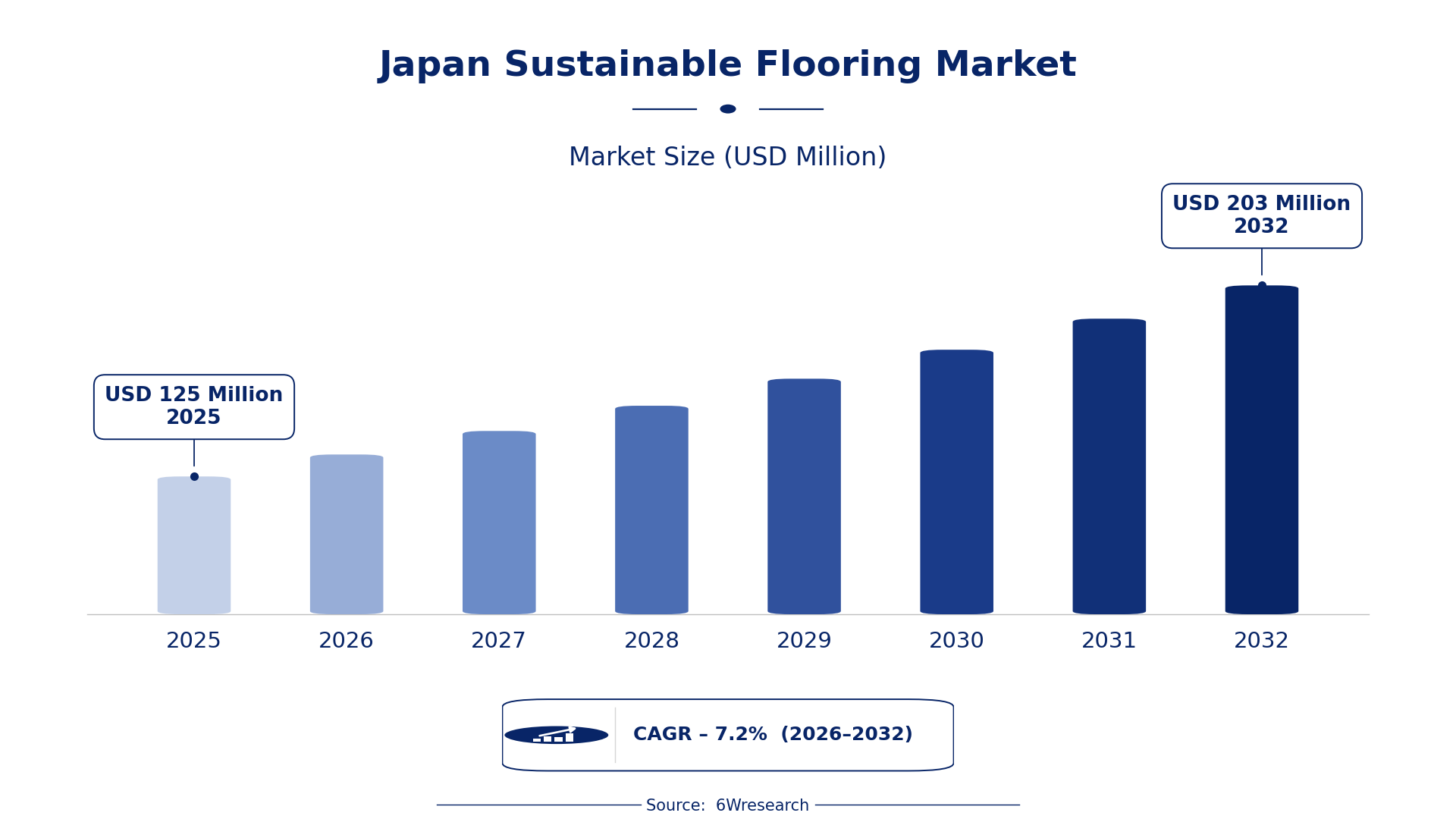
According to 6Wresearch internal database and industry insights, the Japan Sustainable Flooring Market was valued at USD 125 Million in 2025 and is projected to reach USD 203 Million by 2032, growing at a CAGR of approximately 7.2% during 2026–2032.
Japan Sustainable Flooring Market Highlights
| Report Metric | Details |
| Report Name | Japan Sustainable Flooring Market (2026-2032) |
| Market Size 2025 | USD 125 Million |
| Market Size 2032 | USD 203 Million |
| Absolute Growth 2025–2032 | USD 78 Million |
| CAGR 2026–2032 | 7.2% |
| Peak Annual Growth | 7.6% in 2032 |
| Forecast Period | 2026–2032 |
| Historical Data | 2022–2025 |
| Base Year | 2025 |
| Leading Sustainable Flooring, 2025 | Bamboo Flooring (41% share) |
| Leading Product Type, 2025 | Engineered Bamboo (46% share) |
| Leading Material Type, 2025 | Bamboo (40% share) |
| Leading Distribution Channel, 2025 | Direct Sales (46% share) |
| Leading End User Industry, 2025 | Residential Buildings (50% share) |
| Fastest-Growing Sustainable Flooring | Reclaimed Wood Floors (9.3% CAGR) |
| Fastest-Growing Product Type | Solid Wood Flooring (10.0% CAGR) |
| Fastest-Growing Material Type | Reclaimed Timber (10.1% CAGR) |
| Fastest-Growing Distribution Channel | Online Platforms (9.4% CAGR) |
| Fastest-Growing End User Industry | Commercial Offices (9.2% CAGR) |
| Growing Sector | Residential Buildings |
| Key End Users | Residential builders, commercial offices, educational institutions, hospitality sector |
Japan Sustainable Flooring Market Year-wise Growth Rate and Key Drivers (2022–2032)
This graph illustrates the annual growth rates of the market from 2022 to 2032, highlighting a steady upward trajectory and projected market expansion over the forecast period.
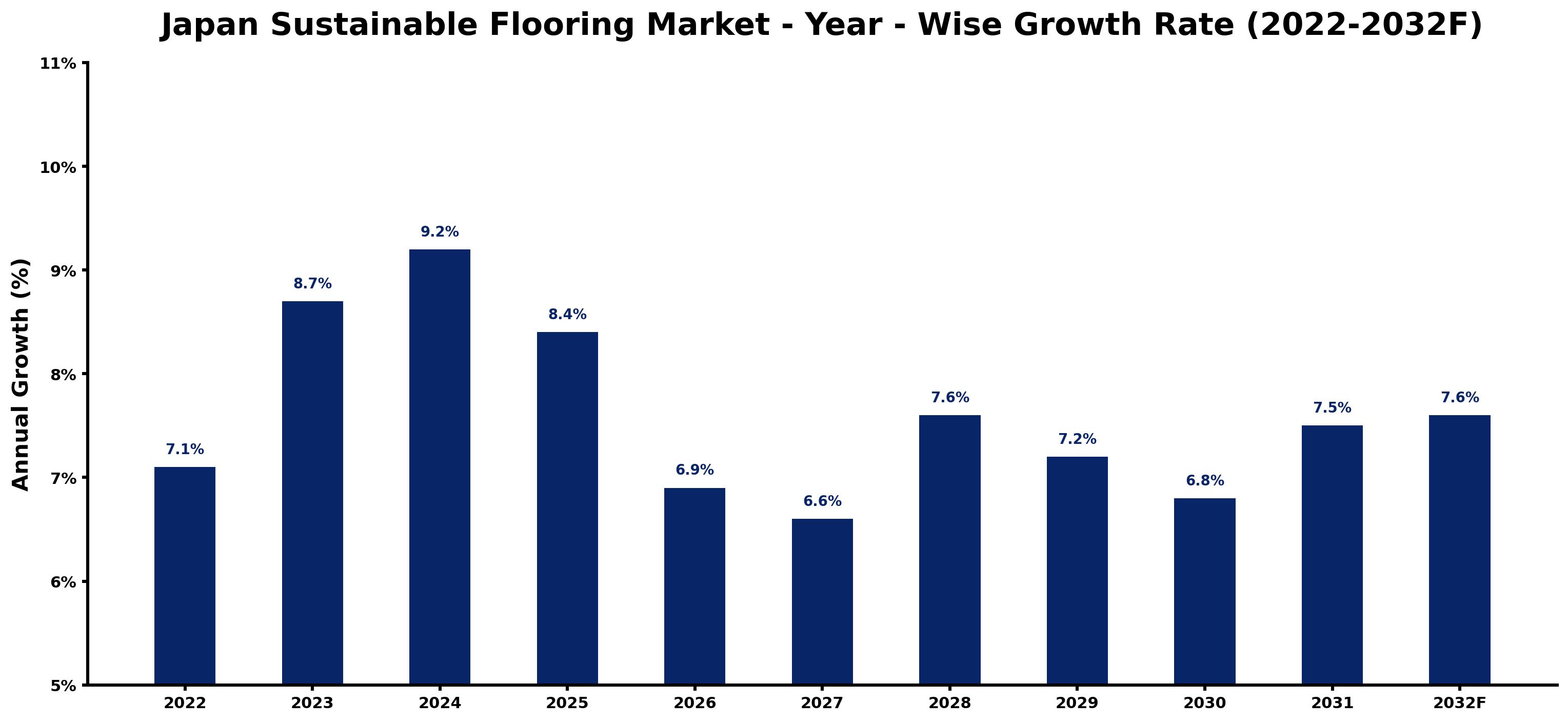
Below, each year's estimated growth is shown next to the factor that most influenced it.
| Year | Estimated Annual Growth (%) | Market Rationale |
| 2022 | 7.1 | The market showed steady growth due to rising consumer interest in sustainable options. |
| 2023 | 8.7 | Demand surged as urban development projects increasingly embraced eco-friendly materials. |
| 2024 | 9.2 | The Tokyo 2020 Olympics highlighted sustainable building practices, boosting market visibility. |
| 2025 | 8.4 | Growth slowed as the market adjusted to increased competition and consumer expectations. |
| 2026 | 6.9 | Demand is projected to rise, reflecting a shift towards sustainable practices in construction. |
| 2027 | 6.6 | The market will maintain growth, driven by ongoing renovation projects in urban areas. |
| 2028 | 7.6 | Growth is anticipated to accelerate again as new eco-friendly initiatives gain traction among buyers. |
| 2029 | 7.2 | Market growth is expected to slow slightly as supply chain challenges emerge in sourcing materials. |
| 2030 | 6.8 | Demand will remain steady, supported by ongoing consumer education on sustainability. |
| 2031 | 7.5 | The market is projected to rebound with renewed interest in sustainable flooring solutions. |
| 2032 | 7.6 | Growth is expected to peak as eco-conscious consumers increasingly prioritise sustainable options. |
Note: Market size estimations and growth projections presented in this report are based on 6Wresearch's proprietary forecasting methodology, utilizing the latest available industry data, government publications, and primary research inputs.
Japan Sustainable Flooring Market Synopsis
Sustainable flooring consists of eco-friendly options sourced from renewable materials like bamboo, reclaimed wood, and cork. These materials are increasingly utilised in residential and commercial applications, contributing to environmentally responsible construction practices. The Japan Sustainable Flooring Market is expanding due to urban development in the Tokyo metropolitan area, driven by eco-conscious consumers and government initiatives promoting green practices. In 2023, a subsidy program for green building materials was launched, supporting the adoption of sustainable materials in construction projects.
Market Dynamics Impact Analysis (2026–2032)
| Factor | Type | Impact | Primary Segment Affected |
| Rising urban development in the Tokyo metropolitan area | Driver | High | Bamboo Flooring |
| Growing consumer awareness of eco-friendly materials | Driver | High | Reclaimed Wood Floors |
| Increased funding for green building initiatives | Opportunity | High | Cork Flooring |
| Expansion of online purchasing platforms for sustainable products | Opportunity | Medium | Linoleum Flooring |
| Supply chain challenges in sourcing sustainable materials | Restraint | High | Bamboo Flooring |
| Higher production costs associated with sustainable materials | Restraint | Medium | Reclaimed Wood Floors |
| Compliance with evolving environmental regulations | Challenge | High | Cork Flooring |
| Capacity constraints in production facilities for sustainable flooring | Challenge | Medium | Linoleum Flooring |
Evaluation of Drivers in Japan Sustainable Flooring Market (2026–2032)
Below are the drivers that matter most for revenue growth, with supporting evidence.
| Drivers | Primary Segment Affected | Why It Matters (Evidence) |
| Urban development projects increasing demand for sustainable flooring | Bamboo Flooring | In 2022, the Tokyo metropolitan area saw substantial construction activity, boosting bamboo flooring sales. |
| Consumer preference for eco-friendly materials | Reclaimed Wood Floors | In 2023, renovations focusing on sustainability led to a rise in reclaimed wood usage. |
| Government initiatives promoting green building practices | Cork Flooring | The Ministry of the Environment's programs have increased the use of cork flooring in educational institutions. |
| Technological advancements in sustainable material production | Linoleum Flooring | ISO 14001 standards are driving improvements in linoleum manufacturing processes, enhancing market appeal. |
| Growth in direct sales channels for sustainable flooring | Engineered Bamboo | Direct sales accounted for 46% of the market share in 2025, improving consumer access. |
Most of the extra volume comes from rising urban development in the Tokyo metropolitan area, where construction activity increased significantly, leading to a population of 125 million seeking sustainable options. In 2023, consumer awareness of sustainability drove renovations, boosting reclaimed wood flooring sales. Technological advancements in production processes are also improving the appeal of linoleum flooring, which is gaining traction in educational institutions. Direct sales channels are expanding, providing consumers with better access to sustainable flooring options.
Evaluation of Restraints in Japan Sustainable Flooring Market
The following restraints limit how fast demand can grow.
| Market Restraint | Primary Segment Affected | Why It Matters (Evidence) |
| Supply chain disruptions affecting material availability | Bamboo Flooring | In 2022, sourcing bamboo faced challenges due to logistical issues, impacting supply. |
| Higher costs associated with sustainable material production | Reclaimed Wood Floors | Production costs rose by 15% in 2023, affecting pricing strategies for reclaimed wood. |
| Compliance with stringent environmental regulations | Cork Flooring | New regulations require additional certifications, increasing operational complexity for producers. |
| Limited consumer awareness of sustainable flooring benefits | Linoleum Flooring | In 2022, many consumers lacked knowledge about linoleum's eco-friendly properties. |
| Capacity constraints in production facilities | Engineered Bamboo | Manufacturers reported challenges in meeting the growing demand for engineered bamboo. |
Japan Sustainable Flooring Market Challenges
In 2022, over 50 local and international players competed in Japan's sustainable flooring market, which pressured margins for producers. Many suppliers face challenges with outdated technology, resulting in delays that restrict buyers' access to modern flooring options. High production costs for eco-friendly materials can inflate prices by up to 20%, complicating pricing strategies for suppliers aiming to remain competitive. Supply chain disruptions, particularly in sourcing reclaimed wood, can postpone projects for contractors, leading to increased costs and extended timelines for construction.
Trends in the Japan Sustainable Flooring Market
Buyers and suppliers in the Japan Sustainable Flooring Market are adjusting to the following trends.
- Shift from Traditional to Sustainable Materials: Since 2022, the trend has shifted towards sustainable flooring materials, with bamboo flooring gaining a 41% market share by 2025, reflecting consumer preferences for eco-friendly options.
- Emergence of Online Sales Channels: In 2023, online platforms for sustainable flooring gained popularity, with a 9.4% CAGR expected through 2032, allowing consumers easier access to eco-friendly products.
- Growing Adoption of Green Building Practices: The Building Energy Efficiency Act initiated in 2022 has led to a 30% increase in sustainable flooring usage in new constructions, aligning with national sustainability goals.
- Increased Focus on Renovation Projects: Renovation projects in urban areas have surged since 2022, with reclaimed wood flooring seeing a 9.3% CAGR, driven by consumer demand for unique, sustainable aesthetics.
Investment Opportunities in the Japan Sustainable Flooring Market
Below are the investment opportunities with the strongest case in the Japan Sustainable Flooring Market.
- Investment in Green Building Materials: With a 30% increase in funding for green initiatives, there is an opportunity for suppliers to engage with residential builders focusing on sustainable materials.
- Expansion of Online Retail Platforms: The rise in online purchasing for sustainable flooring presents an opportunity for distributors to partner with e-commerce platforms, tapping into a growing consumer base.
- Development of Educational Programs: Educational institutions are increasingly adopting sustainable flooring, creating opportunities for suppliers to provide eco-friendly materials to schools and universities.
- Collaboration with Local Governments: Local governments are promoting green building practices, offering a chance for manufacturers to collaborate on projects that require sustainable flooring solutions.
Government Initiatives in the Japan Sustainable Flooring Market
The Building Energy Efficiency Act (2015, amended 2022) mandates that all new buildings in Japan meet energy efficiency standards, impacting sustainable flooring producers. Compliance with these standards encourages the use of eco-friendly materials, such as bamboo and reclaimed wood, in construction projects.
In 2023, the Japanese government launched a subsidy program for green building materials, including sustainable flooring, with an allocation of USD 50 million. The Ministry of the Environment oversees this initiative, supporting producers and buyers in adopting sustainable practices.
Future Insight of the Japan Sustainable Flooring Market
By 2032, residential buyers will increasingly demand sustainable flooring solutions, driven by growing environmental consciousness and government incentives. The Japanese government's subsidy program for green building materials will encourage suppliers to innovate, with a projected 30% increase in sustainable flooring installations. Standards set by the Japan Green Building Council will further promote eco-friendly materials in construction. Urban development in the Tokyo metropolitan area will showcase advanced flooring technologies, enhancing the appeal of sustainable options.
Market Segmentation Analysis
Japan Sustainable Flooring Market report covers a detailed analysis of the following market segments:
By Sustainable Flooring – Bamboo Flooring Leads, Reclaimed Wood Floors Expected to Grow Fastest
According to Saurav Kr Singh, Senior Research Analyst at 6Wresearch, Bamboo Flooring accounted for 41% of the market by sustainable flooring in 2025. Bamboo flooring holds the largest share as it is widely used in residential projects, appealing to consumers seeking eco-friendly materials. Its rapid renewability and aesthetic qualities resonate particularly well in urban developments like those in the Tokyo metropolitan area. Reclaimed Wood Floors are set to record the highest CAGR in this split, 9.3% over 2026–2032. Reclaimed wood floors are growing quickly due to their unique character and sustainability, which attract eco-conscious buyers. The increasing focus on sustainable renovations in urban areas is a key factor driving this segment's expansion. Suppliers should emphasise the unique benefits of reclaimed wood to leverage the rising interest in sustainable renovations.
By Product Type – Engineered Bamboo Leads, Solid Wood Flooring Expected to Grow Fastest
With 46% of product type revenue in 2025, Engineered Bamboo was the largest category. Engineered bamboo leads the market because it combines sustainability with high performance, making it a reliable choice for various applications. Its stability and environmental benefits appeal to consumers looking for durable flooring solutions. Over 2026–2032, Solid Wood Flooring is expected to post the fastest growth, at a CAGR of 10.0%. Solid wood flooring is experiencing rapid growth as it offers natural beauty and longevity, aligning with the increasing consumer preference for sustainable materials. This trend signals a movement towards traditional yet eco-friendly flooring options. Buyers may find solid wood options valuable as they align with both aesthetic preferences and sustainable practices.
By Material Type – Bamboo Leads, Reclaimed Timber Expected to Grow Fastest
The largest material type category in 2025 was Bamboo, at 40% of revenue. Bamboo is the leading material in sustainable flooring, recognised for its rapid growth and renewability, which appeals to eco-conscious consumers. Its widespread use in residential buildings highlights its significance in the market. Reclaimed Timber is projected to grow fastest, at a CAGR of 10.1% during 2026–2032. Reclaimed timber is gaining traction rapidly due to its sustainability and unique aesthetic, attracting consumers looking for distinctive flooring solutions. This shift reflects a broader trend towards sustainable materials in construction and renovation projects. Suppliers should consider expanding their offerings of reclaimed timber to meet the rising demand for sustainable and unique flooring options.
By Distribution Channel – Direct Sales Leads, Online Platforms Expected to Grow Fastest
Direct Sales held 46% of the Japan Sustainable Flooring Market by distribution channel in 2025. Direct sales are the primary channel for sustainable flooring products, facilitating effective consumer education on eco-friendly options. This channel's strength is evident as consumers increasingly seek information about sustainable practices. The quickest growth will come from Online Platforms, forecast to expand at a CAGR of 9.4% between 2026 and 2032. Online platforms are rapidly gaining popularity for purchasing sustainable flooring, providing consumers with easy access to a wider range of products. The convenience of online shopping aligns with the growing trend of digital commerce in the flooring market. Suppliers should strengthen their online presence to meet the increasing preference for digital purchasing among consumers.
By End User Industry – Residential Buildings Lead, Commercial Offices Expected to Grow Fastest
In 2025, Residential Buildings led the end user industry split with a 50% share. Residential buildings are the largest end user of sustainable flooring, driven by a growing consumer demand for eco-friendly home solutions. This segment's prominence is clear as more homeowners prioritise sustainability in their flooring choices. Commercial Offices are set to record the highest CAGR in this split, 9.2% over 2026–2032. Commercial offices are witnessing the fastest growth in sustainable flooring adoption, as businesses strive to enhance their green credentials and attract eco-conscious clients. This trend reflects a shift in corporate responsibility towards sustainability in office environments. Suppliers should focus on the commercial sector with tailored solutions that align with the sustainability goals of businesses.
Key Attractiveness of the Report
- 10 Years of Market Numbers
- Historical Data Starting from 2022 to 2025
- Base Year 2025
- Forecast Data until 2032
- Key Performance Indicators Impacting the Market
- Major Upcoming Developments and Projects
Key Highlights of the Report:
- Japan Sustainable Flooring Market Outlook
- Market Size of Japan Sustainable Flooring Market, 2025
- Forecast of Japan Sustainable Flooring Market, 2032
- Historical Data and Forecast of Japan Sustainable Flooring Revenues & Volume for the Period 2022-2032F
- Japan Sustainable Flooring Market Trend Evolution
- Japan Sustainable Flooring Market Drivers and Challenges
- Japan Sustainable Flooring Price Trends
- Japan Sustainable Flooring Porter's Five Forces
- Japan Sustainable Flooring Industry Life Cycle
- Historical Data and Forecast of Japan Sustainable Flooring Market Revenues & Volume By Sustainable Flooring for the Period 2022-2032F
- Historical Data and Forecast of Japan Sustainable Flooring Market Revenues & Volume By Bamboo Flooring for the Period 2022-2032F
- Historical Data and Forecast of Japan Sustainable Flooring Market Revenues & Volume By Reclaimed Wood Floors for the Period 2022-2032F
- Historical Data and Forecast of Japan Sustainable Flooring Market Revenues & Volume By Cork Flooring for the Period 2022-2032F
- Historical Data and Forecast of Japan Sustainable Flooring Market Revenues & Volume By Linoleum Flooring for the Period 2022-2032F
- Historical Data and Forecast of Japan Sustainable Flooring Market Revenues & Volume By Product Type for the Period 2022-2032F
- Historical Data and Forecast of Japan Sustainable Flooring Market Revenues & Volume By Engineered Bamboo for the Period 2022-2032F
- Historical Data and Forecast of Japan Sustainable Flooring Market Revenues & Volume By Solid Wood Flooring for the Period 2022-2032F
- Historical Data and Forecast of Japan Sustainable Flooring Market Revenues & Volume By Sheet Cork Tiles for the Period 2022-2032F
- Historical Data and Forecast of Japan Sustainable Flooring Market Revenues & Volume By Natural Linoleum for the Period 2022-2032F
- Historical Data and Forecast of Japan Sustainable Flooring Market Revenues & Volume By Material Type for the Period 2022-2032F
- Historical Data and Forecast of Japan Sustainable Flooring Market Revenues & Volume By Bamboo for the Period 2022-2032F
- Historical Data and Forecast of Japan Sustainable Flooring Market Revenues & Volume By Reclaimed Timber for the Period 2022-2032F
- Historical Data and Forecast of Japan Sustainable Flooring Market Revenues & Volume By Cork Oak Bark for the Period 2022-2032F
- Historical Data and Forecast of Japan Sustainable Flooring Market Revenues & Volume By Flax & Jute for the Period 2022-2032F
- Historical Data and Forecast of Japan Sustainable Flooring Market Revenues & Volume By Distribution Channel for the Period 2022-2032F
- Historical Data and Forecast of Japan Sustainable Flooring Market Revenues & Volume By Direct Sales for the Period 2022-2032F
- Historical Data and Forecast of Japan Sustainable Flooring Market Revenues & Volume By Online Platforms for the Period 2022-2032F
- Historical Data and Forecast of Japan Sustainable Flooring Market Revenues & Volume By Specialty Stores for the Period 2022-2032F
- Historical Data and Forecast of Japan Sustainable Flooring Market Revenues & Volume By Industrial Distributors for the Period 2022-2032F
- Historical Data and Forecast of Japan Sustainable Flooring Market Revenues & Volume By End User Industry for the Period 2022-2032F
- Historical Data and Forecast of Japan Sustainable Flooring Market Revenues & Volume By Residential Buildings for the Period 2022-2032F
- Historical Data and Forecast of Japan Sustainable Flooring Market Revenues & Volume By Commercial Offices for the Period 2022-2032F
- Historical Data and Forecast of Japan Sustainable Flooring Market Revenues & Volume By Hospitality Sector for the Period 2022-2032F
- Historical Data and Forecast of Japan Sustainable Flooring Market Revenues & Volume By Educational Institutions for the Period 2022-2032F
- Japan Sustainable Flooring Import Export Trade Statistics
- Market Opportunity Assessment By Sustainable Flooring
- Market Opportunity Assessment By Product Type
- Market Opportunity Assessment By Material Type
- Market Opportunity Assessment By Distribution Channel
- Market Opportunity Assessment By End User Industry
- Japan Sustainable Flooring Top Companies Market Share
- Japan Sustainable Flooring Competitive Benchmarking By Technical and Operational Parameters
- Japan Sustainable Flooring Company Profiles
- Japan Sustainable Flooring Key Strategic Recommendations
Market Covered
Coverage by segment is as follows.
By Sustainable Flooring
- Bamboo Flooring
- Reclaimed Wood Floors
- Cork Flooring
- Linoleum Flooring
By Product Type
- Engineered Bamboo
- Solid Wood Flooring
- Sheet Cork Tiles
- Natural Linoleum
By Material Type
- Bamboo
- Reclaimed Timber
- Cork Oak Bark
- Flax & Jute
By Distribution Channel
- Direct Sales
- Online Platforms
- Specialty Stores
- Industrial Distributors
By End User Industry
- Residential Buildings
- Commercial Offices
- Hospitality Sector
- Educational Institutions































