Japan Sustainable Food Containers Market Size & Growth Rate
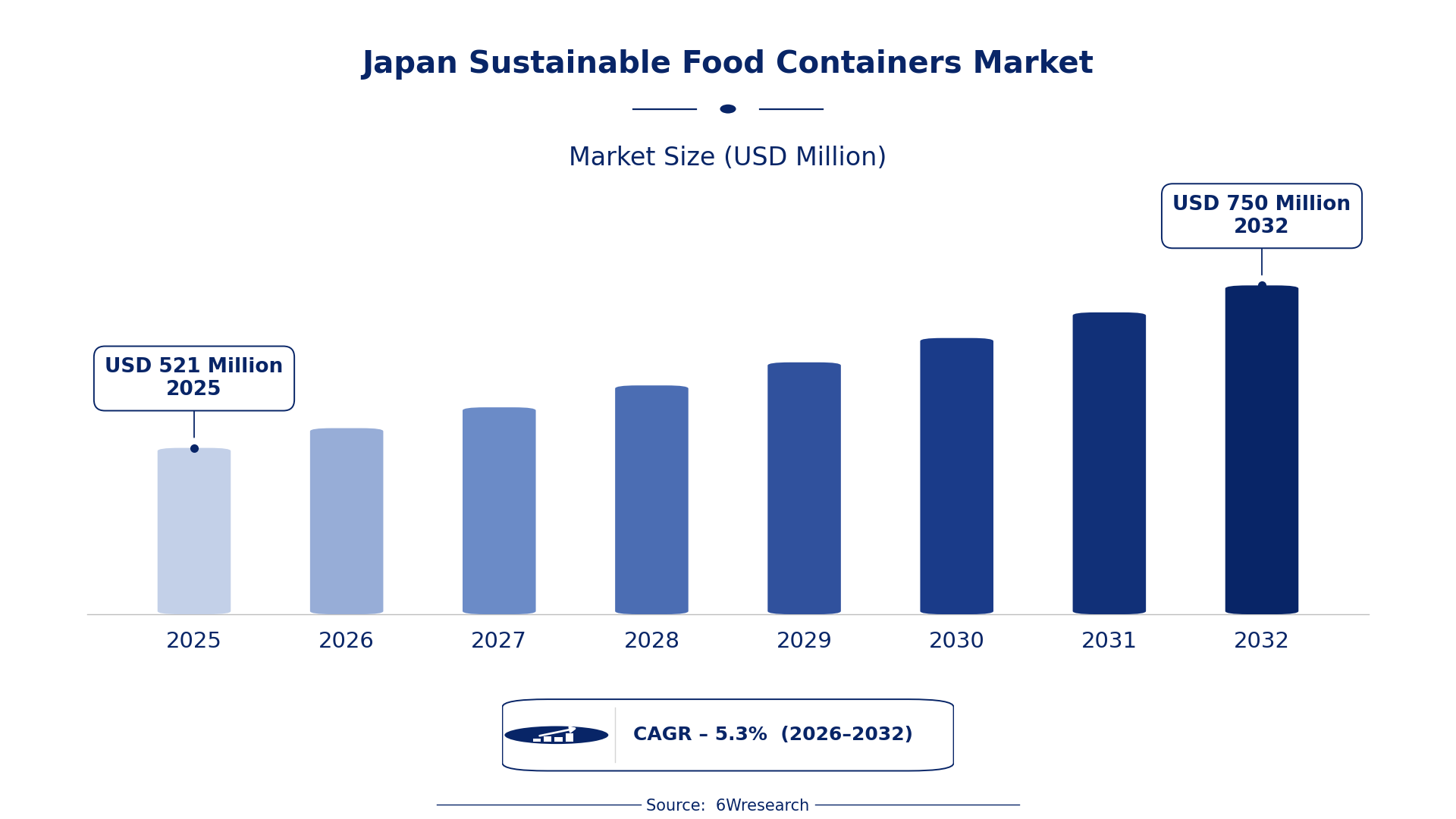
According to 6Wresearch internal database and industry insights, the Japan Sustainable Food Containers Market was valued at USD 521 Million in 2025 and is projected to reach USD 750 Million by 2032, growing at a CAGR of approximately 5.3% during 2026–2032.
Japan Sustainable Food Containers Market Highlights
| Report Metric | Details |
| Report Name | Japan Sustainable Food Containers Market (2026-2032) |
| Market Size 2025 | USD 521 Million |
| Market Size 2032 | USD 750 Million |
| Absolute Growth 2025–2032 | USD 229 Million |
| CAGR 2026–2032 | 5.3% |
| Peak Annual Growth | 6.7% in 2027 |
| Forecast Period | 2026–2032 |
| Historical Data | 2022–2025 |
| Base Year | 2025 |
| Leading Sustainable Food Containers, 2025 | Compostable Containers (39% share) |
| Leading Product Type, 2025 | Clamshells (46% share) |
| Leading Material Type, 2025 | Bagasse (42% share) |
| Leading Distribution Channel, 2025 | Online Platforms (49% share) |
| Leading End User Industry, 2025 | Food Delivery Services (45% share) |
| Fastest-Growing Sustainable Food Containers | Recyclable Containers (7.0% CAGR) |
| Fastest-Growing Product Type | Meal Boxes (7.2% CAGR) |
| Fastest-Growing Material Type | Recycled Paper (7.4% CAGR) |
| Fastest-Growing Distribution Channel | Direct Sales (6.9% CAGR) |
| Fastest-Growing End User Industry | QSR & Restaurants (6.8% CAGR) |
| Growing Sector | Food Delivery Services |
| Key End Users | Restaurants, food delivery services, retail chains, cafes |
Japan Sustainable Food Containers Market Year-wise Growth Rate and Key Drivers (2022–2032)
This graph illustrates the annual growth rates of the market from 2022 to 2032, highlighting a steady upward trajectory and projected market expansion over the forecast period.
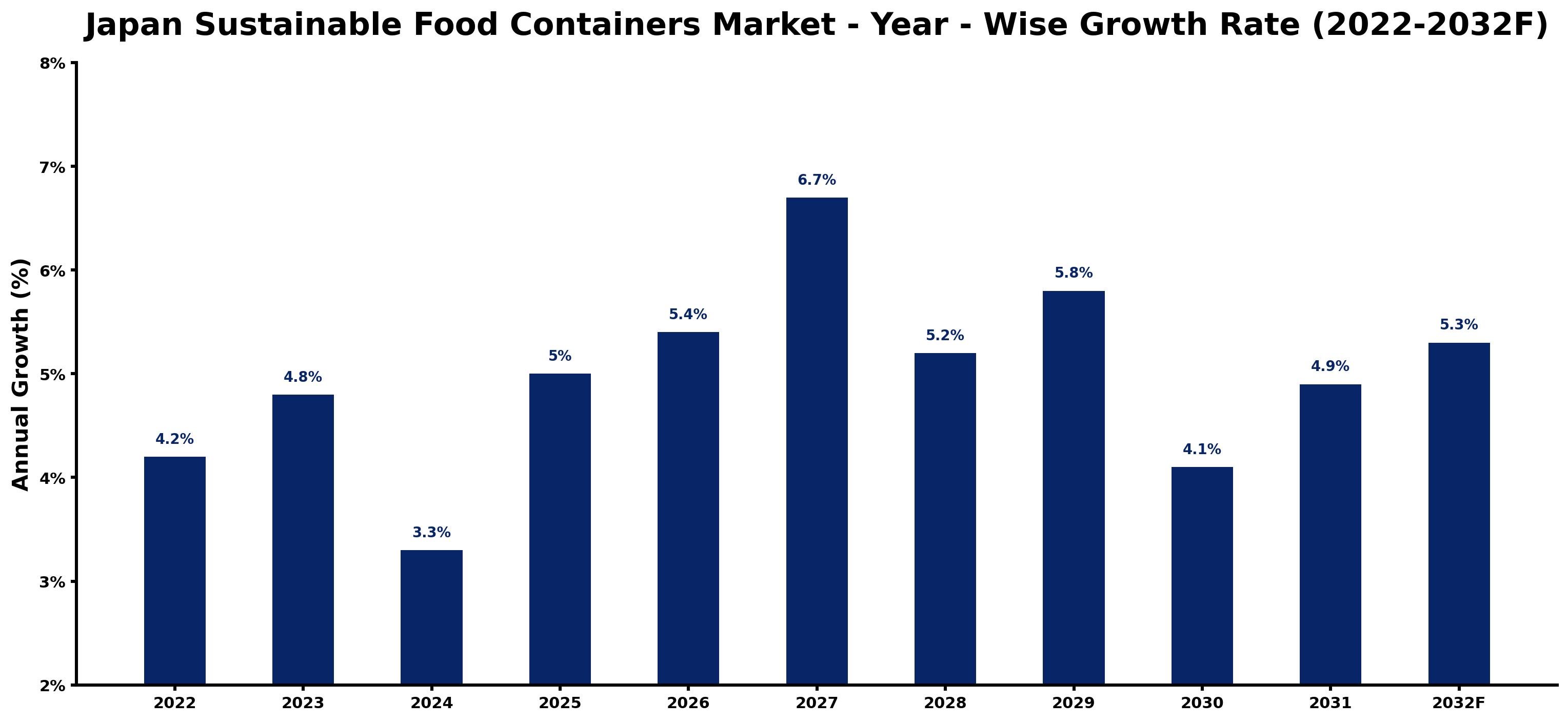
The following figures match every annual growth estimate with the main market development of that year, giving the reasoning behind each rise or slowdown.
| Year | Estimated Annual Growth (%) | Market Rationale |
| 2022 | 4.2 | The market experienced steady growth driven by increased consumer awareness of sustainable practices. |
| 2023 | 4.8 | Growth accelerated as more restaurants adopted eco-friendly packaging solutions. |
| 2024 | 3.3 | The growth rate slowed due to market saturation in some segments, yet demand remained strong. |
| 2025 | 5.0 | Demand surged as the government launched campaigns promoting sustainable packaging. |
| 2026 | 5.4 | The market is expected to expand further as consumer preferences shift towards eco-friendly options. |
| 2027 | 6.7 | The peak growth rate will be reached, reflecting heightened demand from food delivery services. |
| 2028 | 5.2 | Growth is projected to slow slightly as competition intensifies among sustainable packaging providers. |
| 2029 | 5.8 | Demand will rebound as new regulations encourage the use of biodegradable materials. |
| 2030 | 4.1 | The market is expected to experience a slowdown as some buyers hesitate amid economic uncertainty. |
| 2031 | 4.9 | Growth will resume as consumer interest in sustainability continues to rise. |
| 2032 | 5.3 | The market is projected to stabilise, driven by ongoing investments in sustainable practices. |
Note: Market size estimations and growth projections presented in this report are based on 6Wresearch's proprietary forecasting methodology, utilizing the latest available industry data, government publications, and primary research inputs.
Japan Sustainable Food Containers Market Synopsis
Sustainable food containers are eco-friendly packaging solutions made from materials like bagasse, PLA, and recycled paper. These containers primarily serve food delivery, takeout, and storage, meeting Japan's growing demand for sustainable practices. The Japan Sustainable Food Containers Market is expanding due to rising consumer awareness, government initiatives promoting biodegradable materials, and the growth of food delivery services in urban areas like Tokyo. In 2023, approximately 30% of restaurants adopted sustainable packaging, reflecting this trend.
Market Dynamics Impact Analysis (2026–2032)
| Factor | Type | Impact | Primary Segment Affected |
| Increased consumer awareness of sustainability | Driver | High | Compostable Containers |
| Government campaigns promoting eco-friendly packaging | Driver | High | Recyclable Containers |
| Growing demand for biodegradable products | Opportunity | High | Biodegradable Cups |
| Expansion of food delivery services | Opportunity | High | Food Delivery Services |
| Market saturation in certain segments | Restraint | Medium | Reusable Containers |
| Intense competition among packaging providers | Restraint | Medium | Clamshells |
| Economic uncertainty affecting consumer spending | Challenge | High | Meal Boxes |
| Regulatory compliance costs for sustainable packaging | Challenge | Medium | Beverage Cups |
Evaluation of Drivers in Japan Sustainable Food Containers Market (2026–2032)
The table below links each growth driver to the segment it affects and the evidence for it.
| Drivers | Primary Segment Affected | Why It Matters (Evidence) |
| Rising consumer awareness of sustainability | Compostable Containers | In 2023, approximately 30% of restaurants adopted sustainable packaging, which increased demand for compostable options. |
| Government initiatives promoting biodegradable materials | Recyclable Containers | Campaigns in 2023 encouraged the use of recyclable materials, boosting demand for these containers. |
| Expansion of food delivery services in urban areas | Biodegradable Cups | The growth of food delivery services has led to more businesses adopting biodegradable cups, increasing their use. |
| Increased focus on eco-friendly packaging by retailers | Reusable Containers | Retail chains are expanding their sustainable product lines, responding to consumer preferences for eco-friendly options. |
| Rising consumer demand for convenience | Clamshells | The popularity of meal prep and takeout options has led to increased use of clamshell containers. |
Spending rises because approximately 30% of restaurants in Japan adopted sustainable packaging solutions in 2023, which increased demand for eco-friendly options. The growing trend of food delivery services has led to more businesses opting for biodegradable materials, reflecting a shift in consumer preferences. As urban areas expand, the need for sustainable packaging continues to rise, particularly in the food service sector. Retailers are responding by expanding their product lines with eco-friendly options, further driving market growth. The popularity of meal prep and takeout has significantly increased the demand for clamshell containers, showcasing changing consumer habits.
Evaluation of Restraints in Japan Sustainable Food Containers Market
The key brakes on demand, and where they bite hardest, are shown below.
| Market Restraint | Primary Segment Affected | Why It Matters (Evidence) |
| Market saturation in certain segments | Reusable Containers | As the market matures, the growth of reusable containers faces challenges due to limited consumer adoption. |
| Intense competition among packaging providers | Clamshells | High competition has led to price wars, impacting profit margins for clamshell manufacturers. |
| Economic uncertainty affecting consumer spending | Meal Boxes | Economic fluctuations have made consumers more cautious, affecting their willingness to spend on meal boxes. |
| Regulatory compliance costs for sustainable packaging | Beverage Cups | The need to comply with new regulations increases operational costs for beverage cup producers. |
| Limited consumer awareness of certain sustainable options | Biodegradable Cups | Despite growth, some consumers remain unaware of the benefits of biodegradable cups, limiting market expansion. |
Japan Sustainable Food Containers Market Challenges
Producers encounter a shortage of skilled workers in sustainable packaging due to Japan's declining population and ageing workforce, which delays production and raises costs. This situation compels restaurants and food delivery services to pay higher prices for eco-friendly solutions, as around 30% of restaurants have adopted sustainable packaging. Many producers grapple with outdated technology; limited access to advanced machinery extends production times, resulting in longer lead times for food service providers. Regulatory changes, such as local government restrictions on single-use plastics, create uncertainty, pushing producers to adapt swiftly, which can disrupt supply chains.
Trends in the Japan Sustainable Food Containers Market
The following changes are redrawing the Japan Sustainable Food Containers Market.
- Shift from Traditional to Sustainable Packaging: Since 2023, Japan has seen a shift towards sustainable food packaging, particularly in urban areas. The government's campaign to reduce plastic waste has led to a 30% increase in restaurants adopting compostable containers.
- Rise of Online Platforms for Sustainable Products: In 2023, online platforms have become the leading distribution channel for sustainable food containers, capturing 49% of the market share. This trend reflects the growing preference for eco-friendly options among consumers.
- Increased Adoption of Biodegradable Materials: The use of biodegradable materials in food packaging has surged since 2023, driven by consumer demand for sustainability. The beverage industry has increasingly incorporated biodegradable cups, aligning with environmental goals.
- Expansion of Food Delivery Services: The food delivery service sector has expanded rapidly in Japan, particularly in Tokyo, leading to a growing demand for sustainable packaging solutions. This trend is evident as 45% of food delivery services now use eco-friendly containers.
Investment Opportunities in the Japan Sustainable Food Containers Market
Several openings in the Japan Sustainable Food Containers Market merit attention from investors.
- Collaboration with Local Restaurants: Now is an ideal time to partner with local restaurants, as 30% have adopted sustainable packaging. Collaborating with these businesses can improve market presence and drive sales.
- Investment in Biodegradable Materials: The market gap for biodegradable materials presents an opportunity for investment, as consumer awareness increases. Targeting food delivery services can lead to substantial sales growth.
- Expansion into Online Sales Channels: As the Eco Mark certification gains popularity, manufacturers can invest in obtaining this certification to attract eco-conscious consumers, enhancing market competitiveness.
- Focus on Retail Chain Partnerships: With retail chains expanding their sustainable product lines, now is the time to establish partnerships to increase distribution and reach eco-conscious consumers.
Government Initiatives in the Japan Sustainable Food Containers Market
The Food Sanitation Act amendment, enacted in 2018, introduced a positive list system for safe materials used in food packaging. This regulation ensures that sustainable food containers meet hygiene standards, promoting the use of eco-friendly options. Additionally, the Food Recycling Law mandates food businesses to reduce waste and recycle it, further encouraging the adoption of sustainable packaging solutions among producers and buyers.
In 2023, a campaign was launched to reduce plastic waste, with the Ministry of the Environment overseeing initiatives to promote biodegradable materials. This includes funding for businesses transitioning to eco-friendly packaging, supporting the industry's shift towards sustainability.
Future Insight of the Japan Sustainable Food Containers Market
By 2032, investment in sustainable packaging technologies will surge, driven by government subsidies and heightened consumer demand for eco-friendly solutions. This shift will create a robust market for biodegradable materials, with the average household expected to use 50% more reusable containers. New JIS standards will set quality and safety benchmarks, enhancing buyer confidence in sustainable products. Collaboration between the Japan Packaging Institute and local governments will promote wider adoption of sustainable practices across various sectors.
Market Segmentation Analysis
Japan Sustainable Food Containers Market report covers a detailed analysis of the following market segments:
By Sustainable Food Containers – Compostable Containers Lead, Recyclable Containers Expected to Grow Fastest
According to Saurav Kr Singh, Senior Research Analyst at 6Wresearch, with 39% of sustainable food containers revenue in 2025, Compostable Containers was the largest category. Compostable containers are extensively employed in food delivery and takeout, catering to consumers who prioritise sustainability. This segment thrives due to government initiatives promoting the use of biodegradable materials, which resonate with eco-conscious buyers. Recyclable Containers are set to record the highest CAGR in this split, 7.0% over 2026–2032. Recyclable containers are witnessing rapid growth, spurred by increasing consumer awareness and local government regulations aimed at reducing single-use plastics. This momentum is further enhanced by campaigns encouraging recycling practices throughout Japan. Suppliers should ensure a robust supply of compostable options to meet the surging demand for sustainable food containers.
By Product Type – Clamshells Lead, Meal Boxes Expected to Grow Fastest
The largest product type category in 2025 was Clamshells, at 46% of revenue. Clamshells are frequently used for takeout and meal preparation, providing convenience for both consumers and food service providers. Their versatility in packaging various food items contributes to their dominant position in the market. Over 2026–2032, Meal Boxes are expected to post the fastest growth, at a CAGR of 7.2%. Meal boxes are essential for meal delivery services, catering to the growing consumer demand for convenient food options. This segment's growth is driven by the expansion of food delivery services across urban areas. Manufacturers should prioritise the production of clamshells to capitalise on their widespread use.
By Material Type – Bagasse Leads, Recycled Paper Expected to Grow Fastest
Bagasse took 42% of material type revenue in 2025, more than any other category. Bagasse serves as the primary material for compostable containers, sourced from sugarcane, aligning with sustainability goals. Its inherent strength and compostability make it a preferred choice among food service providers across Japan. The quickest growth will come from Recycled Paper, forecast to expand at a CAGR of 7.4% between 2026 and 2032. Recycled paper is gaining traction in various packaging forms, appealing to environmentally conscious consumers and bolstering recycling initiatives. This trend is supported by Japan's strong recycling culture, where over 80% of paper products are recycled annually. Suppliers must prioritise sourcing sustainable materials to cater to the increasing demand for eco-friendly packaging solutions.
By Distribution Channel – Online Platforms Lead, Direct Sales Expected to Grow Fastest
In 2025, Online Platforms led the distribution channel split with a 49% share. Online platforms are becoming a prominent sales channel for sustainable products, catering to eco-conscious consumers who favour online shopping. This shift reflects the broader trend towards digital commerce within the food packaging sector. Direct Sales is projected to grow fastest, at a CAGR of 6.9% during 2026–2032. Direct sales are increasingly employed by manufacturers to connect with businesses directly, although this method is less prevalent. The growing emphasis on sustainability is encouraging more manufacturers to adopt direct sales strategies to engage clients effectively. Companies should strengthen their online presence to capture the expanding market for sustainable food containers.
By End User Industry – Food Delivery Services Lead, QSR & Restaurants Expected to Grow Fastest
Food Delivery Services accounted for 45% of the market by end user industry in 2025. Food delivery services are major consumers of sustainable containers, reflecting the growing market trend towards eco-friendly practices. Their reliance on these containers is further reinforced by consumer preferences favouring sustainable options in food packaging. QSR & Restaurants are set to record the highest CAGR in this split, 6.8% over 2026–2032. QSR and restaurants are significant users of sustainable packaging, driven by consumer demand for environmentally responsible choices. This segment is set for growth as more establishments adopt sustainable practices to align with consumer expectations. Suppliers should align their product offerings with the needs of food delivery services to maximise market opportunities.
Key Attractiveness of the Report
- 10 Years of Market Numbers
- Historical Data Starting from 2022 to 2025
- Base Year 2025
- Forecast Data until 2032
- Key Performance Indicators Impacting the Market
- Major Upcoming Developments and Projects
Key Highlights of the Report:
- Japan Sustainable Food Containers Market Outlook
- Market Size of Japan Sustainable Food Containers Market, 2025
- Forecast of Japan Sustainable Food Containers Market, 2032
- Historical Data and Forecast of Japan Sustainable Food Containers Revenues & Volume for the Period 2022-2032F
- Japan Sustainable Food Containers Market Trend Evolution
- Japan Sustainable Food Containers Market Drivers and Challenges
- Japan Sustainable Food Containers Price Trends
- Japan Sustainable Food Containers Porter's Five Forces
- Japan Sustainable Food Containers Industry Life Cycle
- Historical Data and Forecast of Japan Sustainable Food Containers Market Revenues & Volume By Sustainable Food Containers for the Period 2022-2032F
- Historical Data and Forecast of Japan Sustainable Food Containers Market Revenues & Volume By Compostable Containers for the Period 2022-2032F
- Historical Data and Forecast of Japan Sustainable Food Containers Market Revenues & Volume By Recyclable Containers for the Period 2022-2032F
- Historical Data and Forecast of Japan Sustainable Food Containers Market Revenues & Volume By Biodegradable Cups for the Period 2022-2032F
- Historical Data and Forecast of Japan Sustainable Food Containers Market Revenues & Volume By Reusable Containers for the Period 2022-2032F
- Historical Data and Forecast of Japan Sustainable Food Containers Market Revenues & Volume By Product Type for the Period 2022-2032F
- Historical Data and Forecast of Japan Sustainable Food Containers Market Revenues & Volume By Clamshells for the Period 2022-2032F
- Historical Data and Forecast of Japan Sustainable Food Containers Market Revenues & Volume By Meal Boxes for the Period 2022-2032F
- Historical Data and Forecast of Japan Sustainable Food Containers Market Revenues & Volume By Beverage Cups for the Period 2022-2032F
- Historical Data and Forecast of Japan Sustainable Food Containers Market Revenues & Volume By Storage Boxes for the Period 2022-2032F
- Historical Data and Forecast of Japan Sustainable Food Containers Market Revenues & Volume By Material Type for the Period 2022-2032F
- Historical Data and Forecast of Japan Sustainable Food Containers Market Revenues & Volume By Bagasse for the Period 2022-2032F
- Historical Data and Forecast of Japan Sustainable Food Containers Market Revenues & Volume By Recycled Paper for the Period 2022-2032F
- Historical Data and Forecast of Japan Sustainable Food Containers Market Revenues & Volume By PLA for the Period 2022-2032F
- Historical Data and Forecast of Japan Sustainable Food Containers Market Revenues & Volume By Stainless Steel for the Period 2022-2032F
- Historical Data and Forecast of Japan Sustainable Food Containers Market Revenues & Volume By Distribution Channel for the Period 2022-2032F
- Historical Data and Forecast of Japan Sustainable Food Containers Market Revenues & Volume By Online Platforms for the Period 2022-2032F
- Historical Data and Forecast of Japan Sustainable Food Containers Market Revenues & Volume By Direct Sales for the Period 2022-2032F
- Historical Data and Forecast of Japan Sustainable Food Containers Market Revenues & Volume By Retail Chains for the Period 2022-2032F
- Historical Data and Forecast of Japan Sustainable Food Containers Market Revenues & Volume By Specialty Stores for the Period 2022-2032F
- Historical Data and Forecast of Japan Sustainable Food Containers Market Revenues & Volume By End User Industry for the Period 2022-2032F
- Historical Data and Forecast of Japan Sustainable Food Containers Market Revenues & Volume By Food Delivery Services for the Period 2022-2032F
- Historical Data and Forecast of Japan Sustainable Food Containers Market Revenues & Volume By QSR & Restaurants for the Period 2022-2032F
- Historical Data and Forecast of Japan Sustainable Food Containers Market Revenues & Volume By Beverage Industry for the Period 2022-2032F
- Historical Data and Forecast of Japan Sustainable Food Containers Market Revenues & Volume By Household Use for the Period 2022-2032F
- Japan Sustainable Food Containers Import Export Trade Statistics
- Market Opportunity Assessment By Sustainable Food Containers
- Market Opportunity Assessment By Product Type
- Market Opportunity Assessment By Material Type
- Market Opportunity Assessment By Distribution Channel
- Market Opportunity Assessment By End User Industry
- Japan Sustainable Food Containers Top Companies Market Share
- Japan Sustainable Food Containers Competitive Benchmarking By Technical and Operational Parameters
- Japan Sustainable Food Containers Company Profiles
- Japan Sustainable Food Containers Key Strategic Recommendations
Market Covered
The study includes the following segmentation.
By Sustainable Food Containers
- Compostable Containers
- Recyclable Containers
- Biodegradable Cups
- Reusable Containers
By Product Type
- Clamshells
- Meal Boxes
- Beverage Cups
- Storage Boxes
By Material Type
- Bagasse
- Recycled Paper
- PLA
- Stainless Steel
By Distribution Channel
- Online Platforms
- Direct Sales
- Retail Chains
- Specialty Stores
By End User Industry
- Food Delivery Services
- QSR & Restaurants
- Beverage Industry
- Household Use































