Japan Sustainable Hygiene Materials Market Size & Growth Rate
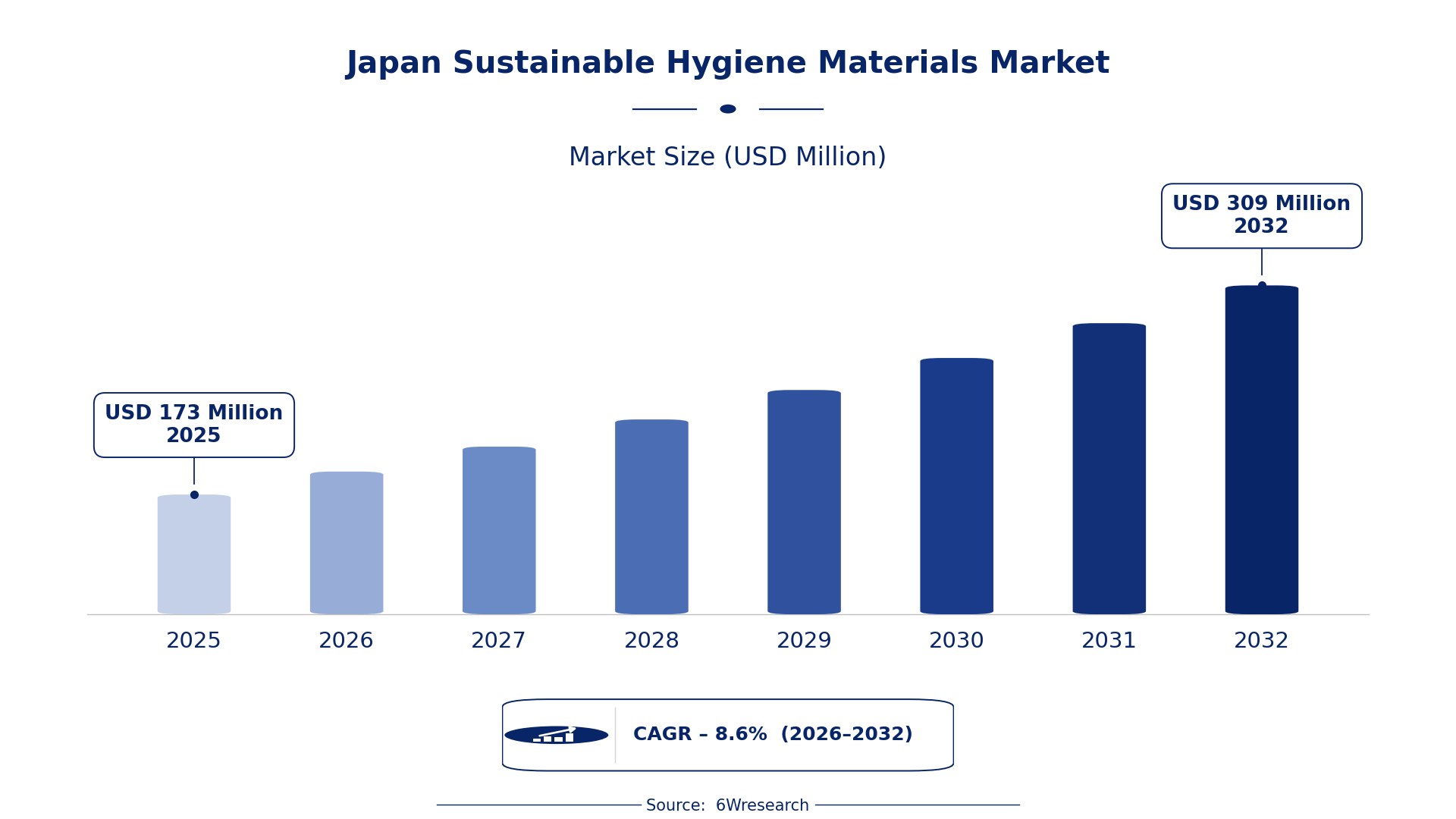
According to 6Wresearch internal database and industry insights, the Japan Sustainable Hygiene Materials Market was valued at USD 173 Million in 2025 and is projected to reach USD 309 Million by 2032, growing at a CAGR of approximately 8.6% during 2026–2032.
Japan Sustainable Hygiene Materials Market Highlights
| Report Metric | Details |
| Report Name | Japan Sustainable Hygiene Materials Market (2026-2032) |
| Market Size 2025 | USD 173 Million |
| Market Size 2032 | USD 309 Million |
| Absolute Growth 2025–2032 | USD 136 Million |
| CAGR 2026–2032 | 8.6% |
| Peak Annual Growth | 9.6% in 2032 |
| Forecast Period | 2026–2032 |
| Historical Data | 2022–2025 |
| Base Year | 2025 |
| Leading Sustainable Hygiene Materials, 2025 | Compostable Diapers (37% share) |
| Leading Product Type, 2025 | Infant Diapers (50% share) |
| Leading Material Type, 2025 | Bamboo + PLA (38% share) |
| Leading Distribution Channel, 2025 | Online Platforms (40% share) |
| Leading End User Industry, 2025 | Baby Care Sector (38% share) |
| Fastest-Growing Sustainable Hygiene Materials | Reusable Sanitary Pads (12.7% CAGR) |
| Fastest-Growing Product Type | Incontinence Products (12.1% CAGR) |
| Fastest-Growing Distribution Channel | Pharmacies (11.5% CAGR) |
| Fastest-Growing End User Industry | Women's Health Clinics (11.4% CAGR) |
| Growing Sector | Women's Health Clinics |
| Key End Users | Baby Care Sector, Elder Care Facilities, Women's Health Clinics, Hospitals & Homes |
Japan Sustainable Hygiene Materials Market Year-wise Growth Rate and Key Drivers (2022–2032)
This graph illustrates the annual growth rates of the market from 2022 to 2032, highlighting a steady upward trajectory and projected market expansion over the forecast period.
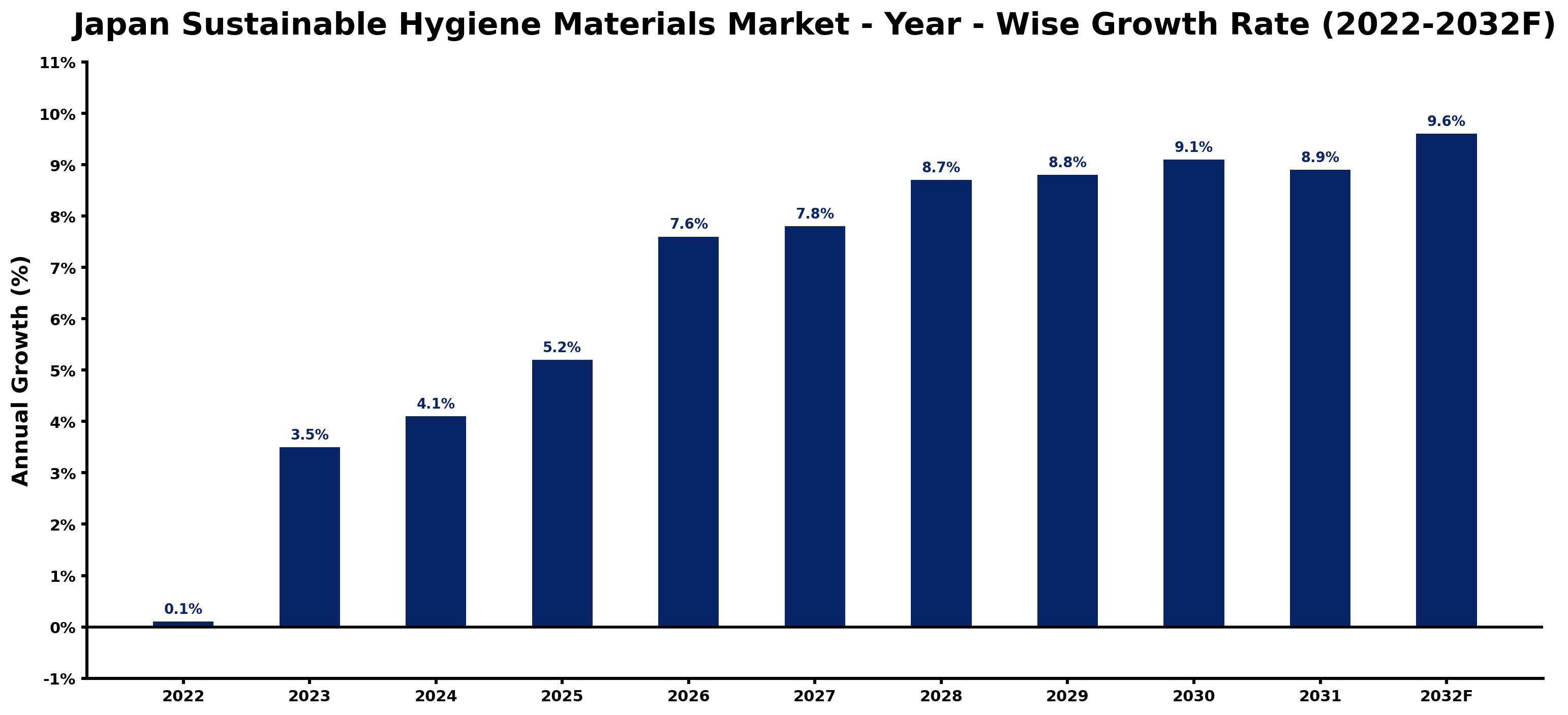
For each year, the table pairs the estimated growth rate with the leading influence on demand, showing how the drivers changed across the period.
| Year | Estimated Annual Growth (%) | Market Rationale |
| 2022 | 0.1 | The market showed minimal growth as consumers began exploring sustainable options. |
| 2023 | 3.5 | Consumer interest in eco-friendly products accelerated, boosting market activity. |
| 2024 | 4.1 | Growth continued as awareness of environmental issues increased among buyers. |
| 2025 | 5.2 | The introduction of new biodegradable products further stimulated demand. |
| 2026 | 7.6 | Investment in sustainable materials is anticipated to increase, broadening product availability. |
| 2027 | 7.8 | Growing consumer preference for eco-friendly hygiene options will drive sales. |
| 2028 | 8.7 | Increased production capacity for sustainable materials is expected to support market expansion. |
| 2029 | 8.8 | Rising environmental consciousness among consumers is likely to sustain growth. |
| 2030 | 9.1 | The government's commitment to reducing plastic waste will stimulate demand. |
| 2031 | 8.9 | Market growth will slow slightly as competition intensifies among suppliers. |
| 2032 | 9.6 | The introduction of new sustainable products will lead to heightened demand. |
Note: Market size estimations and growth projections presented in this report are based on 6Wresearch's proprietary forecasting methodology, utilizing the latest available industry data, government publications, and primary research inputs.
Japan Sustainable Hygiene Materials Market Synopsis
Sustainable Hygiene Materials are eco-friendly products designed to minimise environmental impact, made from biodegradable or recyclable materials. The Japan Sustainable Hygiene Materials Market is growing as consumer awareness and demand for sustainable alternatives rise, particularly in the Baby Care Sector and Women's Health Clinics. Government initiatives, including a target for 50% of hygiene products to be eco-friendly by 2030, drive this growth alongside increasing investments in sustainable materials and production technologies.
Market Dynamics Impact Analysis (2026–2032)
| Factor | Type | Impact | Primary Segment Affected |
| Growing consumer demand for eco-friendly products | Driver | High | Compostable Diapers |
| Increased investment in sustainable production technologies | Driver | High | Reusable Sanitary Pads |
| Expansion of eco-friendly product lines in retail channels | Opportunity | High | Biodegradable Wipes |
| Rising adoption of sustainable materials in healthcare settings | Opportunity | Medium | Recyclable Adult Diapers |
| High costs associated with sustainable material sourcing | Restraint | High | Infant Diapers |
| Limited consumer awareness of available sustainable options | Restraint | Medium | Cloth Pads |
| Competition from traditional hygiene products with lower prices | Challenge | High | Wet Wipes |
| Supply chain disruptions affecting material availability | Challenge | Medium | Incontinence Products |
Evaluation of Drivers in Japan Sustainable Hygiene Materials Market (2026–2032)
The factors lifting demand, and the evidence behind each, are summarised below.
| Drivers | Primary Segment Affected | Why It Matters (Evidence) |
| Rising environmental awareness among consumers | Compostable Diapers | In 2023, the Ministry of the Environment promoted biodegradable products, leading to increased purchases. |
| Investment in sustainable production technologies | Reusable Sanitary Pads | Japan's GX Basic Policy targets JPY 150 trillion in decarbonisation investment, enhancing production capabilities. |
| Growth in online sales channels for eco-friendly products | Biodegradable Wipes | Online Platforms accounted for 40% of sales in 2025, driving demand through convenience. |
| Government initiatives promoting sustainable hygiene products | Recyclable Adult Diapers | The target for 50% of hygiene products to be eco-friendly by 2030 encourages manufacturers. |
| Increased focus on sustainability in the Baby Care Sector | Infant Diapers | The Baby Care Sector is projected to focus on sustainable materials in product development by 2025. |
Purchasing is picking up as consumer awareness of environmental issues grows, with a campaign promoting biodegradable products launched in 2023. Online sales channels accounted for 40% of sales in 2025, improving access to eco-friendly options. The target for 50% of hygiene products to be eco-friendly by 2030 drives manufacturers to innovate. The Baby Care Sector is expected to focus on sustainable materials, increasing demand for eco-friendly infant hygiene products.
Evaluation of Restraints in Japan Sustainable Hygiene Materials Market
The main factors holding the market back are set out below.
| Market Restraint | Primary Segment Affected | Why It Matters (Evidence) |
| High costs associated with sourcing sustainable materials | Infant Diapers | Sustainable materials often come at a premium, limiting affordability for consumers. |
| Limited consumer awareness of sustainable options | Cloth Pads | Many consumers lack knowledge about the benefits of eco-friendly products, reducing market penetration. |
| Competition from traditional hygiene products with lower prices | Wet Wipes | Lower-priced conventional products deter consumers from trying sustainable alternatives, impacting sales. |
| Supply chain disruptions affecting material availability | Incontinence Products | Supply chain issues can delay production and restrict product availability, affecting market supply. |
| Regulatory compliance costs for sustainable materials | Reusable Sanitary Pads | Meeting stringent regulations can increase production costs for manufacturers, impacting pricing. |
Japan Sustainable Hygiene Materials Market Challenges
Producers of sustainable hygiene materials face rising costs from eco-friendly raw materials, which can increase production expenses by up to 20%. Importers encounter supply chain disruptions that may delay product availability by three months, impacting retailers' stock levels. Distributors struggle with a shortage of skilled personnel knowledgeable about sustainable products, limiting effective marketing efforts to consumers. Compliance with JIS standards for sustainability requires substantial investment in testing and certification, costing upwards of JPY 10 million per product line, which can burden smaller manufacturers.
Trends in the Japan Sustainable Hygiene Materials Market
Below are the shifts with the largest effect on the Japan Sustainable Hygiene Materials Market.
- Shift towards Biodegradable Products: A growing trend towards biodegradable hygiene products is apparent, with the Ministry of the Environment promoting such items. In 2023, the campaign resulted in a 25% increase in consumer interest.
- Transition from Conventional to Sustainable Materials: Sustainable hygiene options are increasingly embraced in urban areas, particularly in Tokyo. Specialty stores reported a 30% rise in sales of eco-friendly products over the past year.
- Bamboo Products Gaining Popularity: The use of bamboo in hygiene materials is becoming more widespread, driven by consumer demand for sustainability. In 2023, sales of bamboo-based products increased by 40%.
- Emergence of Reusable Hygiene Products: Reusable sanitary products are becoming more prevalent as consumer preferences evolve. Women's health clinics reported a 35% increase in the adoption of these products in 2023.
Investment Opportunities in the Japan Sustainable Hygiene Materials Market
The openings below show where demand in the Japan Sustainable Hygiene Materials Market is visible and how suppliers can enter.
- Urban Specialty Stores Expanding: Urban areas are increasingly featuring sustainable hygiene options, with a 30% rise in sales. Suppliers can partner with these stores to offer eco-friendly products.
- Investment in Biodegradable Product Development: There is a growing opportunity to invest in the development of biodegradable hygiene products, with a market size increase of 50% by 2030. Collaborating with local manufacturers can facilitate market entry.
- Entry into Online Sales Channels: With online platforms accounting for 40% of sales, there is an opportunity to supply eco-friendly hygiene products through e-commerce. Establishing partnerships with online retailers can improve market reach.
- Focus on Elder Care Facilities: Elder care facilities are increasingly adopting sustainable hygiene products, aligning with environmental goals. Suppliers can target this sector, which is projected to grow by 20% over the next five years.
Government Initiatives in the Japan Sustainable Hygiene Materials Market
The GX Promotion Act (2023) reinforces the legal framework for sustainable practices in hygiene materials, building upon earlier laws like the PRTR Law (1999). This measure requires businesses to report on sustainable practices, ensuring compliance with environmental standards and supporting the growth of eco-friendly products in the market.
Japan's Green Growth Strategy aims for JPY 150 trillion in public and private decarbonisation investment over 10 years, administered by the Ministry of the Environment. This funding supports initiatives for sustainable hygiene products, encouraging manufacturers to innovate and comply with eco-friendly standards.
Future Insight of the Japan Sustainable Hygiene Materials Market
New eco-friendly production facilities will emerge by 2032, aligning with Japan's goal to achieve net zero emissions by 2050. The government’s commitment to reducing plastic waste by 25% by 2030 will drive innovations in hygiene materials. By 2032, 50% of hygiene products are expected to be eco-friendly, reflecting a shift in consumer preferences. Trade shows will showcase advancements in sustainable hygiene technologies, expanding options for buyers and suppliers.
Market Segmentation Analysis
Japan Sustainable Hygiene Materials Market report covers a detailed analysis of the following market segments:
By Sustainable Hygiene Materials – Compostable Diapers Lead, Reusable Sanitary Pads Expected to Grow Fastest
According to Saurav Kr Singh, Senior Research Analyst at 6Wresearch, in 2025, Compostable Diapers led the sustainable hygiene materials split with a 37% share. Compostable Diapers hold the largest share as they are essential for infant hygiene, appealing to eco-conscious parents. The increasing focus on sustainability, particularly in urban areas like Tokyo, contributes to their widespread adoption. Over 2026–2032, Reusable Sanitary Pads are expected to post the fastest growth, at a CAGR of 12.7%. The growth of Reusable Sanitary Pads is propelled by changing consumer preferences, with women's health clinics increasingly stocking these items. This trend reflects a broader shift towards sustainable personal hygiene solutions, indicating strong future growth potential. Suppliers should focus on expanding their eco-friendly product offerings to meet rising consumer demand.
By Product Type – Infant Diapers Lead, Incontinence Products Expected to Grow Fastest
The largest product type category in 2025 was Infant Diapers, at 50% of revenue. Infant Diapers lead the market as the primary hygiene product for babies, with a substantial portion of the population depending on them. The consistent demand from new parents ensures a reliable market presence for these essential items. Incontinence Products are set to record the highest CAGR in this split, 12.1% over 2026–2032. Incontinence Products are experiencing rapid growth due to an ageing population and the increasing need for effective healthcare solutions. This segment's rise aligns with national sustainability initiatives, suggesting promising opportunities ahead. Healthcare buyers should prioritize investments in sustainable incontinence products to align with government sustainability goals.
By Material Type – Bamboo + PLA Leads and Records the Fastest Growth
Bamboo + PLA held 38% of the Japan Sustainable Hygiene Materials Market by material type in 2025. Bamboo + PLA leads the market due to its eco-friendliness, making it a preferred choice among manufacturers of sustainable hygiene materials. The material's biodegradable properties resonate well with consumers looking for environmentally responsible options. Bamboo + PLA is also forecast to expand faster than any other category, at a CAGR of 10.2% over 2026–2032. Bamboo + PLA is also the fastest-growing material type, as its popularity continues to rise alongside the demand for sustainable products. This dual role ensures that the material's market presence will strengthen over time. Suppliers should prioritise the development of products using Bamboo + PLA to capitalise on its growing acceptance.
By Distribution Channel – Online Platforms Lead, Pharmacies Expected to Grow Fastest
Online Platforms accounted for 40% of the market by distribution channel in 2025. Online Platforms are the leading distribution channel, providing consumers with easy access to a wide variety of sustainable hygiene products. The pandemic has accelerated the trend towards e-commerce, making this channel vital for market sales. The quickest growth will come from Pharmacies, forecast to expand at a CAGR of 11.5% between 2026 and 2032. Pharmacies are the fastest-growing distribution channel, reflecting a rising consumer interest in eco-friendly hygiene options within traditional retail settings. This trend indicates a shift in purchasing behaviour towards more accessible sustainable products. Retailers must enhance their online presence and consider partnerships with pharmacies to expand their market reach.
By End User Industry – Baby Care Sector Leads, Women's Health Clinics Expected to Grow Fastest
Baby Care Sector took 38% of end user industry revenue in 2025, more than any other category. The Baby Care Sector is the largest end user, as it includes a substantial portion of the population that requires sustainable hygiene products for infants. This sector's commitment to eco-friendly solutions aligns with wider environmental objectives. Over 2026–2032, Women's Health Clinics are expected to post the fastest growth, at a CAGR of 11.4%. Women's Health Clinics are becoming the fastest-growing end user, driven by an increasing emphasis on sustainable health solutions. This trend underscores the necessity of addressing specific healthcare requirements with eco-friendly products. Manufacturers should focus on women's health clinics to broaden their market presence and promote sustainable practices.
Key Attractiveness of the Report
- 10 Years of Market Numbers
- Historical Data Starting from 2022 to 2025
- Base Year 2025
- Forecast Data until 2032
- Key Performance Indicators Impacting the Market
- Major Upcoming Developments and Projects
Key Highlights of the Report:
- Japan Sustainable Hygiene Materials Market Outlook
- Market Size of Japan Sustainable Hygiene Materials Market, 2025
- Forecast of Japan Sustainable Hygiene Materials Market, 2032
- Historical Data and Forecast of Japan Sustainable Hygiene Materials Revenues & Volume for the Period 2022-2032F
- Japan Sustainable Hygiene Materials Market Trend Evolution
- Japan Sustainable Hygiene Materials Market Drivers and Challenges
- Japan Sustainable Hygiene Materials Price Trends
- Japan Sustainable Hygiene Materials Porter's Five Forces
- Japan Sustainable Hygiene Materials Industry Life Cycle
- Historical Data and Forecast of Japan Sustainable Hygiene Materials Market Revenues & Volume By Sustainable Hygiene Materials for the Period 2022-2032F
- Historical Data and Forecast of Japan Sustainable Hygiene Materials Market Revenues & Volume By Compostable Diapers for the Period 2022-2032F
- Historical Data and Forecast of Japan Sustainable Hygiene Materials Market Revenues & Volume By Reusable Sanitary Pads for the Period 2022-2032F
- Historical Data and Forecast of Japan Sustainable Hygiene Materials Market Revenues & Volume By Biodegradable Wipes for the Period 2022-2032F
- Historical Data and Forecast of Japan Sustainable Hygiene Materials Market Revenues & Volume By Recyclable Adult Diapers for the Period 2022-2032F
- Historical Data and Forecast of Japan Sustainable Hygiene Materials Market Revenues & Volume By Product Type for the Period 2022-2032F
- Historical Data and Forecast of Japan Sustainable Hygiene Materials Market Revenues & Volume By Infant Diapers for the Period 2022-2032F
- Historical Data and Forecast of Japan Sustainable Hygiene Materials Market Revenues & Volume By Cloth Pads for the Period 2022-2032F
- Historical Data and Forecast of Japan Sustainable Hygiene Materials Market Revenues & Volume By Wet Wipes for the Period 2022-2032F
- Historical Data and Forecast of Japan Sustainable Hygiene Materials Market Revenues & Volume By Incontinence Products for the Period 2022-2032F
- Historical Data and Forecast of Japan Sustainable Hygiene Materials Market Revenues & Volume By Material Type for the Period 2022-2032F
- Historical Data and Forecast of Japan Sustainable Hygiene Materials Market Revenues & Volume By Bamboo + PLA for the Period 2022-2032F
- Historical Data and Forecast of Japan Sustainable Hygiene Materials Market Revenues & Volume By Organic Cotton for the Period 2022-2032F
- Historical Data and Forecast of Japan Sustainable Hygiene Materials Market Revenues & Volume By Wood Pulp for the Period 2022-2032F
- Historical Data and Forecast of Japan Sustainable Hygiene Materials Market Revenues & Volume By Recycled Material for the Period 2022-2032F
- Historical Data and Forecast of Japan Sustainable Hygiene Materials Market Revenues & Volume By Distribution Channel for the Period 2022-2032F
- Historical Data and Forecast of Japan Sustainable Hygiene Materials Market Revenues & Volume By Online Platforms for the Period 2022-2032F
- Historical Data and Forecast of Japan Sustainable Hygiene Materials Market Revenues & Volume By Direct Sales for the Period 2022-2032F
- Historical Data and Forecast of Japan Sustainable Hygiene Materials Market Revenues & Volume By Pharmacies for the Period 2022-2032F
- Historical Data and Forecast of Japan Sustainable Hygiene Materials Market Revenues & Volume By Specialty Stores for the Period 2022-2032F
- Historical Data and Forecast of Japan Sustainable Hygiene Materials Market Revenues & Volume By End User Industry for the Period 2022-2032F
- Historical Data and Forecast of Japan Sustainable Hygiene Materials Market Revenues & Volume By Baby Care Sector for the Period 2022-2032F
- Historical Data and Forecast of Japan Sustainable Hygiene Materials Market Revenues & Volume By Women's Health Clinics for the Period 2022-2032F
- Historical Data and Forecast of Japan Sustainable Hygiene Materials Market Revenues & Volume By Hospitals & Homes for the Period 2022-2032F
- Historical Data and Forecast of Japan Sustainable Hygiene Materials Market Revenues & Volume By Elder Care Facilities for the Period 2022-2032F
- Japan Sustainable Hygiene Materials Import Export Trade Statistics
- Market Opportunity Assessment By Sustainable Hygiene Materials
- Market Opportunity Assessment By Product Type
- Market Opportunity Assessment By Material Type
- Market Opportunity Assessment By Distribution Channel
- Market Opportunity Assessment By End User Industry
- Japan Sustainable Hygiene Materials Top Companies Market Share
- Japan Sustainable Hygiene Materials Competitive Benchmarking By Technical and Operational Parameters
- Japan Sustainable Hygiene Materials Company Profiles
- Japan Sustainable Hygiene Materials Key Strategic Recommendations
Market Covered
The following segment groups are covered in the report.
By Sustainable Hygiene Materials
- Compostable Diapers
- Reusable Sanitary Pads
- Biodegradable Wipes
- Recyclable Adult Diapers
By Product Type
- Infant Diapers
- Cloth Pads
- Wet Wipes
- Incontinence Products
By Material Type
- Bamboo + PLA
- Organic Cotton
- Wood Pulp
- Recycled Material
By Distribution Channel
- Online Platforms
- Direct Sales
- Pharmacies
- Specialty Stores
By End User Industry
- Baby Care Sector
- Women's Health Clinics
- Hospitals & Homes
- Elder Care Facilities































