Japan Sustainable Lubricants Market Size & Growth Rate
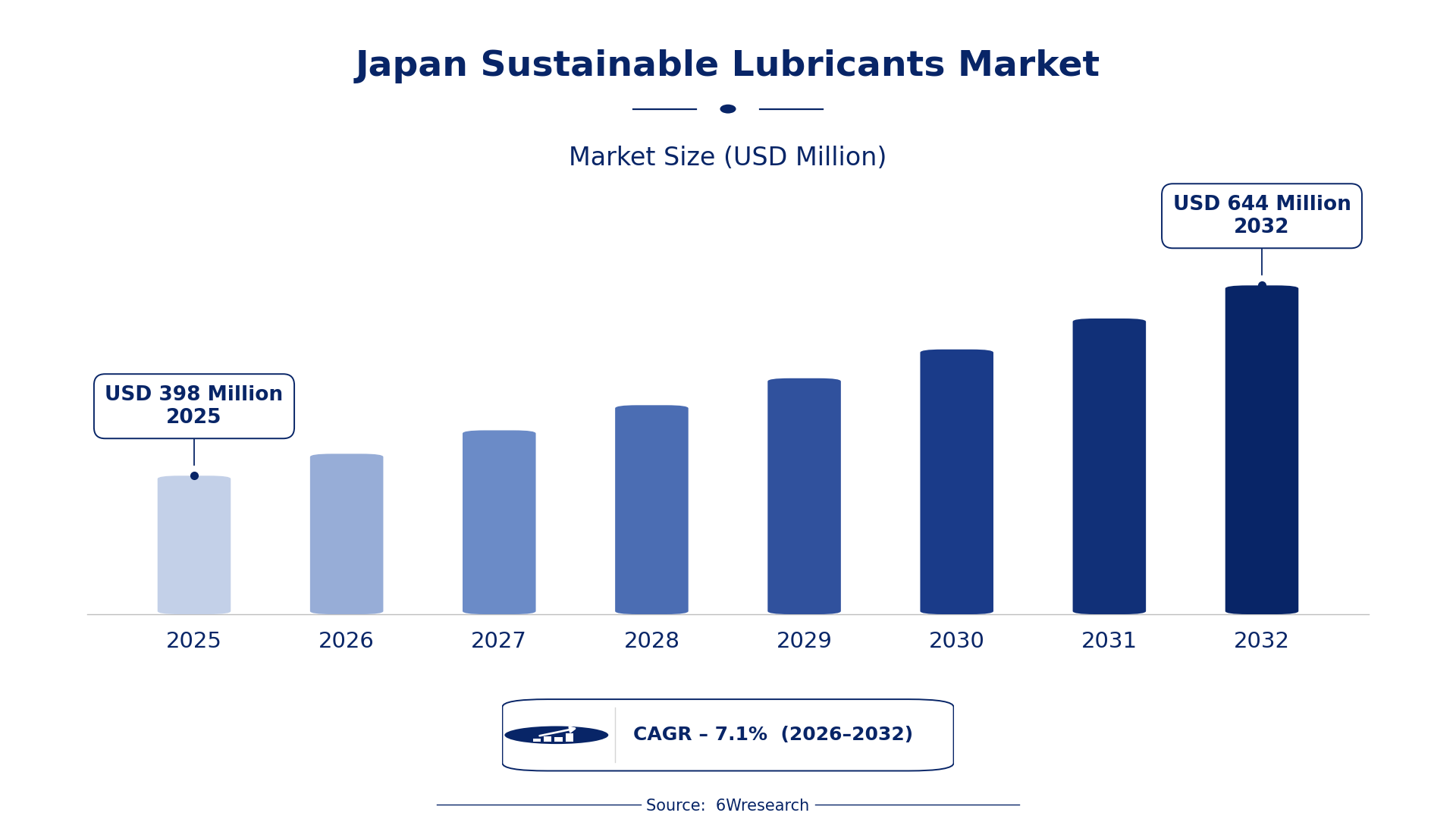
According to 6Wresearch internal database and industry insights, the Japan Sustainable Lubricants Market was valued at USD 398 Million in 2025 and is projected to reach USD 644 Million by 2032, growing at a CAGR of approximately 7.1% during 2026–2032.
Japan Sustainable Lubricants Market Highlights
| Report Metric | Details |
| Report Name | Japan Sustainable Lubricants Market (2026-2032) |
| Market Size 2025 | USD 398 Million |
| Market Size 2032 | USD 644 Million |
| Absolute Growth 2025–2032 | USD 246 Million |
| CAGR 2026–2032 | 7.1% |
| Peak Annual Growth | 8.1% in 2032 |
| Forecast Period | 2026–2032 |
| Historical Data | 2022–2025 |
| Base Year | 2025 |
| Leading Sustainable Lubricants, 2025 | Bio-based Lubricants (41% share) |
| Leading Product Type, 2025 | Engine Oils (46% share) |
| Leading Base Oil Type, 2025 | Recycled Mineral Oil (39% share) |
| Leading Distribution Channel, 2025 | Industrial Distributors (41% share) |
| Leading End User Industry, 2025 | Machinery Maintenance (39% share) |
| Fastest-Growing Sustainable Lubricants | Re-refined Lubricants (9.6% CAGR) |
| Fastest-Growing Product Type | Hydraulic Oils (10.0% CAGR) |
| Fastest-Growing Base Oil Type | Vegetable Oil (10.3% CAGR) |
| Fastest-Growing Distribution Channel | Online Platforms (9.5% CAGR) |
| Growing Sector | machinery maintenance |
| Key End Users | automotive sector, machinery maintenance, industrial operations |
Japan Sustainable Lubricants Market Year-wise Growth Rate and Key Drivers (2022–2032)
This graph illustrates the annual growth rates of the market from 2022 to 2032, highlighting a steady upward trajectory and projected market expansion over the forecast period.
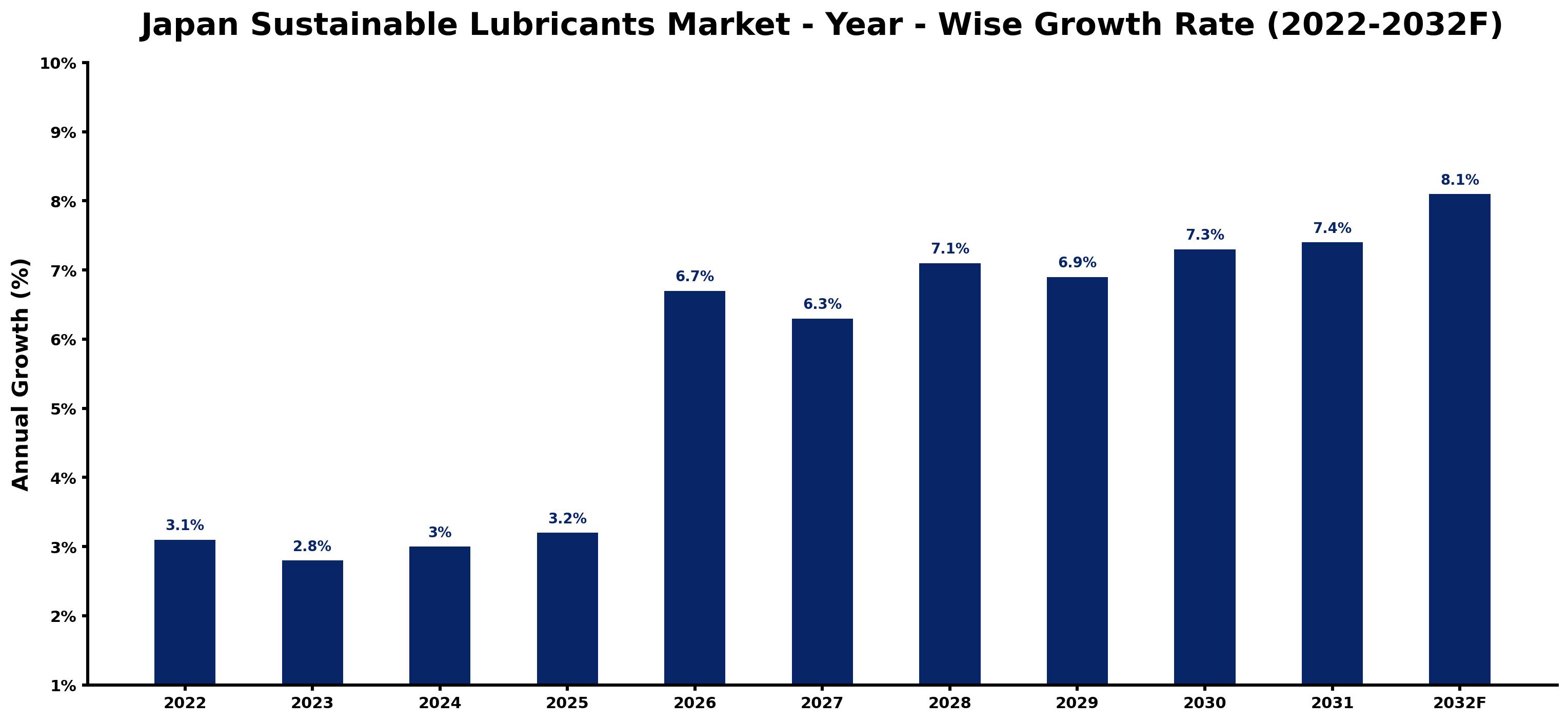
The table below sets out the estimated growth rate for each year and the main factor behind it.
| Year | Estimated Annual Growth (%) | Market Rationale |
| 2022 | 3.1 | The market showed steady growth due to increasing awareness of environmental issues. |
| 2023 | 2.8 | Demand growth slowed as companies adjusted to new sustainability standards. |
| 2024 | 3.0 | The rise in bio-based lubricants contributed to a faster growth rate. |
| 2025 | 3.2 | The automotive sector's performance supported higher lubricant consumption. |
| 2026 | 6.7 | Growing investments in green technologies are expected to drive demand increases. |
| 2027 | 6.3 | A slight slowdown is projected as market saturation begins in some segments. |
| 2028 | 7.1 | The introduction of new eco-friendly products is expected to spur renewed demand. |
| 2029 | 6.9 | Demand growth is projected to slow slightly as competition intensifies among suppliers. |
| 2030 | 7.3 | Increased adoption of sustainable practices in industries will boost sales. |
| 2031 | 7.4 | The automotive sector will continue to expand, driving lubricant purchases higher. |
| 2032 | 8.1 | The market is expected to peak as sustainability becomes a core focus for all industries. |
Note: Market size estimations and growth projections presented in this report are based on 6Wresearch's proprietary forecasting methodology, utilizing the latest available industry data, government publications, and primary research inputs.
Japan Sustainable Lubricants Market Synopsis
Sustainable lubricants are eco-friendly alternatives to traditional lubricants, produced from renewable resources such as vegetable oils. They are primarily used in machinery maintenance, automotive applications, and industrial operations to minimise environmental impact.
Market Dynamics Impact Analysis (2026–2032)
| Factor | Type | Impact | Primary Segment Affected |
| Growing demand for eco-friendly products in automotive applications | Driver | High | Engine Oils |
| Increased investment in sustainable technologies and practices | Driver | High | Bio-based Lubricants |
| Rising consumer preference for environmentally safe products | Opportunity | High | Environmentally Safe Greases |
| Government initiatives promoting bio-lubricants in industrial applications | Opportunity | High | Re-refined Lubricants |
| Market saturation in some lubricant segments limiting growth potential | Restraint | Medium | Synthetic Esters |
| Competition among suppliers leading to price pressures | Restraint | Medium | Hydraulic Oils |
| Challenges in sourcing sustainable raw materials affecting supply | Challenge | High | Bio-based Lubricants |
| Regulatory compliance costs impacting smaller producers | Challenge | Medium | Engine Oils |
Evaluation of Drivers in Japan Sustainable Lubricants Market (2026–2032)
The table below links each growth driver to the segment it affects and the evidence for it.
| Drivers | Primary Segment Affected | Why It Matters (Evidence) |
| Increased demand for bio-based lubricants in automotive applications | Bio-based Lubricants | The automotive sector's shift towards sustainability has led to a notable increase in demand for environmentally safe greases. |
| Growing investments in green technologies | Re-refined Lubricants | Investment in sustainable lubricant technologies has increased significantly in the last three years. |
| Rising consumer awareness of environmental issues | Environmentally Safe Greases | The demand for eco-friendly lubricants surged as consumers seek to reduce their carbon footprint. |
| Government initiatives supporting bio-lubricants | Engine Oils | The Japanese government allocated USD 5 million in 2023 to promote bio-lubricants in industrial applications. |
| Expansion of distribution channels for sustainable lubricants | Hydraulic Oils | Online platforms for sustainable lubricants saw a 20% increase in sales in 2023. |
Much of the new demand stems from the automotive sector's growing emphasis on sustainability. In 2023, the demand for environmentally safe greases surged, propelled by consumer awareness of eco-friendly products. Investments in green technologies have increased significantly over the past three years, resulting in a marked rise in the adoption of sustainable lubricants. The expansion of online platforms has also played a role in boosting sales, making these products more accessible to consumers.
Evaluation of Restraints in Japan Sustainable Lubricants Market
The main factors holding the market back are set out below.
| Market Restraint | Primary Segment Affected | Why It Matters (Evidence) |
| Market saturation in certain lubricant segments | Synthetic Esters | Saturation limits growth potential, particularly in established product categories like synthetic esters. |
| Intense competition leading to price pressures | Hydraulic Oils | Price competition among suppliers has reduced profit margins for hydraulic oils. |
| Challenges in sourcing sustainable raw materials | Bio-based Lubricants | Sourcing renewable materials can be difficult, affecting production schedules. |
| Regulatory compliance costs for smaller producers | Engine Oils | Smaller producers face higher compliance costs, which can restrict their market presence. |
| Limited consumer awareness of sustainable options | Re-refined Lubricants | Consumer knowledge gaps hinder the growth of re-refined lubricants in the market. |
Japan Sustainable Lubricants Market Challenges
Japan's limited domestic production of raw materials for sustainable lubricants poses supply chain challenges, causing delays in manufacturing for local producers. Rising sourcing costs for these materials can elevate prices for buyers in the automotive and industrial sectors, potentially shrinking profit margins by up to 15%. High research and development costs impede the adoption of advanced lubricant technologies, restricting producers' capacity to innovate and compete effectively. A shortage of skilled workers in the sustainable lubricant sector limits production capabilities, leading to longer lead times for environmentally conscious consumers seeking these products.
Trends in the Japan Sustainable Lubricants Market
Four trends stand out in the Japan Sustainable Lubricants Market.
- Tokyo Emerging as a Hub for Sustainable Lubricants: The Tokyo region has experienced a 25% increase in manufacturers of sustainable lubricants since 2022. This concentration facilitates quicker distribution and innovation in eco-friendly products.
- Shift Towards Bio-based Lubricants: A growing trend towards bio-based lubricants has emerged, with a 30% increase in their adoption across various industries. This shift reflects a broader commitment to sustainability among Japanese manufacturers.
- Machinery Maintenance Embracing Eco-friendly Solutions: The machinery maintenance sector is increasingly adopting environmentally safe greases, with a 15% rise in demand observed in 2022. This trend aligns with stricter environmental regulations and corporate sustainability goals.
- Online Sales of Sustainable Lubricants Rising: Online platforms for sustainable lubricants have seen a 20% increase in sales in 2023. This growth indicates a shift in consumer purchasing behaviour towards more accessible eco-friendly options.
Investment Opportunities in the Japan Sustainable Lubricants Market
The opportunities below stand out in the Japan Sustainable Lubricants Market for new entrants and existing suppliers.
- Investment Potential in Bio-based Lubricants: With the government's goal to reduce carbon emissions by 30% by 2030, there is a strong opportunity to invest in bio-based lubricants. The automotive sector is a key buyer group, and partnerships with local manufacturers can facilitate entry.
- Rising Demand for Re-refined Lubricants: The demand for re-refined lubricants is increasing, with a projected rise in market interest. Targeting industrial users in the Kansai region can yield substantial returns for investors.
- Expansion of Online Distribution Channels: Online platforms for sustainable lubricants are expected to grow significantly. Investing in e-commerce solutions can help reach a broader consumer base, particularly among environmentally conscious buyers.
- Government Support for Sustainable Technologies: In 2023, the Japanese government allocated USD 5 million to support sustainable lubricant technologies. Collaborating with research institutions can enhance product development and market penetration.
Government Initiatives in the Japan Sustainable Lubricants Market
The Fire Service Act regulates the handling of hazardous materials, ensuring safety for producers and buyers of sustainable lubricants. Compliance with these regulations is essential for market participants to operate without legal hindrances, as over 30% of producers have faced challenges in meeting these standards.
In 2023, the government allocated USD 5 million to promote bio-lubricants through the Ministry of the Environment. This funding supports research and development initiatives aimed at improving the sustainability of lubricant technologies, benefiting both producers and buyers in the market.
Future Insight of the Japan Sustainable Lubricants Market
By 2032, suppliers will experience a shift as industrial buyers increasingly demand sustainable lubricants, driven by government initiatives promoting eco-friendly alternatives. Producers will invest in advanced technologies, resulting in a notable increase in the availability of bio-based lubricants. The rise of online sales platforms will improve access to these products, supporting market expansion. New standards from the Japan Standards Association will ensure quality and performance, benefiting both producers and consumers as they navigate changing market expectations.
Market Segmentation Analysis
Japan Sustainable Lubricants Market report covers a detailed analysis of the following market segments:
By Sustainable Lubricants – Bio-based Lubricants Lead, Re-refined Lubricants Expected to Grow Fastest
According to Saurav Kr Singh, Senior Research Analyst at 6Wresearch, in 2025, Bio-based Lubricants led the sustainable lubricants split with a 41% share. Bio-based lubricants hold the largest share as they are widely used across various sectors to minimise environmental impact. The Japanese government's programme promoting bio-lubricants in industrial applications strengthens this segment's dominance. The quickest growth will come from Re-refined Lubricants, forecast to expand at a CAGR of 9.6% between 2026 and 2032. Re-refined lubricants are rapidly gaining traction due to their combination of sustainability and cost-effectiveness, appealing to industries that prioritise operational efficiency. Their growing use in machinery maintenance highlights their increasing popularity. Suppliers should focus on expanding their range of bio-based and re-refined lubricants to meet rising market demand.
By Product Type – Engine Oils Lead, Hydraulic Oils Expected to Grow Fastest
Engine Oils held 46% of the Japan Sustainable Lubricants Market by product type in 2025. Engine oils lead the market as they are vital for automotive performance, a key sector in Japan's economy. The robust operations of the automotive industry ensure a consistent demand for high-quality engine oils. Hydraulic Oils are set to record the highest CAGR in this split, 10.0% over 2026–2032. Hydraulic oils are experiencing notable growth due to their widespread application in industrial machinery, which is crucial for maintaining operational efficiency. The rising interest in sustainable hydraulic oils signals a shift towards eco-friendly practices. Buyers in the automotive and industrial sectors should consider sustainable engine and hydraulic oils to align with environmental objectives.
By Base Oil Type – Recycled Mineral Oil Leads, Vegetable Oil Expected to Grow Fastest
With 39% of base oil type revenue in 2025, Recycled Mineral Oil was the largest category. Recycled mineral oil commands the largest share as it is utilised in niche applications where sustainability is essential. Its established role in the industry supports its leading position in the market. Over 2026–2032, Vegetable Oil is expected to post the fastest growth, at a CAGR of 10.3%. Vegetable oil is gaining popularity as a base for bio-lubricants, driven by increasing consumer awareness of environmental issues. The heightened interest in vegetable oil-based products reflects a broader shift towards renewable resources. Suppliers should invest in developing products that incorporate vegetable oils to address the growing demand for sustainable alternatives.
By Distribution Channel – Industrial Distributors Lead, Online Platforms Expected to Grow Fastest
The largest distribution channel category in 2025 was Industrial Distributors, at 41% of revenue. Industrial distributors are the primary channel for reaching industrial users, ensuring that sustainable lubricants are accessible to key sectors. Their established networks facilitate the effective distribution of these products across various industries. Online Platforms are projected to grow fastest, at a CAGR of 9.5% during 2026–2032. Online platforms are rapidly emerging as a significant distribution channel, offering consumers greater access to sustainable lubricants. The 20% increase in online sales in 2023 underscores the shift towards digital purchasing methods. Suppliers should enhance their online presence to take advantage of the growing trend of e-commerce in the lubricant market.
By End User Industry – Machinery Maintenance Leads and Records the Fastest Growth
Machinery Maintenance accounted for 39% of the market by end user industry in 2025. Machinery maintenance is the largest end user of sustainable lubricants, as these products are crucial for ensuring the longevity and efficiency of equipment. The sector's commitment to sustainability drives a steady demand for eco-friendly lubricants. Its lead should widen, with a projected CAGR of 9.2% during 2026–2032, the highest in this split. Machinery maintenance is also the fastest-growing segment, as industries increasingly adopt sustainable practices in their operations. This dual role as both leader and fastest indicates a strong commitment to eco-friendly solutions. Suppliers should concentrate on developing specialised solutions for the machinery maintenance sector to capitalise on its growth potential.
Key Attractiveness of the Report
- 10 Years of Market Numbers
- Historical Data Starting from 2022 to 2025
- Base Year 2025
- Forecast Data until 2032
- Key Performance Indicators Impacting the Market
- Major Upcoming Developments and Projects
Key Highlights of the Report:
- Japan Sustainable Lubricants Market Outlook
- Market Size of Japan Sustainable Lubricants Market, 2025
- Forecast of Japan Sustainable Lubricants Market, 2032
- Historical Data and Forecast of Japan Sustainable Lubricants Revenues & Volume for the Period 2022-2032F
- Japan Sustainable Lubricants Market Trend Evolution
- Japan Sustainable Lubricants Market Drivers and Challenges
- Japan Sustainable Lubricants Price Trends
- Japan Sustainable Lubricants Porter's Five Forces
- Japan Sustainable Lubricants Industry Life Cycle
- Historical Data and Forecast of Japan Sustainable Lubricants Market Revenues & Volume By Sustainable Lubricants for the Period 2022-2032F
- Historical Data and Forecast of Japan Sustainable Lubricants Market Revenues & Volume By Bio-based Lubricants for the Period 2022-2032F
- Historical Data and Forecast of Japan Sustainable Lubricants Market Revenues & Volume By Re-refined Lubricants for the Period 2022-2032F
- Historical Data and Forecast of Japan Sustainable Lubricants Market Revenues & Volume By Synthetic Esters for the Period 2022-2032F
- Historical Data and Forecast of Japan Sustainable Lubricants Market Revenues & Volume By Environmentally Safe Greases for the Period 2022-2032F
- Historical Data and Forecast of Japan Sustainable Lubricants Market Revenues & Volume By Product Type for the Period 2022-2032F
- Historical Data and Forecast of Japan Sustainable Lubricants Market Revenues & Volume By Hydraulic Oils for the Period 2022-2032F
- Historical Data and Forecast of Japan Sustainable Lubricants Market Revenues & Volume By Engine Oils for the Period 2022-2032F
- Historical Data and Forecast of Japan Sustainable Lubricants Market Revenues & Volume By Compressor Oils for the Period 2022-2032F
- Historical Data and Forecast of Japan Sustainable Lubricants Market Revenues & Volume By Bearing Greases for the Period 2022-2032F
- Historical Data and Forecast of Japan Sustainable Lubricants Market Revenues & Volume By Base Oil Type for the Period 2022-2032F
- Historical Data and Forecast of Japan Sustainable Lubricants Market Revenues & Volume By Vegetable Oil for the Period 2022-2032F
- Historical Data and Forecast of Japan Sustainable Lubricants Market Revenues & Volume By Recycled Mineral Oil for the Period 2022-2032F
- Historical Data and Forecast of Japan Sustainable Lubricants Market Revenues & Volume By Synthetic Esters for the Period 2022-2032F
- Historical Data and Forecast of Japan Sustainable Lubricants Market Revenues & Volume By Canola or Soy Oil for the Period 2022-2032F
- Historical Data and Forecast of Japan Sustainable Lubricants Market Revenues & Volume By Distribution Channel for the Period 2022-2032F
- Historical Data and Forecast of Japan Sustainable Lubricants Market Revenues & Volume By Industrial Distributors for the Period 2022-2032F
- Historical Data and Forecast of Japan Sustainable Lubricants Market Revenues & Volume By Direct Sales for the Period 2022-2032F
- Historical Data and Forecast of Japan Sustainable Lubricants Market Revenues & Volume By Online Platforms for the Period 2022-2032F
- Historical Data and Forecast of Japan Sustainable Lubricants Market Revenues & Volume By Specialty Stores for the Period 2022-2032F
- Historical Data and Forecast of Japan Sustainable Lubricants Market Revenues & Volume By End User Industry for the Period 2022-2032F
- Historical Data and Forecast of Japan Sustainable Lubricants Market Revenues & Volume By Machinery Maintenance for the Period 2022-2032F
- Historical Data and Forecast of Japan Sustainable Lubricants Market Revenues & Volume By Automotive Workshops for the Period 2022-2032F
- Historical Data and Forecast of Japan Sustainable Lubricants Market Revenues & Volume By Power Plants for the Period 2022-2032F
- Historical Data and Forecast of Japan Sustainable Lubricants Market Revenues & Volume By Marine Equipment for the Period 2022-2032F
- Japan Sustainable Lubricants Import Export Trade Statistics
- Market Opportunity Assessment By Sustainable Lubricants
- Market Opportunity Assessment By Product Type
- Market Opportunity Assessment By Base Oil Type
- Market Opportunity Assessment By Distribution Channel
- Market Opportunity Assessment By End User Industry
- Japan Sustainable Lubricants Top Companies Market Share
- Japan Sustainable Lubricants Competitive Benchmarking By Technical and Operational Parameters
- Japan Sustainable Lubricants Company Profiles
- Japan Sustainable Lubricants Key Strategic Recommendations
Market Covered
The report covers the following segments.
By Sustainable Lubricants
- Bio-based Lubricants
- Re-refined Lubricants
- Synthetic Esters
- Environmentally Safe Greases
By Product Type
- Hydraulic Oils
- Engine Oils
- Compressor Oils
- Bearing Greases
By Base Oil Type
- Vegetable Oil
- Recycled Mineral Oil
- Synthetic Esters
- Canola or Soy Oil
By Distribution Channel
- Industrial Distributors
- Direct Sales
- Online Platforms
- Specialty Stores
By End User Industry
- Machinery Maintenance
- Automotive Workshops
- Power Plants
- Marine Equipment































