Japan Sustainable Materials Market Size & Growth Rate
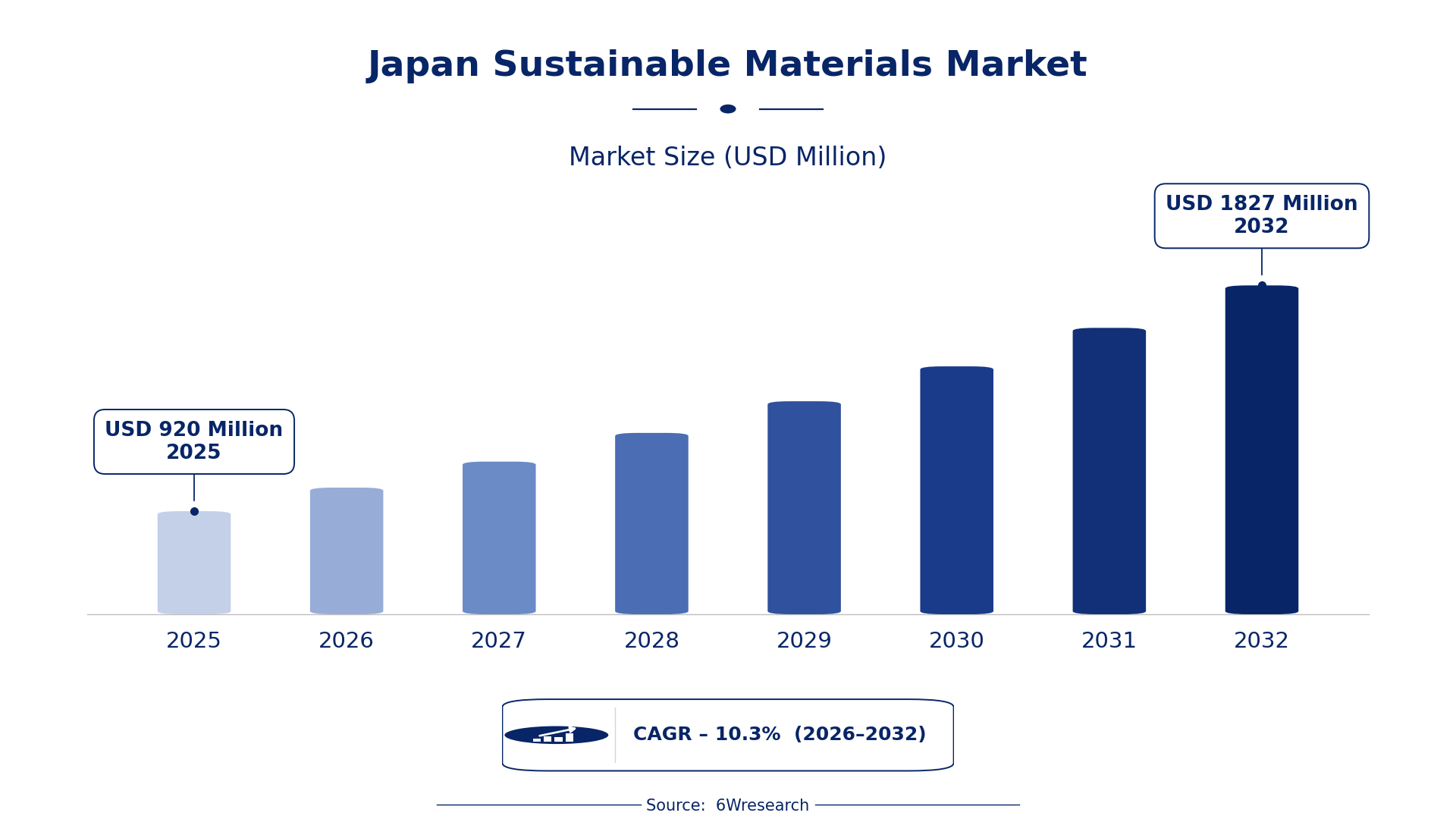
According to 6Wresearch internal database and industry insights, the Japan Sustainable Materials Market was valued at USD 920 Million in 2025 and is projected to reach USD 1,827 Million by 2032, growing at a CAGR of approximately 10.3% during 2026–2032.
Japan Sustainable Materials Market Highlights
| Report Metric | Details |
| Report Name | Japan Sustainable Materials Market (2026-2032) |
| Market Size 2025 | USD 920 Million |
| Market Size 2032 | USD 1,827 Million |
| Absolute Growth 2025–2032 | USD 907 Million |
| CAGR 2026–2032 | 10.3% |
| Peak Annual Growth | 13.4% in 2026 |
| Forecast Period | 2026–2032 |
| Historical Data | 2022–2025 |
| Base Year | 2025 |
| Leading Sustainable Materials, 2025 | Bioplastics (37% share) |
| Leading Product Type, 2025 | Pellets (54% share) |
| Leading Material Type, 2025 | PLA (44% share) |
| Leading Distribution Channel, 2025 | Industrial Distributors (42% share) |
| Leading End User Industry, 2025 | Packaging Manufacturers (35% share) |
| Fastest-Growing Sustainable Materials | Green Concrete (14.6% CAGR) |
| Fastest-Growing Product Type | Construction Material (14.4% CAGR) |
| Fastest-Growing Material Type | PBS (15.1% CAGR) |
| Fastest-Growing Distribution Channel | Direct Sales (13.2% CAGR) |
| Fastest-Growing End User Industry | Infrastructure Projects (13.0% CAGR) |
| Growing Sector | Packaging |
| Key End Users | Packaging Manufacturers, Construction Companies, Automotive Manufacturers, Infrastructure Projects |
Japan Sustainable Materials Market Year-wise Growth Rate and Key Drivers (2022–2032)
This graph illustrates the annual growth rates of the market from 2022 to 2032, highlighting a steady upward trajectory and projected market expansion over the forecast period.
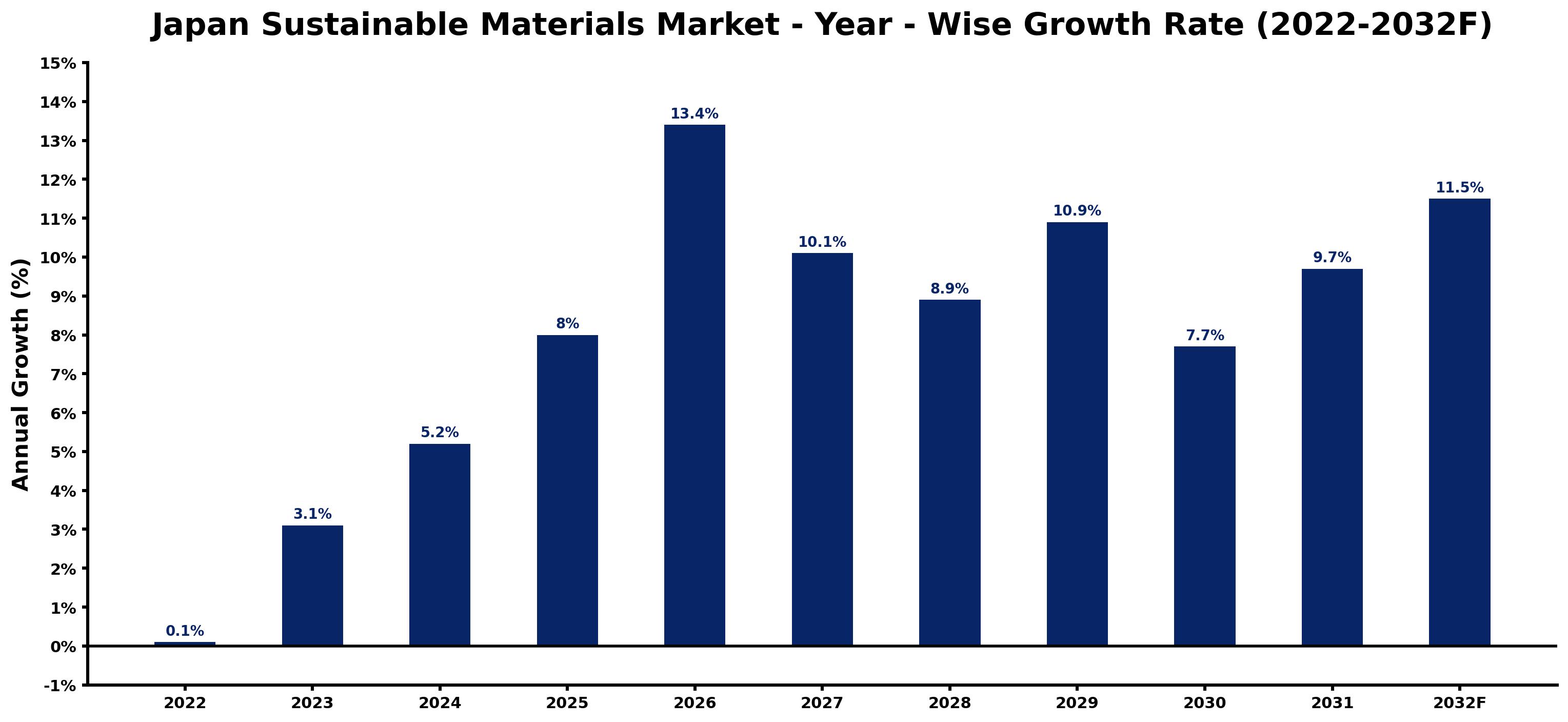
The yearly estimates that follow link every growth rate to its principal driver, so readers can see why the pace changed in each period.
| Year | Estimated Annual Growth (%) | Market Rationale |
| 2022 | 0.1 | The market experienced minimal growth, reflecting steady demand from established sectors. |
| 2023 | 3.1 | Growth accelerated due to increased interest in sustainable packaging solutions. |
| 2024 | 5.2 | The rise in construction projects contributed to a stronger market performance. |
| 2025 | 8.0 | Demand surged as more companies adopted sustainable materials in operations. |
| 2026 | 13.4 | The peak growth year was driven by investments in green technologies. |
| 2027 | 10.1 | Growth is expected to slow as market maturation begins to take effect. |
| 2028 | 8.9 | A further slowdown is projected as competition intensifies among suppliers. |
| 2029 | 10.9 | Demand is expected to increase again, driven by expanding infrastructure projects. |
| 2030 | 7.7 | Growth will decelerate as market saturation in some segments becomes apparent. |
| 2031 | 9.7 | A resurgence in demand is anticipated as new applications emerge. |
| 2032 | 11.5 | The market will continue to grow, supported by ongoing sustainability initiatives. |
Note: Market size estimations and growth projections presented in this report are based on 6Wresearch's proprietary forecasting methodology, utilizing the latest available industry data, government publications, and primary research inputs.
Japan Sustainable Materials Market Synopsis
Sustainable materials are products designed to minimise environmental impact and promote resource efficiency, made from renewable resources or recycled materials. The Japan Sustainable Materials Market is expanding, driven by demand from packaging and construction sectors. The government aims for a 46% reduction in greenhouse gas emissions by 2030, stimulating investments in sustainable solutions. The bioplastics market is projected to reach 100,000 tons by 2025, reflecting growing opportunities for suppliers in various industries, particularly in bioplastics and green concrete applications.
Market Dynamics Impact Analysis (2026–2032)
| Factor | Type | Impact | Primary Segment Affected |
| Growing demand for eco-friendly packaging solutions | Driver | High | Bioplastics |
| Increased investment in sustainable construction projects | Driver | High | Green Concrete |
| Rising need for recycled materials in construction | Opportunity | High | Recycled Metals |
| Emerging applications for natural fibers in automotive interiors | Opportunity | Medium | Natural Fibers |
| High costs associated with sustainable material production | Restraint | High | Pellets |
| Limited awareness of sustainable materials among consumers | Restraint | Medium | PLA |
| Challenges in sourcing quality recycled materials | Challenge | High | Recycled Aggregates |
| Competition from traditional materials remains strong | Challenge | Medium | Construction Material |
Evaluation of Drivers in Japan Sustainable Materials Market (2026–2032)
Demand rests on the following drivers, each shown with the segment it touches most.
| Drivers | Primary Segment Affected | Why It Matters (Evidence) |
| Increased consumer preference for eco-friendly packaging | Bioplastics | Japan's population of approximately 125 million drives demand for sustainable packaging solutions, leading to a projected bioplastics market of 100,000 tons by 2025. |
| Government incentives for green construction practices | Green Concrete | Support for green concrete initiatives boosts demand for sustainable construction materials, reflecting a commitment to environmental standards. |
| Growing urbanisation and infrastructure development | Recycled Metals | Infrastructure projects in urban areas create a strong demand for recycled metals, essential for Japan's circular economy. |
| Rising consumer awareness of environmental issues | PLA | The increasing preference for biodegradable packaging among consumers drives demand for PLA products in various sectors. |
| Technological advancements in material recycling | Construction Material | New recycling technologies improve the quality of recycled aggregates, making them more attractive for construction applications. |
Volumes grow on the back of rising consumer awareness of sustainability, with Japan's population driving demand for eco-friendly packaging solutions. The bioplastics market is projected to reach 100,000 tons by 2025, reflecting a shift towards sustainable materials. Urbanisation and infrastructure development create a strong need for recycled metals, essential for Japan's circular economy. New recycling technologies improve the quality of recycled aggregates, making them more appealing for construction projects. The increasing preference for biodegradable packaging fuels demand for PLA products in various sectors.
Evaluation of Restraints in Japan Sustainable Materials Market
Below are the constraints most often cited by buyers and suppliers, with the segment each affects.
| Market Restraint | Primary Segment Affected | Why It Matters (Evidence) |
| High production costs of sustainable materials | Pellets | The cost of sourcing renewable resources and implementing eco-friendly processes raises production costs, affecting pricing strategies. |
| Limited consumer awareness of sustainable options | PLA | Many consumers lack awareness of the benefits of sustainable materials, hindering market growth. |
| Challenges in maintaining quality standards for recycled materials | Recycled Aggregates | Inconsistent quality of recycled materials can deter construction companies from adopting them. |
| Competition from cheaper traditional materials | Construction Material | Lower costs of conventional materials make it difficult for sustainable options to gain market share. |
| Regulatory hurdles in material certification | Green Concrete | Complex certification processes for sustainable materials can delay market entry for new products. |
Japan Sustainable Materials Market Challenges
Inconsistent access to recycled materials raises costs for construction producers, resulting in project delays that can extend timelines by up to six months. A lack of skilled workers in sustainable material processing prevents suppliers from meeting rising demand, causing an estimated 20% loss in potential contracts. Intense competition from imported sustainable products pressures local manufacturers, forcing them to lower prices and compromise on quality, impacting profit margins by approximately 15%. Buyers struggle to secure eco-friendly packaging due to fluctuating availability, which can disrupt supply chains and increase operational costs by 10%.
Trends in the Japan Sustainable Materials Market
The shifts below are changing how Japan Sustainable Materials Market products are bought and supplied.
- Shift from Traditional to Sustainable Packaging: Packaging manufacturers have increasingly adopted sustainable materials, with a 20% rise in eco-friendly packaging solutions since 2023, aligning with consumer preferences for environmentally responsible products.
- Transition to Green Construction Practices: The push for sustainable construction has spurred a shift towards green materials, with a 30% increase in projects using these solutions, reflecting a commitment to environmental standards.
- Emergence of Natural Fibers in Automotive Interiors: In 2023, the automotive sector began integrating natural fibers like hemp into interiors, marking a shift in material usage towards sustainability, with a focus on eco-friendly designs.
- Growth in Online Sales Channels for Sustainable Materials: Online platforms for sustainable materials have seen a 20% increase in sales channels, reflecting changing buyer behaviours and preferences for convenient purchasing options.
Investment Opportunities in the Japan Sustainable Materials Market
The openings below show where demand in the Japan Sustainable Materials Market is visible and how suppliers can enter.
- Partner with Local Suppliers: With Japan targeting a 46% reduction in greenhouse gas emissions by 2030, there is a strong opportunity for partnerships in sustainable materials, particularly in urban areas.
- Supply Recycled Materials for Construction: The increasing demand for recycled materials in construction presents a significant opportunity for suppliers, especially in urban regions with ongoing infrastructure projects.
- Invest in Green Concrete Solutions: The growing emphasis on sustainable construction practices creates a demand for innovative green concrete solutions, particularly in metropolitan areas, which are expanding rapidly.
- Utilise Direct Sales Channels: The rise of direct sales channels offers an opportunity for suppliers to reach packaging manufacturers more effectively, capitalising on the growing demand for sustainable products.
Government Initiatives in the Japan Sustainable Materials Market
Producers of sustainable materials in Japan are influenced by various laws and strategies aimed at reducing environmental impact. The PRTR Law, enacted in 1999, mandates businesses to report the release of hazardous substances, promoting transparency in production processes. The Green Growth Strategy, updated in 2021, identifies key sectors for growth, including sustainable materials, with a focus on achieving carbon neutrality by 2050. This framework encourages investments in materials and technologies, supporting the industry's expansion.
In 2023, the government allocated ¥10 billion for research into sustainable materials, administered by the Ministry of the Environment. This funding aims to promote the development of green concrete and recycled materials in construction, enhancing their adoption across various projects. The GX Promotion Act, established in 2023, further supports these initiatives by providing a legal framework for carbon neutrality efforts, encouraging businesses to integrate sustainable practices into their operations.
Future Insight of the Japan Sustainable Materials Market
The upcoming ¥150 trillion investment in decarbonisation will drive substantial demand for sustainable materials, benefiting both buyers and suppliers. By 2032, the bioplastics market will reach 100,000 tons, expanding packaging options across various sectors. The government’s target to reduce plastic waste by 25% by 2025 will stimulate demand for eco-friendly alternatives. The promotion of recycled materials in construction will support growth in urban infrastructure projects, encouraging innovation and collaboration among stakeholders.
Market Segmentation Analysis
Japan Sustainable Materials Market report covers a detailed analysis of the following market segments:
By Sustainable Materials – Bioplastics Lead, Green Concrete Expected to Grow Fastest
According to Saurav Kr Singh, Senior Research Analyst at 6Wresearch, Bioplastics took 37% of sustainable materials revenue in 2025, more than any other category. Bioplastics hold the largest share due to their extensive use in packaging and consumer goods, which are in high demand among environmentally conscious consumers. For instance, Japan's bioplastics market is projected to reach 100,000 tons by 2025, reflecting strong market interest. Green Concrete is projected to grow fastest, at a CAGR of 14.6% during 2026–2032. Green Concrete is experiencing rapid growth as the Japanese government promotes its use in construction projects, evidenced by a recent initiative supporting recycled materials. This focus on sustainable construction will likely accelerate the adoption of green concrete in urban developments. Suppliers should prioritise bioplastics and green concrete to align with market trends and government initiatives.
By Product Type – Pellets Lead, Construction Material Expected to Grow Fastest
Pellets held 54% of the Japan Sustainable Materials Market by product type in 2025. Pellets dominate the market as they serve as essential raw materials for a wide range of sustainable products, particularly in packaging applications. Their adaptability and extensive usage among manufacturers make them a top choice in Japan's sustainable materials landscape. Over 2026–2032, Construction Material is expected to post the fastest growth, at a CAGR of 14.4%. Construction Material is witnessing rapid growth, primarily due to the increasing focus on sustainable building practices in urban regions, where the adoption of recycled aggregates is becoming more prevalent. This shift indicates a strong trend towards environmentally responsible construction methods. Suppliers should focus on developing pellet and construction material solutions to meet the rising market demand.
By Material Type – PLA Leads, PBS Expected to Grow Fastest
The largest material type category in 2025 was PLA, at 44% of revenue. PLA is the leading material type, widely used in biodegradable packaging, which resonates with consumer preferences for eco-friendly options. This trend is further supported by Japan's goal to reduce plastic waste by 25% by 2025, solidifying PLA's market position. PBS is set to record the highest CAGR in this split, 15.1% over 2026–2032. PBS is experiencing swift growth as it finds applications in niche areas, driven by the increasing consumer demand for sustainable alternatives. This indicates a broader trend towards diversifying material options within the sustainable sector. Suppliers should explore expanding their product lines in both PLA and PBS to cater to the evolving market needs.
By Distribution Channel – Industrial Distributors Lead, Direct Sales Expected to Grow Fastest
In 2025, Industrial Distributors led the distribution channel split with a 42% share. Industrial Distributors are the primary distribution channel, providing crucial supply chain support for manufacturers of sustainable materials, ensuring steady product availability. Their established networks facilitate efficient distribution across various sectors, reinforcing their market position. The quickest growth will come from Direct Sales, forecast to expand at a CAGR of 13.2% between 2026 and 2032. Direct Sales are gaining momentum, especially for customised orders, as businesses seek tailored solutions for their sustainable material needs. This trend underscores a movement towards more personalised service in the distribution of sustainable products. Suppliers must refine their direct sales strategies to effectively engage with this growing market segment.
By End User Industry – Packaging Manufacturers Lead, Infrastructure Projects Expected to Grow Fastest
With 35% of end user industry revenue in 2025, Packaging Manufacturers was the largest category. Packaging Manufacturers are the largest end user industry, as they are key consumers of sustainable materials for eco-friendly packaging solutions. The increasing focus on sustainability in consumer goods drives this demand. Infrastructure Projects are projected to grow fastest, at a CAGR of 13.0% during 2026–2032. Infrastructure Projects are experiencing the fastest growth as government initiatives promote sustainable building practices, leading to increased consumption of sustainable materials in construction. This trend highlights the importance of sustainability in urban development. Suppliers should target packaging and infrastructure sectors to maximise their market reach.
Key Attractiveness of the Report
- 10 Years of Market Numbers
- Historical Data Starting from 2022 to 2025
- Base Year 2025
- Forecast Data until 2032
- Key Performance Indicators Impacting the Market
- Major Upcoming Developments and Projects
Key Highlights of the Report:
- Japan Sustainable Materials Market Outlook
- Market Size of Japan Sustainable Materials Market, 2025
- Forecast of Japan Sustainable Materials Market, 2032
- Historical Data and Forecast of Japan Sustainable Materials Revenues & Volume for the Period 2022-2032F
- Japan Sustainable Materials Market Trend Evolution
- Japan Sustainable Materials Market Drivers and Challenges
- Japan Sustainable Materials Price Trends
- Japan Sustainable Materials Porter's Five Forces
- Japan Sustainable Materials Industry Life Cycle
- Historical Data and Forecast of Japan Sustainable Materials Market Revenues & Volume By Sustainable Materials for the Period 2022-2032F
- Historical Data and Forecast of Japan Sustainable Materials Market Revenues & Volume By Bioplastics for the Period 2022-2032F
- Historical Data and Forecast of Japan Sustainable Materials Market Revenues & Volume By Green Concrete for the Period 2022-2032F
- Historical Data and Forecast of Japan Sustainable Materials Market Revenues & Volume By Natural Fibers for the Period 2022-2032F
- Historical Data and Forecast of Japan Sustainable Materials Market Revenues & Volume By Recycled Metals for the Period 2022-2032F
- Historical Data and Forecast of Japan Sustainable Materials Market Revenues & Volume By Product Type for the Period 2022-2032F
- Historical Data and Forecast of Japan Sustainable Materials Market Revenues & Volume By Pellets for the Period 2022-2032F
- Historical Data and Forecast of Japan Sustainable Materials Market Revenues & Volume By Construction Material for the Period 2022-2032F
- Historical Data and Forecast of Japan Sustainable Materials Market Revenues & Volume By Fiber Sheets for the Period 2022-2032F
- Historical Data and Forecast of Japan Sustainable Materials Market Revenues & Volume By Raw Material for the Period 2022-2032F
- Historical Data and Forecast of Japan Sustainable Materials Market Revenues & Volume By Material Type for the Period 2022-2032F
- Historical Data and Forecast of Japan Sustainable Materials Market Revenues & Volume By PLA, PBS for the Period 2022-2032F
- Historical Data and Forecast of Japan Sustainable Materials Market Revenues & Volume By Recycled Aggregates for the Period 2022-2032F
- Historical Data and Forecast of Japan Sustainable Materials Market Revenues & Volume By Hemp, Jute for the Period 2022-2032F
- Historical Data and Forecast of Japan Sustainable Materials Market Revenues & Volume By Reclaimed Aluminum for the Period 2022-2032F
- Historical Data and Forecast of Japan Sustainable Materials Market Revenues & Volume By Distribution Channel for the Period 2022-2032F
- Historical Data and Forecast of Japan Sustainable Materials Market Revenues & Volume By Industrial Distributors for the Period 2022-2032F
- Historical Data and Forecast of Japan Sustainable Materials Market Revenues & Volume By Direct Sales for the Period 2022-2032F
- Historical Data and Forecast of Japan Sustainable Materials Market Revenues & Volume By Online Platforms for the Period 2022-2032F
- Historical Data and Forecast of Japan Sustainable Materials Market Revenues & Volume By Specialty Suppliers for the Period 2022-2032F
- Historical Data and Forecast of Japan Sustainable Materials Market Revenues & Volume By End User Industry for the Period 2022-2032F
- Historical Data and Forecast of Japan Sustainable Materials Market Revenues & Volume By Packaging Manufacturers for the Period 2022-2032F
- Historical Data and Forecast of Japan Sustainable Materials Market Revenues & Volume By Infrastructure Projects for the Period 2022-2032F
- Historical Data and Forecast of Japan Sustainable Materials Market Revenues & Volume By Automotive Interiors for the Period 2022-2032F
- Historical Data and Forecast of Japan Sustainable Materials Market Revenues & Volume By Electronics & Appliances for the Period 2022-2032F
- Japan Sustainable Materials Import Export Trade Statistics
- Market Opportunity Assessment By Sustainable Materials
- Market Opportunity Assessment By Product Type
- Market Opportunity Assessment By Material Type
- Market Opportunity Assessment By Distribution Channel
- Market Opportunity Assessment By End User Industry
- Japan Sustainable Materials Top Companies Market Share
- Japan Sustainable Materials Competitive Benchmarking By Technical and Operational Parameters
- Japan Sustainable Materials Company Profiles
- Japan Sustainable Materials Key Strategic Recommendations
Market Covered
The following segment groups are covered in the report.
By Sustainable Materials
- Bioplastics
- Green Concrete
- Natural Fibers
- Recycled Metals
By Product Type
- Pellets
- Construction Material
- Fiber Sheets
- Raw Material
By Material Type
- PLA
- PBS
- Recycled Aggregates
- Hemp
- Jute
- Reclaimed Aluminum
By Distribution Channel
- Industrial Distributors
- Direct Sales
- Online Platforms
- Specialty Suppliers
By End User Industry
- Packaging Manufacturers
- Infrastructure Projects
- Automotive Interiors
- Electronics & Appliances































