Japan Sustainable Mobility Market Size & Growth Rate
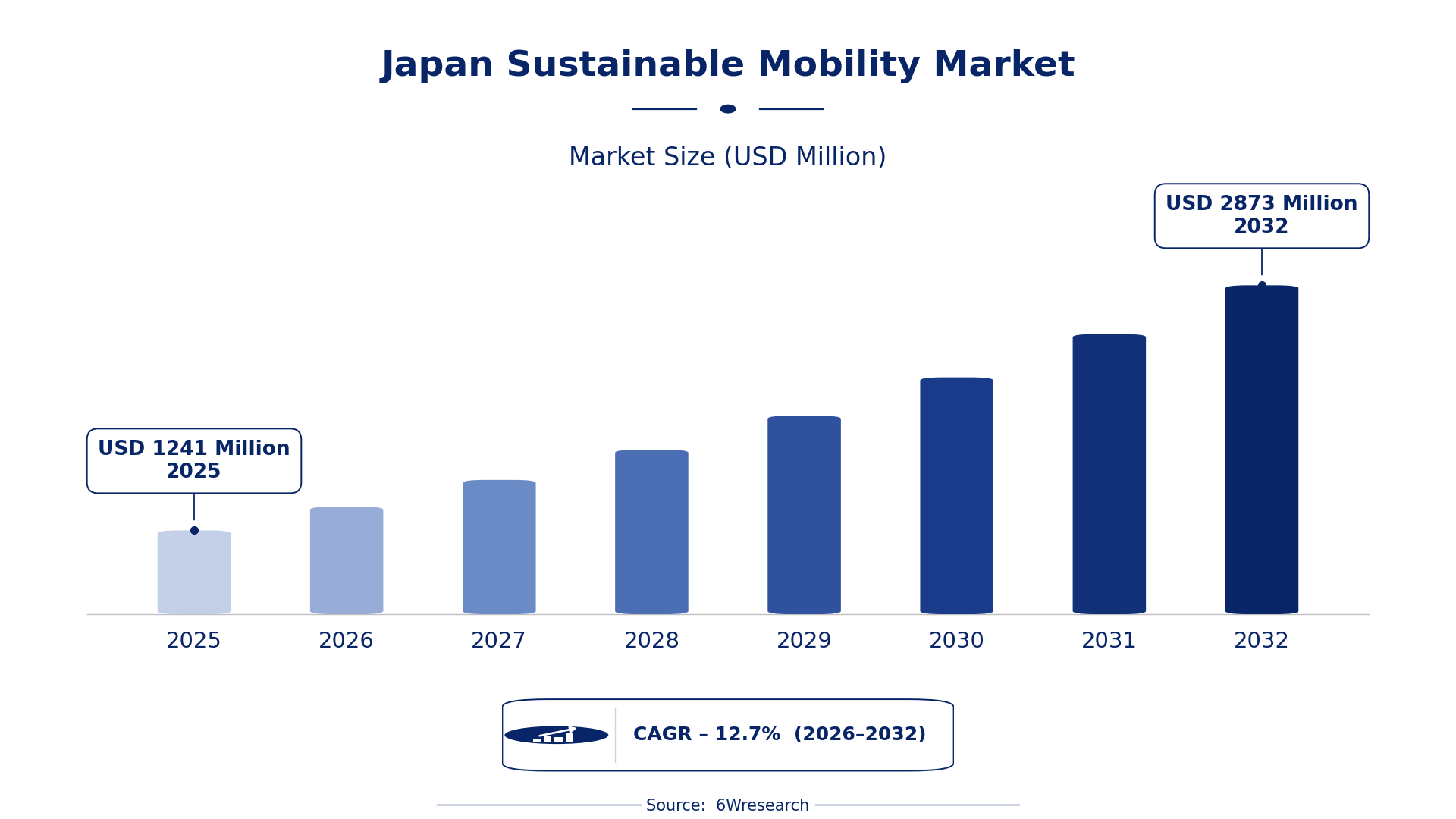
According to 6Wresearch internal database and industry insights, the Japan Sustainable Mobility Market was valued at USD 1,241 Million in 2025 and is projected to reach USD 2,873 Million by 2032, growing at a CAGR of approximately 12.7% during 2026–2032.
Japan Sustainable Mobility Market Highlights
| Report Metric | Details |
| Report Name | Japan Sustainable Mobility Market (2026-2032) |
| Market Size 2025 | USD 1,241 Million |
| Market Size 2032 | USD 2,873 Million |
| Absolute Growth 2025–2032 | USD 1,632 Million |
| CAGR 2026–2032 | 12.7% |
| Peak Annual Growth | 16.0% in 2026 |
| Forecast Period | 2026–2032 |
| Historical Data | 2022–2025 |
| Base Year | 2025 |
| Leading Mobility Type, 2025 | Electric Vehicles (43% share) |
| Leading Energy Source, 2025 | Battery Electric (46% share) |
| Leading Application Area, 2025 | Urban Commute (47% share) |
| Leading End User, 2025 | City Transport Providers (49% share) |
| Fastest-Growing Mobility Type | Shared Mobility (17.9% CAGR) |
| Fastest-Growing Energy Source | Renewable Electricity (18.5% CAGR) |
| Fastest-Growing Application Area | Rideshare Services (14.7% CAGR) |
| Fastest-Growing End User | Mobility Platforms (15.6% CAGR) |
| Growing Sector | Urban transportation |
| Key End Users | City transport providers, municipal operators, mobility platforms |
Japan Sustainable Mobility Market Year-wise Growth Rate and Key Drivers (2022–2032)
This graph illustrates the annual growth rates of the market from 2022 to 2032, highlighting a steady upward trajectory and projected market expansion over the forecast period.
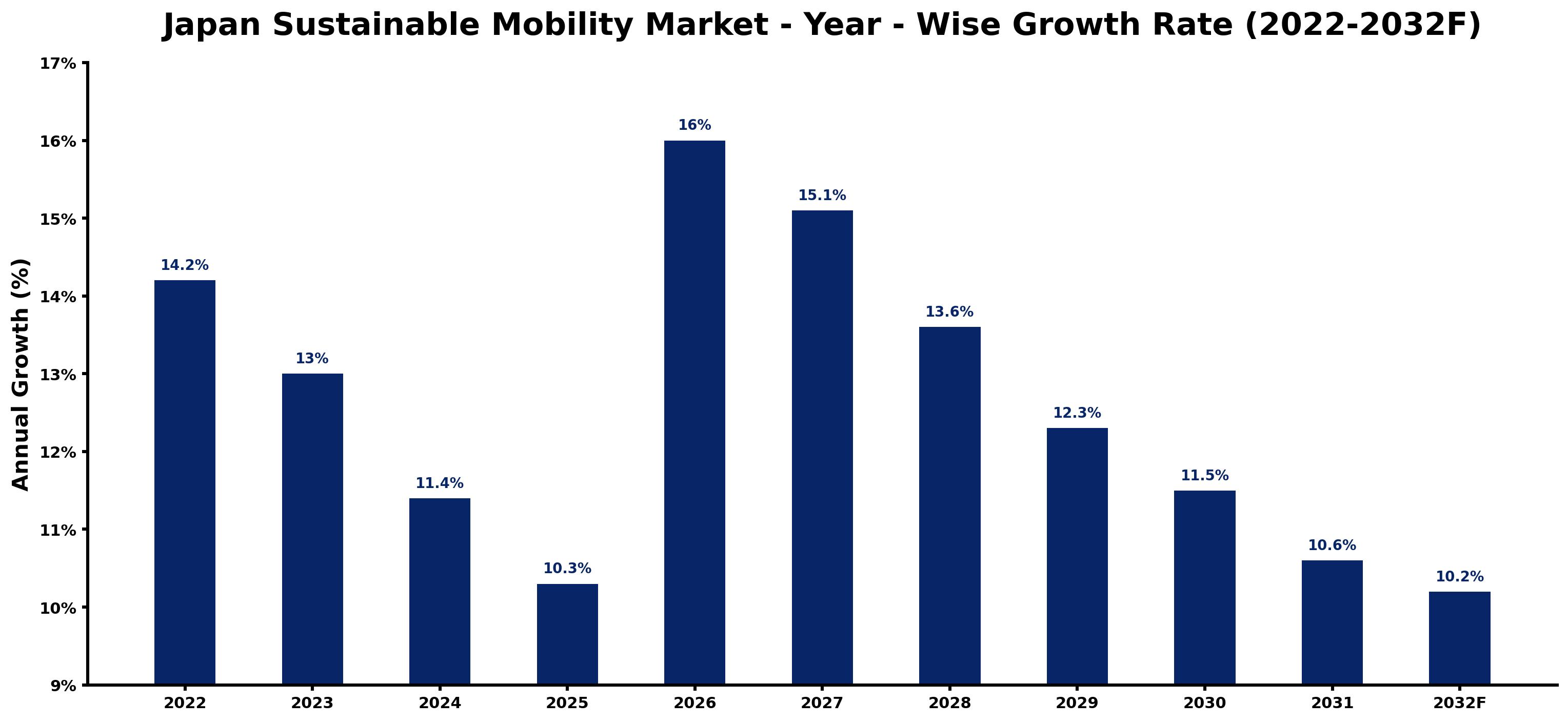
The following figures match every annual growth estimate with the main market development of that year, giving the reasoning behind each rise or slowdown.
| Year | Estimated Annual Growth (%) | Market Rationale |
| 2022 | 14.2 | The market saw strong interest in sustainable transport solutions, particularly electric vehicles. |
| 2023 | 13.0 | Growth slowed as the market adjusted to increased competition and supply chain challenges. |
| 2024 | 11.4 | Demand remained steady, but rising costs impacted consumer purchasing decisions. |
| 2025 | 10.3 | Market growth continued to decelerate as infrastructure development lagged behind expectations. |
| 2026 | 16.0 | A surge in demand is anticipated due to new government initiatives and consumer interest. |
| 2027 | 15.1 | Growth is projected to slow as the market begins to stabilise after rapid expansion. |
| 2028 | 13.6 | Demand is anticipated to continue rising, supported by increasing urbanisation and environmental awareness. |
| 2029 | 12.3 | Growth is expected to slow slightly as market maturity begins to set in, with established players dominating. |
| 2030 | 11.5 | Demand will remain strong, driven by ongoing investments in electric vehicle infrastructure. |
| 2031 | 10.6 | The market will continue to grow, albeit at a slower pace as competition intensifies. |
| 2032 | 10.2 | Growth is projected to stabilise as the market reaches a more mature phase. |
Note: Market size estimations and growth projections presented in this report are based on 6Wresearch's proprietary forecasting methodology, utilizing the latest available industry data, government publications, and primary research inputs.
Japan Sustainable Mobility Market Synopsis
Sustainable mobility in Japan includes technologies aimed at reducing environmental impact from transportation, such as electric vehicles, hydrogen fuel cells, and shared mobility solutions. The Japan Sustainable Mobility Market is expanding due to urbanisation, government initiatives promoting electric vehicles, and rising consumer interest in environmentally friendly transport options. Japan aims for 1 million electric vehicles on the road by 2030, while the Tokyo Metropolitan Government's shared mobility initiative is driving further adoption and improving urban transport solutions.
Market Dynamics Impact Analysis (2026–2032)
| Factor | Type | Impact | Primary Segment Affected |
| Growing urbanisation is increasing demand for efficient transport solutions. | Driver | High | Urban Commute |
| Government initiatives are promoting electric vehicle adoption and infrastructure development. | Driver | High | Electric Vehicles |
| The rise of shared mobility services is creating new opportunities in urban transport. | Opportunity | High | Shared Mobility |
| Investments in renewable energy sources for public transport are expanding the market. | Opportunity | High | Renewable Electricity |
| Limited infrastructure for hydrogen vehicles restricts their market penetration. | Restraint | Medium | Hydrogen Vehicles |
| High initial costs of electric vehicles may deter potential buyers. | Restraint | Medium | Electric Vehicles |
| Infrastructure delays hinder the growth of electric vehicle adoption. | Challenge | High | Electric Vehicles |
| Intense competition among mobility providers can lead to market saturation. | Challenge | Medium | Shared Mobility |
Evaluation of Drivers in Japan Sustainable Mobility Market (2026–2032)
Key forces behind demand, with the segment each one moves most, are listed below.
| Drivers | Primary Segment Affected | Why It Matters (Evidence) |
| Urbanisation increases demand for efficient transport solutions. | Urban Commute | Japan's urban population of approximately 126 million drives higher mobility needs. |
| Government targets for electric vehicle adoption stimulate market growth. | Electric Vehicles | The aim for 1 million electric vehicles on the road by 2030 boosts consumer interest. |
| Environmental awareness encourages consumers to purchase electric vehicles. | Electric Vehicles | The adoption rate of electric vehicles is around 15% as of 2023. |
| Shared mobility services are gaining traction in urban areas. | Shared Mobility | The Tokyo Metropolitan Government's 2023 initiative supports ride-sharing services. |
| Investment in renewable energy sources improves charging infrastructure. | Renewable Electricity | Osaka Prefecture's commitment to sustainable public transport enhances electric vehicle adoption. |
Spending rises because urbanisation is increasing demand for efficient transport solutions, with a population of approximately 126 million in urban areas driving higher mobility needs. Environmental awareness is encouraging consumers to purchase electric vehicles, reflected in a 15% adoption rate as of 2023. Investment in renewable energy sources improves charging infrastructure, as seen in Osaka Prefecture's commitment to sustainable public transport.
Evaluation of Restraints in Japan Sustainable Mobility Market
Several factors work against faster growth; the main ones are summarised below.
| Market Restraint | Primary Segment Affected | Why It Matters (Evidence) |
| Consumer hesitance towards new technologies can slow adoption rates. | Micro-Mobility | Many consumers remain cautious about using e-scooters and bikes due to safety concerns. |
| Infrastructure development lags behind market expectations, limiting growth. | Electric Vehicles | Insufficient charging stations hinder the widespread adoption of electric vehicles. |
| High initial costs of electric vehicles deter potential buyers. | Electric Vehicles | The average price of electric vehicles remains higher than traditional vehicles. |
| Limited awareness of shared mobility options restricts market growth. | Shared Mobility | Many urban residents are unaware of the benefits of ride-sharing services. |
| Regulatory compliance costs can burden new entrants in the market. | Micro-Mobility | New regulations for e-scooter safety create additional financial barriers for companies. |
Japan Sustainable Mobility Market Challenges
Tokyo's public transport system struggles with service delays due to a lack of available electric buses, which hampers buyers' access to sustainable transport options. The adoption rate of electric vehicles is only around 15%, limiting producers' ability to meet rising demand for eco-friendly transport solutions. Skills shortages in advanced engineering create bottlenecks for producers, leading to prolonged product development cycles that frustrate market entry. Regulatory compliance with updated JIS standards for electric vehicle charging infrastructure incurs additional costs for importers, who must invest in new technology to comply with these evolving requirements.
Trends in the Japan Sustainable Mobility Market
These developments are changing demand patterns in the Japan Sustainable Mobility Market.
- Shift from Personal Vehicles to Shared Mobility: Since 2023, there has been a clear shift towards shared mobility solutions as urban residents seek cost-effective transport options. The Tokyo Metropolitan Government's initiative has seen increased participation, with over 10,000 electric buses now in operation.
- Transition from Fossil Fuels to Renewable Energy: The movement towards renewable energy sources has accelerated, with Osaka Prefecture making substantial investments in public transport. By 2023, this investment has resulted in a notable increase in the adoption of electric buses.
- Emergence of E-Scooters in Urban Areas: The popularity of e-scooters has surged, with 50,000 registered in Japan as of 2023. This growth reflects a shift in consumer preferences towards convenient short-distance travel options.
- Prioritisation of Electric Vehicle Infrastructure: The government updated the JIS standard for electric vehicle charging infrastructure in 2023, refining the framework for future development and supporting the growth of electric vehicle adoption.
Investment Opportunities in the Japan Sustainable Mobility Market
Investors looking at the Japan Sustainable Mobility Market should consider the following areas.
- City Transport Providers Seeking Sustainable Solutions: City transport providers are increasingly pursuing sustainable mobility solutions, with the government allocating ¥200 billion for sustainable transport projects in 2023. This funding presents opportunities for suppliers to develop electric vehicle technologies.
- Urban Areas Needing Efficient Mobility Solutions: Urban areas are facing a pressing need for efficient transport solutions, particularly in Tokyo. The target of 1 million electric vehicles by 2030 underscores the demand for improved mobility options.
- Timing for Investment in Shared Mobility: With the rise of shared mobility services, now is an opportune moment to invest in platforms that facilitate ride-sharing. The Tokyo Metropolitan Government's initiative in 2023 highlights this demand for new solutions.
- Gap in E-Scooter Infrastructure: The increasing number of registered e-scooters, reaching 50,000 in 2023, reveals a gap in infrastructure. Suppliers can enter this market by collaborating with local governments to develop charging stations.
Government Initiatives in the Japan Sustainable Mobility Market
The Electrical Appliance and Material Safety Act (1961; METI) regulates the safety of electrical appliances, ensuring that electric vehicles meet safety standards. This law has been fundamental in establishing consumer confidence in electric mobility solutions. More recently, the Hydrogen Society Promotion Act (2024) supports low-carbon hydrogen supply chains, incentivising the development of hydrogen infrastructure and technology, which is essential for sustainable mobility.
The Ministry of Land, Infrastructure, Transport and Tourism oversees transport regulations and funds projects aimed at improving sustainable mobility. In 2023, the agency approved funding for various sustainable transport initiatives, including electric vehicle charging infrastructure and public transport upgrades, benefiting city transport providers and municipal operators.
Future Insight of the Japan Sustainable Mobility Market
Electric vehicles will transform urban transportation by 2032, driven by Japan's goal of 1 million electric vehicles on the road by 2030. The government's ¥200 billion investment in sustainable transport projects will improve infrastructure and stimulate technological progress. Hydrogen fuel cell technology will gain momentum under the Ministry of the Environment's Hydrogen Roadmap, promoting cleaner transport options. Shared mobility initiatives, such as Tokyo's recent launch, will reshape urban commuting, creating new opportunities for suppliers and buyers.
Market Segmentation Analysis
Japan Sustainable Mobility Market report covers a detailed analysis of the following market segments:
By Mobility Type – Electric Vehicles Lead, Shared Mobility Expected to Grow Fastest
According to Saurav Kr Singh, Senior Research Analyst at 6Wresearch, Electric Vehicles accounted for 43% of the market by mobility type in 2025. Electric vehicles hold a prominent position in the market due to their extensive application in both personal and public transport, highlighted by the significant number of electric buses operating in Tokyo. This widespread utilisation reflects strong demand from city transport providers, reinforcing its leading status. Shared Mobility is projected to grow fastest, at a CAGR of 17.9% during 2026–2032. Shared mobility is experiencing rapid growth, driven by initiatives such as the shared mobility programme launched by the Tokyo Metropolitan Government in 2023. As urban areas increasingly adopt ride-sharing services, this segment is poised for continued expansion, further solidifying its position in the market. Suppliers should focus on developing shared mobility solutions to effectively engage with the growing urban transport sector.
By Energy Source – Battery Electric Leads, Renewable Electricity Expected to Grow Fastest
Battery Electric held 46% of the Japan Sustainable Mobility Market by energy source in 2025. Battery electric technology is the primary power source for a substantial portion of electric vehicles, establishing its dominance in the market. The current adoption rate of electric vehicles at 15% underscores the critical importance of battery electric systems in sustainable mobility. Renewable Electricity is set to record the highest CAGR in this split, 18.5% over 2026–2032. Renewable electricity is rapidly advancing as it supports the essential charging infrastructure for electric vehicles, aligning with Japan's goal of achieving 100% renewable energy by 2050. This alignment with national energy objectives ensures that renewable electricity will continue to experience significant growth. Buyers should consider integrating renewable electricity solutions to meet future energy demands in sustainable transportation.
By Application Area – Urban Commute Leads, Rideshare Services Expected to Grow Fastest
With 47% of application area revenue in 2025, Urban Commute was the largest category. Urban commute serves as the primary application area for sustainable mobility, driven by the high population density in Japanese cities. This focus on urban transport solutions is essential for reducing carbon emissions and meeting local mobility needs. The quickest growth will come from Rideshare Services, forecast to expand at a CAGR of 14.7% between 2026 and 2032. Rideshare services are rapidly gaining traction as they are integral to the shared mobility solutions that urban residents increasingly prefer. The growth is supported by the rising demand for flexible transport options in densely populated areas. Suppliers must adapt their strategies to include rideshare solutions to meet the evolving preferences of urban commuters.
By End User – City Transport Providers Lead, Mobility Platforms Expected to Grow Fastest
In 2025, City Transport Providers led the end user split with a 49% share. City transport providers play a crucial role in the sustainable mobility sector, as they are responsible for implementing and managing urban public transport systems. Their considerable investments in electric buses and related infrastructure highlight their dominant position in this segment. Over 2026–2032, Mobility Platforms are expected to post the fastest growth, at a CAGR of 15.6%. Mobility platforms are witnessing swift growth as they enable a variety of transport services, addressing the increasing demand for flexible and efficient transport options. This trend is driven by the rising need for integrated solutions that enhance urban mobility. Suppliers should engage with mobility platforms to leverage the trend towards integrated transport services.
Key Attractiveness of the Report
- 10 Years of Market Numbers
- Historical Data Starting from 2022 to 2025
- Base Year 2025
- Forecast Data until 2032
- Key Performance Indicators Impacting the Market
- Major Upcoming Developments and Projects
Key Highlights of the Report:
- Japan Sustainable Mobility Market Outlook
- Market Size of Japan Sustainable Mobility Market, 2025
- Forecast of Japan Sustainable Mobility Market, 2032
- Historical Data and Forecast of Japan Sustainable Mobility Revenues & Volume for the Period 2022-2032F
- Japan Sustainable Mobility Market Trend Evolution
- Japan Sustainable Mobility Market Drivers and Challenges
- Japan Sustainable Mobility Price Trends
- Japan Sustainable Mobility Porter's Five Forces
- Japan Sustainable Mobility Industry Life Cycle
- Historical Data and Forecast of Japan Sustainable Mobility Market Revenues & Volume By Mobility Type for the Period 2022-2032F
- Historical Data and Forecast of Japan Sustainable Mobility Market Revenues & Volume By Electric Vehicles for the Period 2022-2032F
- Historical Data and Forecast of Japan Sustainable Mobility Market Revenues & Volume By Shared Mobility for the Period 2022-2032F
- Historical Data and Forecast of Japan Sustainable Mobility Market Revenues & Volume By Micro-Mobility for the Period 2022-2032F
- Historical Data and Forecast of Japan Sustainable Mobility Market Revenues & Volume By Hydrogen Vehicles for the Period 2022-2032F
- Historical Data and Forecast of Japan Sustainable Mobility Market Revenues & Volume By Energy Source for the Period 2022-2032F
- Historical Data and Forecast of Japan Sustainable Mobility Market Revenues & Volume By Battery Electric for the Period 2022-2032F
- Historical Data and Forecast of Japan Sustainable Mobility Market Revenues & Volume By Renewable Electricity for the Period 2022-2032F
- Historical Data and Forecast of Japan Sustainable Mobility Market Revenues & Volume By E-Scooters/Bikes for the Period 2022-2032F
- Historical Data and Forecast of Japan Sustainable Mobility Market Revenues & Volume By Hydrogen Fuel Cell for the Period 2022-2032F
- Historical Data and Forecast of Japan Sustainable Mobility Market Revenues & Volume By Application Area for the Period 2022-2032F
- Historical Data and Forecast of Japan Sustainable Mobility Market Revenues & Volume By Urban Commute for the Period 2022-2032F
- Historical Data and Forecast of Japan Sustainable Mobility Market Revenues & Volume By Rideshare Services for the Period 2022-2032F
- Historical Data and Forecast of Japan Sustainable Mobility Market Revenues & Volume By First/Last Mile Travel for the Period 2022-2032F
- Historical Data and Forecast of Japan Sustainable Mobility Market Revenues & Volume By Intercity Mobility for the Period 2022-2032F
- Historical Data and Forecast of Japan Sustainable Mobility Market Revenues & Volume By End User for the Period 2022-2032F
- Historical Data and Forecast of Japan Sustainable Mobility Market Revenues & Volume By City Transport Providers for the Period 2022-2032F
- Historical Data and Forecast of Japan Sustainable Mobility Market Revenues & Volume By Mobility Platforms for the Period 2022-2032F
- Historical Data and Forecast of Japan Sustainable Mobility Market Revenues & Volume By Municipal Operators for the Period 2022-2032F
- Historical Data and Forecast of Japan Sustainable Mobility Market Revenues & Volume By Transport Authorities for the Period 2022-2032F
- Japan Sustainable Mobility Import Export Trade Statistics
- Market Opportunity Assessment By Mobility Type
- Market Opportunity Assessment By Energy Source
- Market Opportunity Assessment By Application Area
- Market Opportunity Assessment By End User
- Japan Sustainable Mobility Top Companies Market Share
- Japan Sustainable Mobility Competitive Benchmarking By Technical and Operational Parameters
- Japan Sustainable Mobility Company Profiles
- Japan Sustainable Mobility Key Strategic Recommendations
Market Covered
Segments analysed in this report are listed below.
By Mobility Type
- Electric Vehicles
- Shared Mobility
- Micro-Mobility
- Hydrogen Vehicles
By Energy Source
- Battery Electric
- Renewable Electricity
- E-Scooters/Bikes
- Hydrogen Fuel Cell
By Application Area
- Urban Commute
- Rideshare Services
- First/Last Mile Travel
- Intercity Mobility
By End User
- City Transport Providers
- Mobility Platforms
- Municipal Operators
- Transport Authorities































