Japan Sustainable Paper Market Size & Growth Rate
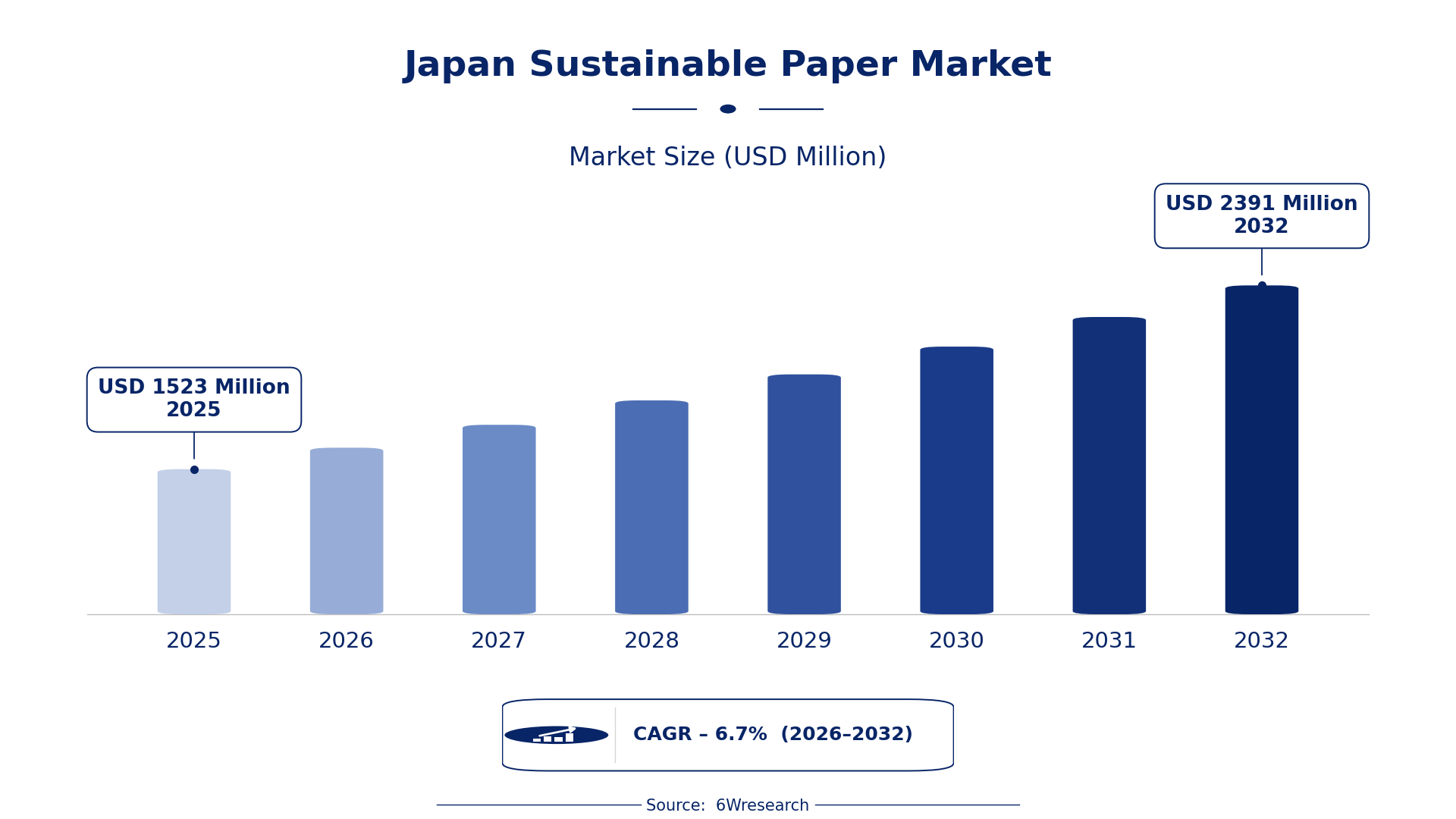
According to 6Wresearch internal database and industry insights, the Japan Sustainable Paper Market was valued at USD 1,523 Million in 2025 and is projected to reach USD 2,391 Million by 2032, growing at a CAGR of approximately 6.7% during 2026–2032.
Japan Sustainable Paper Market Highlights
| Report Metric | Details |
| Report Name | Japan Sustainable Paper Market (2026-2032) |
| Market Size 2025 | USD 1,523 Million |
| Market Size 2032 | USD 2,391 Million |
| Absolute Growth 2025–2032 | USD 868 Million |
| CAGR 2026–2032 | 6.7% |
| Peak Annual Growth | 7.7% in 2027 |
| Forecast Period | 2026–2032 |
| Historical Data | 2022–2025 |
| Base Year | 2025 |
| Leading Paper Type, 2025 | Recycled Paper (44% share) |
| Leading Source Material, 2025 | Post-Consumer Waste (45% share) |
| Leading Application Use, 2025 | Printing & Publishing (38% share) |
| Leading End User, 2025 | Print Houses (35% share) |
| Fastest-Growing Paper Type | Agricultural Residue Paper (9.3% CAGR) |
| Fastest-Growing Source Material | Wheat Straw/Bamboo (9.5% CAGR) |
| Fastest-Growing Application Use | Packaging (8.9% CAGR) |
| Fastest-Growing End User | Eco Paper Brands (8.4% CAGR) |
| Growing Sector | sustainable packaging |
| Key End Users | printing companies, packaging manufacturers, hygiene product producers, eco-conscious consumers |
Japan Sustainable Paper Market Year-wise Growth Rate and Key Drivers (2022–2032)
This graph illustrates the annual growth rates of the market from 2022 to 2032, highlighting a steady upward trajectory and projected market expansion over the forecast period.
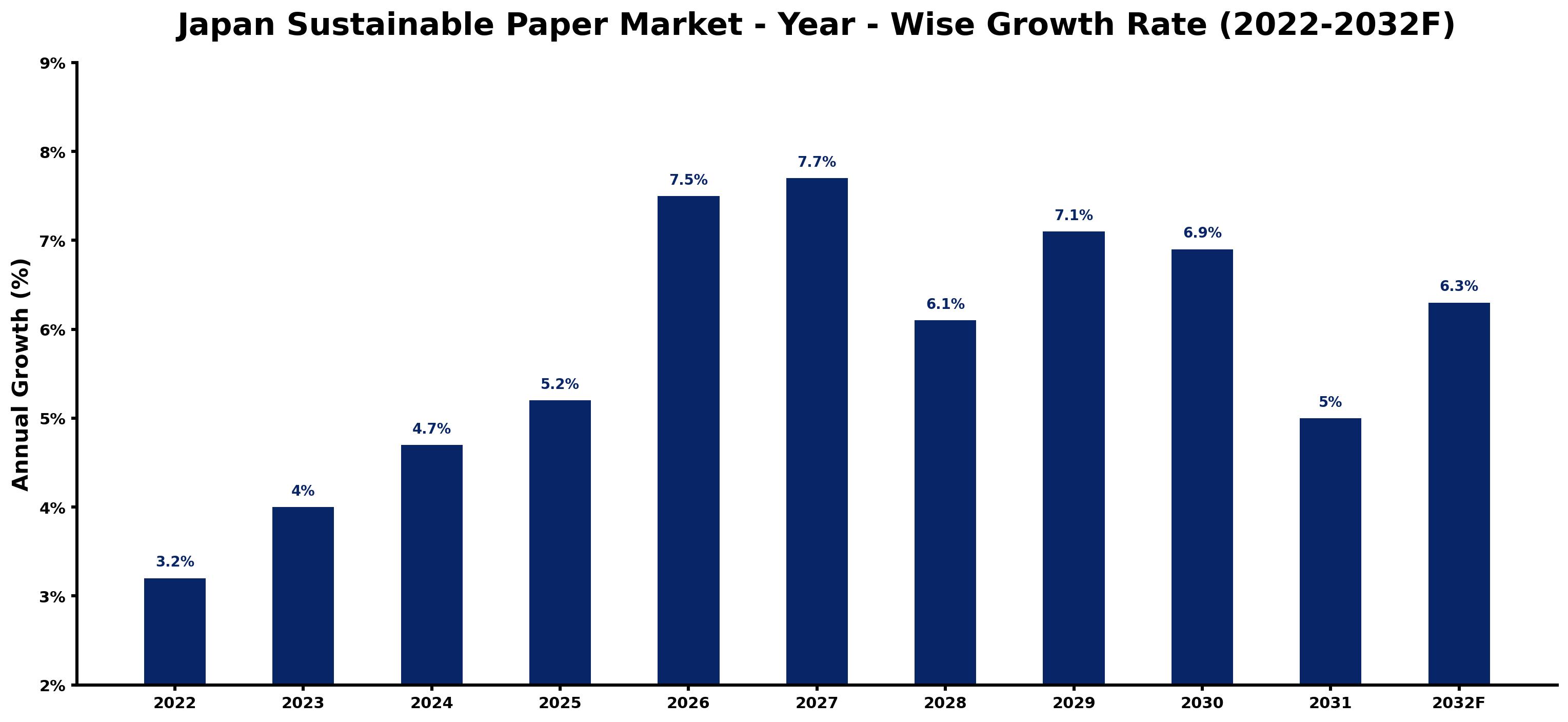
Each row of the following table gives one year's estimated growth and the event or demand shift that explains it.
| Year | Estimated Annual Growth (%) | Market Rationale |
| 2022 | 3.2 | Demand for sustainable paper increased as awareness of environmental issues grew. |
| 2023 | 4.0 | The launch of new initiatives boosted investments in sustainable materials. |
| 2024 | 4.7 | Recycling initiatives led to a rise in the use of post-consumer waste in production. |
| 2025 | 5.2 | Printing and publishing sectors showed strong demand for eco-friendly paper options. |
| 2026 | 7.5 | Investment in sustainable forestry practices is expected to expand supply chains for producers. |
| 2027 | 7.7 | Growing consumer preference for sustainable packaging will drive higher sales volumes. |
| 2028 | 6.1 | A slowdown in growth is expected as supply chain challenges emerge in production. |
| 2029 | 7.1 | Demand for sustainable paper is projected to surge as more businesses adopt eco-friendly practices. |
| 2030 | 6.9 | Growth is expected to slow slightly due to increased competition among suppliers in the market. |
| 2031 | 5.0 | The market will continue to grow as eco-conscious consumers seek sustainable products. |
| 2032 | 6.3 | Demand for sustainable paper is expected to rise as recycling rates improve. |
Note: Market size estimations and growth projections presented in this report are based on 6Wresearch's proprietary forecasting methodology, utilizing the latest available industry data, government publications, and primary research inputs.
Japan Sustainable Paper Market Synopsis
Sustainable paper is produced using eco-friendly methods, including recycling and sustainable forestry practices. With over 50% of paper products in Japan made from recycled materials, the Japan Sustainable Paper Market is expanding due to strong demand from eco-conscious sectors, particularly in the Tokyo region, a major hub for printing and publishing industries. Growth is driven by increased investments in sustainable practices and heightened consumer awareness of environmental issues.
Market Dynamics Impact Analysis (2026–2032)
| Factor | Type | Impact | Primary Segment Affected |
| Increased investment in recycling technologies | Driver | High | Recycled Paper |
| Growing demand for eco-friendly packaging solutions | Driver | High | Packaging |
| Emerging specialty markets for agricultural residue paper | Opportunity | Medium | Agricultural Residue Paper |
| Rising consumer awareness of sustainability | Opportunity | High | Eco Paper Brands |
| Challenges in sourcing sustainable raw materials | Restraint | High | Sustainable Forestry |
| Limited consumer knowledge about sustainable options | Restraint | Medium | Tree-Free Paper |
| Supply chain disruptions affecting production capacity | Challenge | High | FSC-Certified Paper |
| Increased competition among suppliers leading to price pressures | Challenge | Medium | Post-Consumer Waste |
Evaluation of Drivers in Japan Sustainable Paper Market (2026–2032)
These are the developments adding the most demand over the forecast period.
| Drivers | Primary Segment Affected | Why It Matters (Evidence) |
| Investment in recycling initiatives | Recycled Paper | Japan's recycling rate, around 80%, drives demand for recycled paper products. |
| Consumer preference for sustainable packaging | Packaging | The packaging sector is shifting towards eco-friendly materials, with over 50% of options now sustainable. |
| Growth in printing and publishing industries | Printing & Publishing | The Tokyo region's printing sector accounts for 38% of the market, boosting demand for sustainable paper. |
| Support for sustainable forestry practices | Sustainable Forestry | Grants for sustainable sourcing ensure a steady supply of eco-friendly materials. |
| Adoption of eco-certifications like FSC | FSC-Certified Paper | Many businesses adhere to FSC standards, increasing the credibility of sustainable paper products. |
Several shifts outside the market lift sales. The Japanese paper recycling rate, around 80%, supports demand for recycled paper, especially in the printing and publishing sectors, which account for 38% of the market share. Rising consumer awareness of sustainability drives demand for packaging solutions, prompting manufacturers to invest in eco-friendly options.
Evaluation of Restraints in Japan Sustainable Paper Market
The main factors holding the market back are set out below.
| Market Restraint | Primary Segment Affected | Why It Matters (Evidence) |
| Challenges in sourcing sustainable raw materials | Sustainable Forestry | Supply chain disruptions have made it difficult for producers to obtain sustainable materials, affecting production timelines. |
| Limited consumer knowledge about sustainable options | Tree-Free Paper | Many consumers remain unaware of sustainable alternatives, hindering market growth for niche products. |
| High costs associated with sustainable paper production | Agricultural Residue Paper | Production costs for agricultural residue paper remain high, limiting its widespread adoption. |
| Regulatory compliance costs for manufacturers | FSC-Certified Paper | Manufacturers incur costs to meet FSC certification standards, impacting pricing. |
| Competition from traditional paper products | Recycled Paper | Traditional paper products often have lower prices, making it challenging for sustainable options to compete. |
Japan Sustainable Paper Market Challenges
Japan's paper recycling rate is around 80%, yet stringent regulations on recycling practices can delay compliance for manufacturers by up to six months. Limited domestic sources of raw materials lead to supply chain disruptions, causing a 15% increase in input costs for producers reliant on imports. A lack of skilled workers in sustainable practices hampers innovation, resulting in product development delays of over a year for new entrants. Local suppliers face intense competition from international markets, forcing them to cut prices by as much as 10%, which negatively impacts profitability for many businesses.
Trends in the Japan Sustainable Paper Market
These developments are changing demand patterns in the Japan Sustainable Paper Market.
- Shift Towards Eco-Friendly Packaging: The demand for sustainable packaging solutions has increased, particularly in the food and beverage sectors. In 2023, over 50% of packaging materials used were eco-friendly, reflecting a broader trend towards sustainability.
- Transition from Conventional to Recycled Paper: The Japanese paper industry is increasingly moving towards recycled paper, with over 50% of products made from recycled materials as of 2023. This shift is driven by consumer demand for sustainable options.
- Emergence of Agricultural Residue Paper: Agricultural residue paper is gaining traction in specialty markets, with a projected growth rate of 9.3% from 2026 to 2032. This trend is supported by initiatives promoting the use of agricultural waste in paper production.
- Increased Adoption of Eco-Certifications: The adoption of eco-certifications like FSC is on the rise, with many companies adhering to these standards to strengthen their sustainability credentials. As of 2023, this trend influences purchasing decisions across sectors.
Investment Opportunities in the Japan Sustainable Paper Market
Several openings in the Japan Sustainable Paper Market merit attention from investors.
- Partner with Local Producers: With Japan's recycling rate at around 80%, collaborating with local producers can strengthen supply chains for sustainable paper. This partnership can help meet the growing demand from eco-conscious sectors.
- Invest in Sustainable Packaging Facilities: The packaging sector is experiencing a shift towards sustainability, with investments needed to establish facilities in the Tokyo region to cater to the rising demand for eco-friendly packaging solutions.
- Engage Eco-Conscious Consumer Groups: With over 50% of consumers prioritising sustainability, targeting eco-conscious groups can drive sales. Engaging these consumers through marketing campaigns can strengthen brand loyalty and market presence.
- Explore Agricultural Residue Paper Markets: The agricultural residue paper segment is projected to grow rapidly, with a CAGR of 9.3%. Investing in this niche can meet the demand from specialty markets seeking sustainable alternatives.
Government Initiatives in the Japan Sustainable Paper Market
The Waste Management and Public Cleansing Act regulates the treatment of industrial waste, ensuring that sustainable paper producers adhere to strict waste management practices. This law promotes recycling initiatives, contributing to Japan's high recycling rate, which is around 80%.
The Ministry of the Environment oversees various programs that fund recycling initiatives and promote sustainable forestry practices. These efforts support the production of sustainable paper, ensuring a steady supply of eco-friendly materials and compliance with environmental standards.
Future Insight of the Japan Sustainable Paper Market
Investment in advanced recycling technologies and sustainable forestry practices will reshape the market by 2032, creating a more efficient supply chain for eco-friendly paper products. Demand for sustainable paper will rise as the government promotes recycling initiatives through various programs, encouraging broader adoption among businesses. With the Tokyo region as a major hub for printing and publishing, this trend is expected to continue as consumers increasingly favour sustainable options. New certifications will emerge, driving innovation and providing buyers and suppliers with improved product offerings.
Market Segmentation Analysis
Japan Sustainable Paper Market report covers a detailed analysis of the following market segments:
By Paper Type – Recycled Paper Leads, Agricultural Residue Paper Expected to Grow Fastest
According to Saurav Kr Singh, Senior Research Analyst at 6Wresearch, in 2025, Recycled Paper led the paper type split with a 44% share. Recycled paper holds the largest market share because it is extensively utilised across diverse applications, especially in printing and packaging. With over 50% of paper products in Japan made from recycled materials, this aligns well with the needs of eco-conscious consumers. Over 2026–2032, Agricultural Residue Paper is expected to post the fastest growth, at a CAGR of 9.3%. Agricultural residue paper is experiencing rapid growth as niche markets increasingly seek sustainable alternatives. The heightened consumer awareness surrounding environmental concerns is driving demand, indicating a promising future for this specialty product. Suppliers must focus on agricultural residue paper to capitalise on the growing interest in sustainable options.
By Source Material – Post-Consumer Waste Leads, Wheat Straw/Bamboo Expected to Grow Fastest
Post-Consumer Waste took 45% of source material revenue in 2025, more than any other category. Post-consumer waste is the primary source for recycled paper products, making it the leading material in the market. The strong commitment to recycling initiatives in Japan has established a solid base for this source material. Wheat Straw/Bamboo is projected to grow fastest, at a CAGR of 9.5% during 2026–2032. Wheat straw and bamboo are gaining traction as emerging alternatives, particularly among environmentally conscious consumers. The shift towards utilising agricultural residues is being encouraged by government initiatives promoting sustainable practices. Buyers should consider diversifying their sources to include emerging materials like wheat straw and bamboo to meet sustainability goals.
By Application Use – Printing & Publishing Leads, Packaging Expected to Grow Fastest
With 38% of application use revenue in 2025, Printing & Publishing was the largest category. Printing and publishing account for the largest share of sustainable paper usage, fuelled by a strong demand for eco-friendly materials in this sector. The concentration of printing industries in the Tokyo region reinforces the significance of this application in the market. Packaging is set to record the highest CAGR in this split, 8.9% over 2026–2032. Packaging is experiencing the fastest growth as businesses increasingly seek sustainable solutions to align with consumer preferences. The surge in e-commerce has heightened the demand for eco-friendly packaging options, further driving this segment's expansion. Suppliers need to adapt their strategies to meet the rising demand for sustainable packaging solutions.
By End User – Print Houses Lead, Eco Paper Brands Expected to Grow Fastest
Print Houses accounted for 35% of the market by end user in 2025. Print houses are the largest consumers of sustainable paper, utilising it extensively for their printing needs. Their commitment to sustainability drives substantial demand for eco-friendly paper products in the industry. The quickest growth will come from Eco Paper Brands, forecast to expand at a CAGR of 8.4% between 2026 and 2032. Eco paper brands are rapidly expanding as they focus exclusively on sustainable paper products, appealing to a growing eco-conscious consumer base. This segment's growth reflects a broader trend towards sustainability in purchasing decisions. Suppliers should strengthen partnerships with eco paper brands to align with the increasing consumer preference for sustainable products.
Key Attractiveness of the Report
- 10 Years of Market Numbers
- Historical Data Starting from 2022 to 2025
- Base Year 2025
- Forecast Data until 2032
- Key Performance Indicators Impacting the Market
- Major Upcoming Developments and Projects
Key Highlights of the Report:
- Japan Sustainable Paper Market Outlook
- Market Size of Japan Sustainable Paper Market, 2025
- Forecast of Japan Sustainable Paper Market, 2032
- Historical Data and Forecast of Japan Sustainable Paper Revenues & Volume for the Period 2022-2032F
- Japan Sustainable Paper Market Trend Evolution
- Japan Sustainable Paper Market Drivers and Challenges
- Japan Sustainable Paper Price Trends
- Japan Sustainable Paper Porter's Five Forces
- Japan Sustainable Paper Industry Life Cycle
- Historical Data and Forecast of Japan Sustainable Paper Market Revenues & Volume By Paper Type for the Period 2022-2032F
- Historical Data and Forecast of Japan Sustainable Paper Market Revenues & Volume By Recycled Paper for the Period 2022-2032F
- Historical Data and Forecast of Japan Sustainable Paper Market Revenues & Volume By FSC-Certified Paper for the Period 2022-2032F
- Historical Data and Forecast of Japan Sustainable Paper Market Revenues & Volume By Agricultural Residue Paper for the Period 2022-2032F
- Historical Data and Forecast of Japan Sustainable Paper Market Revenues & Volume By Tree-Free Paper for the Period 2022-2032F
- Historical Data and Forecast of Japan Sustainable Paper Market Revenues & Volume By Source Material for the Period 2022-2032F
- Historical Data and Forecast of Japan Sustainable Paper Market Revenues & Volume By Post-Consumer Waste for the Period 2022-2032F
- Historical Data and Forecast of Japan Sustainable Paper Market Revenues & Volume By Sustainable Forestry for the Period 2022-2032F
- Historical Data and Forecast of Japan Sustainable Paper Market Revenues & Volume By Wheat Straw/Bamboo for the Period 2022-2032F
- Historical Data and Forecast of Japan Sustainable Paper Market Revenues & Volume By Cotton/Bagasse for the Period 2022-2032F
- Historical Data and Forecast of Japan Sustainable Paper Market Revenues & Volume By Application Use for the Period 2022-2032F
- Historical Data and Forecast of Japan Sustainable Paper Market Revenues & Volume By Printing & Publishing for the Period 2022-2032F
- Historical Data and Forecast of Japan Sustainable Paper Market Revenues & Volume By Packaging for the Period 2022-2032F
- Historical Data and Forecast of Japan Sustainable Paper Market Revenues & Volume By Stationery for the Period 2022-2032F
- Historical Data and Forecast of Japan Sustainable Paper Market Revenues & Volume By Tissue Products for the Period 2022-2032F
- Historical Data and Forecast of Japan Sustainable Paper Market Revenues & Volume By End User for the Period 2022-2032F
- Historical Data and Forecast of Japan Sustainable Paper Market Revenues & Volume By Print Houses for the Period 2022-2032F
- Historical Data and Forecast of Japan Sustainable Paper Market Revenues & Volume By CPG Manufacturers for the Period 2022-2032F
- Historical Data and Forecast of Japan Sustainable Paper Market Revenues & Volume By Eco Paper Brands for the Period 2022-2032F
- Historical Data and Forecast of Japan Sustainable Paper Market Revenues & Volume By Hygiene Companies for the Period 2022-2032F
- Japan Sustainable Paper Import Export Trade Statistics
- Market Opportunity Assessment By Paper Type
- Market Opportunity Assessment By Source Material
- Market Opportunity Assessment By Application Use
- Market Opportunity Assessment By End User
- Japan Sustainable Paper Top Companies Market Share
- Japan Sustainable Paper Competitive Benchmarking By Technical and Operational Parameters
- Japan Sustainable Paper Company Profiles
- Japan Sustainable Paper Key Strategic Recommendations
Market Covered
The report covers the following segments.
By Paper Type
- Recycled Paper
- FSC-Certified Paper
- Agricultural Residue Paper
- Tree-Free Paper
By Source Material
- Post-Consumer Waste
- Sustainable Forestry
- Wheat Straw/Bamboo
- Cotton/Bagasse
By Application Use
- Printing & Publishing
- Packaging
- Stationery
- Tissue Products
By End User
- Print Houses
- CPG Manufacturers
- Eco Paper Brands
- Hygiene Companies































