Japan Sustainable Pest Management Market Size & Growth Rate
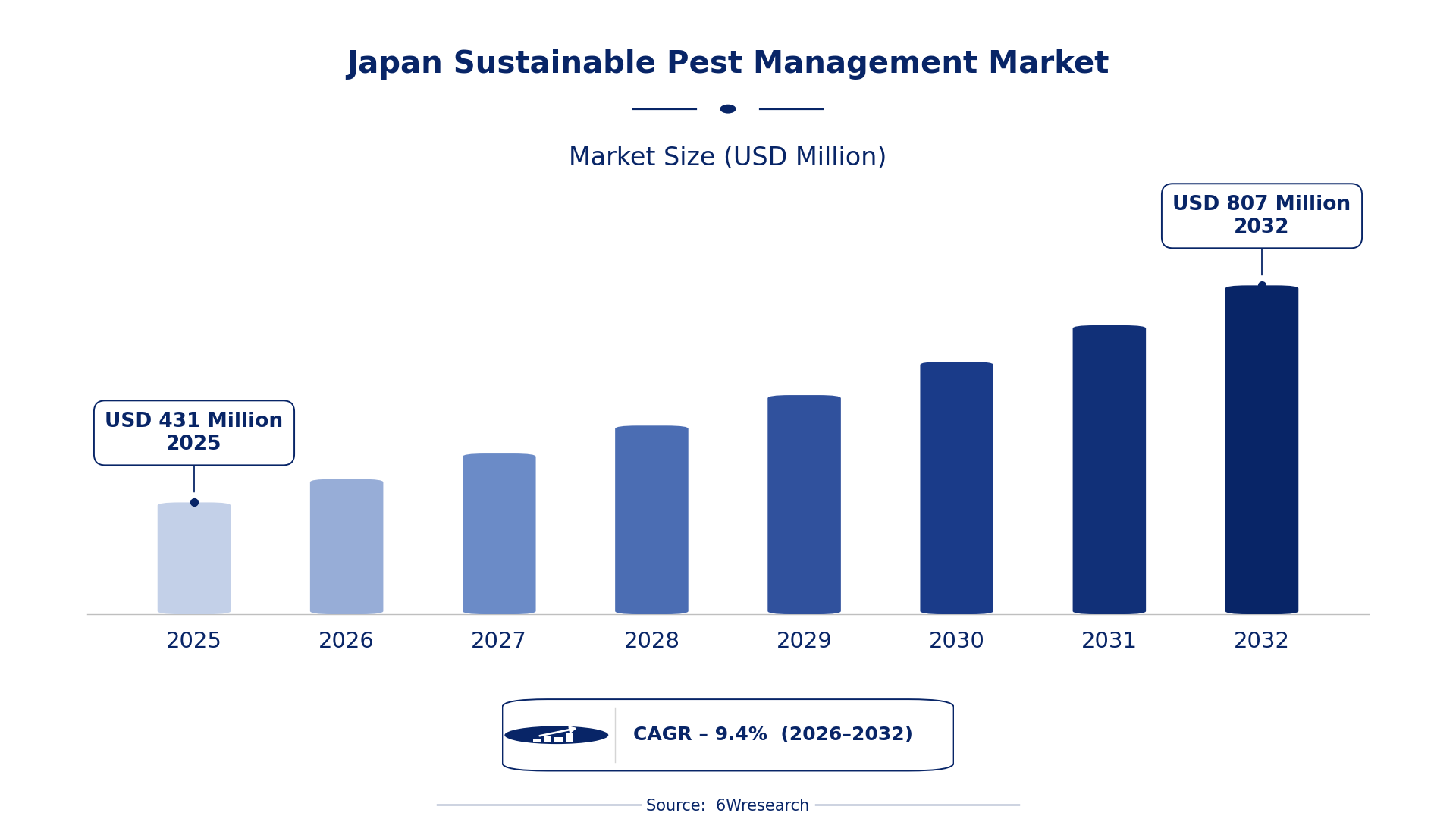
According to 6Wresearch internal database and industry insights, the Japan Sustainable Pest Management Market was valued at USD 431 Million in 2025 and is projected to reach USD 807 Million by 2032, growing at a CAGR of approximately 9.4% during 2026–2032.
Japan Sustainable Pest Management Market Highlights
| Report Metric | Details |
| Report Name | Japan Sustainable Pest Management Market (2026-2032) |
| Market Size 2025 | USD 431 Million |
| Market Size 2032 | USD 807 Million |
| Absolute Growth 2025–2032 | USD 376 Million |
| CAGR 2026–2032 | 9.4% |
| Peak Annual Growth | 10.1% in 2030 |
| Forecast Period | 2026–2032 |
| Historical Data | 2022–2025 |
| Base Year | 2025 |
| Leading Solution Type, 2025 | Biopesticides (40% share) |
| Leading Active Ingredient, 2025 | Neem (42% share) |
| Leading Crop Type, 2025 | Vegetables & Fruits (44% share) |
| Leading End User, 2025 | Organic Farmers (38% share) |
| Fastest-Growing Solution Type | Pheromone Traps (13.1% CAGR) |
| Fastest-Growing Active Ingredient | Bacillus Thuringiensis (12.2% CAGR) |
| Fastest-Growing Crop Type | Orchards (13.3% CAGR) |
| Fastest-Growing End User | Horticultural Growers (12.1% CAGR) |
| Growing Sector | Organic Farming |
| Key End Users | Organic Farmers, Horticultural Growers, Protected Farming Units |
Japan Sustainable Pest Management Market Year-wise Growth Rate and Key Drivers (2022–2032)
This graph illustrates the annual growth rates of the market from 2022 to 2032, highlighting a steady upward trajectory and projected market expansion over the forecast period.
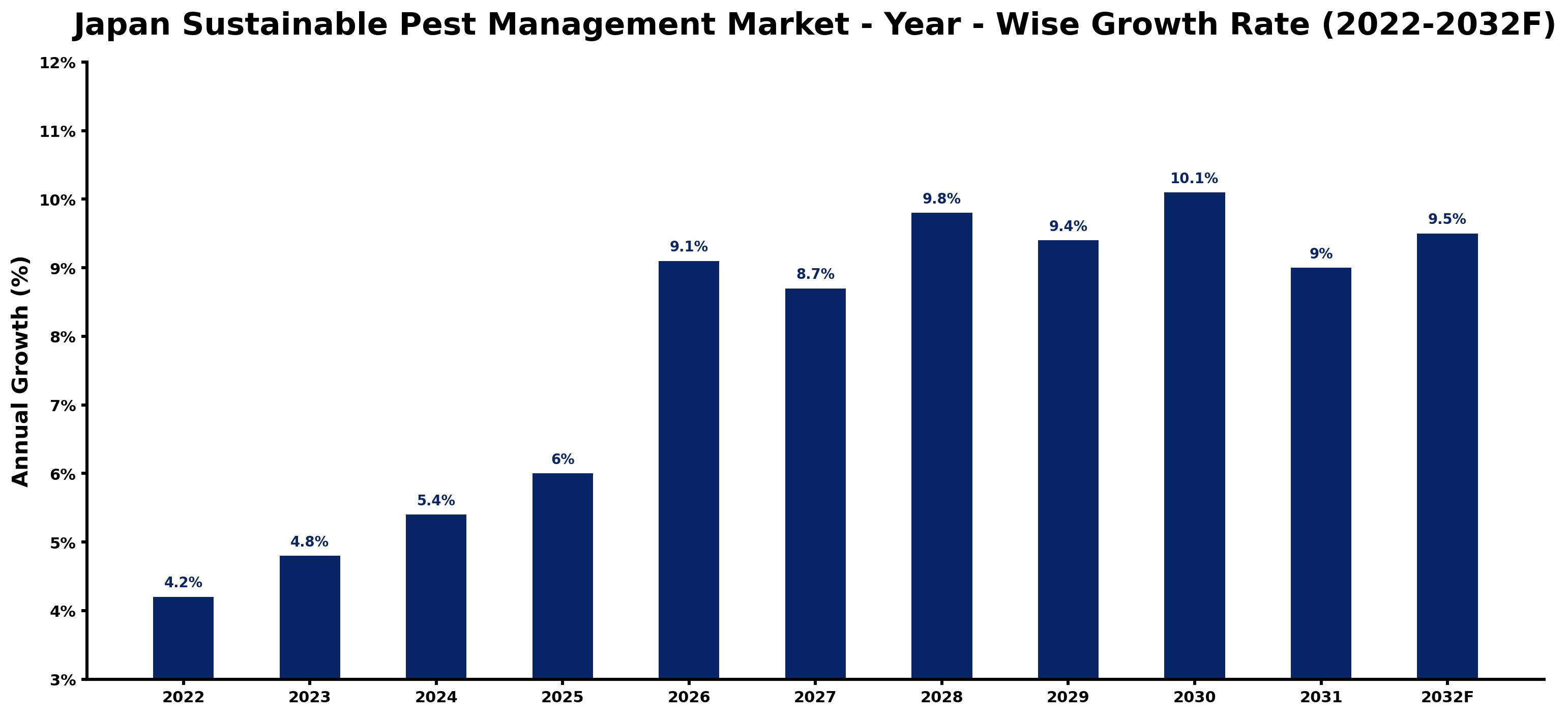
Year by year, the estimates below pair each growth rate with the development that shaped it.
| Year | Estimated Annual Growth (%) | Market Rationale |
| 2022 | 4.2 | The market experienced steady growth due to rising interest in organic farming practices. |
| 2023 | 4.8 | Demand for sustainable pest management solutions increased as awareness of environmental issues grew. |
| 2024 | 5.4 | The introduction of new biopesticide products contributed to higher adoption rates among farmers. |
| 2025 | 6.0 | The market reached a historical peak as horticultural growers expanded their sustainable practices. |
| 2026 | 9.1 | The adoption rate of sustainable pest management practices is projected to increase significantly. |
| 2027 | 8.7 | Growth will slow slightly as market saturation begins to take effect. |
| 2028 | 9.8 | The introduction of new pest control technologies will drive renewed interest in sustainable methods. |
| 2029 | 9.4 | A slight slowdown in growth is anticipated as the market stabilises. |
| 2030 | 10.1 | The market is projected to peak with the introduction of advanced biopesticides. |
| 2031 | 9.0 | Growth will moderate as the market matures and competition increases. |
| 2032 | 9.5 | Sustainable practices will continue to gain traction, supported by ongoing government initiatives. |
Note: Market size estimations and growth projections presented in this report are based on 6Wresearch's proprietary forecasting methodology, utilizing the latest available industry data, government publications, and primary research inputs.
Japan Sustainable Pest Management Market Synopsis
Sustainable Pest Management employs environmentally friendly practices to control pests using natural methods such as biopesticides and pheromone traps. The Japan Sustainable Pest Management Market is expanding, driven by over 1.5 million hectares of organic farmland and increasing consumer demand for eco-friendly solutions. The annual budget for sustainable agriculture initiatives is approximately 10 billion yen, which supports organic farmers and horticultural growers in adopting these practices. This shift towards greener agricultural methods is expected to continue, reflecting a broader trend in sustainable farming.
Market Dynamics Impact Analysis (2026–2032)
| Factor | Type | Impact | Primary Segment Affected |
| Increasing adoption of organic farming practices | Driver | High | Biopesticides |
| Government support for sustainable agriculture | Driver | High | Pheromone Traps |
| Growing demand for organic produce | Opportunity | High | Vegetables & Fruits |
| Expansion of protected farming units | Opportunity | Medium | Protected Farming Units |
| Limited awareness among conventional farmers | Restraint | Medium | Botanicals |
| Higher initial costs of sustainable solutions | Restraint | High | Predatory Insects |
| Competition from chemical pesticides | Challenge | High | Biopesticides |
| Slow adoption rates in some regions | Challenge | Medium | Pheromone Traps |
Evaluation of Drivers in Japan Sustainable Pest Management Market (2026–2032)
These are the developments adding the most demand over the forecast period.
| Drivers | Primary Segment Affected | Why It Matters (Evidence) |
| Growing interest in organic farming | Biopesticides | In 2023, Japan had over 1.5 million hectares of organic farmland, increasing demand for natural pest control solutions. |
| Government initiatives promoting sustainable practices | Pheromone Traps | The annual budget for sustainable agriculture initiatives is approximately 10 billion yen, encouraging the use of pheromone traps. |
| Consumer preference for organic produce | Vegetables & Fruits | Horticultural growers, representing 40% of the market, are increasingly adopting sustainable pest management. |
| Technological advancements in pest control | Botanicals | The adoption rate of sustainable practices among farmers is 30%, supported by new pest control technologies. |
| Increased funding for sustainable agriculture | Predatory Insects | The annual budget for sustainable agriculture initiatives is approximately 10 billion yen, facilitating pest management. |
Orders keep climbing as interest in sustainable practices rises, with over 1.5 million hectares of organic farmland in Japan. Horticultural growers are increasingly opting for biopesticides, reflecting a shift in consumer preference towards eco-friendly solutions. The adoption rate of sustainable practices among farmers is currently 30%, indicating a growing trend towards environmentally responsible agriculture. This funding supports the increasing demand for natural pest management solutions, particularly in regions focused on high-value crops.
Evaluation of Restraints in Japan Sustainable Pest Management Market
Below are the constraints most often cited by buyers and suppliers, with the segment each affects.
| Market Restraint | Primary Segment Affected | Why It Matters (Evidence) |
| Limited availability of effective pest management solutions increases costs for buyers. | Biopesticides | Higher costs hinder efficient pest control, impacting the profitability of organic farmers. |
| Regulatory complexities lead to delays in product approvals. | Pheromone Traps | Delays affect distributors' ability to meet market demands for effective pest control. |
| Skills shortages limit the adoption of sustainable practices among farmers. | Natural Predators | Only 30% of farmers implement these methods, resulting in inefficiencies in pest management. |
| Technology gaps restrict the effectiveness of pest control methods. | Botanicals | The 15% increase in pheromone trap usage indicates limited technological advancement. |
| Market fragmentation complicates supply chain management. | Essential Oil Extracts | Diverse product offerings create challenges for consistent quality and availability. |
Japan Sustainable Pest Management Market Challenges
Buyers incur higher costs due to the limited availability of effective pest management solutions, which hampers their ability to control pests efficiently. Regulatory complexities, such as the updated JIS for biopesticides in 2022, lead to delays in product approvals, impacting distributors who struggle to meet market demands. Skills shortages hinder the adoption of sustainable practices, with only 30% of farmers currently implementing these methods, resulting in inefficiencies for buyers. Technology gaps remain as the use of pheromone traps has only increased by 15% over three years, limiting the effectiveness of pest control for growers relying on these tools.
Trends in the Japan Sustainable Pest Management Market
Several trends are reshaping the Japan Sustainable Pest Management Market; the most important are set out below.
- Increase in Biopesticide Adoption: The use of biopesticides is rising as farmers seek eco-friendly alternatives. In 2023, biopesticides accounted for 25% of the pest management market, reflecting a growing preference for sustainable solutions.
- Surge in Pheromone Trap Usage: The adoption of pheromone traps has surged by 15% in the last three years, due to their effectiveness in monitoring pest populations. This trend supports sustainable pest management practices across various crop types.
- Growth of Protected Farming Units: Protected farming units are increasingly concentrated in regions like Kumamoto and Tochigi, utilising sustainable methods to improve crop health. This growth is critical for high-value crops such as strawberries and tomatoes.
- Rising Popularity of Essential Oil Extracts: Essential oil extracts are gaining traction as natural repellents, recognised under ISO 22000 standards for food safety. Their popularity reflects a broader shift towards non-toxic pest management solutions.
Investment Opportunities in the Japan Sustainable Pest Management Market
Below are the investment opportunities with the strongest case in the Japan Sustainable Pest Management Market.
- Timing for Biopesticide Supply: With over 1.5 million hectares of organic farmland, there is a strong opportunity to supply biopesticides. Organic farmers, numbering around 200,000, are actively seeking effective pest management solutions.
- Focus on High-Value Crop Investment: The demand for sustainable pest management in high-value crops like strawberries is rising, presenting a clear investment opportunity. Suppliers can target horticultural growers in regions with strong agricultural practices.
- Market Gap for Sustainable Practices: The total area under sustainable pest management practices is projected to grow by 10% by 2025, indicating a market gap for innovative products. Collaborating with local agricultural associations can facilitate market entry.
- Expansion of Protected Farming Units: Protected farming units are expanding, particularly in Kumamoto and Tochigi. Suppliers can enter this market by forming partnerships with local growers to provide tailored pest management solutions.
Government Initiatives in the Japan Sustainable Pest Management Market
The Waste Management and Public Cleansing Act regulates the treatment of waste, impacting producers by enforcing strict disposal methods. Compliance with this law is essential for manufacturers of sustainable pest management products to ensure environmental safety, with penalties for non-compliance. Additionally, the annual budget for sustainable agriculture initiatives is approximately 10 billion yen, which supports the development of biopesticides and other eco-friendly solutions.
The Ministry of Agriculture, Forestry and Fisheries funds sustainable agriculture initiatives, including biopesticide development. This agency approves projects aimed at improving pest management practices, with an annual budget of approximately 10 billion yen, ensuring that sustainable solutions are accessible to farmers.
Future Insight of the Japan Sustainable Pest Management Market
By 2032, policy-driven shifts will reshape pest management practices, with government support for organic farming and biopesticide development driving change. The area under sustainable pest management practices is projected to grow by 10% by 2025, reflecting a broader commitment to eco-friendly solutions. Research will lead to advancements in pest control technologies, providing suppliers with innovative tools to meet evolving market needs. As compliance with standards like ISO 22000 for food safety becomes more critical, buyers will benefit from increased market confidence in product safety and efficacy.
Market Segmentation Analysis
Japan Sustainable Pest Management Market report covers a detailed analysis of the following market segments:
By Solution Type – Biopesticides Lead, Pheromone Traps Expected to Grow Fastest
According to Saurav Kr Singh, Senior Research Analyst at 6Wresearch, Biopesticides accounted for 40% of the market by solution type in 2025. Biopesticides hold the largest share as they are effective in controlling pests without harmful chemicals, appealing to the growing organic farming sector. With over 1.5 million hectares of organic farmland in Japan, this segment is essential for sustainable practices. Over 2026–2032, Pheromone Traps are expected to post the fastest growth, at a CAGR of 13.1%. Pheromone traps are experiencing rapid growth due to their effectiveness in monitoring and trapping specific pests, with a 15% increase in usage over the last three years. This trend aligns with the government's push for sustainable agriculture initiatives. Suppliers should focus on expanding their offerings in biopesticides and pheromone traps to meet the increasing demand.
By Active Ingredient – Neem Leads, Bacillus Thuringiensis Expected to Grow Fastest
Neem took 42% of active ingredient revenue in 2025, more than any other category. Neem holds the largest share as a natural pesticide derived from the neem tree, known for its effectiveness in pest control across various crops. Its widespread use among farmers, particularly in organic farming, reinforces its dominant position in the market. Bacillus Thuringiensis is projected to grow fastest, at a CAGR of 12.2% during 2026–2032. Bacillus Thuringiensis is experiencing rapid growth due to its effectiveness against caterpillars, appealing to environmentally conscious farmers. This surge is indicative of the increasing demand for sustainable pest management solutions in agriculture. Suppliers should focus on promoting Bacillus Thuringiensis to meet the growing demand for eco-friendly pest control options.
By Crop Type – Vegetables & Fruits Lead, Orchards Expected to Grow Fastest
The largest crop type category in 2025 was Vegetables & Fruits, at 44% of revenue. Vegetables and fruits hold the largest share as they are essential crops benefiting from sustainable pest management practices. Their role in organic farming and the increasing consumer demand for fresh produce solidify their leading position. The quickest growth will come from Orchards, forecast to expand at a CAGR of 13.3% between 2026 and 2032. Orchards are experiencing the highest growth as they are crucial for pest management in fruit trees, which organic farmers are increasingly focusing on. This segment's rise corresponds with the growing consumer preference for organic fruit products. Suppliers should focus on developing tailored solutions for orchard management to capitalise on the rapid growth in this segment.
By End User – Organic Farmers Lead, Horticultural Growers Expected to Grow Fastest
In 2025, Organic Farmers led the end user split with a 38% share. Organic farmers constitute the largest user group of sustainable pest management methods, driven by their commitment to environmentally friendly agricultural practices. The increasing number of organic farmers, approximately 200,000, solidifies their dominant market share. Horticultural Growers are set to record the highest CAGR in this split, 12.1% over 2026–2032. Horticultural growers are experiencing the fastest growth as they adopt sustainable practices that improve plant health and yield. Their emphasis on producing high-quality crops fuels the demand for effective pest management solutions. Suppliers need to engage with horticultural growers to offer customised solutions that align with their sustainable farming objectives.
Key Attractiveness of the Report
- 10 Years of Market Numbers
- Historical Data Starting from 2022 to 2025
- Base Year 2025
- Forecast Data until 2032
- Key Performance Indicators Impacting the Market
- Major Upcoming Developments and Projects
Key Highlights of the Report:
- Japan Sustainable Pest Management Market Outlook
- Market Size of Japan Sustainable Pest Management Market, 2025
- Forecast of Japan Sustainable Pest Management Market, 2032
- Historical Data and Forecast of Japan Sustainable Pest Management Revenues & Volume for the Period 2022-2032F
- Japan Sustainable Pest Management Market Trend Evolution
- Japan Sustainable Pest Management Market Drivers and Challenges
- Japan Sustainable Pest Management Price Trends
- Japan Sustainable Pest Management Porter's Five Forces
- Japan Sustainable Pest Management Industry Life Cycle
- Historical Data and Forecast of Japan Sustainable Pest Management Market Revenues & Volume By Solution Type for the Period 2022-2032F
- Historical Data and Forecast of Japan Sustainable Pest Management Market Revenues & Volume By Biopesticides for the Period 2022-2032F
- Historical Data and Forecast of Japan Sustainable Pest Management Market Revenues & Volume By Pheromone Traps for the Period 2022-2032F
- Historical Data and Forecast of Japan Sustainable Pest Management Market Revenues & Volume By Botanicals for the Period 2022-2032F
- Historical Data and Forecast of Japan Sustainable Pest Management Market Revenues & Volume By Predatory Insects for the Period 2022-2032F
- Historical Data and Forecast of Japan Sustainable Pest Management Market Revenues & Volume By Active Ingredient for the Period 2022-2032F
- Historical Data and Forecast of Japan Sustainable Pest Management Market Revenues & Volume By Neem, Bacillus Thuringiensis for the Period 2022-2032F
- Historical Data and Forecast of Japan Sustainable Pest Management Market Revenues & Volume By Non-toxic Lures for the Period 2022-2032F
- Historical Data and Forecast of Japan Sustainable Pest Management Market Revenues & Volume By Essential Oil Extracts for the Period 2022-2032F
- Historical Data and Forecast of Japan Sustainable Pest Management Market Revenues & Volume By Natural Predators for the Period 2022-2032F
- Historical Data and Forecast of Japan Sustainable Pest Management Market Revenues & Volume By Crop Type for the Period 2022-2032F
- Historical Data and Forecast of Japan Sustainable Pest Management Market Revenues & Volume By Vegetables & Fruits for the Period 2022-2032F
- Historical Data and Forecast of Japan Sustainable Pest Management Market Revenues & Volume By Orchards for the Period 2022-2032F
- Historical Data and Forecast of Japan Sustainable Pest Management Market Revenues & Volume By Grains & Pulses for the Period 2022-2032F
- Historical Data and Forecast of Japan Sustainable Pest Management Market Revenues & Volume By High-Value Crops for the Period 2022-2032F
- Historical Data and Forecast of Japan Sustainable Pest Management Market Revenues & Volume By End User for the Period 2022-2032F
- Historical Data and Forecast of Japan Sustainable Pest Management Market Revenues & Volume By Organic Farmers for the Period 2022-2032F
- Historical Data and Forecast of Japan Sustainable Pest Management Market Revenues & Volume By Horticultural Growers for the Period 2022-2032F
- Historical Data and Forecast of Japan Sustainable Pest Management Market Revenues & Volume By Agri Input Retailers for the Period 2022-2032F
- Historical Data and Forecast of Japan Sustainable Pest Management Market Revenues & Volume By Protected Farming Units for the Period 2022-2032F
- Japan Sustainable Pest Management Import Export Trade Statistics
- Market Opportunity Assessment By Solution Type
- Market Opportunity Assessment By Active Ingredient
- Market Opportunity Assessment By Crop Type
- Market Opportunity Assessment By End User
- Japan Sustainable Pest Management Top Companies Market Share
- Japan Sustainable Pest Management Competitive Benchmarking By Technical and Operational Parameters
- Japan Sustainable Pest Management Company Profiles
- Japan Sustainable Pest Management Key Strategic Recommendations
Market Covered
Segments analysed in this report are listed below.
By Solution Type
- Biopesticides
- Pheromone Traps
- Botanicals
- Predatory Insects
By Active Ingredient
- Neem
- Bacillus Thuringiensis
- Non-toxic Lures
- Essential Oil Extracts
- Natural Predators
By Crop Type
- Vegetables & Fruits
- Orchards
- Grains & Pulses
- High-Value Crops
By End User
- Organic Farmers
- Horticultural Growers
- Agri Input Retailers
- Protected Farming Units































