Japan sustainable polymer solutions in automotive Market Size & Growth Rate
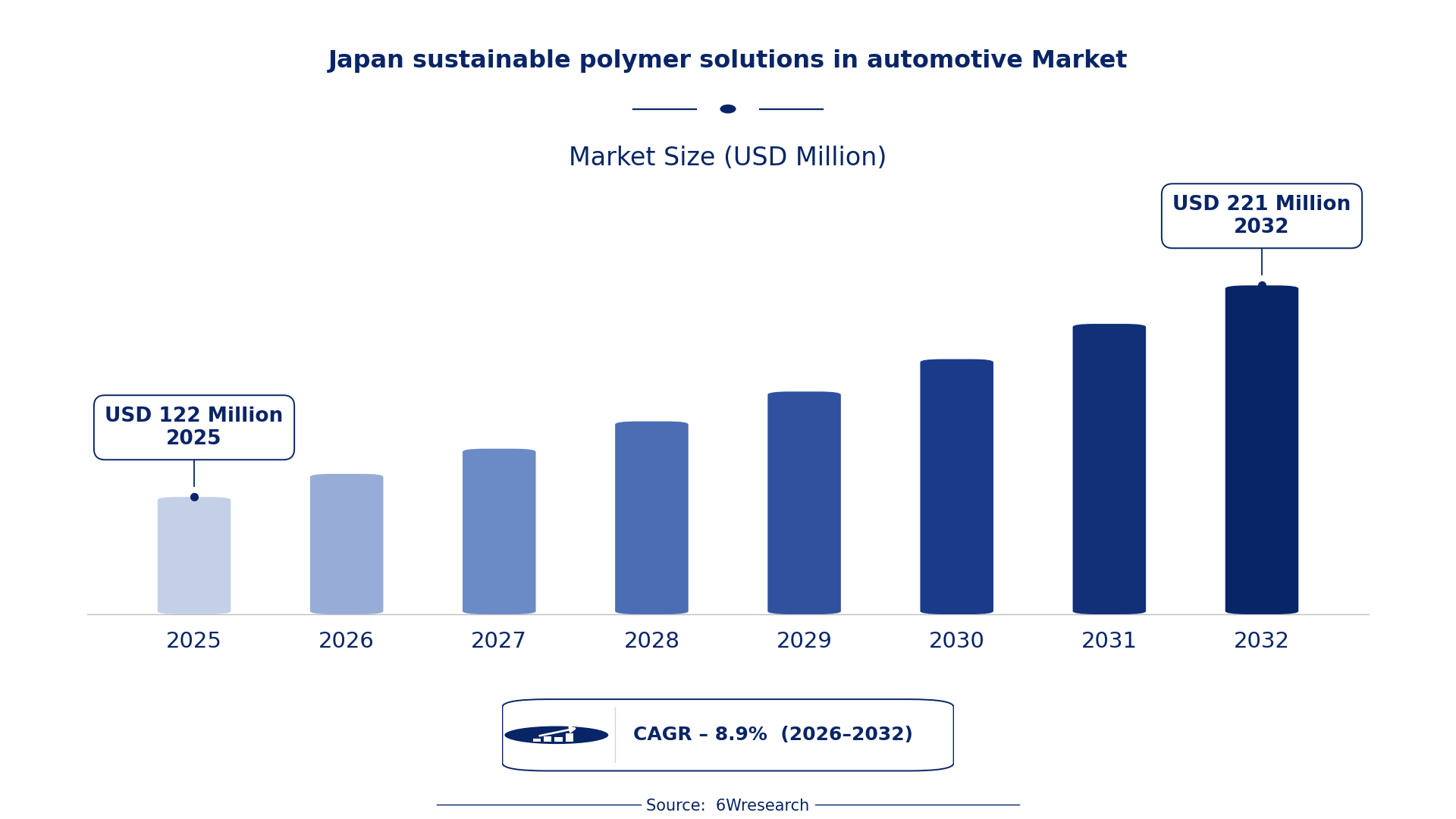
According to 6Wresearch internal database and industry insights, the Japan sustainable polymer solutions in automotive Market was valued at USD 122 Million in 2025 and is projected to reach USD 221 Million by 2032, growing at a CAGR of approximately 8.9% during 2026–2032.
Japan sustainable polymer solutions in automotive Market Highlights
| Report Metric | Details |
| Report Name | Japan sustainable polymer solutions in automotive Market (2026-2032) |
| Market Size 2025 | USD 122 Million |
| Market Size 2032 | USD 221 Million |
| Absolute Growth 2025–2032 | USD 99 Million |
| CAGR 2026–2032 | 8.9% |
| Peak Annual Growth | 9.7% in 2032 |
| Forecast Period | 2026–2032 |
| Historical Data | 2022–2025 |
| Base Year | 2025 |
| Leading Polymer Type, 2025 | Bio-Polyamide (51% share) |
| Leading Source Type, 2025 | Castor Oil (35% share) |
| Leading Component Application, 2025 | Under-the-Hood Parts (41% share) |
| Leading End User, 2025 | Car Manufacturers (52% share) |
| Fastest-Growing Polymer Type | Recycled Polypropylene (12.7% CAGR) |
| Fastest-Growing Source Type | Post-Consumer Plastics (13.5% CAGR) |
| Fastest-Growing Component Application | Interior Trims (12.0% CAGR) |
| Fastest-Growing End User | Tier 1 Suppliers (11.9% CAGR) |
| Growing Sector | automotive |
| Key End Users | Car Manufacturers, Tier 1 Suppliers, EV OEMs |
Japan sustainable polymer solutions in automotive Market Year-wise Growth Rate and Key Drivers (2022–2032)
This graph illustrates the annual growth rates of the market from 2022 to 2032, highlighting a steady upward trajectory and projected market expansion over the forecast period.
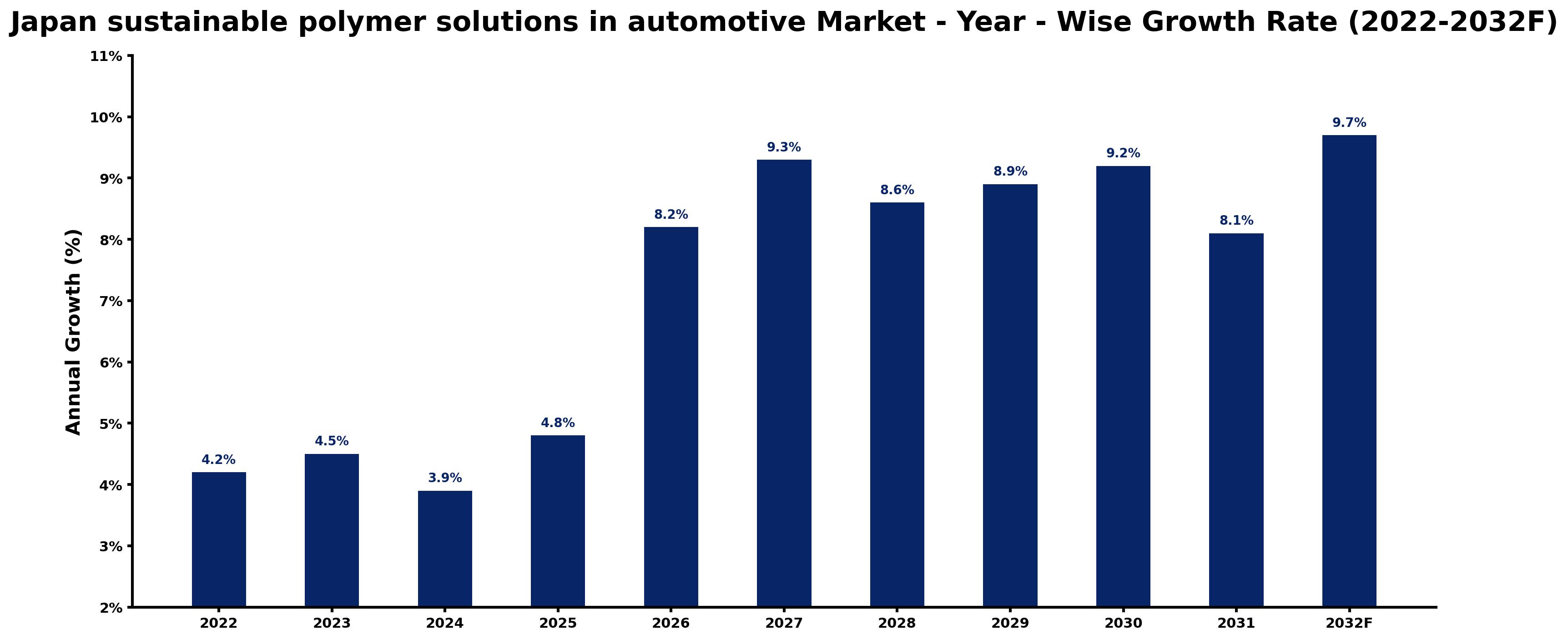
Annual growth estimates for each year appear below with the principal reason behind them, explaining the shifts that set the pace of the market.
| Year | Estimated Annual Growth (%) | Market Rationale |
| 2022 | 4.2 | The market showed steady growth due to rising environmental awareness among buyers. |
| 2023 | 4.5 | Demand increased as manufacturers adopted more sustainable practices in production. |
| 2024 | 3.9 | Growth slowed slightly as some buyers hesitated to switch to new materials. |
| 2025 | 4.8 | The market experienced a resurgence as investment in sustainable technologies rose. |
| 2026 | 8.2 | Demand is expected to surge as automotive manufacturers focus on lightweighting vehicles. |
| 2027 | 9.3 | Growth will continue with increased adoption of sustainable materials in production. |
| 2028 | 8.6 | A slight slowdown is projected as supply chain issues impact material availability. |
| 2029 | 8.9 | Demand is expected to accelerate as electric vehicle production expands. |
| 2030 | 9.2 | Growth will remain strong as manufacturers aim for carbon neutrality targets. |
| 2031 | 8.1 | A slowdown is projected as the market stabilises after rapid growth. |
| 2032 | 9.7 | The market is expected to peak as sustainable polymer solutions become mainstream. |
Note: Market size estimations and growth projections presented in this report are based on 6Wresearch's proprietary forecasting methodology, utilizing the latest available industry data, government publications, and primary research inputs.
Japan sustainable polymer solutions in automotive Market Synopsis
Sustainable polymer solutions in the automotive sector are advanced materials derived from renewable resources or recycled plastics, primarily used for lightweighting vehicles and improving fuel efficiency. The Japan sustainable polymer solutions in automotive Market is expanding due to increasing demand from car manufacturers and Tier 1 suppliers, driven by the need for eco-friendly production methods. Japan's commitment to reducing greenhouse gas emissions by 46% by 2030 and approximately JPY 150 trillion in decarbonisation investments are propelling market growth, particularly in the Tokyo region, which is a hub for automotive innovation.
Market Dynamics Impact Analysis (2026–2032)
| Factor | Type | Impact | Primary Segment Affected |
| Increasing focus on lightweight materials for fuel efficiency | Driver | High | Bio-Polyamide |
| Growing adoption of recycled materials in production processes | Driver | High | Recycled Polypropylene |
| Rising demand for sustainable materials in electric vehicles | Opportunity | High | EV OEMs |
| Expansion of recycling initiatives for automotive plastics | Opportunity | Medium | Post-Consumer Plastics |
| High costs associated with sustainable material sourcing | Restraint | High | Thermoplastic Elastomers |
| Limited performance of some sustainable materials in extreme conditions | Restraint | Medium | PLA Composites |
| Challenges in scaling production of sustainable polymers | Challenge | High | Bio-Polyamide |
| Supply chain disruptions affecting material availability | Challenge | Medium | Recycled Polypropylene |
Evaluation of Drivers in Japan sustainable polymer solutions in automotive Market (2026–2032)
The factors lifting demand, and the evidence behind each, are summarised below.
| Drivers | Primary Segment Affected | Why It Matters (Evidence) |
| Growing environmental regulations pushing for lower emissions | Bio-Polyamide | Japan's target for a 46% reduction in greenhouse gas emissions by 2030 drives demand for lightweight materials. |
| Increased investment in sustainable automotive technologies | Recycled Polypropylene | Recycled polypropylene accounted for 15% of plastics in automotive interiors in 2022, boosting demand. |
| Rising consumer preference for eco-friendly vehicles | Thermoplastic Elastomers | The shift towards electric vehicles increases the need for flexible, durable materials in automotive applications. |
| Government initiatives promoting recycling and sustainability | Post-Consumer Plastics | Recycling initiatives support the supply of sustainable materials. |
| Technological advancements in polymer production | PLA Composites | New production methods are making PLA composites more viable for automotive applications. |
What keeps demand rising is the increasing focus on lightweight materials, as automotive manufacturers prioritise sustainability to meet environmental targets. In 2022, recycled polypropylene accounted for 15% of plastics used in automotive interiors, reflecting a shift towards sustainable solutions. The rising consumer preference for eco-friendly vehicles has led to greater adoption of thermoplastic elastomers, crucial for flexible components. Technological advancements are also making PLA composites more viable, further driving demand in the automotive sector. For instance, the Tokyo region is becoming a centre for innovation in sustainable materials, shaping the market.
Evaluation of Restraints in Japan sustainable polymer solutions in automotive Market
These are the pressures that could keep growth below its potential.
| Market Restraint | Primary Segment Affected | Why It Matters (Evidence) |
| High costs associated with sourcing sustainable materials | Thermoplastic Elastomers | The premium pricing of sustainable materials can deter some manufacturers from adopting them. |
| Limited performance of PLA composites in demanding applications | PLA Composites | Performance constraints restrict the use of PLA composites in high-stress automotive parts. |
| Challenges in scaling production of sustainable polymers | Bio-Polyamide | Production limitations can hinder the availability of bio-polyamide for automotive applications. |
| Supply chain disruptions affecting material availability | Recycled Polypropylene | Global supply chain issues have led to inconsistent availability of recycled materials. |
| Regulatory hurdles in material certification processes | Post-Consumer Plastics | Complex certification requirements can delay the introduction of new sustainable materials. |
Japan sustainable polymer solutions in automotive Market Challenges
Automotive manufacturers face supply challenges due to limited domestic sources of sustainable polymers, increasing production costs by 20%. Suppliers encounter fierce competition from international markets, which can delay product availability by three months for local manufacturers. Raw material price volatility, especially in recycled plastics, can elevate production costs by 15%, impacting profit margins for producers. A shortage of skilled workers in advanced polymer processing technologies restricts suppliers' ability to meet growing demand, hindering the integration of sustainable materials in automotive applications.
Trends in the Japan sustainable polymer solutions in automotive Market
The shifts below are changing how Japan sustainable polymer solutions in automotive Market products are bought and supplied.
- Shift towards Lightweight Vehicle Manufacturing: Car manufacturers are increasingly prioritising lightweight materials to improve fuel efficiency, with the Tokyo region leading innovations in this area. In 2022, Japan's automotive sector produced 8.3 million vehicles, reflecting this trend.
- Transition from Conventional to Sustainable Materials: Since 2021, the adoption of sustainable polymers has accelerated, driven by the Plastic Resource Circulation Act. This act promotes the use of biomass and biodegradable plastics, encouraging manufacturers to innovate.
- Post-Consumer Plastics Gaining Traction: The use of post-consumer plastics in automotive applications is expanding, supported by government recycling initiatives. In 2022, these materials accounted for a significant portion of automotive components.
- Interior Trims Emphasising Sustainability: The trend towards sustainable interior trims began in 2023, with manufacturers exploring new materials. Approximately 15% of plastics used in automotive interiors were recycled, indicating a shift in production practices.
Investment Opportunities in the Japan sustainable polymer solutions in automotive Market
Investors looking at the Japan sustainable polymer solutions in automotive Market should consider the following areas.
- Growing Demand for Lightweight Materials: With Japan targeting a 46% reduction in emissions by 2030, there is a notable gap in lightweight material supply. Car manufacturers are increasingly seeking partnerships to develop sustainable solutions.
- Expansion of Recycling Initiatives: The Ministry of the Environment's recycling initiatives create opportunities for suppliers of recycled materials. The automotive sector is looking for local partners to enhance material sourcing.
- Investment in Sustainable Technologies: The automotive industry is projected to invest approximately JPY 150 trillion in decarbonisation over the next decade. Tier 1 suppliers are well-positioned to provide innovative solutions.
- Emergence of New Production Facilities: New production facilities focusing on sustainable polymers are being established, backed by government support. Collaborating with local manufacturers can facilitate market entry.
Government Initiatives in the Japan sustainable polymer solutions in automotive Market
The Plastic Resource Circulation Act, enacted in 2021, impacts buyers by promoting the reduction, reuse, and recycling of plastics in automotive applications. This law encourages manufacturers to adopt sustainable practices and explore alternatives like biomass and biodegradable plastics, ultimately improving their product offerings. In addition, the GX Promotion Act, introduced in 2023, provides a framework for achieving carbon neutrality and supports investments in sustainable technologies, which benefits automotive manufacturers looking to comply with environmental standards.
The Battery Industry Strategy, initiated by METI in August 2022, aims to boost domestic battery manufacturing capacity significantly by 2030. This strategy supports the automotive sector's transition to electric vehicles, providing funding for innovative projects and improving the supply chain for sustainable materials. The Ministry of the Environment oversees these initiatives, ensuring alignment with national sustainability goals.
Future Insight of the Japan sustainable polymer solutions in automotive Market
The establishment of advanced recycling facilities will enhance the supply of eco-friendly polymers in the automotive sector. By 2032, the use of recycled plastics in automotive interiors will account for 30% of total materials. The government's Green Growth Strategy will drive manufacturers to adopt sustainable practices and adhere to ISO 14001 standards. As the Tokyo region strengthens its position as a hub for automotive innovation, collaboration between suppliers and local manufacturers will accelerate the development of next-generation materials.
Market Segmentation Analysis
Japan sustainable polymer solutions in automotive Market report covers a detailed analysis of the following market segments:
By Polymer Type – Bio-Polyamide Leads, Recycled Polypropylene Expected to Grow Fastest
According to Saurav Kr Singh, Senior Research Analyst at 6Wresearch, Bio-Polyamide held 51% of the Japan sustainable polymer solutions in automotive Market by polymer type in 2025. Bio-polyamide holds the largest share due to its use in high-performance automotive parts that demand strength and durability. Its application in engine covers illustrates its essential role in the automotive market. Recycled Polypropylene is set to record the highest CAGR in this split, 12.7% over 2026–2032. Recycled polypropylene is rapidly growing as it is increasingly utilised for cost-effective and sustainable automotive components, with 15% of automotive interiors made from this material in 2022. This trend reflects a commitment to recycling initiatives promoted by the Ministry of the Environment. Suppliers should focus on enhancing the availability of bio-polyamide and recycled polypropylene to meet rising demand.
By Source Type – Castor Oil Leads, Post-Consumer Plastics Expected to Grow Fastest
Castor Oil accounted for 35% of the market by source type in 2025. Castor oil is the leading source type as it serves as a bio-based feedstock for sustainable polymer solutions, albeit not as a primary component. Its role aligns with Japan's decarbonisation goals and supports the industry's eco-friendly initiatives. Post-Consumer Plastics are projected to grow fastest, at a CAGR of 13.5% during 2026–2032. Post-consumer plastics are the fastest-growing source type, significantly contributing to recycling efforts in automotive applications. This growth is driven by the increasing emphasis on sustainability in the industry, supported by government initiatives. Buyers are likely to prioritise suppliers who can provide post-consumer plastics to align with sustainability targets.
By Component Application – Under-the-Hood Parts Lead, Interior Trims Expected to Grow Fastest
With 41% of component application revenue in 2025, Under-the-Hood Parts was the largest category. Under-the-hood parts represent the largest share because they are critical for engine components that require heat resistance, making them essential for vehicle performance. The demand for durable materials in these applications drives the adoption of sustainable polymers. The quickest growth will come from Interior Trims, forecast to expand at a CAGR of 12.0% between 2026 and 2032. Interior trims are the fastest-growing application as they are commonly made from sustainable polymers, enhancing vehicle aesthetics while meeting environmental standards. This trend is likely to continue as manufacturers seek to improve the consumer appeal of their vehicles. Suppliers must innovate in sustainable materials for interior trims to capitalise on this growing demand.
By End User – Car Manufacturers Lead, Tier 1 Suppliers Expected to Grow Fastest
The largest end user category in 2025 was Car Manufacturers, at 52% of revenue. Car manufacturers dominate the market as they are the primary users of sustainable polymers for vehicle production, reflecting the industry's shift towards eco-friendly practices. Their substantial production volume of 8.3 million vehicles in 2022 underscores this trend. Over 2026–2032, Tier 1 Suppliers are expected to post the fastest growth, at a CAGR of 11.9%. Tier 1 suppliers are the fastest-growing end user group as they increasingly supply sustainable components to OEMs, reflecting a shift in supply chain dynamics. This growth is supported by the rising investment in sustainable materials within the automotive sector. Suppliers should strengthen relationships with Tier 1 suppliers to ensure their products meet the evolving needs of car manufacturers.
Key Attractiveness of the Report
- 10 Years of Market Numbers
- Historical Data Starting from 2022 to 2025
- Base Year 2025
- Forecast Data until 2032
- Key Performance Indicators Impacting the Market
- Major Upcoming Developments and Projects
Key Highlights of the Report:
- Japan sustainable polymer solutions in automotive Market Outlook
- Market Size of Japan sustainable polymer solutions in automotive Market, 2025
- Forecast of Japan sustainable polymer solutions in automotive Market, 2032
- Historical Data and Forecast of Japan sustainable polymer solutions in automotive Revenues & Volume for the Period 2022-2032F
- Japan sustainable polymer solutions in automotive Market Trend Evolution
- Japan sustainable polymer solutions in automotive Market Drivers and Challenges
- Japan sustainable polymer solutions in automotive Price Trends
- Japan sustainable polymer solutions in automotive Porter's Five Forces
- Japan sustainable polymer solutions in automotive Industry Life Cycle
- Historical Data and Forecast of Japan sustainable polymer solutions in automotive Market Revenues & Volume By Polymer Type for the Period 2022-2032F
- Historical Data and Forecast of Japan sustainable polymer solutions in automotive Market Revenues & Volume By Bio-Polyamide for the Period 2022-2032F
- Historical Data and Forecast of Japan sustainable polymer solutions in automotive Market Revenues & Volume By Recycled Polypropylene for the Period 2022-2032F
- Historical Data and Forecast of Japan sustainable polymer solutions in automotive Market Revenues & Volume By Thermoplastic Elastomers for the Period 2022-2032F
- Historical Data and Forecast of Japan sustainable polymer solutions in automotive Market Revenues & Volume By PLA Composites for the Period 2022-2032F
- Historical Data and Forecast of Japan sustainable polymer solutions in automotive Market Revenues & Volume By Source Type for the Period 2022-2032F
- Historical Data and Forecast of Japan sustainable polymer solutions in automotive Market Revenues & Volume By Castor Oil for the Period 2022-2032F
- Historical Data and Forecast of Japan sustainable polymer solutions in automotive Market Revenues & Volume By Post-Consumer Plastics for the Period 2022-2032F
- Historical Data and Forecast of Japan sustainable polymer solutions in automotive Market Revenues & Volume By Hybrid Recyclables for the Period 2022-2032F
- Historical Data and Forecast of Japan sustainable polymer solutions in automotive Market Revenues & Volume By Corn-Based Blends for the Period 2022-2032F
- Historical Data and Forecast of Japan sustainable polymer solutions in automotive Market Revenues & Volume By Component Application for the Period 2022-2032F
- Historical Data and Forecast of Japan sustainable polymer solutions in automotive Market Revenues & Volume By Under-the-Hood Parts for the Period 2022-2032F
- Historical Data and Forecast of Japan sustainable polymer solutions in automotive Market Revenues & Volume By Interior Trims for the Period 2022-2032F
- Historical Data and Forecast of Japan sustainable polymer solutions in automotive Market Revenues & Volume By Seals, Gaskets for the Period 2022-2032F
- Historical Data and Forecast of Japan sustainable polymer solutions in automotive Market Revenues & Volume By Dashboard Panels for the Period 2022-2032F
- Historical Data and Forecast of Japan sustainable polymer solutions in automotive Market Revenues & Volume By End User for the Period 2022-2032F
- Historical Data and Forecast of Japan sustainable polymer solutions in automotive Market Revenues & Volume By Car Manufacturers for the Period 2022-2032F
- Historical Data and Forecast of Japan sustainable polymer solutions in automotive Market Revenues & Volume By Tier 1 Suppliers for the Period 2022-2032F
- Historical Data and Forecast of Japan sustainable polymer solutions in automotive Market Revenues & Volume By EV OEMs for the Period 2022-2032F
- Historical Data and Forecast of Japan sustainable polymer solutions in automotive Market Revenues & Volume By Lightweight Vehicle OEMs for the Period 2022-2032F
- Japan sustainable polymer solutions in automotive Import Export Trade Statistics
- Market Opportunity Assessment By Polymer Type
- Market Opportunity Assessment By Source Type
- Market Opportunity Assessment By Component Application
- Market Opportunity Assessment By End User
- Japan sustainable polymer solutions in automotive Top Companies Market Share
- Japan sustainable polymer solutions in automotive Competitive Benchmarking By Technical and Operational Parameters
- Japan sustainable polymer solutions in automotive Company Profiles
- Japan sustainable polymer solutions in automotive Key Strategic Recommendations
Market Covered
Segments analysed in this report are listed below.
By Polymer Type
- Bio-Polyamide
- Recycled Polypropylene
- Thermoplastic Elastomers
- PLA Composites
By Source Type
- Castor Oil
- Post-Consumer Plastics
- Hybrid Recyclables
- Corn-Based Blends
By Component Application
- Under-the-Hood Parts
- Interior Trims
- Seals
- Gaskets
- Dashboard Panels
By End User
- Car Manufacturers
- Tier 1 Suppliers
- EV OEMs
- Lightweight Vehicle OEMs































