Japan Sustainable Power Market Size & Growth Rate
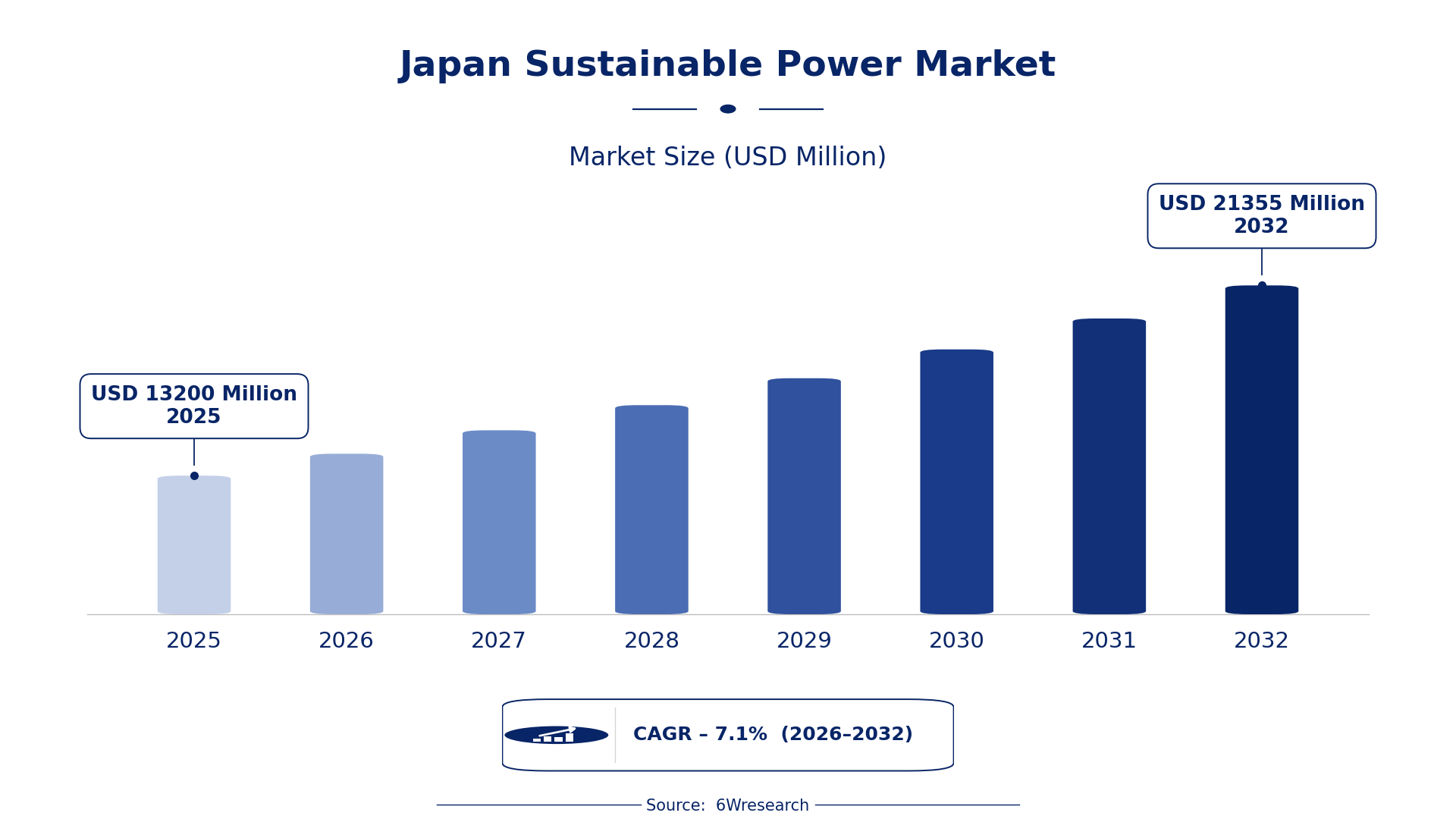
According to 6Wresearch internal database and industry insights, the Japan Sustainable Power Market was valued at USD 13,200 Million in 2025 and is projected to reach USD 21,355 Million by 2032, growing at a CAGR of approximately 7.1% during 2026–2032.
Japan Sustainable Power Market Highlights
| Report Metric | Details |
| Report Name | Japan Sustainable Power Market (2026-2032) |
| Market Size 2025 | USD 13,200 Million |
| Market Size 2032 | USD 21,355 Million |
| Absolute Growth 2025–2032 | USD 8,155 Million |
| CAGR 2026–2032 | 7.1% |
| Peak Annual Growth | 8.2% in 2027 |
| Forecast Period | 2026–2032 |
| Historical Data | 2022–2025 |
| Base Year | 2025 |
| Leading Power Source, 2025 | Solar (37% share) |
| Leading Generation Type, 2025 | PV Modules (42% share) |
| Leading Application Use, 2025 | Rooftop/Utility Scale (50% share) |
| Leading End User, 2025 | Power Utilities (41% share) |
| Fastest-Growing Power Source | Wind (10.2% CAGR) |
| Fastest-Growing Generation Type | Onshore/Offshore (9.9% CAGR) |
| Fastest-Growing End User | Bioenergy Operators (9.4% CAGR) |
| Growing Sector | Renewable Energy |
| Key End Users | Energy Retailers, Power Utilities, Bioenergy Operators |
Japan Sustainable Power Market Year-wise Growth Rate and Key Drivers (2022–2032)
This graph illustrates the annual growth rates of the market from 2022 to 2032, highlighting a steady upward trajectory and projected market expansion over the forecast period.
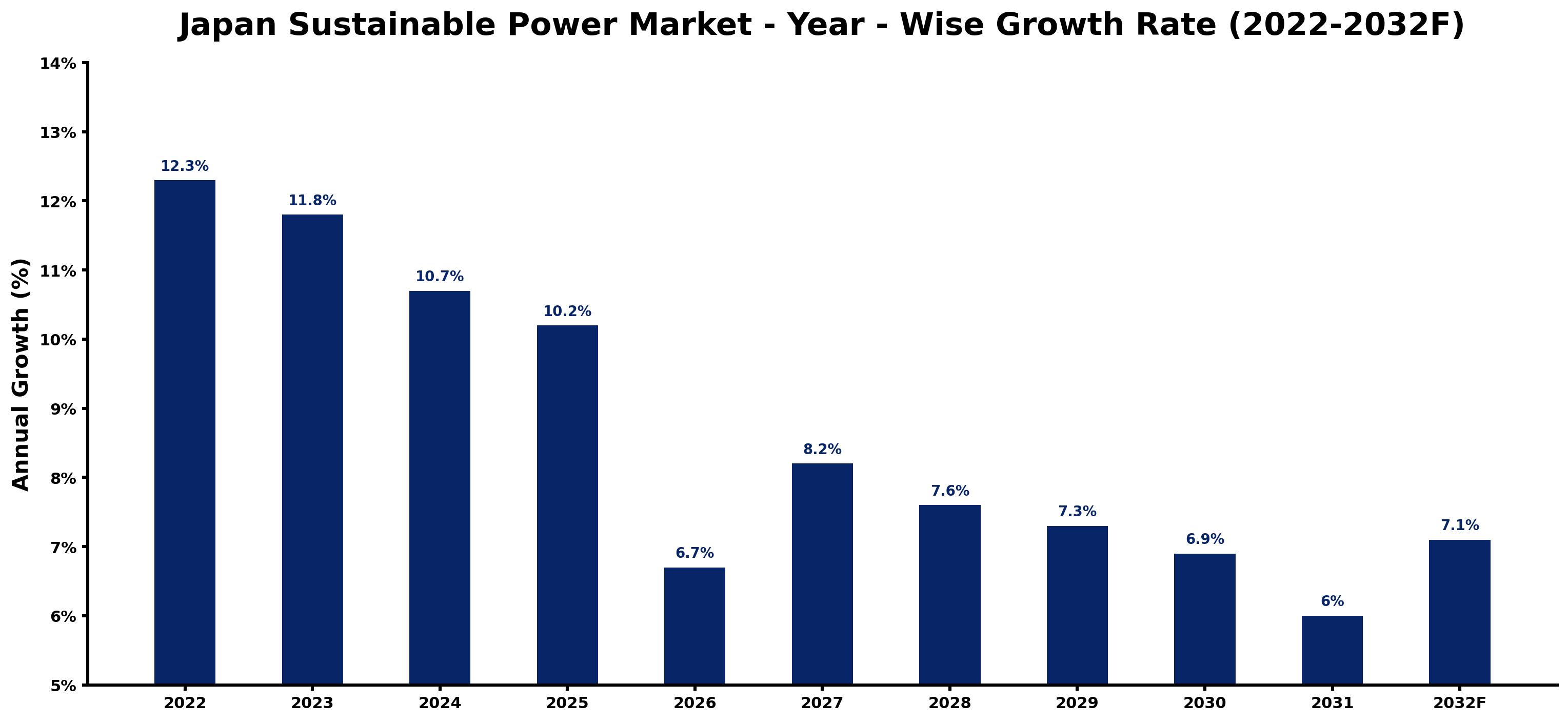
The following figures match every annual growth estimate with the main market development of that year, giving the reasoning behind each rise or slowdown.
| Year | Estimated Annual Growth (%) | Market Rationale |
| 2022 | 12.3 | The market experienced strong demand due to increased renewable energy initiatives. |
| 2023 | 11.8 | Growth slowed as the market adjusted to previous high levels of investment. |
| 2024 | 10.7 | Investment in renewable technologies continued to support positive growth rates. |
| 2025 | 10.2 | Government incentives for renewable energy projects supported market expansion. |
| 2026 | 6.7 | Growth is expected to slow as the market stabilises after rapid expansion. |
| 2027 | 8.2 | The market is projected to accelerate due to new offshore wind projects. |
| 2028 | 7.6 | Growth will slow as the market reaches a more mature phase. |
| 2029 | 7.3 | Demand is expected to remain steady, supported by ongoing renewable energy commitments. |
| 2030 | 6.9 | The market is projected to grow as Japan targets ambitious renewable goals. |
| 2031 | 6.0 | Growth is expected to slow as the market stabilises, reflecting a mature energy sector. |
| 2032 | 7.1 | The market is anticipated to rise again with increased investments in wind energy. |
Note: Market size estimations and growth projections presented in this report are based on 6Wresearch's proprietary forecasting methodology, utilizing the latest available industry data, government publications, and primary research inputs.
Japan Sustainable Power Market Synopsis
Sustainable power in Japan primarily encompasses renewable energy sources such as solar, wind, biomass, and geothermal. The Japan Sustainable Power Market is growing, with solar power capacity reaching 74 GW in 2022. This expansion is propelled by government initiatives, including the GX Basic Policy, which targets JPY 150 trillion of public and private investment over ten years and aims for 36-38% of energy from renewables by 2030.
Market Dynamics Impact Analysis (2026–2032)
| Factor | Type | Impact | Primary Segment Affected |
| Government incentives for renewable energy projects drive demand for sustainable power solutions. | Driver | High | Solar |
| Increased public and private investments in decarbonisation create opportunities for new projects. | Driver | High | Wind |
| The need for energy security and carbon reduction presents opportunities for biomass utilization. | Opportunity | High | Biomass |
| Growing urbanisation creates demand for rooftop solar installations in metropolitan areas. | Opportunity | High | Rooftop/Utility Scale |
| High initial investment costs for renewable energy technologies can deter adoption. | Restraint | High | Geothermal |
| Limited awareness of biomass energy benefits restricts market growth. | Restraint | Medium | Biomass |
| Regulatory complexities can delay project approvals and increase costs. | Challenge | High | Wind |
| Competition from traditional energy sources can hinder renewable energy adoption. | Challenge | Medium | Solar |
Evaluation of Drivers in Japan Sustainable Power Market (2026–2032)
The table below links each growth driver to the segment it affects and the evidence for it.
| Drivers | Primary Segment Affected | Why It Matters (Evidence) |
| Government incentives for renewable energy projects boost demand for solar installations. | Solar | The Feed-in Tariff program has supported solar energy projects since 2012, leading to increased installations. |
| Public and private investments in decarbonisation drive wind energy capacity. | Wind | Japan targets JPY 150 trillion in investments over ten years, promoting wind energy projects. |
| Rooftop solar solutions are increasingly sought after in urban areas. | Rooftop/Utility Scale | Tokyo is a leading region for solar energy installations, reflecting urban demand for renewable solutions. |
| Biomass energy offers a sustainable solution for waste management and energy generation. | Biomass | Japan has over 1,000 operational biomass power plants, highlighting the growing interest in this sector. |
| Technological advancements in renewable energy systems improve efficiency and reduce costs. | Geothermal | The adoption of the JIS Q 14001 standard promotes environmental management in energy projects. |
Volumes grow on the back of investments in renewable energy technologies, with Japan targeting a 46% reduction in greenhouse gas emissions by 2030. The presence of over 1,000 biomass power plants demonstrates the sector's potential, while advancements in efficiency encourage more buyers to adopt these solutions. Urbanisation in regions like Tokyo has increased demand for rooftop solar installations, reflecting a shift towards sustainable energy sources.
Evaluation of Restraints in Japan Sustainable Power Market
The table below lists the restraints and the evidence behind each.
| Market Restraint | Primary Segment Affected | Why It Matters (Evidence) |
| High initial investment costs for renewable energy technologies can deter adoption. | Geothermal | The cost of implementing geothermal systems can be prohibitive for many potential users. |
| Limited awareness of biomass energy benefits restricts market growth. | Biomass | Many stakeholders remain unaware of the advantages of biomass, hindering wider adoption. |
| Regulatory complexities can delay project approvals and increase costs. | Wind | Navigating regulatory requirements can prolong project timelines, impacting investment returns. |
| Competition from traditional energy sources can hinder renewable energy adoption. | Solar | Established fossil fuel markets often provide cheaper energy alternatives, limiting solar's appeal. |
| Supply chain disruptions can affect the availability of renewable energy components. | PV Modules | Global supply chain issues have led to delays in the procurement of essential solar components. |
Japan Sustainable Power Market Challenges
Tokyo's solar energy installations confront high initial costs, with average setup expenses reaching JPY 200,000 per kW, delaying project initiation for developers. Urban expansion intensifies competition for land use, resulting in increased leasing costs that can rise by 15% annually, affecting project viability for producers. Buyers face limited energy options as the government targets 36-38% of energy from renewables by 2030, potentially restricting access to diverse sources. Technology adoption lags, with only 4.2 GW of wind capacity in 2023, hindering growth for suppliers who must innovate to meet demand.
Trends in the Japan Sustainable Power Market
Several trends are reshaping the Japan Sustainable Power Market; the most important are set out below.
- Shift from Conventional to Renewable Energy Sources: Japan is increasingly transitioning to renewable energy sources, with solar capacity reaching 74 GW in 2022. This shift reflects a growing commitment to sustainability and reducing carbon emissions.
- Growth in Offshore Wind Energy Projects: Japan's energy transition plan includes investments in offshore wind, aiming to significantly expand capacity. The government targets an increase beyond 4.2 GW in 2023 to meet future energy demands.
- Advancements in Biomass Technologies: The Ministry of the Environment's biomass utilisation program launched in 2023 aims to improve biomass energy production. This initiative is expected to boost the efficiency of biomass power plants across Japan.
- Increase in Rooftop Solar Installations: Rooftop solar installations are becoming more common, especially in urban areas like Tokyo, where demand for renewable energy solutions is high. The market for rooftop solar is projected to grow as urbanisation continues.
Investment Opportunities in the Japan Sustainable Power Market
Investors looking at the Japan Sustainable Power Market should consider the following areas.
- Form Partnerships with Local Firms for Renewable Projects: Now is the time to invest in renewable energy technologies, as Japan targets JPY 150 trillion in decarbonisation investments. Collaborating with local energy retailers can facilitate market entry.
- Provide Advanced Solar Technologies: The demand for solar energy solutions is rising, with solar power capacity reaching 74 GW in 2022. Suppliers can focus on delivering innovative PV modules to meet this demand.
- Invest in Offshore Wind Energy: With Japan's wind energy capacity at approximately 4.2 GW in 2023, there is a substantial opportunity for investment in offshore wind projects. Engaging with power utilities can strengthen market presence.
- Leverage Government Incentives for Biomass: The biomass utilisation program launched in 2023 presents a unique opportunity for investment. Suppliers can offer advanced biomass technologies to support energy generation and waste management.
Government Initiatives in the Japan Sustainable Power Market
The GX Promotion Act, adopted in 2023, builds on previous energy efficiency laws by establishing a stronger legal framework for decarbonisation. This new law aims to drive substantial investments in renewable energy projects, ensuring compliance with national targets, including a 46% reduction in greenhouse gas emissions by 2030.
Energy retailers are utilising the GX Basic Policy to secure funding for renewable energy projects. The Agency for Natural Resources and Energy oversees these initiatives, facilitating approvals for innovative energy solutions and promoting compliance with the Renewable Energy Standard.
Future Insight of the Japan Sustainable Power Market
By 2032, buyers will experience greater access to sustainable power as the biomass utilisation program launched in 2023 expands operational plants significantly. Japan's investment in offshore wind will triple capacity, creating new opportunities for suppliers. The Renewable Energy Standard will drive compliance and innovation, ensuring sustainable practices across the industry. Advanced grid technologies will facilitate better integration of diverse energy sources, benefiting both buyers and suppliers.
Market Segmentation Analysis
Japan Sustainable Power Market report covers a detailed analysis of the following market segments:
By Power Source – Solar Leads, Wind Expected to Grow Fastest
According to Saurav Kr Singh, Senior Research Analyst at 6Wresearch, the largest power source category in 2025 was Solar, at 37% of revenue. Solar power holds the largest share in Japan as it is extensively utilised for residential and commercial energy generation, particularly in regions like Tokyo where installations are prevalent. The solar capacity reached 74 GW in 2022, reflecting strong market demand supported by government incentives. Wind is projected to grow fastest, at a CAGR of 10.2% during 2026–2032. Wind energy is poised for rapid growth due to Japan's significant investments in offshore projects, which aim to diversify the energy mix. The government's energy transition plan includes substantial funding to enhance wind capacity, driving its swift expansion. Suppliers should focus on advancing solar and wind technologies to meet the rising demand in Japan.
By Generation Type – PV Modules Lead, Onshore/Offshore Expected to Grow Fastest
With 42% of generation type revenue in 2025, PV Modules was the largest category. PV modules dominate the market as essential components for solar energy systems, facilitating widespread solar adoption across various applications. Their critical role in harnessing solar energy has established their presence in both residential and commercial sectors. Onshore/Offshore is set to record the highest CAGR in this split, 9.9% over 2026–2032. Onshore and offshore wind generation types are rapidly expanding, driven by Japan's commitment to increasing renewable energy sources, particularly offshore wind. This growth is supported by government initiatives aimed at enhancing wind energy capacity. Buyers must invest in advanced PV modules and wind generation technologies to stay competitive in the evolving market.
By Application Use – Rooftop/Utility Scale Leads and Records the Fastest Growth
Rooftop/Utility Scale accounted for 50% of the market by application use in 2025. Rooftop and utility-scale applications lead the market as they offer effective solutions for urban and rural energy needs, addressing both residential and commercial sectors. This widespread adoption is bolstered by government incentives and the urgent need for sustainable energy solutions. Its lead should widen, with a projected CAGR of 8.9% during 2026–2032, the highest in this split. Rooftop and utility-scale applications are also the fastest-growing segment, propelled by increasing urbanisation and rising energy security concerns. The ongoing push for renewable energy adoption ensures this segment's sustained growth trajectory. Suppliers should prioritise innovations in rooftop and utility-scale solutions to capitalise on emerging market opportunities.
By End User – Power Utilities Lead, Bioenergy Operators Expected to Grow Fastest
Power Utilities held 41% of the Japan Sustainable Power Market by end user in 2025. Power utilities are the largest end users as they play a crucial role in integrating sustainable power into the national grid, ensuring a reliable energy supply. Their involvement is vital for achieving Japan's ambitious renewable energy targets and facilitating the transition to sustainable sources. The quickest growth will come from Bioenergy Operators, forecast to expand at a CAGR of 9.4% between 2026 and 2032. Bioenergy operators are experiencing rapid growth as they focus on biomass energy production, supported by new government initiatives promoting biomass utilisation. This sector's expansion reflects the increasing emphasis on diverse renewable energy sources. Buyers in the energy sector should consider partnerships with bioenergy operators to diversify their renewable energy portfolios.
Key Attractiveness of the Report
- 10 Years of Market Numbers
- Historical Data Starting from 2022 to 2025
- Base Year 2025
- Forecast Data until 2032
- Key Performance Indicators Impacting the Market
- Major Upcoming Developments and Projects
Key Highlights of the Report:
- Japan Sustainable Power Market Outlook
- Market Size of Japan Sustainable Power Market, 2025
- Forecast of Japan Sustainable Power Market, 2032
- Historical Data and Forecast of Japan Sustainable Power Revenues & Volume for the Period 2022-2032F
- Japan Sustainable Power Market Trend Evolution
- Japan Sustainable Power Market Drivers and Challenges
- Japan Sustainable Power Price Trends
- Japan Sustainable Power Porter's Five Forces
- Japan Sustainable Power Industry Life Cycle
- Historical Data and Forecast of Japan Sustainable Power Market Revenues & Volume By Power Source for the Period 2022-2032F
- Historical Data and Forecast of Japan Sustainable Power Market Revenues & Volume By Solar for the Period 2022-2032F
- Historical Data and Forecast of Japan Sustainable Power Market Revenues & Volume By Wind for the Period 2022-2032F
- Historical Data and Forecast of Japan Sustainable Power Market Revenues & Volume By Biomass for the Period 2022-2032F
- Historical Data and Forecast of Japan Sustainable Power Market Revenues & Volume By Geothermal for the Period 2022-2032F
- Historical Data and Forecast of Japan Sustainable Power Market Revenues & Volume By Generation Type for the Period 2022-2032F
- Historical Data and Forecast of Japan Sustainable Power Market Revenues & Volume By PV Modules for the Period 2022-2032F
- Historical Data and Forecast of Japan Sustainable Power Market Revenues & Volume By Onshore/Offshore for the Period 2022-2032F
- Historical Data and Forecast of Japan Sustainable Power Market Revenues & Volume By Anaerobic Digesters for the Period 2022-2032F
- Historical Data and Forecast of Japan Sustainable Power Market Revenues & Volume By Binary Cycle for the Period 2022-2032F
- Historical Data and Forecast of Japan Sustainable Power Market Revenues & Volume By Application Use for the Period 2022-2032F
- Historical Data and Forecast of Japan Sustainable Power Market Revenues & Volume By Rooftop/Utility Scale for the Period 2022-2032F
- Historical Data and Forecast of Japan Sustainable Power Market Revenues & Volume By Grid-Connected for the Period 2022-2032F
- Historical Data and Forecast of Japan Sustainable Power Market Revenues & Volume By Rural Power Generation for the Period 2022-2032F
- Historical Data and Forecast of Japan Sustainable Power Market Revenues & Volume By Industrial Heat Supply for the Period 2022-2032F
- Historical Data and Forecast of Japan Sustainable Power Market Revenues & Volume By End User for the Period 2022-2032F
- Historical Data and Forecast of Japan Sustainable Power Market Revenues & Volume By Energy Retailers for the Period 2022-2032F
- Historical Data and Forecast of Japan Sustainable Power Market Revenues & Volume By Power Utilities for the Period 2022-2032F
- Historical Data and Forecast of Japan Sustainable Power Market Revenues & Volume By Bioenergy Operators for the Period 2022-2032F
- Historical Data and Forecast of Japan Sustainable Power Market Revenues & Volume By High Energy Users for the Period 2022-2032F
- Japan Sustainable Power Import Export Trade Statistics
- Market Opportunity Assessment By Power Source
- Market Opportunity Assessment By Generation Type
- Market Opportunity Assessment By Application Use
- Market Opportunity Assessment By End User
- Japan Sustainable Power Top Companies Market Share
- Japan Sustainable Power Competitive Benchmarking By Technical and Operational Parameters
- Japan Sustainable Power Company Profiles
- Japan Sustainable Power Key Strategic Recommendations
Market Covered
The following segment groups are covered in the report.
By Power Source
- Solar
- Wind
- Biomass
- Geothermal
By Generation Type
- PV Modules
- Onshore/Offshore
- Anaerobic Digesters
- Binary Cycle
By Application Use
- Rooftop/Utility Scale
- Grid-Connected
- Rural Power Generation
- Industrial Heat Supply
By End User
- Energy Retailers
- Power Utilities
- Bioenergy Operators
- High Energy Users































