Japan Sustainable Products Market Size & Growth Rate
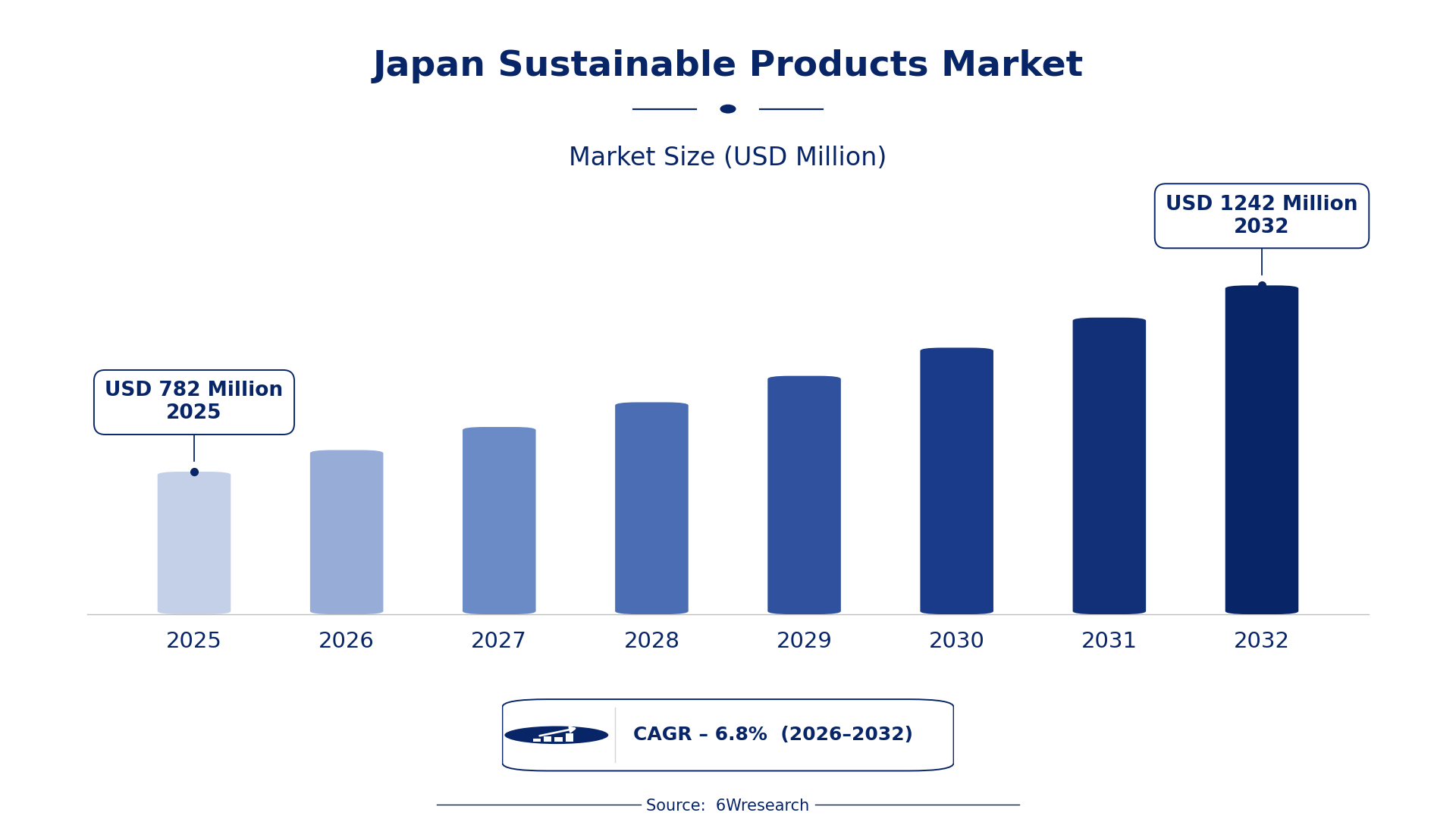
According to 6Wresearch internal database and industry insights, the Japan Sustainable Products Market was valued at USD 782 Million in 2025 and is projected to reach USD 1,242 Million by 2032, growing at a CAGR of approximately 6.8% during 2026–2032.
Japan Sustainable Products Market Highlights
| Report Metric | Details |
| Report Name | Japan Sustainable Products Market (2026-2032) |
| Market Size 2025 | USD 782 Million |
| Market Size 2032 | USD 1,242 Million |
| Absolute Growth 2025–2032 | USD 460 Million |
| CAGR 2026–2032 | 6.8% |
| Peak Annual Growth | 8.6% in 2031 |
| Forecast Period | 2026–2032 |
| Historical Data | 2022–2025 |
| Base Year | 2025 |
| Leading Product Category, 2025 | Eco-Friendly Apparel (35% share) |
| Leading Core Attribute, 2025 | Recycled/Reclaimed Material (48% share) |
| Leading Packaging Type, 2025 | Paper or Bioplastic Wraps (43% share) |
| Leading End User, 2025 | Zero-Waste Retailers (51% share) |
| Fastest-Growing Product Category | Reusable Home Goods (10.1% CAGR) |
| Fastest-Growing Core Attribute | Natural/Organic Fibers (10.0% CAGR) |
| Fastest-Growing Packaging Type | FSC Box + Eco-Inks (9.8% CAGR) |
| Fastest-Growing End User | Sustainable Fashion (9.1% CAGR) |
| Growing Sector | Eco-Friendly Apparel |
| Key End Users | Zero-Waste Retailers, Sustainable Fashion, Beauty Retailers |
Japan Sustainable Products Market Year-wise Growth Rate and Key Drivers (2022–2032)
This graph illustrates the annual growth rates of the market from 2022 to 2032, highlighting a steady upward trajectory and projected market expansion over the forecast period.
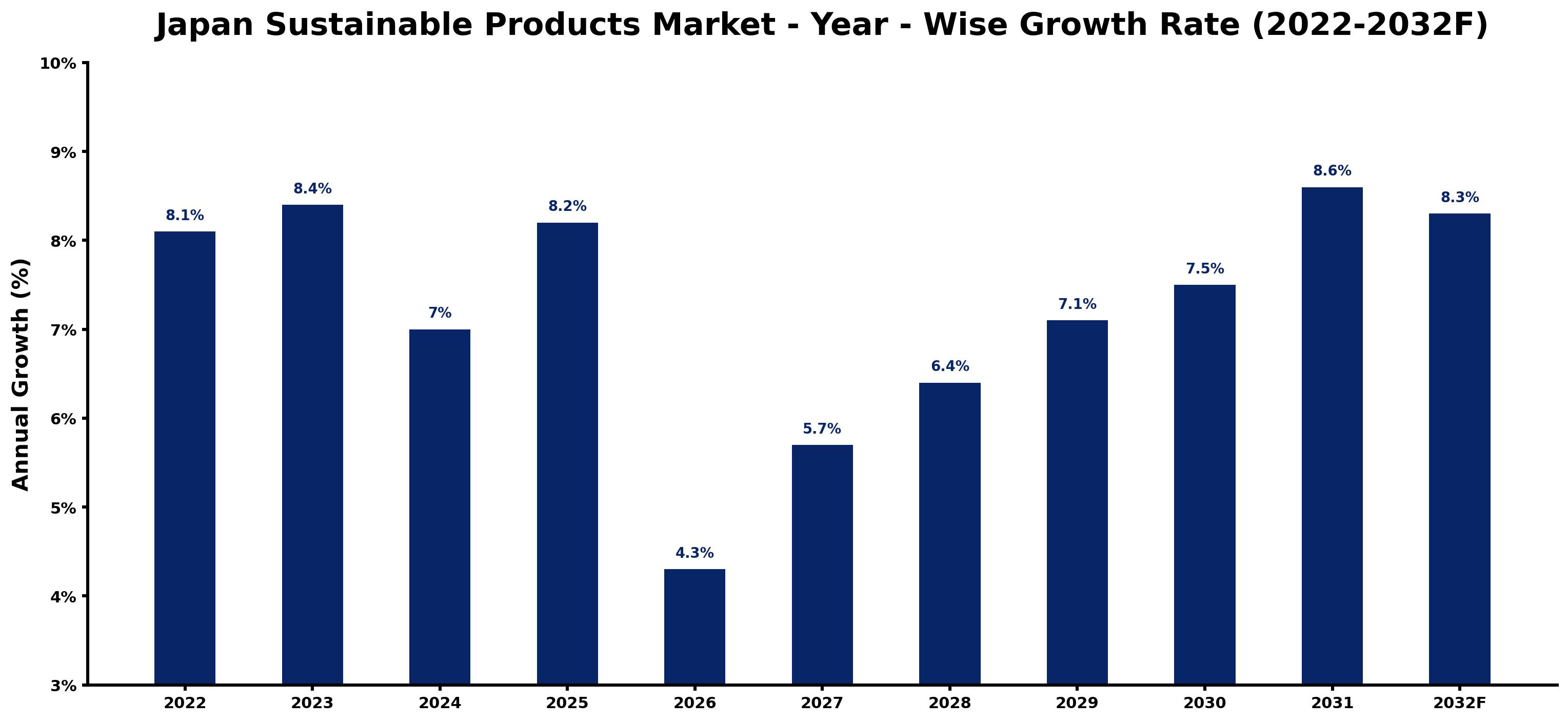
Annual growth estimates for each year appear below with the principal reason behind them, explaining the shifts that set the pace of the market.
| Year | Estimated Annual Growth (%) | Market Rationale |
| 2022 | 8.1 | Consumer interest in sustainable products drove growth across various segments. |
| 2023 | 8.4 | The rise of zero-waste retailers contributed to increased market activity and consumer engagement. |
| 2024 | 7.0 | Growth slowed as market saturation began to affect new product introductions. |
| 2025 | 8.2 | An uptick in eco-friendly apparel purchases led to renewed market enthusiasm. |
| 2026 | 4.3 | A slowdown in growth is expected as competition intensifies among sustainable product offerings. |
| 2027 | 5.7 | Increased consumer awareness of environmental issues will spur demand for sustainable goods. |
| 2028 | 6.4 | The market is projected to see a rebound as innovative packaging solutions gain traction. |
| 2029 | 7.1 | Growing interest in low-waste toiletries will drive further consumer purchases. |
| 2030 | 7.5 | Sustainable fashion initiatives will continue to attract consumers, boosting market growth. |
| 2031 | 8.6 | A peak in growth is expected as eco-conscious living becomes mainstream. |
| 2032 | 8.3 | Growth is projected to slow slightly as the market matures and competition intensifies. |
Note: Market size estimations and growth projections presented in this report are based on 6Wresearch's proprietary forecasting methodology, utilizing the latest available industry data, government publications, and primary research inputs.
Japan Sustainable Products Market Synopsis
Sustainable products encompass a range of items designed to reduce environmental impact, including reusable home goods, eco-friendly apparel, and low-waste toiletries. The Japan Sustainable Products Market is growing as more consumers prioritise sustainable living, with over 50% expressing interest in eco-friendly apparel. The Tokyo Metropolitan Government's 2023 initiative to promote sustainable product use in households further fuels demand, alongside the Eco Mark certification standard that encourages environmentally responsible practices.
Market Dynamics Impact Analysis (2026–2032)
| Factor | Type | Impact | Primary Segment Affected |
| Growing consumer awareness of environmental issues | Driver | High | Eco-Friendly Apparel |
| Increase in zero-waste retailers promoting sustainable products | Driver | High | Reusable Home Goods |
| Rising interest in eco-friendly apparel among consumers | Opportunity | High | Eco-Friendly Apparel |
| Expansion of sustainable product offerings in retail sectors | Opportunity | High | Low-Waste Toiletries |
| Competition among sustainable product brands leading to market saturation | Restraint | Medium | Eco-Friendly Apparel |
| Higher production costs associated with sustainable materials | Restraint | Medium | Reusable Home Goods |
| Consumer hesitance towards higher-priced sustainable options | Challenge | High | Low-Waste Toiletries |
| Limited awareness of sustainable practices among certain demographics | Challenge | Medium | Green Electronics |
Evaluation of Drivers in Japan Sustainable Products Market (2026–2032)
Key forces behind demand, with the segment each one moves most, are listed below.
| Drivers | Primary Segment Affected | Why It Matters (Evidence) |
| Increased consumer interest in eco-friendly apparel | Eco-Friendly Apparel | Over 50% of consumers expressed interest in purchasing eco-friendly apparel in 2023. |
| Rise of zero-waste retailers | Reusable Home Goods | The number of zero-waste retailers reached 300 in 2022, reflecting growing eco-consciousness. |
| Government initiatives promoting sustainable practices | Low-Waste Toiletries | The Tokyo Metropolitan Government launched a program in 2023 to encourage sustainable product usage. |
| Growth in sustainable fashion events | Eco-Friendly Apparel | Tokyo Fashion Week featured a dedicated segment for sustainable fashion brands in 2023. |
| Increased adoption of recycled materials | Recycled/Reclaimed Material | The Ministry of the Environment promotes the use of recycled materials in production. |
Buyers are adding capacity as the number of zero-waste retailers in Japan reached 300 in 2022, reflecting a shift towards eco-conscious consumerism. In 2023, over 50% of consumers expressed interest in purchasing eco-friendly apparel, driving demand for new designs. The Eco Mark certification standard increases consumer trust, while the growth of sustainable fashion events showcases eco-friendly brands, stimulating interest and purchases across demographics.
Evaluation of Restraints in Japan Sustainable Products Market
The main factors holding the market back are set out below.
| Market Restraint | Primary Segment Affected | Why It Matters (Evidence) |
| Market saturation leading to intense competition | Eco-Friendly Apparel | The increasing number of brands has made it challenging for new entrants to gain market share. |
| Higher costs of sustainable materials affecting pricing | Reusable Home Goods | Producers face increased production costs, which can deter price-sensitive consumers. |
| Limited consumer awareness in certain demographics | Green Electronics | Certain groups remain unaware of the benefits of sustainable products, hindering market growth. |
| Consumer hesitance towards premium pricing of sustainable products | Low-Waste Toiletries | Many consumers are reluctant to pay higher prices for eco-friendly options, impacting sales. |
| Inconsistent supply chains for sustainable materials | Recycled/Reclaimed Material | Fluctuations in availability can disrupt production schedules and product launches. |
Japan Sustainable Products Market Challenges
In 2023, while over 50% of consumers expressed interest in eco-friendly apparel, buyers face challenges due to the limited availability of certified products. This issue arises from strict regulations that restrict access to sustainable materials, causing delays in product launches for producers. Increased competition among retailers complicates the situation further, as many lack the financial means for sustainable sourcing, which raises prices for buyers. Technological hurdles in recycling processes also limit the production of eco-friendly goods, leading to higher costs and longer lead times for producers striving to meet consumer demand.
Trends in the Japan Sustainable Products Market
The shifts below are changing how Japan Sustainable Products Market products are bought and supplied.
- Zero-Waste Retailers Gaining Popularity: Zero-waste retailers are increasingly popular, with 300 locations in Japan as of 2022. This growth reflects a shift towards sustainable shopping habits among consumers, encouraging suppliers to innovate and expand their eco-friendly product lines.
- Shift Towards Eco-Friendly Packaging: The use of paper or bioplastic wraps is becoming standard, accounting for 43% of packaging types in 2025. This trend aligns with consumer demand for sustainability and reduces plastic waste in the market.
- Growing Interest in Sustainable Fashion: Tokyo Fashion Week featured a dedicated segment for sustainable fashion brands in 2023, highlighting the increasing consumer interest in eco-friendly apparel. This event showcased designs, driving demand for sustainable clothing options.
- Rise of Bioplastic Packaging: The adoption of bioplastic packaging is encouraged under the Plastic Resource Circulation Strategy initiated in 2021. This shift is essential for reducing plastic waste and aligns with consumer preferences for sustainable products.
Investment Opportunities in the Japan Sustainable Products Market
The openings below show where demand in the Japan Sustainable Products Market is visible and how suppliers can enter.
- Investment in Eco-Friendly Apparel: With over 50% of consumers interested in eco-friendly apparel, now is the time to invest in sustainable fashion brands. Collaborating with sustainable fashion initiatives can improve market presence and consumer engagement.
- Expansion of Zero-Waste Retailers: The rise of zero-waste retailers presents an opportunity for suppliers to partner with these stores. Entering this market can be facilitated through joint ventures or local partnerships to improve distribution.
- Growth in Low-Waste Toiletries: The increasing demand for low-waste toiletries, evidenced by a 40% rise in offerings in 2022, creates a gap for new products. Suppliers can enter this market by focusing on eco-friendly formulations.
- Sustainable Packaging Solutions: With the trend towards bioplastic wraps, suppliers can invest in sustainable packaging solutions. Collaborating with retailers focused on eco-friendly practices can facilitate market entry and improve brand visibility.
Government Initiatives in the Japan Sustainable Products Market
The Circular Economy Promotion Law encourages public entities to procure eco-friendly products, motivating manufacturers to adopt sustainable practices. Enacted in 2020, this law has raised awareness and demand for sustainable goods among consumers and businesses alike.
The Ministry of the Environment supports the use of recycled materials in production through various initiatives. This backing assists manufacturers in transitioning to sustainable practices while minimising waste and environmental impact.
Future Insight of the Japan Sustainable Products Market
Technological advancements in recycling processes are set to transform the sustainable products market by 2032, allowing suppliers to utilise a broader range of materials. The Tokyo Metropolitan Government's programme will expand its reach, improving consumer education on eco-friendly products. As the Eco Mark certification standard gains traction, more producers will adopt sustainable practices, increasing product availability. Initiatives that promote organic farming will further bolster the growth of natural fibres, benefiting both suppliers and buyers in the eco-friendly apparel segment.
Market Segmentation Analysis
Japan Sustainable Products Market report covers a detailed analysis of the following market segments:
By Product Category – Eco-Friendly Apparel Leads, Reusable Home Goods Expected to Grow Fastest
According to Saurav Kr Singh, Senior Research Analyst at 6Wresearch, Eco-Friendly Apparel took 35% of product category revenue in 2025, more than any other category. Eco-Friendly Apparel holds the largest share due to its alignment with the growing consumer interest in sustainable fashion, evidenced by over 50% of consumers expressing interest in purchasing such products in 2023. The Tokyo Fashion Week's dedicated segment for sustainable fashion brands exemplifies the strong market presence of this category. The quickest growth will come from Reusable Home Goods, forecast to expand at a CAGR of 10.1% between 2026 and 2032. The growth of Reusable Home Goods is propelled by the increasing number of zero-waste retailers, which reached 300 in 2022, promoting household waste reduction. This trend indicates a shift towards sustainable living practices among consumers. Suppliers should focus on enhancing their offerings in eco-friendly apparel to meet the increasing consumer demand.
By Core Attribute – Recycled/Reclaimed Material Leads, Natural/Organic Fibers Expected to Grow Fastest
With 48% of core attribute revenue in 2025, Recycled/Reclaimed Material was the largest category. Recycled/Reclaimed Material is the leading attribute as it is vital for sustainability in manufacturing, aligning with the government's Circular Economy Promotion Law enacted in 2020. This focus on recycled materials is crucial for attracting eco-conscious consumers. Natural/Organic Fibers are projected to grow fastest, at a CAGR of 10.0% during 2026–2032. Natural/Organic Fibers are experiencing rapid growth due to the increasing popularity of eco-friendly apparel, which is estimated to be worth around 200 billion yen in 2023. This trend highlights a shift towards more sustainable materials in fashion. Buyers should prioritise products made from recycled materials to align with their sustainability goals.
By Packaging Type – Paper or Bioplastic Wraps Lead, FSC Box + Eco-Inks Expected to Grow Fastest
Paper or Bioplastic Wraps accounted for 43% of the market by packaging type in 2025. Paper or Bioplastic Wraps dominate the market as they are essential for sustainable product distribution, reflecting the growing consumer preference for eco-friendly packaging solutions. The encouragement of bioplastic packaging under the Plastic Resource Circulation Strategy illustrates this trend. FSC Box + Eco-Inks are set to record the highest CAGR in this split, 9.8% over 2026–2032. FSC Box + Eco-Inks are rapidly gaining traction as they support sustainable forestry practices, appealing to environmentally conscious consumers. The increasing awareness of responsible packaging choices is driving this growth. Suppliers must invest in sustainable packaging solutions to meet evolving consumer expectations.
By End User – Zero-Waste Retailers Lead, Sustainable Fashion Expected to Grow Fastest
Zero-Waste Retailers held 51% of the Japan Sustainable Products Market by end user in 2025. Zero-Waste Retailers are the leading end user group as they actively promote sustainable products, contributing significantly to the market's growth. Their prominence is evidenced by the increasing number of such retailers across Japan. Over 2026–2032, Sustainable Fashion is expected to post the fastest growth, at a CAGR of 9.1%. Sustainable Fashion is the fastest-growing end user segment, driven by the rising demand for eco-friendly apparel, which is reflected in the 2023 national survey results. This growth indicates a broader acceptance of sustainable practices in the fashion industry. Retailers should consider expanding their sustainable product lines to capture the growing market interest.
Key Attractiveness of the Report
- 10 Years of Market Numbers
- Historical Data Starting from 2022 to 2025
- Base Year 2025
- Forecast Data until 2032
- Key Performance Indicators Impacting the Market
- Major Upcoming Developments and Projects
Key Highlights of the Report:
- Japan Sustainable Products Market Outlook
- Market Size of Japan Sustainable Products Market, 2025
- Forecast of Japan Sustainable Products Market, 2032
- Historical Data and Forecast of Japan Sustainable Products Revenues & Volume for the Period 2022-2032F
- Japan Sustainable Products Market Trend Evolution
- Japan Sustainable Products Market Drivers and Challenges
- Japan Sustainable Products Price Trends
- Japan Sustainable Products Porter's Five Forces
- Japan Sustainable Products Industry Life Cycle
- Historical Data and Forecast of Japan Sustainable Products Market Revenues & Volume By Product Category for the Period 2022-2032F
- Historical Data and Forecast of Japan Sustainable Products Market Revenues & Volume By Reusable Home Goods for the Period 2022-2032F
- Historical Data and Forecast of Japan Sustainable Products Market Revenues & Volume By Eco-Friendly Apparel for the Period 2022-2032F
- Historical Data and Forecast of Japan Sustainable Products Market Revenues & Volume By Low-Waste Toiletries for the Period 2022-2032F
- Historical Data and Forecast of Japan Sustainable Products Market Revenues & Volume By Green Electronics for the Period 2022-2032F
- Historical Data and Forecast of Japan Sustainable Products Market Revenues & Volume By Core Attribute for the Period 2022-2032F
- Historical Data and Forecast of Japan Sustainable Products Market Revenues & Volume By Recycled/Reclaimed Material for the Period 2022-2032F
- Historical Data and Forecast of Japan Sustainable Products Market Revenues & Volume By Natural/Organic Fibers for the Period 2022-2032F
- Historical Data and Forecast of Japan Sustainable Products Market Revenues & Volume By Solid Bar/Refill Formats for the Period 2022-2032F
- Historical Data and Forecast of Japan Sustainable Products Market Revenues & Volume By Low-Carbon Materials for the Period 2022-2032F
- Historical Data and Forecast of Japan Sustainable Products Market Revenues & Volume By Packaging Type for the Period 2022-2032F
- Historical Data and Forecast of Japan Sustainable Products Market Revenues & Volume By Paper or Bioplastic Wraps for the Period 2022-2032F
- Historical Data and Forecast of Japan Sustainable Products Market Revenues & Volume By Minimalist Tags for the Period 2022-2032F
- Historical Data and Forecast of Japan Sustainable Products Market Revenues & Volume By Tin/Glass Containers for the Period 2022-2032F
- Historical Data and Forecast of Japan Sustainable Products Market Revenues & Volume By FSC Box + Eco-Inks for the Period 2022-2032F
- Historical Data and Forecast of Japan Sustainable Products Market Revenues & Volume By End User for the Period 2022-2032F
- Historical Data and Forecast of Japan Sustainable Products Market Revenues & Volume By Zero-Waste Retailers for the Period 2022-2032F
- Historical Data and Forecast of Japan Sustainable Products Market Revenues & Volume By Sustainable Fashion for the Period 2022-2032F
- Historical Data and Forecast of Japan Sustainable Products Market Revenues & Volume By Beauty Retailers for the Period 2022-2032F
- Historical Data and Forecast of Japan Sustainable Products Market Revenues & Volume By Consumer Tech Startups for the Period 2022-2032F
- Japan Sustainable Products Import Export Trade Statistics
- Market Opportunity Assessment By Product Category
- Market Opportunity Assessment By Core Attribute
- Market Opportunity Assessment By Packaging Type
- Market Opportunity Assessment By End User
- Japan Sustainable Products Top Companies Market Share
- Japan Sustainable Products Competitive Benchmarking By Technical and Operational Parameters
- Japan Sustainable Products Company Profiles
- Japan Sustainable Products Key Strategic Recommendations
Market Covered
Segments analysed in this report are listed below.
By Product Category
- Reusable Home Goods
- Eco-Friendly Apparel
- Low-Waste Toiletries
- Green Electronics
By Core Attribute
- Recycled/Reclaimed Material
- Natural/Organic Fibers
- Solid Bar/Refill Formats
- Low-Carbon Materials
By Packaging Type
- Paper or Bioplastic Wraps
- Minimalist Tags
- Tin/Glass Containers
- FSC Box + Eco-Inks
By End User
- Zero-Waste Retailers
- Sustainable Fashion
- Beauty Retailers
- Consumer Tech Startups































