Japan Sustainable Propellants Market Size & Growth Rate
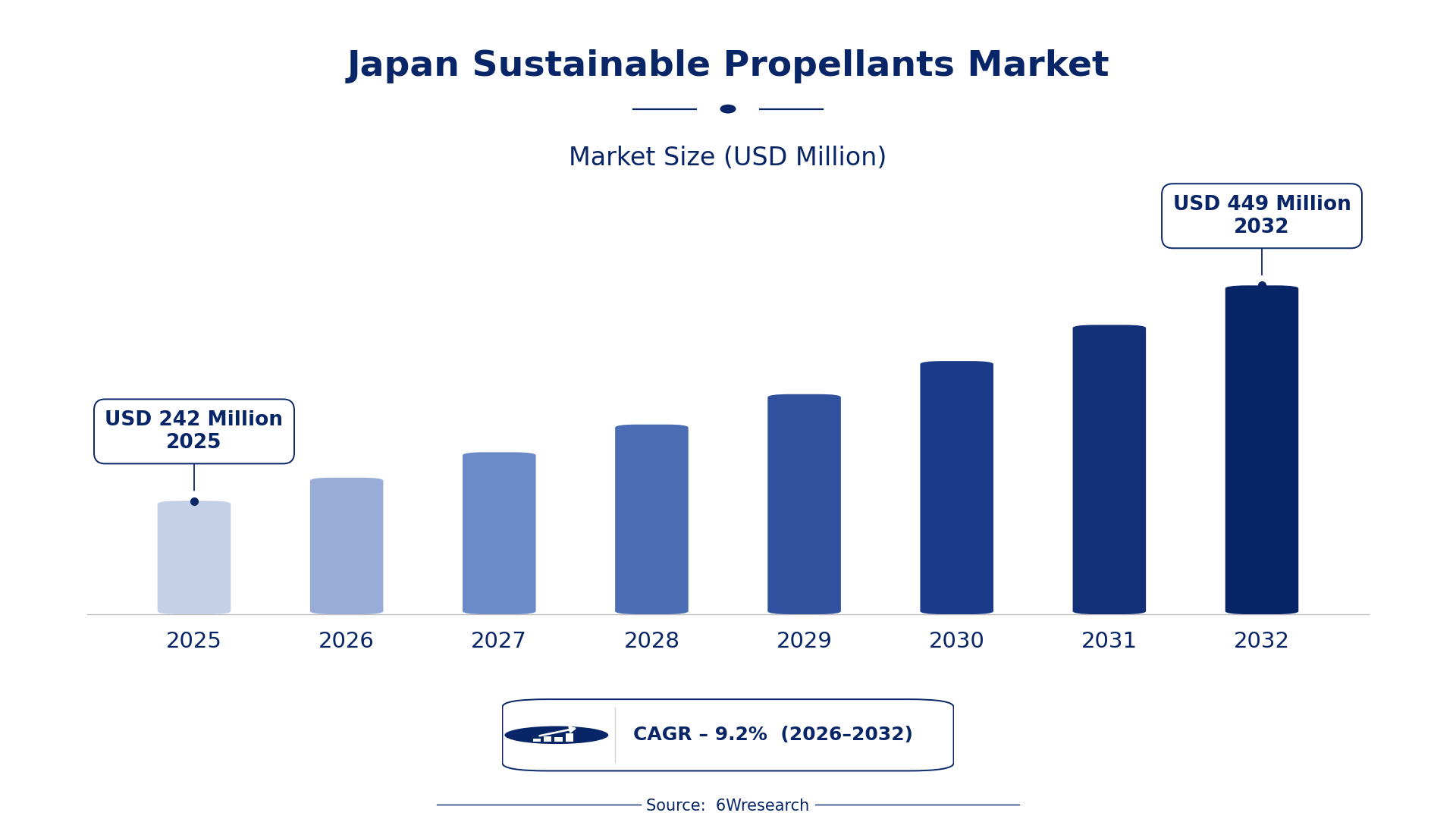
According to 6Wresearch internal database and industry insights, the Japan Sustainable Propellants Market was valued at USD 242 Million in 2025 and is projected to reach USD 449 Million by 2032, growing at a CAGR of approximately 9.2% during 2026–2032.
Japan Sustainable Propellants Market Highlights
| Report Metric | Details |
| Report Name | Japan Sustainable Propellants Market (2026-2032) |
| Market Size 2025 | USD 242 Million |
| Market Size 2032 | USD 449 Million |
| Absolute Growth 2025–2032 | USD 207 Million |
| CAGR 2026–2032 | 9.2% |
| Peak Annual Growth | 11.0% in 2032 |
| Forecast Period | 2026–2032 |
| Historical Data | 2022–2025 |
| Base Year | 2025 |
| Leading Propellant Type, 2025 | Bio-Based Propellants (41% share) |
| Leading Base Material, 2025 | Ethanol/Vegetable Derivatives (47% share) |
| Leading Use Case, 2025 | Small Launch Vehicles (36% share) |
| Leading End User, 2025 | Aerospace Startups (51% share) |
| Fastest-Growing Propellant Type | Green Monopropellants (13.6% CAGR) |
| Fastest-Growing Base Material | Hydrogen Peroxide-based (13.7% CAGR) |
| Fastest-Growing Use Case | Satellite Thrusters (12.4% CAGR) |
| Fastest-Growing End User | Space Agencies (12.0% CAGR) |
| Growing Sector | Aerospace |
| Key End Users | Aerospace Startups, Space Agencies, Research Institutions |
Japan Sustainable Propellants Market Year-wise Growth Rate and Key Drivers (2022–2032)
This graph illustrates the annual growth rates of the market from 2022 to 2032, highlighting a steady upward trajectory and projected market expansion over the forecast period.
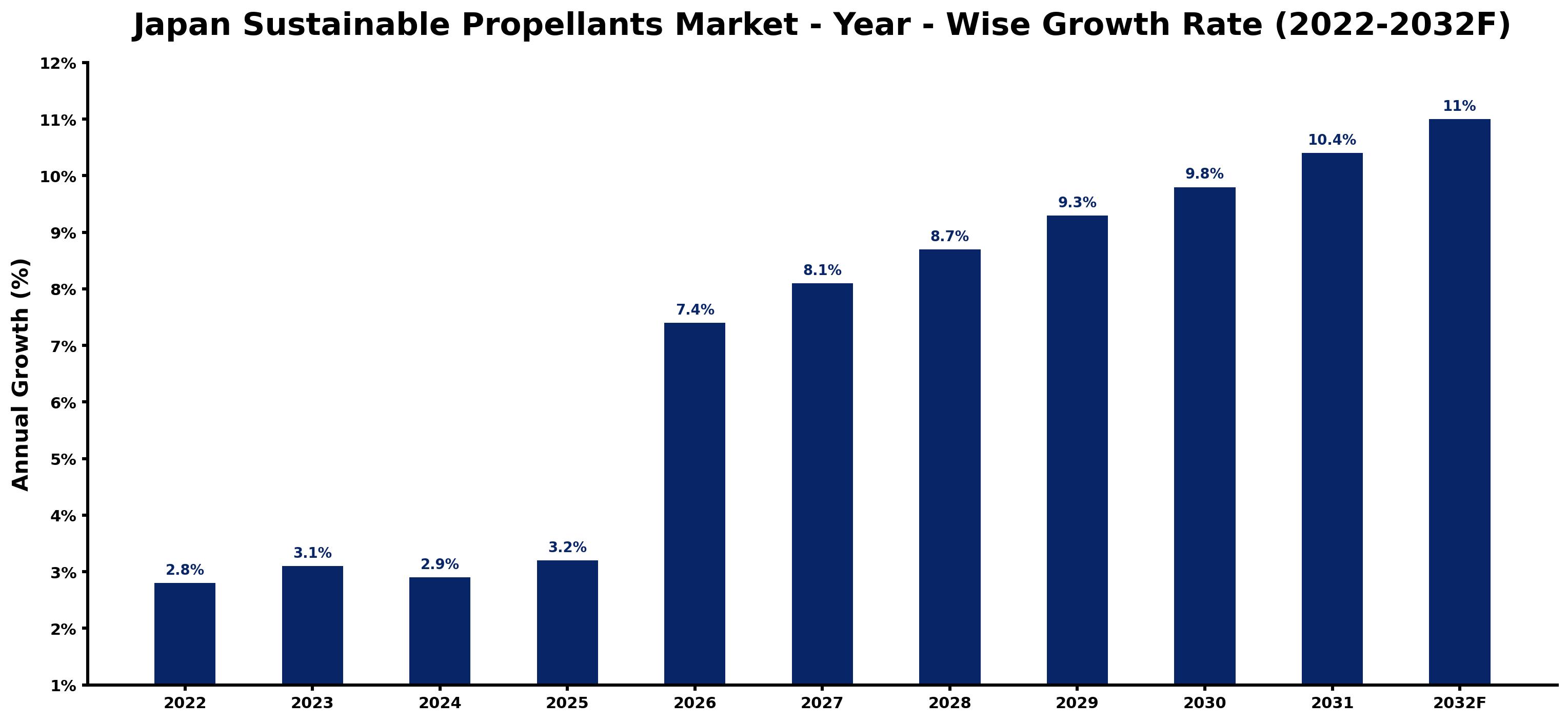
The table below sets out the estimated growth rate for each year and the main factor behind it.
| Year | Estimated Annual Growth (%) | Market Rationale |
| 2022 | 2.8 | The market showed steady growth with increasing interest in sustainable technologies. |
| 2023 | 3.1 | Demand rose as aerospace startups expanded their projects and initiatives. |
| 2024 | 2.9 | Growth slowed due to market adjustments and competitive pressures. |
| 2025 | 3.2 | The market experienced a resurgence as new programmes were introduced. |
| 2026 | 7.4 | Demand is expected to surge as research institutions advance sustainable propulsion technologies. |
| 2027 | 8.1 | The market will continue to grow with increased investments in aerospace advancements. |
| 2028 | 8.7 | Aerospace startups will further stimulate demand through new launches. |
| 2029 | 9.3 | Growth is projected to accelerate as the need for eco-friendly solutions becomes urgent. |
| 2030 | 9.8 | The market will expand as partnerships with international space agencies strengthen. |
| 2031 | 10.4 | Demand is expected to rise due to the success of new propulsion systems. |
| 2032 | 11.0 | The market will peak as sustainable propellant adoption reaches new heights. |
Note: Market size estimations and growth projections presented in this report are based on 6Wresearch's proprietary forecasting methodology, utilizing the latest available industry data, government publications, and primary research inputs.
Japan Sustainable Propellants Market Synopsis
Sustainable propellants are eco-friendly fuels used in propulsion systems, produced from renewable resources or through advanced chemical processes. Their primary applications include powering small launch vehicles, satellite thrusters, and experimental rockets. The Japan Sustainable Propellants Market is expanding due to rising demand from aerospace startups and space agencies, driven by the Japan Aerospace Exploration Agency's 2023 programme to develop bio-based propellants for satellite launches.
Market Dynamics Impact Analysis (2026–2032)
| Factor | Type | Impact | Primary Segment Affected |
| Growing investments in aerospace startups | Driver | High | Small Launch Vehicles |
| Increased research on sustainable propulsion technologies | Driver | High | Electric Propellants |
| Emerging demand for eco-friendly solutions | Opportunity | High | Bio-Based Propellants |
| Rising interest in satellite launches | Opportunity | Medium | Satellite Thrusters |
| Limited awareness of sustainable propellant benefits | Restraint | Medium | Hybrid Propellants |
| High development costs for new technologies | Restraint | High | Green Monopropellants |
| Competition from established propellant technologies | Challenge | High | Electric Propellants |
| Slow adoption rates among traditional aerospace players | Challenge | Medium | Bio-Based Propellants |
Evaluation of Drivers in Japan Sustainable Propellants Market (2026–2032)
Demand rests on the following drivers, each shown with the segment it touches most.
| Drivers | Primary Segment Affected | Why It Matters (Evidence) |
| Increased funding for aerospace startups | Aerospace Startups | This funding leads to new projects requiring sustainable propellants, with a 30% rise in startups since 2020. |
| Growing research on electric propulsion systems | Electric Propellants | Research institutions, such as the Tokyo Institute of Technology, are advancing technology, resulting in higher demand for electric propulsion solutions. |
| Rising eco-consciousness among consumers | Bio-Based Propellants | Aerospace firms are increasingly seeking bio-based propellants to comply with environmental standards, spurred by the Japan Aerospace Exploration Agency's initiatives. |
| Expansion of satellite launch activities | Small Launch Vehicles | The increase in satellite launches is driving demand for efficient propulsion systems, with significant growth expected in this segment. |
| Collaborations on hybrid propulsion systems | Hybrid Propellants | Research institutions are working together to develop innovative propulsion technologies, enhancing market capacity and innovation. |
Purchasing is picking up as aerospace startups receive increased funding, leading to new projects that drive demand for sustainable propellants. The Tokyo Institute of Technology is conducting studies on electric propulsion systems, advancing technology and prompting more procurement. Eco-consciousness among consumers is pushing aerospace firms to seek bio-based propellants for compliance, with a notable increase in projects focusing on sustainability. Research institutions are collaborating on hybrid propulsion systems, which will improve the market's capacity and innovation potential. Rising satellite launch activities are driving the need for efficient propulsion systems, particularly in the small launch vehicle segment, with substantial growth expected in the coming years.
Evaluation of Restraints in Japan Sustainable Propellants Market
Several factors work against faster growth; the main ones are summarised below.
| Market Restraint | Primary Segment Affected | Why It Matters (Evidence) |
| Limited availability of sustainable propellants | Bio-Based Propellants | This scarcity inflates project budgets by 20%, impacting producers' ability to meet demand. |
| Insufficient facilities for bio-based propellant production | Green Monopropellants | This limitation causes delays in technology development, affecting timelines for aerospace projects. |
| Shortage of skilled aerospace engineers | Electric Propellants | This workforce gap may result in a 15% delay in project completions, hindering market growth. |
| High production costs for eco-friendly fuels | Hybrid Propellants | These costs can lead to a 25% increase in overall expenses for producers, limiting competitiveness. |
| Regulatory compliance challenges | Small Launch Vehicles | Navigating complex regulations can slow down project initiation, impacting timely market entry. |
Japan Sustainable Propellants Market Challenges
Producers face rising costs due to limited availability of sustainable propellants, inflating project budgets by 20%. Technology development is hindered by insufficient facilities for bio-based propellant production, causing delays that impact timelines for aerospace projects. A shortage of skilled aerospace engineers restricts the workforce's ability to meet the increasing demand for sustainable technologies, potentially resulting in a 15% delay in project completions. High production costs for eco-friendly fuels can lead to a 25% increase in overall expenses for producers, limiting their competitiveness in the market.
Trends in the Japan Sustainable Propellants Market
These developments are changing demand patterns in the Japan Sustainable Propellants Market.
- Initiative for Bio-Based Propellants: The Japan Aerospace Exploration Agency (JAXA) initiated a programme in 2023 focused on developing bio-based propellants for satellite launches, reflecting a growing commitment to sustainability. This initiative is likely to increase the adoption of eco-friendly fuels in the aerospace sector, with potential market growth of 20% by 2025.
- Focus on Electric Propulsion Systems: Tokyo is emerging as a hub for research on electric propulsion systems, with institutions like the Tokyo Institute of Technology leading studies. This focus is anticipated to drive innovation and increase demand for electric propellants, particularly in deep space missions, with investment levels projected to rise by 15%.
- Aerospace Startups Driving Innovation: Aerospace startups are increasingly adopting sustainable propellants, with a 30% rise in their numbers since 2020. This trend indicates a shift towards environmentally friendly solutions, prompting established players to reconsider their strategies, with potential market share growth of 10%.
- Growing Interest in Satellite Launches: The demand for satellite launches is increasing, particularly for small launch vehicles, as Japan's space initiatives expand. This growth is expected to drive the need for efficient propulsion systems, shaping the market for sustainable propellants, with a projected increase in launch activities by 25%.
Investment Opportunities in the Japan Sustainable Propellants Market
The opportunities below stand out in the Japan Sustainable Propellants Market for new entrants and existing suppliers.
- Aerospace Startups seeking sustainable solutions: With a 30% increase in aerospace startups since 2020, there is a growing need for eco-friendly propellants. Collaborating with research institutions can help meet this demand effectively.
- Funding for green technology initiatives: The Ministry of Economy, Trade and Industry allocated USD 50 million in 2023 for sustainable aerospace projects. This funding presents an opportunity for research institutions to develop innovative propellant solutions.
- Growing demand for satellite launches: The increase in satellite launches drives the need for efficient propulsion systems, particularly in the small launch vehicle segment, which is expected to grow significantly in the coming years.
- Research institutions focusing on hybrid propulsion: Research institutions are collaborating on hybrid propulsion systems, creating opportunities for investment in innovative technologies that enhance propulsion efficiency.
Government Initiatives in the Japan Sustainable Propellants Market
The Green Growth Strategy Through Achieving Carbon Neutrality in 2050, updated in 2021, identifies sustainable aerospace technologies as a priority sector. This strategy encourages investment in eco-friendly propellants and mandates compliance with ISO 14001 standards for environmental management, impacting producers and buyers alike by setting clear guidelines for sustainable practices.
The Ministry of Economy, Trade and Industry (METI) launched a green technology initiative in 2023, providing funding for projects focused on sustainable aerospace solutions. This initiative supports aerospace startups and research institutions in developing eco-friendly propellants, promoting innovation and collaboration in the sector, with a target funding amount of USD 50 million.
Future Insight of the Japan Sustainable Propellants Market
A policy shift will reshape the aerospace sector by 2032, prompting a stronger focus on sustainable propellants. The Japan Aerospace Exploration Agency will enhance collaboration with international partners to facilitate technology exchange. Advanced hybrid propulsion systems will emerge, improving efficiency and reducing environmental impact. Projections indicate a 30% increase in sustainable propellant usage, showcasing a growing commercial interest in eco-friendly solutions.
Market Segmentation Analysis
Japan Sustainable Propellants Market report covers a detailed analysis of the following market segments:
By Propellant Type – Bio-Based Propellants Lead, Green Monopropellants Expected to Grow Fastest
According to Saurav Kr Singh, Senior Research Analyst at 6Wresearch, Bio-Based Propellants took 41% of propellant type revenue in 2025, more than any other category. Bio-based propellants dominate the market as they are extensively used in various aerospace applications aimed at minimising environmental impact. The Japan Aerospace Exploration Agency's initiatives highlight their commitment to integrating these propellants into sustainable space missions. The quickest growth will come from Green Monopropellants, forecast to expand at a CAGR of 13.6% between 2026 and 2032. Green monopropellants are rapidly gaining traction due to their critical application in satellite thrusters, which are vital for efficient satellite operations. The increasing focus on eco-friendly solutions in satellite technology is driving this segment's growth. Suppliers should prioritise the development of bio-based and green monopropellant solutions to cater to the rising demand in aerospace applications.
By Base Material – Ethanol/Vegetable Derivatives Lead, Hydrogen Peroxide-based Expected to Grow Fastest
The largest base material category in 2025 was Ethanol/Vegetable Derivatives, at 47% of revenue. Ethanol and vegetable derivatives dominate the base material segment as they are crucial for creating bio-based propellants, which are gaining traction in Japan's aerospace sector. Their compatibility with sustainable practices appeals to various stakeholders, including aerospace startups looking to innovate. Over 2026–2032, Hydrogen Peroxide-based is expected to post the fastest growth, at a CAGR of 13.7%. Hydrogen peroxide-based materials are rapidly gaining traction as they are increasingly utilised in green monopropellant systems, essential for contemporary propulsion applications. This trend reflects a broader shift towards more efficient and eco-friendly propulsion technologies in the industry. Suppliers should prioritise the development of ethanol/vegetable derivatives and hydrogen peroxide-based materials to align with sustainability goals in aerospace.
By Use Case – Small Launch Vehicles Lead, Satellite Thrusters Expected to Grow Fastest
Small Launch Vehicles held 36% of the Japan Sustainable Propellants Market by use case in 2025. Small launch vehicles lead the use case category as they are preferred for deploying small satellites, driven by a surge in satellite missions across Japan. The increasing number of aerospace startups engaging in this area further solidifies the segment's importance. Satellite Thrusters are projected to grow fastest, at a CAGR of 12.4% during 2026–2032. Satellite thrusters are experiencing the fastest growth due to their critical function in the manoeuvring and positioning of satellites in orbit. The growing deployment of small satellites significantly escalates the demand for effective propulsion systems. Suppliers must concentrate on creating solutions tailored for small launch vehicles and satellite thrusters to capitalise on market growth.
By End User – Aerospace Startups Lead, Space Agencies Expected to Grow Fastest
In 2025, Aerospace Startups led the end user split with a 51% share. Aerospace startups are the leading end users as they are actively developing innovative propulsion solutions that leverage sustainable technologies. The 30% rise in new aerospace ventures in Japan since 2020 highlights their pivotal role in shaping the industry. Space Agencies are set to record the highest CAGR in this split, 12.0% over 2026–2032. Space agencies represent the fastest growing end users as they increasingly adopt sustainable propellant technologies for their missions. The focus on environmentally friendly solutions in government-led space initiatives is driving this swift growth. Suppliers should engage with aerospace startups and space agencies to ensure their products meet the evolving demands of the aerospace sector.
Key Attractiveness of the Report
- 10 Years of Market Numbers
- Historical Data Starting from 2022 to 2025
- Base Year 2025
- Forecast Data until 2032
- Key Performance Indicators Impacting the Market
- Major Upcoming Developments and Projects
Key Highlights of the Report:
- Japan Sustainable Propellants Market Outlook
- Market Size of Japan Sustainable Propellants Market, 2025
- Forecast of Japan Sustainable Propellants Market, 2032
- Historical Data and Forecast of Japan Sustainable Propellants Revenues & Volume for the Period 2022-2032F
- Japan Sustainable Propellants Market Trend Evolution
- Japan Sustainable Propellants Market Drivers and Challenges
- Japan Sustainable Propellants Price Trends
- Japan Sustainable Propellants Porter's Five Forces
- Japan Sustainable Propellants Industry Life Cycle
- Historical Data and Forecast of Japan Sustainable Propellants Market Revenues & Volume By Propellant Type for the Period 2022-2032F
- Historical Data and Forecast of Japan Sustainable Propellants Market Revenues & Volume By Bio-Based Propellants for the Period 2022-2032F
- Historical Data and Forecast of Japan Sustainable Propellants Market Revenues & Volume By Green Monopropellants for the Period 2022-2032F
- Historical Data and Forecast of Japan Sustainable Propellants Market Revenues & Volume By Electric Propellants for the Period 2022-2032F
- Historical Data and Forecast of Japan Sustainable Propellants Market Revenues & Volume By Hybrid Propellants for the Period 2022-2032F
- Historical Data and Forecast of Japan Sustainable Propellants Market Revenues & Volume By Base Material for the Period 2022-2032F
- Historical Data and Forecast of Japan Sustainable Propellants Market Revenues & Volume By Ethanol/Vegetable Derivatives for the Period 2022-2032F
- Historical Data and Forecast of Japan Sustainable Propellants Market Revenues & Volume By Hydrogen Peroxide-based for the Period 2022-2032F
- Historical Data and Forecast of Japan Sustainable Propellants Market Revenues & Volume By Xenon/Ionized Gases for the Period 2022-2032F
- Historical Data and Forecast of Japan Sustainable Propellants Market Revenues & Volume By Paraffin Wax + N2O for the Period 2022-2032F
- Historical Data and Forecast of Japan Sustainable Propellants Market Revenues & Volume By Use Case for the Period 2022-2032F
- Historical Data and Forecast of Japan Sustainable Propellants Market Revenues & Volume By Small Launch Vehicles for the Period 2022-2032F
- Historical Data and Forecast of Japan Sustainable Propellants Market Revenues & Volume By Satellite Thrusters for the Period 2022-2032F
- Historical Data and Forecast of Japan Sustainable Propellants Market Revenues & Volume By Deep Space Propulsion for the Period 2022-2032F
- Historical Data and Forecast of Japan Sustainable Propellants Market Revenues & Volume By Experimental Rockets for the Period 2022-2032F
- Historical Data and Forecast of Japan Sustainable Propellants Market Revenues & Volume By End User for the Period 2022-2032F
- Historical Data and Forecast of Japan Sustainable Propellants Market Revenues & Volume By Aerospace Startups for the Period 2022-2032F
- Historical Data and Forecast of Japan Sustainable Propellants Market Revenues & Volume By Space Agencies for the Period 2022-2032F
- Historical Data and Forecast of Japan Sustainable Propellants Market Revenues & Volume By Satellite OEMs for the Period 2022-2032F
- Historical Data and Forecast of Japan Sustainable Propellants Market Revenues & Volume By Research Institutions for the Period 2022-2032F
- Japan Sustainable Propellants Import Export Trade Statistics
- Market Opportunity Assessment By Propellant Type
- Market Opportunity Assessment By Base Material
- Market Opportunity Assessment By Use Case
- Market Opportunity Assessment By End User
- Japan Sustainable Propellants Top Companies Market Share
- Japan Sustainable Propellants Competitive Benchmarking By Technical and Operational Parameters
- Japan Sustainable Propellants Company Profiles
- Japan Sustainable Propellants Key Strategic Recommendations
Market Covered
The following segment groups are covered in the report.
By Propellant Type
- Bio-Based Propellants
- Green Monopropellants
- Electric Propellants
- Hybrid Propellants
By Base Material
- Ethanol/Vegetable Derivatives
- Hydrogen Peroxide-based
- Xenon/Ionized Gases
- Paraffin Wax + N2O
By Use Case
- Small Launch Vehicles
- Satellite Thrusters
- Deep Space Propulsion
- Experimental Rockets
By End User
- Aerospace Startups
- Space Agencies
- Satellite OEMs
- Research Institutions































