Japan Sustainable Propulsion Market Size & Growth Rate
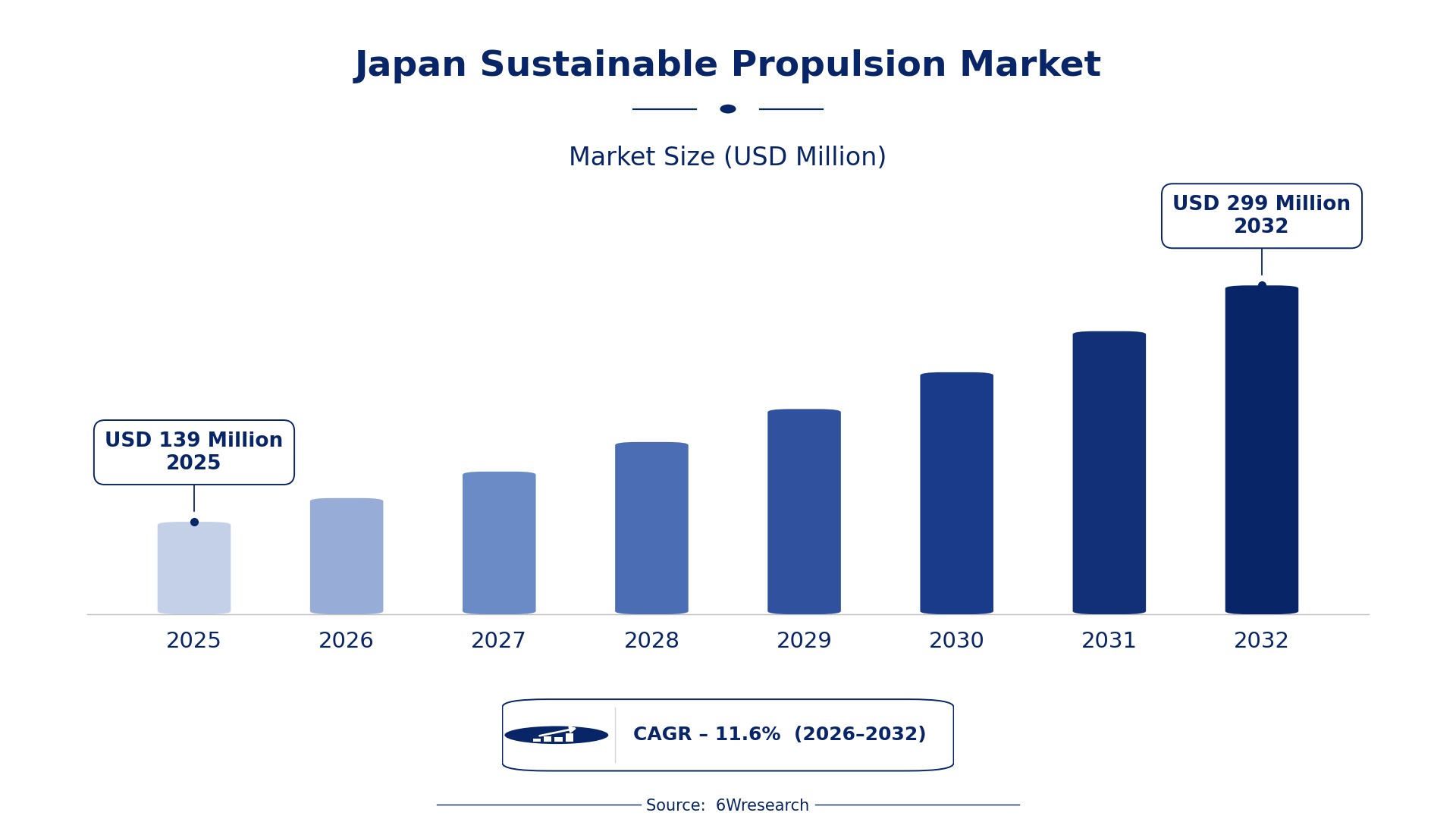
According to 6Wresearch internal database and industry insights, the Japan Sustainable Propulsion Market was valued at USD 139 Million in 2025 and is projected to reach USD 299 Million by 2032, growing at a CAGR of approximately 11.6% during 2026–2032.
Japan Sustainable Propulsion Market Highlights
| Report Metric | Details |
| Report Name | Japan Sustainable Propulsion Market (2026-2032) |
| Market Size 2025 | USD 139 Million |
| Market Size 2032 | USD 299 Million |
| Absolute Growth 2025–2032 | USD 160 Million |
| CAGR 2026–2032 | 11.6% |
| Peak Annual Growth | 13.6% in 2032 |
| Forecast Period | 2026–2032 |
| Historical Data | 2022–2025 |
| Base Year | 2025 |
| Leading Propulsion Type, 2025 | Electric Drivetrain (41% share) |
| Leading Energy Source, 2025 | Lithium-ion Battery (44% share) |
| Leading Vehicle Segment, 2025 | Compact & Luxury EVs (50% share) |
| Leading End User, 2025 | Car OEMs (50% share) |
| Fastest-Growing Propulsion Type | Hydrogen Fuel Cell (17.2% CAGR) |
| Fastest-Growing Energy Source | Hydrogen Gas (16.8% CAGR) |
| Fastest-Growing Vehicle Segment | Commercial Buses (16.1% CAGR) |
| Fastest-Growing End User | Mobility Startups (15.1% CAGR) |
| Growing Sector | Public Transport |
| Key End Users | Car OEMs, Fleet Operators, City Mobility Agencies, Mobility Startups |
Japan Sustainable Propulsion Market Year-wise Growth Rate and Key Drivers (2022–2032)
This graph illustrates the annual growth rates of the market from 2022 to 2032, highlighting a steady upward trajectory and projected market expansion over the forecast period.
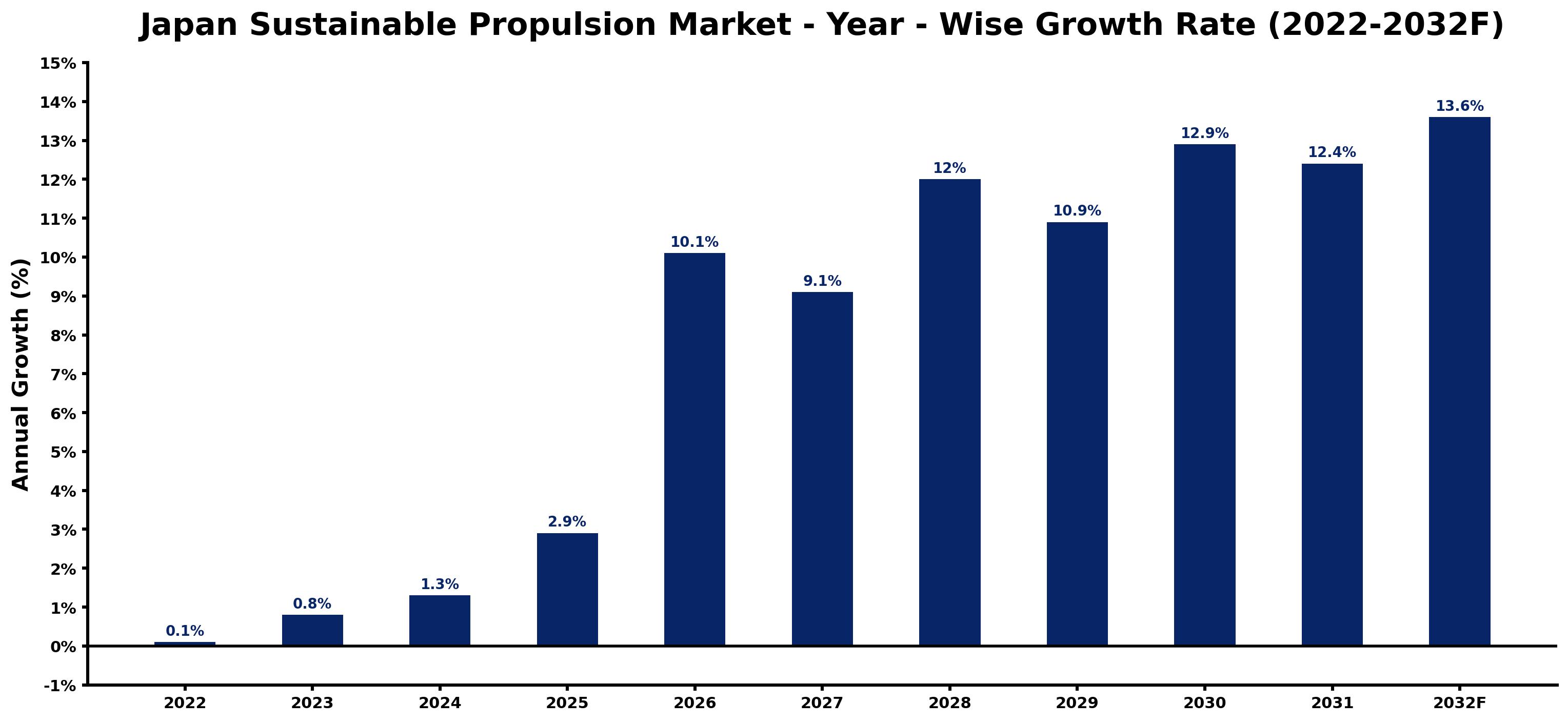
Each row of the following table gives one year's estimated growth and the event or demand shift that explains it.
| Year | Estimated Annual Growth (%) | Market Rationale |
| 2022 | 0.1 | The market showed minimal growth as the adoption of sustainable technologies was still emerging. |
| 2023 | 0.8 | Growth accelerated due to increased awareness of environmental issues and electric vehicle benefits. |
| 2024 | 1.3 | Demand continued to rise as investments in charging infrastructure expanded across urban areas. |
| 2025 | 2.9 | The market reached a historical peak as electric vehicle sales surged, driven by consumer preference. |
| 2026 | 10.1 | Growth surged as the government is expected to implement new incentives for hydrogen fuel cell vehicles. |
| 2027 | 9.1 | Demand growth is projected to slow slightly as the market begins to stabilise after rapid expansion. |
| 2028 | 12.0 | A renewed interest in electric vehicles is expected to boost growth as more models become available. |
| 2029 | 10.9 | The market is projected to continue growing, although at a slower pace as competition intensifies. |
| 2030 | 12.9 | Growth is expected to accelerate again as the Tokyo Metropolitan Government's electric public transport initiative gains traction. |
| 2031 | 12.4 | The market is projected to experience a slight slowdown as the focus shifts to infrastructure development. |
| 2032 | 13.6 | The market is expected to peak with strong demand for sustainable propulsion technologies across all segments. |
Note: Market size estimations and growth projections presented in this report are based on 6Wresearch's proprietary forecasting methodology, utilizing the latest available industry data, government publications, and primary research inputs.
Japan Sustainable Propulsion Market Synopsis
Sustainable propulsion technologies enable vehicles to operate with minimal environmental impact, primarily through electric drivetrains, hydrogen fuel cells, and hybrid systems. The Japan Sustainable Propulsion Market is expanding due to rising electric vehicle adoption, government initiatives such as the Tokyo Metropolitan Government's 100% electric public transport target by 2030, and increasing investments in charging infrastructure, which collectively drive demand from car OEMs and fleet operators. The automotive industry remains strong, with considerable demand from domestic users and exports, particularly in electric and hybrid vehicle segments.
Market Dynamics Impact Analysis (2026–2032)
| Factor | Type | Impact | Primary Segment Affected |
| Rising electric vehicle adoption | Driver | High | Electric Drivetrain |
| Government subsidies for hydrogen fuel cells | Driver | High | Hydrogen Fuel Cell |
| Growing demand for commercial electric vehicles | Opportunity | High | Commercial Buses |
| Investment in charging infrastructure expansion | Opportunity | High | Electric Drivetrain |
| High initial costs of sustainable technologies | Restraint | Medium | Hybrid Powertrains |
| Limited hydrogen refuelling stations | Restraint | Medium | Hydrogen Fuel Cell |
| Competition from traditional fuel vehicles | Challenge | High | Plug-in Hybrids |
| Technological challenges in battery production | Challenge | Medium | Lithium-ion Battery |
Evaluation of Drivers in Japan Sustainable Propulsion Market (2026–2032)
These are the developments adding the most demand over the forecast period.
| Drivers | Primary Segment Affected | Why It Matters (Evidence) |
| Increased electric vehicle population | Electric Drivetrain | Japan's electric vehicle population reached 1.5 million units in 2023, driving demand for electric drivetrains. |
| Government hydrogen incentives | Hydrogen Fuel Cell | Incentives are encouraging adoption of hydrogen fuel cell vehicles, promoting market growth. |
| Expansion of charging stations | Electric Drivetrain | The number of charging stations for EVs in Japan exceeded 30,000 in 2023, facilitating easier access for users. |
| Growing public transport initiatives | Commercial Buses | The Tokyo Metropolitan Government aims for 100% electric public transport by 2030, increasing demand for electric buses. |
| Rising environmental awareness | Hybrid Powertrains | The adoption rate of hybrid vehicles in Japan is over 30%, reflecting consumer preference for sustainable options. |
Spending rises because Japan's electric vehicle population reached 1.5 million units in 2023, leading to increased demand for electric drivetrains. The number of charging stations for EVs in Japan exceeded 30,000 in 2023, making electric vehicle ownership more accessible. The adoption rate of hybrid vehicles in Japan is over 30%, showcasing a growing preference for sustainable transport solutions.
Evaluation of Restraints in Japan Sustainable Propulsion Market
Below are the constraints most often cited by buyers and suppliers, with the segment each affects.
| Market Restraint | Primary Segment Affected | Why It Matters (Evidence) |
| High initial costs of electric vehicles | Electric Drivetrain | The high upfront costs deter potential buyers, limiting market growth despite increasing awareness. |
| Limited hydrogen refuelling infrastructure | Hydrogen Fuel Cell | The scarcity of refuelling stations restricts the widespread adoption of hydrogen fuel cell vehicles. |
| Competition from traditional gasoline vehicles | Plug-in Hybrids | The prevalence of gasoline vehicles continues to challenge the market share of plug-in hybrids. |
| Technological challenges in battery production | Lithium-ion Battery | Production complexities and costs hinder the scaling of lithium-ion battery manufacturing. |
| Consumer hesitation towards new technologies | Hybrid Powertrains | Some consumers remain hesitant to transition to hybrid systems due to unfamiliarity and perceived risks. |
Japan Sustainable Propulsion Market Challenges
Insufficient skilled engineers limit the advancement of sustainable propulsion technologies, delaying project timelines for producers. Outdated manufacturing technology raises production costs, reducing competitiveness for suppliers. Buyers struggle with inadequate charging infrastructure, as 30,000 stations serve 1.5 million electric vehicles, resulting in longer travel times. Stringent regulations from the Ministry of Land, Infrastructure, Transport and Tourism impose compliance costs on producers, which can increase prices and restrict options for buyers.
Trends in the Japan Sustainable Propulsion Market
Buyers and suppliers in the Japan Sustainable Propulsion Market are adjusting to the following trends.
- Shift towards Electric Public Transport: City Mobility Agencies are increasingly adopting electric buses, with the Tokyo Metropolitan Government targeting 100% electric public transport by 2030. This initiative aims to reduce urban emissions and improve public transport efficiency.
- Growing Adoption of Hydrogen Fuel Cells: The Hydrogen Strategy, initiated by the Japanese government, is driving the development of hydrogen infrastructure. This effort aims to establish a reliable supply chain for hydrogen fuel, with investments of ¥100 billion expected by 2025.
- Increase in Charging Infrastructure: The number of EV charging stations in Japan surpassed 30,000 in 2023, reflecting a shift towards improving electric vehicle accessibility. This growth supports the rising demand for electric vehicles across urban areas.
- Emergence of Mobility Startups: Mobility Startups are innovating in sustainable transport solutions, with a notable increase in investment. The trend is clear as the adoption rate of hybrid vehicles exceeds 30%, demonstrating consumer interest in flexible options.
Investment Opportunities in the Japan Sustainable Propulsion Market
Several openings in the Japan Sustainable Propulsion Market merit attention from investors.
- Joint Ventures for Infrastructure Development: Local partnerships are essential for expanding EV charging networks in urban areas, with Japan allocating ¥100 billion for sustainable mobility initiatives. Collaborating with City Mobility Agencies can facilitate market entry.
- Investment in Hydrogen Infrastructure: With the government's Hydrogen Strategy supporting infrastructure development, there is an opportunity for suppliers to invest in hydrogen refuelling stations. Fleet Operators are particularly interested in this expansion.
- Supply of Lithium-ion Batteries: The demand for lithium-ion batteries is surging, with a target of 150 GWh domestic manufacturing capacity by 2030. Collaborating with battery manufacturers can provide a competitive edge in this growing market.
- Expansion of Commercial Electric Buses: The commercial bus segment is growing rapidly, driven by public transport initiatives. Suppliers can enter this market by partnering with local transit authorities to provide electric buses.
Government Initiatives in the Japan Sustainable Propulsion Market
The Electrical Appliance and Material Safety Act (1961; METI) ensures that sustainable propulsion technologies meet safety standards, safeguarding the quality of electrical components used in vehicles. The Hydrogen Society Promotion Act (2024) supports low-carbon hydrogen supply chains, providing price-gap support to encourage the adoption of hydrogen fuel cell vehicles.
City Mobility Agencies are utilising funding from the Economic Security Promotion Act (2022) to improve supply-chain resilience for critical products. This initiative supports the development of sustainable transport solutions, allowing buyers to access advanced technologies and enhance their fleets.
Future Insight of the Japan Sustainable Propulsion Market
The electric vehicle market will see substantial infrastructure improvements as the Tokyo Metropolitan Government targets 100% electric public transport by 2030, boosting charging station availability. By 2032, the number of commercial EVs is expected to reach 400,000, supported by government initiatives for hydrogen fuel cell vehicles. Updated JIS standards will improve manufacturing quality, benefiting both buyers and suppliers. The ¥100 billion allocated for sustainable mobility initiatives will stimulate technological advancements and expand the market for sustainable propulsion technologies.
Market Segmentation Analysis
Japan Sustainable Propulsion Market report covers a detailed analysis of the following market segments:
By Propulsion Type – Electric Drivetrain Leads, Hydrogen Fuel Cell Expected to Grow Fastest
According to Saurav Kr Singh, Senior Research Analyst at 6Wresearch, Electric Drivetrain accounted for 41% of the market by propulsion type in 2025. Electric drivetrains command the largest market share as they are essential for the operation of 1.5 million electric vehicles in Japan. The Tokyo Metropolitan Government's initiative for 100% electric public transport by 2030 further solidifies the demand for this technology. Over 2026–2032, Hydrogen Fuel Cell is expected to post the fastest growth, at a CAGR of 17.2%. The hydrogen fuel cell segment is experiencing rapid growth due to government subsidies that promote the adoption of hydrogen fuel cell vehicles. With the government's commitment to developing hydrogen infrastructure, this segment is likely to expand significantly. Suppliers should focus on enhancing electric drivetrain technologies while also investing in hydrogen fuel cell developments.
By Energy Source – Lithium-ion Battery Leads, Hydrogen Gas Expected to Grow Fastest
The largest energy source category in 2025 was Lithium-ion Battery, at 44% of revenue. Lithium-ion batteries are the leading energy source as they serve as the primary storage solution for electric vehicles, crucial to Japan's sustainable mobility efforts. The allocation of ¥100 billion for sustainable mobility initiatives by the government highlights the importance of this energy source. Hydrogen Gas are set to record the highest CAGR in this split, 16.8% over 2026–2032. Hydrogen gas is rapidly gaining traction as a key energy source for hydrogen fuel cells, supported by government initiatives that encourage its use. This momentum is expected to increase as the hydrogen infrastructure continues to develop. Buyers should consider integrating hydrogen gas into their energy strategies alongside lithium-ion batteries.
By Vehicle Segment – Compact & Luxury EVs Lead, Commercial Buses Expected to Grow Fastest
With 50% of vehicle segment revenue in 2025, Compact & Luxury EVs was the largest category. Compact and luxury EVs dominate the market for sustainable vehicles, reflecting consumer preferences and technological advancements. The over 30% adoption rate of hybrid vehicles indicates a strong inclination towards sustainable options in this segment. The quickest growth will come from Commercial Buses, forecast to expand at a CAGR of 16.1% between 2026 and 2032. Commercial buses are emerging as a rapidly growing segment for public transport, particularly with initiatives like Tokyo's Compact EV initiative aiming for 50,000 new EVs by 2025. This shift signals a broader transition towards sustainable solutions in mass transit. Suppliers should prioritise the development of solutions for commercial buses to capitalise on this expanding market.
By End User – Car OEMs Lead, Mobility Startups Expected to Grow Fastest
Car OEMs took 50% of end user revenue in 2025, more than any other category. Car OEMs are the main producers of sustainable vehicles, playing a pivotal role in the advancement and deployment of electric and hybrid technologies. Their established market position and production capabilities ensure they retain a leading role in this sector. Mobility Startups are projected to grow fastest, at a CAGR of 15.1% during 2026–2032. Mobility startups are swiftly innovating in sustainable transport solutions, responding to the demand for new business models and technologies. Their flexibility allows them to quickly adapt to market changes, ensuring ongoing growth. Suppliers should engage with mobility startups to remain aligned with emerging trends and technological advancements.
Key Attractiveness of the Report
- 10 Years of Market Numbers
- Historical Data Starting from 2022 to 2025
- Base Year 2025
- Forecast Data until 2032
- Key Performance Indicators Impacting the Market
- Major Upcoming Developments and Projects
Key Highlights of the Report:
- Japan Sustainable Propulsion Market Outlook
- Market Size of Japan Sustainable Propulsion Market, 2025
- Forecast of Japan Sustainable Propulsion Market, 2032
- Historical Data and Forecast of Japan Sustainable Propulsion Revenues & Volume for the Period 2022-2032F
- Japan Sustainable Propulsion Market Trend Evolution
- Japan Sustainable Propulsion Market Drivers and Challenges
- Japan Sustainable Propulsion Price Trends
- Japan Sustainable Propulsion Porter's Five Forces
- Japan Sustainable Propulsion Industry Life Cycle
- Historical Data and Forecast of Japan Sustainable Propulsion Market Revenues & Volume By Propulsion Type for the Period 2022-2032F
- Historical Data and Forecast of Japan Sustainable Propulsion Market Revenues & Volume By Electric Drivetrain for the Period 2022-2032F
- Historical Data and Forecast of Japan Sustainable Propulsion Market Revenues & Volume By Hydrogen Fuel Cell for the Period 2022-2032F
- Historical Data and Forecast of Japan Sustainable Propulsion Market Revenues & Volume By Hybrid Powertrains for the Period 2022-2032F
- Historical Data and Forecast of Japan Sustainable Propulsion Market Revenues & Volume By Solar-Powered Motors for the Period 2022-2032F
- Historical Data and Forecast of Japan Sustainable Propulsion Market Revenues & Volume By Energy Source for the Period 2022-2032F
- Historical Data and Forecast of Japan Sustainable Propulsion Market Revenues & Volume By Lithium-ion Battery for the Period 2022-2032F
- Historical Data and Forecast of Japan Sustainable Propulsion Market Revenues & Volume By Hydrogen Gas for the Period 2022-2032F
- Historical Data and Forecast of Japan Sustainable Propulsion Market Revenues & Volume By Gasoline + Battery for the Period 2022-2032F
- Historical Data and Forecast of Japan Sustainable Propulsion Market Revenues & Volume By Photovoltaic Cells for the Period 2022-2032F
- Historical Data and Forecast of Japan Sustainable Propulsion Market Revenues & Volume By Vehicle Segment for the Period 2022-2032F
- Historical Data and Forecast of Japan Sustainable Propulsion Market Revenues & Volume By Compact & Luxury EVs for the Period 2022-2032F
- Historical Data and Forecast of Japan Sustainable Propulsion Market Revenues & Volume By Commercial Buses for the Period 2022-2032F
- Historical Data and Forecast of Japan Sustainable Propulsion Market Revenues & Volume By Plug-in Hybrids for the Period 2022-2032F
- Historical Data and Forecast of Japan Sustainable Propulsion Market Revenues & Volume By Light Urban Vehicles for the Period 2022-2032F
- Historical Data and Forecast of Japan Sustainable Propulsion Market Revenues & Volume By End User for the Period 2022-2032F
- Historical Data and Forecast of Japan Sustainable Propulsion Market Revenues & Volume By Car OEMs for the Period 2022-2032F
- Historical Data and Forecast of Japan Sustainable Propulsion Market Revenues & Volume By Fleet Operators for the Period 2022-2032F
- Historical Data and Forecast of Japan Sustainable Propulsion Market Revenues & Volume By City Mobility Agencies for the Period 2022-2032F
- Historical Data and Forecast of Japan Sustainable Propulsion Market Revenues & Volume By Mobility Startups for the Period 2022-2032F
- Japan Sustainable Propulsion Import Export Trade Statistics
- Market Opportunity Assessment By Propulsion Type
- Market Opportunity Assessment By Energy Source
- Market Opportunity Assessment By Vehicle Segment
- Market Opportunity Assessment By End User
- Japan Sustainable Propulsion Top Companies Market Share
- Japan Sustainable Propulsion Competitive Benchmarking By Technical and Operational Parameters
- Japan Sustainable Propulsion Company Profiles
- Japan Sustainable Propulsion Key Strategic Recommendations
Market Covered
Coverage by segment is as follows.
By Propulsion Type
- Electric Drivetrain
- Hydrogen Fuel Cell
- Hybrid Powertrains
- Solar-Powered Motors
By Energy Source
- Lithium-ion Battery
- Hydrogen Gas
- Gasoline + Battery
- Photovoltaic Cells
By Vehicle Segment
- Compact & Luxury EVs
- Commercial Buses
- Plug-in Hybrids
- Light Urban Vehicles
By End User
- Car OEMs
- Fleet Operators
- City Mobility Agencies
- Mobility Startups































