Japan Sustainable Tire Market Size & Growth Rate
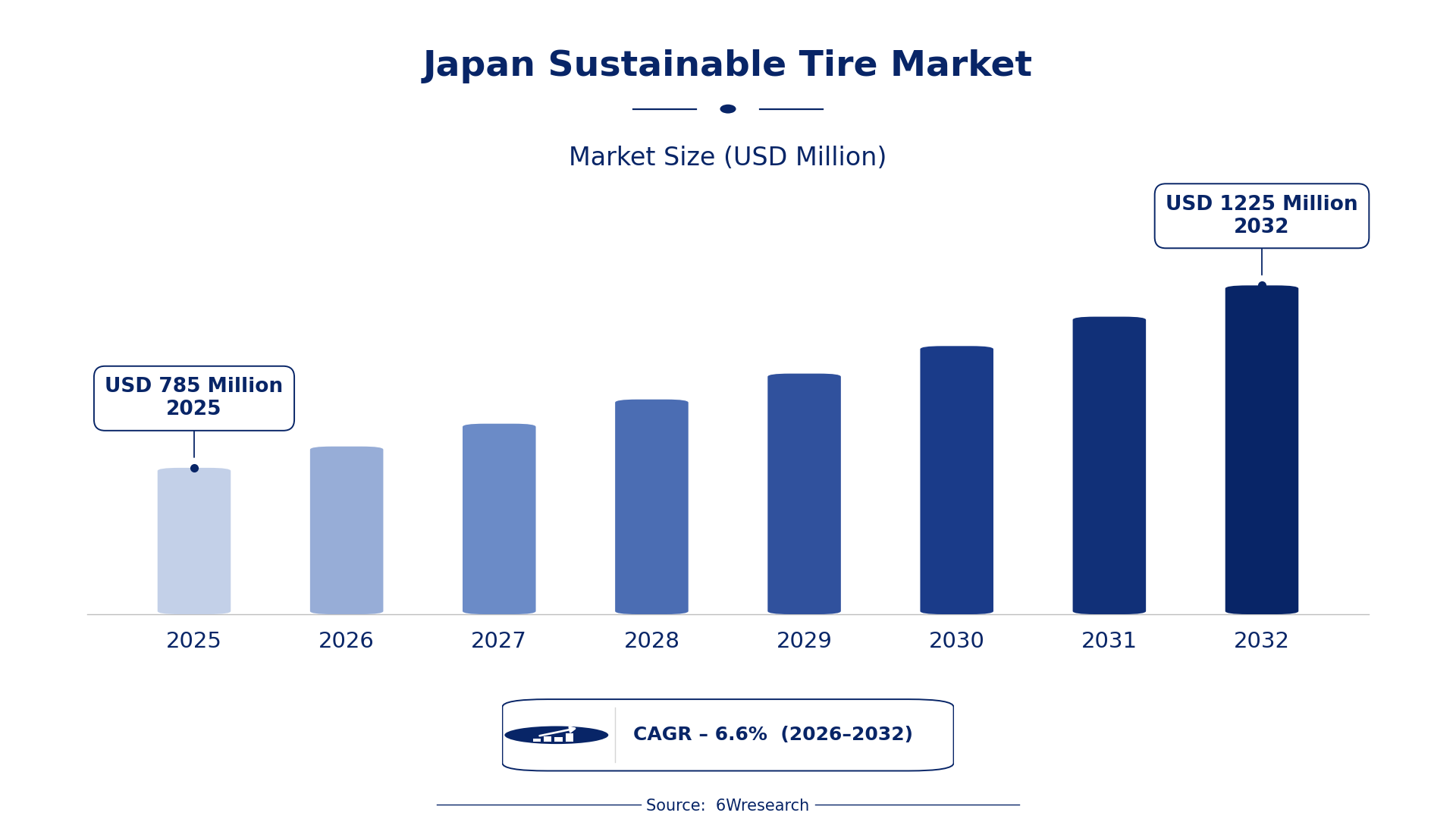
According to 6Wresearch internal database and industry insights, the Japan Sustainable Tire Market was valued at USD 785 Million in 2025 and is projected to reach USD 1,225 Million by 2032, growing at a CAGR of approximately 6.6% during 2026–2032.
Japan Sustainable Tire Market Highlights
| Report Metric | Details |
| Report Name | Japan Sustainable Tire Market (2026-2032) |
| Market Size 2025 | USD 785 Million |
| Market Size 2032 | USD 1,225 Million |
| Absolute Growth 2025–2032 | USD 440 Million |
| CAGR 2026–2032 | 6.6% |
| Peak Annual Growth | 7.7% in 2028 |
| Forecast Period | 2026–2032 |
| Historical Data | 2022–2025 |
| Base Year | 2025 |
| Leading Tire Type, 2025 | Bio-Based Tires (40% share) |
| Leading Sustainable Input, 2025 | Natural Rubber (35% share) |
| Leading Vehicle Segment, 2025 | Passenger Vehicles (34% share) |
| Leading End User, 2025 | Car Manufacturers (46% share) |
| Fastest-Growing Tire Type | Recycled Rubber Tires (9.3% CAGR) |
| Fastest-Growing Sustainable Input | Soy Oil (8.5% CAGR) |
| Fastest-Growing Vehicle Segment | Commercial Fleets (8.7% CAGR) |
| Fastest-Growing End User | Tire Retreading Firms (8.6% CAGR) |
| Growing Sector | passenger vehicles |
| Key End Users | car manufacturers, tire retreading firms, transport operators, commercial fleets |
Japan Sustainable Tire Market Year-wise Growth Rate and Key Drivers (2022–2032)
This graph illustrates the annual growth rates of the market from 2022 to 2032, highlighting a steady upward trajectory and projected market expansion over the forecast period.
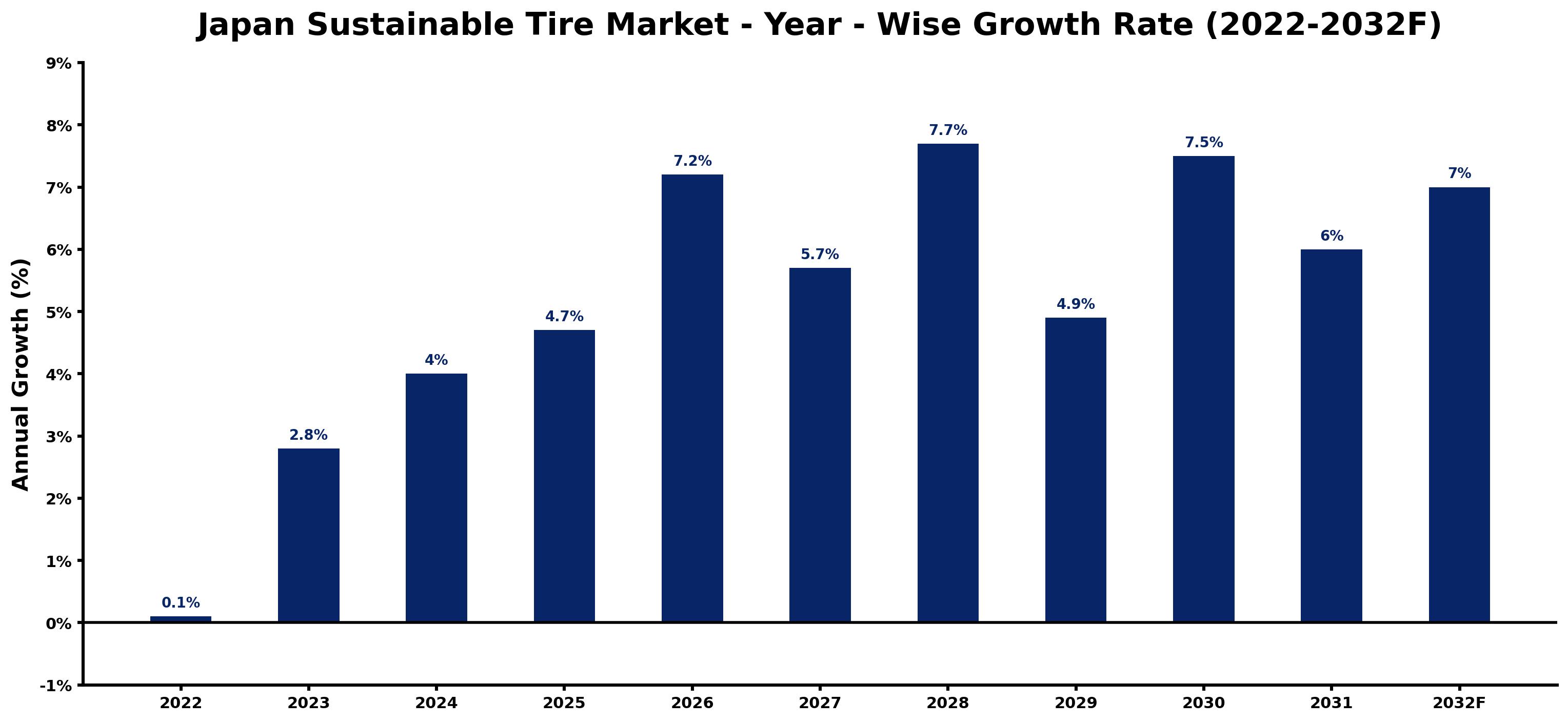
Year by year, the estimates below pair each growth rate with the development that shaped it.
| Year | Estimated Annual Growth (%) | Market Rationale |
| 2022 | 0.1 | The market experienced minimal growth as companies began to adjust to sustainability trends. |
| 2023 | 2.8 | Demand for sustainable tires increased due to heightened environmental awareness among consumers. |
| 2024 | 4.0 | Growth accelerated as more car manufacturers adopted eco-friendly tire options. |
| 2025 | 4.7 | The introduction of new regulations encouraged further investments in sustainable tire production. |
| 2026 | 7.2 | Rising consumer preference for eco-friendly vehicles is expected to drive substantial demand for sustainable tires. |
| 2027 | 5.7 | Growth is projected to slow as the market adjusts to new production capacities and technologies. |
| 2028 | 7.7 | The peak growth year will see substantial investment in sustainable tire innovations and technologies. |
| 2029 | 4.9 | Market growth is expected to decelerate as competition intensifies among tire manufacturers. |
| 2030 | 7.5 | Demand will surge again as more consumers opt for fuel-efficient vehicles with sustainable tires. |
| 2031 | 6.0 | Growth is projected to moderate as manufacturers face challenges in sourcing sustainable materials. |
| 2032 | 7.0 | The market is expected to expand as new recycling technologies become widely adopted. |
Note: Market size estimations and growth projections presented in this report are based on 6Wresearch's proprietary forecasting methodology, utilizing the latest available industry data, government publications, and primary research inputs.
Japan Sustainable Tire Market Synopsis
Sustainable tires are produced from eco-friendly materials like natural rubber and recycled components, aimed at reducing environmental impact while maintaining performance. Heightened consumer awareness and government initiatives, including a 2023 programme promoting eco-friendly transportation, are contributing to this growth.
Market Dynamics Impact Analysis (2026–2032)
| Factor | Type | Impact | Primary Segment Affected |
| Rising environmental awareness among consumers | Driver | High | Bio-Based Tires |
| Increased production of eco-friendly vehicles | Driver | High | Bio-Based Tires |
| Growing demand for eco-friendly transportation solutions | Opportunity | High | Bio-Based Tires |
| Expansion of tire recycling facilities in the Kanto region | Opportunity | Medium | Bio-Based Tires |
| Challenges in sourcing sustainable materials | Restraint | High | Bio-Based Tires |
| Competition among manufacturers for market share | Restraint | Medium | Bio-Based Tires |
| High production costs for sustainable materials | Challenge | High | Bio-Based Tires |
| Regulatory compliance requirements for tire safety | Challenge | Medium | Bio-Based Tires |
Evaluation of Drivers in Japan Sustainable Tire Market (2026–2032)
The following drivers explain most of the expected growth.
| Drivers | Primary Segment Affected | Why It Matters (Evidence) |
| Increased consumer demand for eco-friendly products | Car Manufacturers | Natural rubber, accounting for 40% of tire materials, is increasingly favoured by car manufacturers. |
| Rising production of electric vehicles | Bio-Based Tires | The growing EV market drives demand for specialized sustainable tires, improving vehicle performance. |
| Government initiatives promoting sustainable practices | Bio-Based Tires | The Eco-Products Award recognises innovations, motivating manufacturers to invest in sustainable tire technology. |
| Technological advancements in tire recycling | Bio-Based Tires | New recycling methods increase the use of recycled materials, with over 30% of new tires incorporating them. |
| Consumer preference for fuel-efficient vehicles | Fuel-Efficient Vehicles | Low rolling resistance tires are in demand, improving fuel efficiency and reducing energy consumption. |
Spending rises because car manufacturers are increasingly adopting sustainable tires, with over 30% of new tires now made with recycled materials. The expansion of electric vehicles also boosts demand for specialized tires, which improve vehicle performance. Recognition through awards motivates producers to invest in sustainable practices. Advancements in tire recycling methods are increasing the availability of eco-friendly materials, driving further demand. Consumer preference for fuel-efficient vehicles is rising, leading to a greater focus on low rolling resistance tires that reduce energy consumption.
Evaluation of Restraints in Japan Sustainable Tire Market
The key brakes on demand, and where they bite hardest, are shown below.
| Market Restraint | Primary Segment Affected | Why It Matters (Evidence) |
| High production costs for sustainable materials | Natural Rubber | Natural rubber and recycled components are often more expensive than traditional materials, impacting pricing. |
| Limited availability of eco-friendly raw materials | Bio-Based Tires | Sourcing sustainable materials can be challenging, affecting production timelines and costs. |
| Intense competition among manufacturers | Bio-Based Tires | As more companies enter the sustainable tire market, profit margins may decrease due to price wars. |
| Regulatory compliance costs | Bio-Based Tires | Meeting JIS standards for tire quality and safety can increase operational costs for manufacturers. |
| Market volatility in raw material prices | Natural Rubber | Fluctuating prices for natural rubber and recycled materials can disrupt production planning. |
Japan Sustainable Tire Market Challenges
Natural rubber shortages disrupt supply chains, particularly when climate change affects production in Southeast Asia, causing delays that can extend tire delivery times by up to three months for buyers. Local training institutions struggle to meet the rising demand for eco-friendly tire production, creating skills shortages that hinder suppliers from adopting sustainable practices quickly. Increased manufacturing costs arise from investments in advanced recycling technologies, which can raise expenses by 20%, ultimately inflating retail prices for consumers. Competition intensifies as international players enter the market, forcing local producers to innovate rapidly to retain market share.
Trends in the Japan Sustainable Tire Market
The trends below show where the Japan Sustainable Tire Market is heading.
- Shift from Traditional to Sustainable Tires: The Tokyo region is increasingly focusing on sustainable tire production, with 40% of materials now sourced from natural rubber. This shift reflects a growing commitment to eco-friendly practices within the industry.
- Emergence of Tire Recycling Facilities: Since 2023, new tire recycling facilities have been established in the Kanto region, aiming for a 50% reduction in tire waste by 2030. This trend supports sustainability and advances the circular economy in tire production.
- Transition to Low Rolling Resistance Tires: In 2022, the demand for low rolling resistance tires surged, with a significant increase in sales among fuel-efficient vehicles. This trend indicates a shift towards energy-efficient solutions in the automotive sector.
- Rise of Eco-Friendly Tire Innovations: The Eco-Products Award, launched in 2023, highlights innovative sustainable tire technologies. This recognition encourages manufacturers to invest in research and development for greener tire solutions.
Investment Opportunities in the Japan Sustainable Tire Market
Below are the investment opportunities with the strongest case in the Japan Sustainable Tire Market.
- Joint Ventures for Sustainable Tire Production: Now is the time for partnerships in sustainable tire production, especially in the Kanto region, where recycling facilities are expanding. This collaboration can improve market reach and innovation.
- Investment in Eco-Friendly Material Sourcing: With over 30% of new tires made from recycled materials, investment in sustainable sourcing is timely. Car manufacturers are increasingly seeking suppliers who can provide eco-friendly components.
- Expansion of Electric Vehicle Tire Offerings: The growing EV market presents an opportunity for specialized tire offerings, particularly in urban areas. Investing in R&D for sustainable tire technologies can capture this emerging demand.
- Development of Advanced Recycling Technologies: As the government aims for a 50% reduction in tire waste by 2030, investment in advanced recycling technologies is essential. Tire retreading firms are key players in this transformation.
Government Initiatives in the Japan Sustainable Tire Market
The PRTR Law mandates businesses to report hazardous substances, ensuring transparency in the tire production process. This law impacts producers by requiring compliance with environmental standards, promoting sustainable practices in the industry.
In 2022, the Battery Industry Strategy targeted 150 GWh of domestic battery manufacturing capacity by 2030, overseen by METI. This initiative supports the sustainable tire market by promoting innovation and investment in eco-friendly technologies.
Future Insight of the Japan Sustainable Tire Market
New recycling facilities in the Kanto region will enhance the availability of recycled materials, supporting the government's goal for a 50% reduction in tire waste by 2030. By 2032, advancements in eco-friendly tire technology will enable suppliers to produce 4 million tons of tires annually, benefiting buyers through improved sustainability. Stricter JIS standards will raise the quality and safety of sustainable tires, fostering greater consumer confidence. Initiatives promoting eco-friendly transportation will drive demand for these innovative tire solutions.
Market Segmentation Analysis
Japan Sustainable Tire Market report covers a detailed analysis of the following market segments:
By Tire Type – Bio-Based Tires Lead, Recycled Rubber Tires Expected to Grow Fastest
According to Saurav Kr Singh, Senior Research Analyst at 6Wresearch, with 40% of tire type revenue in 2025, Bio-Based Tires was the largest category. Bio-Based Tires lead the market due to their prevalent use in eco-friendly vehicle segments, appealing to environmentally conscious consumers. The Tokyo region, a significant manufacturing centre, has ramped up production to cater to this increasing demand. Recycled Rubber Tires are set to record the highest CAGR in this split, 9.3% over 2026–2032. Recycled Rubber Tires are experiencing rapid growth as they are increasingly used in retreading and new tire production, reflecting a broader shift towards sustainable practices. Government initiatives promoting eco-friendly transportation are further driving this trend, encouraging manufacturers to incorporate recycled materials. Suppliers should consider expanding their product lines to include recycled rubber options to meet the growing demand for sustainable solutions.
By Sustainable Input – Natural Rubber Leads, Soy Oil Expected to Grow Fastest
Natural Rubber accounted for 35% of the market by sustainable input in 2025. Natural Rubber is the primary material in tire manufacturing, accounting for 40% of production inputs, making it essential for sustainable tire development. Its established supply chain and compliance with JIS quality standards solidify its position in the market. The quickest growth will come from Soy Oil, forecast to expand at a CAGR of 8.5% between 2026 and 2032. Soy Oil is gaining traction as a preferred additive for flexibility in sustainable tires, driven by increasing awareness of eco-friendly materials. Government initiatives aimed at promoting sustainable practices are likely to boost its adoption in the industry. Buyers may benefit from sourcing tires that incorporate soy oil to align with their sustainability goals.
By Vehicle Segment – Passenger Vehicles Lead, Commercial Fleets Expected to Grow Fastest
Passenger Vehicles took 34% of vehicle segment revenue in 2025, more than any other category. Passenger Vehicles account for the largest segment of tire sales, driven by Japan's population of approximately 125 million and the high demand for personal transportation. This segment's established market presence ensures consistent demand for sustainable tire options. Over 2026–2032, Commercial Fleets are expected to post the fastest growth, at a CAGR of 8.7%. Commercial Fleets are experiencing notable growth due to their requirement for durable tires that can endure rigorous usage. The increasing focus on sustainability in fleet management is prompting operators to seek eco-friendly tire solutions, further propelling this segment's expansion. Suppliers should tailor their products to meet the specific durability needs of commercial fleets.
By End User – Car Manufacturers Lead, Tire Retreading Firms Expected to Grow Fastest
Car Manufacturers held 46% of the Japan Sustainable Tire Market by end user in 2025. Car Manufacturers are the main users of sustainable tires, integrating them into their production processes to meet consumer demand for eco-friendly vehicles. Their commitment to sustainability aligns with government initiatives, creating a strong market for sustainable tire solutions. Tire Retreading Firms are projected to grow fastest, at a CAGR of 8.6% during 2026–2032. Tire Retreading Firms are rapidly growing as they play a vital role in recycling and sustainability, responding to the increasing focus on reducing tire waste. Their operations are supported by government targets for waste reduction, enhancing their market position. Suppliers should seek collaborations with tire retreading firms to strengthen their sustainability credentials.
Key Attractiveness of the Report
- 10 Years of Market Numbers
- Historical Data Starting from 2022 to 2025
- Base Year 2025
- Forecast Data until 2032
- Key Performance Indicators Impacting the Market
- Major Upcoming Developments and Projects
Key Highlights of the Report:
- Japan Sustainable Tire Market Outlook
- Market Size of Japan Sustainable Tire Market, 2025
- Forecast of Japan Sustainable Tire Market, 2032
- Historical Data and Forecast of Japan Sustainable Tire Revenues & Volume for the Period 2022-2032F
- Japan Sustainable Tire Market Trend Evolution
- Japan Sustainable Tire Market Drivers and Challenges
- Japan Sustainable Tire Price Trends
- Japan Sustainable Tire Porter's Five Forces
- Japan Sustainable Tire Industry Life Cycle
- Historical Data and Forecast of Japan Sustainable Tire Market Revenues & Volume By Tire Type for the Period 2022-2032F
- Historical Data and Forecast of Japan Sustainable Tire Market Revenues & Volume By Bio-Based Tires for the Period 2022-2032F
- Historical Data and Forecast of Japan Sustainable Tire Market Revenues & Volume By Recycled Rubber Tires for the Period 2022-2032F
- Historical Data and Forecast of Japan Sustainable Tire Market Revenues & Volume By Silica-Enhanced Tires for the Period 2022-2032F
- Historical Data and Forecast of Japan Sustainable Tire Market Revenues & Volume By Low Rolling Resistance for the Period 2022-2032F
- Historical Data and Forecast of Japan Sustainable Tire Market Revenues & Volume By Sustainable Input for the Period 2022-2032F
- Historical Data and Forecast of Japan Sustainable Tire Market Revenues & Volume By Natural Rubber, Soy Oil for the Period 2022-2032F
- Historical Data and Forecast of Japan Sustainable Tire Market Revenues & Volume By Reclaimed Tire Material for the Period 2022-2032F
- Historical Data and Forecast of Japan Sustainable Tire Market Revenues & Volume By Rice Husk Silica for the Period 2022-2032F
- Historical Data and Forecast of Japan Sustainable Tire Market Revenues & Volume By Eco-Friendly Compounds for the Period 2022-2032F
- Historical Data and Forecast of Japan Sustainable Tire Market Revenues & Volume By Vehicle Segment for the Period 2022-2032F
- Historical Data and Forecast of Japan Sustainable Tire Market Revenues & Volume By Passenger Vehicles for the Period 2022-2032F
- Historical Data and Forecast of Japan Sustainable Tire Market Revenues & Volume By Commercial Fleets for the Period 2022-2032F
- Historical Data and Forecast of Japan Sustainable Tire Market Revenues & Volume By High-Performance Cars for the Period 2022-2032F
- Historical Data and Forecast of Japan Sustainable Tire Market Revenues & Volume By Fuel-Efficient Vehicles for the Period 2022-2032F
- Historical Data and Forecast of Japan Sustainable Tire Market Revenues & Volume By End User for the Period 2022-2032F
- Historical Data and Forecast of Japan Sustainable Tire Market Revenues & Volume By Car Manufacturers for the Period 2022-2032F
- Historical Data and Forecast of Japan Sustainable Tire Market Revenues & Volume By Tire Retreading Firms for the Period 2022-2032F
- Historical Data and Forecast of Japan Sustainable Tire Market Revenues & Volume By EV OEMs for the Period 2022-2032F
- Historical Data and Forecast of Japan Sustainable Tire Market Revenues & Volume By Transport Operators for the Period 2022-2032F
- Japan Sustainable Tire Import Export Trade Statistics
- Market Opportunity Assessment By Tire Type
- Market Opportunity Assessment By Sustainable Input
- Market Opportunity Assessment By Vehicle Segment
- Market Opportunity Assessment By End User
- Japan Sustainable Tire Top Companies Market Share
- Japan Sustainable Tire Competitive Benchmarking By Technical and Operational Parameters
- Japan Sustainable Tire Company Profiles
- Japan Sustainable Tire Key Strategic Recommendations
Market Covered
The report covers the following segments.
By Tire Type
- Bio-Based Tires
- Recycled Rubber Tires
- Silica-Enhanced Tires
- Low Rolling Resistance
By Sustainable Input
- Natural Rubber
- Soy Oil
- Reclaimed Tire Material
- Rice Husk Silica
- Eco-Friendly Compounds
By Vehicle Segment
- Passenger Vehicles
- Commercial Fleets
- High-Performance Cars
- Fuel-Efficient Vehicles
By End User
- Car Manufacturers
- Tire Retreading Firms
- EV OEMs
- Transport Operators































