Japan Sustainable Tire Materials Market Size & Growth Rate
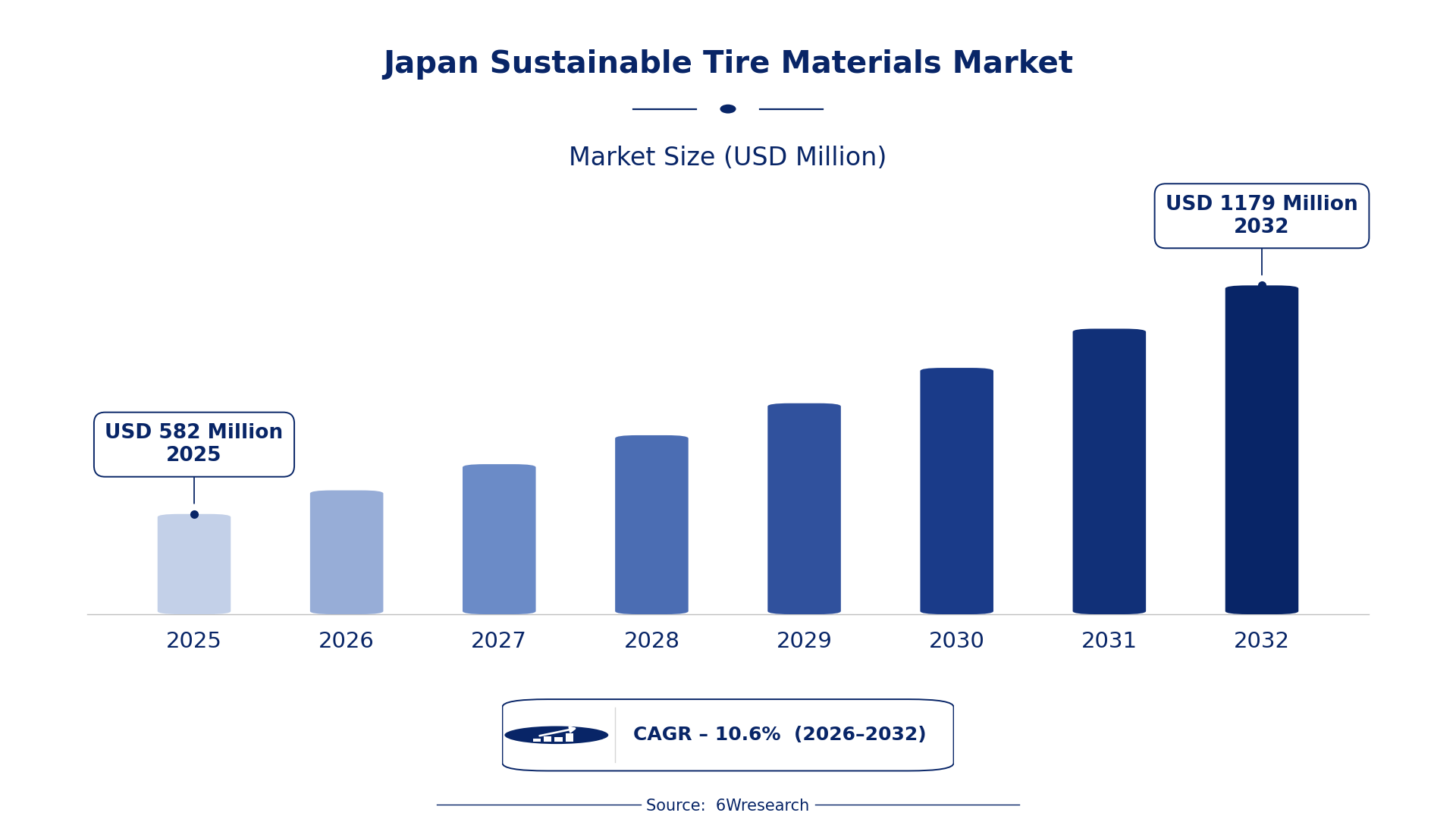
According to 6Wresearch internal database and industry insights, the Japan Sustainable Tire Materials Market was valued at USD 582 Million in 2025 and is projected to reach USD 1,179 Million by 2032, growing at a CAGR of approximately 10.6% during 2026–2032.
Japan Sustainable Tire Materials Market Highlights
| Report Metric | Details |
| Report Name | Japan Sustainable Tire Materials Market (2026-2032) |
| Market Size 2025 | USD 582 Million |
| Market Size 2032 | USD 1,179 Million |
| Absolute Growth 2025–2032 | USD 597 Million |
| CAGR 2026–2032 | 10.6% |
| Peak Annual Growth | 11.6% in 2032 |
| Forecast Period | 2026–2032 |
| Historical Data | 2022–2025 |
| Base Year | 2025 |
| Leading Material Type, 2025 | Bio-Fillers (37% share) |
| Leading Source, 2025 | Scrap Steel Wire (31% share) |
| Leading Tire Component, 2025 | Tread Compound (52% share) |
| Leading End User, 2025 | Tire Manufacturers (47% share) |
| Fastest-Growing Material Type | Soybean Oil Blends (15.6% CAGR) |
| Fastest-Growing Source | Rice Husk (15.1% CAGR) |
| Fastest-Growing Tire Component | Rubber Substitutes (14.9% CAGR) |
| Fastest-Growing End User | Green Tire Suppliers (13.9% CAGR) |
| Growing Sector | Green Tire Suppliers |
| Key End Users | Tire Manufacturers, Green Tire Suppliers, Eco Rubber Suppliers, Compounders |
Japan Sustainable Tire Materials Market Year-wise Growth Rate and Key Drivers (2022–2032)
This graph illustrates the annual growth rates of the market from 2022 to 2032, highlighting a steady upward trajectory and projected market expansion over the forecast period.
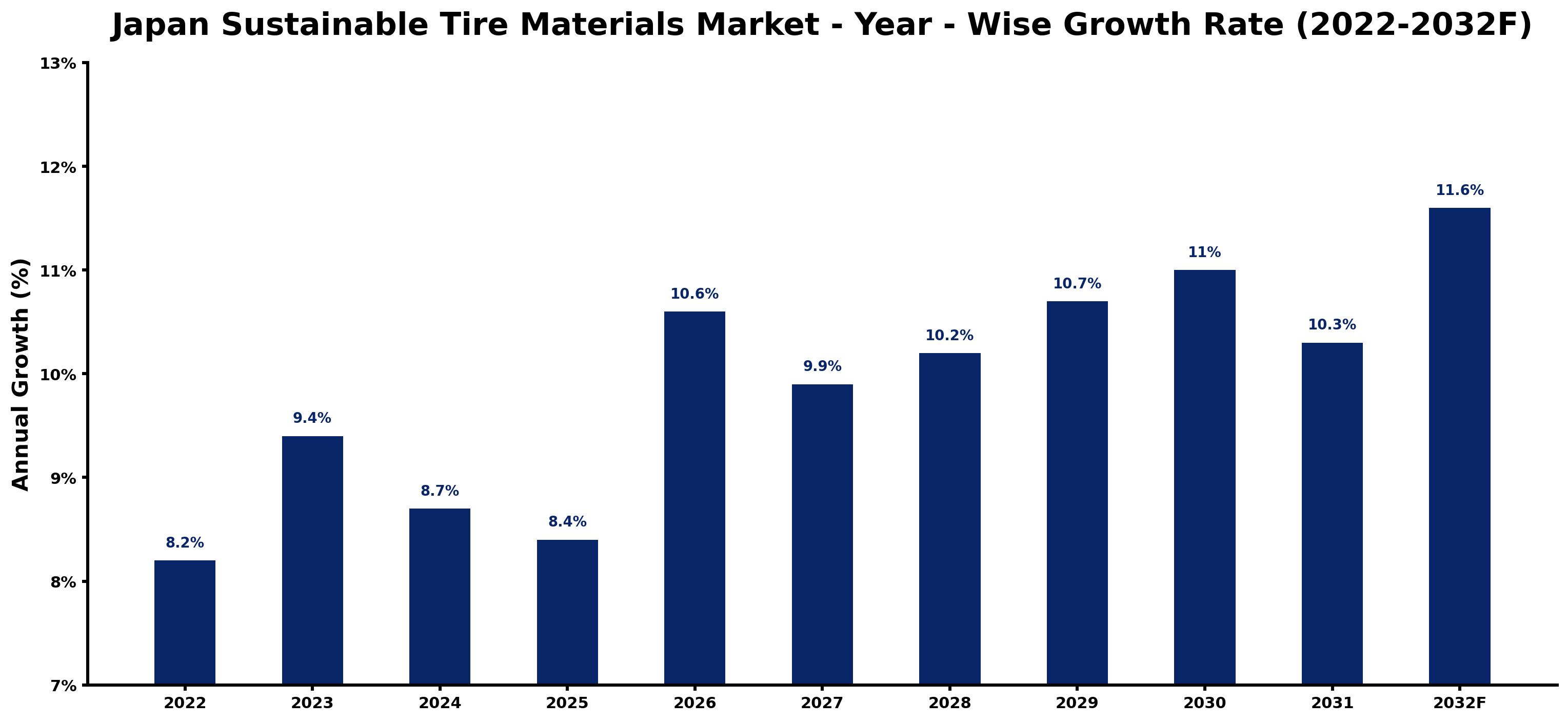
Annual growth estimates for each year appear below with the principal reason behind them, explaining the shifts that set the pace of the market.
| Year | Estimated Annual Growth (%) | Market Rationale |
| 2022 | 8.2 | The market showed steady demand as manufacturers began adopting eco-friendly practices. |
| 2023 | 9.4 | Growth accelerated due to increased awareness of sustainable tire materials among consumers. |
| 2024 | 8.7 | The market experienced a slowdown as manufacturers faced supply chain challenges. |
| 2025 | 8.4 | Demand continued to grow, albeit at a slower pace, as manufacturers adjusted to market conditions. |
| 2026 | 10.6 | Growth is expected to resume strongly as new technologies in sustainable materials are introduced. |
| 2027 | 9.9 | The market is projected to slow again as manufacturers deal with rising material costs. |
| 2028 | 10.2 | Demand is expected to increase as tire manufacturers expand their eco-friendly product lines. |
| 2029 | 10.7 | Growth will continue as consumer preferences shift towards sustainable products. |
| 2030 | 11.0 | The market is projected to see a further increase driven by stricter environmental regulations. |
| 2031 | 10.3 | Growth is expected to slow as the market reaches a more mature phase with established players. |
| 2032 | 11.6 | The market will peak as innovations in sustainable materials gain widespread adoption. |
Note: Market size estimations and growth projections presented in this report are based on 6Wresearch's proprietary forecasting methodology, utilizing the latest available industry data, government publications, and primary research inputs.
Japan Sustainable Tire Materials Market Synopsis
Sustainable tire materials are eco-friendly components used in tire manufacturing, made from renewable resources or recycled materials. The Japan Sustainable Tire Materials Market is projected to grow, driven by a 15% increase in the use of recycled steel in tires over the past five years and a target of 20% reduction in carbon emissions from tire production by 2023. Factors such as domestic demand from tire manufacturers and government initiatives to promote sustainable practices are key to this growth.
Market Dynamics Impact Analysis (2026–2032)
| Factor | Type | Impact | Primary Segment Affected |
| Increasing adoption of eco-friendly materials in tire production | Driver | High | Bio-Fillers |
| Growing consumer demand for sustainable products | Driver | High | Recycled Steel |
| Rising investments in sustainable tire technologies | Opportunity | High | Soybean Oil Blends |
| Government initiatives promoting sustainable manufacturing | Opportunity | Medium | Bio-Based Resin |
| High costs associated with sustainable material sourcing | Restraint | High | Scrap Steel Wire |
| Limited availability of certain eco-friendly materials | Restraint | Medium | Rice Husk |
| Technological challenges in material development | Challenge | High | Rubber Substitutes |
| Competition from traditional tire materials | Challenge | Medium | Tread Compound |
Evaluation of Drivers in Japan Sustainable Tire Materials Market (2026–2032)
Demand rests on the following drivers, each shown with the segment it touches most.
| Drivers | Primary Segment Affected | Why It Matters (Evidence) |
| Increased production of eco-friendly tires | Bio-Fillers | Bio-fillers are projected to account for 20% of the total tire material market by 2025, encouraging manufacturers to invest in sustainable practices. |
| Rising consumer awareness of environmental issues | Recycled Steel | The use of recycled steel in tires has increased by 15% over five years, prompting manufacturers to adopt these materials to meet consumer expectations. |
| Government funding for sustainable technologies | Soybean Oil Blends | Japan targets a JPY 150 trillion decarbonisation investment over 10 years, driving innovation in sustainable tire materials production. |
| Industry standards promoting sustainability | Bio-Based Resin | ISO 14001 certification is widely adopted among tire manufacturers, pushing them towards eco-friendly material usage and compliance. |
| Growing automotive sector demand for sustainable products | Scrap Steel Wire | Japan's automotive sector is a major consumer of sustainable tire materials, boosting demand for eco-friendly alternatives. |
Orders keep climbing as the automotive sector increasingly demands sustainable tire materials, with approximately 80 million tires produced in 2022. The use of recycled steel in tires has grown by 15% over five years, prompting manufacturers to innovate in their product offerings. Rising consumer awareness of environmental issues is influencing purchasing decisions, leading to a shift towards sustainable products. Tire manufacturers are investing in new technologies to improve performance and sustainability, which further drives demand for eco-friendly materials.
Evaluation of Restraints in Japan Sustainable Tire Materials Market
The following restraints limit how fast demand can grow.
| Market Restraint | Primary Segment Affected | Why It Matters (Evidence) |
| High costs of sourcing sustainable materials | Bio-Fillers | The average cost of bio-fillers remains higher than traditional materials, limiting their widespread adoption by manufacturers. |
| Limited supply of recycled materials | Recycled Steel | The availability of quality recycled steel is constrained, affecting production capabilities for tire manufacturers. |
| Technological barriers in developing new materials | Soybean Oil Blends | Challenges in formulating effective soybean oil blends hinder their integration into mainstream tire production, limiting options for manufacturers. |
| Regulatory compliance costs | Bio-Based Resin | Manufacturers face increased costs to meet stringent regulations for bio-based materials, impacting profitability and pricing strategies. |
| Competition from traditional tire materials | Scrap Steel Wire | Traditional materials often offer lower costs and established supply chains, making it difficult for sustainable alternatives to compete effectively. |
Japan Sustainable Tire Materials Market Challenges
High competition from international suppliers pressures local manufacturers, resulting in potential revenue losses of up to 15% for tire producers. Rising production costs stem from the transition to sustainable materials, inflating expenses by 20% and squeezing profit margins for manufacturers. Technological advancements lag behind global standards, causing delays of up to six months in adopting eco-friendly innovations, which affects development timelines for producers. Buyers face increased prices, with costs rising by 10% as manufacturers pass on expenses, limiting accessibility for consumers.
Trends in the Japan Sustainable Tire Materials Market
Buyers and suppliers in the Japan Sustainable Tire Materials Market are adjusting to the following trends.
- Shift from Conventional to Sustainable Materials: In 2023, tire manufacturers began prioritising sustainable materials, with a 20% target for bio-fillers by 2025. This shift reflects changing consumer preferences and regulatory pressures, creating opportunities for suppliers of eco-friendly components.
- Emergence of New Tire Technologies: Since 2023, the adoption of new tire technologies has accelerated, with a reported 15% increase in recycled steel usage. This trend indicates a growing focus on sustainability and performance, benefiting manufacturers investing in research and development.
- Growing Demand for Eco-Friendly Products: The tire manufacturing sector is increasingly influenced by consumer demand for sustainable products, with Japan's population of 125 million showing a preference for eco-friendly options. This trend encourages manufacturers to innovate and expand their sustainable offerings.
- Transition to Circular Economy Practices: In 2023, the Green Purchasing Network advocated for sustainable procurement, promoting circular economy practices in tire production. This initiative aims to reduce waste and improve resource efficiency, benefiting suppliers of recycled materials.
Investment Opportunities in the Japan Sustainable Tire Materials Market
The opportunities below stand out in the Japan Sustainable Tire Materials Market for new entrants and existing suppliers.
- Market Gap for Bio-Fillers: With a projected 20% share in the tire material market by 2025, there is a strong opportunity for suppliers of bio-fillers. Tire manufacturers are increasingly looking for sustainable alternatives to enhance their product offerings.
- Demand from Tire Manufacturers: Tire manufacturers are actively seeking sustainable materials to meet consumer preferences, creating a demand for innovative products. Collaborating with local suppliers can facilitate market entry and improve product availability.
- Investment in Eco-Friendly Technologies: The growing focus on sustainability presents an opportunity to invest in eco-friendly tire materials. Establishing joint ventures with local manufacturers can help navigate the regulatory environment and meet market needs.
- Expansion of Recycled Steel Use: With a 15% increase in recycled steel usage over the last five years, there is a strong opportunity for suppliers to expand their offerings. Engaging with tire manufacturers in the Kansai region can improve market penetration.
Government Initiatives in the Japan Sustainable Tire Materials Market
The GX Promotion Act (2023) establishes a legal framework for promoting sustainable practices in tire manufacturing. This act complements existing regulations like the PRTR Law, requiring businesses to report on chemical substances, thus ensuring greater environmental accountability for producers of sustainable tire materials.
The Ministry of the Environment oversees initiatives that fund research in sustainable tire technologies. This includes grants for projects aimed at increasing the use of bio-based materials, supporting innovation and development in the tire industry.
Future Insight of the Japan Sustainable Tire Materials Market
The integration of advanced bio-based materials will reshape demand by 2032, driven by government initiatives promoting sustainability. Japan's JPY 150 trillion decarbonisation investment will facilitate breakthroughs in eco-friendly technologies. The establishment of JIS standards will enhance quality assurance in sustainable materials, benefiting both buyers and suppliers. By 2025, bio-fillers are expected to constitute 20% of the total tire material market, providing buyers with more sustainable options and suppliers with expanded growth opportunities.
Market Segmentation Analysis
Japan Sustainable Tire Materials Market report covers a detailed analysis of the following market segments:
By Material Type – Bio-Fillers Lead, Soybean Oil Blends Expected to Grow Fastest
According to Saurav Kr Singh, Senior Research Analyst at 6Wresearch, Bio-Fillers took 37% of material type revenue in 2025, more than any other category. Bio-fillers hold the largest share in the market as they are essential for enhancing tire performance and sustainability. Their projected contribution of 20% to the total tire material market by 2025 indicates strong demand from manufacturers focused on eco-friendly solutions. Soybean Oil Blends are projected to grow fastest, at a CAGR of 15.6% during 2026–2032. The rapid expansion of soybean oil blends is attributed to their ability to improve flexibility and reduce reliance on petroleum-based oils. Industry associations' endorsements signal a notable shift towards these sustainable alternatives, ensuring ongoing growth in this segment. This trend necessitates that suppliers focus on developing bio-fillers and soybean oil blends to align with the rising market demand.
By Source – Scrap Steel Wire Leads, Rice Husk Expected to Grow Fastest
In 2025, Scrap Steel Wire led the source split with a 31% share. Scrap steel wire dominates the market as it is commonly recycled for tire bead wire, making it a preferred choice among manufacturers. The established infrastructure for recycling in Japan supports its widespread use in tire production. The quickest growth will come from Rice Husk, forecast to expand at a CAGR of 15.1% between 2026 and 2032. Rice husk is experiencing rapid growth as a filler in specific tire types, driven by increasing interest in sustainable materials. Its limited use is being explored further, suggesting potential for expansion in eco-friendly applications. Buyers should consider sourcing sustainable materials like rice husk to meet evolving environmental standards.
By Tire Component – Tread Compound Leads, Rubber Substitutes Expected to Grow Fastest
Tread Compound accounted for 52% of the market by tire component in 2025. Tread compounds are essential for tire performance and longevity, which secures their position as the leading component. Their critical role in ensuring safety and durability makes them a priority for manufacturers focused on quality. Over 2026–2032, Rubber Substitutes are expected to post the fastest growth, at a CAGR of 14.9%. Rubber substitutes are gaining traction as they replace traditional rubber in eco-friendly tires, driven by the industry's push towards sustainable practices. This trend indicates a shift in material preferences among manufacturers. Manufacturers must invest in research and development of rubber substitutes to stay competitive in the sustainable tire market.
By End User – Tire Manufacturers Lead, Green Tire Suppliers Expected to Grow Fastest
With 47% of end user revenue in 2025, Tire Manufacturers was the largest category. Tire manufacturers represent the largest consumer group for sustainable tire materials, driven by their commitment to meet environmental regulations and consumer preferences. Their substantial production volume reinforces their leading position in this market segment. Green Tire Suppliers are set to record the highest CAGR in this split, 13.9% over 2026–2032. Green tire suppliers are experiencing rapid growth as they are the primary users of sustainable materials, reflecting the rising demand for eco-friendly tire options. This trend indicates a broader industry shift towards greener practices in tire production. Suppliers should consider forming partnerships with green tire suppliers to strengthen their presence in the sustainable materials market.
Key Attractiveness of the Report
- 10 Years of Market Numbers
- Historical Data Starting from 2022 to 2025
- Base Year 2025
- Forecast Data until 2032
- Key Performance Indicators Impacting the Market
- Major Upcoming Developments and Projects
Key Highlights of the Report:
- Japan Sustainable Tire Materials Market Outlook
- Market Size of Japan Sustainable Tire Materials Market, 2025
- Forecast of Japan Sustainable Tire Materials Market, 2032
- Historical Data and Forecast of Japan Sustainable Tire Materials Revenues & Volume for the Period 2022-2032F
- Japan Sustainable Tire Materials Market Trend Evolution
- Japan Sustainable Tire Materials Market Drivers and Challenges
- Japan Sustainable Tire Materials Price Trends
- Japan Sustainable Tire Materials Porter's Five Forces
- Japan Sustainable Tire Materials Industry Life Cycle
- Historical Data and Forecast of Japan Sustainable Tire Materials Market Revenues & Volume By Material Type for the Period 2022-2032F
- Historical Data and Forecast of Japan Sustainable Tire Materials Market Revenues & Volume By Bio-Fillers for the Period 2022-2032F
- Historical Data and Forecast of Japan Sustainable Tire Materials Market Revenues & Volume By Recycled Steel for the Period 2022-2032F
- Historical Data and Forecast of Japan Sustainable Tire Materials Market Revenues & Volume By Soybean Oil Blends for the Period 2022-2032F
- Historical Data and Forecast of Japan Sustainable Tire Materials Market Revenues & Volume By Bio-Based Resin for the Period 2022-2032F
- Historical Data and Forecast of Japan Sustainable Tire Materials Market Revenues & Volume By Source for the Period 2022-2032F
- Historical Data and Forecast of Japan Sustainable Tire Materials Market Revenues & Volume By Rice Husk, Ash for the Period 2022-2032F
- Historical Data and Forecast of Japan Sustainable Tire Materials Market Revenues & Volume By Scrap Steel Wire for the Period 2022-2032F
- Historical Data and Forecast of Japan Sustainable Tire Materials Market Revenues & Volume By Soybeans for the Period 2022-2032F
- Historical Data and Forecast of Japan Sustainable Tire Materials Market Revenues & Volume By Natural Sources for the Period 2022-2032F
- Historical Data and Forecast of Japan Sustainable Tire Materials Market Revenues & Volume By Tire Component for the Period 2022-2032F
- Historical Data and Forecast of Japan Sustainable Tire Materials Market Revenues & Volume By Tread Compound for the Period 2022-2032F
- Historical Data and Forecast of Japan Sustainable Tire Materials Market Revenues & Volume By Bead Wire for the Period 2022-2032F
- Historical Data and Forecast of Japan Sustainable Tire Materials Market Revenues & Volume By Rubber Substitutes for the Period 2022-2032F
- Historical Data and Forecast of Japan Sustainable Tire Materials Market Revenues & Volume By Tire Adhesion for the Period 2022-2032F
- Historical Data and Forecast of Japan Sustainable Tire Materials Market Revenues & Volume By End User for the Period 2022-2032F
- Historical Data and Forecast of Japan Sustainable Tire Materials Market Revenues & Volume By Green Tire Suppliers for the Period 2022-2032F
- Historical Data and Forecast of Japan Sustainable Tire Materials Market Revenues & Volume By Tire Manufacturers for the Period 2022-2032F
- Historical Data and Forecast of Japan Sustainable Tire Materials Market Revenues & Volume By Eco Rubber Suppliers for the Period 2022-2032F
- Historical Data and Forecast of Japan Sustainable Tire Materials Market Revenues & Volume By Compounders for the Period 2022-2032F
- Japan Sustainable Tire Materials Import Export Trade Statistics
- Market Opportunity Assessment By Material Type
- Market Opportunity Assessment By Source
- Market Opportunity Assessment By Tire Component
- Market Opportunity Assessment By End User
- Japan Sustainable Tire Materials Top Companies Market Share
- Japan Sustainable Tire Materials Competitive Benchmarking By Technical and Operational Parameters
- Japan Sustainable Tire Materials Company Profiles
- Japan Sustainable Tire Materials Key Strategic Recommendations
Market Covered
This report examines the market across the segments below.
By Material Type
- Bio-Fillers
- Recycled Steel
- Soybean Oil Blends
- Bio-Based Resin
By Source
- Rice Husk
- Ash
- Scrap Steel Wire
- Soybeans
- Natural Sources
By Tire Component
- Tread Compound
- Bead Wire
- Rubber Substitutes
- Tire Adhesion
By End User
- Green Tire Suppliers
- Tire Manufacturers
- Eco Rubber Suppliers
- Compounders































