Japan Sustainable Transportation Market Size & Growth Rate
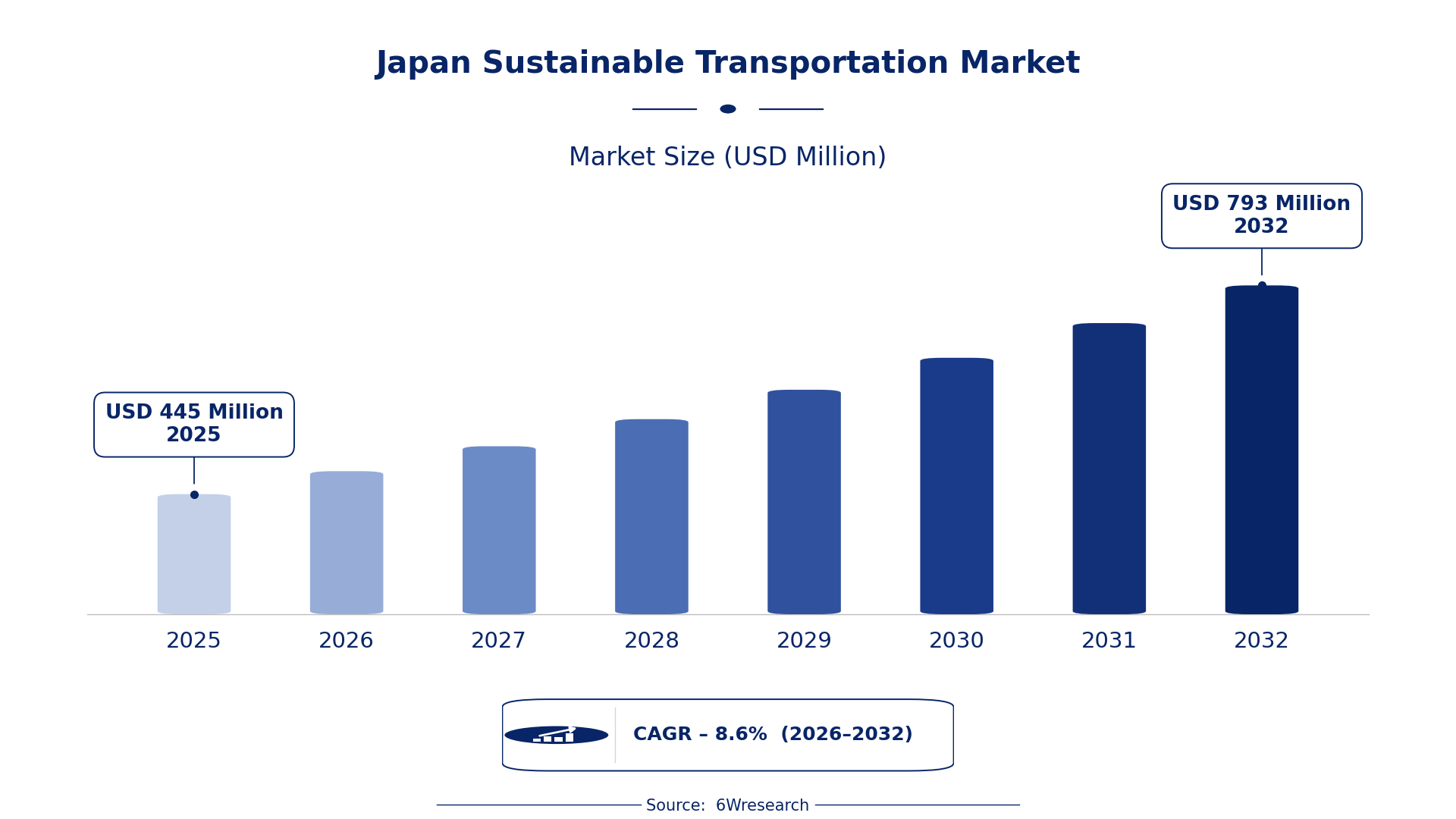
According to 6Wresearch internal database and industry insights, the Japan Sustainable Transportation Market was valued at USD 445 Million in 2025 and is projected to reach USD 793 Million by 2032, growing at a CAGR of approximately 8.6% during 2026–2032.
Japan Sustainable Transportation Market Highlights
| Report Metric | Details |
| Report Name | Japan Sustainable Transportation Market (2026-2032) |
| Market Size 2025 | USD 445 Million |
| Market Size 2032 | USD 793 Million |
| Absolute Growth 2025–2032 | USD 348 Million |
| CAGR 2026–2032 | 8.6% |
| Peak Annual Growth | 10.0% in 2026 |
| Forecast Period | 2026–2032 |
| Historical Data | 2022–2025 |
| Base Year | 2025 |
| Leading Transport Mode, 2025 | Electric Buses (49% share) |
| Leading Energy Type, 2025 | Battery Electric (40% share) |
| Leading Application Area, 2025 | Urban Rail Transit (50% share) |
| Leading End User, 2025 | Public Transit Agencies (38% share) |
| Fastest-Growing Transport Mode | Hydrogen Trains (11.3% CAGR) |
| Fastest-Growing Energy Type | Hydrogen Fuel Cell (12.2% CAGR) |
| Fastest-Growing Application Area | Last-Mile Access (9.9% CAGR) |
| Fastest-Growing End User | Rail Transport Agencies (10.6% CAGR) |
| Growing Sector | Public Transit |
| Key End Users | Public Transit Agencies, Municipal Authorities, Urban Planners, Rail Transport Agencies |
Japan Sustainable Transportation Market Year-wise Growth Rate and Key Drivers (2022–2032)
This graph illustrates the annual growth rates of the market from 2022 to 2032, highlighting a steady upward trajectory and projected market expansion over the forecast period.
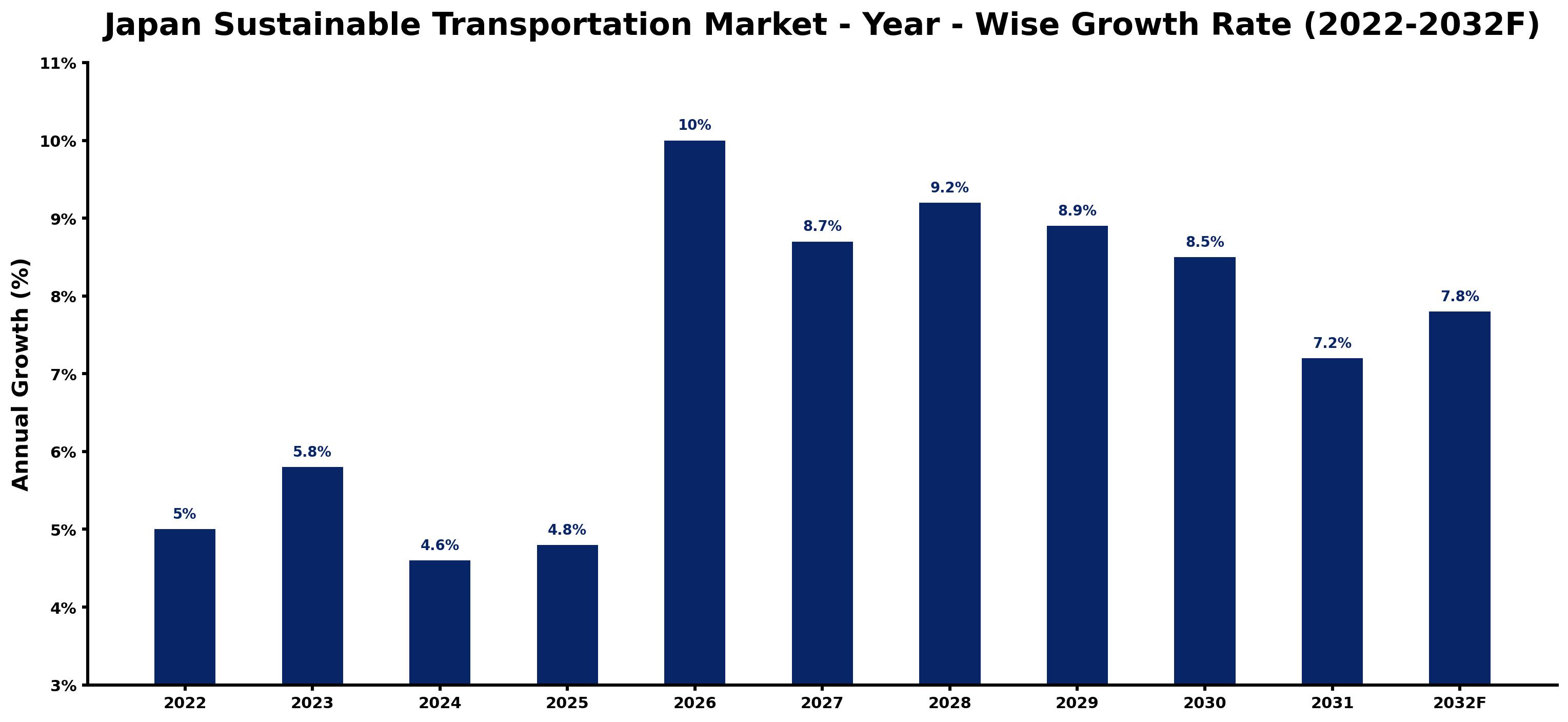
Below, each year's estimated growth is shown next to the factor that most influenced it.
| Year | Estimated Annual Growth (%) | Market Rationale |
| 2022 | 5.0 | The market showed stable growth with increasing investments in sustainable transport technologies. |
| 2023 | 5.8 | Demand surged as public transit agencies expanded their electric bus fleets in urban areas. |
| 2024 | 4.6 | Growth slowed as some municipalities faced budget constraints affecting new projects. |
| 2025 | 4.8 | Investment in bike infrastructure improved urban mobility, driving demand for sustainable transport. |
| 2026 | 10.0 | A rise in hydrogen train testing boosted interest in low-emission rail options. |
| 2027 | 8.7 | Growth slowed as the market adjusted to new regulations and standards in transportation. |
| 2028 | 9.2 | Demand increased as urban planners focused on enhancing last-mile connectivity solutions. |
| 2029 | 8.9 | Growth slowed as public transit agencies faced challenges in funding sustainable initiatives. |
| 2030 | 8.5 | The government’s target for electric public transport spurred further investments in technology. |
| 2031 | 7.2 | Demand growth slowed as competition among transport modes intensified in urban settings. |
| 2032 | 7.8 | A rise in public awareness of sustainability will drive demand for eco-friendly transport. |
Note: Market size estimations and growth projections presented in this report are based on 6Wresearch's proprietary forecasting methodology, utilizing the latest available industry data, government publications, and primary research inputs.
Japan Sustainable Transportation Market Synopsis
Sustainable transportation in Japan includes electric buses, hydrogen trains, and bike infrastructure, focusing on reducing carbon emissions. The Japan Sustainable Transportation Market is expanding due to investments from public transit agencies and municipal authorities, with the government aiming for 20% of public transport to be electric by 2030. The Tokyo Metropolitan Government's promotion of non-motorized transport initiatives further supports this growth, improving urban mobility while minimising environmental impact.
Market Dynamics Impact Analysis (2026–2032)
| Factor | Type | Impact | Primary Segment Affected |
| Increasing investments in electric buses for urban transit | Driver | High | Electric Buses |
| Emerging hydrogen train technology for long-distance travel | Driver | High | Hydrogen Trains |
| Growing demand for bike-sharing programs in urban areas | Opportunity | Medium | Bike Infrastructure |
| Expansion of last-mile access solutions in urban areas | Opportunity | Medium | Last-Mile Access |
| Budget constraints faced by municipal authorities | Restraint | High | Public Transit Agencies |
| Limited infrastructure for hydrogen refueling stations | Restraint | Medium | Hydrogen Trains |
| Regulatory challenges in implementing new technologies | Challenge | High | Electric Buses |
| Competition among different sustainable transport modes | Challenge | Medium | Urban Rail Transit |
Evaluation of Drivers in Japan Sustainable Transportation Market (2026–2032)
The table below links each growth driver to the segment it affects and the evidence for it.
| Drivers | Primary Segment Affected | Why It Matters (Evidence) |
| Government subsidies for electric bus purchases | Electric Buses | Public transit agencies are investing more due to financial support, with over 1,000 electric buses already in operation. |
| Testing of hydrogen trains in the Kansai region | Hydrogen Trains | This initiative is projected to increase interest and investment in hydrogen technology, paving the way for future adoption. |
| Tokyo's bike infrastructure expansion | Bike Infrastructure | With over 200 km of dedicated lanes, urban planners are promoting cycling as a sustainable commuting option. |
| Last-mile access improvements in urban areas | Last-Mile Access | Public transit agencies are enhancing connectivity to transit hubs, driving demand for integrated transport solutions. |
| Public transit agencies' commitment to sustainability | Urban Rail Transit | Agencies are investing in sustainable technologies, supported by government initiatives like the Hydrogen Society Promotion Act. |
Over 1,000 electric buses are currently operating in major cities, improving urban mobility. The testing of hydrogen trains in the Kansai region is driving interest in low-emission rail options, with plans for expansion. Furthermore, Tokyo's bike infrastructure, featuring over 200 km of dedicated lanes, supports sustainable commuting. Urban planners are also focusing on last-mile access improvements, essential for integrating transport systems.
Evaluation of Restraints in Japan Sustainable Transportation Market
These are the pressures that could keep growth below its potential.
| Market Restraint | Primary Segment Affected | Why It Matters (Evidence) |
| Budget constraints limiting new sustainable transport projects | Public Transit Agencies | Municipal authorities face financial challenges, impacting their ability to invest in new technologies. |
| Insufficient hydrogen refueling infrastructure | Hydrogen Trains | The lack of refueling stations hampers the adoption of hydrogen trains in urban transit. |
| Regulatory hurdles for new transport technologies | Electric Buses | Compliance with safety and environmental standards can delay implementation of electric buses. |
| Competition among various sustainable transport options | Urban Rail Transit | Different modes vie for funding and attention, complicating decision-making for public transit agencies. |
| Limited public awareness of sustainable transport benefits | Bike Infrastructure | Without widespread understanding, adoption of bike-sharing programs may be slower than anticipated. |
Japan Sustainable Transportation Market Challenges
A shortage of qualified professionals in sustainable transportation engineering is hindering project execution. This challenge stems from an ageing workforce, leading to delays for producers who find it difficult to implement advanced technologies. Supply chain disruptions arise from insufficient domestic production of components for electric buses, resulting in increased costs and delivery delays. Consequently, buyers face rising operational costs, with reports indicating a 15% increase in expenses. Regulatory hurdles complicate the rapid deployment of eco-friendly transport solutions, as compliance with ISO 14001 standards can extend project timelines for local governments.
Trends in the Japan Sustainable Transportation Market
Several trends are reshaping the Japan Sustainable Transportation Market; the most important are set out below.
- Shift to Electric Buses: In 2023, public transit agencies have increasingly embraced electric buses, with over 1,000 currently in operation. This transition reduces emissions and enhances urban mobility.
- Expansion of Hydrogen Train Testing: The Kansai region initiated testing of hydrogen trains in 2024, demonstrating a commitment to low-emission rail solutions. This initiative is expected to boost investments in hydrogen infrastructure.
- Focus on Non-Motorized Transport: The Tokyo Metropolitan Government's promotion of non-motorized transport initiatives has gained momentum since 2022, with bike lane expansions encouraging sustainable commuting. This has resulted in increased cycling participation.
- Enhancement of Last-Mile Connectivity: In 2025, urban planners are prioritising last-mile access solutions, integrating various transport modes. This focus aims to improve commuter convenience and alleviate urban congestion.
Investment Opportunities in the Japan Sustainable Transportation Market
The openings below show where demand in the Japan Sustainable Transportation Market is visible and how suppliers can enter.
- Electric Buses: With the government targeting 20% of public transport to be electric by 2030, suppliers have the opportunity to invest in electric bus technology. Public transit agencies are actively seeking partnerships to modernise their fleets.
- Bike Infrastructure: Now is an opportune moment to invest in bike-sharing programs, as urban areas expand their bike lanes. Local governments are allocating funds for these initiatives, creating opportunities for suppliers.
- Hydrogen Fuel Cell Technology: As hydrogen trains gain momentum, suppliers can concentrate on providing fuel cell technology. The Japan Railways Group is expanding services by 2025, indicating a growing market.
- Last-Mile Access Solutions: Investing in last-mile connectivity solutions is timely, given the increasing emphasis on urban transit integration. Collaborating with municipal authorities can facilitate entry into this market.
Government Initiatives in the Japan Sustainable Transportation Market
The Hydrogen Society Promotion Act, enacted in 2024, strengthens the existing framework for low-carbon hydrogen and ammonia supply chains by providing price-gap support. This measure builds on previous regulations, ensuring that sustainable transportation producers can access affordable hydrogen resources, crucial for hydrogen trains and other eco-friendly transport modes. By enabling a more stable supply chain, this act encourages investment in sustainable technologies, aligning with Japan's goal of reducing carbon emissions in public transport.
The Ministry of Land, Infrastructure, Transport and Tourism plays a pivotal role in approving and funding sustainable transport projects. With a budget allocation of approximately USD 200 million for 2023, the ministry supports initiatives that focus on electric buses and bike-sharing programs. This funding not only assists public transit agencies in adopting sustainable solutions but also promotes the integration of advanced technologies in urban infrastructure, improving overall mobility.
Future Insight of the Japan Sustainable Transportation Market
Investment in sustainable transportation is set to increase, driven by government initiatives and rising urban demand. By 2032, funding for electric buses and hydrogen trains will rise, with public transit agencies expected to allocate 30% more resources towards eco-friendly projects. Enhanced bike-sharing programs will improve urban mobility, making cities more accessible. As the Tokyo Metropolitan Government aims for zero-emission public transport by 2035, suppliers must swiftly adapt to meet these evolving requirements.
Market Segmentation Analysis
Japan Sustainable Transportation Market report covers a detailed analysis of the following market segments:
By Transport Mode – Electric Buses Lead, Hydrogen Trains Expected to Grow Fastest
According to Saurav Kr Singh, Senior Research Analyst at 6Wresearch, Electric Buses accounted for 49% of the market by transport mode in 2025. Electric buses play a crucial role in urban public transport, significantly contributing to emission reduction efforts. Their widespread use is evidenced by over 1,000 electric buses operating in major cities, making them a key element of sustainable transit solutions. The quickest growth will come from Hydrogen Trains, forecast to expand at a CAGR of 11.3% between 2026 and 2032. Hydrogen trains are gaining traction as a vital technology for long-distance rail transport, with ongoing testing in the Kansai region. The government's commitment to expand hydrogen train services by 2025 is expected to drive rapid growth in this segment. Suppliers should prioritise the development of hydrogen technologies to meet the increasing demand in the transportation sector.
By Energy Type – Battery Electric Leads, Hydrogen Fuel Cell Expected to Grow Fastest
With 40% of energy type revenue in 2025, Battery Electric was the largest category. Battery electric systems serve as the primary energy source for electric vehicles, making them essential for sustainable transport initiatives. Their dominance is underscored by the government's target for 20% of public transport to be electric by 2030. Over 2026–2032, Hydrogen Fuel Cell is expected to post the fastest growth, at a CAGR of 12.2%. Hydrogen fuel cells are rapidly being adopted for hydrogen-powered vehicles, providing a clean energy alternative. This growth is supported by public transit agencies investing in sustainable technologies with government subsidies. Buyers must consider diversifying their energy sources to include hydrogen fuel cells for future sustainability.
By Application Area – Urban Rail Transit Leads, Last-Mile Access Expected to Grow Fastest
Urban Rail Transit took 50% of application area revenue in 2025, more than any other category. Urban rail transit is critical for reducing congestion in densely populated areas, serving over 10 million passengers daily. The government's support for sustainable transport initiatives further emphasises its importance in urban mobility solutions. Last-Mile Access is set to record the highest CAGR in this split, 9.9% over 2026–2032. Last-mile access is becoming increasingly important for connecting commuters to transit hubs, enhancing overall mobility. Growth in this area is likely as local governments adopt sustainable transport plans under the Urban Renaissance Act. Suppliers should focus on improving last-mile connectivity solutions to capitalise on emerging market opportunities.
By End User – Public Transit Agencies Lead, Rail Transport Agencies Expected to Grow Fastest
The largest end user category in 2025 was Public Transit Agencies, at 38% of revenue. Public transit agencies are essential in implementing sustainable transport initiatives, driving significant investments in eco-friendly technologies. Their alignment with government targets for zero-emission public transport by 2035 underscores their influential role in the market. Rail Transport Agencies are projected to grow fastest, at a CAGR of 10.6% during 2026–2032. Rail transport agencies are at the forefront of integrating sustainable technologies within rail systems, ensuring compliance with environmental standards. Their proactive approaches are vital for meeting the rising demand for cleaner transport options. Suppliers must engage with rail transport agencies to ensure their offerings align with the evolving sustainability standards.
Key Attractiveness of the Report
- 10 Years of Market Numbers
- Historical Data Starting from 2022 to 2025
- Base Year 2025
- Forecast Data until 2032
- Key Performance Indicators Impacting the Market
- Major Upcoming Developments and Projects
Key Highlights of the Report:
- Japan Sustainable Transportation Market Outlook
- Market Size of Japan Sustainable Transportation Market, 2025
- Forecast of Japan Sustainable Transportation Market, 2032
- Historical Data and Forecast of Japan Sustainable Transportation Revenues & Volume for the Period 2022-2032F
- Japan Sustainable Transportation Market Trend Evolution
- Japan Sustainable Transportation Market Drivers and Challenges
- Japan Sustainable Transportation Price Trends
- Japan Sustainable Transportation Porter's Five Forces
- Japan Sustainable Transportation Industry Life Cycle
- Historical Data and Forecast of Japan Sustainable Transportation Market Revenues & Volume By Transport Mode for the Period 2022-2032F
- Historical Data and Forecast of Japan Sustainable Transportation Market Revenues & Volume By Electric Buses for the Period 2022-2032F
- Historical Data and Forecast of Japan Sustainable Transportation Market Revenues & Volume By Light Rail for the Period 2022-2032F
- Historical Data and Forecast of Japan Sustainable Transportation Market Revenues & Volume By Bike Infrastructure for the Period 2022-2032F
- Historical Data and Forecast of Japan Sustainable Transportation Market Revenues & Volume By Hydrogen Trains for the Period 2022-2032F
- Historical Data and Forecast of Japan Sustainable Transportation Market Revenues & Volume By Energy Type for the Period 2022-2032F
- Historical Data and Forecast of Japan Sustainable Transportation Market Revenues & Volume By Battery Electric for the Period 2022-2032F
- Historical Data and Forecast of Japan Sustainable Transportation Market Revenues & Volume By Grid-Tied Electric for the Period 2022-2032F
- Historical Data and Forecast of Japan Sustainable Transportation Market Revenues & Volume By Non-Motorized for the Period 2022-2032F
- Historical Data and Forecast of Japan Sustainable Transportation Market Revenues & Volume By Hydrogen Fuel Cell for the Period 2022-2032F
- Historical Data and Forecast of Japan Sustainable Transportation Market Revenues & Volume By Application Area for the Period 2022-2032F
- Historical Data and Forecast of Japan Sustainable Transportation Market Revenues & Volume By Intra-city Commute for the Period 2022-2032F
- Historical Data and Forecast of Japan Sustainable Transportation Market Revenues & Volume By Urban Rail Transit for the Period 2022-2032F
- Historical Data and Forecast of Japan Sustainable Transportation Market Revenues & Volume By Last-Mile Access for the Period 2022-2032F
- Historical Data and Forecast of Japan Sustainable Transportation Market Revenues & Volume By Long Distance Railway for the Period 2022-2032F
- Historical Data and Forecast of Japan Sustainable Transportation Market Revenues & Volume By End User for the Period 2022-2032F
- Historical Data and Forecast of Japan Sustainable Transportation Market Revenues & Volume By Public Transit Agencies for the Period 2022-2032F
- Historical Data and Forecast of Japan Sustainable Transportation Market Revenues & Volume By Municipal Authorities for the Period 2022-2032F
- Historical Data and Forecast of Japan Sustainable Transportation Market Revenues & Volume By Urban Planners for the Period 2022-2032F
- Historical Data and Forecast of Japan Sustainable Transportation Market Revenues & Volume By Rail Transport Agencies for the Period 2022-2032F
- Japan Sustainable Transportation Import Export Trade Statistics
- Market Opportunity Assessment By Transport Mode
- Market Opportunity Assessment By Energy Type
- Market Opportunity Assessment By Application Area
- Market Opportunity Assessment By End User
- Japan Sustainable Transportation Top Companies Market Share
- Japan Sustainable Transportation Competitive Benchmarking By Technical and Operational Parameters
- Japan Sustainable Transportation Company Profiles
- Japan Sustainable Transportation Key Strategic Recommendations
Market Covered
Coverage by segment is as follows.
By Transport Mode
- Electric Buses
- Light Rail
- Bike Infrastructure
- Hydrogen Trains
By Energy Type
- Battery Electric
- Grid-Tied Electric
- Non-Motorized
- Hydrogen Fuel Cell
By Application Area
- Intra-city Commute
- Urban Rail Transit
- Last-Mile Access
- Long Distance Railway
By End User
- Public Transit Agencies
- Municipal Authorities
- Urban Planners
- Rail Transport Agencies































