Japan Sustainable Tubes Market Size & Growth Rate
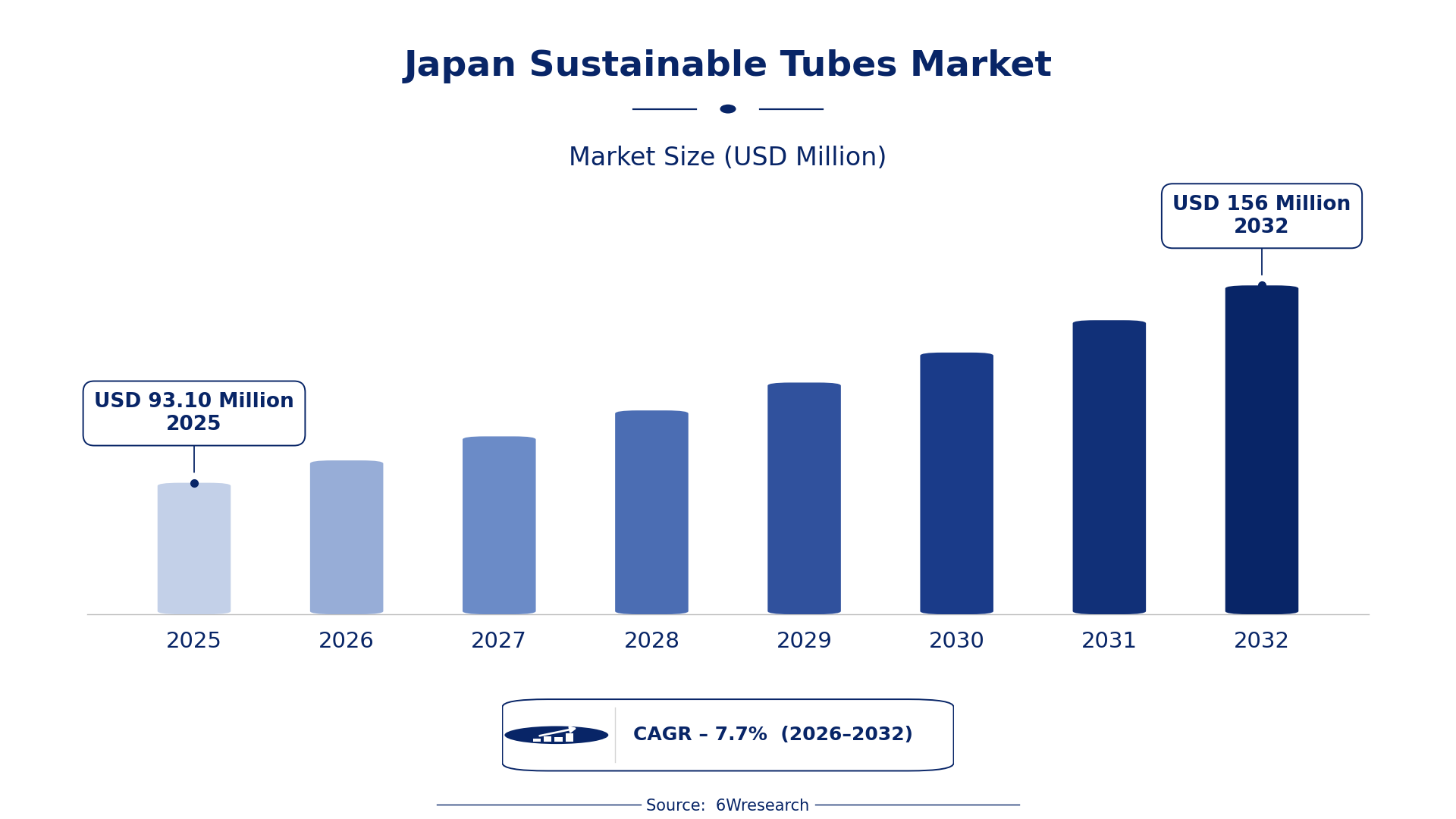
According to 6Wresearch internal database and industry insights, the Japan Sustainable Tubes Market was valued at USD 93.10 Million in 2025 and is projected to reach USD 156 Million by 2032, growing at a CAGR of approximately 7.7% during 2026–2032.
Japan Sustainable Tubes Market Highlights
| Report Metric | Details |
| Report Name | Japan Sustainable Tubes Market (2026-2032) |
| Market Size 2025 | USD 93.10 Million |
| Market Size 2032 | USD 156 Million |
| Absolute Growth 2025–2032 | USD 62.90 Million |
| CAGR 2026–2032 | 7.7% |
| Peak Annual Growth | 8.5% in 2026 |
| Forecast Period | 2026–2032 |
| Historical Data | 2022–2025 |
| Base Year | 2025 |
| Leading Tube Type, 2025 | Toothpaste Tubes (44% share) |
| Leading Material Used, 2025 | Recyclable HDPE (45% share) |
| Leading Product Segment, 2025 | Oral Care (43% share) |
| Leading End User, 2025 | Personal Care Brands (53% share) |
| Fastest-Growing Tube Type | Pharmaceutical Tubes (10.5% CAGR) |
| Fastest-Growing Material Used | Bio-Compostable PLA (11.0% CAGR) |
| Fastest-Growing Product Segment | Ointments (10.7% CAGR) |
| Fastest-Growing End User | Green Beauty Companies (10.1% CAGR) |
| Growing Sector | Green Beauty Companies |
| Key End Users | Personal Care Brands, Green Beauty Companies, Organic Food Brands, Health Product Makers |
Japan Sustainable Tubes Market Year-wise Growth Rate and Key Drivers (2022–2032)
This graph illustrates the annual growth rates of the market from 2022 to 2032, highlighting a steady upward trajectory and projected market expansion over the forecast period.
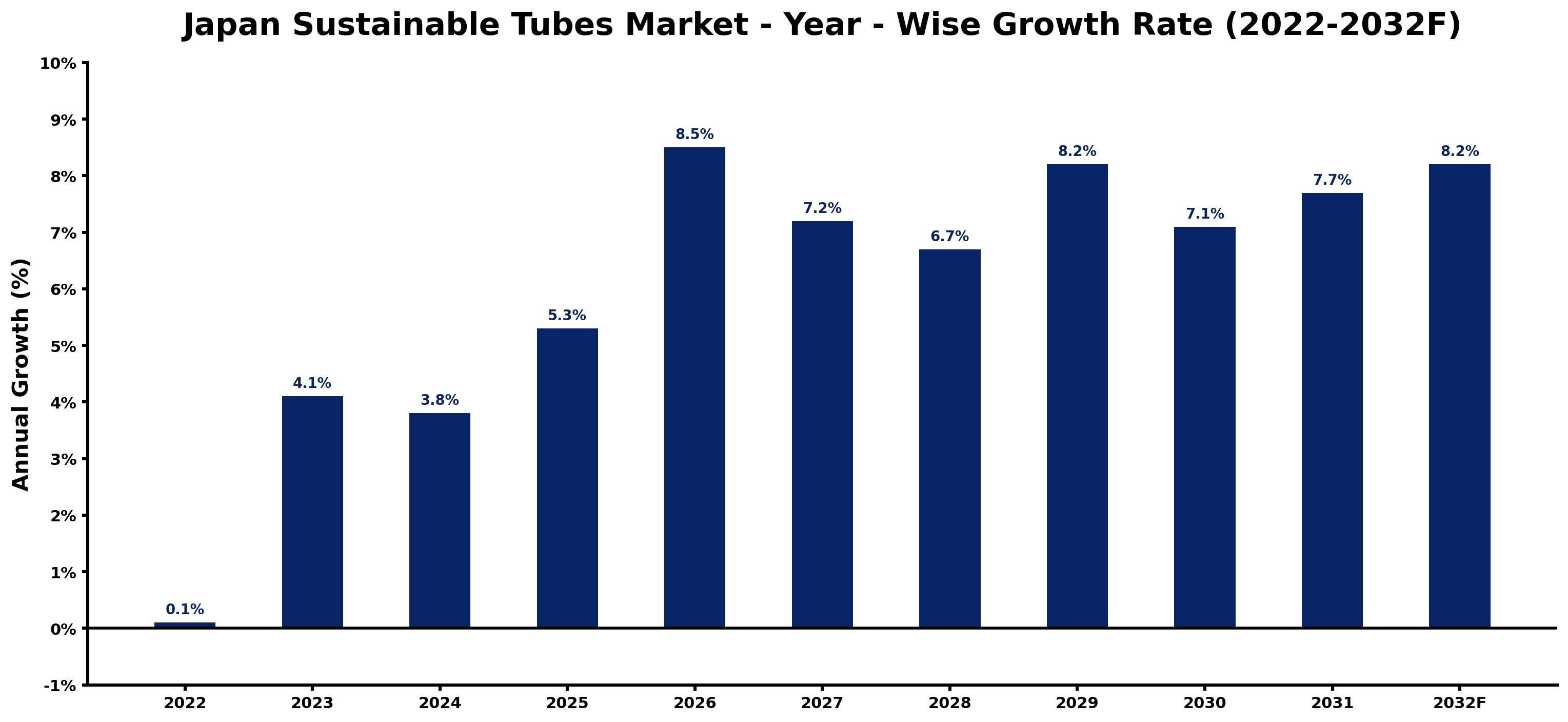
The table below sets out the estimated growth rate for each year and the main factor behind it.
| Year | Estimated Annual Growth (%) | Market Rationale |
| 2022 | 0.1 | The market showed minimal growth as awareness of sustainable packaging began to rise. |
| 2023 | 4.1 | Demand increased due to heightened consumer preference for eco-friendly products. |
| 2024 | 3.8 | Growth slowed as market adjustments to new regulations took place. |
| 2025 | 5.3 | The market accelerated as personal care brands adopted sustainable packaging solutions. |
| 2026 | 8.5 | A peak in growth is anticipated as the government programme to reduce plastic waste gains traction. |
| 2027 | 7.2 | Growth is projected to slow as the market adjusts to increased competition in sustainable materials. |
| 2028 | 6.7 | Demand is expected to continue slowing as brands focus on cost-effective packaging solutions. |
| 2029 | 8.2 | The market is projected to rebound with renewed interest in sustainable practices among consumers. |
| 2030 | 7.1 | Growth is expected to slow again as brands face challenges in sourcing sustainable materials. |
| 2031 | 7.7 | A resurgence in growth is projected, driven by sustainable packaging innovations. |
| 2032 | 8.2 | The market is expected to continue growing as consumer awareness of sustainability remains high. |
Note: Market size estimations and growth projections presented in this report are based on 6Wresearch's proprietary forecasting methodology, utilizing the latest available industry data, government publications, and primary research inputs.
Japan Sustainable Tubes Market Synopsis
Sustainable tubes serve as eco-friendly packaging solutions made from recyclable or biodegradable materials, primarily used in personal care, food, and pharmaceutical products. The Japan Sustainable Tubes Market is growing, driven by rising environmental awareness and regulations that promote sustainability. The recycling rate for plastic packaging materials stands at 84%, with over 70% of consumers favouring brands that use sustainable packaging, reflecting a shift in consumer behaviour towards eco-friendly options. The 2023 Green Packaging Initiative illustrates the government's commitment to supporting sustainable practices in the industry.
Market Dynamics Impact Analysis (2026–2032)
| Factor | Type | Impact | Primary Segment Affected |
| Rising consumer preference for eco-friendly products drives demand for sustainable tubes. | Driver | High | Toothpaste Tubes |
| The Green Packaging Initiative encourages manufacturers to adopt sustainable practices. | Driver | High | Pharmaceutical Tubes |
| Growing demand for sustainable packaging solutions creates opportunities for new entrants. | Opportunity | High | Cosmetic Tubes |
| Increasing awareness of environmental issues among consumers opens new market segments. | Opportunity | High | Food Tubes |
| Challenges in sourcing sustainable materials may limit production capabilities. | Restraint | Medium | Recyclable HDPE |
| Competition from traditional packaging materials can hinder market growth. | Restraint | Medium | Bio-Compostable PLA |
| High production costs for sustainable materials can deter potential buyers. | Challenge | High | Aluminum Recyclable Tubes |
| Technological limitations in recycling processes may restrict material availability. | Challenge | Medium | Sugarcane-Based Plastic |
Evaluation of Drivers in Japan Sustainable Tubes Market (2026–2032)
These are the developments adding the most demand over the forecast period.
| Drivers | Primary Segment Affected | Why It Matters (Evidence) |
| Increased consumer demand for eco-friendly packaging solutions. | Toothpaste Tubes | Over 70% of consumers prefer brands using sustainable packaging, driving purchases. |
| Government initiatives promoting sustainability encourage manufacturers to innovate. | Pharmaceutical Tubes | The Economic Security Promotion Act supports the adoption of sustainable materials, fostering innovation. |
| Rising environmental awareness among consumers boosts demand for sustainable products. | Cosmetic Tubes | Japan's cosmetics market is valued at over $30 billion, with a shift towards sustainability driving purchases. |
| The recycling rate of 84% for plastic packaging materials supports sustainable tube use. | Food Tubes | Higher recycling rates encourage brands to adopt eco-friendly packaging solutions, increasing demand. |
| The popularity of bio-compostable materials is increasing among eco-conscious brands. | Bio-Compostable PLA | Bio-Compostable PLA tubes are gaining traction, appealing to environmentally aware consumers. |
Much of the new demand originates from Tokyo's personal care manufacturing sector, where over 70% of consumers prefer brands that use sustainable packaging. The cosmetics market, valued at over $30 billion, is also moving towards sustainable options, with a notable portion of new product launches featuring eco-friendly materials. Increased environmental awareness is shaping consumer expectations, prompting manufacturers to invest in sustainable tubes. The recycling rate for plastic packaging materials in Japan, at 84%, supports this trend by encouraging brands to adopt eco-friendly solutions. The rising popularity of bio-compostable materials appeals to consumers seeking sustainable alternatives, further driving demand.
Evaluation of Restraints in Japan Sustainable Tubes Market
The table below lists the restraints and the evidence behind each.
| Market Restraint | Primary Segment Affected | Why It Matters (Evidence) |
| High production costs hinder the adoption of sustainable tubes. | Toothpaste Tubes | Eco-friendly materials are often pricier than traditional options, leading to increased prices for buyers in the personal care sector. |
| Supply chain disruptions arise from reliance on specific raw materials. | Pharmaceutical Tubes | Dependence on certain materials can delay production timelines for manufacturers, impacting product availability. |
| Technological limitations exist in recycling processes for certain sustainable materials. | Food Tubes | Inefficiencies in recycling can increase waste for producers, affecting sustainability goals, with an estimated 15% more waste generated. |
| Regulatory changes impose new compliance requirements. | Cosmetic Tubes | New standards can strain resources for suppliers, potentially delaying product launches by several weeks. |
| Market competition increases pressure on pricing and innovation. | Bio-Compostable PLA | As more brands enter the sustainable packaging space, maintaining competitive pricing becomes challenging. |
Japan Sustainable Tubes Market Challenges
High production costs impede the sustainable tube market, with eco-friendly materials priced up to 30% higher than conventional options, raising expenses for buyers in the personal care sector. Supply chain disruptions arise from reliance on specific raw materials, causing delays of up to three months for manufacturers, which affects product availability. Technological limitations in recycling processes for certain sustainable materials lead to inefficiencies, resulting in approximately 15% more waste for producers. Regulatory changes from the Ministry of the Environment impose new compliance standards that can strain resources for suppliers, potentially delaying product launches by several weeks.
Trends in the Japan Sustainable Tubes Market
These developments are changing demand patterns in the Japan Sustainable Tubes Market.
- Shift Towards Bio-Compostable Materials: In 2023, bio-compostable PLA tubes gained traction among eco-conscious brands, reflecting a growing trend towards sustainable materials. This shift is evident as over 60% of new product launches in cosmetics featured sustainable packaging.
- Emphasis on Recycling Initiatives: Japan's recycling rate for plastic packaging materials reached 84%, encouraging greater adoption of sustainable tubes. Local government initiatives aim to reduce plastic waste, further supporting this trend.
- Growth of Eco-Friendly Personal Care Products: The personal care sector is increasingly focusing on sustainable packaging solutions, with over 70% of consumers preferring brands that prioritise eco-friendliness. This change is particularly pronounced in Tokyo, a major hub for personal care manufacturing.
- Expansion of Sustainable Packaging Standards: Since 2023, JIS standards for packaging have increasingly included sustainability criteria, pushing manufacturers to improve their offerings. This trend aligns with global sustainability goals and consumer expectations.
Investment Opportunities in the Japan Sustainable Tubes Market
Investors looking at the Japan Sustainable Tubes Market should consider the following areas.
- Rising Demand from Personal Care Brands: The timing is ideal for suppliers to invest in sustainable tubes, as personal care brands are increasingly seeking eco-friendly packaging solutions. With over 70% of consumers preferring sustainable options, entering this market can yield substantial returns.
- Expansion in Food Packaging Sector: Food manufacturers are searching for sustainable packaging alternatives, creating opportunities for suppliers of eco-friendly tubes. The increasing focus on sustainability among organic food brands presents a notable market entry point, with a projected growth rate of 7.7%.
- Growing Interest from Health Product Makers: Health product manufacturers are increasingly adopting sustainable packaging, driving demand for eco-friendly tubes. Suppliers can enter this market by collaborating with health product makers focused on sustainability, particularly in regions with high consumer awareness.
- Investment in Bio-Compostable Materials: With the growing popularity of bio-compostable materials, there is an opportunity for suppliers to invest in this segment. Eco-conscious brands are actively seeking partnerships to improve their sustainable offerings, particularly in the cosmetics sector.
Government Initiatives in the Japan Sustainable Tubes Market
The Economic Security Promotion Act supports supply-chain resilience for critical products, including sustainable packaging materials. This law encourages manufacturers to innovate and invest in eco-friendly solutions, aligning with consumer demand for sustainability. The government aims for a 50% reduction in plastic waste by 2030, which further drives the adoption of sustainable tubes.
The Ministry of the Environment oversees the implementation of various sustainability initiatives, including funding for projects that improve recycling capabilities. Agencies like the Japan Packaging Institute provide guidance and support for businesses transitioning to sustainable packaging, ensuring compliance with evolving standards.
Future Insight of the Japan Sustainable Tubes Market
Advanced recycling technologies will drive demand for sustainable tubes by 2032, as manufacturers seek efficient methods to process eco-friendly materials. The government's Green Packaging Initiative will stimulate innovation in packaging solutions. By 2032, JIS standards are expected to enforce stricter sustainability criteria, prompting suppliers to improve their offerings. With over 70% of consumers favouring brands that utilise sustainable packaging, companies will increasingly prioritise eco-friendly solutions to align with market preferences.
Market Segmentation Analysis
Japan Sustainable Tubes Market report covers a detailed analysis of the following market segments:
By Tube Type – Toothpaste Tubes Lead, Pharmaceutical Tubes Expected to Grow Fastest
According to Saurav Kr Singh, Senior Research Analyst at 6Wresearch, the largest tube type category in 2025 was Toothpaste Tubes, at 44% of revenue. Toothpaste tubes hold the largest share in Japan due to their essential role in oral care products, which are a staple in most households. The significant consumer preference for sustainable packaging in this category drives continuous demand for eco-friendly solutions. Pharmaceutical Tubes are projected to grow fastest, at a CAGR of 10.5% during 2026–2032. Pharmaceutical tubes are experiencing rapid growth as manufacturers in the health sector increasingly seek sustainable packaging options. The rise in eco-conscious consumer behaviour is motivating brands to transition towards greener alternatives, further accelerating this segment's expansion. Suppliers should focus on developing sustainable packaging solutions specifically for pharmaceutical tubes to capitalise on this growing market.
By Material Used – Recyclable HDPE Leads, Bio-Compostable PLA Expected to Grow Fastest
In 2025, Recyclable HDPE led the material used split with a 45% share. Recyclable HDPE leads the market as it is widely utilised for its recyclability in various sustainable packaging applications. The material's dominance is supported by Japan's high recycling rate of 84% for plastic packaging, reinforcing its appeal among manufacturers. Bio-Compostable PLA is set to record the highest CAGR in this split, 11.0% over 2026–2032. Bio-Compostable PLA is rapidly gaining traction, particularly in niche markets that prioritise sustainability in their packaging choices. The increasing consumer demand for eco-friendly products is prompting brands to adopt these bio-based alternatives, driving growth in this segment. Buyers should prioritise sourcing bio-compostable materials to align with the rising consumer expectations for sustainable packaging solutions.
By Product Segment – Oral Care Leads, Ointments Expected to Grow Fastest
Oral Care took 43% of product segment revenue in 2025, more than any other category. The oral care segment is the largest due to the high volume of toothpaste and mouthwash products that require sustainable packaging. This segment benefits from a strong consumer inclination towards brands that commit to environmentally responsible practices. The quickest growth will come from Ointments, forecast to expand at a CAGR of 10.7% between 2026 and 2032. Ointments are experiencing fast growth as the pharmaceutical industry increasingly embraces sustainable packaging solutions. This trend is indicative of a broader movement towards eco-friendly practices within healthcare, driving the segment's rapid expansion. Suppliers must adapt their packaging offerings for ointments to align with the healthcare sector's sustainability goals.
By End User – Personal Care Brands Lead, Green Beauty Companies Expected to Grow Fastest
Personal Care Brands held 53% of the Japan Sustainable Tubes Market by end user in 2025. Personal care brands represent the largest segment of sustainable tube packaging users, underscoring their commitment to environmentally responsible practices. This segment is further strengthened by the substantial size of Japan's cosmetics market, valued at over $30 billion. Over 2026–2032, Green Beauty Companies are expected to post the fastest growth, at a CAGR of 10.1%. Green beauty companies are experiencing the fastest growth, as they focus on eco-friendly packaging solutions to appeal to environmentally conscious consumers. The rising preference for sustainable brands is driving this segment's rapid expansion. Suppliers should customise their products to address the specific requirements of green beauty companies to capture this burgeoning market.
Key Attractiveness of the Report
- 10 Years of Market Numbers
- Historical Data Starting from 2022 to 2025
- Base Year 2025
- Forecast Data until 2032
- Key Performance Indicators Impacting the Market
- Major Upcoming Developments and Projects
Key Highlights of the Report:
- Japan Sustainable Tubes Market Outlook
- Market Size of Japan Sustainable Tubes Market, 2025
- Forecast of Japan Sustainable Tubes Market, 2032
- Historical Data and Forecast of Japan Sustainable Tubes Revenues & Volume for the Period 2022-2032F
- Japan Sustainable Tubes Market Trend Evolution
- Japan Sustainable Tubes Market Drivers and Challenges
- Japan Sustainable Tubes Price Trends
- Japan Sustainable Tubes Porter's Five Forces
- Japan Sustainable Tubes Industry Life Cycle
- Historical Data and Forecast of Japan Sustainable Tubes Market Revenues & Volume By Tube Type for the Period 2022-2032F
- Historical Data and Forecast of Japan Sustainable Tubes Market Revenues & Volume By Toothpaste Tubes for the Period 2022-2032F
- Historical Data and Forecast of Japan Sustainable Tubes Market Revenues & Volume By Cosmetic Tubes for the Period 2022-2032F
- Historical Data and Forecast of Japan Sustainable Tubes Market Revenues & Volume By Food Tubes for the Period 2022-2032F
- Historical Data and Forecast of Japan Sustainable Tubes Market Revenues & Volume By Pharmaceutical Tubes for the Period 2022-2032F
- Historical Data and Forecast of Japan Sustainable Tubes Market Revenues & Volume By Material Used for the Period 2022-2032F
- Historical Data and Forecast of Japan Sustainable Tubes Market Revenues & Volume By Recyclable HDPE for the Period 2022-2032F
- Historical Data and Forecast of Japan Sustainable Tubes Market Revenues & Volume By Sugarcane-Based Plastic for the Period 2022-2032F
- Historical Data and Forecast of Japan Sustainable Tubes Market Revenues & Volume By Bio-Compostable PLA for the Period 2022-2032F
- Historical Data and Forecast of Japan Sustainable Tubes Market Revenues & Volume By Aluminum Recyclable Tubes for the Period 2022-2032F
- Historical Data and Forecast of Japan Sustainable Tubes Market Revenues & Volume By Product Segment for the Period 2022-2032F
- Historical Data and Forecast of Japan Sustainable Tubes Market Revenues & Volume By Oral Care for the Period 2022-2032F
- Historical Data and Forecast of Japan Sustainable Tubes Market Revenues & Volume By Skincare for the Period 2022-2032F
- Historical Data and Forecast of Japan Sustainable Tubes Market Revenues & Volume By Sauces/Pastes for the Period 2022-2032F
- Historical Data and Forecast of Japan Sustainable Tubes Market Revenues & Volume By Ointments for the Period 2022-2032F
- Historical Data and Forecast of Japan Sustainable Tubes Market Revenues & Volume By End User for the Period 2022-2032F
- Historical Data and Forecast of Japan Sustainable Tubes Market Revenues & Volume By Personal Care Brands for the Period 2022-2032F
- Historical Data and Forecast of Japan Sustainable Tubes Market Revenues & Volume By Green Beauty Companies for the Period 2022-2032F
- Historical Data and Forecast of Japan Sustainable Tubes Market Revenues & Volume By Organic Food Brands for the Period 2022-2032F
- Historical Data and Forecast of Japan Sustainable Tubes Market Revenues & Volume By Health Product Makers for the Period 2022-2032F
- Japan Sustainable Tubes Import Export Trade Statistics
- Market Opportunity Assessment By Tube Type
- Market Opportunity Assessment By Material Used
- Market Opportunity Assessment By Product Segment
- Market Opportunity Assessment By End User
- Japan Sustainable Tubes Top Companies Market Share
- Japan Sustainable Tubes Competitive Benchmarking By Technical and Operational Parameters
- Japan Sustainable Tubes Company Profiles
- Japan Sustainable Tubes Key Strategic Recommendations
Market Covered
The study includes the following segmentation.
By Tube Type
- Toothpaste Tubes
- Cosmetic Tubes
- Food Tubes
- Pharmaceutical Tubes
By Material Used
- Recyclable HDPE
- Sugarcane-Based Plastic
- Bio-Compostable PLA
- Aluminum Recyclable Tubes
By Product Segment
- Oral Care
- Skincare
- Sauces/Pastes
- Ointments
By End User
- Personal Care Brands
- Green Beauty Companies
- Organic Food Brands
- Health Product Makers































