Japan Sustainable Waste Management Market Size & Growth Rate
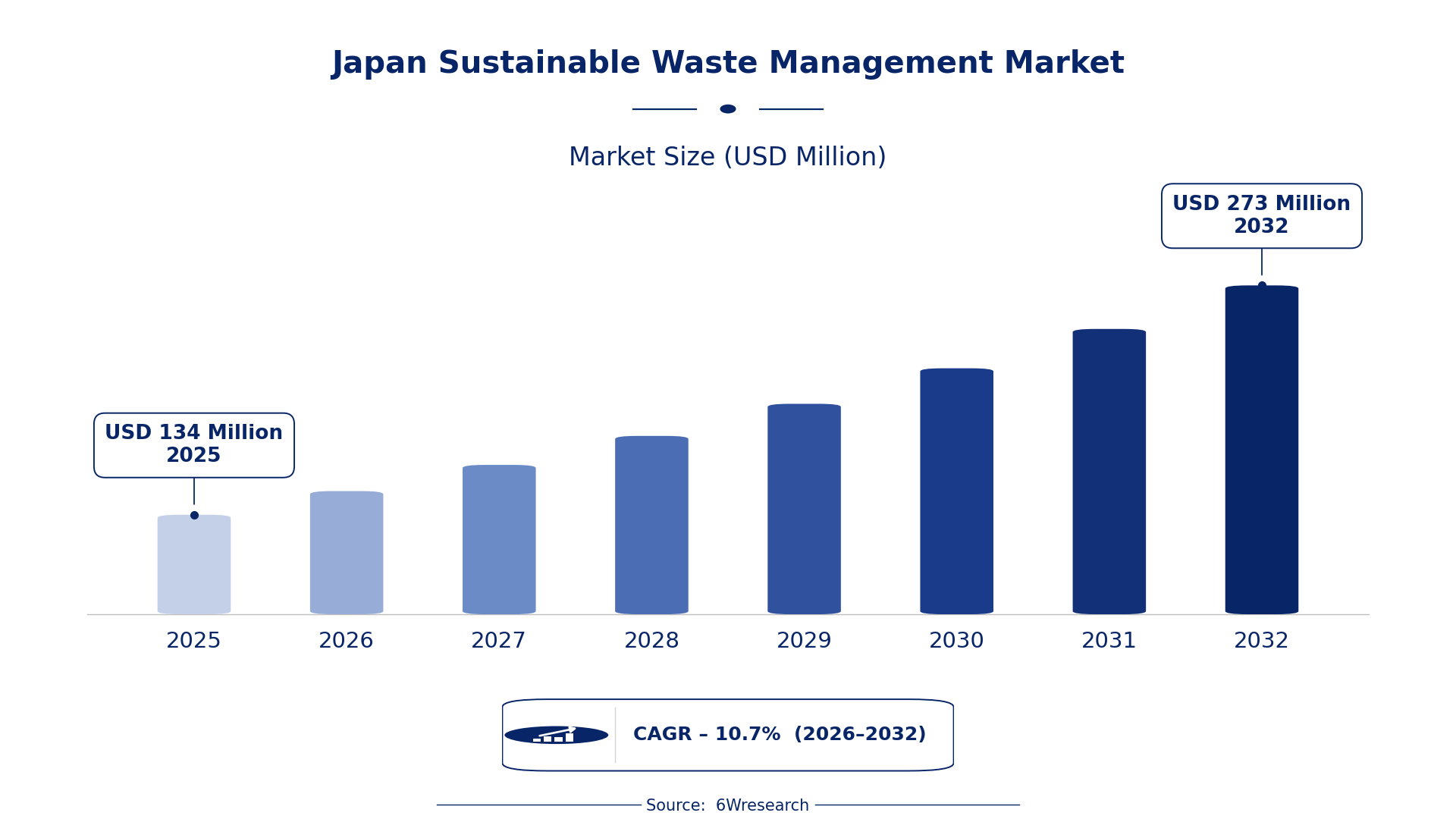
According to 6Wresearch internal database and industry insights, the Japan Sustainable Waste Management Market was valued at USD 134 Million in 2025 and is projected to reach USD 273 Million by 2032, growing at a CAGR of approximately 10.7% during 2026–2032.
Japan Sustainable Waste Management Market Highlights
| Report Metric | Details |
| Report Name | Japan Sustainable Waste Management Market (2026-2032) |
| Market Size 2025 | USD 134 Million |
| Market Size 2032 | USD 273 Million |
| Absolute Growth 2025–2032 | USD 139 Million |
| CAGR 2026–2032 | 10.7% |
| Peak Annual Growth | 13.5% in 2030 |
| Forecast Period | 2026–2032 |
| Historical Data | 2022–2025 |
| Base Year | 2025 |
| Leading Waste Type, 2025 | Organic Waste (45% share) |
| Leading Management Solution, 2025 | Composting (43% share) |
| Leading Treatment Process, 2025 | Aerobic Processing (43% share) |
| Leading End User, 2025 | Municipal Corporations (42% share) |
| Fastest-Growing Waste Type | E-waste (15.4% CAGR) |
| Fastest-Growing Management Solution | Mechanical Recycling (14.0% CAGR) |
| Fastest-Growing Treatment Process | Sorting & Shredding (15.9% CAGR) |
| Fastest-Growing End User | Electronics Manufacturers (14.3% CAGR) |
| Growing Sector | Waste Management |
| Key End Users | Municipal Corporations, Recycling Plants, Industrial Facilities, Electronics Manufacturers |
Japan Sustainable Waste Management Market Year-wise Growth Rate and Key Drivers (2022–2032)
This graph illustrates the annual growth rates of the market from 2022 to 2032, highlighting a steady upward trajectory and projected market expansion over the forecast period.
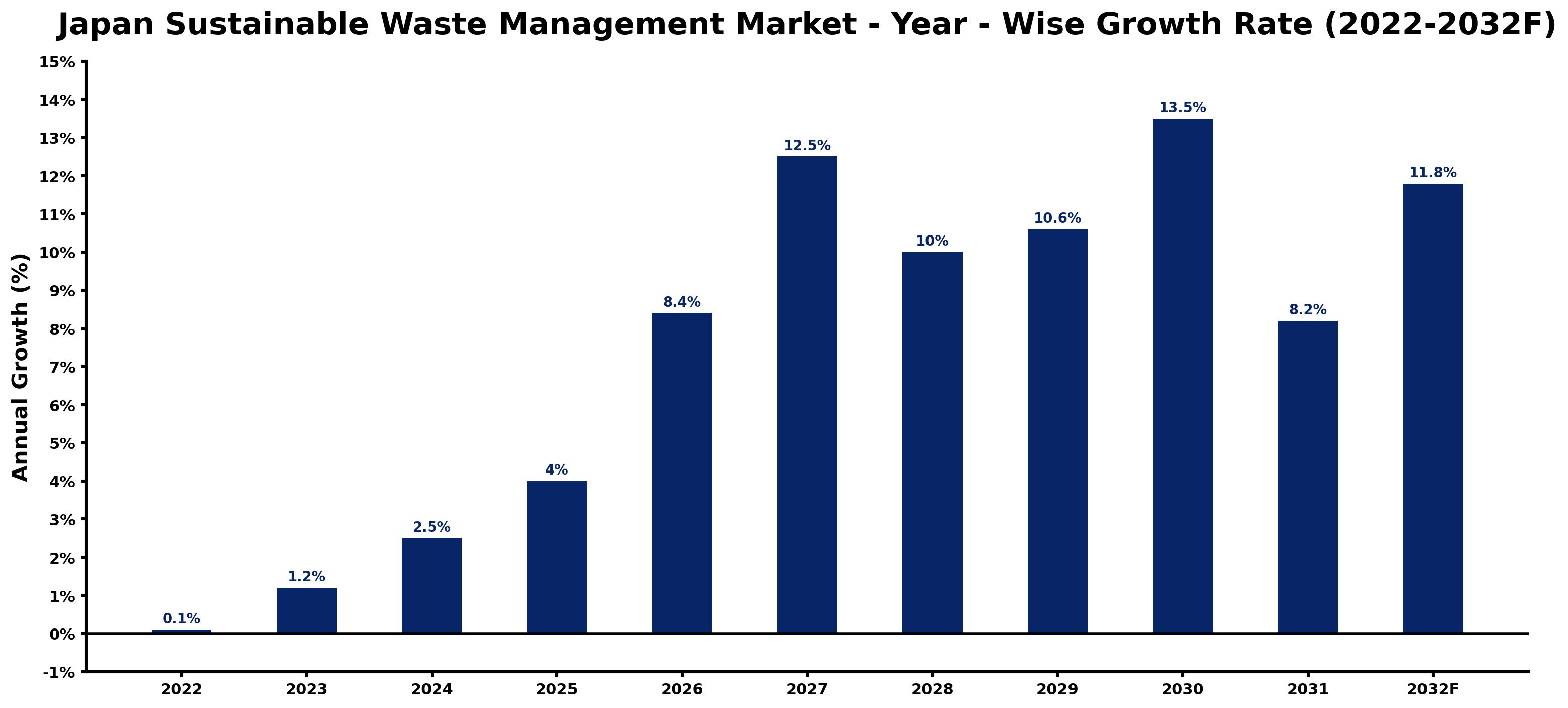
For each year, the table pairs the estimated growth rate with the leading influence on demand, showing how the drivers changed across the period.
| Year | Estimated Annual Growth (%) | Market Rationale |
| 2022 | 0.1 | The market was stable, with minimal growth observed due to existing waste management practices. |
| 2023 | 1.2 | Growth accelerated as municipal corporations increased investments in sustainable waste management solutions. |
| 2024 | 2.5 | Demand continued to rise as awareness of recycling benefits expanded among industrial facilities. |
| 2025 | 4.0 | The market peaked historically as Tokyo implemented its zero waste policy, driving further investments. |
| 2026 | 8.4 | Growth surged as new technologies in waste processing were adopted across various facilities. |
| 2027 | 12.5 | Demand rose sharply with increased consumer awareness and corporate responsibility initiatives. |
| 2028 | 10.0 | Growth slowed slightly as the market began to stabilise after rapid advancements in waste management. |
| 2029 | 10.6 | Demand picked up again as recycling rates improved, particularly for plastic waste. |
| 2030 | 13.5 | The market reached its peak annual growth as the government set ambitious recycling targets for 2030. |
| 2031 | 8.2 | Growth moderated as the market adjusted to new regulations and operational efficiencies. |
| 2032 | 11.8 | Demand is projected to rise again as investments in e-waste recycling technologies increase. |
Note: Market size estimations and growth projections presented in this report are based on 6Wresearch's proprietary forecasting methodology, utilizing the latest available industry data, government publications, and primary research inputs.
Japan Sustainable Waste Management Market Synopsis
Sustainable waste management involves the systematic collection, treatment, and disposal of waste to mitigate environmental impact. The Japan Sustainable Waste Management Market is propelled by municipal corporations, industrial facilities, and recycling plants. Growth is driven by increased investments in recycling technologies and initiatives aimed at achieving a 50% recycling rate by 2030. The implementation of Tokyo's zero waste policy underscores the commitment to effective waste management in the country.
Market Dynamics Impact Analysis (2026–2032)
| Factor | Type | Impact | Primary Segment Affected |
| Increased recycling initiatives | Driver | High | Recycling Plants |
| Growing public awareness of sustainability | Driver | High | Municipal Corporations |
| Expansion of e-waste recycling facilities | Opportunity | Medium | E-waste |
| Rising demand for composting services | Opportunity | Medium | Composting |
| Limited public funding for waste management | Restraint | High | Municipal Corporations |
| Challenges in the implementation of recycling standards | Restraint | Medium | Recycling Plants |
| High operational costs for recycling plants | Challenge | High | Recycling Plants |
| Insufficient infrastructure for hazardous waste disposal | Challenge | Medium | Hazardous Waste |
Evaluation of Drivers in Japan Sustainable Waste Management Market (2026–2032)
Below are the drivers that matter most for revenue growth, with supporting evidence.
| Drivers | Primary Segment Affected | Why It Matters (Evidence) |
| Investment in advanced sorting technologies | Recycling Plants | This technology improves recycling efficiency, with over 300 certified recycling plants operating nationwide. |
| Increased municipal funding for waste management | Municipal Corporations | In 2023, 1,000 municipal corporations are involved in waste management, driving demand for sustainable solutions. |
| Consumer demand for sustainable practices | E-waste | Growing concern for e-waste recycling has prompted new programs to improve recycling efficiency. |
| Implementation of zero waste policies | Composting | Tokyo's zero waste policy aims for 2025, encouraging composting initiatives across the city. |
| Adoption of ISO 14001 standards | Organic Waste | The widespread adoption of ISO 14001 for environmental management improves compliance and operational practices. |
What keeps demand rising is the investment in advanced sorting technologies that improve recycling efficiency across over 300 certified recycling plants. Increased municipal funding for waste management is also stimulating demand, as 1,000 corporations actively engage in sustainable practices.
Evaluation of Restraints in Japan Sustainable Waste Management Market
The key brakes on demand, and where they bite hardest, are shown below.
| Market Restraint | Primary Segment Affected | Why It Matters (Evidence) |
| Limited public funding for waste management initiatives | Municipal Corporations | Budget constraints restrict the ability of municipal corporations to invest in sustainable waste management solutions. |
| Challenges in implementing recycling standards | Recycling Plants | Inconsistent adherence to recycling standards hampers operational efficiency in recycling plants. |
| High operational costs for recycling facilities | Recycling Plants | The operational costs associated with advanced recycling technologies can deter investment. |
| Insufficient infrastructure for hazardous waste disposal | Hazardous Waste | The lack of adequate facilities for hazardous waste disposal complicates compliance with regulations. |
| Limited consumer awareness of recycling benefits | E-waste | Low awareness levels hinder participation in e-waste recycling programs, affecting overall recovery rates. |
Japan Sustainable Waste Management Market Challenges
Tokyo's waste management system faces competition from informal waste collectors, resulting in inefficiencies that cost municipal corporations up to 15% more in operational expenses. Rising costs of recycling technologies burden producers, who encounter a 20% increase in processing fees, ultimately squeezing their profit margins. Adherence to the Waste Management and Public Cleansing Law incurs strict compliance costs, delaying project timelines for buyers by an average of six months. Municipal corporations contend with a low recycling rate of only 25% for plastic waste, complicating efforts to meet sustainability targets.
Trends in the Japan Sustainable Waste Management Market
Below are the shifts with the largest effect on the Japan Sustainable Waste Management Market.
- Shift towards Improved E-waste Recycling: In 2023, Japan launched a new program to improve e-waste recycling efficiency, targeting a 30% increase in recovery rates. This initiative aims to enhance the overall sustainability of electronic waste management.
- Transition to Zero Waste Policies: Tokyo's zero waste policy, implemented in 2023, aims for a complete reduction of waste by 2025. This shift encourages municipalities to adopt similar policies, significantly impacting local waste management practices.
- Increase in Composting Initiatives: The year 2025 marks a notable rise in composting initiatives across Japan, driven by municipal efforts to promote organic waste treatment. This trend is expected to strengthen the composting market significantly.
- Growth in Mechanical Recycling: The mechanical recycling segment is experiencing rapid growth, with a projected CAGR of 14.0% from 2026 to 2032. This trend reflects the increasing focus on sustainable plastic waste management.
Investment Opportunities in the Japan Sustainable Waste Management Market
The following opportunities in the Japan Sustainable Waste Management Market pair current demand with a clear way in.
- Gap in E-waste Recycling Facilities: With a growing e-waste generation, there is a gap in recycling facilities, estimated to require an investment of USD 50 million. Electronics manufacturers can partner with local firms to establish new facilities.
- Demand for Composting Services: The composting sector is expanding rapidly, with a projected growth rate of 14.0%. Municipal corporations are seeking innovative composting solutions to meet sustainability targets, presenting opportunities for new suppliers.
- Investment in Advanced Sorting Technologies: The need for improved recycling efficiency presents an opportunity for investments in advanced sorting technologies, with a market potential of USD 20 million. Recycling plants can enhance their operations through partnerships.
- Expansion of Recycling Programs: With the government aiming for a 50% recycling rate by 2030, there is an opportunity for investment in recycling programs, particularly in urban areas. Local governments are looking for partnerships to implement these initiatives.
Government Initiatives in the Japan Sustainable Waste Management Market
The Waste Management and Public Cleansing Act, established in 1970, regulates the treatment and disposal of waste. This law has been updated with recent measures aimed at improving recycling efficiency, particularly for e-waste, ensuring compliance with modern environmental standards. The act impacts sustainable waste management by setting clear guidelines for waste treatment and disposal practices, which must be adhered to by all waste management authorities.
The Ministry of the Environment oversees the implementation of waste management regulations. It funds various programs aimed at improving recycling capabilities, including the recent initiative to enhance e-waste recycling efficiency, which benefits multiple stakeholders by providing better infrastructure and support for recycling efforts.
Future Insight of the Japan Sustainable Waste Management Market
Investment in new waste processing facilities will surge, driven by the government's commitment to a 50% recycling rate by 2030. The push for enhanced e-waste recycling will lead to the adoption of advanced sorting technologies. As Tokyo advances its zero waste policy by 2025, suppliers will innovate to meet stricter standards. The total waste generated in Japan, approximately 43 million tons, will necessitate improved resource recovery strategies, benefiting buyers through more efficient waste management solutions.
Market Segmentation Analysis
Japan Sustainable Waste Management Market report covers a detailed analysis of the following market segments:
By Waste Type – Organic Waste Leads, E-waste Expected to Grow Fastest
According to Saurav Kr Singh, Senior Research Analyst at 6Wresearch, with 45% of waste type revenue in 2025, Organic Waste was the largest category. Organic waste holds the largest share because it is extensively used for composting and energy recovery, supported by municipal initiatives. The involvement of over 1,000 municipal corporations in waste management enhances the recycling efforts for this waste type. Over 2026–2032, E-waste is expected to post the fastest growth, at a CAGR of 15.4%. E-waste is experiencing rapid growth due to increasing concerns regarding electronic waste recycling, particularly with new government initiatives aimed at improving efficiency. The launch of a specific programme in 2023 to enhance e-waste recycling processes is driving this segment's swift expansion. Suppliers must develop solutions that address the rising demand for effective e-waste management.
By Management Solution – Composting Leads, Mechanical Recycling Expected to Grow Fastest
Composting held 43% of the Japan Sustainable Waste Management Market by management solution in 2025. Composting is the leading management solution, widely adopted for treating organic waste, making it a preferred method among municipal corporations. Its role is crucial in achieving government recycling targets, especially in urban areas such as Tokyo. The quickest growth will come from Mechanical Recycling, forecast to expand at a CAGR of 14.0% between 2026 and 2032. Mechanical recycling is experiencing swift growth, propelled by the urgent need for effective plastic waste management solutions. The current recycling rate for plastics, around 25%, underscores the increasing importance of this method in the market. Buyers should invest in mechanical recycling technologies to comply with regulatory requirements and meet consumer expectations.
By Treatment Process – Aerobic Processing Leads, Sorting & Shredding Expected to Grow Fastest
Aerobic Processing accounted for 43% of the market by treatment process in 2025. Aerobic processing is the dominant treatment process, primarily employed for organic waste treatment, aligning with Japan's sustainability objectives. Its effectiveness in reducing waste volume and generating compost is vital for municipal waste management systems. Sorting & Shredding is set to record the highest CAGR in this split, 15.9% over 2026–2032. Sorting and shredding are rapidly advancing due to the necessity for efficient preparation of recyclables, particularly as recycling rates improve. The focus on enhancing sorting technologies is essential for boosting overall recycling efficiency in Japan. Suppliers should prioritise advancements in sorting and shredding technologies to satisfy the demands of the waste management sector.
By End User – Municipal Corporations Lead, Electronics Manufacturers Expected to Grow Fastest
In 2025, Municipal Corporations led the end user split with a 42% share. Municipal corporations are the primary end users, holding the largest share as they are responsible for waste management across Japan. Their involvement ensures compliance with regulations and the implementation of effective waste reduction strategies. Electronics Manufacturers are projected to grow fastest, at a CAGR of 14.3% during 2026–2032. Electronics manufacturers are experiencing the fastest growth as they increasingly engage in e-waste recycling efforts, driven by regulatory pressures and consumer awareness. This sector's focus on sustainability is reshaping waste management practices. Suppliers need to tailor their offerings to support electronics manufacturers in meeting e-waste recycling standards.
Key Attractiveness of the Report
- 10 Years of Market Numbers
- Historical Data Starting from 2022 to 2025
- Base Year 2025
- Forecast Data until 2032
- Key Performance Indicators Impacting the Market
- Major Upcoming Developments and Projects
Key Highlights of the Report:
- Japan Sustainable Waste Management Market Outlook
- Market Size of Japan Sustainable Waste Management Market, 2025
- Forecast of Japan Sustainable Waste Management Market, 2032
- Historical Data and Forecast of Japan Sustainable Waste Management Revenues & Volume for the Period 2022-2032F
- Japan Sustainable Waste Management Market Trend Evolution
- Japan Sustainable Waste Management Market Drivers and Challenges
- Japan Sustainable Waste Management Price Trends
- Japan Sustainable Waste Management Porter's Five Forces
- Japan Sustainable Waste Management Industry Life Cycle
- Historical Data and Forecast of Japan Sustainable Waste Management Market Revenues & Volume By Waste Type for the Period 2022-2032F
- Historical Data and Forecast of Japan Sustainable Waste Management Market Revenues & Volume By Organic Waste for the Period 2022-2032F
- Historical Data and Forecast of Japan Sustainable Waste Management Market Revenues & Volume By Plastic Waste for the Period 2022-2032F
- Historical Data and Forecast of Japan Sustainable Waste Management Market Revenues & Volume By Hazardous Waste for the Period 2022-2032F
- Historical Data and Forecast of Japan Sustainable Waste Management Market Revenues & Volume By E-waste for the Period 2022-2032F
- Historical Data and Forecast of Japan Sustainable Waste Management Market Revenues & Volume By Management Solution for the Period 2022-2032F
- Historical Data and Forecast of Japan Sustainable Waste Management Market Revenues & Volume By Composting for the Period 2022-2032F
- Historical Data and Forecast of Japan Sustainable Waste Management Market Revenues & Volume By Mechanical Recycling for the Period 2022-2032F
- Historical Data and Forecast of Japan Sustainable Waste Management Market Revenues & Volume By Incineration for the Period 2022-2032F
- Historical Data and Forecast of Japan Sustainable Waste Management Market Revenues & Volume By Extended Producer Recovery for the Period 2022-2032F
- Historical Data and Forecast of Japan Sustainable Waste Management Market Revenues & Volume By Treatment Process for the Period 2022-2032F
- Historical Data and Forecast of Japan Sustainable Waste Management Market Revenues & Volume By Aerobic Processing for the Period 2022-2032F
- Historical Data and Forecast of Japan Sustainable Waste Management Market Revenues & Volume By Sorting & Shredding for the Period 2022-2032F
- Historical Data and Forecast of Japan Sustainable Waste Management Market Revenues & Volume By High-Temperature Burn for the Period 2022-2032F
- Historical Data and Forecast of Japan Sustainable Waste Management Market Revenues & Volume By Metal Extraction for the Period 2022-2032F
- Historical Data and Forecast of Japan Sustainable Waste Management Market Revenues & Volume By End User for the Period 2022-2032F
- Historical Data and Forecast of Japan Sustainable Waste Management Market Revenues & Volume By Municipal Corporations for the Period 2022-2032F
- Historical Data and Forecast of Japan Sustainable Waste Management Market Revenues & Volume By Recycling Plants for the Period 2022-2032F
- Historical Data and Forecast of Japan Sustainable Waste Management Market Revenues & Volume By Industrial Facilities for the Period 2022-2032F
- Historical Data and Forecast of Japan Sustainable Waste Management Market Revenues & Volume By Electronics Manufacturers for the Period 2022-2032F
- Japan Sustainable Waste Management Import Export Trade Statistics
- Market Opportunity Assessment By Waste Type
- Market Opportunity Assessment By Management Solution
- Market Opportunity Assessment By Treatment Process
- Market Opportunity Assessment By End User
- Japan Sustainable Waste Management Top Companies Market Share
- Japan Sustainable Waste Management Competitive Benchmarking By Technical and Operational Parameters
- Japan Sustainable Waste Management Company Profiles
- Japan Sustainable Waste Management Key Strategic Recommendations
Market Covered
Segments analysed in this report are listed below.
By Waste Type
- Organic Waste
- Plastic Waste
- Hazardous Waste
- E-waste
By Management Solution
- Composting
- Mechanical Recycling
- Incineration
- Extended Producer Recovery
By Treatment Process
- Aerobic Processing
- Sorting & Shredding
- High-Temperature Burn
- Metal Extraction
By End User
- Municipal Corporations
- Recycling Plants
- Industrial Facilities
- Electronics Manufacturers































