Japan Sustainable Water Solutions Market Size & Growth Rate
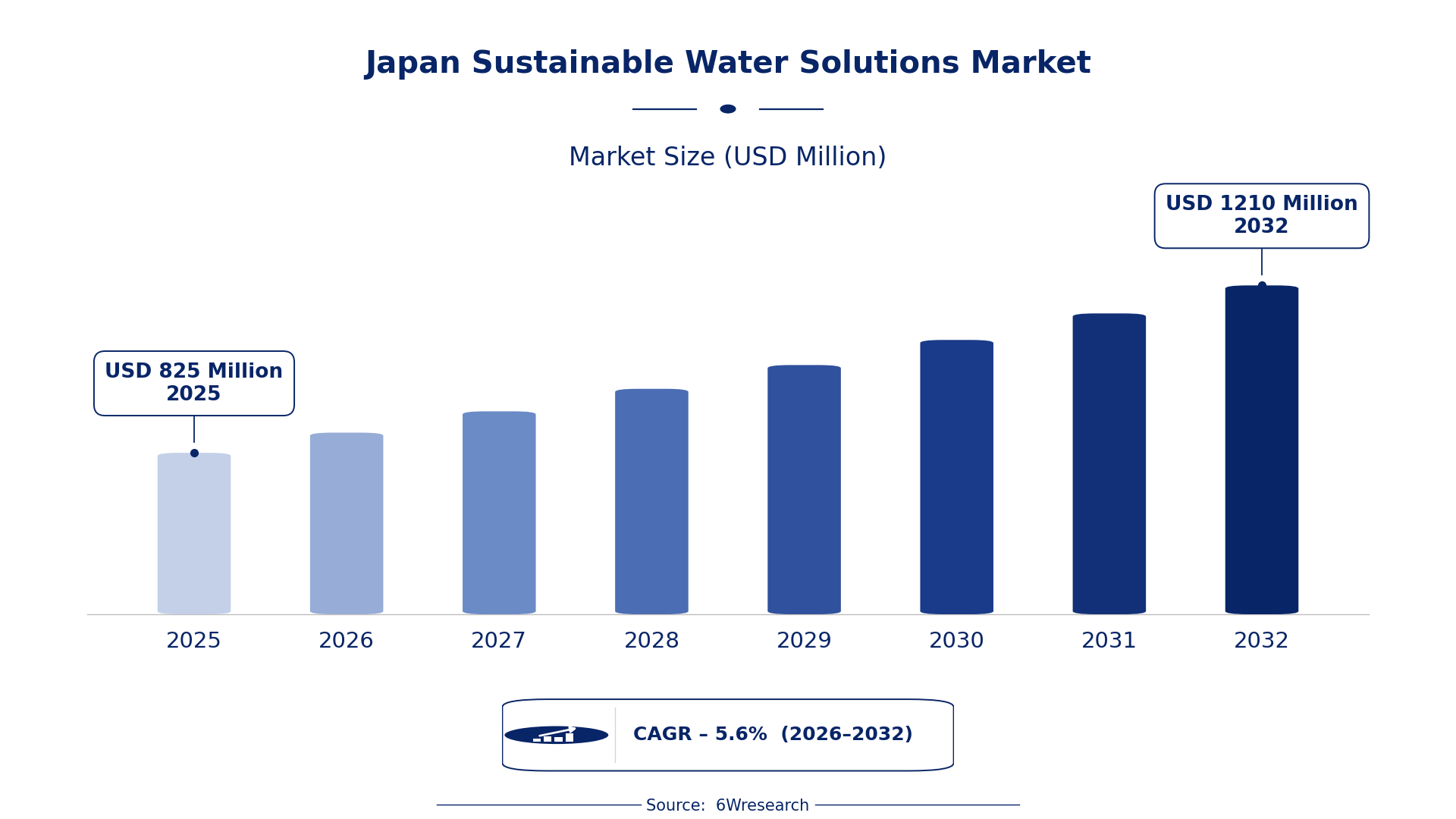
According to 6Wresearch internal database and industry insights, the Japan Sustainable Water Solutions Market was valued at USD 825 Million in 2025 and is projected to reach USD 1,210 Million by 2032, growing at a CAGR of approximately 5.6% during 2026–2032.
Japan Sustainable Water Solutions Market Highlights
| Report Metric | Details |
| Report Name | Japan Sustainable Water Solutions Market (2026-2032) |
| Market Size 2025 | USD 825 Million |
| Market Size 2032 | USD 1,210 Million |
| Absolute Growth 2025–2032 | USD 385 Million |
| CAGR 2026–2032 | 5.6% |
| Peak Annual Growth | 6.4% in 2028 |
| Forecast Period | 2026–2032 |
| Historical Data | 2022–2025 |
| Base Year | 2025 |
| Leading Solution Type, 2025 | Desalination (36% share) |
| Leading Technology Used, 2025 | Reverse Osmosis (45% share) |
| Leading Application Sector, 2025 | Coastal Municipalities (41% share) |
| Leading End User, 2025 | Water Utility Providers (41% share) |
| Fastest-Growing Solution Type | Greywater Recycling (8.2% CAGR) |
| Fastest-Growing Technology Used | Membrane Bioreactor (8.7% CAGR) |
| Fastest-Growing Application Sector | Commercial Buildings (7.2% CAGR) |
| Fastest-Growing End User | Real Estate Developers (7.3% CAGR) |
| Growing Sector | Water Utility Providers |
| Key End Users | Water Utility Providers, Coastal Municipalities, Agricultural Institutions, Real Estate Developers |
Japan Sustainable Water Solutions Market Year-wise Growth Rate and Key Drivers (2022–2032)
This graph illustrates the annual growth rates of the market from 2022 to 2032, highlighting a steady upward trajectory and projected market expansion over the forecast period.
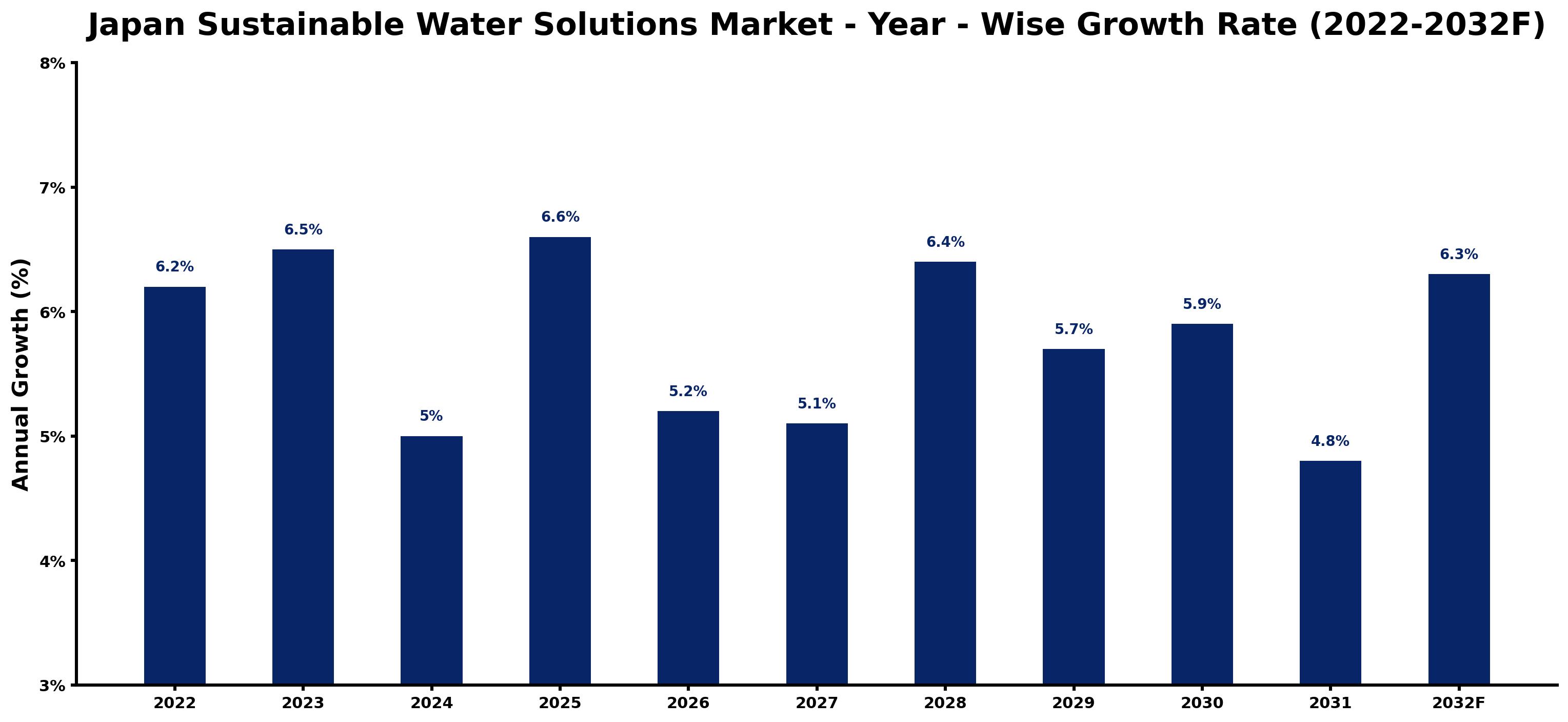
The following figures match every annual growth estimate with the main market development of that year, giving the reasoning behind each rise or slowdown.
| Year | Estimated Annual Growth (%) | Market Rationale |
| 2022 | 6.2 | The market experienced solid growth due to increasing urban water demands. |
| 2023 | 6.5 | Demand surged as urban areas implemented new water conservation measures. |
| 2024 | 5.0 | Growth slowed as some regions faced temporary water supply stability. |
| 2025 | 6.6 | The market peaked as major cities expanded desalination projects. |
| 2026 | 5.2 | Growth slowed as competition increased among water solution providers. |
| 2027 | 5.1 | Demand continued to grow, driven by agricultural efficiency needs. |
| 2028 | 6.4 | The market rebounded with renewed investment in water infrastructure. |
| 2029 | 5.7 | Growth slowed as market saturation began in urban areas. |
| 2030 | 5.9 | Demand increased as new technologies improved water management. |
| 2031 | 4.8 | Growth slowed as regulatory changes impacted project timelines. |
| 2032 | 6.3 | The market is expected to grow as greywater recycling initiatives expand. |
Note: Market size estimations and growth projections presented in this report are based on 6Wresearch's proprietary forecasting methodology, utilizing the latest available industry data, government publications, and primary research inputs.
Japan Sustainable Water Solutions Market Synopsis
Sustainable Water Solutions encompass advanced technologies and practices for efficient water management, including desalination, greywater recycling, and rainwater harvesting. The Tokyo metropolitan area has implemented greywater recycling systems in over 200 buildings, while the government encourages sustainable practices through various initiatives. With around 126 million people served by water utilities, investment in sustainable water solutions is set to increase significantly in the coming years.
Market Dynamics Impact Analysis (2026–2032)
| Factor | Type | Impact | Primary Segment Affected |
| Urban water scarcity drives demand for desalination technologies. | Driver | High | Desalination |
| Increased focus on sustainable practices boosts greywater recycling adoption. | Driver | High | Greywater Recycling |
| Growing urban populations create demand for efficient water management solutions. | Opportunity | High | Coastal Municipalities |
| Government initiatives support the expansion of rainwater harvesting systems. | Opportunity | High | Rainwater Harvesting |
| High initial investment costs limit adoption of advanced technologies. | Restraint | Medium | Membrane Bioreactor |
| Regulatory compliance can delay project implementation timelines. | Restraint | Medium | Reverse Osmosis |
| Technological complexities can hinder system integration. | Challenge | High | Smart Metering |
| Competition among solution providers may lead to price wars. | Challenge | Medium | Water Utility Providers |
Evaluation of Drivers in Japan Sustainable Water Solutions Market (2026–2032)
The following drivers explain most of the expected growth.
| Drivers | Primary Segment Affected | Why It Matters (Evidence) |
| Urban water shortages increase demand for desalination plants. | Desalination | Japan has 1,500 operational desalination plants as of 2023, providing essential potable water. |
| Growing awareness of water conservation drives greywater recycling. | Greywater Recycling | The Tokyo metropolitan area utilizes greywater systems in over 200 buildings, promoting water reuse. |
| Government mandates promote rainwater harvesting in new constructions. | Rainwater Harvesting | New commercial buildings in Tokyo are required to implement rainwater harvesting systems. |
| Technological advancements improve the efficiency of membrane bioreactors. | Membrane Bioreactor | The Japanese government promotes membrane bioreactors for wastewater treatment, improving sustainability. |
| Rising agricultural needs drive investments in smart metering technologies. | Smart Metering | Over 30% of agricultural institutions in Japan use smart metering for effective water management. |
Most of the extra volume arises from growing urban water demands and agricultural efficiency needs. In 2023, Japan's desalination plants supplied essential potable water to coastal regions. Greywater recycling systems have been installed in many buildings throughout the Tokyo metropolitan area, promoting water reuse. New mandates for rainwater harvesting in commercial structures further stimulate demand. The agricultural sector, which encompasses 1.5 million hectares of irrigated land, is increasingly adopting smart metering to manage water resources efficiently, improving allocation.
Evaluation of Restraints in Japan Sustainable Water Solutions Market
Several factors work against faster growth; the main ones are summarised below.
| Market Restraint | Primary Segment Affected | Why It Matters (Evidence) |
| High initial costs deter widespread adoption of advanced water solutions. | Membrane Bioreactor | The high investment required for membrane bioreactors limits their implementation in many facilities. |
| Regulatory compliance can slow down project timelines. | Reverse Osmosis | Strict regulations around water quality can delay the approval of reverse osmosis projects. |
| Limited public awareness restricts greywater recycling adoption. | Greywater Recycling | Many consumers lack awareness of the benefits of greywater recycling systems. |
| Technological complexities can hinder effective integration. | Smart Metering | Integration of smart metering systems often requires significant technical expertise and training. |
| Market saturation in urban areas limits growth potential. | Desalination | With many coastal areas already utilizing desalination, new projects face diminishing returns. |
Japan Sustainable Water Solutions Market Challenges
Approximately 126 million people depend on water utility providers in Japan, yet buyers encounter challenges due to ageing infrastructure, resulting in water loss rates exceeding 10% in some regions. Suppliers face intense competition, compelling them to reduce prices, which may affect the quality of sustainable solutions for buyers. Regulatory requirements, such as the ISO 14046 standard for water footprint assessment, impose considerable compliance costs on producers, delaying project timelines for buyers. While technology progresses, many suppliers lack the resources to implement new methods, leading to slower adoption of efficient practices for buyers seeking improved water management.
Trends in the Japan Sustainable Water Solutions Market
Four trends stand out in the Japan Sustainable Water Solutions Market.
- Increase in Greywater Recycling by 2025: The Japanese government aims to boost greywater recycling by 20% by 2025, promoting water reuse in urban settings. This initiative is expected to drive investments in greywater systems.
- Shift Towards Integrated Water Management Solutions: Coastal municipalities are increasingly embracing integrated water management solutions that combine various sustainable practices. Urban water grids are being established, with 15% already incorporating IoT-based sensors.
- Rise in Rainwater Harvesting Systems: New commercial buildings in Tokyo are required to include rainwater harvesting systems, reflecting a shift in urban water management practices. The average annual rainfall of about 1,700 mm supports the feasibility of these systems.
- Growth in Membrane Bioreactor Adoption: The adoption of membrane bioreactors in wastewater treatment facilities is increasing, driven by government support. This trend is anticipated to enhance water quality and sustainability in urban environments.
Investment Opportunities in the Japan Sustainable Water Solutions Market
The following areas offer the clearest openings for investors and suppliers in the Japan Sustainable Water Solutions Market.
- Water Utility Providers Seeking Efficient Solutions: Water utility providers are increasingly searching for sustainable water solutions to manage resources effectively. With around 126 million people served, there is an opportunity for investment in advanced technologies.
- Coastal Municipalities Expanding Water Infrastructure: Coastal municipalities are investing in new desalination plants to meet water demands. With 1,500 operational plants, there is ample opportunity for suppliers to enhance capacity and efficiency.
- Growing Demand for Smart Metering Technologies: As over 30% of agricultural institutions adopt smart metering, there is a pressing need for innovative solutions. Suppliers can tap into this market by collaborating with local agricultural bodies.
- Rainwater Harvesting Systems in New Developments: New commercial buildings are mandated to implement rainwater harvesting systems, creating a market for suppliers. The average rainfall of 1,700 mm supports this investment opportunity.
Government Initiatives in the Japan Sustainable Water Solutions Market
The Water Supply Act (1957) established standards for drinking-water quality and supply, ensuring safe access across Japan. The Sewerage Act (1958) regulates sewerage systems and wastewater treatment, providing a framework for sustainable practices. These foundational laws have shaped water management in Japan, promoting public health and environmental protection.
Water utility providers benefit from the Ministry of the Environment's water conservation programme launched in 2023, with a budget of ¥10 billion. This initiative supports projects aimed at improving water efficiency and sustainability, enabling providers to enhance service delivery and reduce operational costs.
Future Insight of the Japan Sustainable Water Solutions Market
The introduction of new rainwater harvesting systems in commercial buildings will transform resource management by 2032. Enhanced government programmes will drive funding for innovative water solutions, encouraging suppliers to develop advanced technologies. A projected increase in the use of membrane bioreactors will improve wastewater treatment efficiency for urban buyers. Integration of IoT-based sensors in urban water grids will enable real-time data access, allowing buyers to optimise their water consumption and minimise waste.
Market Segmentation Analysis
Japan Sustainable Water Solutions Market report covers a detailed analysis of the following market segments:
By Solution Type – Desalination Leads, Greywater Recycling Expected to Grow Fastest
According to Saurav Kr Singh, Senior Research Analyst at 6Wresearch, in 2025, Desalination led the solution type split with a 36% share. Desalination holds the largest share as it provides essential potable water to Japan's coastal areas, where water scarcity poses a significant challenge. With 1,500 operational desalination plants, this technology is critical for urban populations relying on it for their water supply. The quickest growth will come from Greywater Recycling, forecast to expand at a CAGR of 8.2% between 2026 and 2032. Greywater recycling is experiencing rapid growth due to government initiatives targeting a 20% increase in adoption by 2025. The implementation of greywater recycling systems in over 200 buildings in the Tokyo metropolitan area illustrates the rising trend in this solution's use. Suppliers should prioritise developing greywater recycling technologies to address the increasing demand from urban environments.
By Technology Used – Reverse Osmosis Leads, Membrane Bioreactor Expected to Grow Fastest
Reverse Osmosis took 45% of technology used revenue in 2025, more than any other category. Reverse osmosis is the predominant technology used in the market, widely employed for water purification and desalination across Japan. Its estimated capacity of 500,000 m³/day illustrates its critical role in sustainable water management. Over 2026–2032, Membrane Bioreactor is expected to post the fastest growth, at a CAGR of 8.7%. Membrane bioreactor technology is experiencing the fastest growth due to its efficiency in wastewater treatment and reuse, aligning with the national focus on sustainable practices. Government promotion of this technology further accelerates its adoption in various sectors. Buyers should explore membrane bioreactor systems to improve their wastewater treatment and resource recovery efforts.
By Application Sector – Coastal Municipalities Lead, Commercial Buildings Expected to Grow Fastest
The largest application sector category in 2025 was Coastal Municipalities, at 41% of revenue. Coastal municipalities represent the largest application sector, as they are essential for urban water supply in regions facing water shortages. The reliance on desalination in these areas highlights the critical need for sustainable water solutions to meet municipal water requirements. Commercial Buildings are projected to grow fastest, at a CAGR of 7.2% during 2026–2032. The commercial buildings sector is rapidly growing as developers increasingly implement sustainable water management practices to comply with regulations and improve operational efficiency. This trend is evident in the rising number of greywater recycling systems being incorporated into new commercial projects. Suppliers should concentrate on commercial building developments to capitalise on the growing demand for sustainable water solutions.
By End User – Water Utility Providers Lead, Real Estate Developers Expected to Grow Fastest
With 41% of end user revenue in 2025, Water Utility Providers was the largest category. Water utility providers are the primary users of sustainable water solutions, as they are responsible for managing water supply and quality for approximately 126 million people in Japan. Their central role in implementing these solutions ensures a steady demand. Real Estate Developers are set to record the highest CAGR in this split, 7.3% over 2026–2032. Real estate developers are experiencing the fastest growth as they increasingly implement water-saving technologies in their projects. This trend is driven by a heightened focus on sustainability and regulatory requirements in the construction sector. Suppliers must engage with real estate developers to align their offerings with the growing emphasis on sustainable construction practices.
Key Attractiveness of the Report
- 10 Years of Market Numbers
- Historical Data Starting from 2022 to 2025
- Base Year 2025
- Forecast Data until 2032
- Key Performance Indicators Impacting the Market
- Major Upcoming Developments and Projects
Key Highlights of the Report:
- Japan Sustainable Water Solutions Market Outlook
- Market Size of Japan Sustainable Water Solutions Market, 2025
- Forecast of Japan Sustainable Water Solutions Market, 2032
- Historical Data and Forecast of Japan Sustainable Water Solutions Revenues & Volume for the Period 2022-2032F
- Japan Sustainable Water Solutions Market Trend Evolution
- Japan Sustainable Water Solutions Market Drivers and Challenges
- Japan Sustainable Water Solutions Price Trends
- Japan Sustainable Water Solutions Porter's Five Forces
- Japan Sustainable Water Solutions Industry Life Cycle
- Historical Data and Forecast of Japan Sustainable Water Solutions Market Revenues & Volume By Solution Type for the Period 2022-2032F
- Historical Data and Forecast of Japan Sustainable Water Solutions Market Revenues & Volume By Desalination for the Period 2022-2032F
- Historical Data and Forecast of Japan Sustainable Water Solutions Market Revenues & Volume By Greywater Recycling for the Period 2022-2032F
- Historical Data and Forecast of Japan Sustainable Water Solutions Market Revenues & Volume By Rainwater Harvesting for the Period 2022-2032F
- Historical Data and Forecast of Japan Sustainable Water Solutions Market Revenues & Volume By Smart Metering for the Period 2022-2032F
- Historical Data and Forecast of Japan Sustainable Water Solutions Market Revenues & Volume By Technology Used for the Period 2022-2032F
- Historical Data and Forecast of Japan Sustainable Water Solutions Market Revenues & Volume By Reverse Osmosis for the Period 2022-2032F
- Historical Data and Forecast of Japan Sustainable Water Solutions Market Revenues & Volume By Membrane Bioreactor for the Period 2022-2032F
- Historical Data and Forecast of Japan Sustainable Water Solutions Market Revenues & Volume By Collection & Filtration for the Period 2022-2032F
- Historical Data and Forecast of Japan Sustainable Water Solutions Market Revenues & Volume By IoT-based Sensors for the Period 2022-2032F
- Historical Data and Forecast of Japan Sustainable Water Solutions Market Revenues & Volume By Application Sector for the Period 2022-2032F
- Historical Data and Forecast of Japan Sustainable Water Solutions Market Revenues & Volume By Coastal Municipalities for the Period 2022-2032F
- Historical Data and Forecast of Japan Sustainable Water Solutions Market Revenues & Volume By Commercial Buildings for the Period 2022-2032F
- Historical Data and Forecast of Japan Sustainable Water Solutions Market Revenues & Volume By Agriculture for the Period 2022-2032F
- Historical Data and Forecast of Japan Sustainable Water Solutions Market Revenues & Volume By Urban Water Grids for the Period 2022-2032F
- Historical Data and Forecast of Japan Sustainable Water Solutions Market Revenues & Volume By End User for the Period 2022-2032F
- Historical Data and Forecast of Japan Sustainable Water Solutions Market Revenues & Volume By Water Utility Providers for the Period 2022-2032F
- Historical Data and Forecast of Japan Sustainable Water Solutions Market Revenues & Volume By Real Estate Developers for the Period 2022-2032F
- Historical Data and Forecast of Japan Sustainable Water Solutions Market Revenues & Volume By Agri Institutions for the Period 2022-2032F
- Historical Data and Forecast of Japan Sustainable Water Solutions Market Revenues & Volume By Utility Companies for the Period 2022-2032F
- Japan Sustainable Water Solutions Import Export Trade Statistics
- Market Opportunity Assessment By Solution Type
- Market Opportunity Assessment By Technology Used
- Market Opportunity Assessment By Application Sector
- Market Opportunity Assessment By End User
- Japan Sustainable Water Solutions Top Companies Market Share
- Japan Sustainable Water Solutions Competitive Benchmarking By Technical and Operational Parameters
- Japan Sustainable Water Solutions Company Profiles
- Japan Sustainable Water Solutions Key Strategic Recommendations
Market Covered
The following segment groups are covered in the report.
By Solution Type
- Desalination
- Greywater Recycling
- Rainwater Harvesting
- Smart Metering
By Technology Used
- Reverse Osmosis
- Membrane Bioreactor
- Collection & Filtration
- IoT-based Sensors
By Application Sector
- Coastal Municipalities
- Commercial Buildings
- Agriculture
- Urban Water Grids
By End User
- Water Utility Providers
- Real Estate Developers
- Agri Institutions
- Utility Companies































