Japan Symptom Checker AI Market Size & Growth Rate
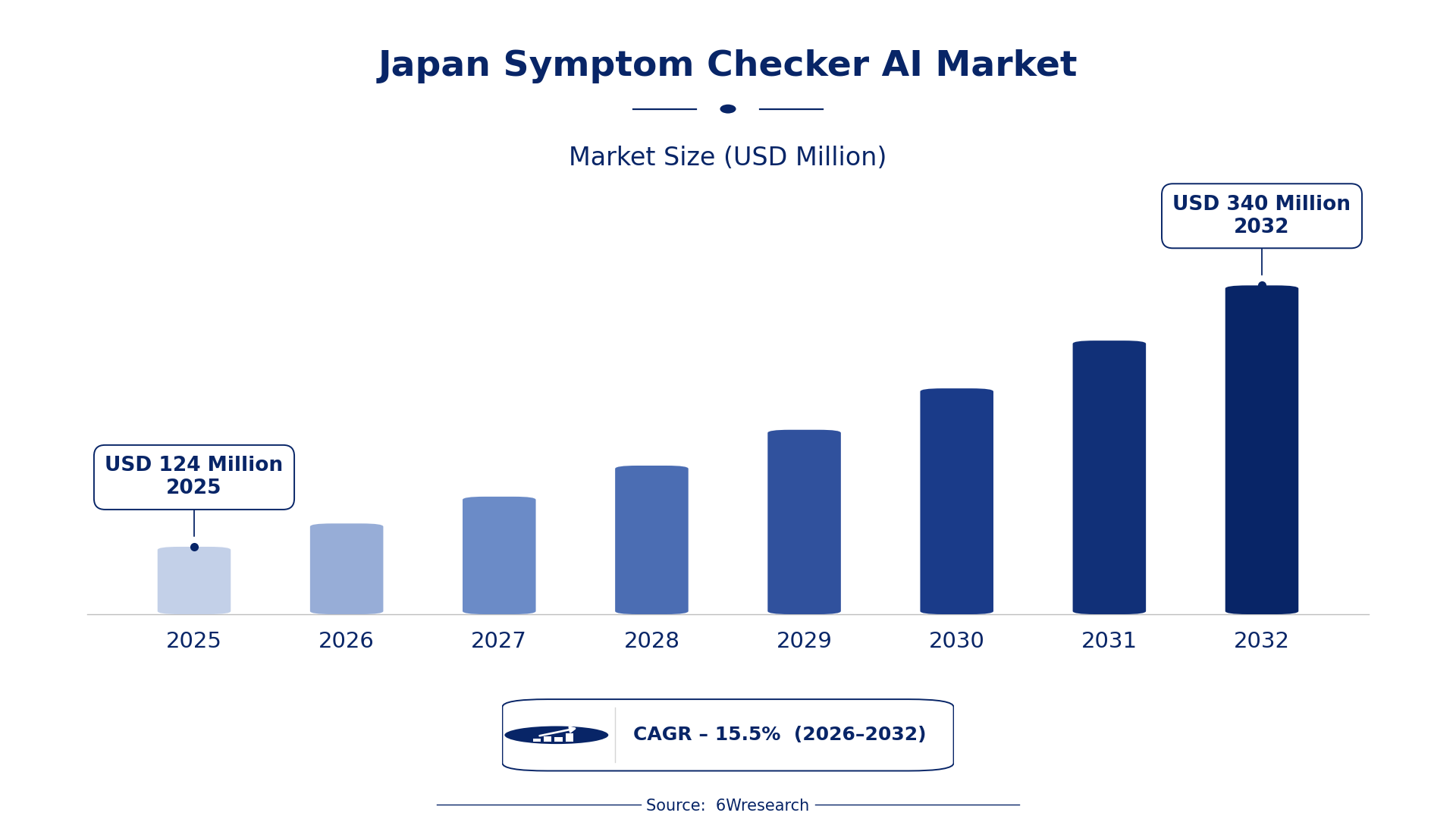
According to 6Wresearch internal database and industry insights, the Japan Symptom Checker AI Market was valued at USD 124 Million in 2025 and is projected to reach USD 340 Million by 2032, growing at a CAGR of approximately 15.5% during 2026–2032.
Japan Symptom Checker AI Market Highlights
| Report Metric | Details |
| Report Name | Japan Symptom Checker AI Market (2026-2032) |
| Market Size 2025 | USD 124 Million |
| Market Size 2032 | USD 340 Million |
| Absolute Growth 2025–2032 | USD 216 Million |
| CAGR 2026–2032 | 15.5% |
| Peak Annual Growth | 16.6% in 2032 |
| Forecast Period | 2026–2032 |
| Historical Data | 2022–2025 |
| Base Year | 2025 |
| Leading AI Tool Type, 2025 | Chatbot-Based Tools (42% share) |
| Leading Diagnostic Model, 2025 | NLP + Decision Trees (38% share) |
| Leading User Interface, 2025 | Web/App Interface (51% share) |
| Leading End User, 2025 | Telehealth Providers (40% share) |
| Fastest-Growing AI Tool Type | Visual Symptom Input (16.8% CAGR) |
| Fastest-Growing Diagnostic Model | Image Recognition AI (21.4% CAGR) |
| Fastest-Growing User Interface | Mobile Camera (21.9% CAGR) |
| Fastest-Growing End User | Patients (19.8% CAGR) |
| Growing Sector | telehealth |
| Key End Users | telehealth providers, patients, physicians, preventive health users |
Japan Symptom Checker AI Market Year-wise Growth Rate and Key Drivers (2022–2032)
This graph illustrates the annual growth rates of the market from 2022 to 2032, highlighting a steady upward trajectory and projected market expansion over the forecast period.
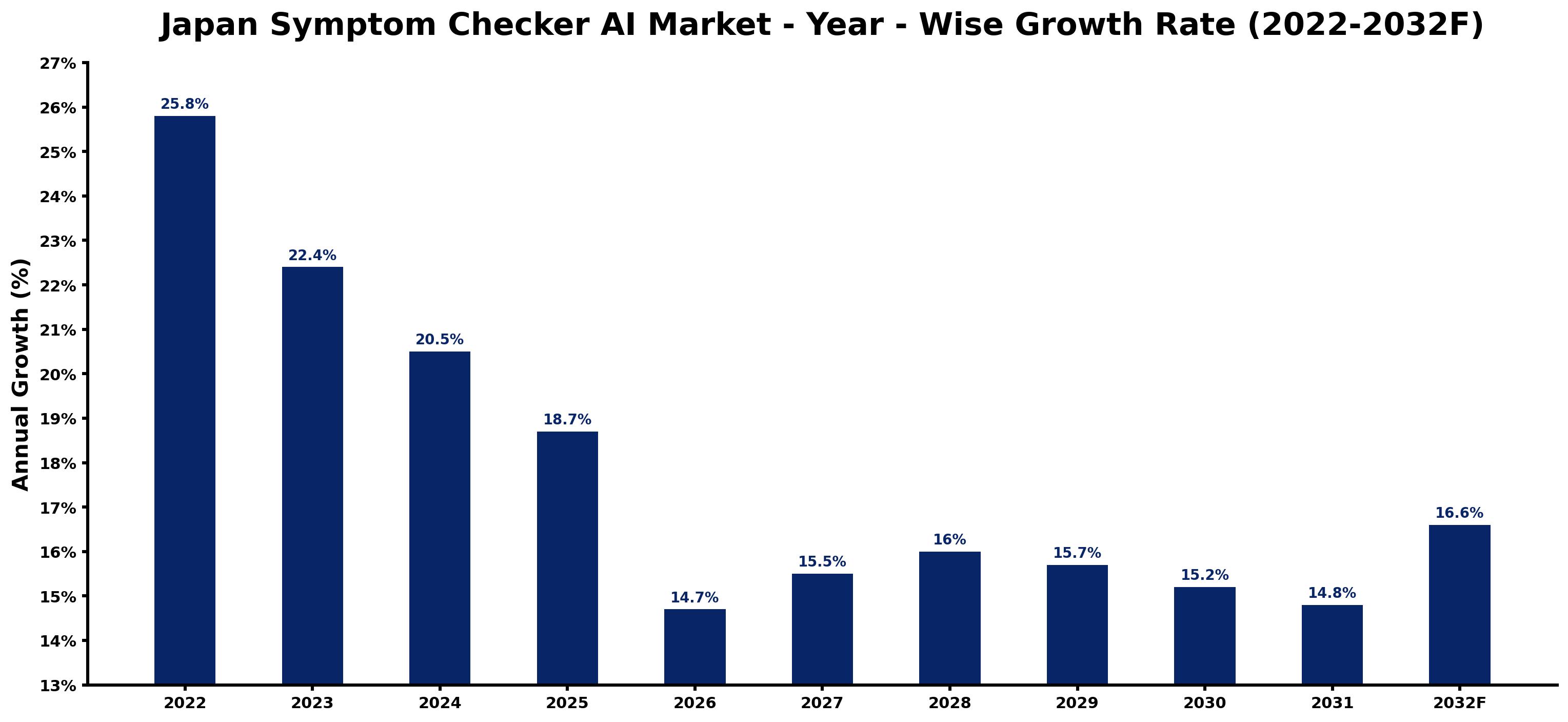
The following figures match every annual growth estimate with the main market development of that year, giving the reasoning behind each rise or slowdown.
| Year | Estimated Annual Growth (%) | Market Rationale |
| 2022 | 25.8 | The market experienced high demand due to increased telehealth adoption. |
| 2023 | 22.4 | Growth slowed as initial excitement settled into regular usage patterns. |
| 2024 | 20.5 | Market expansion continued, driven by rising smartphone penetration and user familiarity. |
| 2025 | 18.7 | Demand remained strong, supported by ongoing healthcare digitalisation efforts. |
| 2026 | 14.7 | Growth is expected to slow as the market begins to stabilise after rapid expansion. |
| 2027 | 15.5 | An increase in user engagement will lead to a rebound in growth rates. |
| 2028 | 16.0 | Continued technological advancements will contribute to a further rise in demand. |
| 2029 | 15.7 | Growth will slow slightly as market saturation begins to take effect. |
| 2030 | 15.2 | Demand is projected to stabilise as users become accustomed to available solutions. |
| 2031 | 14.8 | The market will maintain steady growth as new features attract users. |
| 2032 | 16.6 | A surge in healthcare integration and AI capabilities will drive growth. |
Note: Market size estimations and growth projections presented in this report are based on 6Wresearch's proprietary forecasting methodology, utilizing the latest available industry data, government publications, and primary research inputs.
Japan Symptom Checker AI Market Synopsis
Symptom Checker AI tools use artificial intelligence to help users identify health issues based on symptoms. These tools utilise machine learning and natural language processing, integrating with electronic medical records and wearable devices. In Japan, demand is rising from telehealth providers, with the telehealth market projected to reach 1.5 million users by 2025. The government's support for digital health initiatives, including a ¥10 billion allocation for innovation in 2023, is driving further adoption of these technologies.
Market Dynamics Impact Analysis (2026–2032)
| Factor | Type | Impact | Primary Segment Affected |
| Increasing smartphone penetration supports mobile health solutions. | Driver | High | Chatbot-Based Tools |
| The growing elderly population drives demand for preventive health solutions. | Driver | High | Clinical Support AI |
| Emerging telehealth providers seek advanced AI tools for patient engagement. | Opportunity | High | Telehealth Providers |
| The rise of wearable devices creates a demand for integrated AI solutions. | Opportunity | Medium | Wearable-Linked AI |
| Integration challenges with existing healthcare systems may slow adoption. | Restraint | High | EMR Integration |
| Limited awareness among potential users restricts market growth. | Restraint | Medium | Patients |
| Competition from alternative health solutions may hinder market share. | Challenge | High | Visual Symptom Input |
| Technological complexities can delay product development and deployment. | Challenge | Medium | NLP + Decision Trees |
Evaluation of Drivers in Japan Symptom Checker AI Market (2026–2032)
The main growth drivers and the segments they affect most are set out below.
| Drivers | Primary Segment Affected | Why It Matters (Evidence) |
| Rising smartphone users enhance accessibility to AI tools. | Chatbot-Based Tools | Over 80 million smartphone users in Japan facilitate mobile health solutions. |
| Increased telehealth adoption drives demand for AI diagnostics. | Clinical Support AI | The telehealth market is projected to reach 1.5 million users by 2025. |
| Growing interest from healthcare providers accelerates AI integration. | Telehealth Providers | According to the Japan Medical Association, 70% of physicians are open to using AI. |
| Government support for digital health initiatives boosts investment. | Wearable-Linked AI | In 2023, the government allocated ¥10 billion for digital health innovation. |
| Technological advancements in AI improve diagnostic accuracy. | NLP + Decision Trees | ISO 13485 sets standards relevant for medical device software, enhancing reliability. |
Several shifts outside the market lift sales. The telehealth sector is expected to reach 1.5 million users by 2025, driving demand for AI tools that improve patient engagement. With over 80 million smartphone users in Japan, accessibility to mobile health solutions is increasing. A large portion of healthcare providers express willingness to use AI in diagnostics, indicating a strong market interest.
Evaluation of Restraints in Japan Symptom Checker AI Market
Below are the constraints most often cited by buyers and suppliers, with the segment each affects.
| Market Restraint | Primary Segment Affected | Why It Matters (Evidence) |
| Integration challenges with existing healthcare systems may hinder adoption. | EMR Integration | Complex integration processes slow down the deployment of AI tools in hospitals. |
| Limited awareness among potential users restricts market growth. | Patients | Many patients remain unaware of available AI solutions for health assessment. |
| Competition from alternative health solutions may hinder market share. | Visual Symptom Input | Other health applications may divert attention from symptom checker tools. |
| Technological complexities can delay product development and deployment. | NLP + Decision Trees | Developing reliable AI tools requires substantial technical expertise and resources. |
| Regulatory compliance can slow down the introduction of new products. | Clinical Support AI | Compliance with standards like ISO 13485 demands extensive testing and validation. |
Japan Symptom Checker AI Market Challenges
Buyers of symptom checker AI tools face high initial costs due to strict regulatory requirements, delaying product launches by up to six months. Regulatory hurdles stem from the need to comply with evolving digital health policies, which frustrate producers and slow market entry. Skills shortages in AI and healthcare integration hinder the development of effective tools, resulting in a slower rollout of services that buyers urgently need. Rising operational costs, driven by government funding initiatives, can increase prices for end-users, limiting access to essential health resources for consumers.
Trends in the Japan Symptom Checker AI Market
Several trends are reshaping the Japan Symptom Checker AI Market; the most important are set out below.
- Shift from Traditional Assessments to AI-Driven Diagnostics: The trend towards AI-driven diagnostics gained momentum as telehealth providers increasingly adopted these tools. The integration of AI technologies is expected to improve patient assessment accuracy, potentially reaching 1.5 million users by 2025.
- Transition from Basic Chatbots to Advanced Clinical Support AI: Since 2022, there has been a notable shift towards more sophisticated Clinical Support AI tools. This evolution reflects the growing demand for accurate diagnostics, with an increasing number of hospitals integrating these technologies across major cities.
- Emergence of Visual Symptom Input Technologies: The introduction of Visual Symptom Input tools began in 2022, allowing users to input symptoms visually. This innovation is anticipated to improve diagnostic accuracy, appealing to a broader user base in Japan's telehealth market.
- Growing Integration of AI with Wearable Devices: The trend of linking AI tools with wearable devices has gained traction since 2023. This integration improves user experience and health monitoring, as seen in the increasing adoption of wearable technologies among health-conscious individuals.
Investment Opportunities in the Japan Symptom Checker AI Market
Below are the investment opportunities with the strongest case in the Japan Symptom Checker AI Market.
- Gap in AI Integration for Telehealth Providers: With the telehealth market projected to reach 1.5 million users by 2025, there is a notable opportunity for AI tool providers to improve service offerings. Collaborating with telehealth providers can facilitate market entry.
- Timing for Advanced Diagnostic Tools: As the demand for accurate diagnostics increases, now is the ideal time to invest in Clinical Support AI technologies. Telehealth providers are actively seeking advanced solutions to improve patient care.
- Supply of Advanced Wearable-Linked AI Solutions: The rise of wearable devices presents an opportunity to supply integrated AI solutions. Targeting health-conscious consumers in urban areas can drive adoption and market penetration.
- Investment in User Education and Awareness: With limited awareness among patients, there is a pressing need for educational initiatives. Investing in outreach programs can help increase understanding of AI tools, particularly among elderly users.
Government Initiatives in the Japan Symptom Checker AI Market
The Semiconductor and Digital Industry Strategy, established by METI in June 2021, aims to secure domestic semiconductor manufacturing, which is essential for AI tools. The Economic Security Promotion Act of 2022 supports supply-chain resilience for critical products, improving the overall digital health environment for producers and buyers of Symptom Checker AI.
The Digital Agency promotes digital transformation in healthcare. It approves funding for health technologies, including AI tools, ensuring that projects align with national health objectives. In 2023, the agency allocated ¥10 billion to support digital health initiatives.
Future Insight of the Japan Symptom Checker AI Market
A policy-driven shift towards digital health will transform healthcare delivery by 2032, with a projected 1.5 million users in Japan's telehealth market. Government investment in digital health innovation will encourage suppliers to develop advanced symptom checker AI solutions. Integration with wearable devices will improve user engagement and accessibility. Training programmes will equip healthcare providers with the skills necessary to effectively utilise these technologies.
Market Segmentation Analysis
Japan Symptom Checker AI Market report covers a detailed analysis of the following market segments:
By AI Tool Type – Chatbot-Based Tools Lead, Visual Symptom Input Expected to Grow Fastest
According to Saurav Kr Singh, Senior Research Analyst at 6Wresearch, in 2025, Chatbot-Based Tools led the ai tool type split with a 42% share. Chatbot-Based Tools lead the market due to their widespread use for initial symptom assessment and guidance. Their user-friendly design and accessibility make them a preferred choice for many individuals seeking health information. Over 2026–2032, Visual Symptom Input is expected to post the fastest growth, at a CAGR of 16.8%. Visual Symptom Input is rapidly gaining traction as it allows users to visually input symptoms, improving assessment accuracy. This capability is particularly attractive to users who desire more precise evaluations of their health issues. Suppliers should prioritise the development of visual input features to cater to the increasing demand from users.
By Diagnostic Model – NLP + Decision Trees Lead, Image Recognition AI Expected to Grow Fastest
NLP + Decision Trees held 38% of the Japan Symptom Checker AI Market by diagnostic model in 2025. NLP + Decision Trees dominate the market as they effectively understand patient queries and provide tailored responses. Their proven reliability in processing natural language makes them highly appealing to both healthcare providers and users. The quickest growth will come from Image Recognition AI, forecast to expand at a CAGR of 21.4% between 2026 and 2032. Image Recognition AI is experiencing swift growth due to its relevance in identifying conditions from images, especially in telehealth applications. As technology progresses, more users are likely to seek these capabilities for accurate diagnostics. Investing in image recognition technologies could give suppliers a competitive edge in the market.
By User Interface – Web/App Interface Leads, Mobile Camera Expected to Grow Fastest
The largest user interface category in 2025 was Web/App Interface, at 51% of revenue. Web/App Interface is the leading user interface as it serves as the primary means for user interaction with AI tools. Its widespread adoption among telehealth providers ensures that users have consistent access to health information. Mobile Camera is projected to grow fastest, at a CAGR of 21.9% during 2026–2032. Mobile Camera is seeing rapid growth, albeit on a smaller scale, as it allows for visual symptom input. This method is gaining traction among users who prefer a more interactive approach to health assessments. Suppliers should consider optimising mobile interfaces to cater to the increasing demand for mobile health solutions.
By End User – Telehealth Providers Lead, Patients Expected to Grow Fastest
Telehealth Providers accounted for 40% of the market by end user in 2025. Telehealth Providers hold the largest share as they are the primary users of symptom checker technologies, utilising these tools to improve patient care and streamline healthcare delivery. Their integration of such technologies is evident in major cities like Tokyo and Osaka, where telehealth services are expanding. Patients are set to record the highest CAGR in this split, 19.8% over 2026–2032. Patients represent the fastest-growing segment, increasingly seeking health information and guidance through symptom checker tools. The growing elderly demographic and rising smartphone usage, with over 80 million users, are key factors contributing to this rapid increase in demand. This trend indicates that suppliers should focus on developing user-friendly solutions tailored to the needs of patients.
Key Attractiveness of the Report
- 10 Years of Market Numbers
- Historical Data Starting from 2022 to 2025
- Base Year 2025
- Forecast Data until 2032
- Key Performance Indicators Impacting the Market
- Major Upcoming Developments and Projects
Key Highlights of the Report:
- Japan Symptom Checker AI Market Outlook
- Market Size of Japan Symptom Checker AI Market, 2025
- Forecast of Japan Symptom Checker AI Market, 2032
- Historical Data and Forecast of Japan Symptom Checker AI Revenues & Volume for the Period 2022-2032F
- Japan Symptom Checker AI Market Trend Evolution
- Japan Symptom Checker AI Market Drivers and Challenges
- Japan Symptom Checker AI Price Trends
- Japan Symptom Checker AI Porter's Five Forces
- Japan Symptom Checker AI Industry Life Cycle
- Historical Data and Forecast of Japan Symptom Checker AI Market Revenues & Volume By AI Tool Type for the Period 2022-2032F
- Historical Data and Forecast of Japan Symptom Checker AI Market Revenues & Volume By Chatbot-Based Tools for the Period 2022-2032F
- Historical Data and Forecast of Japan Symptom Checker AI Market Revenues & Volume By Visual Symptom Input for the Period 2022-2032F
- Historical Data and Forecast of Japan Symptom Checker AI Market Revenues & Volume By Clinical Support AI for the Period 2022-2032F
- Historical Data and Forecast of Japan Symptom Checker AI Market Revenues & Volume By Wearable-Linked AI for the Period 2022-2032F
- Historical Data and Forecast of Japan Symptom Checker AI Market Revenues & Volume By Diagnostic Model for the Period 2022-2032F
- Historical Data and Forecast of Japan Symptom Checker AI Market Revenues & Volume By NLP + Decision Trees for the Period 2022-2032F
- Historical Data and Forecast of Japan Symptom Checker AI Market Revenues & Volume By Image Recognition AI for the Period 2022-2032F
- Historical Data and Forecast of Japan Symptom Checker AI Market Revenues & Volume By Bayesian/ML Algorithms for the Period 2022-2032F
- Historical Data and Forecast of Japan Symptom Checker AI Market Revenues & Volume By Sensor Fusion + Predictive for the Period 2022-2032F
- Historical Data and Forecast of Japan Symptom Checker AI Market Revenues & Volume By User Interface for the Period 2022-2032F
- Historical Data and Forecast of Japan Symptom Checker AI Market Revenues & Volume By Web/App Interface for the Period 2022-2032F
- Historical Data and Forecast of Japan Symptom Checker AI Market Revenues & Volume By Mobile Camera for the Period 2022-2032F
- Historical Data and Forecast of Japan Symptom Checker AI Market Revenues & Volume By EMR Integration for the Period 2022-2032F
- Historical Data and Forecast of Japan Symptom Checker AI Market Revenues & Volume By Wearables + App for the Period 2022-2032F
- Historical Data and Forecast of Japan Symptom Checker AI Market Revenues & Volume By End User for the Period 2022-2032F
- Historical Data and Forecast of Japan Symptom Checker AI Market Revenues & Volume By Telehealth Providers for the Period 2022-2032F
- Historical Data and Forecast of Japan Symptom Checker AI Market Revenues & Volume By Patients for the Period 2022-2032F
- Historical Data and Forecast of Japan Symptom Checker AI Market Revenues & Volume By Physicians for the Period 2022-2032F
- Historical Data and Forecast of Japan Symptom Checker AI Market Revenues & Volume By Preventive Health Users for the Period 2022-2032F
- Japan Symptom Checker AI Import Export Trade Statistics
- Market Opportunity Assessment By AI Tool Type
- Market Opportunity Assessment By Diagnostic Model
- Market Opportunity Assessment By User Interface
- Market Opportunity Assessment By End User
- Japan Symptom Checker AI Top Companies Market Share
- Japan Symptom Checker AI Competitive Benchmarking By Technical and Operational Parameters
- Japan Symptom Checker AI Company Profiles
- Japan Symptom Checker AI Key Strategic Recommendations
Market Covered
This report examines the market across the segments below.
By AI Tool Type
- Chatbot-Based Tools
- Visual Symptom Input
- Clinical Support AI
- Wearable-Linked AI
By Diagnostic Model
- NLP + Decision Trees
- Image Recognition AI
- Bayesian/ML Algorithms
- Sensor Fusion + Predictive
By User Interface
- Web/App Interface
- Mobile Camera
- EMR Integration
- Wearables + App
By End User
- Telehealth Providers
- Patients
- Physicians
- Preventive Health Users































