Japan Synthetic Agri Lubricants Market Size & Growth Rate
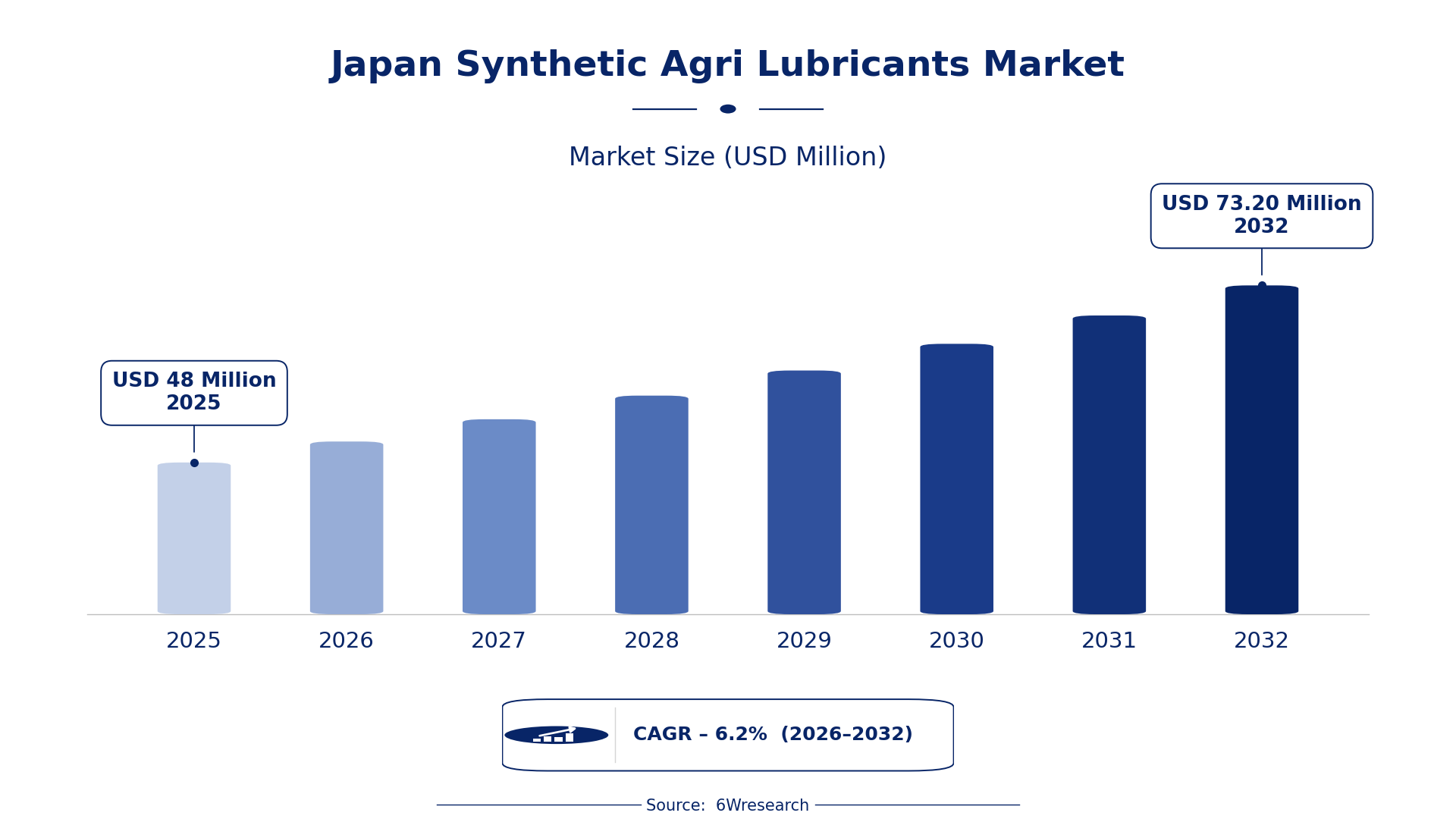
According to 6Wresearch internal database and industry insights, the Japan Synthetic Agri Lubricants Market was valued at USD 48 Million in 2025 and is projected to reach USD 73.20 Million by 2032, growing at a CAGR of approximately 6.2% during 2026–2032.
Japan Synthetic Agri Lubricants Market Highlights
| Report Metric | Details |
| Report Name | Japan Synthetic Agri Lubricants Market (2026-2032) |
| Market Size 2025 | USD 48 Million |
| Market Size 2032 | USD 73.20 Million |
| Absolute Growth 2025–2032 | USD 25.20 Million |
| CAGR 2026–2032 | 6.2% |
| Peak Annual Growth | 7.9% in 2032 |
| Forecast Period | 2026–2032 |
| Historical Data | 2022–2025 |
| Base Year | 2025 |
| Leading Lubricant Type, 2025 | Synthetic Grease (41% share) |
| Leading Base Fluid, 2025 | PAO with Thickeners (44% share) |
| Leading Application Equipment, 2025 | Harvesters (45% share) |
| Leading End User, 2025 | Large Farm Operators (45% share) |
| Fastest-Growing Lubricant Type | Synthetic Hydraulic Oil (9.2% CAGR) |
| Fastest-Growing Base Fluid | Esters/PAO (8.8% CAGR) |
| Fastest-Growing Application Equipment | Tractors/Loaders (8.5% CAGR) |
| Fastest-Growing End User | Agriculture OEMs (8.4% CAGR) |
| Growing Sector | Agricultural machinery |
| Key End Users | Large Farm Operators, Agriculture OEMs, Sustainable Farms |
Japan Synthetic Agri Lubricants Market Year-wise Growth Rate and Key Drivers (2022–2032)
This graph illustrates the annual growth rates of the market from 2022 to 2032, highlighting a steady upward trajectory and projected market expansion over the forecast period.
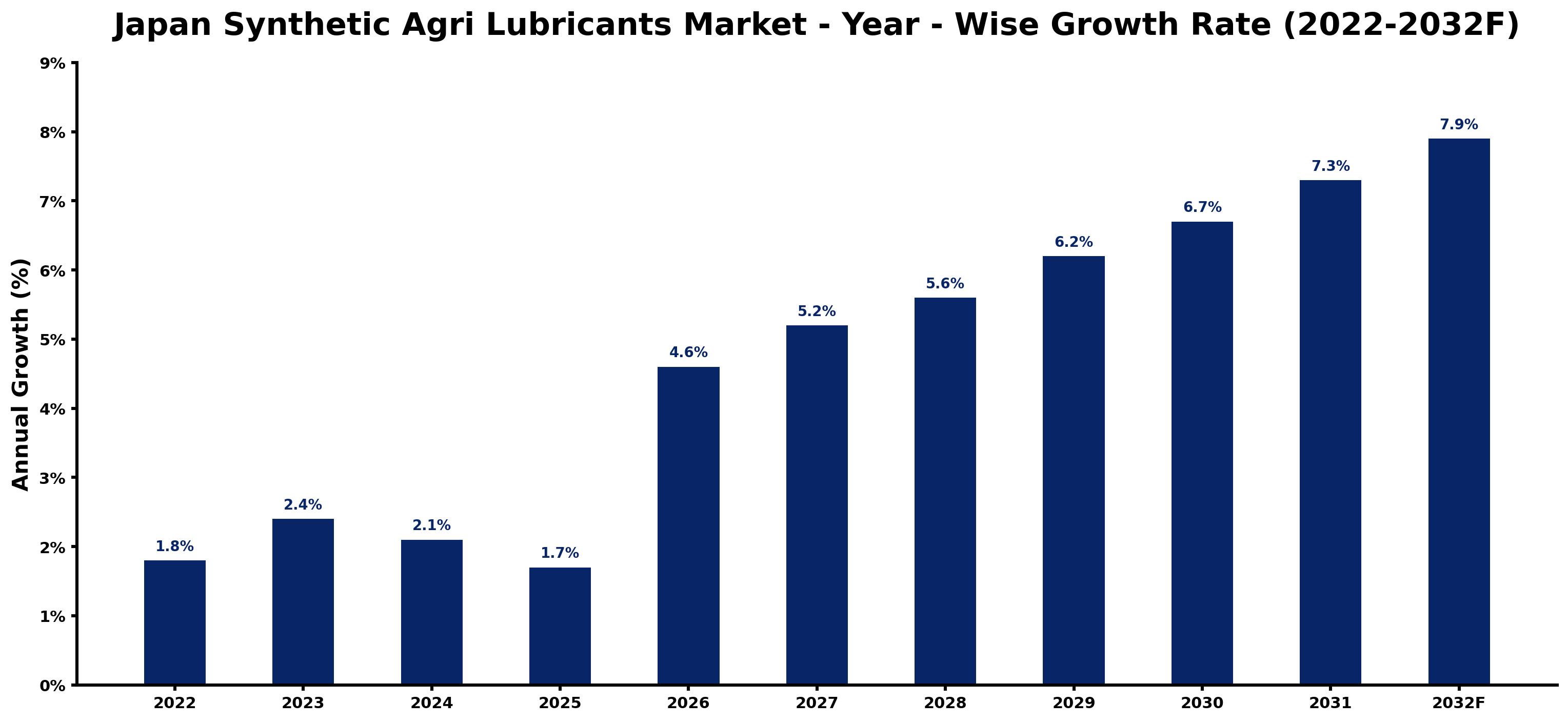
For each year, the table pairs the estimated growth rate with the leading influence on demand, showing how the drivers changed across the period.
| Year | Estimated Annual Growth (%) | Market Rationale |
| 2022 | 1.8 | The market showed steady demand from large farm operators and sustainable practices. |
| 2023 | 2.4 | Growth was driven by increasing use of synthetic lubricants in modern machinery. |
| 2024 | 2.1 | Demand slowed as some operators delayed equipment upgrades and maintenance. |
| 2025 | 1.7 | The market continued to grow, but at a slower pace due to cautious spending. |
| 2026 | 4.6 | Demand is expected to surge as investments in sustainable farming practices increase. |
| 2027 | 5.2 | Increased adoption of synthetic lubricants in agricultural machinery will boost growth. |
| 2028 | 5.6 | Rising efficiency demands will lead to further growth in lubricant usage. |
| 2029 | 6.2 | The trend towards eco-friendly products is projected to continue driving market expansion. |
| 2030 | 6.7 | Technological advancements in lubricant formulations will support increasing demand. |
| 2031 | 7.3 | Sustained growth will be apparent as large farm operators expand their operations. |
| 2032 | 7.9 | The market is projected to peak with high demand for advanced synthetic lubricants. |
Note: Market size estimations and growth projections presented in this report are based on 6Wresearch's proprietary forecasting methodology, utilizing the latest available industry data, government publications, and primary research inputs.
Japan Synthetic Agri Lubricants Market Synopsis
Synthetic Agri Lubricants are high-performance products designed for agricultural machinery, utilising synthetic base oils for superior lubrication. Their primary applications include reducing friction and wear, improving efficiency, and extending maintenance intervals. The Japan Synthetic Agri Lubricants Market is expanding due to rising demand from large farm operators and sustainable farming practices. In 2023, the Ministry of Agriculture allocated 1 billion yen for sustainable agriculture initiatives, driving the adoption of these lubricants across modern agricultural machinery.
Market Dynamics Impact Analysis (2026–2032)
| Factor | Type | Impact | Primary Segment Affected |
| Increasing adoption of synthetic lubricants in modern agricultural machinery | Driver | High | Synthetic Hydraulic Oil |
| Growing demand for environmentally friendly options | Driver | High | Biodegradable Oils |
| Rising demand for high-performance lubricants in large farms | Opportunity | High | Synthetic Grease |
| Expansion of sustainable farming practices among operators | Opportunity | High | Synthetic Grease |
| Limited awareness of the benefits of synthetic lubricants | Restraint | Medium | Synthetic Gear Oil |
| High initial costs of synthetic lubricants compared to conventional options | Restraint | Medium | Synthetic Hydraulic Oil |
| Fluctuating raw material prices affecting production costs | Challenge | High | Synthetic Grease |
| Competition from traditional lubricants affecting market share | Challenge | Medium | Biodegradable Oils |
Evaluation of Drivers in Japan Synthetic Agri Lubricants Market (2026–2032)
The following drivers explain most of the expected growth.
| Drivers | Primary Segment Affected | Why It Matters (Evidence) |
| Increased efficiency of agricultural machinery | Synthetic Hydraulic Oil | Over 60% of modern machinery in Japan uses synthetic lubricants, enhancing operational performance. |
| Growing focus on sustainability | Biodegradable Oils | Biodegradable oils account for 15% of the lubricant market, appealing to eco-conscious buyers seeking alternatives. |
| Demand for extended maintenance intervals | Synthetic Grease | Large farm operators seek lubricants that minimise downtime and maintenance costs, driving higher sales. |
| Technological advancements in lubricant formulations | Synthetic Gear Oil | Innovations in formulation enhance performance in extreme conditions, attracting more buyers seeking reliability. |
| Rising agricultural output in key regions | Synthetic Grease | The Kanto region's high agricultural output increases demand for efficient lubricants, boosting sales. |
Spending rises because large farm operators increasingly adopt synthetic lubricants for their efficiency and performance. Approximately 60% of modern agricultural machinery in Japan utilises these lubricants, which enhances operational capabilities. The Kanto region's agricultural output drives demand, with farmers seeking reliable products. Innovations in lubricant formulations improve performance in extreme conditions, leading to higher purchases among operators. The growing focus on sustainability prompts more farmers to choose biodegradable options, reflecting a shift in buyer preferences.
Evaluation of Restraints in Japan Synthetic Agri Lubricants Market
Several factors work against faster growth; the main ones are summarised below.
| Market Restraint | Primary Segment Affected | Why It Matters (Evidence) |
| Limited awareness of synthetic lubricants' benefits | Synthetic Gear Oil | Many operators do not recognise the advantages, hindering adoption rates and resulting in lower sales. |
| High initial costs compared to conventional lubricants | Synthetic Hydraulic Oil | The price difference discourages some buyers from switching to synthetic options, impacting market growth. |
| Fluctuating raw material prices | Synthetic Grease | Price volatility creates unpredictable production costs for manufacturers, affecting pricing strategies. |
| Competition from traditional lubricants | Biodegradable Oils | Established products often dominate the market, making it challenging for new options to gain traction, limiting market share. |
| Regulatory hurdles for new formulations | Synthetic Grease | Compliance with standards can delay product launches and market entry, impacting supplier revenues. |
Japan Synthetic Agri Lubricants Market Challenges
In Japan, complex regulations regarding lubricant production often slow down product approvals, causing suppliers to face extended timelines that restrict buyers' access to critical synthetic lubricants. Large farm operators struggle with sourcing challenges, as reliance on domestic production limits options and can delay deliveries by up to 20%. Producers encounter hurdles in technology adoption due to the high costs associated with upgrading to advanced formulations, which hampers machinery efficiency. Rising raw material expenses have pushed lubricant prices up by 10%, putting financial pressure on farmers and machinery operators.
Trends in the Japan Synthetic Agri Lubricants Market
These developments are changing demand patterns in the Japan Synthetic Agri Lubricants Market.
- Shift towards Biodegradable Oils: In 2023, biodegradable oils accounted for 15% of the agricultural lubricant market, reflecting a growing preference for eco-friendly options among farmers.
- Transition from Conventional to Synthetic Lubricants: The Tohoku region has seen a rise in synthetic lubricant usage, with over 60% of modern machinery now adopting these products, indicating a shift in industry standards.
- Emerging Demand for High-Performance Lubricants: Large farm operators are increasingly seeking high-performance lubricants, driving innovation and development in lubricant technology across Japan, as they aim for greater efficiency.
- Growing Adoption of Sustainable Practices: The Japanese government allocated 1 billion yen for sustainable agriculture initiatives in 2023, promoting the use of eco-friendly lubricants and encouraging sustainable farming.
Investment Opportunities in the Japan Synthetic Agri Lubricants Market
Where to invest in the Japan Synthetic Agri Lubricants Market: the main openings are set out below.
- Supply of High-Performance Synthetic Lubricants: With the market projected to reach 73.20 million USD by 2032, suppliers can invest in high-performance synthetic lubricants to meet rising demand from large farm operators.
- Expansion into Biodegradable Oils: As biodegradable oils account for 15% of the market, suppliers can focus on developing eco-friendly products to capture this growing segment and meet buyer preferences.
- Partnerships with Agricultural OEMs: Collaborating with agricultural OEMs can facilitate market entry, as they increasingly require high-quality lubricants for their machinery, ensuring steady demand.
- Investment in Research and Development: Investing in R&D for new lubricant formulations can help suppliers meet the evolving demands of large farm operators, ensuring competitive advantage.
Government Initiatives in the Japan Synthetic Agri Lubricants Market
The Fire Service Act of 1948, enforced by the Fire and Disaster Management Agency, mandates safety measures for the storage and handling of hazardous materials, including synthetic lubricants. This law complements the Clinical Trials Act of 2017, which sets standards for product testing and disclosure, ensuring that lubricants meet safety and performance criteria. These regulations collectively enhance buyer confidence and ensure that producers adhere to high safety standards, fostering a reliable market environment for synthetic agri lubricants.
Large farm operators benefit from the subsidies provided under the Japanese government's sustainable agriculture initiatives, which support the adoption of eco-friendly lubricants. The Ministry of Agriculture oversees the allocation of 1 billion yen for these initiatives, facilitating access to high-performance products. This funding enables farmers to invest in advanced lubricant technologies, improving machinery efficiency and reducing environmental impact, ultimately enhancing productivity in the agricultural sector.
Future Insight of the Japan Synthetic Agri Lubricants Market
Investment in sustainable agriculture initiatives will drive demand for high-performance lubricants, creating opportunities for suppliers. The 1 billion yen allocated for these initiatives will stimulate advancements in lubricant technology, encouraging producers to innovate. Adoption of Japanese Agricultural Standards will improve product quality, increasing buyer confidence in performance. The Agricultural Machinery Expo will showcase new technologies, enabling suppliers to engage with buyers and expand their market presence.
Market Segmentation Analysis
Japan Synthetic Agri Lubricants Market report covers a detailed analysis of the following market segments:
By Lubricant Type – Synthetic Grease Leads, Synthetic Hydraulic Oil Expected to Grow Fastest
According to Saurav Kr Singh, Senior Research Analyst at 6Wresearch, the largest lubricant type category in 2025 was Synthetic Grease, at 41% of revenue. Synthetic Grease holds the largest market share as it is essential for lubrication across a wide range of agricultural machinery, ensuring efficient operation and longevity. Its widespread use is evident in the fact that over 60% of modern agricultural machinery in Japan relies on synthetic lubricants for optimal performance. Synthetic Hydraulic Oil is set to record the highest CAGR in this split, 9.2% over 2026–2032. The growth of Synthetic Hydraulic Oil is propelled by its critical function in hydraulic systems, which are becoming more prevalent in contemporary agricultural equipment. The demand for enhanced hydraulic efficiency in tractors and loaders is driving this segment's rapid expansion. This trend indicates that suppliers should focus on advancing synthetic hydraulic oil formulations to meet the growing needs of the agricultural sector.
By Base Fluid – PAO with Thickeners Lead, Esters/PAO Expected to Grow Fastest
In 2025, PAO with Thickeners led the base fluid split with a 44% share. PAO with Thickeners leads the market due to its superior performance in extreme conditions, making it the preferred choice for high-performance agricultural lubricants. This base fluid is widely adopted in the Tohoku region, known for its agricultural machinery production. Esters/PAO is projected to grow fastest, at a CAGR of 8.8% during 2026–2032. Esters/PAO are experiencing the fastest growth as they are increasingly favoured for their biodegradability and performance, aligning with the Japanese government's push for sustainable farming practices. The allocation of 1 billion yen for sustainable agriculture initiatives further fuels this trend. Buyers are likely to seek more eco-friendly lubricant options, prompting suppliers to invest in the development of biodegradable formulations.
By Application Equipment – Harvesters Lead, Tractors/Loaders Expected to Grow Fastest
Harvesters accounted for 45% of the market by application equipment in 2025. Harvesters dominate the market as they are critical for efficient operation and maintenance in large-scale farming, making them a key focus for lubricant suppliers. Their extensive use in the Kanto region, known for high agricultural output, underscores their importance. The quickest growth will come from Tractors/Loaders, forecast to expand at a CAGR of 8.5% between 2026 and 2032. Tractors/Loaders are the fastest-growing segment due to their widespread use in daily agricultural operations, reflecting the increasing mechanisation of farming practices. The annual Agricultural Machinery Expo showcases innovations that further drive this segment's growth. Suppliers must adapt to the rising demand for lubricants specifically designed for tractors and loaders to remain competitive in the market.
By End User – Large Farm Operators Lead, Agriculture OEMs Expected to Grow Fastest
Large Farm Operators took 45% of end user revenue in 2025, more than any other category. Large Farm Operators constitute the primary user group of high-performance lubricants, necessitating dependable and efficient solutions for their extensive machinery. This segment's significance is highlighted by the fact that Japan's agricultural sector employs around 2 million individuals, many of whom manage large farms. Over 2026–2032, Agriculture OEMs are expected to post the fastest growth, at a CAGR of 8.4%. Agriculture OEMs are experiencing the fastest growth among end users, driven by the demand for high-quality lubricants in the production of advanced agricultural machinery. The emphasis on sustainable practices in agriculture further fuels the need for these lubricants. Suppliers should strengthen their connections with agriculture OEMs to take advantage of the growing demand for high-performance lubricants in new equipment.
Key Attractiveness of the Report
- 10 Years of Market Numbers
- Historical Data Starting from 2022 to 2025
- Base Year 2025
- Forecast Data until 2032
- Key Performance Indicators Impacting the Market
- Major Upcoming Developments and Projects
Key Highlights of the Report:
- Japan Synthetic Agri Lubricants Market Outlook
- Market Size of Japan Synthetic Agri Lubricants Market, 2025
- Forecast of Japan Synthetic Agri Lubricants Market, 2032
- Historical Data and Forecast of Japan Synthetic Agri Lubricants Revenues & Volume for the Period 2022-2032F
- Japan Synthetic Agri Lubricants Market Trend Evolution
- Japan Synthetic Agri Lubricants Market Drivers and Challenges
- Japan Synthetic Agri Lubricants Price Trends
- Japan Synthetic Agri Lubricants Porter's Five Forces
- Japan Synthetic Agri Lubricants Industry Life Cycle
- Historical Data and Forecast of Japan Synthetic Agri Lubricants Market Revenues & Volume By Lubricant Type for the Period 2022-2032F
- Historical Data and Forecast of Japan Synthetic Agri Lubricants Market Revenues & Volume By Synthetic Grease for the Period 2022-2032F
- Historical Data and Forecast of Japan Synthetic Agri Lubricants Market Revenues & Volume By Synthetic Hydraulic Oil for the Period 2022-2032F
- Historical Data and Forecast of Japan Synthetic Agri Lubricants Market Revenues & Volume By Biodegradable Oils for the Period 2022-2032F
- Historical Data and Forecast of Japan Synthetic Agri Lubricants Market Revenues & Volume By Synthetic Gear Oil for the Period 2022-2032F
- Historical Data and Forecast of Japan Synthetic Agri Lubricants Market Revenues & Volume By Base Fluid for the Period 2022-2032F
- Historical Data and Forecast of Japan Synthetic Agri Lubricants Market Revenues & Volume By PAO with Thickeners for the Period 2022-2032F
- Historical Data and Forecast of Japan Synthetic Agri Lubricants Market Revenues & Volume By Esters/PAO for the Period 2022-2032F
- Historical Data and Forecast of Japan Synthetic Agri Lubricants Market Revenues & Volume By Vegetable/Synthetic Mix for the Period 2022-2032F
- Historical Data and Forecast of Japan Synthetic Agri Lubricants Market Revenues & Volume By High Viscosity Esters for the Period 2022-2032F
- Historical Data and Forecast of Japan Synthetic Agri Lubricants Market Revenues & Volume By Application Equipment for the Period 2022-2032F
- Historical Data and Forecast of Japan Synthetic Agri Lubricants Market Revenues & Volume By Harvesters for the Period 2022-2032F
- Historical Data and Forecast of Japan Synthetic Agri Lubricants Market Revenues & Volume By Tractors/Loaders for the Period 2022-2032F
- Historical Data and Forecast of Japan Synthetic Agri Lubricants Market Revenues & Volume By Irrigation Pumps for the Period 2022-2032F
- Historical Data and Forecast of Japan Synthetic Agri Lubricants Market Revenues & Volume By Power Tillers for the Period 2022-2032F
- Historical Data and Forecast of Japan Synthetic Agri Lubricants Market Revenues & Volume By End User for the Period 2022-2032F
- Historical Data and Forecast of Japan Synthetic Agri Lubricants Market Revenues & Volume By Large Farm Operators for the Period 2022-2032F
- Historical Data and Forecast of Japan Synthetic Agri Lubricants Market Revenues & Volume By Agriculture OEMs for the Period 2022-2032F
- Historical Data and Forecast of Japan Synthetic Agri Lubricants Market Revenues & Volume By Sustainable Farms for the Period 2022-2032F
- Historical Data and Forecast of Japan Synthetic Agri Lubricants Market Revenues & Volume By Machinery Dealers for the Period 2022-2032F
- Japan Synthetic Agri Lubricants Import Export Trade Statistics
- Market Opportunity Assessment By Lubricant Type
- Market Opportunity Assessment By Base Fluid
- Market Opportunity Assessment By Application Equipment
- Market Opportunity Assessment By End User
- Japan Synthetic Agri Lubricants Top Companies Market Share
- Japan Synthetic Agri Lubricants Competitive Benchmarking By Technical and Operational Parameters
- Japan Synthetic Agri Lubricants Company Profiles
- Japan Synthetic Agri Lubricants Key Strategic Recommendations
Market Covered
The report covers the following segments.
By Lubricant Type
- Synthetic Grease
- Synthetic Hydraulic Oil
- Biodegradable Oils
- Synthetic Gear Oil
By Base Fluid
- PAO with Thickeners
- Esters/PAO
- Vegetable/Synthetic Mix
- High Viscosity Esters
By Application Equipment
- Harvesters
- Tractors/Loaders
- Irrigation Pumps
- Power Tillers
By End User
- Large Farm Operators
- Agriculture OEMs
- Sustainable Farms
- Machinery Dealers































