Japan Synthetic Aircraft Lubricants Market Size & Growth Rate
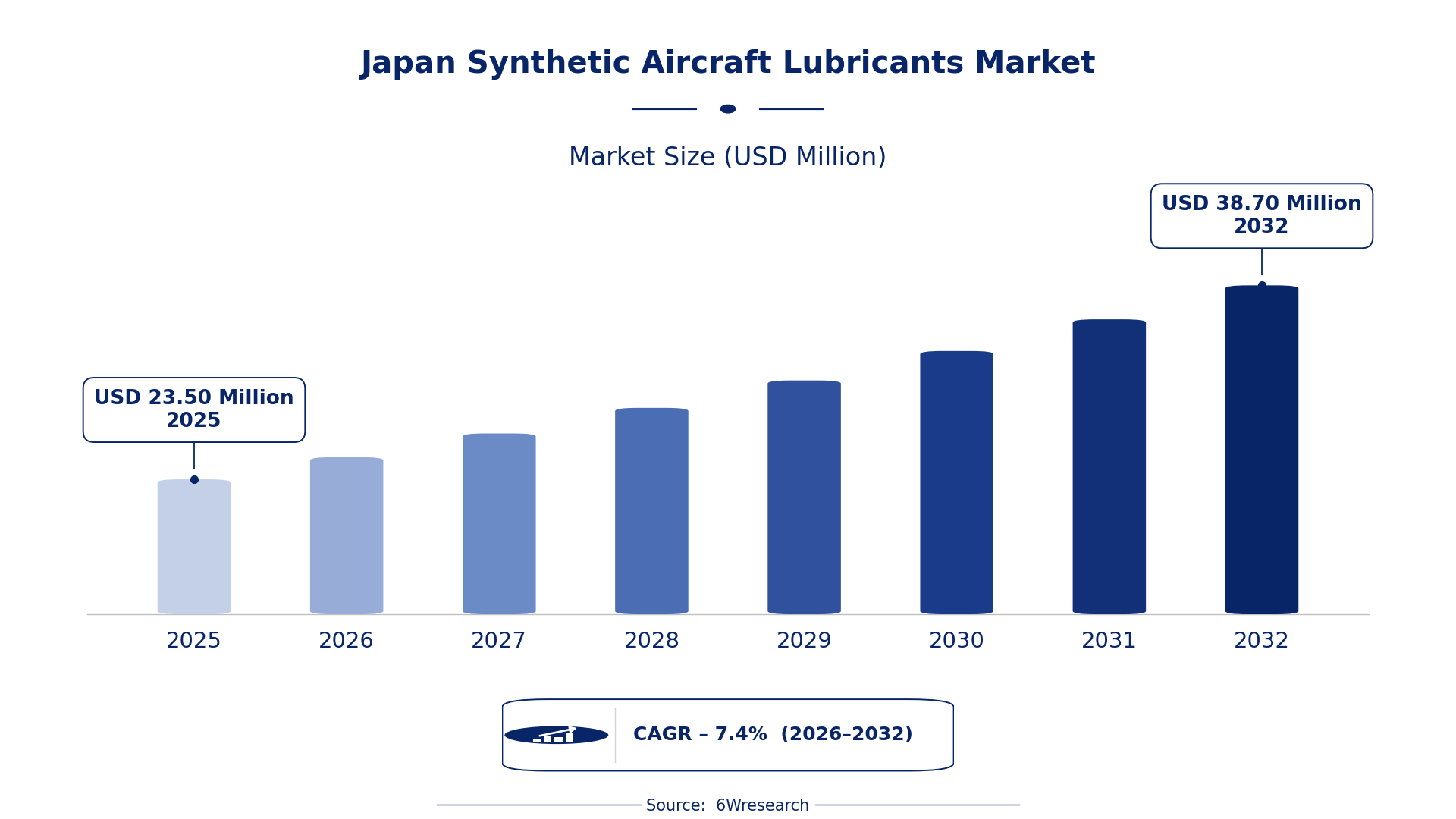
According to 6Wresearch internal database and industry insights, the Japan Synthetic Aircraft Lubricants Market was valued at USD 23.50 Million in 2025 and is projected to reach USD 38.70 Million by 2032, growing at a CAGR of approximately 7.4% during 2026–2032.
Japan Synthetic Aircraft Lubricants Market Highlights
| Report Metric | Details |
| Report Name | Japan Synthetic Aircraft Lubricants Market (2026-2032) |
| Market Size 2025 | USD 23.50 Million |
| Market Size 2032 | USD 38.70 Million |
| Absolute Growth 2025–2032 | USD 15.20 Million |
| CAGR 2026–2032 | 7.4% |
| Peak Annual Growth | 8.9% in 2029 |
| Forecast Period | 2026–2032 |
| Historical Data | 2022–2025 |
| Base Year | 2025 |
| Leading Lubricant Type, 2025 | Turbine Engine Oils (51% share) |
| Leading Base Stock, 2025 | Ester-Based Synthetics (50% share) |
| Leading Aircraft System, 2025 | Jet Engines (42% share) |
| Leading End User, 2025 | Commercial Airlines (38% share) |
| Fastest-Growing Lubricant Type | Hydraulic Fluids (10.5% CAGR) |
| Fastest-Growing Aircraft System | Flight Control Systems (10.6% CAGR) |
| Fastest-Growing End User | MRO Companies (9.6% CAGR) |
| Growing Sector | MRO Companies |
| Key End Users | Commercial Airlines, MRO Companies, Military Operators, OEMs |
Japan Synthetic Aircraft Lubricants Market Year-wise Growth Rate and Key Drivers (2022–2032)
This graph illustrates the annual growth rates of the market from 2022 to 2032, highlighting a steady upward trajectory and projected market expansion over the forecast period.
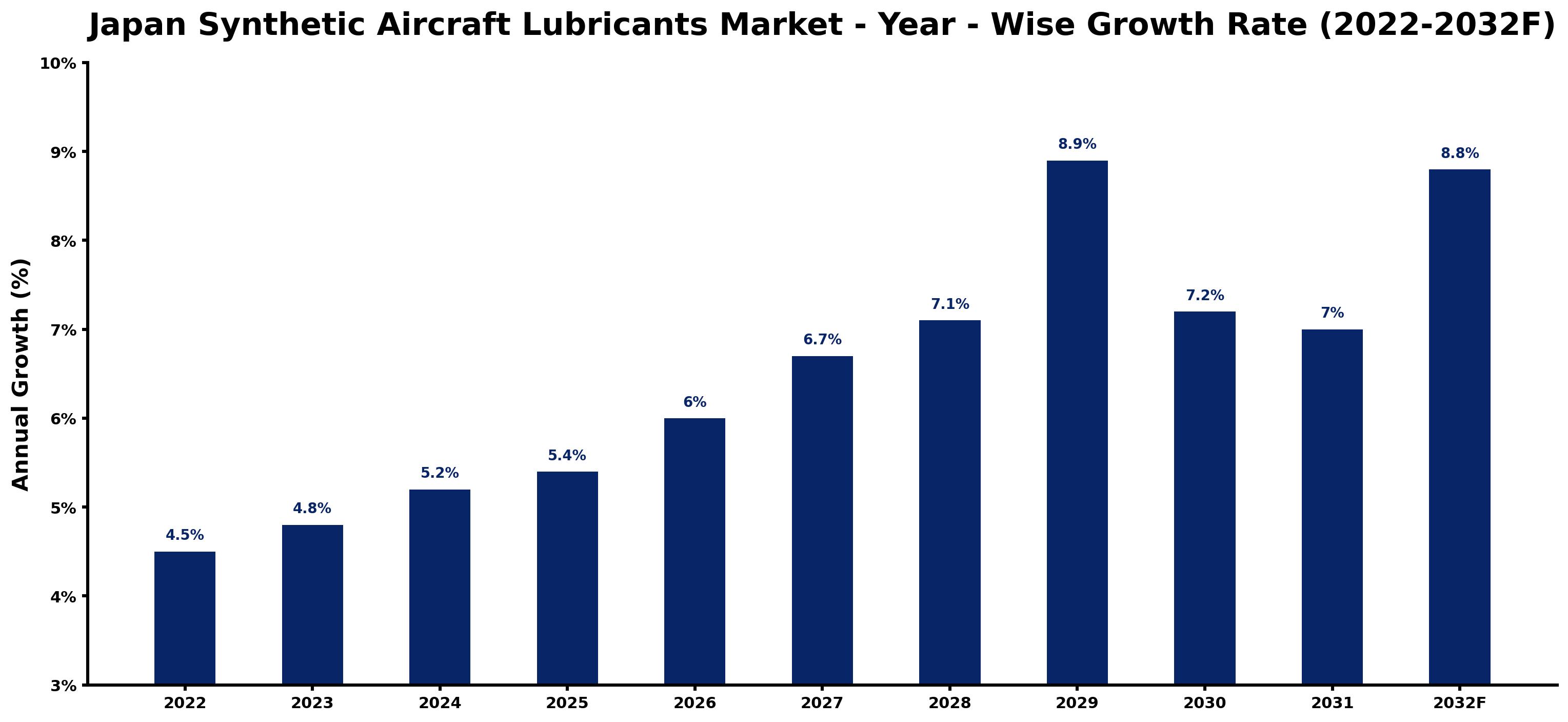
The table below sets out the estimated growth rate for each year and the main factor behind it.
| Year | Estimated Annual Growth (%) | Market Rationale |
| 2022 | 4.5 | The market experienced steady growth due to ongoing demand from domestic airlines. |
| 2023 | 4.8 | Growth accelerated as military operators increased their procurement of lubricants. |
| 2024 | 5.2 | Demand rose further with MRO companies expanding services for aircraft maintenance. |
| 2025 | 5.4 | The market peaked historically as commercial airlines invested in fleet upgrades. |
| 2026 | 6.0 | Growth is anticipated as aviation activity rises alongside new safety standards. |
| 2027 | 6.7 | Demand will strengthen as Ester-based synthetics gain popularity for their performance. |
| 2028 | 7.1 | The market is projected to expand as new aviation technologies are introduced in Japan. |
| 2029 | 8.9 | The peak annual growth is expected due to heightened military procurement programs. |
| 2030 | 7.2 | Growth will slow as the market adjusts to previous peaks in demand. |
| 2031 | 7.0 | The market will continue to grow, albeit at a slower rate than the previous year. |
| 2032 | 8.8 | Demand is projected to surge again as the aviation sector targets emission reductions. |
Note: Market size estimations and growth projections presented in this report are based on 6Wresearch's proprietary forecasting methodology, utilizing the latest available industry data, government publications, and primary research inputs.
Japan Synthetic Aircraft Lubricants Market Synopsis
Synthetic aircraft lubricants are advanced formulations designed to meet the stringent requirements of aviation applications, produced through complex chemical processes involving synthetic base stocks and additives. The Japan Synthetic Aircraft Lubricants Market is growing due to increased investments from domestic airlines and military operators, alongside a focus on sustainability. The government aims to reduce aviation emissions by 30% by 2030, prompting further demand for high-performance lubricants that meet these new standards.
Market Dynamics Impact Analysis (2026–2032)
| Factor | Type | Impact | Primary Segment Affected |
| Rising demand from commercial airlines for fleet upgrades | Driver | High | Turbine Engine Oils |
| Increased military procurement for defense applications | Driver | High | Hydraulic Fluids |
| Growing focus on sustainability in aviation lubricants | Opportunity | High | Ester-Based Synthetics |
| Expansion of MRO services in the Tokyo metropolitan area | Opportunity | Medium | Grease for Bearings |
| Regulatory compliance costs for lubricant manufacturers | Restraint | High | Multipurpose Oils |
| Limited availability of high-performance synthetic base stocks | Restraint | Medium | Phosphate Ester |
| Competition from alternative lubrication technologies | Challenge | High | Mixed Synthetic |
| Supply chain disruptions affecting raw material availability | Challenge | Medium | Lithium Complex + PAO |
Evaluation of Drivers in Japan Synthetic Aircraft Lubricants Market (2026–2032)
These are the developments adding the most demand over the forecast period.
| Drivers | Primary Segment Affected | Why It Matters (Evidence) |
| Increased aircraft activity | Turbine Engine Oils | The rise in domestic airline operations boosts demand for turbine engine oils, reflecting the need for reliable performance. |
| Military aviation expansion | Hydraulic Fluids | Japan's military aviation sector is increasing its use of hydraulic fluids, vital for operational capabilities and mission readiness. |
| Technological advancements in lubricants | Ester-Based Synthetics | Ester-based synthetics are increasingly adopted by manufacturers to improve aircraft performance and meet stringent requirements. |
| Growth in MRO services | Grease for Bearings | The Tokyo metropolitan area is experiencing a surge in demand for grease to ensure reliability in maintenance operations. |
| Regulatory compliance with aviation standards | Multipurpose Oils | ISO 9001 compliance among manufacturers drives demand for oils that meet aviation safety requirements. |
Several shifts outside the market lift sales. The aviation sector is driving demand for turbine engine oils as domestic airlines expand operations, with passenger numbers reaching approximately 126 million in 2023. Increased military procurement is raising the use of hydraulic fluids, vital for operational efficiency and mission readiness. Ester-based synthetics are gaining traction for their thermal stability, which improves aircraft performance. MRO services in the Tokyo area are rising, leading to greater demand for grease for bearings that ensure reliability in aircraft systems.
Evaluation of Restraints in Japan Synthetic Aircraft Lubricants Market
The main factors holding the market back are set out below.
| Market Restraint | Primary Segment Affected | Why It Matters (Evidence) |
| High compliance costs for aviation lubricant manufacturers | Multipurpose Oils | Manufacturers face expenses to meet ISO 9001 standards, which can increase product pricing. |
| Limited supply of high-performance synthetic base stocks | Phosphate Ester | The scarcity of quality synthetic base stocks constrains production capabilities and limits product availability. |
| Regulatory hurdles in lubricant formulations | Mixed Synthetic | Compliance with stringent aviation regulations complicates the development of lubricants, increasing time to market. |
| Market competition from alternative lubrication technologies | Lithium Complex + PAO | Emerging technologies threaten traditional lubrication products, impacting market share and pricing strategies. |
| Environmental regulations affecting production processes | Ester-Based Synthetics | Stringent environmental regulations increase operational costs for producers, affecting their pricing and profitability. |
Japan Synthetic Aircraft Lubricants Market Challenges
A limited number of domestic producers restricts supply, causing delays in delivery for maintenance, repair, and overhaul companies. Regulatory changes from the Ministry of Land, Infrastructure, Transport and Tourism increase compliance costs, impacting pricing strategies for aviation lubricant manufacturers. Intense competition among suppliers drives aggressive pricing, which can erode profit margins and hinder research and development budgets. Skills shortages in advanced lubricant formulation limit production capabilities, delaying product availability for buyers in the aviation sector, potentially costing them up to 15% in operational efficiency.
Trends in the Japan Synthetic Aircraft Lubricants Market
The trends below show where the Japan Synthetic Aircraft Lubricants Market is heading.
- Shift from Conventional to Synthetic Lubricants: Since 2023, the aviation sector has increasingly adopted synthetic lubricants, reflecting their superior performance. Ester-based synthetics now account for 50% of the base stock market, ensuring reliability in aircraft systems.
- Transition to Sustainable Aviation Practices: The Japanese government's target to reduce aviation emissions by 30% by 2030 has prompted airlines to invest in eco-friendly lubricants. This shift is clear in the growing use of ester-based synthetics, which align with new regulations.
- Emergence of Advanced MRO Services: The Tokyo metropolitan area has seen a rise in advanced MRO services since 2023, with companies expanding capabilities to meet increased demand for aircraft maintenance. This growth is reflected in a 10% rise in MRO activities.
- Prioritisation of Safety Standards in Aviation: The Japan Aerospace Exploration Agency's initiatives launched in 2023 focus on improving aviation safety standards. This emphasis is driving demand for high-quality lubricants that comply with new regulations.
Investment Opportunities in the Japan Synthetic Aircraft Lubricants Market
Where to invest in the Japan Synthetic Aircraft Lubricants Market: the main openings are set out below.
- Timing for Investment in Eco-Friendly Lubricants: With the government targeting a 30% reduction in aviation emissions by 2030, there is a growing market for eco-friendly lubricants. Suppliers can target commercial airlines looking to comply with these regulations, which will drive demand.
- Gap in High-Performance Lubricants: The increasing demand for high-performance lubricants presents a clear investment opportunity. MRO companies are actively seeking products that meet stringent aviation standards, providing a clear entry point for new suppliers.
- Expansion of MRO Services in Tokyo: The rise in MRO activities in the Tokyo metropolitan area creates demand for advanced lubricants. Suppliers can enter this market by partnering with local MRO companies to meet their specific needs and requirements.
- Investment in Ester-Based Synthetic Lubricants: The growing preference for ester-based synthetics offers a timely opportunity for investment. Manufacturers can focus on developing formulations that improve thermal stability and performance for aviation applications.
Government Initiatives in the Japan Synthetic Aircraft Lubricants Market
The Fire Service Act of 1948 regulates the safe handling and storage of hazardous materials, including aviation lubricants, ensuring safety in production and distribution processes. The Waste Management and Public Cleansing Act of 1970 mandates proper disposal of industrial waste, impacting lubricant manufacturers' operational practices and compliance costs.
In 2023, the Japan Aerospace Exploration Agency launched initiatives to improve aviation safety standards, which are administered by the Japan Civil Aviation Bureau. These measures include funding for compliance assessments, ensuring that manufacturers meet the latest safety requirements and standards.
Future Insight of the Japan Synthetic Aircraft Lubricants Market
By 2032, stricter emissions regulations will compel suppliers to develop sustainable aviation lubricants, responding to government targets for a 30% reduction in aviation emissions. Innovations in synthetic formulations will improve performance and thermal stability, providing better options for buyers. Increased collaboration among industry stakeholders will enhance safety standards and product quality. The Tokyo International Air Show will serve as a platform for showcasing advancements in aviation technologies, driving further progress in the aviation lubricant market.
Market Segmentation Analysis
Japan Synthetic Aircraft Lubricants Market report covers a detailed analysis of the following market segments:
By Lubricant Type – Turbine Engine Oils Lead, Hydraulic Fluids Expected to Grow Fastest
According to Prakhar Dixit, Senior Research Analyst at 6Wresearch, Turbine Engine Oils accounted for 51% of the market by lubricant type in 2025. Turbine engine oils command the largest market share due to their indispensable role in ensuring optimal engine performance and longevity. Their extensive application among domestic airlines in Japan underscores their critical importance in aviation operations. The quickest growth will come from Hydraulic Fluids, forecast to expand at a CAGR of 10.5% between 2026 and 2032. Hydraulic fluids are experiencing rapid growth as the demand for dependable hydraulic system operation in modern aircraft escalates. The surge in maintenance, repair, and overhaul services in the Tokyo metropolitan area significantly contributes to this trend. Suppliers should focus on enhancing hydraulic fluid offerings to capture opportunities in the growing MRO market.
By Base Stock – Ester-Based Synthetics Lead and Record the Fastest Growth
With 50% of base stock revenue in 2025, Ester-Based Synthetics was the largest category. Ester-based synthetics lead the market as they are widely favoured for their high-temperature stability, crucial for aviation applications. Their prevalent use among manufacturers adhering to ISO 9001 standards in Japan ensures quality and reliability. Its lead should widen, with a projected CAGR of 10.2% during 2026–2032, the highest in this split. Ester-based synthetics are also the fastest-growing segment, as their superior thermal properties consistently align with industry standards. Initiatives by the Japan Aerospace Exploration Agency to improve aviation safety further stimulate this segment's growth. Buyers will benefit from a focus on ester-based synthetics, ensuring compliance with safety and performance regulations.
By Aircraft System – Jet Engines Lead, Flight Control Systems Expected to Grow Fastest
Jet Engines took 42% of aircraft system revenue in 2025, more than any other category. Jet engines are the primary application for synthetic lubricants, serving as the focal point for performance and reliability in aviation. Their essential function in the operations of commercial airlines in Japan solidifies their leading market position. Flight Control Systems are set to record the highest CAGR in this split, 10.6% over 2026–2032. Flight control systems are the fastest-growing segment due to their critical role in ensuring system reliability in advanced aircraft designs. The increasing complexity of aircraft systems necessitates improved lubrication solutions, driving this segment's expansion. Suppliers must prioritise developing lubricants specifically designed for flight control systems to meet rising demands.
By End User – Commercial Airlines Lead, MRO Companies Expected to Grow Fastest
The largest end user category in 2025 was Commercial Airlines, at 38% of revenue. Commercial airlines are the largest end-user of synthetic aircraft lubricants, reflecting their significant operational needs. The robust aviation sector in Japan, particularly in the Tokyo area, substantially drives this demand for high-quality lubricants. MRO Companies are projected to grow fastest, at a CAGR of 9.6% during 2026–2032. MRO companies represent the fastest-growing end-user segment, as they are crucial for maintaining aircraft performance and safety. The growth of MRO services within Japan's aviation industry is a key factor behind this expansion. Suppliers should strengthen collaborations with MRO companies to leverage their increasing lubricant requirements.
Key Attractiveness of the Report
- 10 Years of Market Numbers
- Historical Data Starting from 2022 to 2025
- Base Year 2025
- Forecast Data until 2032
- Key Performance Indicators Impacting the Market
- Major Upcoming Developments and Projects
Key Highlights of the Report:
- Japan Synthetic Aircraft Lubricants Market Outlook
- Market Size of Japan Synthetic Aircraft Lubricants Market, 2025
- Forecast of Japan Synthetic Aircraft Lubricants Market, 2032
- Historical Data and Forecast of Japan Synthetic Aircraft Lubricants Revenues & Volume for the Period 2022-2032F
- Japan Synthetic Aircraft Lubricants Market Trend Evolution
- Japan Synthetic Aircraft Lubricants Market Drivers and Challenges
- Japan Synthetic Aircraft Lubricants Price Trends
- Japan Synthetic Aircraft Lubricants Porter's Five Forces
- Japan Synthetic Aircraft Lubricants Industry Life Cycle
- Historical Data and Forecast of Japan Synthetic Aircraft Lubricants Market Revenues & Volume By Lubricant Type for the Period 2022-2032F
- Historical Data and Forecast of Japan Synthetic Aircraft Lubricants Market Revenues & Volume By Turbine Engine Oils for the Period 2022-2032F
- Historical Data and Forecast of Japan Synthetic Aircraft Lubricants Market Revenues & Volume By Hydraulic Fluids for the Period 2022-2032F
- Historical Data and Forecast of Japan Synthetic Aircraft Lubricants Market Revenues & Volume By Grease for Bearings for the Period 2022-2032F
- Historical Data and Forecast of Japan Synthetic Aircraft Lubricants Market Revenues & Volume By Multipurpose Oils for the Period 2022-2032F
- Historical Data and Forecast of Japan Synthetic Aircraft Lubricants Market Revenues & Volume By Base Stock for the Period 2022-2032F
- Historical Data and Forecast of Japan Synthetic Aircraft Lubricants Market Revenues & Volume By Ester-Based Synthetics for the Period 2022-2032F
- Historical Data and Forecast of Japan Synthetic Aircraft Lubricants Market Revenues & Volume By Phosphate Ester for the Period 2022-2032F
- Historical Data and Forecast of Japan Synthetic Aircraft Lubricants Market Revenues & Volume By Lithium Complex + PAO for the Period 2022-2032F
- Historical Data and Forecast of Japan Synthetic Aircraft Lubricants Market Revenues & Volume By Mixed Synthetic for the Period 2022-2032F
- Historical Data and Forecast of Japan Synthetic Aircraft Lubricants Market Revenues & Volume By Aircraft System for the Period 2022-2032F
- Historical Data and Forecast of Japan Synthetic Aircraft Lubricants Market Revenues & Volume By Jet Engines for the Period 2022-2032F
- Historical Data and Forecast of Japan Synthetic Aircraft Lubricants Market Revenues & Volume By Flight Control Systems for the Period 2022-2032F
- Historical Data and Forecast of Japan Synthetic Aircraft Lubricants Market Revenues & Volume By Nose/Engine Bearings for the Period 2022-2032F
- Historical Data and Forecast of Japan Synthetic Aircraft Lubricants Market Revenues & Volume By Landing Gear for the Period 2022-2032F
- Historical Data and Forecast of Japan Synthetic Aircraft Lubricants Market Revenues & Volume By End User for the Period 2022-2032F
- Historical Data and Forecast of Japan Synthetic Aircraft Lubricants Market Revenues & Volume By Commercial Airlines for the Period 2022-2032F
- Historical Data and Forecast of Japan Synthetic Aircraft Lubricants Market Revenues & Volume By Military Operators for the Period 2022-2032F
- Historical Data and Forecast of Japan Synthetic Aircraft Lubricants Market Revenues & Volume By MRO Companies for the Period 2022-2032F
- Historical Data and Forecast of Japan Synthetic Aircraft Lubricants Market Revenues & Volume By OEMs for the Period 2022-2032F
- Japan Synthetic Aircraft Lubricants Import Export Trade Statistics
- Market Opportunity Assessment By Lubricant Type
- Market Opportunity Assessment By Base Stock
- Market Opportunity Assessment By Aircraft System
- Market Opportunity Assessment By End User
- Japan Synthetic Aircraft Lubricants Top Companies Market Share
- Japan Synthetic Aircraft Lubricants Competitive Benchmarking By Technical and Operational Parameters
- Japan Synthetic Aircraft Lubricants Company Profiles
- Japan Synthetic Aircraft Lubricants Key Strategic Recommendations
Market Covered
Segments analysed in this report are listed below.
By Lubricant Type
- Turbine Engine Oils
- Hydraulic Fluids
- Grease for Bearings
- Multipurpose Oils
By Base Stock
- Ester-Based Synthetics
- Phosphate Ester
- Lithium Complex + PAO
- Mixed Synthetic
By Aircraft System
- Jet Engines
- Flight Control Systems
- Nose/Engine Bearings
- Landing Gear
By End User
- Commercial Airlines
- Military Operators
- MRO Companies
- OEMs































