Japan Synthetic Antioxidants Market Size & Growth Rate
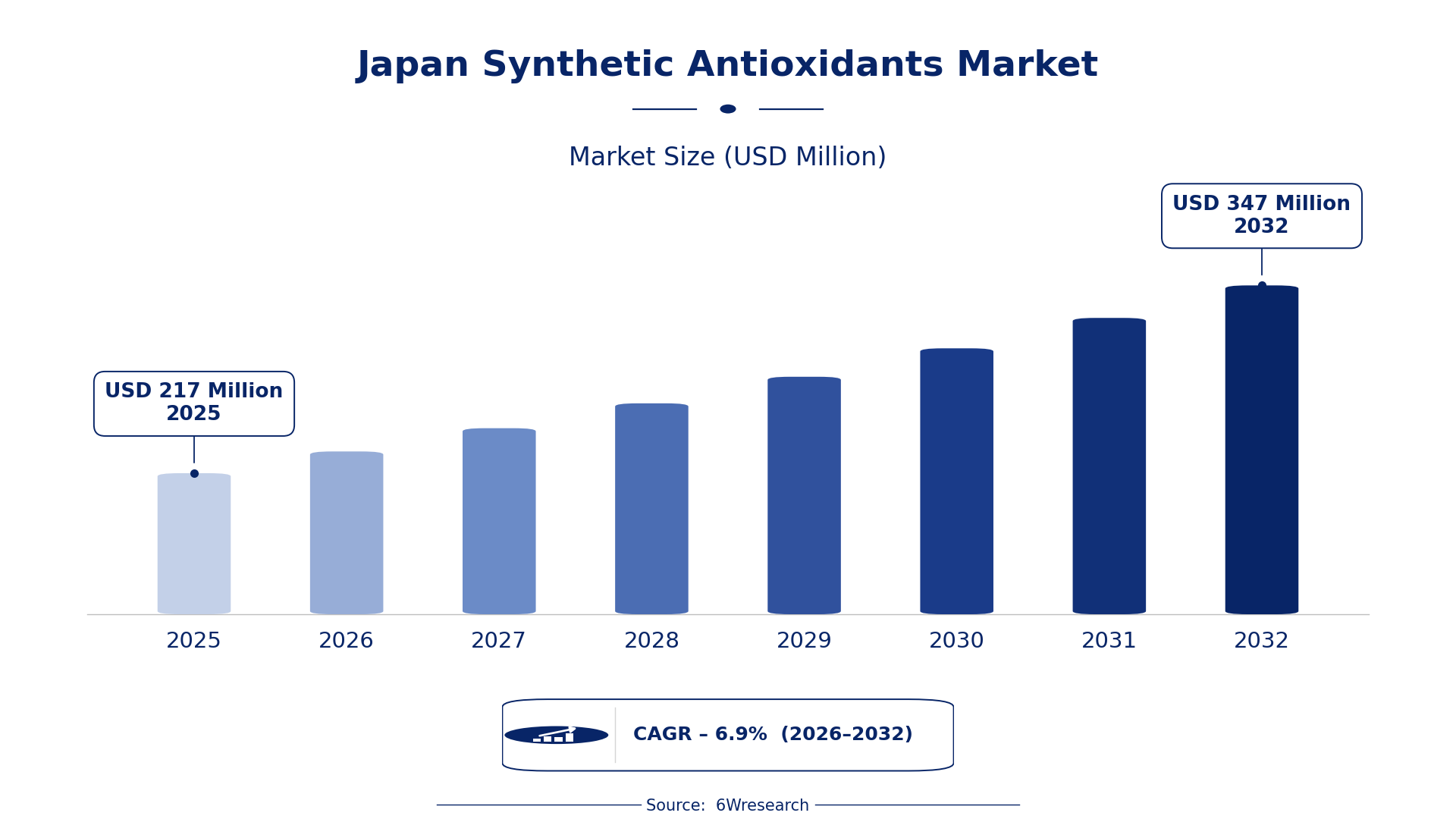
According to 6Wresearch internal database and industry insights, the Japan Synthetic Antioxidants Market was valued at USD 217 Million in 2025 and is projected to reach USD 347 Million by 2032, growing at a CAGR of approximately 6.9% during 2026–2032.
Japan Synthetic Antioxidants Market Highlights
| Report Metric | Details |
| Report Name | Japan Synthetic Antioxidants Market (2026-2032) |
| Market Size 2025 | USD 217 Million |
| Market Size 2032 | USD 347 Million |
| Absolute Growth 2025–2032 | USD 130 Million |
| CAGR 2026–2032 | 6.9% |
| Peak Annual Growth | 8.2% in 2032 |
| Forecast Period | 2026–2032 |
| Historical Data | 2022–2025 |
| Base Year | 2025 |
| Leading Antioxidant Type, 2025 | BHA/BHT (34% share) |
| Leading Chemical Base, 2025 | Phenolic Compounds (45% share) |
| Leading Application Segment, 2025 | Food & Beverages (36% share) |
| Leading End User, 2025 | Food Manufacturers (42% share) |
| Fastest-Growing Antioxidant Type | Phosphite Antioxidants (9.8% CAGR) |
| Fastest-Growing Chemical Base | Organophosphorus (8.9% CAGR) |
| Fastest-Growing Application Segment | Plastics & Polymers (9.5% CAGR) |
| Fastest-Growing End User | Polymer Producers (9.0% CAGR) |
| Growing Sector | Plastics & Polymers |
| Key End Users | Food & Beverages, Plastics & Polymers, Rubber Compounding, Lubricants |
Japan Synthetic Antioxidants Market Year-wise Growth Rate and Key Drivers (2022–2032)
This graph illustrates the annual growth rates of the market from 2022 to 2032, highlighting a steady upward trajectory and projected market expansion over the forecast period.
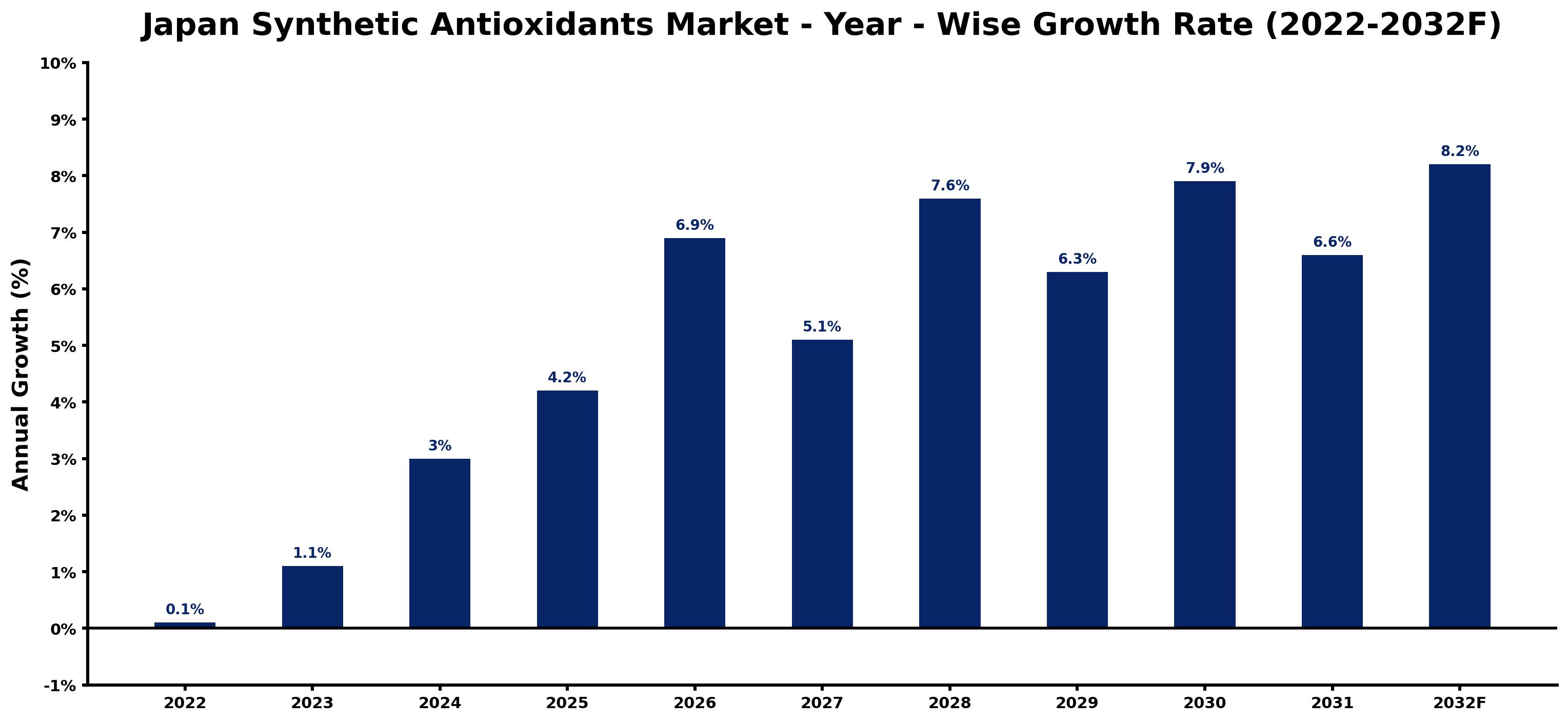
Each row of the following table gives one year's estimated growth and the event or demand shift that explains it.
| Year | Estimated Annual Growth (%) | Market Rationale |
| 2022 | 0.1 | The market showed minimal growth, reflecting steady demand from the food sector. |
| 2023 | 1.1 | Growth accelerated due to increased consumption in the food and beverage industry. |
| 2024 | 3.0 | Demand rose as food manufacturers sought to improve product shelf life. |
| 2025 | 4.2 | The market peaked with strong demand from both food and polymer sectors. |
| 2026 | 6.9 | Growth is expected to be driven by rising production in the plastics industry and food safety standards. |
| 2027 | 5.1 | A slowdown is expected as growth stabilises after the previous peak. |
| 2028 | 7.6 | Demand is projected to increase again, supported by innovations in food packaging materials. |
| 2029 | 6.3 | Growth is anticipated to moderate as the market adjusts to new supply dynamics. |
| 2030 | 7.9 | Demand is expected to surge due to heightened focus on food safety and quality standards. |
| 2031 | 6.6 | Growth is projected to slow slightly, reflecting market maturation and competition. |
| 2032 | 8.2 | The market is expected to peak with strong demand from multiple sectors. |
Note: Market size estimations and growth projections presented in this report are based on 6Wresearch's proprietary forecasting methodology, utilizing the latest available industry data, government publications, and primary research inputs.
Japan Synthetic Antioxidants Market Synopsis
Synthetic antioxidants are chemical compounds that prevent oxidation in various products, primarily produced through chemical synthesis. Their main applications include preserving food, stabilising plastics, and improving lubricant performance. The Japan Synthetic Antioxidants Market is growing, driven by the thriving food and beverage sector, valued at approximately ¥20 trillion, alongside the plastics industry, a major consumer of these compounds. Increased adoption of food safety standards, such as ISO 22000, and innovations in packaging are propelling market demand.
Market Dynamics Impact Analysis (2026–2032)
| Factor | Type | Impact | Primary Segment Affected |
| Rising food safety standards are increasing demand for preservatives in food products. | Driver | High | BHA/BHT |
| The growing plastics industry is driving the need for antioxidants to enhance product stability. | Driver | High | Phosphite Antioxidants |
| The shift towards sustainable materials in packaging presents opportunities for innovative antioxidant solutions. | Opportunity | High | Phenolic Compounds |
| Increased production of polymers creates a demand for high-performance antioxidants. | Opportunity | Medium | Organophosphorus |
| The rising trend of natural alternatives is limiting the market for synthetic antioxidants. | Restraint | High | BHA/BHT |
| Strict regulations on food additives can complicate market entry for new products. | Restraint | Medium | BHA/BHT |
| Supply chain disruptions can delay product availability, impacting buyer operations. | Challenge | High | BHA/BHT |
| Technological advancements in food processing can reduce reliance on synthetic antioxidants. | Challenge | Medium | BHA/BHT |
Evaluation of Drivers in Japan Synthetic Antioxidants Market (2026–2032)
The following drivers explain most of the expected growth.
| Drivers | Primary Segment Affected | Why It Matters (Evidence) |
| Increased food safety regulations are driving demand for synthetic antioxidants in food products. | BHA/BHT | Japan's food industry, valued at approximately ¥20 trillion, requires effective preservatives to meet stringent safety standards. |
| The growth of the plastics industry is boosting demand for antioxidants to stabilise products. | Phosphite Antioxidants | Japan produced over 1 million tons of polymers in 2022, necessitating effective stabilisers. |
| The demand for high-performance lubricants is increasing, driving the need for antioxidants. | Organophosphorus | The lubricant market in Japan was estimated at ¥1 trillion in 2023, requiring additives for improved performance. |
| Rising consumer awareness about food quality is pushing food manufacturers to adopt antioxidants. | Phenolic Compounds | Food manufacturers are increasingly adopting standards like ISO 22000 to ensure product safety. |
| The trend towards sustainable packaging solutions is creating opportunities for new antioxidant applications. | Phenolic Compounds | The Japanese government promotes sustainable materials in packaging, encouraging innovation in the sector. |
The food industry, valued at approximately ¥20 trillion, is increasingly adopting preservatives to improve product longevity. In 2022, Japan produced over 1 million tons of polymers, boosting the need for stabilisers in plastics. The lubricant market, estimated at ¥1 trillion in 2023, also drives demand for high-performance antioxidants. The push for sustainable packaging solutions is encouraging innovation in antioxidant applications, particularly among food manufacturers.
Evaluation of Restraints in Japan Synthetic Antioxidants Market
The key brakes on demand, and where they bite hardest, are shown below.
| Market Restraint | Primary Segment Affected | Why It Matters (Evidence) |
| The increasing preference for natural antioxidants is limiting the market for synthetic alternatives. | BHA/BHT | Food manufacturers in Japan are increasingly adopting natural antioxidants, impacting synthetic product sales. |
| Strict regulations on food additives can complicate market entry for new synthetic antioxidants. | Phenolic Compounds | Japan's food safety standards are among the strictest globally, ensuring high quality but limiting new entrants. |
| Supply chain disruptions can lead to delays in product availability for buyers. | Organophosphorus | The ongoing global supply chain issues have affected the timely delivery of synthetic antioxidants. |
| Consumer awareness of health issues related to synthetic additives is growing. | BHA/BHT | Increased scrutiny of food ingredients is pushing manufacturers towards cleaner labels. |
| High production costs can limit the competitiveness of synthetic antioxidants. | BHA/BHT | Rising raw material prices have increased production costs for synthetic antioxidant manufacturers. |
Japan Synthetic Antioxidants Market Challenges
A major obstacle for producers is the shortage of skilled workers in chemical synthesis, which hampers production efficiency and delays timelines for synthetic antioxidants. Importers face intense competition from natural antioxidants, as buyers increasingly prefer these alternatives, forcing them to lower prices and diminishing profit margins. Buyers encounter rising costs due to Japan's stringent food safety regulations, with compliance to ISO 22000 increasing operational expenses for food and beverage companies by up to 15%. Supply chain disruptions arise from dependency on specific suppliers for raw materials, causing delays that can extend lead times by three months for producers.
Trends in the Japan Synthetic Antioxidants Market
Four trends stand out in the Japan Synthetic Antioxidants Market.
- Shift towards Sustainable Packaging Solutions: The Tokyo region is increasingly adopting sustainable packaging practices, supported by government initiatives. In 2023, Japan's government announced a target to reduce plastic waste by 25% by 2030, creating demand for eco-friendly antioxidants.
- Transition from Synthetic to Natural Antioxidants: Since 2022, food manufacturers have been shifting towards natural antioxidants due to consumer preferences. This trend is evidenced by the increased adoption of natural alternatives in food products, impacting synthetic antioxidant demand.
- Emergence of Food Safety Management Systems: The introduction of the HACCP-based hygiene management system in 2021 has reshaped food safety practices. This standard has increased the demand for effective preservatives, including synthetic antioxidants, among food manufacturers.
- Growing Focus on Performance in Lubricants: The lubricant market is shifting towards high-performance formulations, requiring effective antioxidants. In 2023, the market was valued at approximately ¥1 trillion, highlighting the need for effective performance additives.
Investment Opportunities in the Japan Synthetic Antioxidants Market
The following areas offer the clearest openings for investors and suppliers in the Japan Synthetic Antioxidants Market.
- Market Gap in Sustainable Antioxidants: With the Japanese government promoting sustainable materials, there is a growing opportunity for effective antioxidant solutions. The food and beverage sector, valued at approximately ¥20 trillion, is seeking alternatives.
- Timing for Advanced Polymer Applications: As Japan produced over 1 million tons of polymers in 2022, there is a pressing need for high-performance antioxidants. Polymer producers are looking for effective stabilisers to improve product longevity.
- Demand from Food Manufacturers: Food manufacturers are increasingly seeking effective preservatives to comply with stringent safety standards. The Tokyo metropolitan area, a key hub for food production, presents significant opportunities for suppliers.
- Expansion in Lubricant Formulations: The lubricant market, estimated at ¥1 trillion in 2023, is expanding with a focus on performance. Suppliers can enter by partnering with oil additive manufacturers to provide effective antioxidants.
Government Initiatives in the Japan Synthetic Antioxidants Market
The Food Sanitation Act amendment of 2018 established mandatory hygiene management practices for food businesses, impacting how manufacturers ensure safety and quality. This regulation ensures that synthetic antioxidants used in food products meet stringent safety standards, benefiting both producers and consumers.
In 2023, the Ministry of Health, Labour and Welfare allocated ¥5 billion to support food safety initiatives, including the approval of new food additives. This funding helps ensure that synthetic antioxidants are rigorously tested and approved for use in the food industry, boosting consumer confidence.
Future Insight of the Japan Synthetic Antioxidants Market
The food and beverage sector will experience notable transformations by 2032, as buyers increasingly adopt natural antioxidants, reshaping demand for synthetic alternatives. Enhanced standards in food safety will streamline compliance processes, improving operational efficiency for buyers. Innovations in polymer production will lead to more effective formulations, benefiting suppliers and enhancing product quality. The Tokyo Food Tech Expo will showcase advancements that foster collaboration, ultimately improving product offerings and meeting the evolving needs of the market.
Market Segmentation Analysis
Japan Synthetic Antioxidants Market report covers a detailed analysis of the following market segments:
By Antioxidant Type – BHA/BHT Leads, Phosphite Antioxidants Expected to Grow Fastest
According to Saurav Kr Singh, Senior Research Analyst at 6Wresearch, in 2025, BHA/BHT led the antioxidant type split with a 34% share. BHA/BHT holds the largest share due to its extensive use as a preservative in food products, which is crucial in Japan's thriving food industry valued at approximately ¥20 trillion. This widespread application ensures a consistent demand from food manufacturers across the country. The quickest growth will come from Phosphite Antioxidants, forecast to expand at a CAGR of 9.8% between 2026 and 2032. Phosphite Antioxidants are experiencing rapid growth as they are increasingly utilised to protect plastics from degradation, particularly in the context of Japan's significant polymer production exceeding 1 million tons in 2022. This trend indicates a shift towards enhancing the longevity of plastic products. Suppliers should focus on developing and marketing phosphite antioxidants to capitalise on the growing demand in the plastics sector.
By Chemical Base – Phenolic Compounds Lead, Organophosphorus Expected to Grow Fastest
Phenolic Compounds took 45% of chemical base revenue in 2025, more than any other category. Phenolic Compounds dominate the market as they are widely used in food packaging, ensuring the safety and longevity of food products in Japan's strict regulatory environment. This established application makes them a preferred choice among food manufacturers. Organophosphorus is projected to grow fastest, at a CAGR of 8.9% during 2026–2032. Organophosphorus compounds are witnessing the fastest growth due to their increasing use in lubricants and oils, driven by the expanding automotive and industrial sectors in Japan. This trend reflects a broader shift towards high-performance lubricants that require effective oxidation prevention. Buyers in the lubricant sector should consider sourcing organophosphorus antioxidants to meet the rising performance standards.
By Application Segment – Food & Beverages Lead, Plastics & Polymers Expected to Grow Fastest
With 36% of application segment revenue in 2025, Food & Beverages was the largest category. The Food & Beverages segment leads the market as it is the primary sector utilising antioxidants to preserve food quality and safety, aligning with Japan's high food safety standards. This sector's robust growth is supported by the country's large population of over 127 million people. Plastics & Polymers are set to record the highest CAGR in this split, 9.5% over 2026–2032. Plastics & Polymers are the fastest-growing application area due to the increasing demand for stability in polymer products, particularly as Japan's plastics industry continues to innovate. This growth is indicative of a broader trend towards enhancing product durability and performance. Suppliers should prioritise the development of antioxidants tailored for the plastics industry to meet the surging demand.
By End User – Food Manufacturers Lead, Polymer Producers Expected to Grow Fastest
Food Manufacturers held 42% of the Japan Synthetic Antioxidants Market by end user in 2025. Food Manufacturers are the key end users of antioxidants, as they rely on these compounds to ensure the safety and shelf-life of their products in a highly competitive market. Their substantial presence in Japan's food sector underscores their importance in the overall demand for antioxidants. Over 2026–2032, Polymer Producers are expected to post the fastest growth, at a CAGR of 9.0%. Polymer Producers are experiencing the fastest growth in demand for antioxidants, driven by the need for improved stability in plastic products amid rising production levels. This trend suggests a significant opportunity for suppliers to cater to this expanding market segment. Buyers in the polymer industry should seek reliable sources of antioxidants to enhance product performance and meet market expectations.
Key Attractiveness of the Report
- 10 Years of Market Numbers
- Historical Data Starting from 2022 to 2025
- Base Year 2025
- Forecast Data until 2032
- Key Performance Indicators Impacting the Market
- Major Upcoming Developments and Projects
Key Highlights of the Report:
- Japan Synthetic Antioxidants Market Outlook
- Market Size of Japan Synthetic Antioxidants Market, 2025
- Forecast of Japan Synthetic Antioxidants Market, 2032
- Historical Data and Forecast of Japan Synthetic Antioxidants Revenues & Volume for the Period 2022-2032F
- Japan Synthetic Antioxidants Market Trend Evolution
- Japan Synthetic Antioxidants Market Drivers and Challenges
- Japan Synthetic Antioxidants Price Trends
- Japan Synthetic Antioxidants Porter's Five Forces
- Japan Synthetic Antioxidants Industry Life Cycle
- Historical Data and Forecast of Japan Synthetic Antioxidants Market Revenues & Volume By Antioxidant Type for the Period 2022-2032F
- Historical Data and Forecast of Japan Synthetic Antioxidants Market Revenues & Volume By BHA/BHT for the Period 2022-2032F
- Historical Data and Forecast of Japan Synthetic Antioxidants Market Revenues & Volume By Phosphite Antioxidants for the Period 2022-2032F
- Historical Data and Forecast of Japan Synthetic Antioxidants Market Revenues & Volume By Amine Antioxidants for the Period 2022-2032F
- Historical Data and Forecast of Japan Synthetic Antioxidants Market Revenues & Volume By Thioesters for the Period 2022-2032F
- Historical Data and Forecast of Japan Synthetic Antioxidants Market Revenues & Volume By Chemical Base for the Period 2022-2032F
- Historical Data and Forecast of Japan Synthetic Antioxidants Market Revenues & Volume By Phenolic Compounds for the Period 2022-2032F
- Historical Data and Forecast of Japan Synthetic Antioxidants Market Revenues & Volume By Organophosphorus for the Period 2022-2032F
- Historical Data and Forecast of Japan Synthetic Antioxidants Market Revenues & Volume By Aromatic Amines for the Period 2022-2032F
- Historical Data and Forecast of Japan Synthetic Antioxidants Market Revenues & Volume By Sulfur-Based for the Period 2022-2032F
- Historical Data and Forecast of Japan Synthetic Antioxidants Market Revenues & Volume By Application Segment for the Period 2022-2032F
- Historical Data and Forecast of Japan Synthetic Antioxidants Market Revenues & Volume By Food & Beverages for the Period 2022-2032F
- Historical Data and Forecast of Japan Synthetic Antioxidants Market Revenues & Volume By Plastics & Polymers for the Period 2022-2032F
- Historical Data and Forecast of Japan Synthetic Antioxidants Market Revenues & Volume By Rubber Compounding for the Period 2022-2032F
- Historical Data and Forecast of Japan Synthetic Antioxidants Market Revenues & Volume By Lubricants for the Period 2022-2032F
- Historical Data and Forecast of Japan Synthetic Antioxidants Market Revenues & Volume By End User for the Period 2022-2032F
- Historical Data and Forecast of Japan Synthetic Antioxidants Market Revenues & Volume By Food Manufacturers for the Period 2022-2032F
- Historical Data and Forecast of Japan Synthetic Antioxidants Market Revenues & Volume By Polymer Producers for the Period 2022-2032F
- Historical Data and Forecast of Japan Synthetic Antioxidants Market Revenues & Volume By Tire Manufacturers for the Period 2022-2032F
- Historical Data and Forecast of Japan Synthetic Antioxidants Market Revenues & Volume By Oil Additive Suppliers for the Period 2022-2032F
- Japan Synthetic Antioxidants Import Export Trade Statistics
- Market Opportunity Assessment By Antioxidant Type
- Market Opportunity Assessment By Chemical Base
- Market Opportunity Assessment By Application Segment
- Market Opportunity Assessment By End User
- Japan Synthetic Antioxidants Top Companies Market Share
- Japan Synthetic Antioxidants Competitive Benchmarking By Technical and Operational Parameters
- Japan Synthetic Antioxidants Company Profiles
- Japan Synthetic Antioxidants Key Strategic Recommendations
Market Covered
The report covers the following segments.
By Antioxidant Type
- BHA/BHT
- Phosphite Antioxidants
- Amine Antioxidants
- Thioesters
By Chemical Base
- Phenolic Compounds
- Organophosphorus
- Aromatic Amines
- Sulfur-Based
By Application Segment
- Food & Beverages
- Plastics & Polymers
- Rubber Compounding
- Lubricants
By End User
- Food Manufacturers
- Polymer Producers
- Tire Manufacturers
- Oil Additive Suppliers































