Japan Synthetic Building Materials Market Size & Growth Rate
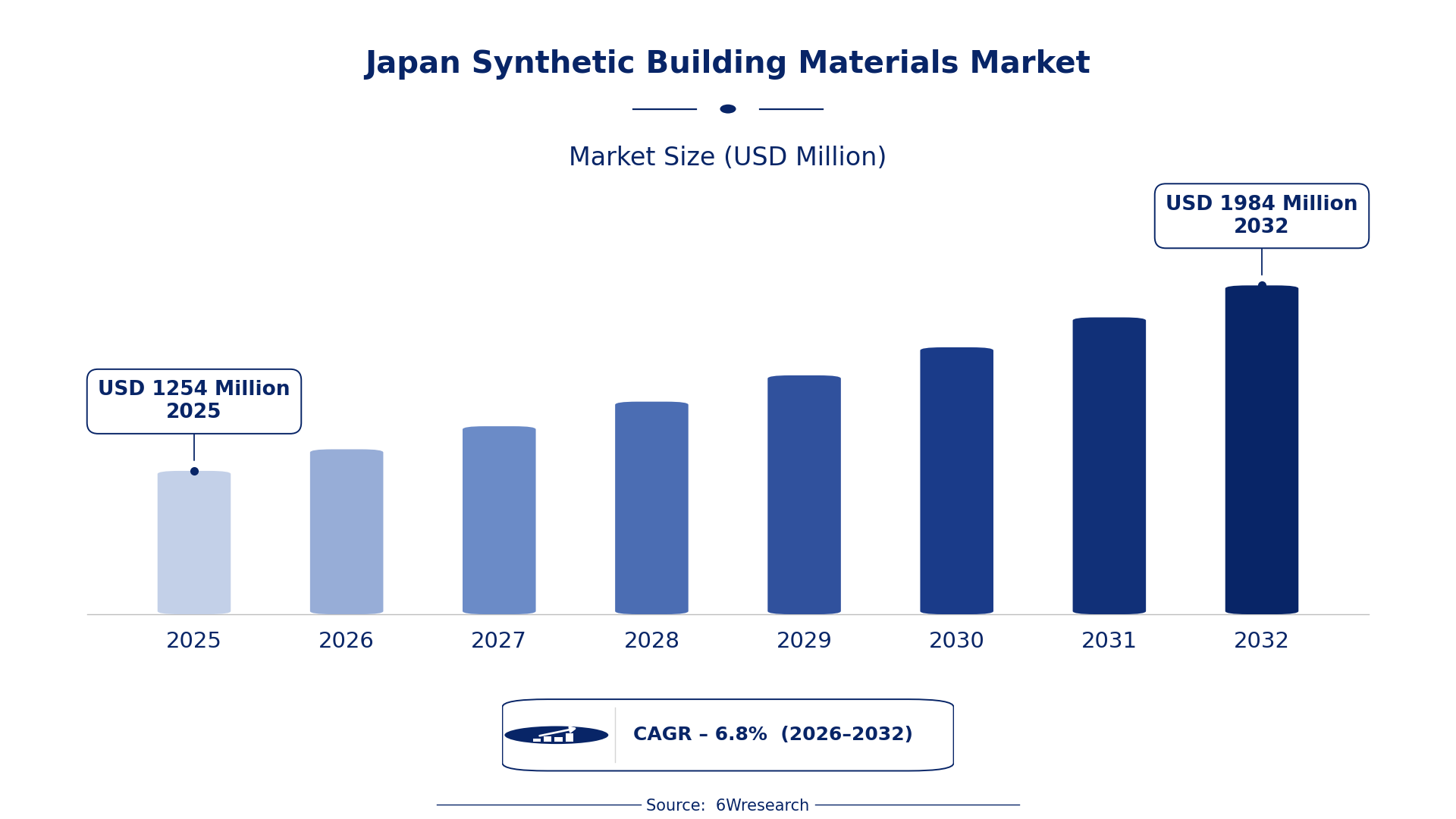
According to 6Wresearch internal database and industry insights, the Japan Synthetic Building Materials Market was valued at USD 1,254 Million in 2025 and is projected to reach USD 1,984 Million by 2032, growing at a CAGR of approximately 6.8% during 2026–2032.
Japan Synthetic Building Materials Market Highlights
| Report Metric | Details |
| Report Name | Japan Synthetic Building Materials Market (2026-2032) |
| Market Size 2025 | USD 1,254 Million |
| Market Size 2032 | USD 1,984 Million |
| Absolute Growth 2025–2032 | USD 730 Million |
| CAGR 2026–2032 | 6.8% |
| Peak Annual Growth | 7.3% in 2027 |
| Forecast Period | 2026–2032 |
| Historical Data | 2022–2025 |
| Base Year | 2025 |
| Leading Material Type, 2025 | Synthetic Roofing (51% share) |
| Leading Composition, 2025 | PVC/TPO/EPDM Membranes (45% share) |
| Leading Application Segment, 2025 | Commercial Roofing (35% share) |
| Leading End User, 2025 | Construction Firms (49% share) |
| Fastest-Growing Material Type | Composite Lumber (9.9% CAGR) |
| Fastest-Growing Composition | Wood-Plastic Blend (9.6% CAGR) |
| Fastest-Growing Application Segment | Decking/Flooring (9.4% CAGR) |
| Fastest-Growing End User | Builders (8.6% CAGR) |
| Growing Sector | Construction |
| Key End Users | Construction Firms, Builders, Prefab Manufacturers, Real Estate Developers |
Japan Synthetic Building Materials Market Year-wise Growth Rate and Key Drivers (2022–2032)
This graph illustrates the annual growth rates of the market from 2022 to 2032, highlighting a steady upward trajectory and projected market expansion over the forecast period.
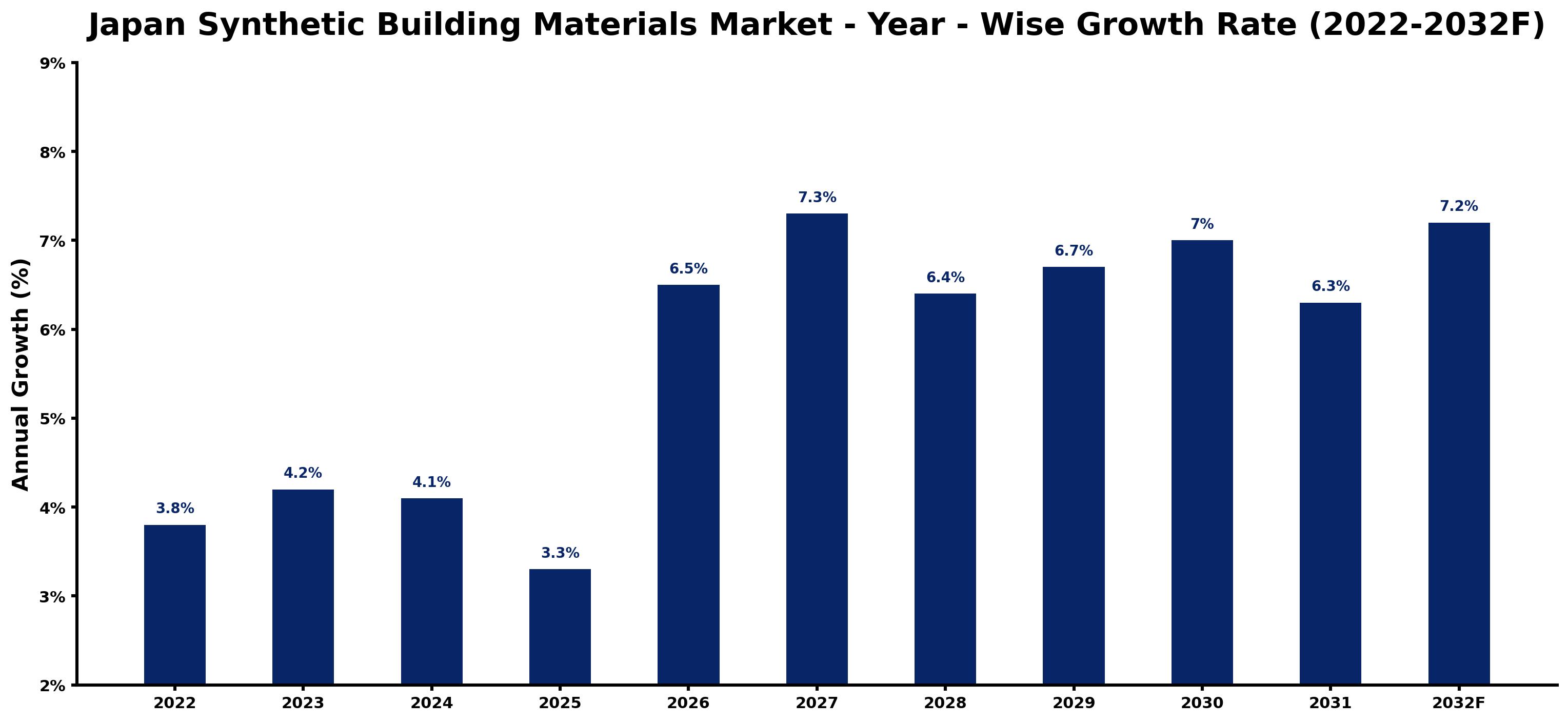
For each year, the table pairs the estimated growth rate with the leading influence on demand, showing how the drivers changed across the period.
| Year | Estimated Annual Growth (%) | Market Rationale |
| 2022 | 3.8 | The construction industry remained active, supporting steady demand for synthetic materials. |
| 2023 | 4.2 | Demand rose due to increased infrastructure projects, boosting material purchases. |
| 2024 | 4.1 | Growth slowed as some projects faced delays, yet demand persisted. |
| 2025 | 3.3 | A slight slowdown occurred as construction firms adjusted to market conditions. |
| 2026 | 6.5 | Demand is expected to surge with new investments in energy-efficient building initiatives. |
| 2027 | 7.3 | The market is projected to experience peak growth as urban construction projects accelerate. |
| 2028 | 6.4 | Growth is anticipated to slow slightly as the market stabilises after peak demand. |
| 2029 | 6.7 | A resurgence in demand is expected as builders seek sustainable materials. |
| 2030 | 7.0 | Growth is projected to accelerate again as energy efficiency regulations prompt purchases. |
| 2031 | 6.3 | A slowdown is anticipated as projects begin to normalise after rapid expansion. |
| 2032 | 7.2 | Demand is expected to increase as construction firms adapt to new sustainability standards. |
Note: Market size estimations and growth projections presented in this report are based on 6Wresearch's proprietary forecasting methodology, utilizing the latest available industry data, government publications, and primary research inputs.
Japan Synthetic Building Materials Market Synopsis
Synthetic building materials include products such as synthetic roofing, composite lumber, and insulated panels, which are essential for roofing, flooring, and insulation applications. The Japan Synthetic Building Materials Market is expanding, driven by a projected JPY 150 trillion investment in decarbonisation over the next decade and a target of 30% energy efficiency improvement in buildings by 2030. These factors are propelling demand from construction firms and real estate developers, contributing to a strong growth outlook.
Market Dynamics Impact Analysis (2026–2032)
| Factor | Type | Impact | Primary Segment Affected |
| Increasing urbanisation in Tokyo and Osaka | Driver | High | Synthetic Roofing |
| Rising energy efficiency regulations | Driver | High | Insulated Panels |
| Growing demand for energy-efficient buildings | Opportunity | High | Composite Lumber |
| Investment in sustainable construction methods | Opportunity | Medium | Synthetic Insulation |
| High costs of raw materials | Restraint | High | PVC/TPO/EPDM Membranes |
| Limited availability of skilled labour | Restraint | Medium | Composite Lumber |
| Compliance with stringent building regulations | Challenge | High | Insulated Panels |
| Capacity constraints in manufacturing | Challenge | Medium | Synthetic Roofing |
Evaluation of Drivers in Japan Synthetic Building Materials Market (2026–2032)
Key forces behind demand, with the segment each one moves most, are listed below.
| Drivers | Primary Segment Affected | Why It Matters (Evidence) |
| Urbanisation drives demand for durable roofing solutions | Synthetic Roofing | In Tokyo, synthetic roofing is used in 25% of new residential projects, increasing purchases. |
| Energy efficiency regulations boost insulation demand | Insulated Panels | Over 40% of new commercial buildings utilise insulated panels for compliance with energy standards. |
| Investment in decarbonisation fuels material purchases | Composite Lumber | With JPY 150 trillion earmarked for decarbonisation, demand for composite lumber is rising. |
| Sustainable building practices increase market growth | Synthetic Insulation | The Tokyo Metropolitan Government promotes energy-efficient building materials, increasing their adoption. |
| Technological advancements improve material performance | PVC/TPO/EPDM Membranes | ISO 14001 standards ensure quality, leading to higher demand for these membranes. |
The strongest pull on demand comes from urbanisation in Tokyo and Osaka, where synthetic roofing is used in 25% of new residential projects, increasing purchases. Investment in decarbonisation, with JPY 150 trillion allocated, fuels the rising need for composite lumber. Technological advancements adhering to ISO 14001 standards improve the performance of PVC/TPO membranes, driving their market growth.
Evaluation of Restraints in Japan Synthetic Building Materials Market
The following restraints limit how fast demand can grow.
| Market Restraint | Primary Segment Affected | Why It Matters (Evidence) |
| High costs of raw materials limit profitability | PVC/TPO/EPDM Membranes | Rising prices of polymers have increased production costs, affecting margins. |
| Limited availability of skilled labour affects production capacity | Composite Lumber | The construction workforce in Japan is approximately 5 million, constraining output. |
| Compliance with stringent building regulations increases operational complexity | Insulated Panels | New energy standards require extensive testing and certification, delaying project timelines. |
| Market saturation in urban areas restricts growth potential | Synthetic Roofing | Intense competition in major cities limits price flexibility and market entry. |
| Economic fluctuations impact construction budgets | Synthetic Insulation | Economic uncertainties can lead to reduced spending on building materials. |
Japan Synthetic Building Materials Market Challenges
Buyers encounter rising compliance costs due to Japan's goal for a 30% energy efficiency improvement in buildings by 2030, which can extend project timelines. Regulatory requirements impose additional challenges on producers, as they must adapt to changing standards, resulting in higher expenses. Many manufacturers face difficulties with technology adoption, leading to inferior product quality and prolonged lead times for buyers. A shortage of skilled workers, with the construction workforce numbering around 5 million, restricts the effective use of new synthetic materials, causing delays and escalating labour costs for builders.
Trends in the Japan Synthetic Building Materials Market
Several trends are reshaping the Japan Synthetic Building Materials Market; the most important are set out below.
- Growing Focus on Energy-Efficient Materials: Construction firms are increasingly prioritising energy-efficient materials, as demonstrated by the Tokyo Metropolitan Government's promotion of sustainable practices. This shift is reflected in the rising use of insulated panels, which are incorporated in over 40% of new commercial buildings.
- Rise of Composite Lumber in Urban Construction: The adoption of composite lumber is on the rise, particularly in urban construction projects, due to its durability and sustainability. This trend is underscored by a projected 9.9% CAGR for composite lumber from 2026 to 2032.
- Increase in Prefabricated Construction Techniques: Prefabricated construction is gaining popularity, driven by the demand for efficiency and speed. The Japan Prefabricated Construction Suppliers and Manufacturers Association supports this trend, which is expected to boost the use of synthetic materials.
- Emphasis on Acoustic and Thermal Barriers: There is an increasing focus on thermal and acoustic barriers in urban residential buildings, spurred by energy efficiency regulations. This trend aligns with the government's target of achieving a 30% energy efficiency improvement by 2030.
Investment Opportunities in the Japan Synthetic Building Materials Market
Below are the investment opportunities with the strongest case in the Japan Synthetic Building Materials Market.
- Rising Demand for Energy-Efficient Solutions: With Japan's aim for a 30% energy efficiency improvement by 2030, there is a growing opportunity to supply insulated panels. Construction firms are actively seeking compliant materials to adhere to these regulations.
- Increasing Need for Composite Lumber in Urban Projects: As urban construction projects expand, supplying composite lumber presents a promising opportunity. Builders in major cities are in search of sustainable options to meet environmental standards.
- Growth in Prefabricated Construction: The current trend towards prefabricated construction offers a chance to supply synthetic building materials. Collaborating with prefab manufacturers can facilitate market entry and growth.
- Expansion of Sustainable Building Practices: The timing is favourable to invest in synthetic insulation products, as the Tokyo Metropolitan Government promotes sustainable building practices. Forming partnerships with local firms can improve market penetration.
Government Initiatives in the Japan Synthetic Building Materials Market
The Building Energy Efficiency Act, amended in 2022, requires that all new buildings meet specific energy standards starting in April 2025. This legislation compels producers to ensure their materials comply with these regulations, influencing the types of synthetic materials available in the market.
In 2023, a new subsidy programme supporting energy-efficient building materials was introduced, administered by the Ministry of Land, Infrastructure, Transport and Tourism. This initiative aims to encourage construction firms to adopt sustainable practices, promoting the use of synthetic materials.
Future Insight of the Japan Synthetic Building Materials Market
The construction sector will experience notable changes by 2032, driven by new subsidy programs for energy-efficient building materials. Updated standards like JIS A 5759 will enhance insulation performance, offering buyers improved energy savings. Increased investment in infrastructure will stimulate innovation in synthetic building materials, enabling faster production cycles. The anticipated JPY 1 trillion investment in infrastructure for 2023-2025 will further support the advancement of sustainable practices, benefiting both buyers and suppliers.
Market Segmentation Analysis
Japan Synthetic Building Materials Market report covers a detailed analysis of the following market segments:
By Material Type – Synthetic Roofing Leads, Composite Lumber Expected to Grow Fastest
According to Saurav Kr Singh, Senior Research Analyst at 6Wresearch, the largest material type category in 2025 was Synthetic Roofing, at 51% of revenue. Synthetic roofing holds the largest share due to its extensive use for weatherproofing roofs across various building types. It is a key component in over 25% of new residential projects, showcasing its critical role in the market. Composite Lumber is set to record the highest CAGR in this split, 9.9% over 2026–2032. Composite lumber is experiencing rapid growth as urban construction projects increasingly incorporate it for decking and structural applications. The ongoing investment in infrastructure prioritises the use of durable building materials, further driving this trend. Suppliers should focus on enhancing their composite lumber offerings to capitalise on this growth opportunity.
By Composition – PVC/TPO/EPDM Membranes Lead, Wood-Plastic Blend Expected to Grow Fastest
With 45% of composition revenue in 2025, PVC/TPO/EPDM Membranes was the largest category. PVC/TPO/EPDM membranes dominate the market as they are commonly used in flat roofing systems, which are prevalent in urban areas. Their reliability and weather resistance make them a preferred choice among construction firms. The quickest growth will come from Wood-Plastic Blend, forecast to expand at a CAGR of 9.6% between 2026 and 2032. The wood-plastic blend is gaining traction due to its application in decking, appealing to environmentally conscious builders. As sustainability becomes a priority, this segment is likely to see increased adoption in various projects. Buyers should consider sourcing wood-plastic blends to meet the growing demand for sustainable building materials.
By Application Segment – Commercial Roofing Leads, Decking/Flooring Expected to Grow Fastest
Commercial Roofing took 35% of application segment revenue in 2025, more than any other category. Commercial roofing is the leading application area for synthetic materials, driven by high demand from businesses seeking durable roofing solutions. Its significance is underscored by the substantial value it adds to the construction industry. Over 2026–2032, Decking/Flooring is expected to post the fastest growth, at a CAGR of 9.4%. Decking and flooring are witnessing the fastest growth as outdoor applications gain popularity in both residential and commercial developments. The trend towards outdoor living spaces significantly fuels this demand, presenting a key opportunity for suppliers. Suppliers must innovate in decking and flooring solutions to align with changing consumer preferences for outdoor spaces.
By End User – Construction Firms Lead, Builders Expected to Grow Fastest
Construction Firms accounted for 49% of the market by end user in 2025. Construction firms represent the largest user group of synthetic building materials, acting as primary contractors for various construction projects. Their extensive involvement across both residential and commercial sectors ensures a steady demand for these materials. Builders are projected to grow fastest, at a CAGR of 8.6% during 2026–2032. Builders are the fastest-growing segment, particularly as they respond to rising housing demands driven by Japan's population and infrastructure projects. This shift towards more residential developments enhances the need for synthetic materials. Suppliers should strengthen relationships with builders to capture the increasing demand in the residential construction market.
Key Attractiveness of the Report
- 10 Years of Market Numbers
- Historical Data Starting from 2022 to 2025
- Base Year 2025
- Forecast Data until 2032
- Key Performance Indicators Impacting the Market
- Major Upcoming Developments and Projects
Key Highlights of the Report:
- Japan Synthetic Building Materials Market Outlook
- Market Size of Japan Synthetic Building Materials Market, 2025
- Forecast of Japan Synthetic Building Materials Market, 2032
- Historical Data and Forecast of Japan Synthetic Building Materials Revenues & Volume for the Period 2022-2032F
- Japan Synthetic Building Materials Market Trend Evolution
- Japan Synthetic Building Materials Market Drivers and Challenges
- Japan Synthetic Building Materials Price Trends
- Japan Synthetic Building Materials Porter's Five Forces
- Japan Synthetic Building Materials Industry Life Cycle
- Historical Data and Forecast of Japan Synthetic Building Materials Market Revenues & Volume By Material Type for the Period 2022-2032F
- Historical Data and Forecast of Japan Synthetic Building Materials Market Revenues & Volume By Synthetic Roofing for the Period 2022-2032F
- Historical Data and Forecast of Japan Synthetic Building Materials Market Revenues & Volume By Composite Lumber for the Period 2022-2032F
- Historical Data and Forecast of Japan Synthetic Building Materials Market Revenues & Volume By Insulated Panels for the Period 2022-2032F
- Historical Data and Forecast of Japan Synthetic Building Materials Market Revenues & Volume By Synthetic Insulation for the Period 2022-2032F
- Historical Data and Forecast of Japan Synthetic Building Materials Market Revenues & Volume By Composition for the Period 2022-2032F
- Historical Data and Forecast of Japan Synthetic Building Materials Market Revenues & Volume By PVC/TPO/EPDM Membranes for the Period 2022-2032F
- Historical Data and Forecast of Japan Synthetic Building Materials Market Revenues & Volume By Wood-Plastic Blend for the Period 2022-2032F
- Historical Data and Forecast of Japan Synthetic Building Materials Market Revenues & Volume By PU Foam Core for the Period 2022-2032F
- Historical Data and Forecast of Japan Synthetic Building Materials Market Revenues & Volume By Polystyrene/Fiberglass for the Period 2022-2032F
- Historical Data and Forecast of Japan Synthetic Building Materials Market Revenues & Volume By Application Segment for the Period 2022-2032F
- Historical Data and Forecast of Japan Synthetic Building Materials Market Revenues & Volume By Commercial Roofing for the Period 2022-2032F
- Historical Data and Forecast of Japan Synthetic Building Materials Market Revenues & Volume By Decking/Flooring for the Period 2022-2032F
- Historical Data and Forecast of Japan Synthetic Building Materials Market Revenues & Volume By Wall & Ceiling Panels for the Period 2022-2032F
- Historical Data and Forecast of Japan Synthetic Building Materials Market Revenues & Volume By Thermal & Acoustic Barriers for the Period 2022-2032F
- Historical Data and Forecast of Japan Synthetic Building Materials Market Revenues & Volume By End User for the Period 2022-2032F
- Historical Data and Forecast of Japan Synthetic Building Materials Market Revenues & Volume By Construction Firms for the Period 2022-2032F
- Historical Data and Forecast of Japan Synthetic Building Materials Market Revenues & Volume By Builders for the Period 2022-2032F
- Historical Data and Forecast of Japan Synthetic Building Materials Market Revenues & Volume By Prefab Manufacturers for the Period 2022-2032F
- Historical Data and Forecast of Japan Synthetic Building Materials Market Revenues & Volume By Real Estate Developers for the Period 2022-2032F
- Japan Synthetic Building Materials Import Export Trade Statistics
- Market Opportunity Assessment By Material Type
- Market Opportunity Assessment By Composition
- Market Opportunity Assessment By Application Segment
- Market Opportunity Assessment By End User
- Japan Synthetic Building Materials Top Companies Market Share
- Japan Synthetic Building Materials Competitive Benchmarking By Technical and Operational Parameters
- Japan Synthetic Building Materials Company Profiles
- Japan Synthetic Building Materials Key Strategic Recommendations
Market Covered
The study includes the following segmentation.
By Material Type
- Synthetic Roofing
- Composite Lumber
- Insulated Panels
- Synthetic Insulation
By Composition
- PVC/TPO/EPDM Membranes
- Wood-Plastic Blend
- PU Foam Core
- Polystyrene/Fiberglass
By Application Segment
- Commercial Roofing
- Decking/Flooring
- Wall & Ceiling Panels
- Thermal & Acoustic Barriers
By End User
- Construction Firms
- Builders
- Prefab Manufacturers
- Real Estate Developers































