Japan Synthetic Cornea Market Size & Growth Rate
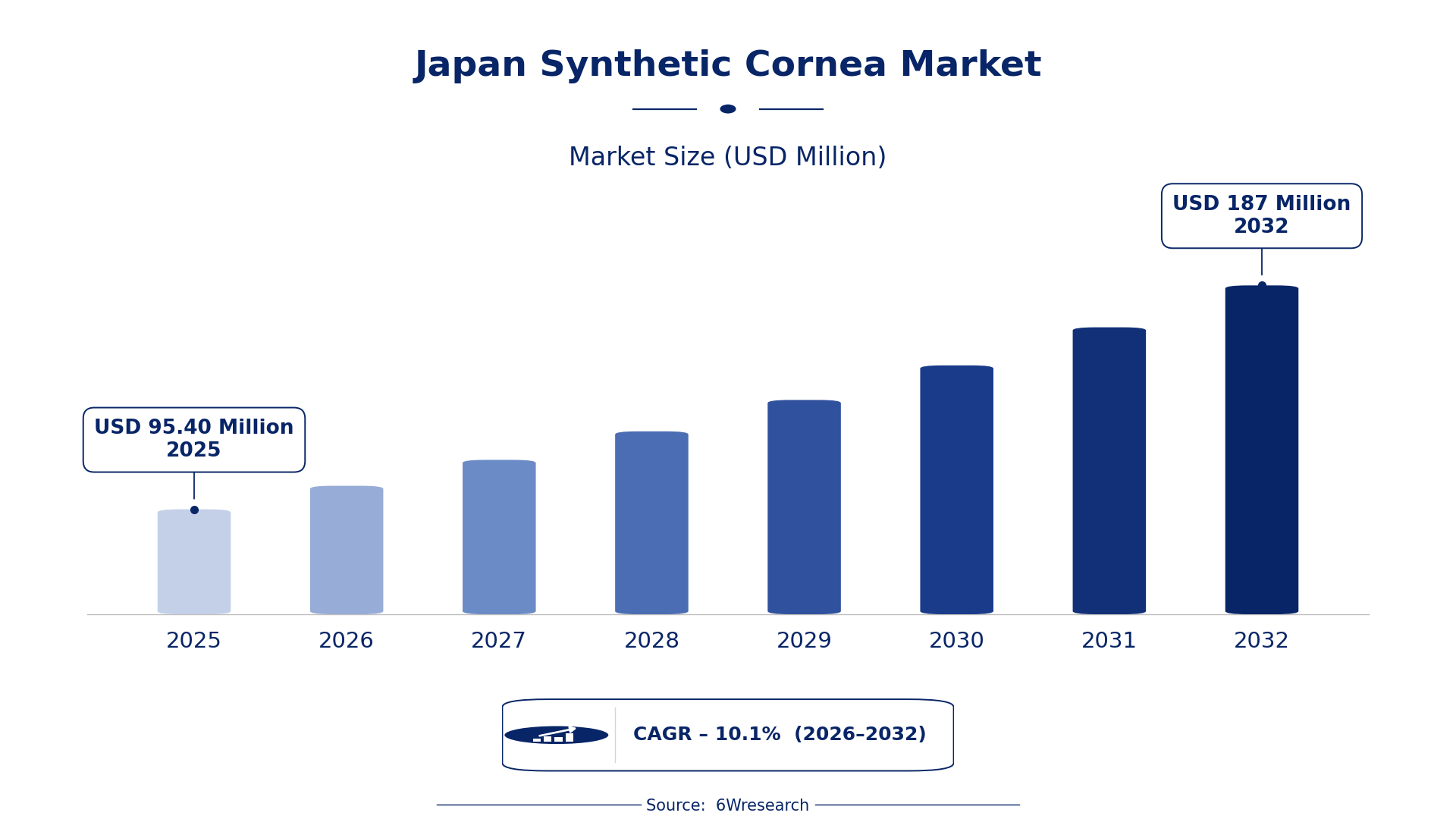
According to 6Wresearch internal database and industry insights, the Japan Synthetic Cornea Market was valued at USD 95.40 Million in 2025 and is projected to reach USD 187 Million by 2032, growing at a CAGR of approximately 10.1% during 2026–2032.
Japan Synthetic Cornea Market Highlights
| Report Metric | Details |
| Report Name | Japan Synthetic Cornea Market (2026-2032) |
| Market Size 2025 | USD 95.40 Million |
| Market Size 2032 | USD 187 Million |
| Absolute Growth 2025–2032 | USD 91.60 Million |
| CAGR 2026–2032 | 10.1% |
| Peak Annual Growth | 11.4% in 2028 |
| Forecast Period | 2026–2032 |
| Historical Data | 2022–2025 |
| Base Year | 2025 |
| Leading Cornea Type, 2025 | Keratoprosthesis (KPro) (38% share) |
| Leading Polymer Used, 2025 | PMMA/Boston Type (48% share) |
| Leading Implantation Method, 2025 | Full-Thickness Transplant (53% share) |
| Leading End User, 2025 | Eye Hospitals (46% share) |
| Fastest-Growing Cornea Type | 3D-Printed Synthetic (15.3% CAGR) |
| Fastest-Growing Polymer Used | Biocompatible Resins (14.0% CAGR) |
| Fastest-Growing Implantation Method | Personalized Implantation (14.4% CAGR) |
| Fastest-Growing End User | Vision Restoration Labs (12.7% CAGR) |
| Growing Sector | Ophthalmic Care |
| Key End Users | Eye Hospitals, Corneal Clinics, Vision Restoration Labs, Ophthalmic Surgeons |
Japan Synthetic Cornea Market Year-wise Growth Rate and Key Drivers (2022–2032)
This graph illustrates the annual growth rates of the market from 2022 to 2032, highlighting a steady upward trajectory and projected market expansion over the forecast period.
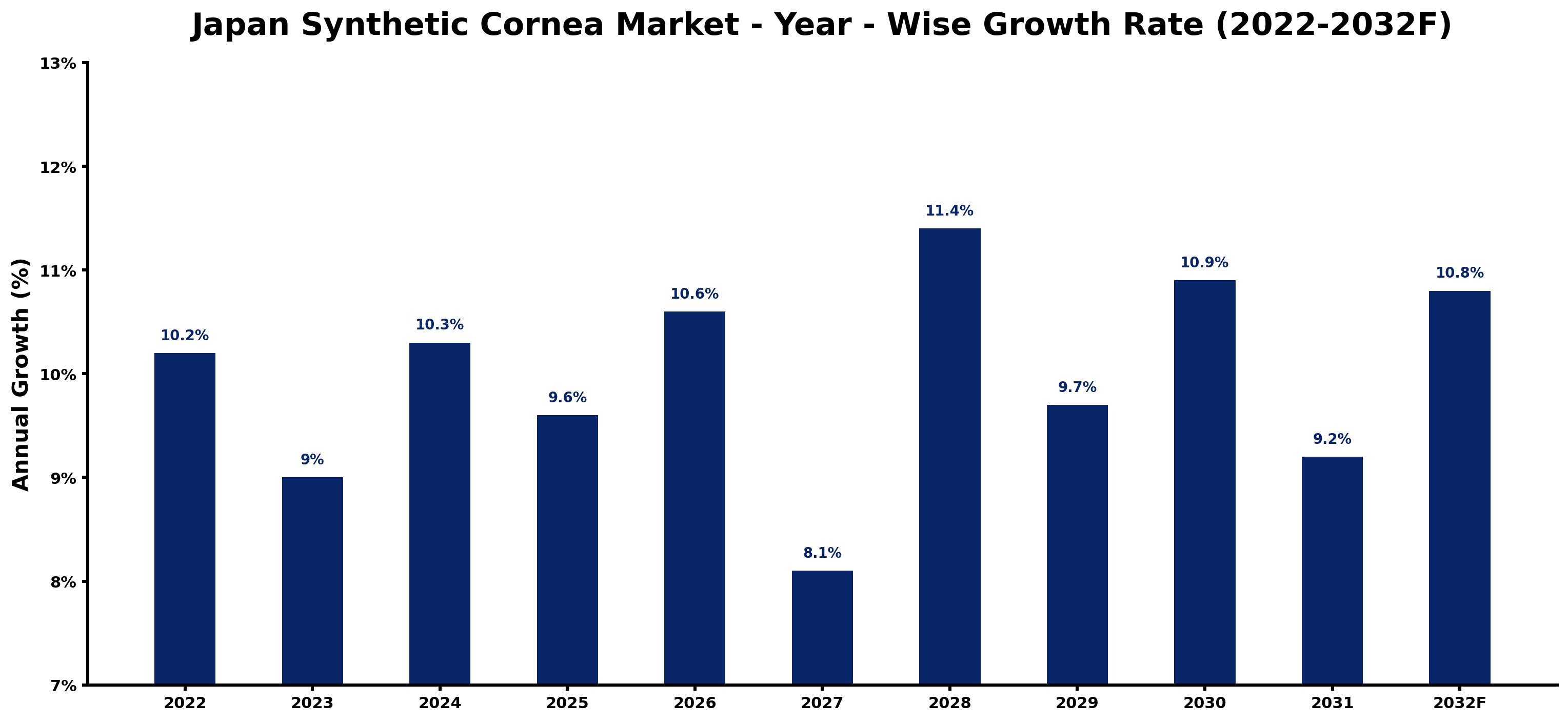
Below, each year's estimated growth is shown next to the factor that most influenced it.
| Year | Estimated Annual Growth (%) | Market Rationale |
| 2022 | 10.2 | The market showed a healthy demand for synthetic corneas among healthcare providers. |
| 2023 | 9.0 | Growth slowed as the market adjusted to increased competition and supply chain challenges. |
| 2024 | 10.3 | Demand surged due to advancements in surgical techniques and technology adoption. |
| 2025 | 9.6 | A slight slowdown occurred as market saturation began to impact growth rates. |
| 2026 | 10.6 | Growth is expected to accelerate as new facilities open, increasing access to treatments. |
| 2027 | 8.1 | Growth is projected to slow as the market stabilises after rapid expansion. |
| 2028 | 11.4 | The market is expected to peak with rising awareness and acceptance of synthetic corneas. |
| 2029 | 9.7 | Growth is projected to slow as the market matures and competition intensifies. |
| 2030 | 10.9 | Demand will increase again as technological innovations improve surgical outcomes. |
| 2031 | 9.2 | A slowdown is expected as the market faces challenges from alternative treatments. |
| 2032 | 10.8 | Growth is expected to rise as the aging population demands more vision restoration. |
Note: Market size estimations and growth projections presented in this report are based on 6Wresearch's proprietary forecasting methodology, utilizing the latest available industry data, government publications, and primary research inputs.
Japan Synthetic Cornea Market Synopsis
Synthetic corneas are artificial devices designed to replace damaged corneas, primarily made from biocompatible polymers. They are essential in ophthalmic surgeries aimed at restoring vision for patients suffering from corneal blindness. The Japan Synthetic Cornea Market is growing due to a large elderly population, with approximately 35 million individuals over 60 years old. Advancements in medical technology and the opening of new corneal clinics are driving demand for these devices, with an estimated annual demand of 5,000 units.
Market Dynamics Impact Analysis (2026–2032)
| Factor | Type | Impact | Primary Segment Affected |
| Increasing number of eye hospitals performing corneal surgeries | Driver | High | Keratoprosthesis (KPro) |
| Rising cases of corneal diseases leading to higher demand for transplants | Driver | High | Collagen-Based Scaffold |
| Growing elderly population in Japan needing vision restoration | Opportunity | High | Hydrogel Cornea |
| Advancements in 3D printing technology for customized corneas | Opportunity | Medium | 3D-Printed Synthetic |
| Limited awareness of synthetic corneas among patients | Restraint | Medium | PMMA/Boston Type |
| High costs associated with advanced synthetic cornea technologies | Restraint | High | Synthetic Collagen |
| Competition from traditional corneal transplant methods | Challenge | High | PEG/HEMA |
| Regulatory hurdles for new product approvals | Challenge | Medium | Biocompatible Resins |
Evaluation of Drivers in Japan Synthetic Cornea Market (2026–2032)
Key forces behind demand, with the segment each one moves most, are listed below.
| Drivers | Primary Segment Affected | Why It Matters (Evidence) |
| Increased investment in ophthalmic healthcare facilities | Keratoprosthesis (KPro) | In 2023, over 100 eye hospitals in Japan performed corneal surgeries, enhancing demand. |
| Rising prevalence of corneal diseases among the elderly | Collagen-Based Scaffold | Approximately 35 million people over 60 in Japan drive demand for vision restoration. |
| Technological advancements in synthetic cornea production | Hydrogel Cornea | Research funding for synthetic cornea development reached ¥500 million in 2023. |
| Growing acceptance of synthetic corneas among surgeons | 3D-Printed Synthetic | The Tokyo Medical University is conducting advanced research on 3D-printed synthetic corneas. |
| Increased training programs for ophthalmic surgeons | PMMA/Boston Type | In 2023, a program was launched to enhance training for synthetic cornea implantation. |
Orders keep climbing as investment in ophthalmic healthcare facilities increases, with over 100 eye hospitals performing corneal surgeries in 2023. The aging population, approximately 35 million individuals over 60, drives demand for vision restoration. Research funding for synthetic cornea development reached ¥500 million in 2023, facilitating technological advancements. Acceptance of synthetic corneas among surgeons is rising, with institutions like Tokyo Medical University conducting research on 3D-printed options.
Evaluation of Restraints in Japan Synthetic Cornea Market
These restraints slow adoption and weigh on supplier margins.
| Market Restraint | Primary Segment Affected | Why It Matters (Evidence) |
| Limited patient awareness regarding synthetic corneas | PMMA/Boston Type | Despite advancements, many patients remain unaware of synthetic cornea options, limiting adoption. |
| High costs associated with advanced synthetic cornea technologies | Synthetic Collagen | The financial burden can deter healthcare providers from adopting new technologies, impacting availability. |
| Competition from traditional corneal transplant methods | PEG/HEMA | Established methods continue to be preferred by some surgeons and patients, affecting market growth. |
| Regulatory hurdles for new product approvals | Biocompatible Resins | Stringent regulations can delay the introduction of new products, limiting market expansion. |
| Limited availability of specialized training for surgeons | Hydrogel Cornea | A shortage of training programs can restrict the adoption of new techniques, affecting treatment options. |
Japan Synthetic Cornea Market Challenges
Patients face prolonged wait times for corneal transplants, averaging around six months, which delays vision restoration for those in need. Regulatory hurdles from the Ministry of Health, Labour and Welfare can extend the approval process for new synthetic cornea technologies, complicating treatment options for hospitals. Producers incur higher costs due to compliance with ISO 13485 standards, which can increase the price of synthetic corneas, making them less affordable for clinics. A shortage of skilled ophthalmic surgeons hampers the adoption of advanced surgical techniques, limiting timely treatment for patients requiring urgent care.
Trends in the Japan Synthetic Cornea Market
Buyers and suppliers in the Japan Synthetic Cornea Market are adjusting to the following trends.
- Shift from Traditional to 3D-Printed Synthetic Corneas: Since 2023, the trend towards 3D-printed synthetic corneas has gained momentum, with Tokyo Medical University leading research efforts. This shift allows for customization, improving patient outcomes and satisfaction.
- Emergence of Collagen-Based Scaffolds in Surgeries: Collagen-based scaffolds have become increasingly popular, used in over 40% of corneal surgeries in Japan. This trend reflects a growing focus on tissue regeneration and healing.
- Growing Demand for Personalized Implantation Techniques: The rise in demand for personalized implantation methods is clear, with a projected CAGR of 14.4% for this segment. This approach caters to individual anatomical needs, improving surgical success rates.
- Increase in Corneal Clinics Across Japan: In 2023, 15 new corneal clinics opened, enhancing access to treatments for patients. This expansion reflects a growing commitment to improving corneal health and vision restoration.
Investment Opportunities in the Japan Synthetic Cornea Market
The opportunities below stand out in the Japan Synthetic Cornea Market for new entrants and existing suppliers.
- Eye Hospitals Seeking Advanced Solutions: Eye hospitals are increasingly looking for advanced synthetic corneas, with an estimated demand of 5,000 units annually. Collaborating with local suppliers can help meet this demand effectively.
- Timing for Investment in 3D-Printed Solutions: With a projected CAGR of 15.3% for 3D-printed synthetic corneas, now is an opportune time to invest in this technology. Vision restoration labs are key buyers in this segment.
- Tokyo Region as a Hub for Ophthalmic Care: The Tokyo region is a major hub for ophthalmic care, with significant investment opportunities in synthetic corneas. Establishing partnerships with local clinics can facilitate market entry.
- Funding for Research and Development: Research funding for synthetic corneas reached ¥500 million in 2023, indicating strong support for innovation. Engaging with research institutions can open new avenues for product development.
Government Initiatives in the Japan Synthetic Cornea Market
The regulatory environment for synthetic corneas is shaped by key laws, including the Clinical Trials Act of 2017, which sets rules for clinical research, and the Next-Generation Medical Infrastructure Act of 2017, which facilitates the anonymisation of medical data for research. These measures ensure that synthetic corneas meet safety and efficacy standards, benefiting producers and patients alike.
The Pharmaceuticals and Medical Devices Agency (PMDA) reviews medical devices, including synthetic corneas, ensuring they meet safety standards. The Japan Agency for Medical Research and Development (AMED) funds medical research and development, supporting innovation in synthetic cornea technology.
Future Insight of the Japan Synthetic Cornea Market
By 2032, buyers will experience greater availability of synthetic corneas as 15 new corneal clinics open, improving access to vision restoration. Training programmes for ophthalmic surgeons will enhance surgical skills, leading to faster and more efficient procedures. Research funding for synthetic cornea development is projected to reach ¥600 million, driving technological advancements. The focus on 3D printing at Tokyo Medical University will revolutionise production methods, allowing for customised solutions that better meet patient needs.
Market Segmentation Analysis
Japan Synthetic Cornea Market report covers a detailed analysis of the following market segments:
By Cornea Type – Keratoprosthesis (KPro) Leads, 3D-Printed Synthetic Expected to Grow Fastest
According to Saurav Kr Singh, Senior Research Analyst at 6Wresearch, Keratoprosthesis (KPro) accounted for 38% of the market by cornea type in 2025. Keratoprosthesis is the leading sub-segment because it is specifically designed for patients with severe corneal damage, providing essential vision restoration. With over 20,000 corneal transplants performed annually in Japan, this type of synthetic cornea addresses a critical need in the healthcare system. 3D-Printed Synthetic is projected to grow fastest, at a CAGR of 15.3% during 2026–2032. The 3D-Printed Synthetic segment is growing rapidly as it offers the ability to create customised implants that cater to individual anatomical requirements. This is increasingly relevant given that the average age of patients receiving synthetic corneas is 65 years, highlighting the need for tailored solutions. Suppliers should invest in technologies that support the development of 3D-printed synthetic corneas to align with the increasing demand for personalised medical solutions.
By Polymer Used – PMMA/Boston Type Leads, Biocompatible Resins Expected to Grow Fastest
In 2025, PMMA/Boston Type led the polymer used split with a 48% share. PMMA/Boston Type holds the largest share due to its proven durability and optical clarity, making it a preferred choice for many ophthalmic surgeons. This polymer's reliability is crucial in ensuring successful surgical outcomes in the numerous corneal procedures performed each year. Over 2026–2032, Biocompatible Resins are expected to post the fastest growth, at a CAGR of 14.0%. Biocompatible Resins are witnessing the fastest growth as they provide compatibility with human tissue, which is vital for long-term success in synthetic cornea applications. The increasing focus on patient safety and comfort drives the demand for these materials in the market. Manufacturers should prioritise the development of biocompatible resins to meet the rising expectations for safety and effectiveness in synthetic cornea products.
By Implantation Method – Full-Thickness Transplant Leads, Personalized Implantation Expected to Grow Fastest
Full-Thickness Transplant held 53% of the Japan Synthetic Cornea Market by implantation method in 2025. Full-Thickness Transplant is the leading method as it has been the traditional approach for corneal replacement, ensuring a high success rate in surgeries. This method is widely adopted in Japan's eye hospitals, which are the primary facilities for such procedures. Personalized Implantation is set to record the highest CAGR in this split, 14.4% over 2026–2032. Personalized Implantation is experiencing rapid growth because it allows for adjustments based on individual patient anatomy, enhancing surgical outcomes. As the demand for tailored medical solutions increases, this method is becoming more prevalent in clinical practice. Providers should consider incorporating personalized implantation techniques to stay competitive and meet the evolving needs of patients and healthcare professionals.
By End User – Eye Hospitals Lead, Vision Restoration Labs Expected to Grow Fastest
With 46% of end user revenue in 2025, Eye Hospitals was the largest category. Eye Hospitals dominate the market as they are the primary facilities where corneal surgeries are conducted, catering to a large patient base. The presence of over 100 eye hospitals in Japan ensures a steady demand for synthetic corneas to support these procedures. The quickest growth will come from Vision Restoration Labs, forecast to expand at a CAGR of 12.7% between 2026 and 2032. Vision Restoration Labs are growing quickly as they focus on the development and testing of synthetic corneas, addressing the need for advanced treatment options. This trend reflects the increasing emphasis on research and innovation in the field of ophthalmology. Suppliers should explore partnerships with vision restoration labs to enhance their product offerings and align with the latest advancements in synthetic cornea technology.
Key Attractiveness of the Report
- 10 Years of Market Numbers
- Historical Data Starting from 2022 to 2025
- Base Year 2025
- Forecast Data until 2032
- Key Performance Indicators Impacting the Market
- Major Upcoming Developments and Projects
Key Highlights of the Report:
- Japan Synthetic Cornea Market Outlook
- Market Size of Japan Synthetic Cornea Market, 2025
- Forecast of Japan Synthetic Cornea Market, 2032
- Historical Data and Forecast of Japan Synthetic Cornea Revenues & Volume for the Period 2022-2032F
- Japan Synthetic Cornea Market Trend Evolution
- Japan Synthetic Cornea Market Drivers and Challenges
- Japan Synthetic Cornea Price Trends
- Japan Synthetic Cornea Porter's Five Forces
- Japan Synthetic Cornea Industry Life Cycle
- Historical Data and Forecast of Japan Synthetic Cornea Market Revenues & Volume By Cornea Type for the Period 2022-2032F
- Historical Data and Forecast of Japan Synthetic Cornea Market Revenues & Volume By Keratoprosthesis (KPro) for the Period 2022-2032F
- Historical Data and Forecast of Japan Synthetic Cornea Market Revenues & Volume By Collagen-Based Scaffold for the Period 2022-2032F
- Historical Data and Forecast of Japan Synthetic Cornea Market Revenues & Volume By Hydrogel Cornea for the Period 2022-2032F
- Historical Data and Forecast of Japan Synthetic Cornea Market Revenues & Volume By 3D-Printed Synthetic for the Period 2022-2032F
- Historical Data and Forecast of Japan Synthetic Cornea Market Revenues & Volume By Polymer Used for the Period 2022-2032F
- Historical Data and Forecast of Japan Synthetic Cornea Market Revenues & Volume By PMMA/Boston Type for the Period 2022-2032F
- Historical Data and Forecast of Japan Synthetic Cornea Market Revenues & Volume By Synthetic Collagen for the Period 2022-2032F
- Historical Data and Forecast of Japan Synthetic Cornea Market Revenues & Volume By PEG/HEMA for the Period 2022-2032F
- Historical Data and Forecast of Japan Synthetic Cornea Market Revenues & Volume By Biocompatible Resins for the Period 2022-2032F
- Historical Data and Forecast of Japan Synthetic Cornea Market Revenues & Volume By Implantation Method for the Period 2022-2032F
- Historical Data and Forecast of Japan Synthetic Cornea Market Revenues & Volume By Full-Thickness Transplant for the Period 2022-2032F
- Historical Data and Forecast of Japan Synthetic Cornea Market Revenues & Volume By Stromal Regeneration for the Period 2022-2032F
- Historical Data and Forecast of Japan Synthetic Cornea Market Revenues & Volume By Biointegration Support for the Period 2022-2032F
- Historical Data and Forecast of Japan Synthetic Cornea Market Revenues & Volume By Personalized Implantation for the Period 2022-2032F
- Historical Data and Forecast of Japan Synthetic Cornea Market Revenues & Volume By End User for the Period 2022-2032F
- Historical Data and Forecast of Japan Synthetic Cornea Market Revenues & Volume By Eye Hospitals for the Period 2022-2032F
- Historical Data and Forecast of Japan Synthetic Cornea Market Revenues & Volume By Ophthalmic Surgeons for the Period 2022-2032F
- Historical Data and Forecast of Japan Synthetic Cornea Market Revenues & Volume By Vision Restoration Labs for the Period 2022-2032F
- Historical Data and Forecast of Japan Synthetic Cornea Market Revenues & Volume By Corneal Clinics for the Period 2022-2032F
- Japan Synthetic Cornea Import Export Trade Statistics
- Market Opportunity Assessment By Cornea Type
- Market Opportunity Assessment By Polymer Used
- Market Opportunity Assessment By Implantation Method
- Market Opportunity Assessment By End User
- Japan Synthetic Cornea Top Companies Market Share
- Japan Synthetic Cornea Competitive Benchmarking By Technical and Operational Parameters
- Japan Synthetic Cornea Company Profiles
- Japan Synthetic Cornea Key Strategic Recommendations
Market Covered
The following segment groups are covered in the report.
By Cornea Type
- Keratoprosthesis (KPro)
- Collagen-Based Scaffold
- Hydrogel Cornea
- 3D-Printed Synthetic
By Polymer Used
- PMMA/Boston Type
- Synthetic Collagen
- PEG/HEMA
- Biocompatible Resins
By Implantation Method
- Full-Thickness Transplant
- Stromal Regeneration
- Biointegration Support
- Personalized Implantation
By End User
- Eye Hospitals
- Ophthalmic Surgeons
- Vision Restoration Labs
- Corneal Clinics































