Japan Synthetic Data Generation AI Market Size & Growth Rate
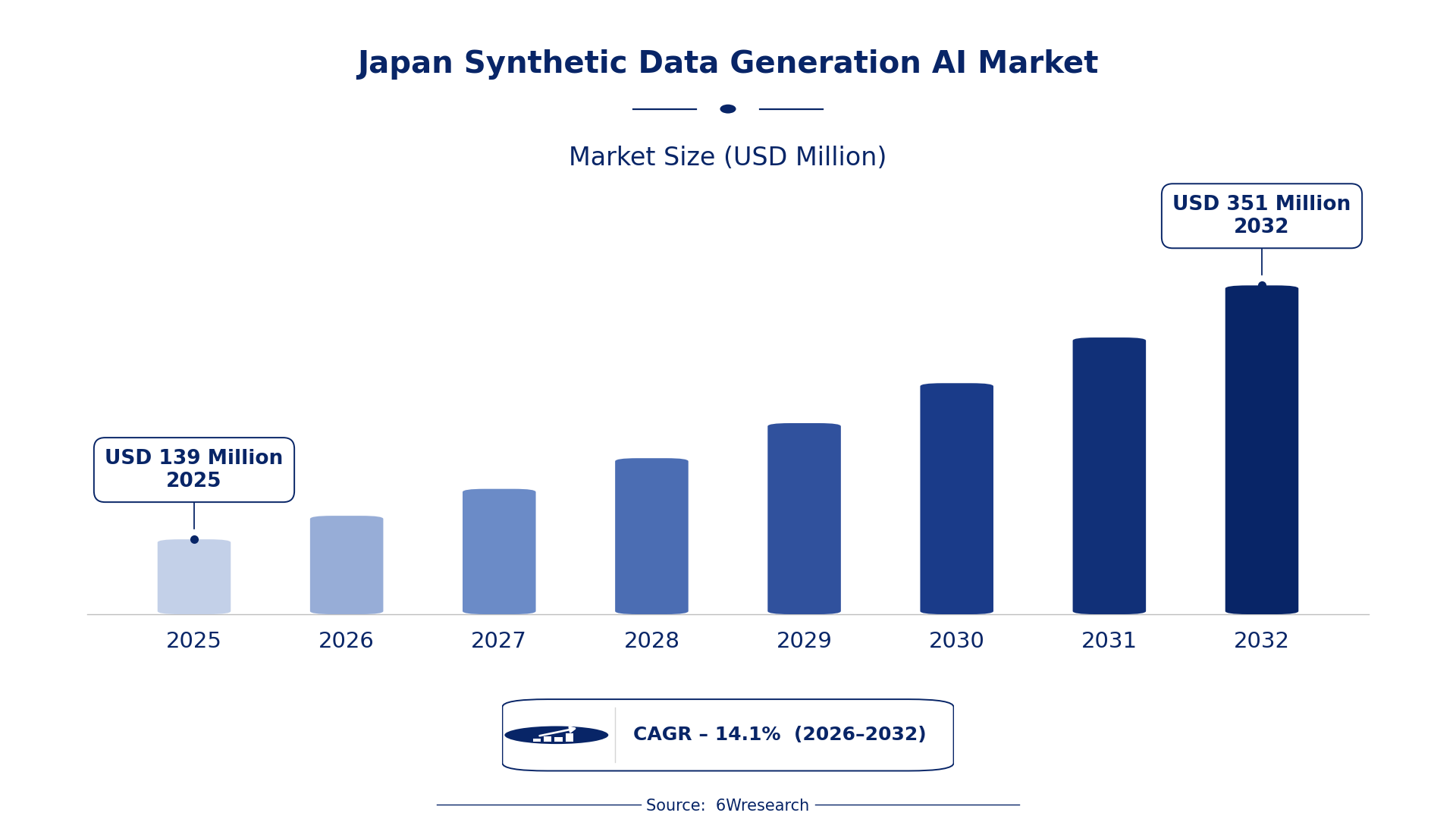
According to 6Wresearch internal database and industry insights, the Japan Synthetic Data Generation AI Market was valued at USD 139 Million in 2025 and is projected to reach USD 351 Million by 2032, growing at a CAGR of approximately 14.1% during 2026–2032.
Japan Synthetic Data Generation AI Market Highlights
| Report Metric | Details |
| Report Name | Japan Synthetic Data Generation AI Market (2026-2032) |
| Market Size 2025 | USD 139 Million |
| Market Size 2032 | USD 351 Million |
| Absolute Growth 2025–2032 | USD 212 Million |
| CAGR 2026–2032 | 14.1% |
| Peak Annual Growth | 19.1% in 2032 |
| Forecast Period | 2026–2032 |
| Historical Data | 2022–2025 |
| Base Year | 2025 |
| Leading Generation Type, 2025 | Tabular Data Simulation (50% share) |
| Leading AI Model Used, 2025 | GANs/VAEs (43% share) |
| Leading Application Sector, 2025 | Financial Modeling (37% share) |
| Leading End User, 2025 | FinTech Firms (48% share) |
| Fastest-Growing Generation Type | Image Data Synthesis (21.7% CAGR) |
| Fastest-Growing AI Model Used | Diffusion Models (18.8% CAGR) |
| Fastest-Growing Application Sector | Medical Imaging (19.0% CAGR) |
| Fastest-Growing End User | AI Research Labs (19.1% CAGR) |
| Growing Sector | Healthcare |
| Key End Users | FinTech Firms, Healthcare Providers, AI Research Labs, SaaS Companies |
Japan Synthetic Data Generation AI Market Year-wise Growth Rate and Key Drivers (2022–2032)
This graph illustrates the annual growth rates of the market from 2022 to 2032, highlighting a steady upward trajectory and projected market expansion over the forecast period.
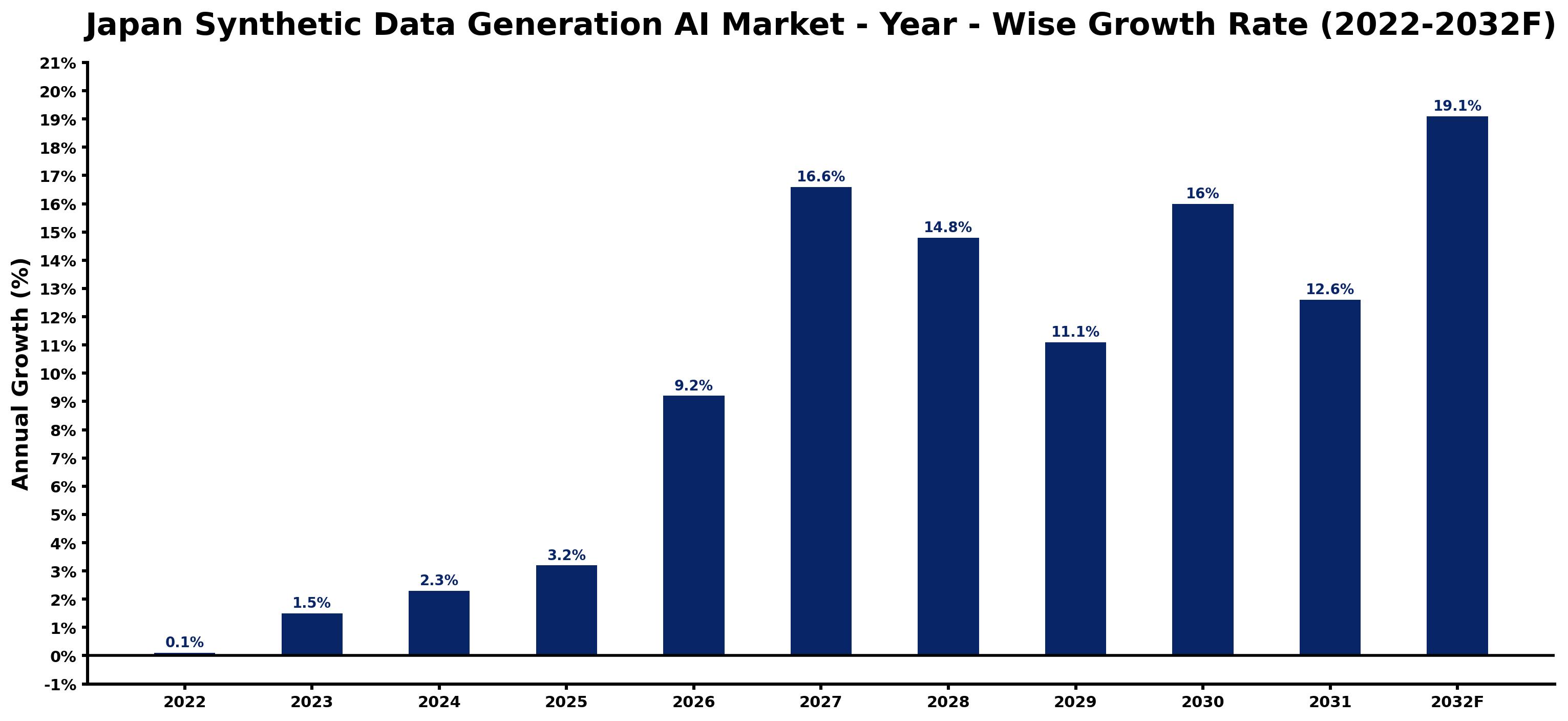
The table below sets out the estimated growth rate for each year and the main factor behind it.
| Year | Estimated Annual Growth (%) | Market Rationale |
| 2022 | 0.1 | The market experienced minimal activity with initial adoption of synthetic data solutions. |
| 2023 | 1.5 | Demand grew as more sectors recognised the benefits of synthetic data for AI training. |
| 2024 | 2.3 | The increase in AI startups contributed to a faster growth rate in synthetic data usage. |
| 2025 | 3.2 | Financial modelling applications drove demand for synthetic data generation. |
| 2026 | 9.2 | The introduction of advanced algorithms spurred a notable rise in market activity. |
| 2027 | 16.6 | Healthcare applications began utilising synthetic data, boosting overall market growth. |
| 2028 | 14.8 | Growth slowed slightly as the market began to stabilise after rapid expansion. |
| 2029 | 11.1 | The market continued to expand, driven by ongoing investments in AI technologies. |
| 2030 | 16.0 | Technological advancements in data generation led to increased demand in various sectors. |
| 2031 | 12.6 | Growth moderated as the market matured and competition intensified. |
| 2032 | 19.1 | A peak in growth occurred due to widespread adoption across multiple industries. |
Note: Market size estimations and growth projections presented in this report are based on 6Wresearch's proprietary forecasting methodology, utilizing the latest available industry data, government publications, and primary research inputs.
Japan Synthetic Data Generation AI Market Synopsis
Synthetic Data Generation AI creates artificial datasets to train machine learning models, improving privacy and AI training. The Japan Synthetic Data Generation AI Market is expanding due to rising demand from sectors like finance and healthcare, driven by the need for data privacy and compliance with regulations.
Market Dynamics Impact Analysis (2026–2032)
| Factor | Type | Impact | Primary Segment Affected |
| Growing demand for AI training data | Driver | High | Tabular Data Simulation |
| Increased focus on data privacy regulations | Driver | High | Image Data Synthesis |
| Emerging applications in healthcare | Opportunity | High | Medical Imaging |
| Expansion of AI research initiatives | Opportunity | Medium | AI Research Labs |
| Limited awareness of synthetic data benefits | Restraint | Medium | Text Data Generation |
| High initial investment costs for implementation | Restraint | High | Video Data Simulation |
| Shortage of skilled professionals in AI | Challenge | High | GANs/VAEs |
| Rapid technological changes in AI | Challenge | Medium | Diffusion Models |
Evaluation of Drivers in Japan Synthetic Data Generation AI Market (2026–2032)
Demand rests on the following drivers, each shown with the segment it touches most.
| Drivers | Primary Segment Affected | Why It Matters (Evidence) |
| Increased investment in AI technologies | Tabular Data Simulation | Japan's AI market is projected to reach 1 trillion yen by 2025, driving demand for synthetic data solutions. |
| Rising need for data privacy | Image Data Synthesis | The healthcare sector is adopting AI for medical imaging, necessitating synthetic data for compliance with regulations. |
| Growth of AI startups | Text Data Generation | The number of AI startups in Japan has increased to over 1,000, creating a demand for synthetic data in model training. |
| Regulatory support for FinTech innovation | Medical Imaging | The Financial Services Agency supports regulatory sandboxes, encouraging the use of synthetic data in financial modelling. |
| Technological advancements in AI models | GANs/VAEs | The development of new algorithms improves the capabilities of synthetic data generation, attracting more buyers. |
Much of the new demand traces back to the projected growth of Japan's AI market, which is set to reach 1 trillion yen by 2025. This surge is linked to the increasing number of AI startups, now exceeding 1,000, which require synthetic data for effective model training. Advancements in algorithms and AI technologies are improving the efficiency of synthetic data generation, attracting a wider range of buyers. The healthcare sector's adoption of AI for medical imaging necessitates high-quality synthetic datasets for compliance and training.
Evaluation of Restraints in Japan Synthetic Data Generation AI Market
These are the pressures that could keep growth below its potential.
| Market Restraint | Primary Segment Affected | Why It Matters (Evidence) |
| Limited access to proprietary algorithms hinders development of effective solutions. | Tabular Data Simulation | Local developers often prioritise proprietary technologies, restricting availability of essential tools for healthcare providers. |
| Rising costs of AI development tools strain budgets for users. | Tabular Data Simulation | Expenses for clinics implementing these technologies have increased by 30%, limiting their ability to invest in necessary tools. |
| Shortage of skilled professionals restricts growth in the sector. | Tabular Data Simulation | With around 30,000 researchers available, the workforce cannot meet the demands of over 1,000 startups. |
| Intense competition among AI firms leads to price wars. | Tabular Data Simulation | This competition squeezes profit margins for suppliers, restricting their capacity to invest in innovation. |
| Regulatory compliance requirements can slow down adoption. | Tabular Data Simulation | Firms must navigate complex regulations, which can delay the implementation of synthetic data solutions. |
Japan Synthetic Data Generation AI Market Challenges
Access to advanced algorithms remains a major hurdle for the development of synthetic data generation AI solutions. This challenge exists because local developers often focus on proprietary technologies, delaying essential tools for healthcare providers needing timely data for model training. Rising costs of AI development tools strain budgets, with expenses increasing by 30% for clinics implementing these technologies. A shortage of skilled professionals limits progress, as the workforce of around 30,000 researchers cannot support the needs of over 1,000 startups. Intense competition among AI firms leads to price wars, squeezing profit margins for suppliers and restricting their ability to invest in innovation.
Trends in the Japan Synthetic Data Generation AI Market
The following changes are redrawing the Japan Synthetic Data Generation AI Market.
- Shift towards Healthcare Applications: In 2023, the healthcare sector increasingly adopted synthetic data for medical imaging, reflecting a growing need for accurate training datasets to improve diagnostic accuracy.
- Growing Interest from FinTech Firms: FinTech firms are rapidly integrating synthetic data into their risk modelling processes, capturing 48% of the market share in 2025, which supports better financial predictions and compliance with regulations.
- Rise of AI Startups in Tokyo: Tokyo, as a major hub for AI research, has seen over 1,000 startups emerge by 2023, driving innovation and competition in synthetic data generation technologies.
- Increased Regulatory Support for AI: The AI Promotion Act, enacted in 2025, has led to a surge in AI initiatives across sectors, supporting the development and use of synthetic data in various applications.
Investment Opportunities in the Japan Synthetic Data Generation AI Market
Several openings in the Japan Synthetic Data Generation AI Market merit attention from investors.
- Gap in Synthetic Data Awareness: With over 1,000 AI startups in Japan, there is a notable gap in understanding synthetic data applications. Investing in educational initiatives can help bridge this gap and expand market reach.
- Demand from Healthcare Sector: The healthcare sector's need for high-quality training datasets presents an opportunity for synthetic data providers. Collaborating with medical facilities can facilitate entry into this growing market.
- Partnerships with FinTech Firms: FinTech firms are actively seeking synthetic data solutions for risk modelling. Establishing joint ventures can improve product offerings and meet the growing demand.
- Expansion in Tokyo's AI Ecosystem: Tokyo's vibrant AI ecosystem offers opportunities for synthetic data generation companies. Setting up operations in this hub can attract local clients and drive innovation.
Government Initiatives in the Japan Synthetic Data Generation AI Market
The AI Promotion Act, enacted in 2025, establishes a framework for AI research and development in Japan. This law mandates that companies comply with data management standards, ensuring the ethical use of synthetic data in AI applications. Additionally, the Digital Agency, established in September 2021, leads digital transformation efforts, promoting AI adoption across various sectors and facilitating the integration of synthetic data technologies.
The Next-Generation Medical Infrastructure Act of 2017 allows certified bodies to anonymise medical data for research, encouraging the use of synthetic data for product development. This act enables companies to innovate while maintaining data privacy. The Ministry of Economy, Trade and Industry also supports AI initiatives, having allocated 50 billion yen for AI research funding in 2023, further strengthening the environment for synthetic data generation.
Future Insight of the Japan Synthetic Data Generation AI Market
New AI research initiatives will emerge by 2032, driven by government funding aimed at establishing Japan as a global AI leader. The implementation of JIS X 0161 will standardise data management, facilitating smoother integration across sectors. By 2025, the AI market is projected to reach 1 trillion yen, providing numerous opportunities for suppliers to expand their offerings. Improved AI education in schools will cultivate a skilled workforce, ensuring a steady supply of talent for buyers seeking advanced solutions.
Market Segmentation Analysis
Japan Synthetic Data Generation AI Market report covers a detailed analysis of the following market segments:
By Generation Type – Tabular Data Simulation Leads, Image Data Synthesis Expected to Grow Fastest
According to Saurav Kr Singh, Senior Research Analyst at 6Wresearch, Tabular Data Simulation held 50% of the Japan Synthetic Data Generation AI Market by generation type in 2025. Tabular Data Simulation holds the largest share due to its extensive use in generating structured datasets essential for financial analysis. This method is crucial for organisations that require accurate data representation to make informed decisions in various sectors. The quickest growth will come from Image Data Synthesis, forecast to expand at a CAGR of 21.7% between 2026 and 2032. Image Data Synthesis is experiencing rapid growth as it plays a vital role in training models for computer vision applications, particularly in healthcare. The increasing need for advanced imaging techniques is propelling this segment's expansion significantly. Suppliers should enhance their capabilities in image data synthesis to meet the growing demands of the healthcare sector.
By AI Model Used – GANs/VAEs Lead, Diffusion Models Expected to Grow Fastest
GANs/VAEs accounted for 43% of the market by ai model used in 2025. GANs/VAEs dominate the market as they are commonly used for generating synthetic datasets, particularly in finance and healthcare applications. Their established presence ensures a consistent demand, reflecting their reliability and effectiveness in various scenarios. Diffusion Models are set to record the highest CAGR in this split, 18.8% over 2026–2032. Diffusion Models are gaining traction as an emerging technology, attracting interest from research institutions for their potential applications in data generation. This trend indicates a shift towards more sophisticated methodologies in synthetic data creation. Buyers should consider integrating diffusion models into their strategies to stay competitive amid technological advancements.
By Application Sector – Financial Modeling Leads, Medical Imaging Expected to Grow Fastest
In 2025, Financial Modeling led the application sector split with a 37% share. Financial Modeling is the leading application sector, essential for simulating financial scenarios and conducting risk assessments in the FinTech industry. The reliance on accurate data for forecasting solidifies its dominant position in the market. Over 2026–2032, Medical Imaging is expected to post the fastest growth, at a CAGR of 19.0%. Medical Imaging is witnessing accelerated growth as the healthcare sector increasingly adopts synthetic data for developing training datasets, particularly for diagnostics. This trend highlights the urgent demand for high-quality synthetic datasets in healthcare applications. Suppliers must focus on tailored solutions for medical imaging to capitalise on the expanding opportunities within the healthcare market.
By End User – FinTech Firms Lead, AI Research Labs Expected to Grow Fastest
FinTech Firms took 48% of end user revenue in 2025, more than any other category. FinTech Firms represent the largest end user group, heavily relying on synthetic data for risk modelling and financial analysis. Their significant investment in advanced technologies underscores their strong demand for accurate data generation solutions. AI Research Labs are projected to grow fastest, at a CAGR of 19.1% during 2026–2032. AI Research Labs are rapidly expanding as they require synthetic datasets for experimentation and model training across various applications. This growth signifies a rising interest in research-oriented data solutions within the market. Providers should develop specialised offerings for AI research labs to tap into their increasing demand for synthetic data.
Key Attractiveness of the Report
- 10 Years of Market Numbers
- Historical Data Starting from 2022 to 2025
- Base Year 2025
- Forecast Data until 2032
- Key Performance Indicators Impacting the Market
- Major Upcoming Developments and Projects
Key Highlights of the Report:
- Japan Synthetic Data Generation AI Market Outlook
- Market Size of Japan Synthetic Data Generation AI Market, 2025
- Forecast of Japan Synthetic Data Generation AI Market, 2032
- Historical Data and Forecast of Japan Synthetic Data Generation AI Revenues & Volume for the Period 2022-2032F
- Japan Synthetic Data Generation AI Market Trend Evolution
- Japan Synthetic Data Generation AI Market Drivers and Challenges
- Japan Synthetic Data Generation AI Price Trends
- Japan Synthetic Data Generation AI Porter's Five Forces
- Japan Synthetic Data Generation AI Industry Life Cycle
- Historical Data and Forecast of Japan Synthetic Data Generation AI Market Revenues & Volume By Generation Type for the Period 2022-2032F
- Historical Data and Forecast of Japan Synthetic Data Generation AI Market Revenues & Volume By Tabular Data Simulation for the Period 2022-2032F
- Historical Data and Forecast of Japan Synthetic Data Generation AI Market Revenues & Volume By Image Data Synthesis for the Period 2022-2032F
- Historical Data and Forecast of Japan Synthetic Data Generation AI Market Revenues & Volume By Text Data Generation for the Period 2022-2032F
- Historical Data and Forecast of Japan Synthetic Data Generation AI Market Revenues & Volume By Video Data Simulation for the Period 2022-2032F
- Historical Data and Forecast of Japan Synthetic Data Generation AI Market Revenues & Volume By AI Model Used for the Period 2022-2032F
- Historical Data and Forecast of Japan Synthetic Data Generation AI Market Revenues & Volume By GANs/VAEs for the Period 2022-2032F
- Historical Data and Forecast of Japan Synthetic Data Generation AI Market Revenues & Volume By Diffusion Models for the Period 2022-2032F
- Historical Data and Forecast of Japan Synthetic Data Generation AI Market Revenues & Volume By NLP Transformers for the Period 2022-2032F
- Historical Data and Forecast of Japan Synthetic Data Generation AI Market Revenues & Volume By Deep Neural Networks for the Period 2022-2032F
- Historical Data and Forecast of Japan Synthetic Data Generation AI Market Revenues & Volume By Application Sector for the Period 2022-2032F
- Historical Data and Forecast of Japan Synthetic Data Generation AI Market Revenues & Volume By Financial Modeling for the Period 2022-2032F
- Historical Data and Forecast of Japan Synthetic Data Generation AI Market Revenues & Volume By Medical Imaging for the Period 2022-2032F
- Historical Data and Forecast of Japan Synthetic Data Generation AI Market Revenues & Volume By Chatbots & Virtual Assistants for the Period 2022-2032F
- Historical Data and Forecast of Japan Synthetic Data Generation AI Market Revenues & Volume By Surveillance & AR for the Period 2022-2032F
- Historical Data and Forecast of Japan Synthetic Data Generation AI Market Revenues & Volume By End User for the Period 2022-2032F
- Historical Data and Forecast of Japan Synthetic Data Generation AI Market Revenues & Volume By FinTech Firms for the Period 2022-2032F
- Historical Data and Forecast of Japan Synthetic Data Generation AI Market Revenues & Volume By AI Research Labs for the Period 2022-2032F
- Historical Data and Forecast of Japan Synthetic Data Generation AI Market Revenues & Volume By SaaS Companies for the Period 2022-2032F
- Historical Data and Forecast of Japan Synthetic Data Generation AI Market Revenues & Volume By Tech Startups for the Period 2022-2032F
- Japan Synthetic Data Generation AI Import Export Trade Statistics
- Market Opportunity Assessment By Generation Type
- Market Opportunity Assessment By AI Model Used
- Market Opportunity Assessment By Application Sector
- Market Opportunity Assessment By End User
- Japan Synthetic Data Generation AI Top Companies Market Share
- Japan Synthetic Data Generation AI Competitive Benchmarking By Technical and Operational Parameters
- Japan Synthetic Data Generation AI Company Profiles
- Japan Synthetic Data Generation AI Key Strategic Recommendations
Market Covered
The report covers the following segments.
By Generation Type
- Tabular Data Simulation
- Image Data Synthesis
- Text Data Generation
- Video Data Simulation
By AI Model Used
- GANs/VAEs
- Diffusion Models
- NLP Transformers
- Deep Neural Networks
By Application Sector
- Financial Modeling
- Medical Imaging
- Chatbots & Virtual Assistants
- Surveillance & AR
By End User
- FinTech Firms
- AI Research Labs
- SaaS Companies
- Tech Startups































